About

Posts by :

Tara Laure Claire Receive The 1st Prize Of The PhMuseum 2023 Photography Grant

The Franco-Indian photographer explores the facets of life in her project The Studio. Peruvian Joseph Ladron de Guevara the New Generation Prize. Discover all the judges motivations and awarded projects of this 11th edition!

from The Studio © Tara Laure Claire

For the 11th edition of our annual grant dedicated to photography and visual language, an independent jury comprised of Jason Fulford (Photographer and co-founder of J&L Books), Federica Chiocchetti (Director of the Musée des Beaux-Arts Le Locle – MBAL), Vasantha Yogananthan (Photographer and co-founder of Chose Commune), and Max Siedentopf (Multi-disciplinary conceptual artist) has assigned the €5,000 PhMuseum 2023 Photography Grant Main Prize to Franco-Indian photographer Tara Laure Claire for her project The Studio.

Judge Vasantha Yogananthan explains the choice on behalf of the panel: “The protagonists from The Studio feel like family. They have fun. They dress up. They are sad. They wonder about the mysteries of existence. They look inwards and outwards in a series of performative pictures that bring back one’s own memories — after all, who has never played for the camera? Tara Laure Claire’s work reminds us that photography can be a democratic tool to let our creativity shine and to reflect on our lives.”

image
from There Is A Big River, In Which There Is A Big Island, In Which There Is A Lake, In Which There Is An Island, In Which There Is A Small House, Where A Life Is Growing In A Womb © Andras Ladocsi

The € 2,000-second prize was claimed by Hungarian photographer Andras Ladocsi who presented the project There Is A Big River, In Which There Is A Big Island, In Which There Is A Lake, In Which There Is An Island, In Which There Is A Small House, Where A Life Is Growing In A Womb. The choice is explained by Judge Jason Fulford: “When we look at Andras Ladocsi’s work, and live vicariously through his camera, we experience the life-affirming pleasure of friendship.”

image
from Tsavt Tanem (If You Take Away Our Pain, What Is Left Of Us?) © Camille Lévêque

The third prize of €1,000 was awarded instead to Franco-Armenian artist Camille Lévêque for her work Tsavt Tanem. Judge Federica Chiocchetti motivates the panel’s decision: “With her multilayered compelling narrative, Camille Lévêque teleports us into a fascinating universe of diaspora, memory, and rituals. The French-born artist explores her Armenian heritage, the burden of an unrecognized genocide, the construction of memory, and the narratives that pass from generation to generation thanks to an articulated usage of the visual language. Portraits, landscapes, drawings, archival images, and documents intertwine into a speculative narrative that successfully questions the theme of identity and representation.”

image
from Si El Sol Llegara A Oscurecer (Y No Brille Más) © Joseph Ladron de Guevara

The New Generation Prize offering €2,000 was assigned to Peruvian photographer Joseph Ladron de Guevara who presented the project Si El Sol Llegara A Oscurecer. The jury explains: “When does faith blind us? Peruvian photographer Joseph Ladron de Guevara delves into spirituality starting from the personal story of his grandmother. His visual strategy pairs family archives and notes from her diaries, documentation of Christian believers’ communities and contemplative images of nature. The result is an open and evocative narrative that engages us with the theme of loss and acceptance in an impressively mature way for an artist of his age.”

Other prizes:

PhEST’s team granted a solo show at the coming edition of the Italian festival to Eviction by Ingmar Björn Nolting. Giovanni Troilo (PhEST Artistic Director) and Arianna Rinaldo (PhEST Photography Curator) explain how they selected the work that will be exhibited in Monopoli, Italy this summer: “Eviction is a tale of resistance and of loss. It stands for what we all need to fight for, the future of our planet, and the forces we encounter against us. Nolting’s story on the activists in the small German village is subtle but harsh. The images and their soft tones take us into a parallel dimension where idealism and climate activism are protagonists. Even if this fight is lost, the poetry and strength of each individual portrayed while trying to make a difference in the world, becomes a universal cry for what needs to be done: save our planet with our actions, one by one.”

German Artist Masha Wysocka will travel to Landskrona this fall to produce work informed by the Swedish town and surrounding areas thanks to the residency bursary offered by Landskrona Foto. Their Artistic Director Jenny Nordquist commented: “As springtime lay bare the ground, so does Wysocka’s work unearth stories archived long ago. Examining what is kept for posterity with a critical eye, as well as incorporating accounts from different sources makes a tale pieced together from different timelines and intentions. The notion of multiple truth, fiction and nonfiction storytelling is studied, becoming work that in a complex and poetic way discusses what stories we ultimately tell about ourselves. It is nothing less than scrutinizing truth itself, and how we put photography and text in the service of narrating history as we want it. “

The exhibition at Fonderia 20.9 was awarded instead to H Is For Hemp by Maren Rings. The festival Artistic Director Maria Ptkq comments on the decision to bring the project to the Basque Country this June:Fonderia 20.9 H is for Hemp is a global research on Industrial Hemp in the broader context of climate change challenges. A six-year-long project with the goal to examine how hemp can help create circular economies and contribute to a system reset. Maren Krings has documented more than 200 projects in 26 countries on four continents and interviewed more than 80 industry experts. Photo documentaries, expert interviews and infographics make  H is for Hemp an exhibition and a book printed on hemp paper, developed for this production in collaboration with the paper producer Hahnemühle. Among the meaningful topic and areas of investigation, what we find interesting in Maren’work is the will to experiment with how photography exhibitions can be made more sustainable. New materials, frameless hanging, ecologically produced inks, weight, packing and size optimization of the exhibition works will be part of the curatorial process.

The exhibition at Getxo Photo Festival was awarded instead to Protege Noctem by Italian Mattia Balsamini. The festival Artistic Director Maria Ptkq comments on the decision to bring the project to the Basque Country this June: GetxoPhoto on Mattia Balsamini In the 1990s, Europe and Russia tried to create a network of satellites that would reflect sunlight and illuminate the Earth permanently. Fortunately, this fantasy of total lighting did not prosper, but we have arrived at a similar situation with alarming consequences by other means, as completely dark nights have disappeared except in a few parts of the globe. Protege Noctem is a broad and incisive documentation project that chronicles the impact of overexposure to ALAN (Artificial Light At Night) together with experiments and citizen science projects that are fighting against the disappearance of the night.

Improve Your Landscape Photos by Including and Excluding These Things

Improve Your Landscape Photos by Including and Excluding These Things

Creating a successful landscape image takes a variety of factors, including good technique, solid planning, a knowledge of lighting, and more. Composition is one of the most challenging aspects, and it takes a keen knowledge of what to include in the frame, what to exclude, and how to position them all. If that is something you find yourself struggling with, check out this fantastic video tutorial that will show you some solid advice sure to help you improve. 

Coming to you from Christian Irmler – Landscape Photography, this great video tutorial discusses how to decide what to include and exclude in a landscape photo composition. By far, I think the most commonly overlooked part of the frame is the edges. It is easy to become overly focused on the center of the frame and miss something like a tree branch creeping into the edge of the frame, and while that might not seem like a big deal, once the eye catches it, it can pull the viewer out of the frame, which really upsets the balance of the frame. Be sure to do a check of the edges whenever you are about to press the shutter. Check out the video above for the full rundown from Irmler. 

And if you really want to dive into landscape photography, check out “Photographing The World 1: Landscape Photography and Post-Processing with Elia Locardi.” 

Studio Thier & van Daalen’s Hypnotic GRID Pendant Lights Debut at Salone del Mobile

Studio Thier & van Daalen’s Hypnotic GRID Pendant Lights Debut at Salone del Mobile

An assemblage of colorful, confectionary lights illuminated a corner of this year’s Salone del Mobile 2023. Studio Thier & van Daalen’s GRID pendant lights are mouth-blown glass crafted into knobbly shapes resembling an assortment of super-sized hard candies (in fact, to this writer’s eyes, they immediately evoked fond memories of a favorite childhood confection alongside the bittersweet memories the shapes are associated with the fruit flavored treats) – literally a light-spirited manifestation of illumination.

Photo: Studio Pim Top

Studio Thier & van Daalen explored various glass shapes and structures to fashion a mesmerizing array of imaginary projections and reflections illuminating from the bulbous, structured glass surfaces. An imaginative eye may see cloudy skies, rippling water, or morning dew glowing forth in a soothing and hypnotic effect glowing from these pendant lights onto nearby surfaces.

Hanging trio of GRID pendant glass lights in orange, opaque pink and light blue.

Photo: Studio Pim Top

Six hanging GRID pendant glass lights in orange, opaque pink, white and light blue BULLA wall lights in background on white brick wall.

Photo: Studio Pim Top

GRID pendant light shown in its molten red hot state being handblown inside a kiln

The bulbous handblown glass wares intentionally retain imprints of imperfection.

The round structure in the glass is created when the red-hot, almost liquid bubble is on one side pressed into the brutalist steel construction. Directed by the designers, the right combination of temperature, air pressure, and gravity leave a soft imprint of the structure in the glass.

An array of handblown glass GRID pendants and BULLA wall lights in various colors displayed across bubble wrap covered table with wavy ceiling light above and arched mirror in background.

An array of handblown glass GRID pendants and BULLA wall lights in various colors displayed across towels on the ground.

Person holding a large piece of white paper in front of opaque white GRID handblown glass with spherical LED spotlight to show the unique patterns seen passing through the textured glass surface.

When light is projected across the textured pendant glass, variances in roundness and thickness across the glass surface become visible.

Black wall showroom with a selection of seven GRID pendant lights over circular coffee table in center with BULLA wall lights in background

To further enhance and complement the GRID pendant light’s enchanting light shaping presence, the studio developed a custom spherical LED spot (both dimmable and set to a warmly rated 2700°K) to accurately project light where desired, while also doubling as mounting bead.

Closer cropped show of black painted showroom with a selection of seven GRID pendant lights over circular coffee table in center with BULLA wall lights in background

man and woman standing sideways facing camera with red background

Iris van Daalen & Ruben Thier

The GRID pendant light was on display at Salone del Mobile within the Dutch corner (aka, Isola Design) of the annual international design fair.

Gregory Han is the Managing Editor of Design Milk. A Los Angeles native with a profound love and curiosity for design, hiking, tide pools, and road trips, a selection of his adventures and musings can be found at gregoryhan.com.

Cadabra By Canon: Bridging The Gap Between Photography And NFTs

Cadabra By Canon: Bridging The Gap Between Photography And NFTs

Canon USA has announced the launch of Cadabra, a photography marketplace for Non-Fungible Tokens (NFTs), which will offer a variety of digital art from invited creators with a goal to empower creators by putting them in touch with passionate collectors who share their admiration for digital artworks.

Canon, the Japanese multinational corporation known for its imaging and optical products, is now venturing into the world of Non-Fungible Tokens (NFTs) through its upcoming photography marketplace named Cadabra. 

Following its partnership with Immutable Image in July 2022 to issue a collection of photo NFTs, Canon is now making its second entry into the NFT market with this announcement.

About Cadabra

ezgif 3 fe23f3ceb1
Image source: Canon Rumors

Cadabra is scheduled to go live in the latter part of this year, and will offer a curated platform of digital art spanning a variety of categories, including landscape, wildlife, lifestyle, sports, abstract, and others. In addition, the site will have a secondary market for the reselling of NFTs, providing artists with the chance to sell actual prints, which Canon will then fulfill.

Canon has not provided a great deal of specific information regarding the functioning of their soon-to-be-launched curated NFT marketplace. However, later on in this year, according to Canon’s announcement, the company would share information regarding the “first drop” of Cadabra as well as its developers.

Nevertheless, Canon’s Cadabra is an exciting development for the NFT market, particularly for photography enthusiasts and artists. With Canon’s reputation as a leading manufacturer of cameras and lenses, the company’s involvement in the NFT market is expected to draw more attention to digital art and further legitimize its value.

Canon’s previous foray into NFTs

ezgif 3 1e9822d289
Image source: PetaPixel

Canon’s previous collaboration with Immutable Image in July 2022 resulted in “The Legends Mint” collection launched on the Solana blockchain, which included photograph NFTs from accomplished photographers such as Sam Abell, Barbara Bordnick, Gregory Heisler, Ryszard Horowitz, Walter Iooss, Jr., Melvin Sokolsky, and Joyce Tenneson. The success of this collaboration may have inspired Canon to further explore the NFT market and establish its own marketplace.

Final Thoughts

Canon’s launch of Cadabra is a testament to the growing importance of NFTs in the artistic world. This move signifies the company’s desire to explore new technologies and leverage its expertise in photography to tap into the burgeoning NFT market. It remains to be seen how the marketplace will operate and how it will fare in the highly competitive NFT market, but one thing is for sure – the Cadabra marketplace is sure to attract attention and generate interest among art collectors and photography enthusiasts alike.

Memories 4

Rickie Sanchez is an article writer specializing in cryptocurrency news. Since late 2017, he has been actively investing in cryptocurrencies. He is enthusiastic about everything that has to do with crypto and he hopes that the readers of his articles in the years to come will gain a massive understanding of blockchain technology.

Brookgreen Gardens to host annual art festival, spring plant sale

Brookgreen Gardens to host annual art festival, spring plant sale
image

Take a quick day trip to shop an annual plant sale. Brookgreen Gardens in Murrells Inlet is hosting an exciting weekend of events for guests to shop local art and native plants from April 29-30.

The Brookgreen Gardens Art Festival, happening Saturday and Sunday from 9:30 a.m. to 5 p.m., will feature the work of more than 70 artists for sale. The spring plant sale on Saturday only from 9:30 a.m. to 2 p.m. will offer an extensive selection of Lowcountry native plants for guests to shop in Brookgreen’s Arboretum.

“We are thrilled to offer these talented artisans a platform in our art festival and to continue our popular plant sale for guests to take a piece of Brookgreen home with them,” said Page Kiniry, the president of Brookgreen Gardens. “There is truly something for everyone this weekend at Brookgreen, from art to shopping to an exquisite selection of seasonal and annual plants for sale. We hope visitors will also stay to explore the gardens in bloom.”

Over 70 vendors and artists will gather under the 250-year-old live oaks in Brookgreen’s Oak Allée during the two-day art festival, showcasing the regionally and nationally produced fine craftsmanship and quality art. Guests can browse rows of photography, watercolor and pastel paintings, wooden sculptures, basketry, pottery and ceramics, fiber art, glass-blown designs, jewelry, metalwork, sculpture, oil and acrylic paintings and much more on display and available for purchase.

During the spring plant sale, visitors can browse a vast selection of plants, many propagated at Brookgreen, so buyers can take a piece of the gardens home with them. Native plants, perennials, shrubs, edibles and annuals will all be available for purchase. The plant sale is orchestrated by horticulture staff and knowledgeable volunteers who will be onsite to answer any questions.

During the festivities on Saturday, Brookgreen’s artist-in-residence Anne Thompson will also be onsite to give a presentation, “Pressing Botanicals — Harvesting Nature’s Bounty,” from 11 a.m. to 12 p.m. in the Wall Lowcountry Center Auditorium. She will cover her artistic journey, from collecting vibrant blooms and foliage from the Southern landscape to her meticulous preservation and creative presentation to elevate her harvested treasures.

For both festivals, price is included with garden admission. For more information about these events, visit www.brookgreen.org.

div.ctct-form-embed div.ctct-form-defaults {font: 14px ‘Lato’, sans-serif; padding: 10px 20px; margin-bottom: 10px; border-radius:0px;}
div.ctct-form-embed div.ctct-form-defaults h2.ctct-form-header {font: 18px ‘Lato’; border-bottom: solid 1px #cccccc; padding-bottom: 8px;}
div.ctct-form-embed div.ctct-form-defaults p.ctct-form-text {font: 14px ‘Lato’, sans-serif ;}
div.ctct-form-embed form.ctct-form-custom div.ctct-form-field {margin: 0 0 12px 0;}
div.ctct-form-embed form.ctct-form-custom label.ctct-form-label {margin-bottom: 5px;}
div.ctct-form-embed form.ctct-form-custom input.ctct-form-element {height:30px;}
div.ctct-form-embed form.ctct-form-custom button.ctct-form-button {padding: 8px;}
.g-recaptcha {display:none;}

Yevonde: an introduction to the woman who pioneered colour photography

Yevonde: an introduction to the woman who pioneered colour photography

The National Portrait Gallery, London, reopens in June following a three-year closure for the “largest redevelopment” in its 127-year history. Its opening exhibition, Yevonde: Life and Colour, will be the most comprehensive to date on British photographer, Yevonde Middleton (1893-1975).

Signing her work simply, Yevonde (though she also worked under “Madame Yevonde”), she was a celebrated portraitist, innovative colourist and advocate for women in the profession. In short, she was a pioneer. Yet Yevonde is not widely known outside photography circles.

In 1921, she became the first women to lecture at the Professional Photographers’ Association. In the 1930s – against a tide of resistance – she championed the use of colour photography and was the first person in Britain to exhibit colour portraits.

Over a 60-year career, Yevonde photographed the rich and famous. Around 10,000 sitters passed through her studios. She also ran a successful commercial photography business until the year before her death, shortly before her 83rd birthday.

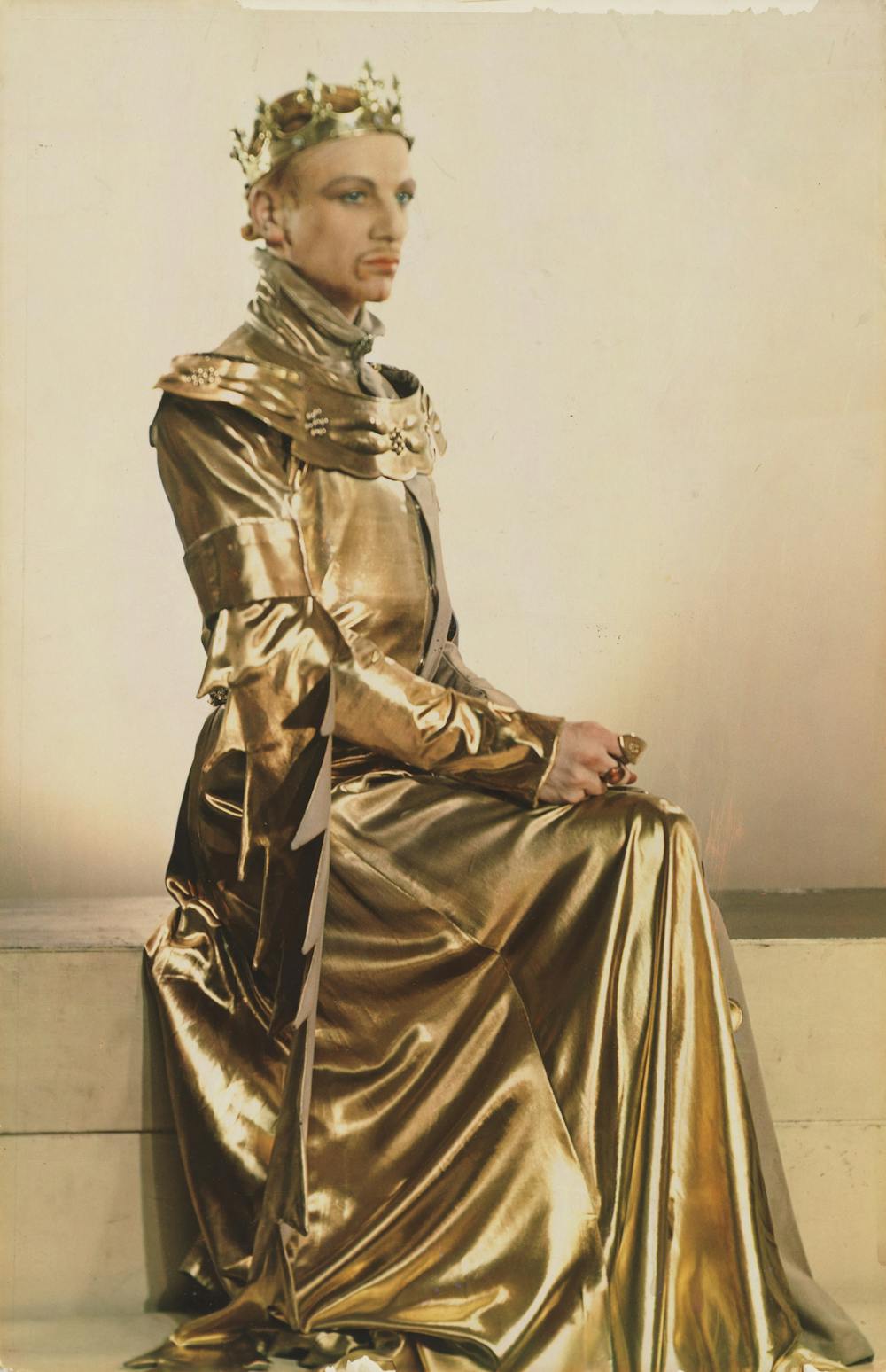
John Gielgud poses in an all-gold dress with a crown, looking to the right of the photograph. The colour is highly saturated.

John Gielgud as Richard II in Richard of Bordeaux by Yevonde (1933).
Courtesy of the National Portrait Gallery

From her teens, Yevonde was an advocate of women’s suffrage and was active in the Women’s Social and Political Union, the militant wing of the suffrage movement, from 1909.

However, a personal disinclination for suffragette lawbreaking (and the prison sentence that would likely follow) led her to champion women’s emancipation via a different route.

In her autobiography, In camera (1940), she remembers thinking at age 17: “I must earn my own living … To be independent was the greatest thing in life”.

It was an advertisement in suffrage newspaper Votes for Women, that gave Yevonde the idea that photography could offer economic independence.

Yevonde’s only formal training was an apprenticeship to Charlotte (Lallie) Charles (1911-13). Despite not finishing, and taking only one photograph throughout, it gave her the fundamentals to start a photographic business.

In 1914, having just turned 21 – and with some funding from her family – she opened her first studio.

Colour photography and innovation

Yevonde’s decision to set out on her own coincided with the decline of Lallie Charles’ studio. This reflected a widespread malaise in photographic portraiture, which was at that time stylistically confined to long-established conventions of black and white.

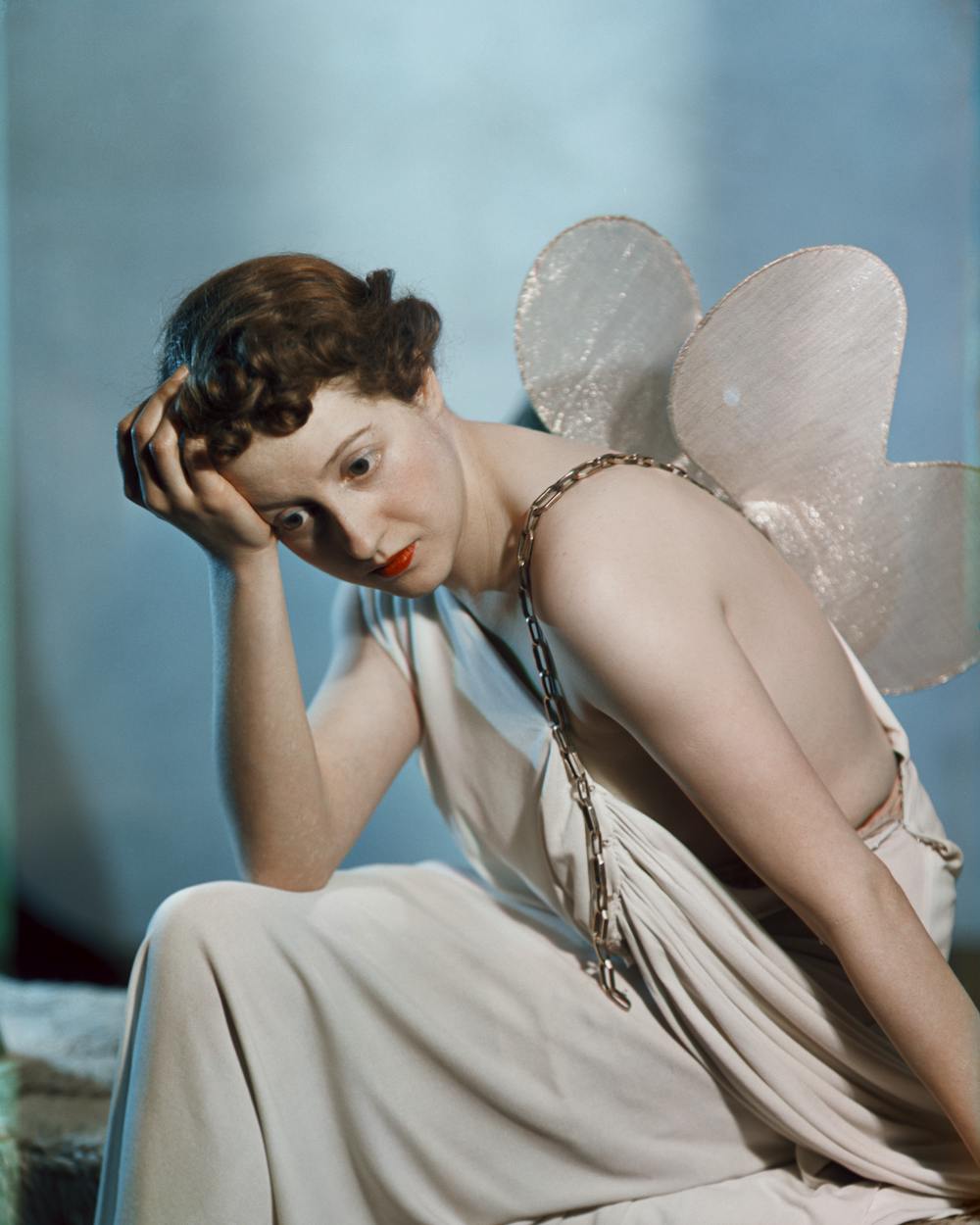
Dorothy Gisborne with her head in her hand wears a white robe dress and fairy wings, against a blue backdrop.

Dorothy Gisborne as Psyche, by Yevonde (1935). A recent discovery which is testament to the National Portrait Gallery’s ongoing research.
Courtesy of the National Portrait Gallery

She explained that clients were: “Getting tired of the pale soft … prints, tired of the artificial roses, of the Empire furniture … They grumbled at the lack of variety in the poses.”

Seeing an opportunity to try something different, she developed a more dynamic approach and style, establishing a moderately successful business despite the disruption of the first world war and a stint as a land worker.

But it was with the advent of Vivex – a technically demanding process for colouring photographs – around 1930, that Yevonde’s breakthrough came, despite strong resistance to colour photography from within the profession and potential clients.

“I started experimenting madly”, she remembered in her autobiography, “oblivious of the fact that people did not want such things.”

She believed that photographers had become:

So engrossed in the beauty of light and shade and in their deep velvety blacks and sparkling whites that they will tell you quite seriously that the colour photograph is unnecessary and unnatural.

At the same time, Yevonde was excited to discover that a few studios were beginning to explore the new process, despite feeling that their preoccupation with achieving naturalistic colour rendered everything “astonishingly unattractive”.

She declared that her priority was to use colour differently, to “produce a striking and original picture”.

Yevonde’s Goddesses Series

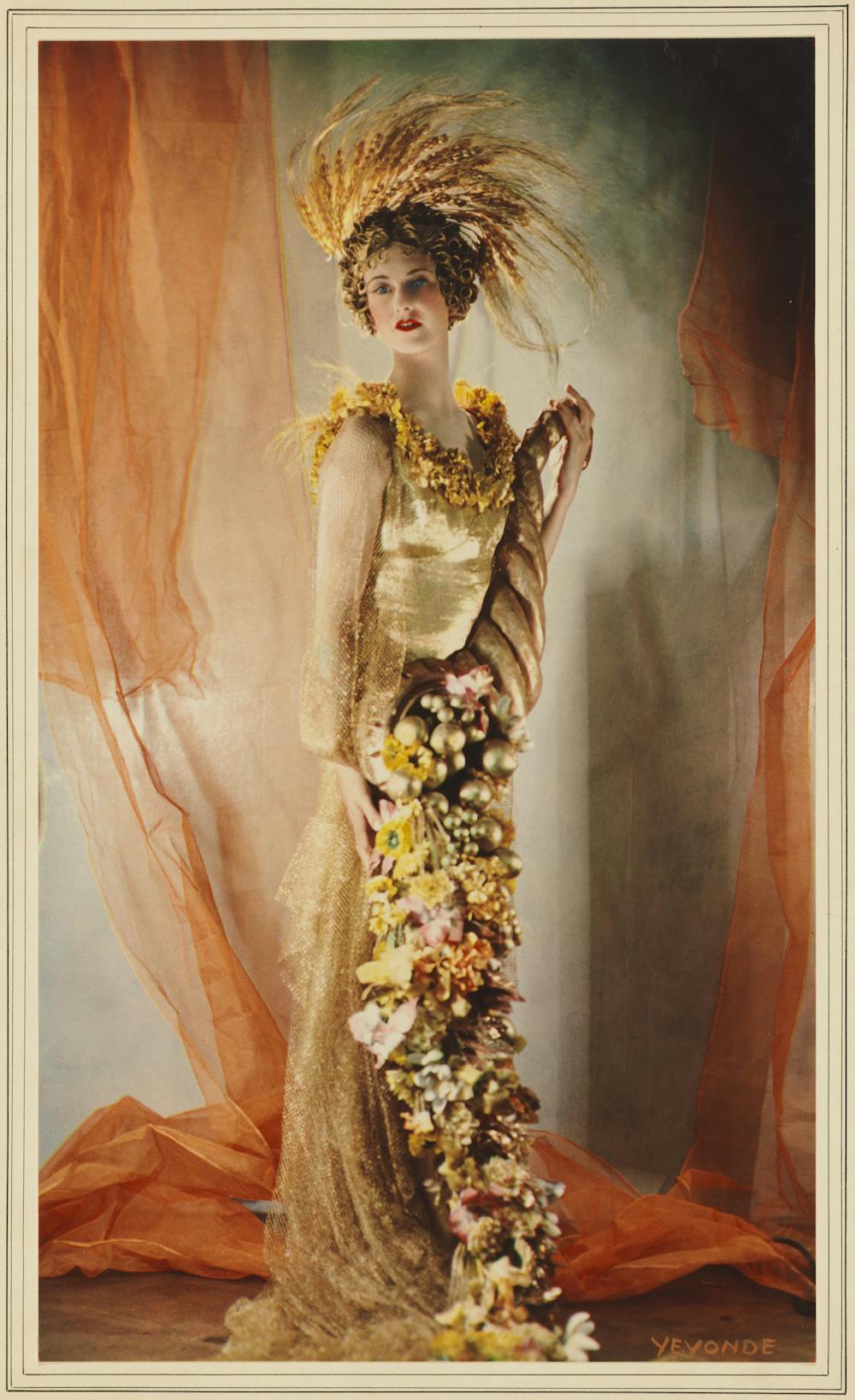
Lady Dorothy Warrender stands in a gold dress with a trading spring bouquet. She wears an orange feather headdress which looks like flames licking the crown of her head.

Lady Dorothy Warrender as Ceres by Yevonde (1935).
Courtesy of the National Portrait Gallery

Yevonde’s most famous project – the Goddesses Series of 1935 – was inspired by a charity ball. Soon after she photographed several society women in the guise of a mythological goddess. Each woman was furnished with props derived from Yevonde’s, sometimes whimsical, interpretation of their attributes.

For me, the series reveals both the extent and the limits of her pioneering spirit.

Despite her attempts to renegotiate the conventions of her time, Yevonde – ever the expedient businesswoman – was mindful of her client’s wishes, the majority of whom were female. As a result, many of her subjects align with the prevailing expectations of beauty and behaviour: looking sultry but with a submissive air, gazing wistfully out of the frame.

But in other examples, the women she photographed appeared liberated from the shackles of expectations for their sex. There’s daring composition and movement in the representation of Ariel and the confrontational gaze of Medusa.

In other work, an audacious use of saturated primary colour is highly effective, as in the portrait of actress Vivien Leigh.

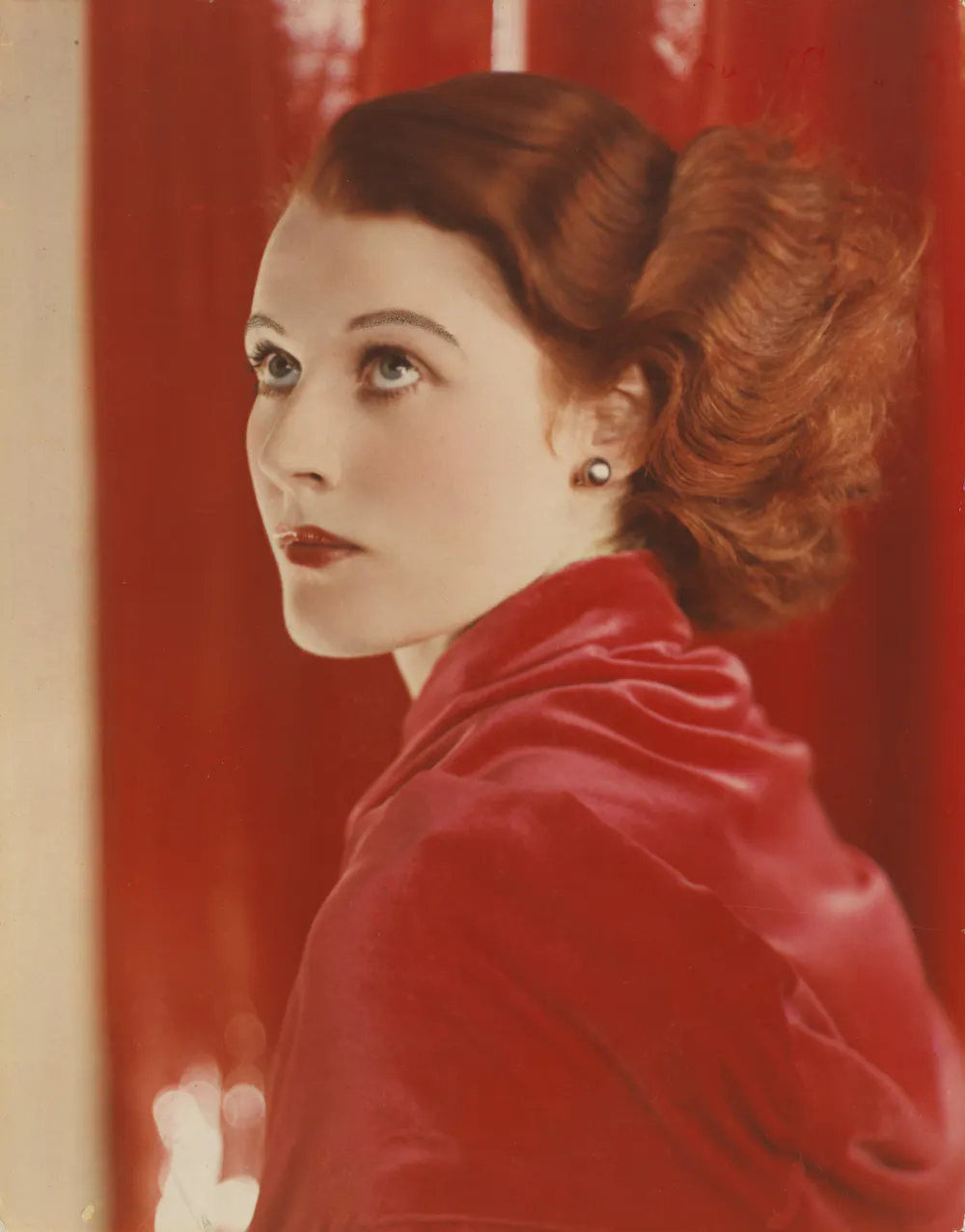
An all-red portrait of Joan Maude in close up. Her hair is red and waved, she wears a red shirt and stands against a red backdrop, looking skywards.

Joan Maude by Yevonde (1932).
Courtesy of the National Portrait Gallery

In her photograph of actress Joan Maude, a vibrant palette of reds is brought together in a single image. This shows an industrious photographer thrilling to the possibilities offered by the new colour technology.

Sadly, with the outbreak of the second world war, Vivex ceased trading and Yevonde was obliged to return to black and white.

Throughout her career, Yevonde sought to promote and motivate other women photographers, encouraging them to “come out and meet one another” and to “join the association” of photographers.

“We must see one another’s work and criticise, and, more important still, receive criticism,” she wrote in her autobiography, “or we shall never improve”.

Most previous exhibitions have favoured Yevonde’s Goddesses Series. The planned show at the reopened Portrait Gallery, however, will broaden the scope considerably and include some newly discovered works.

As much as I love Yevonde’s use of colour, I am looking forward to seeing her later portraits in black and white and her practice of bringing elements of surrealism into her portraiture and other commercial work.

Yevonde: Life and Colour will be at the National Portrait Gallery, 22 June to 15 October 2023.

Photographer is Shot at While Taking Photos of the Dallas Skyline

Photographer is Shot at While Taking Photos of the Dallas Skyline

Dallas skyline

A photographer had a terrifying incident while taking pictures of the Dallas skyline when men chased and shot at him.

Ron Shipp was on the Houston Street Viaduct over the Trinity River and believes a group of men targeted him for his camera equipment.

“I’ve been out here countless dozens of times,” Shipp tells NBC DFW. “Day and night and never once felt unsafe.”

However that changed on Wednesday, April 12 after he heard voices coming from beneath the bridge while out shooting at 23:00 and instantly felt unsafe.

“Probably within 30 yards of leaving my car I could hear voices in the shadows behind me,” he tells Fox 4. “I saw some movement but I couldn’t see people. It concerned me, but not a lot.”

“Every time I walked out, they kept coming closer and closer. They weren’t on the bridge, I knew that much,” he says.

“I looked over the bridge again and saw two men 20 yards away and I realized they were using the outside ledge and the handrail to kind of walk and approach me hidden down low.”

Shipp says the sight of two grown men going to that much effort to approach him in the dark really scared him.

When Shipp realized that there was a group of at least four men stalking him, he began to run toward downtown — that’s when he heard gunshots.

“I saw flashes from a handgun and heard six shots right in my direction, it motivated me to run much faster,” he explains.

Shipp avoided being shot and reported the incident to the police. He has gone public with his story to warn other photographers who frequent there for photos.

“Empty bridge does not mean you are safe,” he adds.

Shipp regularly sets his camera up from South Dallas to capture stunning landscape shots of downtown Dallas.

“This is one of my favorite and most frequent locations to visit,” he tells Fox 4. “Especially after dark when the city is lit up.”

Despite the scary episode he plans to come back to the bridge but this time with a group of photographers.


Image credits: Header photo licensed via Depositphotos.

Why Is Vermeer’s Girl with a Pearl Earring So Famous?

Why Is Vermeer’s Girl with a Pearl Earring So Famous?


Girl with a Pearl Earring, 1665, painted by Dutch Golden Age master Johannes Vermeer during the late 17th century must surely be one of the best-known paintings of all time, coming at a close second only to Leonardo da Vinci’s Mona Lisa, 1503. So much so, it has often been referred to as the ‘Mona Lisa of the North’. But what is it about this modestly scaled, enigmatic portrait that has attracted so much attention over the centuries? In part, the painting’s fame today is thanks to Tracy Chevalier’s bestselling fiction novel of the same name, published in 1999, which imagined the life of the girl behind the scenes, and in turn led to a Hollywood film adaptation in 2003, followed by a play is 2008. Meanwhile Banksy’s famed riff Girl with a Pierced Eardrum in 2014, is amongst numerous spoofs and spin-offs.

But the painting’s enduring appeal has far more than clever marketing to thank for its worldwide recognition. We look closer at some of the painting’s key qualities that have made it such an unassuming icon of art history

Vermeer’s Girl with a Pearl Earring Has an Enigmatic Quality

johannes vermeer girl with pearl earring dutch golden age
Girl with a Pearl Earring by Johannes Vermeer, 1665, via Mauritshuis, The Hague

The enigmatic mystery of Vermeer’s subject has been a subject of fascination amongst art historians and enthusiasts for many centuries. One of the most intriguing aspects of the painting is that no one actually knows who the sitter for the painting actually was. Instead, she is a ‘tronie’ or an imaginary character, which Vermeer has dressed up in sumptuous fabric and pearl earrings. Although a sitter would most likely have posed for the painting, many writers believe Vermeer has idealized his model to fit a particular type, giving her smooth, flawless porcelain skin, red, moist lips, and large, glistening eyes that meet ours with a soulful, intimate gaze. 

Vermeer’s Study Explores Dramatic Lighting

johannes vermeer's girl with pearl earring
Girl with a Pearl Earring by Johannes Vermeer, 1665, via Mauritshuis, The Hague

The dramatic, chiaroscuro lighting is one of the most striking and enduring aspects of Vermeer’s Girl with a Pearl Earring. Vermeer plays with how an almost black backdrop becomes the ideal setting for his young woman, who stands out like a spot lit actor on a stage. Raking, chiaroscuro light seems to stream in from the right, catching the young woman’s pale, luminous skin face and the shimmering drapery falling from her head, creating a crisp, clear illusion of volume in space. Vermeer pays particular attention to the light on the young woman’s eyes, lips, and the suspended pearl falling from her ear. Recent studies of Vermeer’s painting reveal that he had once painted in a green curtain behind her, before obscuring it with darker color to create a greater quality of mystery and intrigue. 

Get the latest articles delivered to your inbox

Sign up to our Free Weekly Newsletter

The Painting Looks Different from Vermeer’s Other Work

johannes vermeer milkmaid genre painting dutch golden age
The Milkmaid by Johannes Vermeer, c. 1660, via Rijksmuseum, Amsterdam

One of the reasons why Vermeer’s painting fascinates historians is because it is an outlier in Vermeer’s overall oeuvre. Although he only produced a small volume of paintings during his lifetime, his paintings have predominantly focused on interior scenes viewed from a distance, with features such as floor tiles, windows and furniture creating perspectival lines that pull us into the scene. While Vermeer often painted women alone in interior settings, this painting stands out for its closely cropped design, in which there is little to no background detail. Instead, the painting is a masterful exercise in simplicity, restraint, and elegance. 

The Painting Has Appeared in Many Book, Film and Art References

banksy girl with pierced eardrum
Banksy, Girl with a Pierced Eardrum, 2014

Vermeer’s Girl with a Pearl Earring was less popular than the artist’s other paintings during his day, and it was even lost for over 200 years! Since going on display at its current home in the Mauritshuis in the Hague in 1902, however, all this has changed. Chevalier’s novel, published in 1999 was an international bestseller which did much to publicize the painting, along with subsequent film and play adaptations respectively in 2003 and 2008. Following the success of Banksy’s mural in 2014, famously adorned with a facemask during the global pandemic, the Mauritshuis museum launched a competition in March 2023, titled My Girl with a Pearl, asking artists to reimagine the artwork in their own creative way, with some surprising and unexpected results including painting, photography, digital imaging, ceramics and felting.

Polish photographer Zofia Nasierowska is celebrated in today’s Google Doodle

Polish photographer Zofia Nasierowska is celebrated in today’s Google Doodle

You may have noticed that today’s Google Doodle (the logo atop the Google homepage) is a picture of a 35mm film camera celebrating Zofia Nasierowska, a Polish photographer who would’ve been celebrating her 85th birthday. Known best for her portraits of influential Polish people, her passion for the art form was influenced by her father from an early age. 

Considered one of the most significant Polish photographers of her years, Zofia picked up a camera aged just seven years old. Her father, Eugeniusz Nasierowski, was also a well-known photographer, and just four years after she started learning photography she landed her own exhibition. 

• Check out the best film cameras from years gone by that are still popular today

Although her love for photography started close to home, the young photographer continued to expand her love for the subject at the Leon Schiller National Film School in Lódź, Poland, where she photographed many of her peers. 

Some of Nasierowska’s most famous portraits include a photo of Barbara Brylska, a Polish actress who appeared in Pharaoh and Irony of Fate, Polish actor and comedian Jan Kobuszewski, and the Polish singer / actress Kalina Jędrusik. 

All her photos were shot in black-and-white and, in one particular self-portrait, she can be seen using a Praktisix medium format camera – which appears to be the camera on which the Google Doodle is modeled, with a portrait of Nasierowska in the viewfinder. 

Although the photographer died in 2011 after a battle with brain cancer, her photography career spanned 35 years, only ending when she developed an eye disease. She continued to work with photographers and inspire a new generation – so much so that a Librabry in Elk, Poland, was named after her. 

She may not be as well known as some of the other photographers of her era, such as Cindy Sherman, Annie Leibovitz or Robert Mapplethorpe, but she is still remembered as one of the greatest Polish photographers of all time thanks to her movie star-style portraits. 

If you enjoyed this article, check out the 50 best photographers ever including Ansel Adams, Henri Cartier-Bresson and Vivian Maier, along with the best film for your camera.