About

Posts by :

Cyrus Kabiru Fashions Elaborate Mixed-Media Masks and Goggles from Found Objects

Cyrus Kabiru Fashions Elaborate Mixed-Media Masks and Goggles from Found Objects

All images © Cyrus Kabiru, shared with permission

Ranging from mechanical parts and cooking utensils to plastic caps and beads, Kenyan artist Cyrus Kabiru fashions dazzling eyewear and helmets from salvaged and found objects. The futuristic forms often obscure the eyes like an ornamental veil, and motorbike helmets provide a fitting canvas for fins and frills.

Kabiru (previously) originally began making innovative glasses after being denied a pair when he was young. The variety of materials the artist found around his hometown of Nairobi inspired him to create playful versions, bringing joy to those around him. Over time, his creations have grown and become more elaborate, hinting at mysterious technological functions.

Kabiru has recently begun larger standalone sculptures, and you can explore more of his work on Instagram.


an elaborately sculpted helmet from found materials with colorful ribbons, a teal metal face plate, and other metallic decorations and beads

two side by side images of elaborate eye-mask sculptures made from found materials like metal and beads

a wearable sculpture made from a black motorbike helmet with various found materials like a spoon, mesh, and other metal parts

two side by side images of elaborate eye-mask sculptures made from found materials like metal, beads, and kitchen appliances

a wearable sculpture made from a motorbike helmet with various pieces of metal and other objects attached to it

a man wears a pair of sculptural goggles made from a sheet of metal that has been cut out for eye holes with metallic spirals inserted

Do stories and artists like this matter to you? Become a Colossal Member today and support independent arts publishing for as little as $5 per month. The article Cyrus Kabiru Fashions Elaborate Mixed-Media Masks and Goggles from Found Objects appeared first on Colossal.

Meditations on mortality: Venice exhibition revisits the photography of Peter Hujar

Meditations on mortality: Venice exhibition revisits the photography of Peter Hujar

Photography “converts the whole world into a cemetery”, wrote Susan Sontag. “Photographers, connoisseurs of beauty, are also—wittingly or unwittingly—the recording-angels of death.”

Sontag was writing a year before the publication of her book On Photography (1977), expanding on the subject in what remains a key text on the medium and its influence on society. The words appeared in an essay to go with a book by a photographer who was little known beyond his bohemian circle of friends and acquaintances, the demi-monde of New York’s downtown scene in the mid 1970s. It was the only book the photographer published, 11 years before his death from Aids-related illness in 1987, and nearly two decades before his reappraisal as a key American photographer of his generation was cemented with an exhibition at the Stedelijk Museum in Amsterdam.

Palermo Catacombs #6 (Girl with Gloves) is from a series of photographs Hujar took during a visit to the Capuchin Catacombs in Palermo, Sicily, in 1963 © The Peter Hujar Archive/Artists Rights Society (ARS), NY

His posthumous celebration has since moved beyond his status as a cult figure within a time and place and a community of people that have come to be mythologised. And now, perhaps, we are about to hit peak Peter Hujar. The British actor Ben Wishaw is to play the impoverished yet influential photographer in a film biopic based on Linda Rosenkrantz’s book, Peter Hujar’s Day, retelling a recorded conversation in 1974. But before that, Hujar’s 1976 book Portraits in Life and Death is being turned into an exhibition at this year’s Venice Biennale, one of 30 collateral events selected by curator Adriano Pedrosa to fit the theme, Foreigners Everywhere, and its focus on queer and Indigenous figures.

The exhibition will present all 41 photographs from the book at the Chiesa di Santa Maria della Pietà, close to the Doge’s Palace, staged by the Peter Hujar Foundation and curated by Grace Deveney of the Art Institute of Chicago. It will feature two bodies of work: a series of portraits of fellow artists, writers and performers; and photographs taken of the mummified remains vaulted within the Capuchin Catacombs of Palermo, made on a Fulbright scholarship in 1963 in the company of his lover, the artist Paul Thek.

Peter Hujar knows that portraits in life are always, also, portraits in death

Susan Sontag

The subjects of the portraits “stand, sit, slouch, mostly lie—and are made to appear to meditate on their own mortality”, wrote Sontag, who also sat for the photographer. “Peter Hujar knows that portraits in life are always, also, portraits in death.” The catacomb pictures clearly made an impact on the writer, because they inspired the setting of a scene in her second novel, Death Kit. “So there’s this really beautiful exchange between [Hujar and Sontag] about photography,” says Deveney. “And that comes through in her writing. And there’s that really iconic portrait of her in the series as well.”

Beautiful and morbid irony

Portraits of Sontag, Thek, Divine, Robert Wilson, Fran Lebowitz, John Waters and others from the Lower East Side arts scene are interspersed with the lesser immortals of the Sicilian catacombs. “What seems to have caught Hujar’s eye was the beautiful and morbid irony of the dead, framed to appear to be as lifelike as possible,” Deveney says. “And then, on the flipside, in a lot of the portraits, both in the book and beyond, you get representations of people—friends and chosen family—displayed in ways that underscore the undercurrent of death and life.

“So many of the figures in the book are reclining or appear to be sleeping or are in these kind of otherworldly states where they appear to be looking beyond or through. And so that tension between finding the most lifelike presentations of death, and then sort of treading into these other states of consciousness within the portraits in the book, is something that comes through really clearly in the juxtaposition.”

Portraits is important because it was the only book Peter made,” says the art critic Vince Aletti, a friend of Hujar, whose portrait also appears in the book and the Venice exhibition. It is the first time these pictures have been seen together in Europe, and only the second time they have been shown since their debut at Matthew Marks Gallery in New York in 2002. “And because he got Susan Sontag to write an introduction… he continued to make great—and greater—work but he died before most of it was collected for a book or an exhibition.”

Whether he’s looking at a choppy sea, a dead cat or a celebrity… he’s looking as deep as he can

Vince Aletti, critic

Aletti’s writings have played a part in Hujar’s embrace by a wider audience. “Peter never had the recognition he deserved while he was alive, but the work survives and it’s gratifying to know people want to know more about the pictures and the person who made them,” Aletti says.

“I think of Peter’s work as soulful and sensitive without being in the least sentimental. Whether he’s looking at a choppy sea, a dead cat or a celebrity he’s just met, he’s looking as deep as he can, determined to convey something plain and true. Something that still has a palpable presence after all these years.”

Top photography shows to see in Venice

  • In the exhibition Rise of the Sunken Sun, Inuuteq Storch sets out “to tell the Greenlanders’ visual history, not seen through the visitors’ eyes, but through the Greenlanders’ own.” He is the first photographer and the first Greenlandic artist to represent Denmark at the Biennale, presenting hundreds of images of his own diaristic impressions of daily life alongside family snapshots and archive material from the first professional photographer from the self-governing, autonomous territory (see also p29).
  • Resisting the colonial gaze is also the theme of much of the Bolivian artist River Claure’s work, in which he responds to stereotypical depictions of his homeland by imagining alternative territories that play on notions of tradition and modernity. “Identity is a question, not an answer,” says the photographer, whose work will be shown in the main Biennale exhibition, Foreigners Everywhere.
  • One of the rooms in the exhibition’s Nucleo Storico section will be dedicated to an Italian diaspora of 40 artists who moved abroad in the 20th century and who “played significant roles in the development of the narratives of Modernism”. Among them is the photographer Tina Modotti who became a key figure in the Mexican avant-garde in the 1920s.
  • In the guise of the Institute of Critical Zoologists, Robert Zhao Renhui has spent much of the past 15 years examining man’s complex relationship with the natural world, primarily using photography in his research-based works. He is increasingly turning to video, performance and installation, as in this latest project, Seeing Forest, showing at the Singapore pavilion, which explores the notion of secondary forests, “where novel organisms are able to thrive despite and because of human activity”.

Peter Hujar: Portraits in Life and Death, Chiesa di Santa Maria della Pietà, Riva degli Schiavoni, 20 April-24 November

US pavilion features first Indigenous artist to have solo show

US pavilion features first Indigenous artist to have solo show

Jeffrey Gibson is representing the US at this year’s Venice Biennale, marking the first time the country has staged a solo exhibition by an Indigenous artist. Gibson, who is a member of the Mississippi Band of Choctaw Indians and is also of Cherokee descent, was born in Colorado and moved frequently growing up, living across the US as well as abroad, including in Germany and South Korea. This international upbringing influenced Gibson’s colourful work, which often incorporates Native American traditions with text, a variety of textiles and concepts like identity and globalism.

Jeffrey Gibson: “Words like ‘nationhood’ and ‘homeland’ become complicated when I’m representing the US.” Cara Romero

How are you approaching the idea of representing the US, given the country’s history of massacres, displacement and racism? How are you thinking about your presentation in relation to that history?

It was very daunting initially. My initial proposal was very different from what I ultimately decided to do. I went to Venice [in 2022] and I realised the kind of weight and pressure of representing the US, and I started thinking about what I felt was important for me to contribute, content-wise, to that.

Ultimately, it came down to looking at my practice and thinking about the things that have been the most impactful with audiences. Some of it is where people see themselves in the work, in particular Native people and Indigenous people. In Native communities, many people refer to their nations, like the Choctaw Nation. Words like “nationhood” and “homeland” become complicated when I’m representing the US. I also had to be really honest with myself that throughout my life growing up abroad, I have identified as American, and then talked about being Native American in places where some people were really unfamiliar with it. I felt like it was my responsibility to just tell my story.

They Come From Fire (2022) Courtesy of Portland Art Museum

The title of the pavilion is the space in which to place me. Can you share what drew you to this passage from Layli Long Soldier’s poem He Sápa?

I have followed Layli’s work for years now, and it speaks to me on a personal level. She is able to put into words and lay onto a page the internal thoughts I’ve had my whole life. When I was thinking about a title, I knew that I wanted to work with an Indigenous writer.

The text goes, “This is how you see me the space in which to place me/The space in me you see is this place/To see this space see how you place me in you”. That piece does what I try to accomplish with the way that I use text, which is always hoping that people can project themselves and their own stories into it in a way that becomes self-reflective. That’s one of the goals of the pavilion. Although I am Indigenous, I hope that we’re not just looked at as [having] a kind of separate experience, but more as individuals who have experiences that can overlap with people from many different nationalities and many different backgrounds.

Gibson’s sculpture The Sun Will Be Shining (2022) features glass and bone pipe beads Photo: Max Yawney, courtesy of Sikkema Jenkins & Co., Roberts Projects and Stephen Friedman Gallery

What kind of themes does the pavilion explore?

I wanted to start by reading the foundational documents of the US. I started with the Bill of Rights and the Declaration of Independence, and eventually that led me to things like amendments and proposals that have yet to be passed or may never be passed. You get into individuals who were parts of those movements and statements that they’ve made. There are a little over 20 works in the exhibition. It is a wonderful way for me to walk through history and think about my own family and my own tribes and where they’ve existed in the states of the US and in what periods of history.

What do you think are the hallmarks of a successful national pavilion? Have any in particular stuck with you?

Mike Nelson for the British Pavilion [I, Imposter in 2011]. It was like you were in a weird headspace. You just couldn’t make sense of it. I felt like it was a real, very immersive experience that I wanted to return to. I also remember seeing Félix González-Torres’s installation in the American pavilion [America in 2007]. I’m a huge fan, he’s been a huge influence on me.

American History (2015) is a woven and beaded work featuring the words of James Baldwin Photo: Pete Mauney, courtesy of Sikkema Jenkins & Co., Roberts Projects and Stephen Friedman Gallery

I think a strong pavilion for me is when the space is addressed, and it doesn’t feel like we’ve tried to recreate a white box institutional space, and the building itself is sculpturally important. For me, the American pavilion is a fully activated space. This is the building you inherit if you’re going to represent the US.

The American pavilion didn’t come into the Biennale until 1930, so I think it’s interesting that the architecture is very much marked by the period it was commissioned, and that was a very significant period for Native people as well. There are very few things that don’t carry a ton of content with them, including the building itself.

Fantastical image of slime mould encased in a raindrop among winners in close-up photography challenge

Fantastical image of slime mould encased in a raindrop among winners in close-up photography challenge

The results of this year’s Close-up Photographer of the Year Challenge have been announced.

The photography challenge – which aims to inspire a wider appreciation of nature’s wealth, encourage a deeper connection to often-overlooked animals, plants and landscapes, and kindle a desire to protect them – has a different theme each year – 2023’s was ‘water’.

The following gallery features all 12 winning images, from a newt feeding on frogspawn at night (overall winner) and rain-covered slime mould to frozen poppies and a spying snake.

12 fabulous photos from the competition

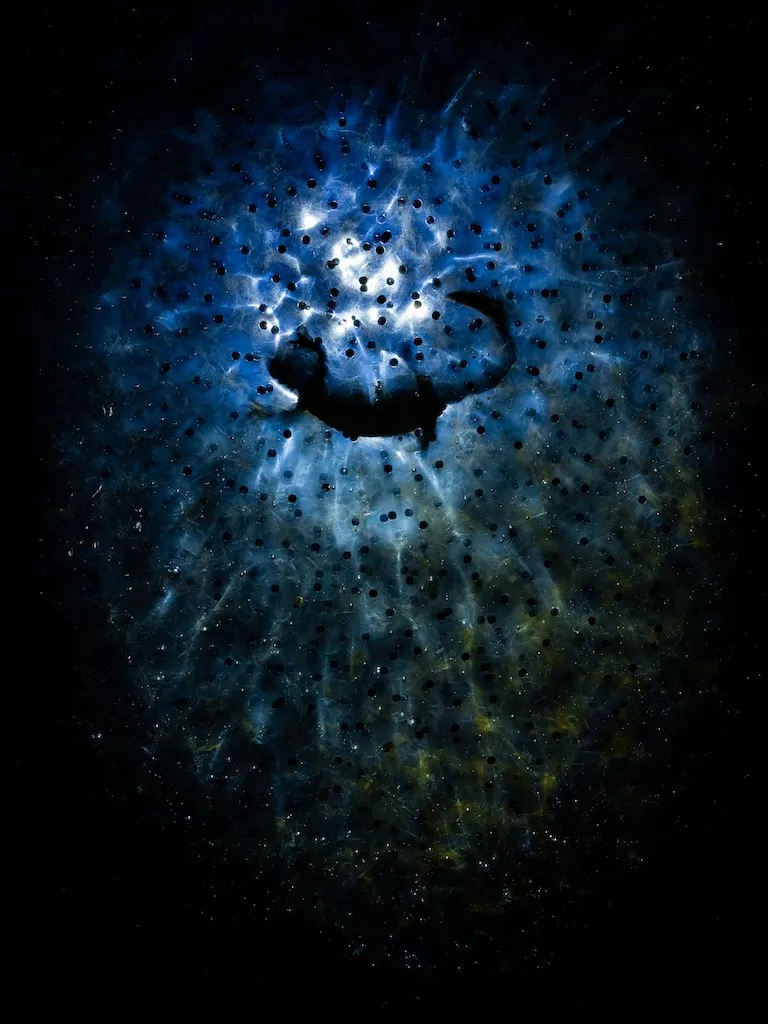
Between the Stars – Tibor Litauszki (overall winner)

Between the Stars. Credit: Tibor Litauszki | cupoty.com

‘In Germany, where I live, there are many clear and slow-flowing streams that provide excellent habitat for alpine newts. I have been following their lives for years, and last year was no exception. A few days after the frogs lay their eggs, at dusk, the newts appear and feast on the spawn all through the night. I wanted to capture this moment underwater. To do this, I placed my camera in an underwater housing, attached it with weights, and placed it under the frogs’ eggs. I was a bit nervous at first because I wasn’t sure if the underwater housing was completely waterproof. But I figured that if no bubbles appeared, my camera would stay dry. I manually set the focus on the lens beforehand and hoped to get lucky. Waiting nearby until it got dark, I illuminated the first newt that appeared with an LED light and triggered the camera with a homemade wired remote release.’ Tibor Litauszki

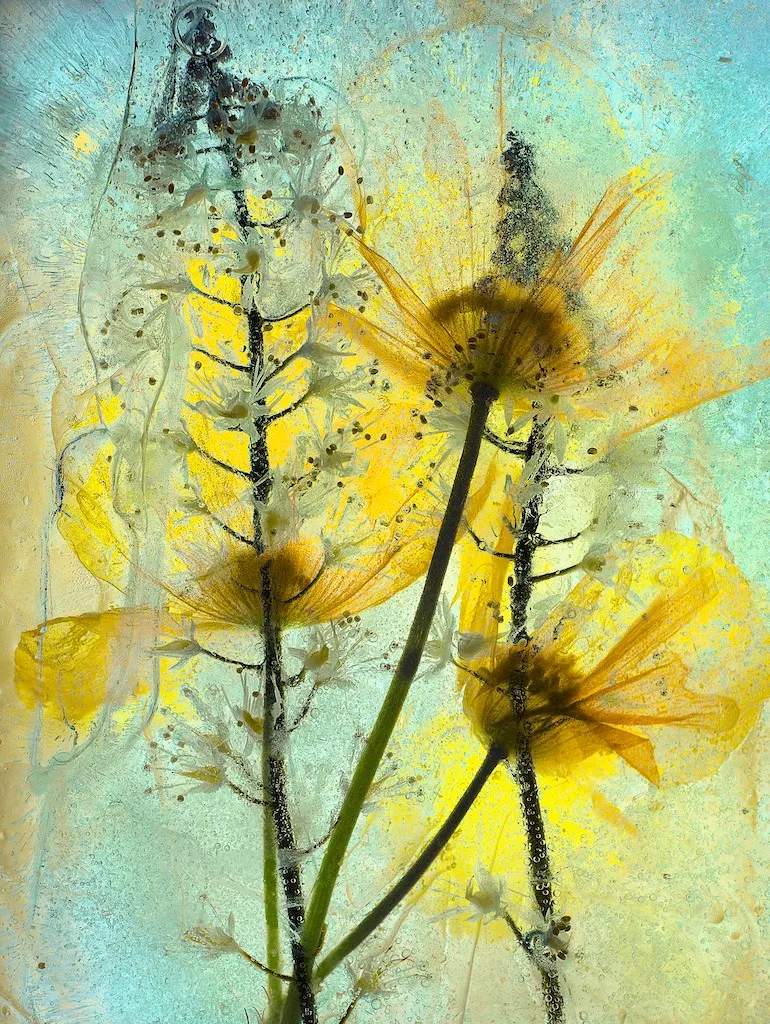
Poppies Tiarella in Ice – Ian Gilmour (2nd place)

Poppies Tiarella in Ice. Credit: Ian Gilmour | cupoty.com

‘I submerged some wild poppies in water with tiarella flowers and froze them overnight. I then placed the frozen block on a lightbox and photographed them using my Venus Laowa super macro lens. My first attempt was unsuccessful as the water was cloudy, so I boiled the water before re-freezing for the second attempt, which seemed to give a better result.’ Ian Gilmour

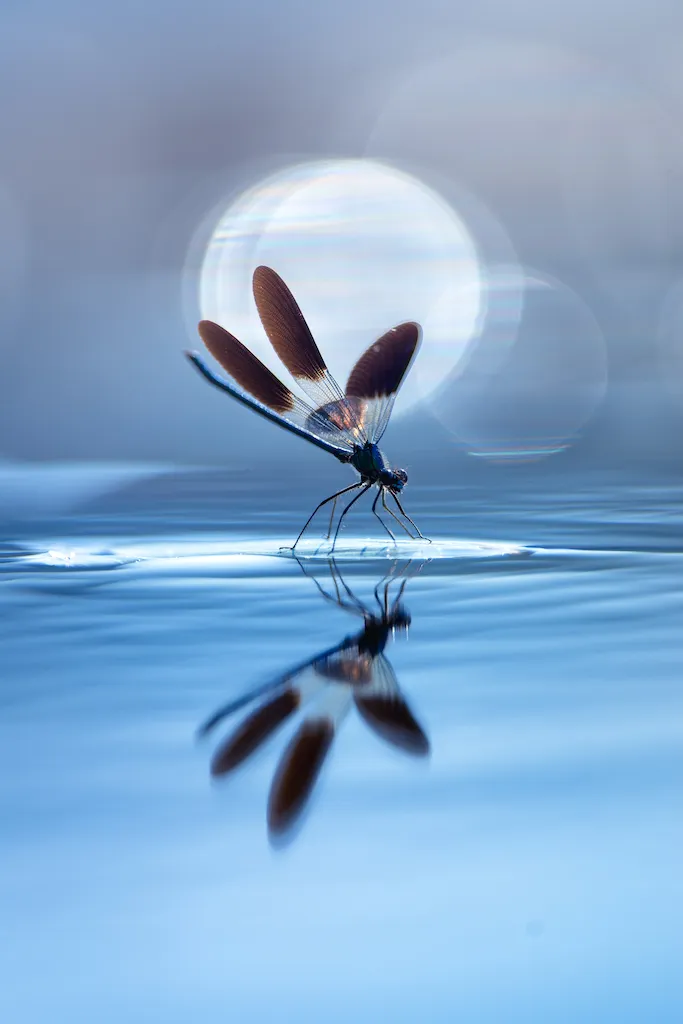
The Ice Skater – Sebastien Blomme

The Ice Skater. Credit: Sebastien Blomme | cupoty.com

‘For a long time, the idea of ​​capturing the graceful ballet of dragonflies flying over the Garonne (the river that winds near my home) had been running through my head. It’s enchanting to observe hundreds of these creatures circling, skilfully capturing midges and other insects in mid-flight every summer. One day, I settled in the water at a spot where I had noticed a dragonfly regularly returned to rest. I waited patiently for its return. At each appearance I fired my camera in burst mode, hoping to capture the moment when its wings would be spread in all their glory. After a hundred attempts, I finally managed to obtain the image I desired.’ Sebastien Blomme

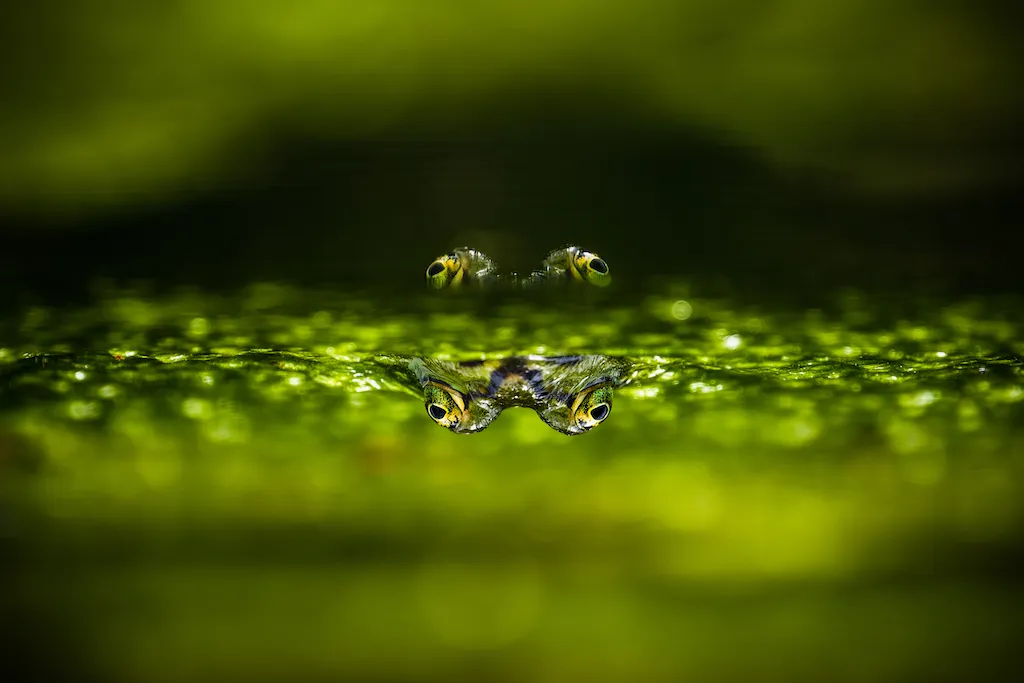
You See Better With Four Eyes – Gabi Swart

You See Better With Four Eyes. Credit: Gabi Swart | cupoty.com

‘This picture was taken in a pond near Ladenburg, Germany. It was shot from a low angle so that the reflection of the frog’s eyes are just visible. I then decided to turn it upside down to confuse the viewer and encourage him/her to look more closely.’ Gabi Swart

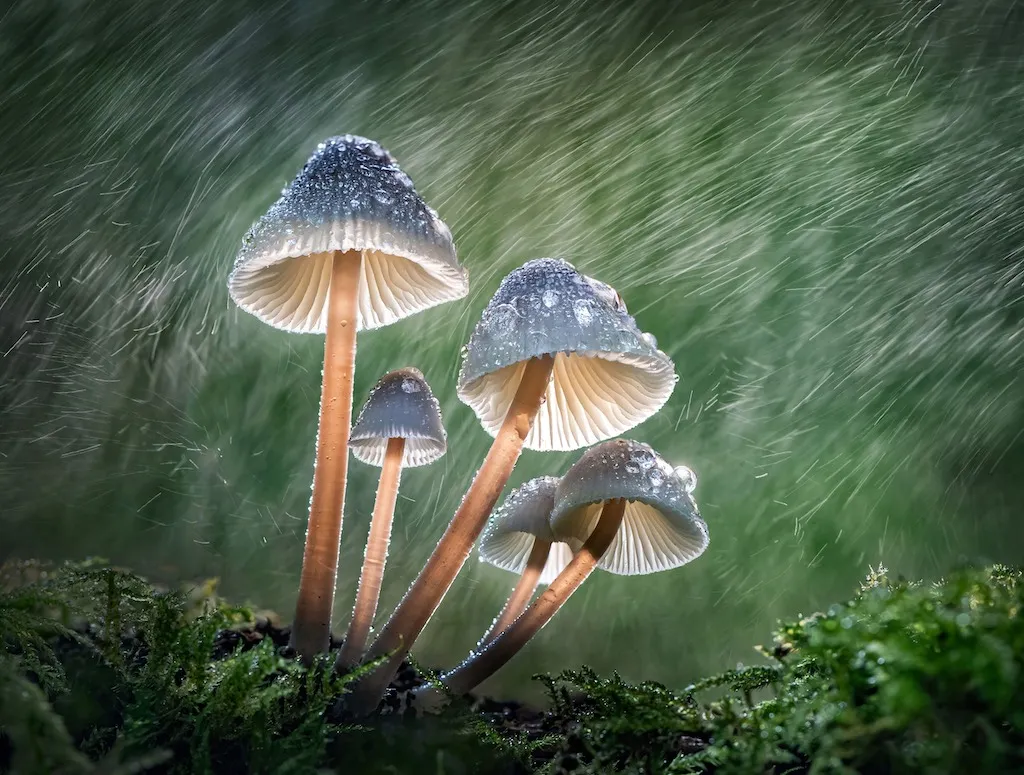
Tony North – Milking Bonnets

Milking Bonnets. Credit: Tony North | cupoty.com

‘I found this clump of mushrooms with an almost perfect shape and number in Marbury Country Park, UK. I lit the scene from behind with an LED panel, both to fill the bonnets with light and to illuminate the droplets, which I created with a fine mist spray. My aim was to enhance the natural beauty of the fungi by adding more light and atmosphere. I focus bracketed 40 frames of the bonnets, then took one shot with the fungi and the “rain”. I combined the files later in Photoshop.’ Tony North

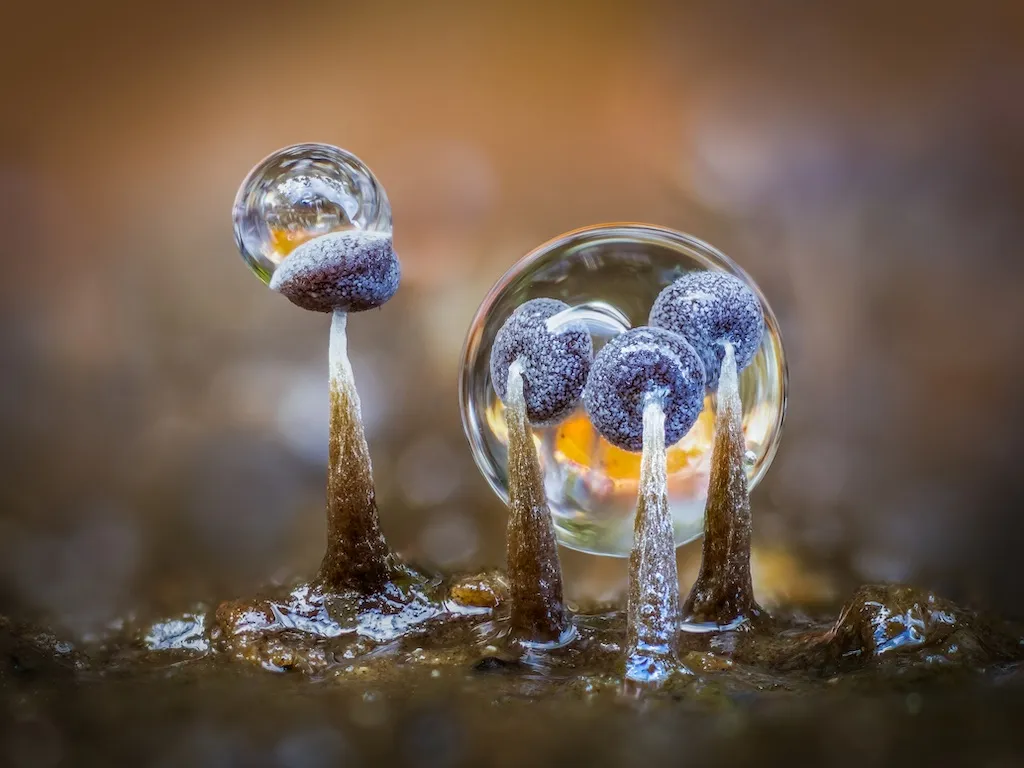
Slime Moulds and Raindrops – Barry Webb

Slime Moulds And Raindrops. Credit: Barry Webb | cupoty.com

‘Following overnight rain, I came across a colony of 2mm tall Physarum album slime mould fruiting bodies on a short section of beech branch, lying in leaf litter on the woodland floor. On closer inspection, I spotted this little group encased in raindrops. Carefully positioning the branch in a suitable position, taking care not to disturb the droplets, I shot 101 focus bracketed images to capture the full depth of the subjects. The resulting images were focus stacked using Zerene Stacker software.’ Barry Webb

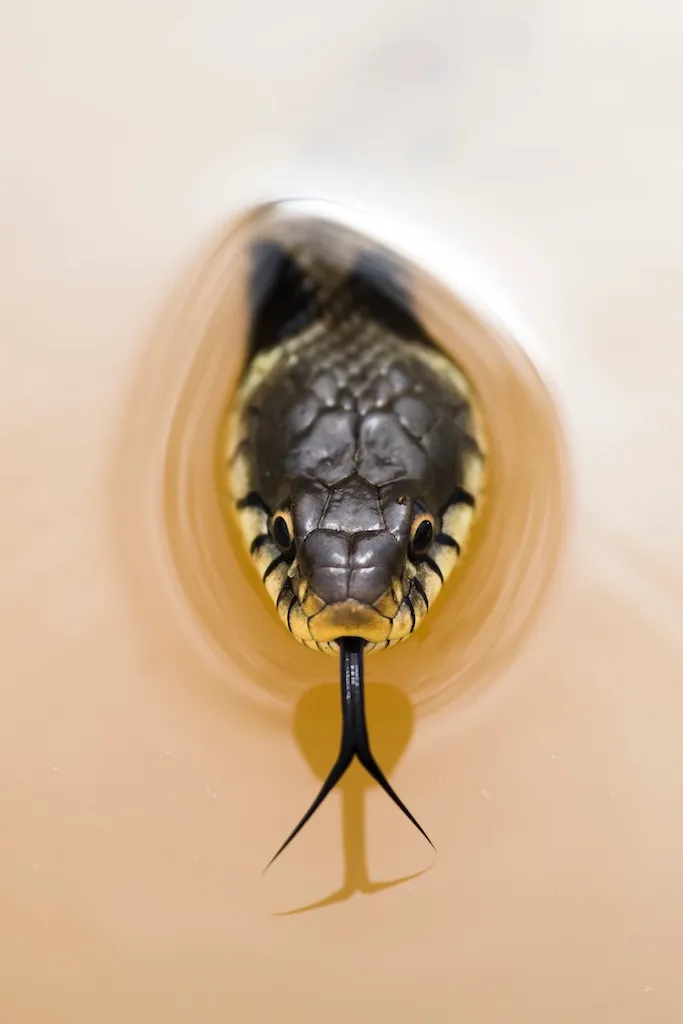
Periscope – Marco Maggesi

Periscope. Credit: Marco Maggesi | cupoty.com

‘This beautiful snake was looking for prey in a pond. I was really lucky because it stopped right in front of me to taste the air. The light was very soft because it was a cloudy day. I used a 300mm lens to capture this portrait. I will never forget this encounter.’ Marco Maggesi

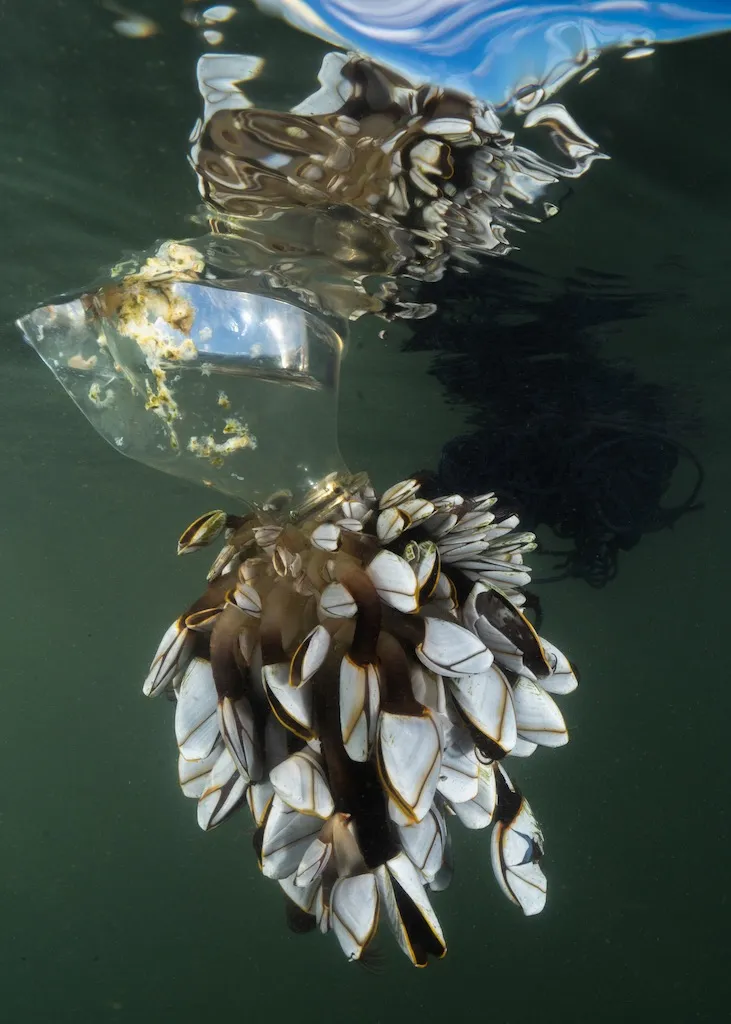
Plastic Sailors – Sandra Stalker

Plastic Sailors. Credit: Sandra Stalker | cupoty.com

‘Hundreds of items covered in gooseneck barnacles wash up on Chesil Beach, in the UK, every year, carried there by winter storms. These are non-native to the UK and have usually travelled across the Atlantic. This particular item was a plastic bottle with a colony of goose barnacles and some fishing net I found on the beach. To tell the story of ocean litter becoming a habitat for wildlife, I took them to the sheltered side of Chesil in Portland harbour and re-floated them there. The water was about 8°C, I was in a wetsuit and the water was incredibly choppy from the wind, which kept blowing the bottle away from me. I shot upwards as I loved the reflection on the surface of the water, while keeping the bottle and barnacles as the main focus of the image.’ Sandra Stalker

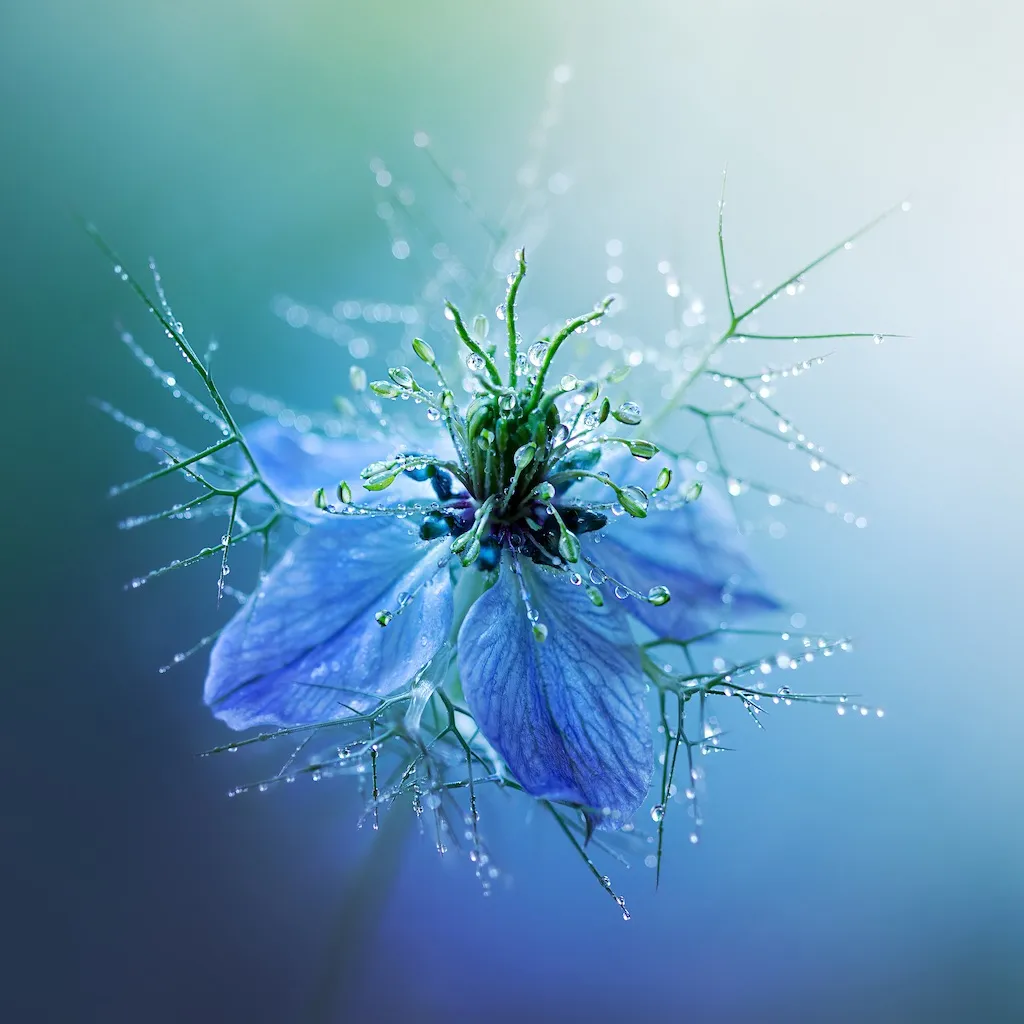
Sparkling Crown – Claudia Gaupp

Sparkling Crown. Credit: Claudia Gaupp | cupoty.com

Love-in-the-Mist (Nigella damascena) is the epitome of early summer for me. I have always been fascinated by the variety of nigella flowers. From the bud to the dried seed capsule – each phase holds its own secret. In this case I was intrigued by the details of the stamens and petals, which are surrounded by net-like leaves. Shortly after a rain shower, the tiny drops of water caught in the leaves made me think of a sparkling crown on the bloom. I took the picture in my garden in natural evening light and converted it in post-processing to a very cool blue-green background to match the blue of the flower.’ Claudia Gaupp

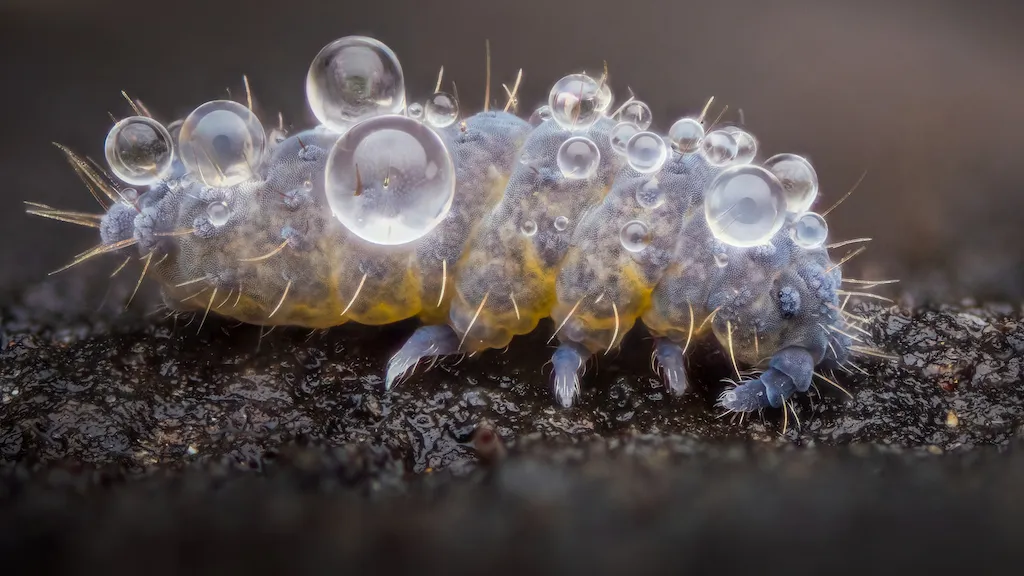
Moss Springtail – Alexis Tinker-Tsavalas

Moss Springtail. Credit: Alexis Tinker-Tsavalas | cupoty.com

‘While searching for macro subjects on dead wood in winter I came across this springtail (Neanura muscorum) covered in dew droplets. Normally this species is quite active, which makes focus stacking almost impossible, but this individual stayed quite still, giving me the opportunity to get a high magnification focus stack. I used Zerene Stacker to combine the frames and sharpened the final image with Topaz DeNoise AI.’ Alexis Tinker-Tsavalas

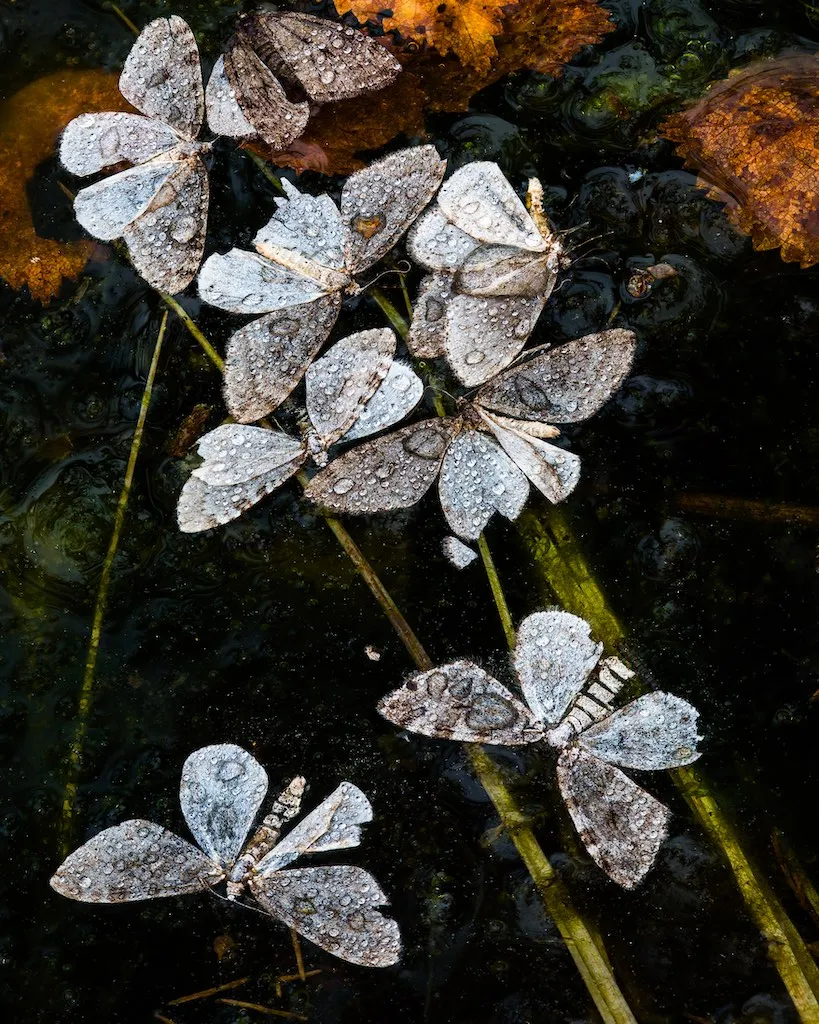
Last Flight – Harald Cederlund

Last Flight. Credit: Harald Cederlund | cupoty.com

‘In early autumn, large quantities of moths were swarming in the mountain birch forest of Grövelsjön, Sweden – giving the hike through it a certain dream-like quality. My hiking buddy wasn’t feeling great, so we had to stay and rest in a mountain station, allowing me time to explore the immediate surroundings with my camera. I followed the trail down to Linnés källa – a spring that was supposedly discovered by the botanist Carl Linnaeus. Its surface was littered with large quantities of dead moths, along with some autumn leaves, grasses and algae. It looked to me as if the moths were still dancing over a meadow somewhere, taking one last flight. Later on, I combined five frames in Zerene Stacker to give a greater depth of field.’ Harald Cederlund

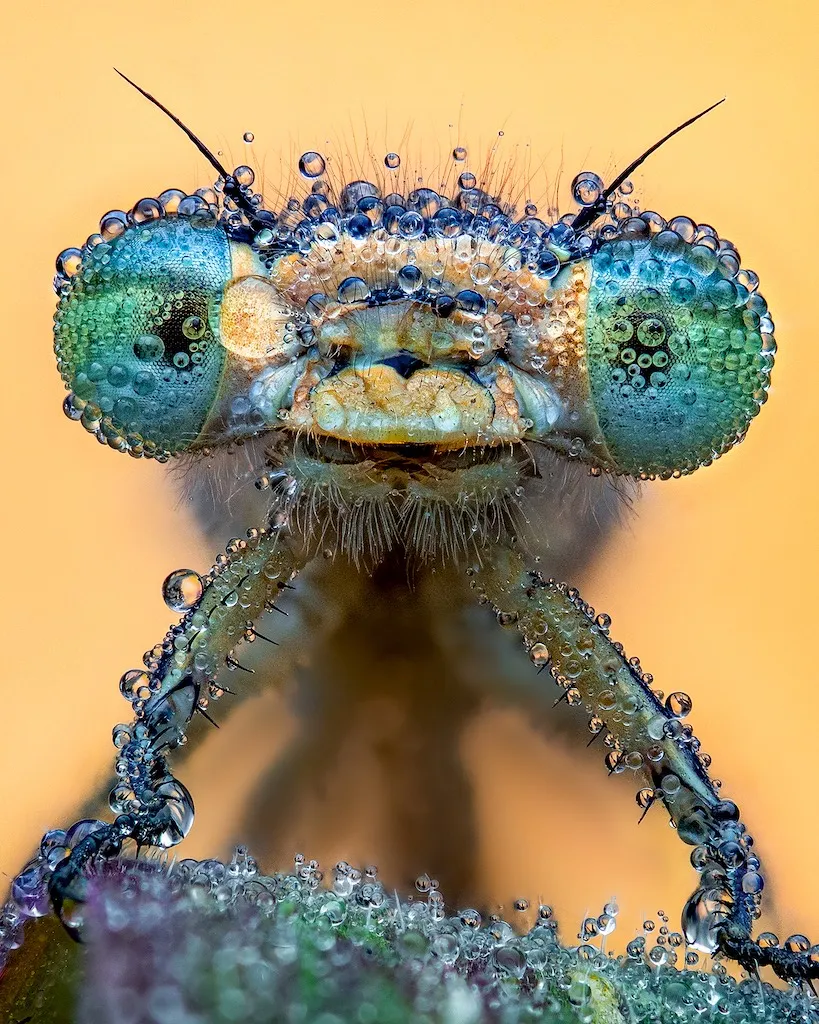
Long Over Dew – Pete Burford

Long Over Dew. Credit: Pete Burford | cupoty.com

‘At Mousecroft pool, Shrewsbury, I photographed this damselfly covered in dew during the early morning hours, at around 3am, in May. Given that insects are cold-blooded and need warmth to move, they typically rest at night. The sudden drop in temperature causes dew to cling to them. This moment is ideal for portraits as they cannot move or fly. As they warm up with the rising sun in the morning, they wipe away the moisture and fly off. To enhance the visual appeal, I used a coloured background card to add contrast and additional hues to the image. Afterwards, I stacked the frames in Helicon Focus, edited in Lightroom and Photoshop and then finished off with Topaz DeNoise.’ Pete Burford

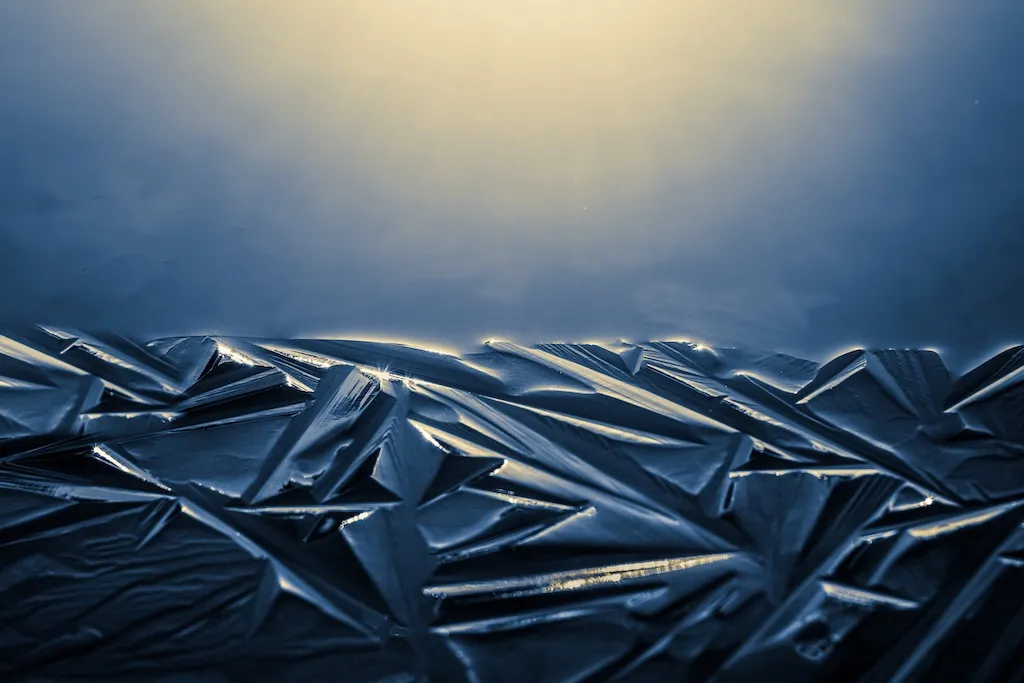
Pond Geometry – Abby Raeder

Pond Geometry. Credit: Abby Raeder | cupoty.com

‘The earliest signs of a changing season are captivating to me. By mid-November, nights become bitingly cold. At morning’s light, I visited a pond in Vermont to find the first ice of the season. For me, this scene is thrilling beyond words. Seeing the physical change of water into a striking geometric marvel is an experience that makes me appreciate the glories of life.’ Abby Raeder

Between the Stars – Tibor Litauszki (overall winner)

Between the Stars. Credit: Tibor Litauszki | cupoty.com

‘In Germany, where I live, there are many clear and slow-flowing streams that provide excellent habitat for alpine newts. I have been following their lives for years, and last year was no exception. A few days after the frogs lay their eggs, at dusk, the newts appear and feast on the spawn all through the night. I wanted to capture this moment underwater. To do this, I placed my camera in an underwater housing, attached it with weights, and placed it under the frogs’ eggs. I was a bit nervous at first because I wasn’t sure if the underwater housing was completely waterproof. But I figured that if no bubbles appeared, my camera would stay dry. I manually set the focus on the lens beforehand and hoped to get lucky. Waiting nearby until it got dark, I illuminated the first newt that appeared with an LED light and triggered the camera with a homemade wired remote release.’ Tibor Litauszki

Find out more about the Close-up Photographer of the Year Challenge

Five photographers tackle matters of home, identity, and migration

Five photographers tackle matters of home, identity, and migration

WINCHESTER — As a title, “Traces of Existence,” the show currently at the Griffin Museum of Photography, could apply to pretty much any aspect of the medium. Among many (many) other things, a trace of existence is what each and every photograph is.

The show runs through June 9.

Here the title refers to matters of home, identity, and migration. Each of the five photographers with work in the show — Muriel Hasbun, Alejandro “Luperca” Morales, Rodrigo Valenzuela, Ileana Doble Hernandez, Alejandro Cartagena — is Hispanic. In a sensible curatorial decision, all wall texts are bilingual. Griffin director Crista Dix curated the show.

Muriel Hasbun is a Salvadoran immigrant. “Traces” includes 18 images from her “Pulse: New Cultural Registers” series. Although these works are photographic, they look like paintings: adjacent to Surrealism, spectral and often slightly eerie, hovering between abstraction and representation. Is that the outline of a whale there? A set of torsos here? A sleeping, or dead, body? The works are all the more striking for being subdued, even recessive, in appearance.

Muriel Hasbun, “Pulse: Seismic Register 2020.02.27.057 (Norte),” 2020.Muriel Hasbun

“Pulse” takes its title from the fact that the images incorporate lines from seismic readings from El Salvador, documenting earthquakes and volcanic activity. Symbolically, the lines connect Hasbun (and the viewer) to Hasbun’s homeland. Practically, they’re a distinctive visual element, harkening to grids, schematics, and, yes, barbed wire.

Hasbun also has a video in “Traces,” describing a final visit to her dying father and how they made paper boats together. She invites museumgoers to make their own (materials are provided). Spread across the floor is a colorful and charming array of boats made by viewers of previous exhibitions of the video. Boats made by Griffin visitors will be added over the run of “Traces.”

Alejandro “Luperca” Morales, screenshot form “You tell all the guys. . .,” 2024.Alejandro Morales

Alejandro “Luperca” Morales was born in Ciudad Juárez, Mexico. That fact is pertinent because he has a pair of videos in here, showing the Paso del Norte International Bridge, between El Paso and Ciudad Juárez. One is a live stream from the bridge’s walkway, the other a loop of excerpts culled from the stream. Both are, in effect, surveillance footage. The experience of watching is at once hypnotic and unsettling.

Of the five artists’ work, this is the simplest visually. It’s hardly simple otherwise, touching as it does— presenting as it does — immigration, deportation, and inequality. Morales notes that the bridge cameras belong to the same network as the El Paso Zoo’s. He does not belabor the point, leaving it to museumgoers to draw their own conclusions.

Rodrigo Valenzuela, “New Land 231.”Rodrigo Valenzuela

Born in Chile, Rodrigo Valenzuela lives in Los Angeles. The six examples from his “New Land” series are large-scale desert scenes. On those scenes, he superimposes lines, planes, and structures. His work recalls that of John Pfahl, in its juxtaposition of landscape with human artifice. Emptiness becomes a kind of ghost settlement. The dry, dun landscape becomes an extension of geometry — or perhaps the other way around. The work takes on a further dimension, insofar as this is terrain associated with the attempted border crossings of undocumented immigrants and a history of violence going back to the Spanish Conquest.

Valenzuela is the Griffin’s first Cummings Fellow. His duties include working with students at Winchester High School, which is a short walk from the museum and has a vigorous tradition of student photography.

Ileana Doble Hernandez, “Blue,” 2023.Ileana Doble Hernandez

A self-described “artivist,” Ileana Doble Hernandez was born in Mexico and currently lives in Boston. She has work from two series in the show. “Los Gringos” consists of 14 color diptychs of Los Angeles street life. They frequently contain text (signs, banners). There are five lightbox transparences from the other series, “Pollage” (a mash-up of “politics” and “collage”). Where the diptychs are lively, the transparencies go beyond that, with their frenetic content and garish appearance.

Alejandro Cartagena was born in the Dominican Republic and lives in Mexico. He repurposes vintage vernacular photographs in two ways. With the larger group in “Traces,” he removes the sitters’ faces, a commentary on identity, absence, presence, and disappearance (a word with a grim and weighty history in Latin America). One such distressed picture would look bizarre. A dozen would make a telling point. There are many dozens here, which rather dulls that point.

Alejandro Cartagena, “Studio Session 881.”ALEJANDRO CARTAGENA

The other group consists of three arrangements of vintage black-and-white studio portraits of unidentified people. The portraits are various shapes and sizes, with several dozen within each frame. The idea is to convey “erasure through multiplicity.”

That sure sounds like echo-chamber artspeak. For at least this viewer, there’s an echo of Walker Evans’s 1936 “Penny Picture Display.” That photograph shows a sign for a Georgia photo studio, consisting of 225 thumbnail-size portraits. “I look at it,” Evans said, “and think, and think, and think about all those people.” Sometimes art manages to join with democracy, making traces of existence that enlighten, extend, and maybe even endure.

On April 20, an opening reception will be held at the museum from 4 p.m.-6 p.m. It’s free and open to the public.

TRACES OF EXISTENCE

At Griffin Museum of Photography, 67 Shore Road, Winchester, through June 9. 781-729-1158, griffinmuseum.org


Mark Feeney can be reached at mark.feeney@globe.com.

Experiment with your long lens

Experiment with your long lens

We all know that a long lens is useful for photographing wildlife and things that are far away. I took my new 150-600mm lens, (check my review) which has a field of view equivalent to a 300-1200mm full frame lens, and turned it to subjects normally more suited to macro or shorter lenses. Ended up with some pretty nice results.

In the backyard

This idea started in the backyard. While waiting to capture some birds, I turned my OM System 150-600mm lens to plant life much closer. Facilitated by adding a 10mm extension tube I was able to get some very interesting bokeh with a very shallow depth of field. This lens has a long reach but I was still able to hand hold due to the built-in incredible camera and lens Image Stabilization. 1200mm equivalent at 1/125th of a sec in the shadows and 1/8000th of a sec when photographing the hummingbird in full sun.

yellow rose photo
Yellow miniature rose with bud. f/6.7 1200mm (FF Eqiv) with 10mm extension tube. 1/350th sec ISO 3200

Hummingbird

Is this an incredible hummingbird photo? Nope. But, I’m seeing how far I can push the lens while hand holding. Not being tethered to a tripod comes in handy as the hummers tend to move around to different perches when they are away from the feeders.

hummingbird in flight photo
Hummingbird captured with 150-600mm f/5.0-6.3 OM System lens (300-1200mm FF equivalent field of view) @1200mm f/6.7 ISO 3200 1/8000 sec.

Boredom for the win

Maybe it’s boredom or maybe it’s an active mind difficult to quiet. I was waiting for the hummers to return and just for fun I turned the camera to the greenery and miniature roses that surround my patio. I’ve used long lenses in the past for a different look with small subjects. This turned out to be a solid reminder to remember to work the long lenses more often.

vinca vine photo
I enjoy the soft feel of this Vinca vine. f/6.7 1200mm (FF Eqiv) with 10mm extension tube. 1/125th sec ISO 3200 hand held

Gear used

I used the OM-1 camera fitted with 150-600mm f/5.0-6.3 OM System lens. Being able to hand hold this lens lends itself to capturing more creative images. I took this same concept and gear added a tripod and captured some next level images. That article will be coming soon.

Yours in Creative Photography, Bob

Sunshine at midnight on the arctic tundra: Inuuteq Storch’s best photograph

Sunshine at midnight on the arctic tundra: Inuuteq Storch’s best photograph

In the summer of 2023, I was living in Qaanaaq, Greenland, one of the most northern cities in the world. It’s a tundra: there are no plants, it barely rains and, in the summer months, there are 24 hours of sun. During the night, the weather is calmer and more colourful – by day, it’s hardcore and very bright. This was taken just before midnight. I could hear kids playing tag outside, then they got tired and lay down. I went out and asked if I could take a photo. We have a lot of nostalgia in our culture in Greenland, and this photograph captures that feeling: it is the middle of summer, but it has the look of spring. Greenland in spring is unlike any other place. Since the sun is not visible in the winter, when spring comes it brings life back. That time of total darkness is very spiritual.

The whole town knew I was taking photographs, but the fact that they’re now going be on show at the Danish Pavilion of the Venice Biennale isn’t so interesting to them – it’s too far away. My work has always been about Greenland’s history, traditions and everyday life, such as hunting. I was given permission to take photos with the hunters, but it was difficult to shoot where they work because the ice was melting.

I’d been thinking about going to Qaanaaq for years as my name originates in the town. I wanted to take my name home, to understand its meaning and its spirit. That is how this series Soon Will Summer Be Over began.

Qaanaaq is one of the last places in Greenland to have been colonised by Denmark, in 1937. At that time, they were still living exactly as they had in the old days, a traditional life, with shamans and hunters. We Greenlandic people call ourselves Inuit, which really means human. We use a drum called “the one to take you to different skies”, and when we play it we connect to different worlds and meet other creatures. That is how we understand we are human. It is hard to explain, but this is how Greenlandic people work. Our language is very visual, too.

Photographs come naturally to me. I follow my instincts. To me, a good photo is an honest photo. I work with three different cameras. This was taken with a point and shoot. In the same series, I also worked with a camera from the 1940s, which requires more planning and preparation. When I present my photography, I try to show it in an Inuit way, in terms of how the works are hung and represented, what materials are used, all adapting to the environment. We are very good at adapting to places.

I lived for a time in New York and believed I was going to stay there for many years. But I quickly realised most of the photographs I wanted to take were in Greenland, so I went home and started capturing the Greenlandic lifestyle. When I moved back from New York, where it is so busy and everyone walks very fast, I understood the meaning of walking slowly.

Art culture is a western concept. When we make harpoons and decorate them with depictions of animals, it is not to make them look good – it is because we hope the harpoon will get that animal. A lot of our traditions are about hope. Living in Greenland is not easy – we need a lot of hope!

When people from home see my photographs and feel homesick, that’s a sign they like my work. They feel something familiar in what they see. That is what I want to achieve.

Inuuteq Storch’s CV

Born: Sisimiut, Greenland, 1989
Trained: Self-taught.
Influences: “Everyday life. Qunerseeq Rosing, John Møller, Richard Billingham, Jacob Aue Sobol, my family.”
High point: “Being in east and north Greenland.”
Low point: “The first time I couldn’t take any photos due to being creatively exhausted – I thought I would never be good at taking photos for the rest of my life.”
Top tip: “Be honest and be excited.”

In ‘Felt Love,’ a Young Boy and His Mother Learn the Value of Spending Quality Time Together

In ‘Felt Love,’ a Young Boy and His Mother Learn the Value of Spending Quality Time Together

A mother working overtime at home as a seamstress finds it difficult to carve out a few moments for her son in “Felt Love,” a poignant short film about family, togetherness, and quality time. Created by a group of students at San Jose State University as a senior thesis project in 2020, the piece combines a miniature 3D set with 2D animation to tell the story of a young boy who learns the depth of his mother’s hard work and adoration and how she learns to share that with him.

Go behind-the-scenes of “Felt Love” on the project’s Instagram, and you might also enjoy the stop-motion short “Visible Mending” by Samantha Moore.


All images © Felt Love Film

a gif from a short animated film showing a young boy playing with a spool of thread and it gets away from him and rolls toward his mother, who is busy working

a still from a short animated film showing a young boy holding up a book he wants to read, but his mother is working hard at a sewing machine

a gif from a short animated film showing a clock ticking by and a young boy's leg's dangling from a chair, viewed from beneath the desk

Do stories and artists like this matter to you? Become a Colossal Member today and support independent arts publishing for as little as $5 per month. The article In ‘Felt Love,’ a Young Boy and His Mother Learn the Value of Spending Quality Time Together appeared first on Colossal.
Photographers Around The World Submitted Thousands Of Engagement Photos, Here Are Our Top 40

Photographers Around The World Submitted Thousands Of Engagement Photos, Here Are Our Top 40

Choosing the top 50 images from a pool of thousands is no easy feat. Judging requires a certain amount of subjectivity, and we understand that not every photo in our collections will appeal to every person. Some images will strike deep feelings within you and others won’t—these feelings change from person to person.

We try to make sure that our photo collections speak to more than just one audience and that they represent a wide spectrum of photographic styles, cultures, and love. Over the years, it’s become clear that the more diverse the submission pool is, the more diverse the final collection is. Because of this, we urge photographers everywhere to submit work that highlights diversity in subject matter and style.

We’re proud of this collection and are so excited to celebrate another year of dedication and artistry in the wedding photography community. We hope the photos in this collection speak to you the way they do to us.

ADVERTISEMENT

ADVERTISEMENT

ADVERTISEMENT

ADVERTISEMENT

See Also on Bored Panda

ADVERTISEMENT

See Also on Bored Panda

Photographer Carla Williams ’86’s Thesis Is Back in the Spotlight

Photographer Carla Williams ’86’s Thesis Is Back in the Spotlight

‘It was a revelation that it had stood the test of time’

In this black-and-white photo, Carla Williams closes her eyes and rests her chin in her left hand.

One of the photos from Carla Williams ’86’s thesis.

Carla Williams

For her senior thesis, Carla Williams ’86 mounted an exhibition of 74 photographic self-portraits. Her adviser Emmet Gowin remembers the show as perhaps the best thesis he advised in his 36 years on the Princeton faculty. “There are images here which are painful, fearful, proud, strong, humorous, sensuous, tender and even faintly frightening,” Gowin wrote in 1986 of the body of work Williams produced in her dorm room — a 1901 Hall single her senior year — with a secondhand Speed Graphic 4×5 camera. 

Williams went on to craft a career as a scholar, teacher, and merchant of photography, but her college work didn’t gain a wider audience until it was published last year as a monograph with the title Tender, which later won the First PhotoBook award at the 2023 Paris Photo-Aperture PhotoBook Awards. Shortly after publication last fall, the images were exhibited once again — for the first time since her Princeton thesis show — at Higher Pictures Generation, a gallery in Brooklyn, New York.

Williams didn’t take art classes in high school in Los Angeles, where she grew up, but she enjoyed a course in Italian Renaissance art and applied to take a photography course the next semester.

“I had an interview with Emmet,” Williams remembers, “and from the moment I stepped into the basement of 185 Nassau Street, I knew. It was the smell of it, the sound of it. By the time I got to the classroom and office area, I wanted in.”

Williams started making self-portraits in her first photography class, and she initially focused on the genre for practical reasons. “I wanted to learn how to use the large-format viewfinder on the camera,” she says, “so I thought, ‘Let me use myself as a subject until I get up to speed.’”

But there was a deeper rationale for her project. “I was a young Black woman,” she says. “I was curious to see my likeness. I was taking Peter Bunnell’s History of Photography course, and I wasn’t represented in what I was seeing.” 

Williams did take some of the works she studied in the course as models, including Alfred Stieglitz’s portraits of Georgia O’Keeffe and Edward Weston’s portraits of female nudes. She says she was also influenced by images of naked women in the collection of Penthouse and Playboy magazines her father kept in their home. 

 “Once she began to take self-portraits, her personhood, her sensibility started to really come out,” Gowin says of Williams. “It was totally uncommon in that era for women to take themselves as the central subject of everything they did. She was able to sustain a level of invention and beauty that’s still astonishing.”   

And, he adds, her “willingness to accept chance and imperfection” in the photographs themselves, “to take what you get and make the most of it, is a really strong characteristic. It made her work more personal.”

Williams earned an MFA in photography from the University of New Mexico after graduating from Princeton, but she never marketed her work aggressively. She was uncomfortable with the commercial aspects of the art world, and, she says, “In the early 1990s, Black photographers were only just starting to be shown.”  

Instead, Williams worked as a curator of photography, first at the Getty Museum in Los Angeles and then at the Schomburg Center for Research in Black Culture in New York. In 2002, she co-authored The Black Female Body: A Photographic History, a foundational work on the topic, with curator and scholar Deborah Willis. Williams taught photography for five years at the Rochester Institute of Technology, but in 2014 she moved to New Orleans to open a store featuring fine and decorative arts by Black artists and designers.

“There was no conscious moment of feeling done” as a photographer, Williams says. “It just wasn’t my focus. At that point I had no plans to pursue photography.”    

After Williams had to close her store at the start of the pandemic, she scanned all of the photographs in her house, created a website, and put some of the images on her store’s Instagram page. One of her customers, the photographer Paul Mpagi Sepuya, noticed the self-portraits on Instagram and recommended them to publisher Paul Schiek, who suggested Williams put out a book of her work. 

Through Schiek, Williams was introduced to the gallery Higher Pictures, which proposed restaging Williams’ senior thesis exhibition. “It delighted me that someone else was thinking about the show besides me,” Williams says. “I had my trepidations about some of the images holding up, but I trusted the gallerists.”

Gowin came to the November opening of the show, which was composed mostly of original prints from the thesis exhibition with the same presentation and sequencing. “The first thing we said was that it was better than we had thought,” Williams says. “It was a revelation that it had stood the test of time. I was quite delighted.”