About

Posts by :

$25m gift puts focus on photography at the Art Institute of Chicago

$25m gift puts focus on photography at the Art Institute of Chicago

The impact of the recent $25m gift to the photography department of the Art Institute of Chicago (AIC) will perhaps be most visible to the public with the creation of the Bucksbaum Photography Center, although its completion is bound up in an even larger construction project. When the museum engaged the Barcelona-based design firm Barozzi Veiga in 2019 to begin the process of devising a plan for a campus makeover, it was intended to be a slow process even before the Covid-19 pandemic delayed it.

The museum’s photography collection began auspiciously with a gift in 1949 of 231 images and photogravures from the collection of Alfred Stieglitz (151 by the trailblazer himself), and has grown to nearly 25,000 pieces that include installation art, albums, photobooks and time-based media. The AIC’s commitment to photography dates to 1900, when it hosted the First Annual Photographic Salon; Stieglitz and Clarence H. White, a founder of the Photo-Secession movement, served on the jury.

In the meaty Art Institute of Chicago Field Guide to Photography and Media (Yale University Press, 2023), the museum’s first survey of the collection, co-edited by the former curator Elizabeth Siegel (now the chief curator of the Milwaukee Art Museum, after 25 years at AIC), there are some hints about the department’s existing facilities being less than optimal. For instance, the subterranean galleries were previously part of a café connected to the interior courtyard. In the Modern Wing, the Renzo Piano-designed 2009 expansion, there is a dedicated gallery for photography, thanks again to the generosity of the Bucksbaum family.

Improving the visitor experience

Matthew Witkovsky, the chair and curator of photography and media at the museum, who has spearheaded the growth of the photography department since arriving at the AIC in 2009, elaborated on its collecting strategies. (Witkovsky also serves as the museum’s vice-president for strategic art initiatives.) While the acquisition in 2019 of the W. Bruce and Delaney H. Lundberg collection of historic images notably filled one gap in the AIC’s holdings, the collection has slowly been evolving in other areas.

“The Bucksbaum family gift has been made to further visitor experience of the collection. That said, the acquisition of the Lundberg Collection of 500 American daguerreotypes did transform our holdings of 19th-century photography; other initiatives over the past decade and more have made the Art Institute a centre for the study of post-war Japanese photography and media, African Modern and contemporary, and international conceptual art,” Witkovsky says. “European Modernism remains a pillar of the collection and there is more to do to strengthen our attention to Central and Eastern Europe, as the current show of photograms by Hungarian artist János Megyik [until 8 July] makes clear.”

Entire collection online

Witkovsky described the collection as highly visitor-oriented. “With the opening of dedicated galleries in 1980 came a study room that is open by appointment to the general public—no special diplomas or credentials needed,” he says, adding: “The entire collection of nearly 25,000 objects is online.”

A gift of this magnitude impacts not only the museum but the city and the photography community at large. Chicago’s roots as a centre for American photography run deep, beginning with the New Bauhaus that started in 1937, with László Moholy-Nagy at the helm, to the Institute of Design’s photography programme. (The school’s eminent alumni includes Harry Callahan, who went on to establish the photography programme at the Rhode Island School of Design in 1961.) Then there is the growing Museum of Contemporary Photography (MoCP) nearby, with around 17,000 works in its collection. The MoCP is part of Columbia College, where the revered photographer Dawoud Bey has been on faculty for more than 20 years.

“Chicago has a very rich history of photography and media—far more widely distributed across the city’s neighbourhoods than has commonly been acknowledged—and attention to it in recent years has diversified appropriately,” Witkovsky says. In 2018, the AIC’s exhibition Never a Lovely So Real—referencing Nelson Algren’s 1951 book Chicago: City on the Make—focused on photojournalists and documentary film-makers on the south and west sides of Chicago. In 2021, the show Subscribe brought attention to the queer photo-illustrated magazine Thing/Think Ink. The museum also partnered with the Chicago collective Floating Museum to commission portraits from ten local photographers.

“The Bucksbaum Photography and Media Center will help the Art Institute mightily in bringing the world to Chicago—and, just as much, in ensuring that Chicago achievements stay visible in the world,” Witkovsky says.

Solar eclipse photography

Solar eclipse photography
image

Local photographer Morgan Somers captured the eclipse Monday, April 8 using his Masphoto company’s photography equipment that he set up in downtown Flint. He added a 20 stop solar filter to the end of his camera lens to properly expose for the image on a tripod. Somers said, “I was shooting a timelapse of the eclipse and when I saw the plane fly through I was so excited.”

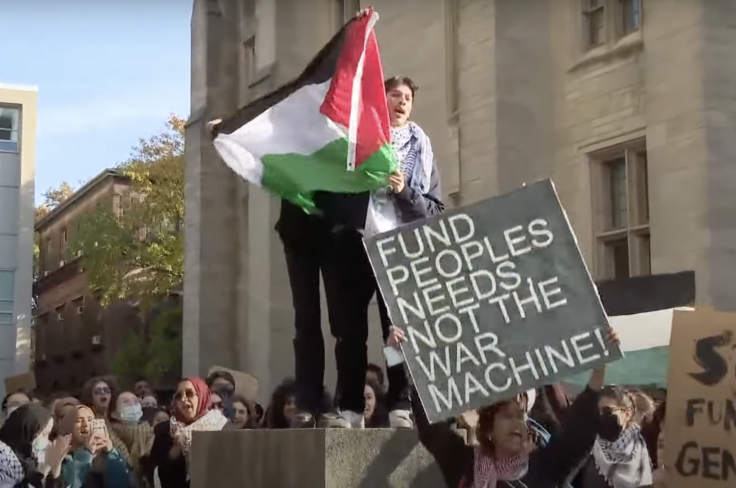
Yale Administrators Stand By as Students Unveil ‘Free Palestine’ Banner During Official Class Photograph

Yale Administrators Stand By as Students Unveil ‘Free Palestine’ Banner During Official Class Photograph

‘I was incredibly disappointed that there were over 5 school officials there that did nothing,’ Jewish student says

Pro-Palestinian rally at Yale (Fox 61/YouTube)

Yale University officials stood by silently as students unveiled a large “Free Palestine” banner during an official class photograph for the School of the Environment. The move came after university officials said they had warned students not to display “political messages,” according to internal emails obtained by the Washington Free Beacon.

Students in the school’s 2024 class met Tuesday morning for a class photo. Those photographs are displayed at Yale’s Forest School. The photo shoot was derailed, however, when students unfurled a large banner that displayed a message that included the words “Free Palestine,”  according to an email from School of the Environment dean Indy Burke reviewed by the Free Beacon.

While Burke advised students in a message sent ahead of the photo shoot to avoid “displaying political messages as they may not represent all students,” Yale officials “did nothing” and “still took the photo” after the banner was displayed, according to a Jewish member of the class.

“I was incredibly disappointed that there were over 5 school officials there that did nothing,” the student said in an email to Shmully Hecht, a rabbi who serves Yale students. “I felt that the Jewish students were targeted by this poster because there was no protest occurring at the time that was relevant to this banner. It was just about denouncing Israel for all memory and stating that it should not exist.”

Burke acknowledged the ordeal in a follow-up email sent to Yale professors, administrators, and students. “The staff members present were in a tough position,” Burke wrote in an email following the event, which included Yale University professors and other members of the media, adding that the sign “definitely broke the rules.” She pledged to “destroy” the photo in question.

She did not indicate whether the students who displayed the banner would face disciplinary action. A spokeswoman for Yale University did not respond to a request for comment.

Yale is no stranger to anti-Israel protests. In February, the law school’s Students for Justice in Palestine chapter called on Yale to cancel an event with an Israel Defense Forces soldier, saying his presence on campus “will make students unsafe.”

In the wake of Hamas’s Oct. 7 terror attack on Israel, meanwhile, the head of Yale Law School’s Schell Center for International Human Rights wavered on whether to address the massacre, calling the situation “more complex than people hurt so directly by last week’s atrocities in Israel might feel.”

The law school’s dean, Heather Gerken, issued a statement three days after the attack that did not include the words “Jewish” or “anti-Semitism.” Gerken is now gunning for a promotion to serve as Yale’s president.

The School of the Environment’s photo shoot invitation, which was sent to the school’s 2024 class Monday afternoon, informed students that “TWO photos” would be taken: “one with signs and one without signs.” The school asked students to display “smaller more personal signs” and discouraged both political signs and “signs that may block the persons around you from being seen in the class photo.”

“Also, important to note (per previous feedback from students) that we encourage everyone to think carefully before displaying political messages as they may not represent all students,” the message said.

“The hope is for the class picture to live on as a celebration of and for the entire group,” the invitation said. “Thank you in advance.”

Suffocating Subjects Long for Air in Nick Brandt’s Unsettling Underwater Photos

Suffocating Subjects Long for Air in Nick Brandt’s Unsettling Underwater Photos

All images © Nick Brandt, shared with permission

Although warming global temperatures are causing sea levels to rise around the globe, the Pacific islands are experiencing the change at a more rapid rate than anywhere else. Higher tides and extreme weather can wage unrelating flooding, rendering low-lying regions uninhabitable and displacing the communities that call them home.

In Sink / Rise, Nick Brandt peers into the not-so-distant future to imagine the effects of rising waters. His photographs depict people performing unremarkable tasks like sitting at a table or tottering on a seesaw, although their surroundings are incredibly unsettling. Shot entirely in-camera off the coast of Fiji, each seemingly mundane scene occurs on the ocean floor. The subjects hold their breath as they pose, and their suffocation quickly becomes literal. Each wears a tense, rigid expression reflective of their catastrophic situation.

Conjuring an apocalyptic reality, Brandt is known for visualizing the often difficult-to-comprehend impacts of the climate crisis and now, its remarkable potential for danger. Sink / Rise is the third part of an ongoing series titled The Day May Break, which depicts people and animals affected by environmental destruction in Zimbabwe, Kenya, and Bolivia. Now available in a book published by Hatje Cantz, the most recent collection is the first situated underwater.

As Zoë Lescaze describes in the introduction, the portraits are haunting and appear “as though the familiar laws of physics have stalled in this strange, liminal zone between land and sea.” Rather than buoyantly swim or float, the subjects are critically bound to their submerged positions.

Pick up Sink / Rise on Bookshop, and find more from Brandt, including upcoming opportunities to see The Day May Break in person, on his site and Instagram.


a young boy rests his head on a girls lap in a metal bed frame underwater

a man sits on a bench on the ocean floor

a girl sits at a table on the ocean floor

two young women, one sitting on a bench and the other standing on it at the bottom of the ocean floor

a young woman embraces a boy underwater

a man and a boy use a teeter totter on the ocean floor

a behind the scenes shot that shows a diver photographing a boy sitting on a table on the ocean floor

Do stories and artists like this matter to you? Become a Colossal Member today and support independent arts publishing for as little as $5 per month. The article Suffocating Subjects Long for Air in Nick Brandt’s Unsettling Underwater Photos appeared first on Colossal.