
Heidi Lau walks us through ‘A Cacophony of Rocks’ her debut solo exhibition with Sikkema Jenkins on view in New York now.
Sculptor Heidi Lau on ‘World-Building’ With Personal Memory and Ancient Myth


Since I first started writing about art and money almost 11 years ago, one lesson that people’s reactions have reinforced over and over again is that the tensions between the two forces tend to be thought of as relatively recent phenomena. In reality, the truth is that they are anything but. A brilliant exhibition at the Morgan Library and Museum in New York elucidates that people have been vexed by the tensions between visual art and the monetary economy for as long as the latter has existed.
Titled Medieval Money, Merchants and Morality (until 10 March), the show turns works of art, manuscripts and other objects into a prism to examine the economic revolution that took place in western Europe from the 13th to the 16th centuries—and vice versa. The unifying conceit is that money functioned as what Diane Wolfthal, a professor emerita of art history at Houston’s Rice University and the show’s guest curator, calls a “new medium” whose purpose, proper use and consequences were all being debated by people up and down the financial hierarchy, from Italy and England to the Low Countries, with art becoming a vital piece of the conversation.
I want to focus on three particular ways that works of art played into the metabolising of the new monetary economy during this period: as a visual record of the new developments, as an instruction manual about how to think through the tensions they raised and as an arena in which people and institutions wrestled with their own doubts about the morality of money.
The Middle Ages and Renaissance saw multiple economic innovations that laid the groundwork for modern capitalism, starting with the production of low-value coins for everyday trade. Prior to this, the dominant mode of exchange was the bartering of goods or services—say, trading a chicken for three heads of cabbage—since “most stores of value were in people’s homes, land, textiles, furs, fish and other things”, says Deirdre Jackson, the assistant curator of Medieval and Renaissance manuscripts at the Morgan.
But low-value coins also created several problems. For starters, they were all handmade, limiting their production while also meaning that, even in the best times, each coin was slightly irregular in form, size and weight. Worse, even the imperfect standards for these coins tended to erode based on the availability (or scarcity) of their raw materials. “In general most types of Medieval coins gradually declined in precious metal content over time—by being made lighter, by alloying the silver or gold with cheaper metals, or both,” the scholar Steven Yoon writes in the exhibition catalogue.
Despite being royally sanctioned, the minting of coins was also typically a for-profit business run at a local or regional level. This fact meant that dozens and dozens of currencies cropped up throughout the region now known as Europe. Italy, for instance, at various points gave rise to the Venetian torneselli, the Florentine florin and the Bolognese doppio ducato, among others. For trade networks to expand, the abundance of currencies necessitated currency exchanges. Operating them was only possible if people in one location were keeping close tabs on how the coin supply was changing elsewhere.

The Master of Catherine of Cleves, St. Gregory the Great and Coins, from the Hours of Catherine of Cleves, around 1440.
Photography by Janny Chiu. Courtesy of The Morgan Library & Museum
This new form of interconnection through money became so ever-present that it even infiltrated some religious texts. On view in the exhibition is St Gregory the Great and Coins, a page in the Hours of Catherine of Cleves, an illuminated manuscript made in Utrecht around 1440. The central image depicts the titular saint in full regalia against a red-patterned background and gold-leaf chequered floor. But much more interesting is what borders the image and text: 25 representations of eight actual coins from the Netherlands, Germany and Denmark that would have circulated through Utrecht in the early 15th century. (The one exception is the Danish penny, which appears six times on the right side of the page despite not being in wide use there, Wolfthal writes in the exhibition catalogue.)
The artist’s rendering of the coins is impressively illusionistic. The images largely replicate the iconography and text that adorned the front and back of the various coins, as well as their relative sizes and the colours of the metals they were made of. The irregularity caused by the coins’ handcrafting is also evident in their contours, making the page almost as much a historical document as a work of art.
There are multiple hypotheses about why the artist behind the manuscript paired St Gregory with the border of coins. Most revolve around his generosity to the poor (and his willingness to live simply to enable it). But one especially interesting theory is that, after being appointed pope in 590, the man who would become St Gregory established, in Wolfthal’s words, “a very effective administrative system of channelling donations to the Church to support the poor, especially refugees in Rome fleeing the violence of the Lombards”, who had seized much of Italy during his reign.
Regardless of the exact motivation, St Gregory the Great and Coins indicates that money and morality were already tied together in complex ways more than half a millennium ago. And that’s just one example of one interplay between these forces.
Despite the rise of currency exchanges, carrying physical money from place to place was difficult and risky in the Middle Ages, and it only became more so as commerce incentivised people to travel greater and greater distances. Coins were heavy in large quantities, and thieves were plentiful. Not surprisingly, people were not thrilled by either the extra costs of hiring others to lug strongboxes full of metal and fight off brigands, or the strain and perils of doing both themselves.
These headaches catalysed financial innovations. Vital among them was the bill of exchange, a slip of paper written by a banker or a merchant in one place and time that guaranteed payment to the bearer elsewhere, later, in a different currency. Yoon calls the bill of exchange both “an adaptation to the extreme complexities of Medieval coinage systems” and “one of the harbingers of a new system of banks, credit, paper currency and virtual money that exists only as numbers in accounts”.
In other words, the bill of exchange initiated the ways we understand money today. But it also exacerbated the ways we agonise over it, too.
Consider the moral dilemma facing merchants and bankers, both of whom were able to achieve levels of wealth previously exclusive to royalty and the Church courtesy of the new monetary economy. Their chief spiritual problem was their perception as usurers. Initially defined as the practice of charging interest on a loan to members of your own faith, usury stemmed from the belief that making money “reproduce” on its own was unnatural—an idea that dated back to Aristotle. The only truly moral profits, in contrast, came from manual labour. “If you made money in any way through investment, you had tremendous guilt and were worried you were going to hell,” Wolfthal says.
The new financiers set out to counteract this problem partly through visual art, in more ways than one. First, they used their wealth to fund or donate religious works of art as a form of penance. Examples include the Paduan money-lender Enrico Scrovegni commissioning Giotto to paint the frescoes of the Arena Chapel, and the Florentine banker Cosimo de’ Medici paying for the frescoes made to adorn the San Marco religious complex in his hometown.

Jan Gossart, Portrait of a Merchant, around 1530
Courtesy of the National Gallery of Art, Washington, D.C., Ailsa Mellon Bruce Fund
But bankers and merchants also tried to reshape perceptions of their professions through visual language, even on a personal scale. For instance, the Morgan exhibition includes Jan Gossart’s Portrait of a Merchant (around 1530), which goes to great lengths to portray its sitter as an honourable workingman rather than an idle (and thus immoral) plutocrat. It contains minimal visible signs of wealth; aside from the subject’s clothing and rings, there are only a few coins scattered on the desk—notably, to be weighed on the balance atop them as a part of his job.
Gossart’s subject appears to have only looked up momentarily from updating his ledger. Suspended behind him are two sheafs of work-related documents (the cover-page scripts read “miscellaneous drafts” and “miscellaneous letters”). His desk is blanketed by an array of unglamorous mercantile instruments and office necessities: an inkwell and blotter, tape, scissors, twine and a modest candle-holder. All of these elements feed into the notion that this merchant is genuinely labouring in a manner befitting the Church’s ideal. Basically, it’s all a way of communicating, “Hey, even though I work in this field you’re suspicious of, I’m a good guy!” In this sense, it functions as a kind of instruction manual for how to live as a part of the new financial class.
Works of art also served as more literal instruction manuals. Covetousness, a page from an illuminated version of the chivalric poem Le roman de la rose (the romance of the rose) made around 1350, anthropomorphises the sin as a woman grabbing money bags out of coffers stacked with gold objects and silver coins. The conceit of the poem’s opening section is that a man searching for his beloved must overcome a variety of moral failings along the way—many of them involving wealth. In addition to Covetousness, they include Avarice and Envy, with each depiction premised in one way or another on riches (or want of them). Together, the poem and its imagery, which proliferated across Europe during the Middle Ages, offered central lessons for people grappling with the ethical challenges of the new economy.

Covetousness, from Guillaume de Lorris and Jean de Meun, Le roman de la rose (the romance of the rose), Paris, France, around 1350.
Photography by Janny Chiu. Courtesy of The Morgan Library & Museum
Crucially, none of the efforts by merchants and bankers to revise their images would have mattered had the Church itself not gone along with the revisionism. Fortunately for the financial class, however, there was too much opportunity for religious institutions to do anything else. “The main thing I saw changing over time is that the Church gradually acclimated to capitalism,” Wolfthal says of the period covered by the exhibition.
The Church “originally came down very hard on usury”, adds Wolfthal, who first came to this subject roughly 20 years ago while teaching a course on mercantile culture. She writes in the exhibition catalogue that the overarching belief during the Middle Ages and Renaissance was that there were only three “fruitful” uses of money: “meeting the needs of one’s family, the poor and the Christian community”.
But the last of these took a momentous turn as theologians gradually redefined the boundaries of morality vis-à-vis the economic revolution. Enter the purchase of indulgences, payments that the Church channelled into public works and, supposedly, neutralising the sins of the benefactor.
Indulgences were an invention as ingenious as they were disruptive to the faith. Spiritually, the exchange was simple: the more money a person gave, the more of their moral failings would be scrubbed away—and thus the better their odds of entering heaven would become. Practically, indulgences helped strengthen the Church’s influence by funding the construction of valued spaces such as hospitals, lepers’ sanctuaries and (of course) new and improved cathedrals during a time when the collection of secular taxes and corresponding civic maintenance and improvement projects were still nascent and rare.
Prior to the emergence of the monetary economy, indulgences were typically granted only in exchange for good works or military service in the Crusades. Afterward, however, their expansion into the economic system meant that salvation could be bought and sold, an audacious turn for a faith ostensibly premised on virtue’s supremacy over wealth and earthly power.
Indulgences also made the Church a key cog in the nascent international network of finance, as believers could purchase them in one place to support projects sited in another city or country hundreds of miles away. Jackson, for instance, mentions one indulgence scheme offered in London to help fund the construction of St Peter’s Basilica in Rome.

Artist unknown (possibly The Master of St. Augustine), St. Francis renouncing His Worldly Goods, around 1500
Courtesy of the Philadelphia Museum of Art, Purchased with the Henry P. McIlhenny Fund in memory of Frances P. McIlhenny, 2003
Although these changes were officially sanctioned, not everyone was comfortable with them. Multiple works in the Morgan exhibition embody the doubts some patrons and artists harboured about the Church’s embrace of capitalism. Take, for example, St Francis Renouncing His Worldly Goods, painted around 1500 by an unknown artist (possibly the Master of St Augustine, possibly in Antwerp). Although it tells the familiar story of the titular saint opting for poverty and God over his middle-class existence as the son of a textile merchant, the painting also seems to criticise the Church’s entanglement with money. In the centre of the canvas, we see Francis stripping off his fine clothes in front of a bishop dripped out in gold, jewels and opulent vestments. The bishop and his attendants look mortified by Francis’s choice; the bishop even has one gloved, ringed hand on Francis’s arm, as if imploring him to stop.
The imagery seems damning enough without further context. But it only becomes more so given that versions of this scene were not uncommon in everyday life by the turn of the 16th century in Europe. The reason is that the Church, which had earlier deemed usurers to be sinners, later declared it sinful for borrowers not to repay their debts. In fact, when lenders wanted their money back, they sometimes dragged debtors in front of ecclesiastical officials, who could seize the debtor’s goods—including the clothes off their backs—by the authority of the Church.
Medieval Money, Merchants and Morality brims with other works reflecting the contortions the monetary economy put the people of Europe through during the Middle Ages and Renaissance. Along with the objects that track the emergence of capitalism in less complicated ways, they capture that art’s collision with money has been confronting humanity with questions about what is good and right for hundreds of years. That we as a species are still debating their proper relationship in the 2020s proves that there will never be broad agreement on where the boundaries should be—and that’s fine, as long as we don’t fool ourselves into believing otherwise. On this subject, even the Medieval Church wasn’t holier than thou.

The April 8 solar eclipse could very well be the best-documented eclipse to date, but for one man, it’s one photo in one spot that matters.
“I mean, look at it, it’s magical,” said photographer Doug DiRamio. “I don’t even have words to describe it sometimes.”
For decades, DiRamio has been pulled in by Niagara Falls.
“I can probably go back to the ’70s,” he said. “We used to have to sneak down here and that’s where my love affair with photography started.”
His portfolio is filled with images of the natural wonder, but one is missing.
“The tall hotel by the skyline tower, it’s gonna be just to the right of that,” DiRamio said, glancing at a sun tracker app.
He’s looking for a total solar eclipse, over the Falls.
“The orange dot that’s where we are right now and the orange line moving is the sun,” he said, explaining where exactly the sun would be during totality.
A total solar eclipse in Western New York is a sight that hasn’t happened in about 100 years and won’t happen again for more than 100 years.
“I think it’s gonna be a great shot,” he said.
With under four minutes of totality, preparation is key.
“I’ve ordered special solar lens filters from my lenses. People might want to know, you can burn your camera sensor out staring at that sun without a filter, just like you get burn your eyes out,” he explained.
DiRamio plans multiple trips to scout spots and take test shots.
“For the wide-angle shot, I’d be using something a little different, but this is going to be my mid-range shot,” he said, gesturing to the camera he had set up. “Then I also got a 600-millimeter strictly on the sun.”
He won’t be the only one trying to get this shot of the century.
“Some people probably don’t even think twice about it,” he said. “Yeah, they’ll take a ride and they’ll stop and take a picture with their cell phone, but like I said, I’ve been planning for this all this for six, seven months.”
National Geographic ranked watching the eclipse over Falls as the 11th best activity to do this year, in the world, so expect crowds.
“I think if I get out here early enough and camp out, I’m good,” DiRamio said.
He’s not worried about the crowds. He’s got a bigger eye on the weather.
“Fingers crossed, Niagara Falls,” he said. “The eclipse gods gotta be looking down on us.”
If he has to go elsewhere to see the eclipse, he will.
“I took a week’s vacation for this,” DiRamio laughed.
But priority one is clear.
“Nothing better than a total eclipse with the Falls in the background and a sunset,” he added.
So, for now, he’ll focus on what he can control.
“I kind of liked this spot because I got the whole gorge,” he said while scouting spots.
DiRamio will keep his fingers crossed for the perfect day, not just for him, but for the whole region.
“This belongs to everybody, not just me or any particular photographer,” he added.

English vernacular calls it a deer-in-headlights. It’s a term sometimes given to the look a person has when they’re plagued by anxiety, shock or fear. That’s what you’d get if you point a camera at someone unknowingly. But photographer Ellen von Unwerth doesn’t do that. She’s turning 70 this year, and in 1989, her photographic work started to bear fruit. Where Annie Leibovitz doesn’t believe in making a subject feel at ease, Ellen channels the person’s calm and excitement into photos that have a deer-in-headlights look. It’s a dichotomy that no one else has done quite like her — and is currently being celebrated at the Staley-Wise Gallery.
All images by Ellen von Unwerth and used with permission from the Staley-Wise Gallery. You can follow her on Instagram @ellenvonunwerth. To find out more about the exhibit, which runs until May 11th, 2024, please visit this link.
This is the 5th time that Ellen’s work is being showcased in a solo exhibit and it includes photographs that haven’t been seen before. The images are all in line with Ellen’s ideals that take the ideas of her German homeland and add quite a contrast to it. Quite frankly, Ellen is a dreamer who sets about finding the right ingredients for her witches brew. Her base is a bit of sex-appeal, contrasting colors in conventional places, and the souls and bodies of the heroes of her images. Ellen’s use of flash is synonamous to a magician’s poof-effect after saying the words abra-cadabra. And just like that, magic is made.
The Provocateur is Ellen von Unwerth’s fifth solo exhibition at Staley-Wise Gallery. The photographs included in this exhibition, several of which have never been seen before, reflect a liberated and irrepressible engagement with her subjects that the photographer has championed for her entire career. Von Unwerth notes “I know what it’s like when you feel really uncomfortable, so I do everything in my power to make them feel at ease – and to live and laugh and move.” These exhibition images reflect a winking provocateur; not so much the object of lust but the playful instigator – both innocent and naughty. While eroticism is in the forefront of many of these images, fantasy and humor unite von Unwerth’s vision of her subjects simply having fun – with each other, and with the viewer who they tease, taunt, and provoke.
Staley-Wise Gallery
Ellen’s use of flash teeter totters between the look of a forensic crime scene and the lighting you find only in night life spots that are considered taboo by mainstream western culture. It brings burlesque venues, brothels, and urbex sites into the spotlight so to speak. But at the same time, it makes you turn a blind eye to the taboo and bedazzles you with flash.


Now, more than ever, Ellen’s work is so insanely important. Most photographers these days pull inspiration from other visual mediums and apply an ethos of looking, but not seeing. Ellen’s photographs are rare — she has a creative vision and dances with the heroes of her images to wow us with something no human can see on a camera’s screen before pressing the shutter. By all means, she’s imaginative and delves deep into her fantasy world to give character traits to people that we wouldn’t normally see in them otherwise. I’ve never seen David Bowie photographed in just the same way that Ellen has.
If you’re in NYC or taking a visit, Ellen’s work is incredibly important to your understanding of the idea of looking vs seeing and creating vs capturing. Check it out at Staley-Wise.

Unless you’ve been living under a rock for the past few months, you’ll know that the Samsung Galaxy S24 series suite of cameras makes heavy uses of AI; what you may not of known is how the smart processing can take care of the more challenging aspects of phone photography: low-light shots.
Extolling the virtues of its AI-centric ‘ProVisual Engine’, Samsung highlighted how the Galaxy S24, Galaxy 24 Plus and Galaxy S24 Ultra can capture “the perfect shot on a mobile”.
The crux of this is not only are the neural processing unit behind the engine trained on a library of more than of 400 million image datasets, the smart tech can supposedly combat common challenges that photographers face, such as low-light conditions, fast-moving subjects, and cluttered backgrounds or unwanted objects.
In our Samsung Galaxy S24 review we found that the camera system and the AI processing makes it a worthy contender for a spot on our best camera phones list, and the AI tools work rather well. But it doesn’t always beat an iPhone 15 and the Google Pixel 8 handles low-light photos better. Speaking of which let’s dig into Samsung’s low-light claims.
Low-light conditions have always been an issue for photographers, and this is especially apparent in smartphones, which use smaller sensors than the best DSLR cameras, and as a result can struggle to capture enough light for a detailed photo.
By doubling the physical size of the telephoto camera sensor in the Galaxy S24 Ultra from 12.52mm to approximately 24.47mm, Samsung said the sensor has 60% larger pixels that can capture more light, which translates into more detailed zoomed-in images.
Add in an AI-enhanced image signal processor and a 30% increased shutter speed compared to the Galaxy S23, and Samsung claims users can capture brighter and less noisy images, while details are pulled out of dark shadows and bright highlights.
However, in our testing Senior Phones Editor Philip Berne noted that low-light photography on the Galaxy S24 Ultra didn’t blow him away, with the Google Pixel 8 Pro putting in better results.
Of course, if you’re not happy with the low-light photos on your Galaxy S234 Ultra, or indeed the other Galaxy S24 models, then the AI-powered Generative Edit can be used to smartly edit them to your heart’s desire without needing any Photoshop skills, just bear in mind you could end up moving into more of an artificial image than an enhanced one.
As for shutter speed, the Galaxy S24 is no slouch for sure. But we’ve not noticed that it’s faster than that of rival Apple and Google phones in real-world use. Ongoing testing and living with the Galaxy phones might highlight those quirks a little more, but it does feel Samsung may be making a mountain out of a molehill here.
Despite or skepticism however, the Galaxy S24 Ultra tops our best Android phones and best phones lists, so is a mighty smartphone with a pair of very good siblings. And there’s scope for updates to improve things, just take Samsung’s hype with a pinch of salt and don’t forget that phones like the iPhone 15 Pro Max, Pixel 8 Pro and OnePlus 12 are all worthy smartphone photography contenders, albeit with their own quirks too.


Part of the Original Harlem Globetrotters world tour, the iconic basketball spectacle took on legacy rivals the Washington Generals during a Feb. 29 recent event at Mullett Arena in Tempe.
Fans were treated to the world-famous Harlem Globetrotters Thursday, Feb. 29, at Mullett Arena, 411 S. Packard Drive. where players took to the court offering a glimpse of extreme basketball innovation and unparalleled fan fun, promoters say.
Attendees saw new levels of trick shots, expert ball-handling skills, and big laughs featuring unrivaled opportunities for pre-game, post-game and in-game fan engagement.


AUGUSTA, Ga. (WRDW/WAGT) – There could be a picture of you driving down Interstate 20 on Instagram right now.
We met up with one portrait photographer with a unique hobby.
When you drive down the highway, you may think you’re just trying to get from Point A to Point B, but what you might not realize is you could also be a participant in Patrick Biestman’s photo shoot.
“It’s kind of like a Pokemon – going to collect them all,” he said.
He’s taken thousands of pictures of cars driving through Augusta and posted them on Instagram.
Biestman took pictures of some of our on-air staff driving news cars, too, including Ashley Campbell and Hallie Turner.
“It’s a good pastime, you know? It’s a good way to burn an hour or so,” Biestman said.
The big question is: Why is he doing this? Biestman is a portrait photographer, and he says this is a fun way to keep his skills sharp.
“When it’s slow, but still wanting to work the craft, I needed something to do,” he said.
By doing this for about a year, he thinks his skills have really improved.
“I’m just trying to get better incrementally, so I think I’ll do this as long as I can do this,” he said.
By the way, if you’re concerned about him posting embarrassing pictures of you, he says don’t worry.
“I try not to shame people in any way, shape, or form,” he said. “If you’re picking your nose, I’m not putting it up.”
If you’re interested in seeing his work, his account is “Panning Augusta” on Instagram.
Who knows – maybe you can find pictures of yourself there.
Copyright 2024 WRDW/WAGT. All rights reserved.

Northeast Ohio university wants to privatize dorms
.cls-3{fill:#fff;fill-rule:evenodd}
WATCH: Head-shaving event for cancer research

.cls-3{fill:#fff;fill-rule:evenodd}
More remains found at funeral home owner’s house

.cls-3{fill:#fff;fill-rule:evenodd}
Weather Clickable: Rain, wind, & snow — here’s a …

.cls-3{fill:#fff;fill-rule:evenodd}
New Day Cleveland: Nightlight

.cls-3{fill:#fff;fill-rule:evenodd}
New Day Cleveland: Summit Artspace

.cls-3{fill:#fff;fill-rule:evenodd}
New Day Cleveland: Amanda Bellan Photography

.cls-3{fill:#fff;fill-rule:evenodd}
New Day Cleveland: Red Shamrock 2

.cls-3{fill:#fff;fill-rule:evenodd}
New Day Cleveland: Village Trends Boutique

.cls-3{fill:#fff;fill-rule:evenodd}
New Day Cleveland: Destination Cleveland

.cls-3{fill:#fff;fill-rule:evenodd}
New Day Cleveland: Optima Dermatology

.cls-3{fill:#fff;fill-rule:evenodd}
New Day Cleveland: Uncle Crunch

.cls-3{fill:#fff;fill-rule:evenodd}
New Day Cleveland: Culinary Fights Cancer 2

.cls-3{fill:#fff;fill-rule:evenodd}
New Day Cleveland: Paw Patrol

.cls-3{fill:#fff;fill-rule:evenodd}
New Day Cleveland: Red Shamrock 1

.cls-3{fill:#fff;fill-rule:evenodd}
New Day Cleveland: Culinary Fights Cancer 1

.cls-3{fill:#fff;fill-rule:evenodd}
Pro-Palestine student group suspended at Case Western …

.cls-3{fill:#fff;fill-rule:evenodd}
87 animals found in luggage at Bangkok airport (Credit: …

.cls-3{fill:#fff;fill-rule:evenodd}
Weather: Rain, wind & snow

.cls-3{fill:#fff;fill-rule:evenodd}
Cavs legend Campy Russell talks about 2024 Cavs Wall …

.cls-3{fill:#fff;fill-rule:evenodd}

“Because Every Hair is Different” by Marlene Haring and “Wasteland” by Ulla Jokisalo — two works currently on view at the Brooklyn Museum as part of a new feminist photography exhibition.
Photos courtesy of the artists/Brooklyn Museum
In celebration of International Women’s Day, the Brooklyn Museum on Friday unveiled two groundbreaking feminist photography exhibitions that challenge conventional notions of gender, nationality and photography itself.
The first exhibition, titled “In the Now,” boldly unites nearly 50 artists who resist traditional ideas surrounding gender and nationality while redefining the very essence of photography. Representing the first museum survey of photography-based works by women artists born or based in Europe, the collection delves into the continent’s legacies of nationalism and patriarchal power structures.
These themes persist in shaping the everyday experiences of women today, curators said. The exhibit showcases over 70 artworks from the Sir Mark Fehrs Haukohl Photography Collection, all created after the year 2000, providing a unique window into the first decades of the twenty-first century. The collective works challenge outdated definitions of womanhood, artistic identity, nationhood, and the photographic medium itself.
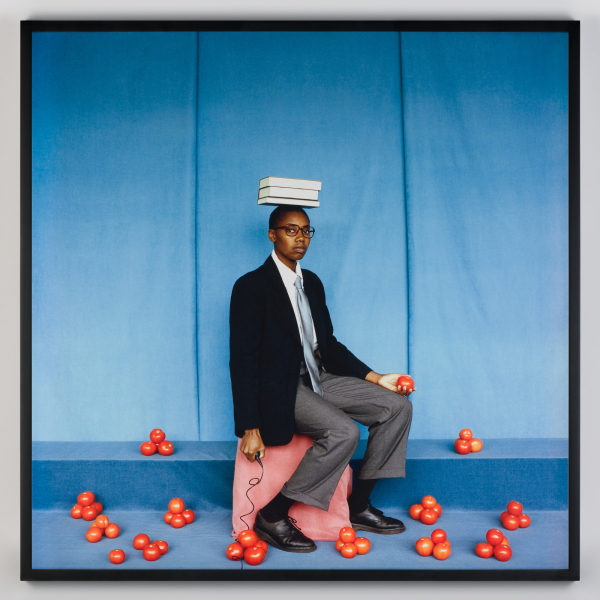
In the second showcase, renowned artist Nona Faustine takes center stage in her first solo museum exhibition, “White Shoes.” In this series, Faustine poses the question: “What does a Black person look like today in those places where Africans were once sold, a century and a half ago?”
The series features 42 self-portraits of Faustine standing in various locations across New York City that are steeped in the legacies of enslavement. The artist stands nude, partially covered, or holding props, her feet adorned with sensible white pumps — a symbol of the oppressions of colonialism and assimilation imposed on Black and Indigenous peoples globally.
“White Shoes” marks the first complete installation of Faustine’s consequential series, amplifying the artist’s unique perspective on the intersections of race, history and identity.
Speaking to Daily Art Magazine, Faustine said she hopes her message transcends the institutions her work is displayed in.
“I just hope that the message goes as far as it can, and reaches as many people as possible and moves people to rebuild new systems that address and heal around the trauma of the Transatlantic slave trade and its Diaspora,” she said. “I want more credit and importance given to under-represented voices that have built and contributed at great expense to America and the world. Artistically, I hope people enjoy the images and bring them into institutions so that more people can see them.”
Both exhibits, open Friday, will run through July 7 in the museum’s Elizabeth A. Sackler Center for Feminist Art.





