About

Posts by :

Wildlife Photographer of the Year People’s Choice Award winner

Wildlife Photographer of the Year People’s Choice Award winner
imageNima Sarikhani/Wildlife Photographer of the Year Polar bear asleep on a small iceberg, NorwayNima Sarikhani/Wildlife Photographer of the Year

A stunning image of a young polar bear drifting to sleep on an iceberg, by British amateur photographer Nima Sarikhani, has won the Wildlife Photographer of the Year People’s Choice Award.

“Sarikhani’s breathtaking and poignant image allows us to see the beauty and fragility of our planet,” Natural History Museum director Dr Douglas Gurr said.

“His thought-provoking image is a stark reminder of the integral bond between an animal and its habitat and serves as a visual representation of the detrimental impacts of climate warming and habitat loss.”

Sarikhani made the image after three days searching for polar bears through thick fog off Norway’s Svalbard archipelago.

Wildlife photography and nature fans from around the world were invited to vote from a short list of 25 images.

Four other outstanding finalists were “highly commended”.

The Happy Turtle, by Tzahi Finkelstein

imageTzahi Finkelstein/WPY A Balkan pond turtle and a northern banded groundling dragonflyTzahi Finkelstein/WPY

Tzahi Finkelstein was in his hide, photographing shore birds, when he spotted a Balkan pond turtle walking in the shallow water.

The dragonfly unexpectedly landed on the turtle’s nose.

Starling Murmuration, by Daniel Dencescu

imageDaniel Dencescu/WPY A starling murmuration in the sky over Rome, ItalyDaniel Dencescu/WPY

Daniel Dencescu spent hours following the starlings around the city and suburbs of Rome, Italy.

Finally, on the cloudless winter’s day, the flock, swirled into the shape of a giant bird.

Shared Parenting, by Mark Boyd

imageMark Boyd/WPY Two lionesses groom a cubs in Maasai Mara, KenyaMark Boyd/WPY

Two lionesses had gone hunting, leaving the pride’s five cubs hidden overnight in dense bushes, in Kenya’s Maasai Mara Mara.

Returning from their unsuccessful mission, they called the cubs out on to the open grassland and began grooming.

Aurora Jellies, by Audun Rikardsen

imageAudun Rikardsen/WPY Moon jellyfish pictured in a fjord as the Aurora Borealis glow overheadAudun Rikardsen/WPY

Sheltering his equipment in a self-made waterproof housing, Audun Rikardsen used his own system for adjusting the focus and aperture during a single exposure, as moon jellyfish swarmed in the cool autumnal waters of a fjord outside Tromsø, in northern Norway, illuminated by the aurora borealis.

The five images will be displayed online and at London’s Natural History Museum until 30 June.

All photos copyright Wildlife Photographer of the Year


Wildlife Photographer of the Year People’s Choice Award winner named

Wildlife Photographer of the Year People’s Choice Award winner named
Advertisement

A dreamy image of a polar bear drifting to sleep on a ‘bed’ carved into an iceberg has been voted the winner of the Wildlife Photographer of the Year People’s Choice Award (WPY). 

It was taken by British amateur photographer Nima Sarikhani while exploring Norway’s Svalbard archipelago on an expedition ship. She beat four highly commended finalists to claim the crown. 

The 25 images in the running for this year’s People’s Choice Award received a record number of votes, with over 75,000 wildlife photography and nature fans from around the world casting their ballots to name Nima this year’s winner. 

Nima captured her remarkable picture – called ‘Ice Bed’ – after three days searching for polar bears in thick fog. The expedition vessel she was on decided to change course and headed towards an area of sea ice. Here they encountered two polar bears.

Just before midnight, the young male clambered onto a small iceberg and, using his strong paws, clawed away at it to carve out a bed for himself. Nima captured the dreamlike moment the young bear drifted off to sleep. 

This dreamy image of a polar bear drifting to sleep on a ‘bed’ carved into an iceberg has been voted the winner of the Wildlife Photographer of the Year People’s Choice Award (WPY). It was taken by British amateur photographer Nima Sarikhani while exploring Norway’s Svalbard archipelago on an expedition ship

Mark Boyd's highly commended 'Shared Parenting' photo shows a pair of lionesses devotedly grooming a cub in Kenya's Maasai Mara

For 'Aurora Jellies', highly commended finalist Audun Rikardsen photographed two moon jellyfish in the cool autumnal waters of a fjord outside Tromsø in northern Norway, illuminated by the aurora borealis

Director of the Natural History Museum, Dr Douglas Gurr, said: ‘Nima’s breathtaking and poignant image allows us to see the beauty and fragility of our planet. His thought-provoking image is a stark reminder of the integral bond between an animal and its habitat and serves as a visual representation of the detrimental impacts of climate warming and habitat loss.’ 

Nima says: ‘I am so honoured to have won this year’s People’s Choice award for WPY, the most prestigious wildlife photography competition. This photograph has stirred strong emotions in many of those who have seen it. 

‘Whilst climate change is the biggest challenge we face, I hope that this photograph also inspires hope – there is still time to fix the mess we have caused.’

The work of the four other finalists spanned the globe to depict nature at its most miraculous.

Mark Boyd, from Kenya, submitted ‘Shared Parenting’. It shows a pair of lionesses devotedly grooming one of the pride’s five cubs in Kenya’s Maasai Mara. 

'The Happy Turtle', by finalist Tzahi Finkelstein from Israel, shows a Balkan pond turtle sharing a moment of fascinating peaceful coexistence with a northern banded groundling dragonfly in Israel's Jezreel Valley

Highly commended 'Starling Murmuration' by Daniel Dencescu shows a mesmerising mass of starlings swirling into the shape of a giant bird on their way to communal roosts above Rome, Italy

For ‘Aurora Jellies’, finalist Audun Rikardsen, from Norway, photographed two moon jellyfish in the cool autumnal waters of a fjord outside Tromsø in northern Norway, illuminated by the aurora borealis. It’s common for this species to gather in their hundreds under the Northern Lights.

‘The Happy Turtle’, by finalist Tzahi Finkelstein from Israel, shows a Balkan pond turtle sharing a moment of fascinating peaceful coexistence with a northern banded groundling dragonfly in Israel’s Jezreel Valley.

‘Starling Murmuration’, meanwhile, by Daniel Dencescu shows a mesmerising mass of starlings swirling into the shape of a giant bird on their way to communal roosts above Rome, Italy.

Wildlife Photographer of the year is developed and produced by the Natural History Museum, London. Images entered into the 60th competition are currently being judged by an international panel of experts. 

The winners will be announced at the next annual awards ceremony, which takes place in South Kensington in October 2024.

Visitors can see the Wildlife Photographer of the Year exhibition until 30 June, 2024, at the Natural History Museum.

Sleepy Polar Bear Portrait Wins the Wildlife Photographer of the Year People’s Choice Award

Sleepy Polar Bear Portrait Wins the Wildlife Photographer of the Year People’s Choice Award
Wildlife Photographer of the Year People's Choice Award winners announced by the Natural History Museum, London
‘Ice Bed’ by Nima Sarikhani (United Kingdom) | Wildlife Photographer of the Year

British amateur photographer Nima Sarikhani’s dreamy and serene portrait of a sleepy polar bear on an iceberg has been voted the People’s Choice winner in this year’s Wildlife Photographer of the Year competition, the 59th edition of the famous photo contest.

The People’s Choice Award saw a record-breaking 75,000 votes cast, propelling Sarikhani to victory over 24 other finalists. These 25 finalists were chosen by the Natural History Museum in London and an international judging panel from nearly 50,000 submitted photos.

“Nima’s breathtaking and poignant image allows us to see the beauty and fragility of our planet. His thought-provoking image is a stark reminder of the integral bond between an animal and its habitat and serves as a visual representation of the detrimental impacts of climate warming and habitat loss,” says Dr. Douglass Gurr, Director of the Natural History Museum.

Sarikhani captured the image after three days of searching for polar bears off the coast of Norway. The expedition vessel the photographer was on decided to change its course and head toward areas where there was still sea ice.

The vessel located a pair of polar bears and one of them, the particularly photogenic of the two, clambered onto a small iceberg around midnight. He proceeded to carve out a bed for himself and settle in for a restful sleep.

“I am so honored to have won this year’s People’s Choice Award for WPY, the. Most prestigious wildlife photography competition,” Sarikhani says. “This photograph has stirred strong emotions in many of those who have seen it. Whilst climate change is the biggest challenge we face, I hope that this photograph also inspires hope; there is still to fix the mess we have caused.”

With the votes tallied, four “Highly Commended” finalists have also been decided, which can be seen below.

Wildlife Photographer of the Year People's Choice Award winners announced by the Natural History Museum, London
‘Aurora Jellies’ by Audun Rikardsen (Norway) | Wildlife Photographer of the Year
Wildlife Photographer of the Year People's Choice Award winners announced by the Natural History Museum, London
‘Shared Parenting’ by Mark Boyd (Kenya) | Wildlife Photographer of the Year
Wildlife Photographer of the Year People's Choice Award winners announced by the Natural History Museum, London
‘Starling Murmuration’ by Daniel Dencescu (Germany/Romania) | Wildlife Photographer of the Year
Wildlife Photographer of the Year People's Choice Award winners announced by the Natural History Museum, London
‘The Happy Turtle’ by Tzahi Finkelstein (Israel) | Wildlife Photographer of the Year

Wildlife Photographer of the Year is developed and produced by the Natural History Museum, London. The annual contest was originally founded in 1965 by BBC Wildlife Magazine. The Natural History Museum joined forces in 1984 and now owns and operates the contest.

Sarikhani’s People’s Choice Award joins the overall competition winners announced last fall.

The entrants of the 60th Wildlife Photographer of the Year contest are currently being judged, and the winners will be announced in October at a special awards ceremony in South Kensington, England.


Image credits: Images courtesy of the Wildlife Photographer of the Year contest, which is organized by the Natural History Museum in England. The individual photographers are credited in accompanying image captions.

Polar bear sleeping on iceberg wins wildlife photography competition

Polar bear sleeping on iceberg wins wildlife photography competition

An image of a young polar bear drifting off to sleep on an iceberg has won the UK’s annual Wildlife Photographer of the Year People’s Choice Award.

The shot was captured by British amateur photographer Nima Sarikhani in Svalbard, a Norwegian archipelago in the Arctic Ocean, a region that has been particularly affected by global warming.

Mr Sarikhani said he wanted the photograph to inspire hope and that there is still time to “fix the mess we have caused” by the human-made climate crisis.

It came top in a public vote that saw a record 75,000 nature and photography enthusiasts choose their favourite picture from shortlist of 25 images.

Dr Douglas Gurr, director of the Natural History Museum, which runs the annual Wildlife Photographer of the Year competition, said the picture is a visual representation of the impacts of climate change and habitat loss.

After three days searching for polar bears in thick fog off Svalbard, the expedition vessel Mr Sarikhani was travelling on changed course to where there was still some sea ice, and encountered two of the animals.

Just before midnight, a young male climbed on to a small iceberg and used his paws to scrape away the ice to carve out a bed for himself, allowing Mr Sarikhani to capture the moment the bear drifted off to sleep.

Dr Gurr said that Mr Sarikhani’s image allows us to see the “beauty and fragility of our planet”.

“His thought-provoking image is a stark reminder of the integral bond between an animal and its habitat and serves as a visual representation of the detrimental impacts of climate warming and habitat loss.”

Among the 25 pictures, four shots that also proved favourites with voters included the interaction between a pond turtle and a northern banded groundling dragonfly, and a starling murmuration forming the shape of a bird.

Two lionesses grooming a cub and two moon jellyfish illuminated by the aurora borealis in a fjord in Norway were also among the highly commended finalists in the public vote.

The shortlist for the People’s Choice Award was drawn by the Natural History Museum and an international judging panel from almost 50,000 images submitted for the Wildlife Photographer of the Year competition.

The five images will be displayed online and at the Natural History Museum in London until June 30, 2024.

Updated: February 07, 2024, 12:01 AM

Photography exhibit inspired by ‘The Talk’

Photography exhibit inspired by ‘The Talk’
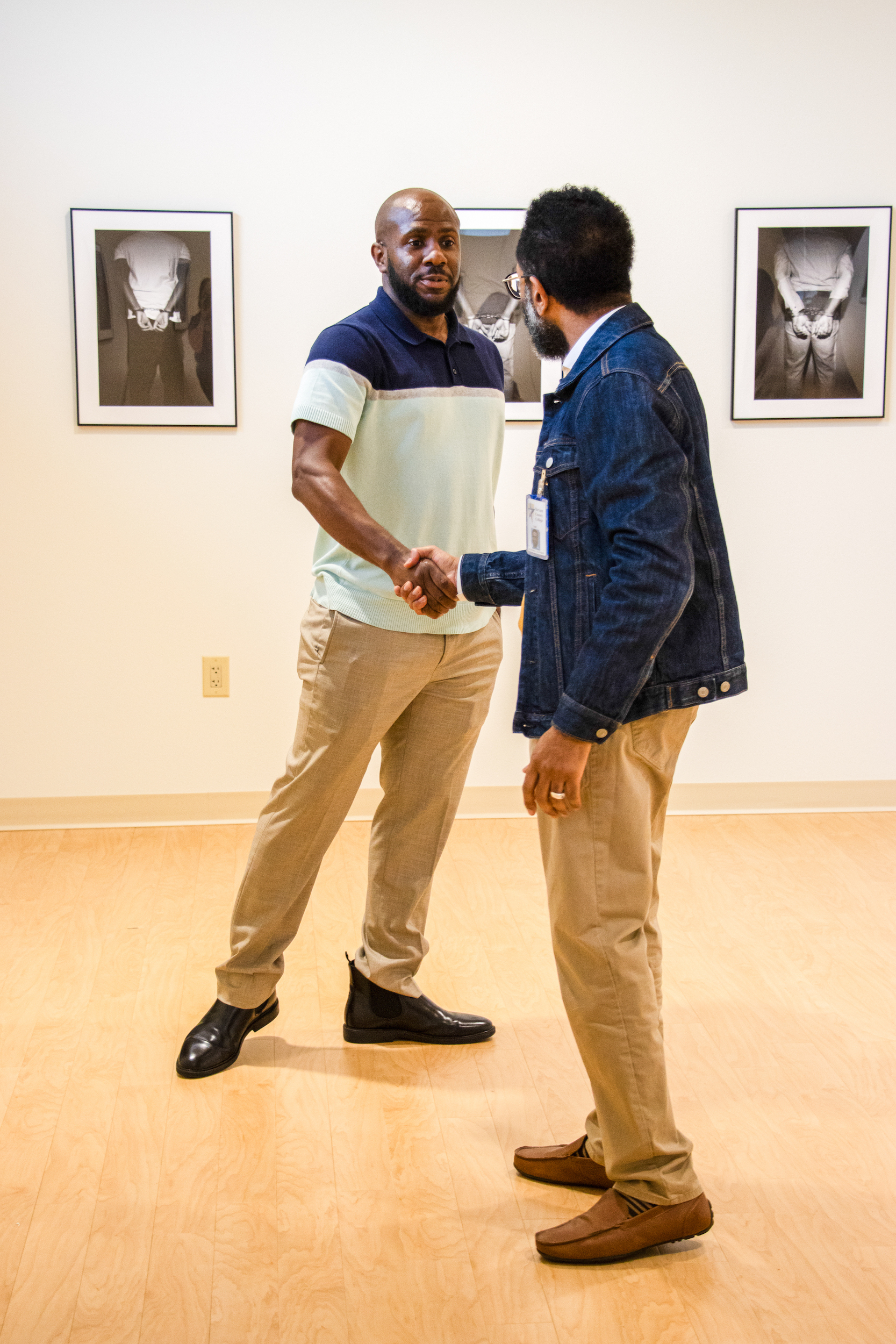
Alex Hoben/The Collegian Visiting artist Michael Darough held an artist's talk for the opening of his exhibition
Alex Hoben/The Collegian
Visiting artist Michael Darough held an artist’s talk for the opening of his exhibition “The Talk.” The exhibition is open to students and staff and will be in the East Fork Gallery on TR Campus until March 8.

NINA BANKS
managing editor
nina.banks@my.tccd.edu

“The talk” is a potentially lifesaving conversation Black families have with their children. 

Prior to the opening reception, Darough held an artist talk where he recalled receiving “the talk” on how to interact with his surroundings without drawing unnecessary attention to himself. 

“Before I left the house as a young kid, my parents had to sit down and have a conversation with me,” Darough said. “They had to talk to me about how I should carry myself in the streets, how I should address police officers, how I should address people. So that talk was necessary. If they wanted me to come home at the end of the day, they needed to make sure they had a conversation before I left.” 

Darough is from Ferguson, Missouri, where the Ferguson uprising took place after the murder of Michael Brown by a police officer in 2014. He often frequented the area where Brown was killed. 

“I could’ve been a Mike Brown,” Darough said.

Alex Hoben/The Collegian
Included in “The Talk” exhibition is “The Cycle” series, which depicts multiple men with their hands behind their backs in handcuffs. The main model that Darough used in his photographs was actually himself.

Following the Ferguson uprising, Darough’s photography took a more political lens. “The Talk” exhibition drew inspiration from different sources throughout history and extensive research. 

“I started creating different images,” Darough said. “I was watching the news, and every time I am watching the news, I am jotting down notes. Who is being killed? Who is being stopped? How are they being stopped? The language that they are using with the individual. I am trying to make sure I am getting the rhetoric right so that when I am creating these images, they are coming from a place of truth.” 

TR speech instructor Sheldon Smart attended the artist talk and opening reception. Smart said the exhibit “hits close to home.” 

“Well, it was emotional obviously being a Black male,” Smart said. “I think it was also emotional because when you see the number of instances, it’s not a one-off type of thing. But it’s the number of instances.” 

Though his work focuses on a personal and heavy subject matter, Darough found the process of creating “The Talk” to be cathartic. 

“I had an opportunity to deconstruct the image and not focus on what I was feeling,” Darough said. “How I can make this presentable for the audience and how I can get people to enjoy this while still thinking about what’s going on?” 

TR student Lexine Henry resonated with the piece “I Fit the Description.” The work features Darough with his back toward the camera and hands raised towards two lights shining on him. 

“It’s a light and he’s surrounded, almost as if police got him,” Henry said. “Since this is a heavy thing, you kind of wonder and are kind of fearful of what’s going to happen because it’s within the context of all these pieces. We all know the ending in which they forcefully got murdered. They died, so you’re wondering how long is this going to continue?” 

Darough has enjoyed seeing the varied responses to his exhibition. 

“Everybody has a different reaction to it,” he said. “Some like the technical look of it. Some get lost in an image, and some feel very emotional and drawn to it.” 

He hopes attendees will understand that racial inequality still exists in the United States. 

“We have some work in terms of fixing that,” Darough said. “Until we acknowledge it and make efforts towards fixing the institutional racism we have, it’s going to continue to be a problem.” 

“The Talk” will be on display until Mar. 8 in the TR East Fork Gallery. 

Local artists sought for Native American art installation at USU-Moab – The Times-Independent

Local artists sought for Native American art installation at USU-Moab – The Times-Independent

Utah State University-Moab seeks to commission a Native American-inspired work of art to be prominently displayed in its academic building.

Image courtesy of USU

The work of art will celebrate the rich cultural heritage of the surrounding area and contribute to the vibrant tapestry of the Moab community, reads a press release from USU.

“In a concerted effort to support and showcase local talent, USU-Moab is asking any and all artists residing in the region to submit proposals of their artistic vision for the project for consideration,” reads the statement. “USU-Moab is eager to invest in the creativity of someone who calls the area home, further fostering a connection with the local community and contributing to the flourishing arts scene in Moab, according to Kristian Olsen, senior associate vice president at USU-Moab.

“We are honored to be a member of the Moab community and recognize the importance of embracing and celebrating the rich cultural diversity that surrounds us,” Olsen said. “This project reflects our commitment to not only acknowledge the history of this land but also to actively contribute to the cultural fabric of Moab by supporting local artists and promoting their work.”

As part of its commitment to acknowledging the history of the land it occupies, USU-Moab has recently adopted a Land Acknowledgment. This acknowledgment recognizes and pays tribute to the Native American communities that have resided on the land for generations. In a thoughtful integration of art and heritage, the commissioned work will find its place beside the Land Acknowledgment, creating a meaningful and harmonious display, reads the statement.

Those interested in learning more about how their artwork can be considered may reach out to USU Moab at 435-259-7432.

Local artists are encouraged to submit their proposals by May 1 to Samantha Campbell at samantha.campbell@usu.edu.

‘Frybread as Fok’: Art exhibit centres being unapologetically Indigenous

‘Frybread as Fok’: Art exhibit centres being unapologetically Indigenous

A new exhibition, Frybread as Fok, highlights Indigenous joy and the power of coming together.

“There’s a lot of hardship, and there’s a lot of trauma and a lot of these really heavy things that happen,” said Zoë Laycock co-curator of the exhibition on display at Emily Carr University.

“It was really about bringing to the forefront joy and the way frybread is a symbol of resilience and gathering. It’s honouring those hardships but seeing the exhibition, seeing Emily Carr, as a place to grow and a place to grow our community unapologetically.”


Click to play video: 'Indigenous artists come together to unveil new exhibit at Emily Carr University'

1:16
Indigenous artists come together to unveil new exhibit at Emily Carr University


Laycock co-curated the exhibit with Aaron Rice, Vance Wright, Taylor Baptiste and Rylee Taje and said the idea for the name came from Rice.

Story continues below advertisement

“You can’t really just make a batch of frybread for yourself, right? You’re going to have to share it,” they said. “Community is built around food so it speaks to building that community and building those connections and growing together within an institution that, historically, we had been excluded from.


Taylor Baptiste’s piece for the exhibit Frybread as Fok. The piece is titled ‘Wildfire Regalia’ and depicts firefighter turnout boots and gear, pine needles, sinew, rawhide.


Perrin Grauer / Emily Carr University of Art + Design

Over 30 Indigenous artists have their work on display during Frybread As Fok which is the Aboriginal Gathering Place’s 2024 exhibition — including students, faculty, staff and alumni.


Get the latest National news.

Sent to your email, every day.

“Everyone does amazing work, there’s a lot of different sculptural pieces and, a lot of mixed media work in this in this show,” said Laycock. “There’s everything from paintings to printmaking to video and all kinds of sculptural garments.

“Lots of merging traditional material practices and contemporary material practices and, it’s really lively.”

Story continues below advertisement

Laycock says their favourite part of every year is seeing the work produced by students, staff and alumni.

“It really showcases the diversity that we have within the institution, sure. It’s at the Aboriginal [Gathering Place] but with everybody coming from different nations and different places and different programs, it’s really an incredible array of artworks.”


The work of (from left to right) Lara Felsing, Vance Wright and Felsing again displayed in Frybread as Fok.


Perrin Grauer / Emily Carr University of Art + Design

While celebrating joy, Laycock believes it’s their job as curators to continue to hold space for fellow Indigenous artists.

“It’s not the ’60s, ’70s, ’80 or ’90s anymore — we’ve had trailblazers in our communities, we’ve had like all these amazing people that have come before us,” they said. “Our role is being a trail maintainer, like the trail has been blazed.”

Story continues below advertisement

And that’s where they saw themselves in curating Frybread as Fok, being in their masters they’ve curated at Emily Carr before. “It’s taking a step back, like a big step back and letting new people take over and take those responsibilities and maintain the trail,” Laycock said.

“I am so proud of the other curators, ” they added. “They’ve done an amazing job and really taken the the reins and everybody should come see.”

Frybread as Fok is on display until Feb. 15, 2024.


Click to play video: 'Depicting Coast Salish history through comic art'

1:56
Depicting Coast Salish history through comic art


&copy 2024 Global News, a division of Corus Entertainment Inc.

Ted Nugent Concert Photographer Wins Reversal of Fair-Use Ruling

Ted Nugent Concert Photographer Wins Reversal of Fair-Use Ruling

A concert photographer convinced the Fourth Circuit to reverse a ruling that a conservative news website’s use of a 2013 photo of musician and gun-rights activist Ted Nugent constituted fair use.

Larry Philpot established that all four statutory fair-use factors weighed against a federal judge’s finding that the Independent Journal Review’s use of his work was allowable, the US Court of Appeals for the Fourth Circuit said in a precedential opinion Tuesday. The use of the photo alongside a listicle titled “15 Signs Your Daddy Was a Conservative” wasn’t transformative, and the fact that licensing it wouldn’t have required a …