Art World News

Dress up as art and join this lively Laguna Beach parade

Dress up as art and join this lively Laguna Beach parade

What to Know

  • Pageant Parade & Party in honor of the Pageant of the Masters
  • A parade through downtown Laguna Beach will pay tribute to the event’s 90th anniversary; prizes will be awarded in a costume contest
  • Saturday, July 22 at 12:30 p.m.; meet at noon at Heisler Park Gazebo

Fashion inspirations can come from all corners, but some of the most sartorially splendid among us draw their divine looks from centuries-old paintings, those sumptuous works of art full of fabulous gowns, beautiful bonnets, and frocks festooned with frills.

Where, though, can a person try out these styles without committing to them on a daily basis?

Look to Laguna Beach and the Pageant Parade & Party, a celebration in honor of the Pageant of the Masters and one major milestone.

It’s the “tableaux vivant” spectacular’s 90th anniversary in 2023, and rather than standing still, which is what the volunteers so winningly do during the summertime stage show, the July 22 parade is, well, very much about parading (hence the name).

Anyone is invited to take part in the playful yet pompful procession, which will wend through downtown Laguna Beach just after noon.

What to wear to such an over-the-top event, where “colorful” and “quirky” will most definitely trump “casual”?

Dress like a figure from your favorite painting, an artist you admire, or a bowl of fruit, if you’re feeling it. But go big, if you decide to take part, for there is a costume contest afoot, with a top prize of $250 for first place.

“We hope everyone will march with us in the parade to commemorate this milestone anniversary,” said Marketing/PR Director, Sharbie Higuchi.

“This event captures the essence of our humble beginnings, honoring the origins of the Pageant of the Masters when local volunteers paraded through town as famous works of art.”

“Come dressed up, bring your family and friends, and let’s have a great time together, creating memories that will go down in history.”

Even if you don’t plan on prancing as a Degas ballerina or Renaissance-era lady, you are invited to visit Laguna Beach to witness the whimsy and joy the Pageant Parade & Party will summon.

Everything begins at Heisler Park Gazebo, with the on-stage contest, back at the Festival’s longtime stomping grounds, serving as the concluding event.

Or rather, “standing still grounds” is more accurate.

This is, after all, one of the most unusual cultural events around, and the chance to join a costumed cadre of fans, all to honor its 90th, is something that should inspire movement for those who’d like to participate.

So don’t stand still: Find out more about the costume contest, location, and important details now.

One additional highlight among many? A recognition of longtime volunteers will play a central role, adding to the gratitude-sweet spirit of the event.

Dallas arts groups try to stay alive while working to diversify their boards

Dallas arts groups try to stay alive while working to diversify their boards

In the late summer of 2016, The Dallas Morning News took a long, hard look at local arts boards. Those are the people who make up the governing bodies of the city’s six biggest arts organizations. And what we found was surprising.

The boards were beginning to veer younger and more corporate, and although older, white men continued to dominate, their once-fierce hold — some would say stranglehold — was beginning to fade. Seven years ago, for the first time, boards were inching toward becoming more diverse, albeit slowly.

Women were commanding a more powerful presence than ever before, with four of the city’s six biggest arts groups placing female leaders at the helm. The city took the progression a step further in 2018, when the City Council voted 14-0 to adopt a radically new Cultural Plan.

But that was then and this is now.

In the first quarter of 2020, we entered what was called “a national emergency,” as COVID-19 began its march around the world. And suddenly, Dallas’ six biggest arts companies — and in particular, their boards — were faced with a new mission: survival.

As their focus has changed, each of the nonprofit companies — Dallas Symphony Orchestra, Dallas Museum of Art, AT&T Performing Arts Center, the Dallas Opera, Dallas Theater Center, and Broadway Dallas (known seven years ago as Dallas Summer Musicals) — has moved on.

At the moment, they are juggling the need to continue embracing the tenets of diversity, equity, and inclusion, while at the same time navigating the economic perils of staying alive as arts organizations in the challenging world of 2023.

Taken as a whole, however, the “Big 6” have improved dramatically in the area of diversity since we took our first poll in 2016.

Kenneth T. Novice, who became the president of Broadway Dallas in 2017, said the primary change affecting boards across the country in the last seven years comes down to a single word: desire.

“There is a desire,” Novice says, “to make changes to boards when it comes to diversity and inclusion. There’s a lot of conversation about that and people discussing ‘How can we do more than just make a statement? And what would that look like?’ ”

Soon after his arrival, Novice’s company adopted a new strategic plan, which contained five pillars, one of which is EDIA (equity, diversity, inclusion, access).

“However, since that time,” he says, Novice and two board members “went through the Dallas Truth, Racial Healing & Transformation program.

“And it opened our eyes,” he says, to making diversity, equity and inclusion “a larger plan of the organization.” And not just a separate adjunct. “In other words, we need to have this running through the entire organization to make it have the kind of effect we need to have.”

And that, he says, is the single biggest change in the approach arts companies are taking toward diversity since 2016.

During his years as an arts executive, Novice once worked with Sheldon Epps, an American theater and television producer and the artistic director of The Pasadena Playhouse, who believed that diversifying artistic boards would not lessen or compromise the economic power of such groups but rather do the opposite.

“Sheldon’s view is that there is an economic benefit in a commitment to EDIA — by expanding your base of ticket buyers, your base of donors, by reaching people who may not have been patrons of your theater before.”

In other words, Epps believed that reaching out to communities of color in California “was going to be good for the organization financially, as well as being beneficial from a social perspective.”

The Epps doctrine has, for the most part, become a national trend.

So, where does it stand in Dallas? With that context in mind, we offer a detailed look at the “Big 6” and how they’re faring culturally and financially in what may be the most challenging era arts organizations have seen at any point in their history.

Broadway Dallas

Broadway Dallas chart of board diversity and funding.

Michael Hogue

/

The Dallas Morning News

Board president: Tom Watson 

Board size: 36 (in 2016, the board had 146 general members, with 15 officers and 40 on its executive committee. That is a reduction in board size of more than 75%).

Diversity: 80.5% white, 19.4% non-white. (In 2016, it was three Hispanics, one Black American board member and one Asian American). That is an increase in diversity of 40%.

Gender: 24 male, 12 female (in 2016, it was 78 men, 68 women). That is an increase since 2016 of slightly more than 3%. 

Term limits: The board member elected as chair serves in that role for two years. However, they can potentially continue as a board member after their service as chair. Each board member (including the chair) serves on the board for three years, with an opportunity to potentially serve a consecutive three-year term. 

Giving and participating guidelines: Each board member must give a minimum of $5,000.

Noteworthy mentions: Board member Vicki D. Blanton recently achieved a career milestone when she was admitted to the U.S. Supreme Court bar, meaning that she is eligible to argue cases in front of the U.S. Supreme Court. 

Fundraising expectations: “Board members must give a minimum of $5,000 annually, plus hold a season subscription. They are required to serve as ambassadors of Broadway Dallas and participate in ‘friend-raising’ and fund-raising activities.”

Annual budget: $35 million (in 2016, it was $19.5 million. Between then and now, that is an increase of more than 79%.)

Endowment: $250,000 (in 2016, there was no endowment fund).

Debt: $0

How has the pandemic impacted diversity efforts and the organization’s financial standing?

 “The pandemic did not impact our commitment or activities related to EDIA and our financial standing remains strong. We are grateful for the support we received through SVOG and the enthusiasm of our Broadway audiences who helped bring us through the pandemic. It was, of course, not without pain, like many of our sister arts organizations, we had to make difficult choices, but we’re pleased with our current attendance and the wonderful experiences audiences are having with Broadway shows.”

AT&T Performing Arts Center

(Data covers fiscal year 2024, which begins Aug. 1)

AT&T Performing Arts Center data on board diversity and funding.

Michael Hogue

/

The Dallas Morning News

Board president: Danny Tobey, partner at the law firm DLA Piper

Board size:  70 (“Our total number has stayed in the 60-70 range. We have term limits and some ‘retirements,’ so the membership is not static.) That is an increase of more than 27% since 2016. 

Diversity: 43% non-white, 57% white (That is an increase of almost 114% in seven years.)

Gender: 46% male, 54% female (“It has generally hovered around 50-50 for years.”)

Term limits: “Each term is three years. A director may serve two consecutive terms. When terms are through, board members who want to stay engaged but not with board service move to our emeritus board. We also have an auxiliary board of young professionals. We have five lifetime directors: Matrice Ellis-Kirk, Bess Enloe, Caren Prothro, Deedie Rose and Howard Hallam.”

Giving and participating guidelines: “While there is an expectation of giving, we do not have a minimum give. We ask all to make a gift that is personally significant for them. We have 100% participation. Average gift is $10,000. In addition to regular attendance at board meetings, they need to serve on at least one of our standing committees (annual fund, marketing, education and community engagement, nominations and Governance, finance, etc.)

Noteworthy mentions: “We recently added our first artist to the board, singer/producer/actress Denise Lee!” 

Annual budget: $23 million (in 2016, it was $35 million). 

Endowment: $3.9 million

Debt: $15 million, which is targeted to be paid down by 2026. (Seven years ago, it was $95 million.)

How has the pandemic impacted diversity efforts and the organization’s financial standing? “In about 2015, when Matrice Ellis-Kirk became our chair-elect, we built a long-term strategy to diversify our board on a range of fronts, with a strong focus on ethnicity, but also LGBTQ status, geography and profession.

“We have adhered to this strategy [even through the pandemic] and have seen our ethnic and LGBT percentage continue to grow. While I haven’t looked in a while, I believe the Center’s board membership has one of the highest ethnic percentage numbers among major non-ethnic arts organizations in Dallas.

Financially, we are healthy. We are ending fiscal year 2023 with a small surplus which is targeted for deferred maintenance and repairs. Our board has approved a balanced budget for fiscal year 2024.”  

Dallas Museum of Art

Dallas Museum of Art chart on board diversity and funding.

Michael Hogue

/

The Dallas Morning News

Board president: Gowri N. Sharma

Board size: 65

Diversity: 62% white, 38 non-white. That is an increase of more than 171% in the diversity category. 

Gender: 38% male, 62% female. That is an increase of almost 32% in the number of female trustees.

Term limits and/or length of service requirement: 

Officers: president, chairman: 6-year total with three, 2-year terms

Elected trustees: 6-year total with two, 3-year terms

Representative trustees: term varies, minimum of one year

Ex-Officios: term varies, minimum of one year

Giving and participating guidelines: “There is no minimum entry fee. Requirements include attendance at every board meeting and service on a standing committee or task force.”

Fundraising expectations:  “We would consider our board to be both. Although there is no financial requirement, we are thankful for a board that prioritizes financial support as part of their service.”

Noteworthy mentions: “Gowri N. Sharma is the first BIPOC chair in the history of the Dallas Museum of Art. The 2022-23 board of trustees was the most diverse board in museum history.

Annual budget: $31,132,298 in fiscal year 2022. That is an increase of more than $9 million since 2016. 

Endowment: $234,247,198 in fiscal year 2022. That is an increase of more than $46 million since 2016. 

Debt: $5,083,280 (That is an increase of almost $1.6 million since 2016)

How has the pandemic impacted diversity efforts and the organization’s financial standing?

“The pandemic brought what National Public Radio coined the ‘summer of racial reckoning.’ Our pursuit of diversity started from the top in 2016 when Dr. Agustin Arteaga, a Mexican-born gay man, was selected through an international search to serve as the first non-white director in the history of the DMA. The DMA has worked to increase diversity since and 2020 helped us accelerate that work. In fiscal year 2023, the DMA elected its most diverse board in history — 64% of new hires were BIPOC, 64% of art purchased was created by BIPOC artists and 53% of our programs featured BIPOC performers and artists.

“The DMA, like its peers, continues to work to get back to pre-pandemic revenue numbers as we navigate the realities of post-pandemic attendance and behaviors.”

Dallas Symphony Orchestra

Dallas Symphony Orchestra chart on board diversity and funding.

Michael Hogue

/

The Dallas Morning News

Board president: Cece Smith

Board size: 116 (an increase of 48 since 2016)

Diversity: 29% non-white (an increase of 19% in the non-white category since 2016)

Gender: 50% male/female (an increase of 10% in female board members since 2016)

Term limits: Three-year terms (no term limits for board of governors members)

Giving and participating guidelines (for instance, is there a minimum entry fee or annual requirements)? Suggested annual donation of $10,000

Notable Mentions: DSA Board Chair Cece Smith served as chair of the board of directors of the Federal Reserve of Dallas, the first woman in that role. The board of the DSA includes members from across the community including Zenetta Drew, executive director of the Dallas Black Dance Theatre; T.D. Jakes, the founder and senior pastor at The Potter’s House; and Geoffroy van Raemdonck, CEO of Neiman Marcus.

Annual budget: $48 million (an increase of almost $12 million since 2016)

Endowment: $136 million (an increase of $15 million since 2016)

Debt: “No debt but use line of credit to manage cash flow.”

How has the organization changed since the pandemic lockdown and how does that affect the organization in moving forward? 

“Full audience engagement and ticket sales have not yet rebounded to pre-COVID levels, requiring more fundraising this and last season. While sales are trending in the right direction, we are also increasing our reach in the coming months with new marketing and message development. We have expanded our community concerts with more than 200 chamber music concerts annually throughout [Dallas-Fort Worth] including park concerts, DSO on the Go, the Concert Truck residency and DSO Cares concerts in hospitals and elder care facilities.

We have redoubled our EDI efforts as well as our music education work for Dallas ISD students. As a result of the pandemic, we expanded our digital efforts and are producing 30-40 on-demand DSO concerts each season. Several of these productions were aired on PBS and Bloomberg TV and nominated for and won Emmy and Telly awards. Due to the pandemic, the Meyerson Symphony Center was used less frequently, which allowed the DSO to do a tremendous amount of deferred maintenance to the property.”

Dallas Theater Center

Dallas Theater Center chart on board diversity and funding.

Michael Hogue

/

The Dallas Morning News

Board President:  Chris Luna

Board size:  53, excluding life trustees (a reduction of 13 since 2016)

Diversity: White 64%, BIPOC 36% (an increase of 26% in the latter category since 2016)

Gender: 54% female, 46% male (an increase of 7% in female board members since 2016)

Term limits: Trustees normally serve three-year terms, renewable for a total of two consecutive terms.

Giving and participating guidelines: While not all trustees will fulfill their responsibilities in exactly the same way, the responsibilities generally expected of a trustee include support of DTC’s performance program by purchasing a full-season subscription and by assisting DTC in building its base of season subscribers; provide or procure $15,000 in contributions; and attend board meetings on a regular basis.

Fundraising expectations: Maintain a minimum $2,500 benefactor membership, which will count toward the above mentioned $15,000 contributions requirement.

Noteworthy mentions: “Deedie Rose is a Linz Award winner, and Frank Risch will receive the Linz Award this year. The Linz Award honors individuals whose community and humanitarian efforts have created the greatest benefit to Dallas over the last decade. We also have as board members multiple recipients of the Silver Cup Award, given for excellence in service to the arts in Dallas.

One interesting board member (among many) is Lynn Pride Richardson, the chief public defender for Dallas County. Lynn was a theater major in college and has appeared twice onstage in the Wyly in DTC’s Public Works Pageants as a featured cast member. DTC’s Public Works Pageants include professional actors working alongside more than one hundred community members to present epic theater by and for all of Dallas.”

Annual budget:  For fiscal year 2024, $7.5 million. (A reduction of $2.5 million since 2016). 

Endowment: $10.8 million. (An increase of $4.8 million since 2016).

Debt: “We are currently executing a plan that will eliminate all debt by the end of our fiscal year (Aug. 31, 2023), except for a loan to DTC from its endowment, which has an extended maturity date and payment schedule. (There was no debt in 2016.)” 

How has the organization changed since the pandemic lockdown and how does that affect the organization in moving forward? “The pandemic has had a profound impact on audiences. Our productions of Clue, A Christmas Carol and Into the Woods had sold-out performances last season, but overall attendance remains below pre-pandemic levels and inflation-driven expenses have increased. In order to ensure balanced, sustainable budgets for the future, we have had to reduce our expenses, including painful staff layoffs in the spring.

“These industry-wide challenges are causing a re-examination of the business and artistic models for professional theaters nationwide, which ultimately presents an opportunity for reinvention. Just as the birth of the regional theater movement has deep roots in Dallas, we expect the Dallas theater community will embrace these challenges and remake theater in a more creative, collaborative and sustainable way. At DTC, we have been fortunate to have a deeply committed and engaged board throughout these difficult times. Their determination in the face of adversity and their belief in the importance of theater for our community has been inspiring.”

The Dallas Opera

The Dallas Opera chart on board diversity and funding.

Michael Hogue

/

The Dallas Morning News

Board president: Quincy Roberts, as of July 1

Board size: 45 (directors, including ex officio) (A reduction of 15 since 2016)

Diversity: 22% non-white (An increase of 17% in the latter category since 2016)

Gender: 49% female; 51% male (No change since 2016)

Term limits and/or length of service requirement: “The Dallas Opera implemented term limits for members of the executive committee in February 2020; limit is 2 consecutive 3-year terms in the same office.”

Giving and participating guidelines: “Not anymore. Candidates are evaluated on their ability to contribute in different ways: their time, their skills or talent, and financially.”

Noteworthy mentions: “Quincy Roberts, CEO of Dallas-based Roberts Trucking, Inc., is the first Black American board chair in the history of The Dallas Opera.”

Annual budget: $18.9 million (for fiscal year 2024)

Endowment: $28.9 million at the end of fiscal year 2023. (An increase of $1.1 million since 2016)

Debt: “As of the latest audited financials (June 30, 2022), the opera’s total debt was $5 million, of which $2 million was a pandemic-related loan from The Dallas Opera Foundation. That amount hasn’t changed much since then.” (There was no reported debt in 2016.)

How has the organization changed since the pandemic lockdown and how does that affect the organization in moving forward? “Many aspects of our operations have changed. To the good, enhanced and improved capabilities for remote meetings have helped in both our daily and long-term planning, especially with international creative teams. We continue to offer our staff a myriad of work-from-home options that have resulted in better work/life balance without hindering productivity. Our greatly expanded and successful online and digital offerings with over 4,000 subscribers were primarily born from the pandemic. We showcase unique free content to audiences of all ages and our low-cost livestreams provide international access and build brand awareness.

“With the rise of inflation, nearly every one of our expense lines has increased post-pandemic (travel, housing, transportation, production supplies, etc.). However, for the audience, the most evident change is not what they see in our performances, but how much. We added two free community engagement concerts (The People’s Choice and Holiday Concert at Cathedral Guadalupe) but reduced our seasonal mainstage productions from five to four with only four performances of each. The Dallas Opera is not an outlier in this; most major opera companies in the United States have implemented similar reductions. Moving forward, we feel we are better positioned to grow as audience demand increases. In fact, our mainstage capacity sold for the 2022-23 season was 71% compared to 57% for the 18/19 season.”

Arts Access is an arts journalism collaboration powered by The Dallas Morning News and KERA.

This community-funded journalism initiative is funded by the Better Together Fund, Carol & Don Glendenning, City of Dallas OAC, Communities Foundation of Texas, The Dallas Foundation, Eugene McDermott Foundation, James & Gayle Halperin Foundation, Jennifer & Peter Altabef and The Meadows Foundation. The News and KERA retain full editorial control of Arts Access’ journalism.

Two new Fresh Waves murals planned for downtown

Two new Fresh Waves murals planned for downtown

Courtesy Photo
The back wall of 133 W. Chisholm St. will be painted by Tim Nijenhuis of Hamilton, Ontario this summer as part of the Alpena Downtown Development Authority’s Fresh Waves mural project.

ALPENA — The Alpena Downtown Development Authority is excited to announce two new murals that will be painted as part of their Fresh Waves mural project this summer in Downtown Alpena.

The first mural will be painted mid-August on the back of 133 W. Chisholm St., which faces the alleyway directly off 3rd Avenue next to HopSide Brewery.

This mural will be completed by artist Tim Nijenhuis of Hamilton, Ontario. He was previously part of the Fresh Waves project and painted the Alpena Flyer mural on the side of Light of Hope Clubhouse in 2022. This first mural will be completed the week of Aug. 9 through 17 (weather permitting). The building is owned by Chris and Missi LeFave, who have been deeply involved in the growth of Downtown Alpena over the years.

“Missi and I are excited to be part of the DDA’s continued efforts to showcase talented artists and make our downtown unique and beautiful,” said Chris LeFave.

The second mural will be painted near the entrance to Harborside Cycle that faces the alleyway closer to 2nd Avenue. This mural is made possible through the support of The Sunset Project, a nonprofit organization focused on fostering creative advancement while being a driving force for mental health awareness. In line with its mission of generating creative advancement opportunities, The Sunset Project committed to providing additional funding for this year’s competition to expand the reach of the Fresh Waves project.

Courtesy Photo The back wall of Harborside Cycle will be painted by Adrienne Pickett and Kellie Bambach, of Sous La Ciel based in Ann Arbor, this summer as part of the Alpena Downtown Development Authority’s Fresh Waves mural project.

The Sunset Project coordinated closely with area business owner Sam Rumbles to find a location for its mural on his building, and selected Sous La Ciel as the artist of choice from an outstanding pool of Fresh Waves applicants. The Sunset Project hopes that by providing additional resources to projects such as Fresh Waves, that new talent and opportunity will follow closely behind and benefit the Northeast Michigan community.

“We’re really looking forward to seeing how the expansion of projects such as Fresh Waves will positively impact the community that we all care so deeply about,” said Nick Poli, creative director for The Sunset Project. “It’s been such a fun and exciting process for the entire Sunset Project team, including myself, and we’re looking forward to being more involved with DDA projects down the road.”

Ann-Arbor based artists Adrienne Pickett and Kellie Bambach of Sous La Ciel will be painting the piece beginning July 26.

“No matter the season, between Thunder Bay, Starlite Beach, and the sandy shores of Lake Huron, the call for Vitamin D is strong. There’s a calm that goes along with sitting at the waters’ edge,” said the artists about the piece they will be painting. “Whether canoeing in the river, playing the sand, or strolling along the shore, the fresh air of this ‘fresh coast’ will keep viewers yearning for more. This sweet vintage take on these days of summer will keep the memories strong all winter long.”

This year, the Alpena DDA received over 30 applications from artists all over the country to be part of this summer’s project, which will focus on adding murals throughout the alleyway that runs through downtown. The DDA received a grant from the Michigan Arts and Cultural Council to expand this year’s project and add murals in the alleyway as part of the placemaking project to make the alleyways pedestrian-friendly spaces that can be used for live music, events and more.

For more information on the Fresh Waves project, please visit downtownalpenami.com/fresh-waves-mural-project.

About the Artists

Tim Nijenhuis is a professional international mural painter from Hamilton, Ontario, Canada. Over the past two decades, he has created over 100 murals, in various countries, many of them large scale exterior works. He also creates props and sets for the local film industry in Southern Ontario.

Additionally, he is active as a musical performer, composer, producer, and publisher. Before painting a mural, he finds a great source of inspiration by listening to the local community, does historic research and investigates the surrounding landscape, architecture, and culture.

His works tend to enhance the surrounding neighborhoods and bringing people together from all walks of life, social, or ethnic backgrounds. He strives for his murals to provoke thought and energy, but he always intends for them to have a positive and constructive vibe. He is inspired by, and works with Trompe l’oeil, surrealism and 3-dimensional illusion styles. Learn more at ninehouseproductions.com.

Sous La Ciel is a duo based in Ann Arbor, Michigan. After spending a collective 30 years as art and creative directors working with nationally recognized brands, they launched Ciel to create engaging public art that speaks to everyone. Their work blends deep expertise in brand development with the aesthetics of fine art to give clients a unique and highly visible medium for their message.

Adrienne Pickett laid the foundation for Ciel by painting murals at just 12 years old, and she began formal art training in childhood that would ultimately inspire her graphic and gestural style. After receiving a fine art scholarship from the City of Livonia and several Scholastic Art Awards, she earned a Bachelor of Fine Arts degree from the University of Michigan’s School of Art and Design. She has since served as an art director and creative director for high-visibility campaigns and companies, and, in 2017, she launched her own creative marketing firm serving local and state political candidates, nonprofit organizations, and NGOs (non-governmental organizations). Whether she’s painting murals or crafting impactful design for a campaign, Pickett is passionate about using art as a positive force in the world.

Kellie Bambach’s artistic journey began as a toddler with a 64-count box of Crayola crayons, evolved into painting murals with her high school art club, and has led to an award-winning career in graphic design, art direction, painting, and drawing. Bambach earned her Bachelor of Fine Arts degree from the University of Michigan School of Art and Design and studied abroad in Florence, Italy at the Studio Arts Center International after graduation. She spent 15 years working with advertising agencies, small design studios, and corporate retail and entertainment companies before launching her own branding studio in 2011. Art has infused every aspect of Bambach’s life and career, and she loves telling her clients’ stories and bringing people together through inspiring design, murals, and street art.

Learn more at souslaciel.com.

Today’s breaking news and more in your inbox

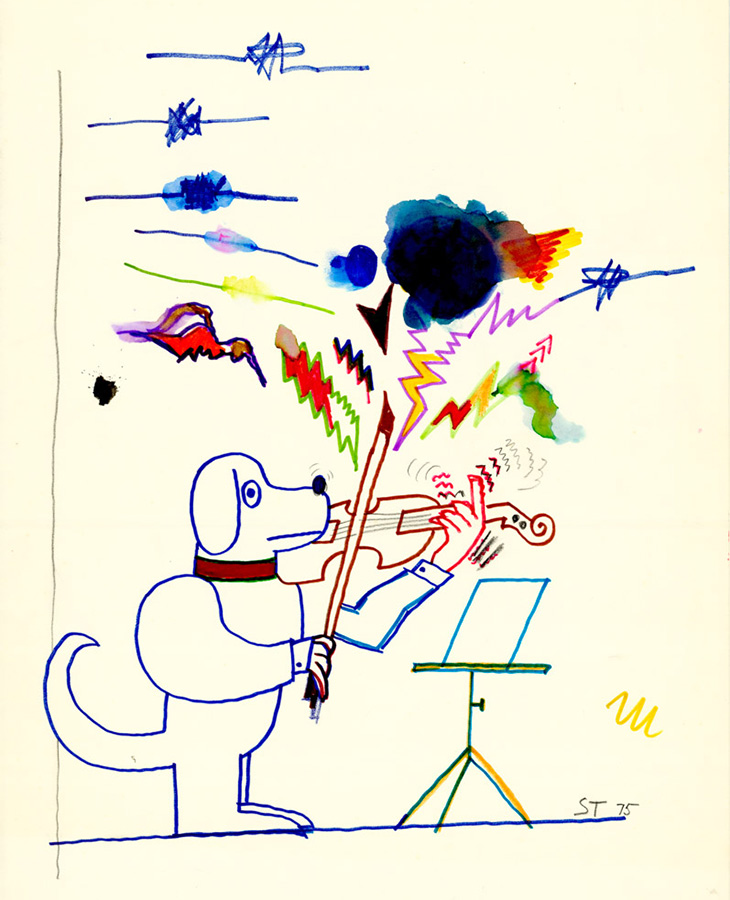
Uncover the Witty World of Saul Steinberg at the OSU Museum of Art’s ‘Line of Thought’ Exhibition

Uncover the Witty World of Saul Steinberg at the OSU Museum of Art’s ‘Line of Thought’ Exhibition
Saul Steinberg (American/Romanian born, 1914–1999), Untitled, 1975, Markers, watercolor,
colored pencil and pencil on Strathmore paper, OSU Museum of Art, Gift of The Saul
Steinberg Foundation. 2021.009.062. © The Saul Steinberg Foundation

Tuesday, July 18, 2023

Media Contact:
Casey Ihde | OSU Museum of Art Marketing and Communications | 405-744-2783 | casey.pankey@okstate.edu

Explore the career of Romanian American artist Saul Steinberg at the Oklahoma State
University Museum of Art’s exhibition “Line of Thought: The Work of Saul Steinberg.” 

On view from July 25 to Sept. 30, this exhibition showcases a selection of Steinberg’s
witty drawings and paintings.

Saul Steinberg, best known for his iconic illustrations in The New Yorker, left an indelible mark on the art world with his humorous and insightful depictions
of modern life. 

“His drawings combine humor, satire and social commentary, resulting in designs which
are both aesthetically pleasing and intellectually engaging,” curator Christina Elliott
said. 

However, Steinberg’s artistic journey was not without its challenges.

Born into a Russian Jewish family in Romania, Steinberg experienced the weight of
antisemitism during the 1920s. Seeking refuge from the growing hostility, he moved
to Milan in 1933. There he pursued architecture studies and worked as an illustrator
for a local Italian newspaper. His time at the newspaper ended quickly due to the
rise of antisemitic ideologies under Benito Mussolini’s regime. 

Determined, Steinberg sent his illustrations to periodicals in the United States while
awaiting his visa approval. By the time he arrived in New York City in 1942, his drawings
were already a regular feature in
The New Yorker. In 1943, Steinberg joined the U.S. Naval Reserve and became a U.S. citizen.

Throughout his career, Steinberg continued his collaboration with The New Yorker. He exhibited his works in over 80 solo shows in galleries and museums across the
United States, Europe and South America. 

“Steinberg’s lines depict forms that look effortless but show clever deliberation,”
Elliott said. “He’s playful but tactical, which allows him to explore serious themes
with humor and visual intrigue.”        

Selections for this exhibition were pulled from a generous gift of Steinberg’s artwork
given by the Saul Steinberg Foundation to the museum in 2021. The donation comprises
drawings, textiles, wallpaper samples, paintings and prints.

The exhibition invites viewers to delve into Steinberg’s imaginative world where lines
transform into narratives. “Line of Thought: The Work of Saul Steinberg” offers visitors
an in-depth exploration of Steinberg’s career, artistic talents and sense of humor.
Learn more at
http://museum.okstate.edu/art/line-of-thought.html. 

Nebraska City establishes Creative Arts District

Nebraska City establishes Creative Arts District

(Nebraska City) — Some Nebraska City residents hope to spur economic development through the arts.

During Monday night’s Nebraska City City Council meeting, supporters announced the formation of a Creative Arts District. Nebraska City Mayor Bryan Bequette tells KMA News local residents worked with state officials on a 10-year plan identifying specific strategies using the arts to increase tourism and business activity in the community.

“We had a group of citizens who came forward and said, ‘Nebraska City fits this perfectly,'” said Bequette. “So, they went through a lot of paperwork, working with the Nebraska Arts Council. First you apply, then they ask you to approve your application, then develop a strategic plan. You have to put together your city partners, and your city supporters, and put out as to how you’re going to use any funding that you might get from the state in order to move forward on economic development, focusing on your arts.”

Bequette says several Nebraska City facilities lend themselves to arts activities.

“Of course, we have the Kimmel Harding Arts Studio here in Nebraska City, where they bring in resident artists to focus on their skills for a couple weeks–two or three weeks at a time,” he said. “We have a lot of history. We have art galleries, and things like that. But, we’re also bringing in other different things in arts. We’re focusing on the (Veterans) Memorial Building with culinary arts. We’re building a commercial kitchen where people can rent out a space, or we could have people come in and do culinary instruction.”

Among other things, communities with creative arts districts are eligible for state funding.

“Typically, when a city first gets approved, there’s $10,000 they can use for planning,” said Bequette. “Then, that’s followed by a little over $2,000 that you can use for marketing. There’s also the Arena Fund–a slang term for it–for communities who put aside a certain amount of their tax proceeds for rural communities. Next fiscal year for the state, only communities with a creative district apply for those funds.”

Arts district supports meet Wednesday at 5 p.m. at the Veterans Memorial Building to establish an executive board, and discuss a strategic plan, among other agenda items.

Thank you for reading kmaland.com

At KMA, we attempt to be accurate in our reporting. If you see a typo or mistake in a story, please contact us by emailing kmaradio@kmaland.com.

What You Can Do, See and Eat at Oakland’s First Corridor Market

What You Can Do, See and Eat at Oakland’s First Corridor Market

AN EARLIER SIDEWALK MARKET ON CRAIG STREET IN OAKLAND | COURTESY PITTSBURGH INNOVATION DISTRICT

In a bid to foster community engagement and strengthen local businesses, Pittsburgh’s Innovation District is hosting for the first time a Corridor Market event on South Craig Street in North Oakland every third Thursday through Sept 21. 

It kicks off on Thursday, July 20, and will feature more than two dozen local artists, vendors and makers selling their goods from 5-9 p.m. Each market will be held here, featuring different Pittsburgh artists, creators and makers each week.

The initiative aims to bring residents together and showcase the diverse offerings in the area. ”We’re really hoping to get people out in the open to discover all that Oakland has to offer,” says Mollie Crowe, marketing and communications manager of the Business Improvement District in Oakland

The Innovation District, formed in 2017, includes the 1-square mile connecting the University of Pittsburgh to Carnegie Mellon University and aims to unify the mass of talent, university resources, transformative technology and cultural assets of that part of Oakland.

In conjunction with the Corridor Markets, the Carnegie Museum of Art’s Inside Out program holds events every Thursday and Saturday from 5-9 p.m. in the Sculpture Court, just a short walk from the market. The events feature free performances, food trucks, workshops and gatherings, DJs, art activities and more.

“All of these events are free and available to the public, so there’s no reason to not come out to Oakland,” says Crowe. 

A special promotion is being offered by the Business Improvement District to highlight the Innovation District’s event.  By sharing your favorite lyric or quote that encapsulates why you believe Oakland is poetic, you will receive a “Sidewalk Sweet” card. You can participate here

The “Sidewalk Sweet” card features Oakland businesses giving out free tasty treats. By presenting your card to any of the 15 participating establishments, you will receive a complimentary sample. Some of the participating establishments include Milkshake Factory, Rita’s, Pittsburgh Popcorn Company, Fuku Tea and more. The offer is only redeemable at locations in Central Oakland.

In ‘Microcosmos,’ Roberto de la Torre Photographs the Elaborate Masked Characters of Northern Spain’s Entroidos

In ‘Microcosmos,’ Roberto de la Torre Photographs the Elaborate Masked Characters of Northern Spain’s Entroidos

“Vellarron de Catrelo de Cima,” Galicia. All images © Roberto de la Torre, shared with permission

In Microcosmos, photographer Roberto de la Torre (previously) centers his lens on the celebratory costumes of the entroido. Held widely in his home region of Galicia around Lent and the shift from winter to spring, entroidos are annual gastronomic carnivals in which food and dance are plentiful. Elaborate costumes and masks are essential for participation, which de la Torre documents in the ongoing series.

Taken throughout northern Spain and Portugal, the photos capture the expressive, varied designs made with feather-like husks, vibrant tufts of synthetic materials, and animal horns. Each costume is unique and tied to a specific role in the celebration. “Some of them are difficult to portray because of their elusive character. Sometimes the people who wear them do not want them to become tourist symbols and lose their ritual character, so they do not like to be photographed,” he tells Colossal.

The demonic “Chocalheiro de Bemposta,” for example, has bulbous horns and a serpent-like creature on the shoulder and is from a small Portuguese village in Mogadouro called Bemposta. It emerges twice annually, making “an appearance the first day of the year and the day after Christmas in a very special ritual for its movement through the village, visiting people and bowing in the houses where some of its inhabitants have recently died,” he explains.

De la Torre is currently working on a parallel series to Microcosmos that considers ritual and divinity. View more of the costumes on the photographer’s Instagram, and find prints in his shop.


A figure wears a corn husk costume in a field

“Follateiro de Lobios,” Galicia

A figure wears a black and red costume with bulbous horns

“Chocalheiro de Bemposta,” Portugal

A figures wears a white tunic and white pants with a tall mask with purple face and duck near the top of the mask

“Felos de Esgos,” Galicia

Vibrant synthetic material forms a feet-tall headdress worn by an exaggerated masked figure in vibrant costume

“Boteiro de Vlana do Bolo,” Galicia

A figure wears a dried grass costume with animal horns

“Feo de Bande,” Galicia

A figure wearing a white and red costume holding gold balloons

“Pantalla de Pinzo de Limia,” Galicia

Do stories and artists like this matter to you? Become a Colossal Member today and support independent arts publishing for as little as $5 per month. The article In ‘Microcosmos,’ Roberto de la Torre Photographs the Elaborate Masked Characters of Northern Spain’s Entroidos appeared first on Colossal.

Harold Smith on the Art of Blackness: More than Sustenance, Soul Food Speaks to the Power of the Human Spirit

Harold Smith on the Art of Blackness: More than Sustenance, Soul Food Speaks to the Power of the Human Spirit

A Smith family Thanksgiving photograph from 1955 (My parents are in the upper right of the photograph.)


This Black art form, like rap and the blues, was born from the economic limitations created by racial oppression


This article is the first in a series titled “The Art of Blackness.” Says author Harold Smith, “Like assemblage created from found objects, many iconic cultural elements in the Black experience — notably in areas of music, food, hair, clothing — lie at the intersection of both African and American cultures. Like the ‘Big Bang,’ this collision of African creativity and American captivity resulted in an explosion of new ways of personal expression that still reverberates in Black American life.

“As a result, simply experiencing life as a Black American is an artistic endeavor.”


You just workin’ with the scraps you was given
And Mama made miracles every Thanksgivin

Tupac Amaru Shakur (from the song “Dear Mama”)

Some of my fondest memories of my childhood are of Christmas, Mother’s Day and occasional Thanksgiving dinners at the home of my Uncle Henry and Aunt Mabel Burrell. Their large home, located right off Prospect on Victor, would be filled with laughter, joy and the unforgettable smells of freshly cooked soul food.

The day before, my mother would spend the entire day there with her sisters Mabel Burrell and Irene Williams, preparing the dishes that would grace our plates the next day. It wasn’t until much later in life that I realized that this time of preparation was, in itself, a ritual of bonding between siblings.

The next day, the adults would eat at the big table with the high back chairs while we children would be in an adjacent room, sitting on folding chairs and dining at card tables.

After dinner, the men would move to the living room, where they watched football games and smoked cigars; the ladies would clear the table, wash the dishes, and gossip while we would play Monopoly or try the dances we saw on Soul Train.

That was a long time ago. My mother, along with Aunt Mabel and Aunt Irene, have long ago passed on. So have all those who were adults at that time. The large home, listed on a historic registry, is no longer in the family. And, as in a lot of Black families, the large extended family dinners died along with the matriarchs and patriarchs.

When I think of the food, however, I smile. The generous helpings of fried chicken and fish, mashed potatoes, macaroni and cheese, peach cobbler, pound cake and other delights still make my mouth water. All made from scratch and seasoned to perfection, these culinary masterpieces adorn the walls of the museum of my childhood memories. It was art, plain and simple.

Good art captures experiences in ways that can’t be put into words. It captures feelings, emotional nuances, and those moments in the human soul that impact us for life. Soul food is no exception.

Dan Hogan, culinary arts instructor at the Manual Career Technical Center, states, “For me soul food nourishes my body, mind, and soul. It brings back amazing memories of simpler times, loved ones that have passed on and times when families sit down and eat dinner together. Memories of me and my siblings sitting in the living room on newspapers picking green beans or cleaning greens. Soul food is what kept us fed and brought us together as a family.”

Like other Black art forms such as the blues and even hip-hop music, the art of soul food was born from the necessity of navigating the economic limitations created by racial oppression.

Wilma Hooks-Gibson, known locally for her tasty cobblers and cakes (and mother of renowned poet and curator Natasha Ria El-Scari), recalled, “In my early years we did not have a refrigerator, gas stove, or washer/dryer. We basically ate the same meal five days a week for dinner — white or pinto beans and cornbread.”

Four generations of soul food creators From left to right Natasha Ria El-Scari, Beauty Hooks, Wilma Hooks-Gibson, Rolanda Gibson, Naeema El-Scari
Soul food cooked by Wilma Hooks-Gibson. A true artisan, Wilma cooks from memory and instinct, not a recipe.

Like other Black forms of artistic expression, soul food captures the experience of finding cause and method of celebration in the darkest of times. “Sunday was our ‘Soul Food Dinner’! Hooks-Gibson added. “It was fried chicken, greens, mashed potatoes, and a cake, and if we were having company, perhaps a lemon meringue pie.”

During slavery, and long after, Black Americans were forced to find sustenance in portions of meat and vegetables that were considered inedible by whites. Like early rap artists who, in the absence of musical instruments, created beats using trash cans and even their own mouths and bodies, economically oppressed Black Americans were forced to find a way to create tasty and appealing meals from what they had. Like blues musicians who manipulated sound into something not before heard, these culinary artisans used heat, water, seasonings and herbs to sculpt these discarded meats and vegetables into flavors and textures that had not existed before.

Over time, like soul musicians building upon the foundations of blues, Black Americans have built soul food into an internationally known art form.

Phillip Griffin at Niecie’s Restaurant serves up breakfast. (photograph by Paula Griffin)

The Spirit of Soul Food

As with other Black-originated art forms, cultural appropriation is making inroads into the world of soul food. White authors, publishers and manufacturers are using Black faces and deceptive marketing to promote their faux soul food books, videos, processed foods, and even restaurants. Veterans of true soul food can taste, maybe even smell, the difference within seconds.

Nonetheless, the artistic spirit of soul food is still indelibly tied to the unique nature of human relationships in Black America. “I started cooking at two and a half years old with my great aunt over an open fire in the back of the little convenience store,” said Kansas City food writer Danielle Jean-Francois. “Whether it was a chicken, a goat, or a pig that she was cooking, she would give the organs to my twin sister and I to clean, season and cook as we listened and watched her. There, at her feet we learned.”

The same way that authentic blues is created by those who lived the blues, authentic soul food is created by those who truly have soul. Those who have soul live and operate from a place of pure intentions, even while conducting business. “For over 30 years, it has been an honor to be a part of our customers’ most important moments, be it joyful celebrations like weddings or somber occasions like funerals,” states Denise Ward, owner of Niecie’s Restaurant at 6441 Troost. “We understand that food has a unique way of bringing people together and creating lasting memories. Each dish we serve is prepared with love, care, and a deep-rooted commitment to preserving the rich culinary heritage of soul food.”

As an art form, soul food is both temporary and permanent. While the food is eventually consumed, tables are cleared and dishes are washed, the memories are sowed into our permanent consciousness. “I grew up watching the women I loved and who loved me present their soul food like art, says Natasha Ria El-Scari, who recently added director of UMKC’s Women’s Center to her distinguished resume. “The laborious process of making something disgusting edible, like chitterlings, and watching people go crazy over the delicacy of the process, texture and taste. Soul food, making the recipes of our immediate ancestors and nailing it for all to praise you and remember them.”

There is an undeniable sensuality to soul food. Like sex, soul food appeals to all five senses. The succulent taste of well-prepared fried catfish is as unforgettable as the sounds made when one bites into the spicy, crunchy breading. Who can forget the aroma of homemade macaroni and cheese or a freshly baked cobbler? The vision of steaming green beans laced with red strips of tender pork provokes aesthetic delight. Just thinking about the texture of fried chicken between my fingers brings to mind the sounds of it being fried in a cast-iron skillet.

The resulting complexity is, to be honest, artistic genius that is often imitated but never truly duplicated. “The dishes possess a character, history, value and an unfuckablewithness that is exclusive to the contributions and genius of Black existence…despite every attempt to win from it and lose it when it’s time to credit and compensate,” says performance artist Stephonne Singleton.

Soul food also has another impact on Black American culture. Scientifically known as postprandial somnolence, “the itis” is Black vernacular for the sluggishness that often sets in as the large amounts of starches in soul food are processed by the body.

The genius of soul food transcends the food itself. It speaks to who we are as human beings. “When I think of soul food I think of comfort, peace, ease and warmth,” says painter Kwanza Humphrey. “I’m not thinking of calories, proteins, fat or nutrients. Honestly, I’m not even thinking about satiating my hunger. Typically, I’m thinking of seeing my dad and family, as that’s the most common place I get it.”

Not only does the art of soul food speak to our humanity, it speaks to the power of the human spirit. Not just any human spirit, but the Black human spirit.

“My grandmother could wring a chicken’s neck
at noon, use the blood that sprayed from his
headless body to teach a lesson about Jesus
and have it plucked, breaded, and fried before
Granddaddy walked through the door at five.”

— excerpt from a poem by Glenn North

A Bench by Akasaki Vanhuyse on the River Thames Buoyantly Nods to London’s Maritime History

A Bench by Akasaki Vanhuyse on the River Thames Buoyantly Nods to London’s Maritime History

All images © Akasaki Vanhuyse, shared with permission

Once the largest enclosed docks in the world, London’s Royal Docks span around 2.5 miles of waterway along the River Thames, encompassing about 250 acres. Today the home of numerous repurposed spaces and contemporary living developments, the area remains flush with industrial and maritime heritage, with historic architecture characterized by red brick. For design studio Akasaki Vanhuyse, founded by Japanese architect Kenta Akasaki and French designer Astrid Vanhuyse, Royal Albert Wharf provided the perfect platform for “FLOAT,” a curvaceous brick bench perched on the quayside.

Working with specialty brickmaker Mishelmersh, the designers tapped into the company’s deadstock, plucking 360 pieces that were expertly cut into 13 unit types with specific angles and dimensions so that they could be precisely puzzled together into the final shape. The shape of the seat nods to the recognizable ring shape of the life preservers dotting the river’s edge, and users can sit around the perimeter or sink into the middle as if in an inner tube. “By connecting the bench design to its immediate surroundings, we wanted to create a symbol for the town,” the studio says.

See more work on Akasaki Vanhuyse’s website and Instagram. (via designboom)


Detail of brickwork.

A circular bench made of bricks, pictured with someone seated in it like an innertube. A circular bench made from bricks.

Detail of brickwork.

A bench made of bricks in progress in a workshop.

Do stories and artists like this matter to you? Become a Colossal Member today and support independent arts publishing for as little as $5 per month. The article A Bench by Akasaki Vanhuyse on the River Thames Buoyantly Nods to London’s Maritime History appeared first on Colossal.

Alfred State launches new bachelor’s in marketing

ALFRED — Alfred State College will now offer a Bachelor of Business Administration in marketing, and students can enroll in the program starting this fall.

The program is a unique degree providing students with a 2-in-1 component of applied technology learning in digital art/design and writing for emergent media while immersing students in 21st century marketing topics, ASC officials reported. Topics including but not limited to e-commerce, SEO marketing, marketing analytics and metrics, digital marketing development, and marketing management.

Upon completion of the degree occupational opportunities could include marketing manager, website creative content developer, marketing analyst, marketing brand/design manager, and social media manager.

Assistant Marketing Professor and Program Coordinator Susan Gorman is excited about of the new degree and the extensive career opportunities now available to our students.

“The Marketing BBA is a culmination of key topics and digital skills preparing students for today’s new marketing environments,” Gorman said. “The advantage of them learning digital design, content writing, and business marketing emulates how marketing and advertising firms actually work together. Students will have the benefit of hands-on projects and presentations solving marketing issues, completing market analyses, and developing digital marketing campaigns for business clients.”

Business Department Chair Mark Bloxsom said Alfred State brings faculty together from a variety of departments and focuses on the groundbreaking tools and techniques used in the modern digital marketing industry.

“Our future graduates will have experiences and knowledge under their belt that very few marketing students are able to enjoy in a bachelor’s program,” he said. “They will be armed with exactly what they need to be on the cutting edge of the future of marketing.”