Art World News

VIPs keep market afloat at Art Basel Miami Beach

VIPs keep market afloat at Art Basel Miami Beach

A market-wide show of resilience, or a collective display of faking it until you make it? That was the question hovering over the first VIP day of Art Basel in Miami Beach on Wednesday. Although the final answer will not become clear until later, results in the early hours of the fair gave reason for at least some measured optimism.

Despite a nearly year-long market correction that has chastened many in the trade, the convention centre’s aisles were abuzz shortly after doors opened. Anyone ignorant to the broader market context would have had a difficult time detecting much anxiety. Still, conversations reaffirmed that the latest iteration of the fair is taking place in a more discerning environment than even last year’s edition, when the cracks in the trade were beginning to show.

“It’s a slightly more selective market. For us, that’s not a bad thing because we have a lot of things that are really canonised,” says Nick Olney, the president of Kasmin gallery. “We’re not aiming to push markets into some really hot streak, we’re really building things for the long term.”

Kasmin’s stand, larger than in previous years, features works by a wide range of artists, from the institutional fixtures Alex Katz and Judith Bernstein to the ascendant American artists Cynthia Daignault and vanessa german. The gallery made several sales in the opening hours, from $1.4m for Katz’s Leigh (2007) to $50,000 for 31-year-old Sara Anstis’s The tree surgeon (2023).

Several other blue-chip stalwarts were rewarded for soldiering on, albeit not at market-recalibrating levels. Thaddaeus Ropac placed three works in the seven-figure range by early Wednesday afternoon, particularly notable given the gallery’s long-time refusal to presell the pieces bound for its stands. Robert Rauschenberg’s Copperhead-Bite IX / ROCI CHILE (1985) led the pack at $1.7m, while Georg Baselitz’s Alles fällt vom Tisch (2020) and Grüße aus Dinard (2023) sold for €1.5m and €1.2m, respectively.

Gladstone Gallery placed $2.2m worth of works in the fair’s first two hours: a pair of Keith Haring works on paper for $950,000 and $650,000, Amy Sillman’s painting Machine (2023) for $450,000 and an untitled acrylic-on-archival-print work by Arthur Jafa for $150,000. Pace Gallery also closed multiple deals for six-figure prices, including Isamu Noguchi’s Plus Equals Minus (around 1945-79) for $450,000, a painting from the Korean artist Lee Kun-Yong’s Bodyscape series for $250,000 and multiple editions of Lynda Benglis’s 2023 bronze sculpture QT for more than $200,000 each.

Lehmann Maupin did similarly well with international artists and buyers alike. Teresita Fernández’s Dark Earth (Reservoir), a 2023 wall-based work, went to prominent private collectors in Europe for between $375,000 and $425,000. Lee Bul’s Perdu CLXXXVII (2023) is bound for a Hong Kong-based collection at a price in the $250,000 to $300,000 range. The gallery also placed a piece by the Brazilian duo OSGEMEOS, on show in the fair’s Kabinett sector, for $250,000 with US collectors.

Opening-hours demand went beyond the canonical names, with some young artists’ work flying off the stands. Perrotin, which split its large stand between a solo presentation of new paintings by the fast-rising California-based artist Emma Webster and a group presentation of the gallery’s other artists, also found swift success. All eight of Webster’s paintings, of climate-change-induced apocalyptic landscapes adapted from the artist’s own digital models, were placed by early afternoon, at prices from $80,000 to $175,000 each. The gallery also found buyers for works by Jason Boyd Kinsella, Alex Gardner and Xiyao Wang, at prices ranging from $65,000 to $115,000, as well as an Emily Mae Smith canvas (priced $200,000 to $300,000).

Setting aside sales, the exposure provided by a mega-fair like Art Basel in Miami Beach remains irreplaceable for modestly sized dealers. “This is a place that is key for us in terms of developing our programme and developing our collector base,” says Omayra Alvarado-Jensen, the executive director of the Bogotá- and New York-based gallery Instituto de Visión, which is selling works by Latin American women artists, ranging from $5,000 to $60,0000.

“It’s a tighter market,” one New York-based adviser said early on preview day. “Dealers who play it safe, they’re boring everyone. The ones who are willing to say, ‘This is my eye, this is my vision’, they do really well.”

A New Film Documents Kerry James Marshall’s Dynamic Stained Glass Windows for the Washington National Cathedral

A New Film Documents Kerry James Marshall’s Dynamic Stained Glass Windows for the Washington National Cathedral

How do you revise a narrative that some still believe true? And, how do you change that story to focus on perseverance and reform when the fight for justice is ongoing?

In 2017, two stained glass windows commemorating Confederate generals Robert E. Lee and Thomas Jonathan “Stonewall” Jackson were removed from the Washington National Cathedral. When Kerry James Marshall (previously) was commissioned to create their replacements, he grappled with these questions, ultimately offering a dynamic pair of works installed this September.

A new short film for Art21’s Extended Play series documents the artist’s process and thinking behind the monumental windows, which were made in collaboration with stained-glass artisan Andrew Goldkuhle. The vibrant pieces depict anonymous protestors engaged in a peaceful demonstration. Some figures holding signs saying “No,” “No Foul Play,” and “Fairness,” slogans inspired by a speech by Chicago’s first Black mayor, Harold Washington. The phrases connect a basic principle of the U.S. Constitution with that of dishonesty and crimes and reflect the need to redress wrongs.

“We tend to make celebrities the focal point of any kind of achievement when for the most part, almost all the achievements we experience are the work of a vast number of anonymous and unidentified people who put in the work on a day-to-day basis,” Marshall says. The title of both the windows and the documentary, “Now and Forever,” reflects this dedication to showing up and striving for a better world each day.

No matter how much progress we make, the artist reminds us, “achievement doesn’t necessarily mean complacency.”

Watch the full film above and find more about the project on Art21.


a still showing the artist painting the word play in red

a still of the completed windows showing protesters holding signs saying no and no foul play

a detail of the finished windows showing protestors holding signs saying fairness and not

Do stories and artists like this matter to you? Become a Colossal Member today and support independent arts publishing for as little as $5 per month. The article A New Film Documents Kerry James Marshall’s Dynamic Stained Glass Windows for the Washington National Cathedral appeared first on Colossal.

NADA Miami Starts Strong, With Multiple Sold-Out Booths on Opening Night

NADA Miami Starts Strong, With Multiple Sold-Out Booths on Opening Night

Eager buyers and viewers thronged the aisles at the opening day of NADA at Ice Palace studios in downtown Miami last night (December 5), with sales, particularly of smaller scale paintings at lower price points, seemingly on fire.

Nearly every dealer we spoke to in the main galleries section and in the Projects section was upbeat, having closed at least some sales already, some solidified in the days leading up to the opening day.

Work by Jiyoung Park at Gallery Afternoon (Seoul, Korea) booth at NADA. Photo by Eileen Kinsella.

Work by Jiyoung Park at Gallery Afternoon (Seoul, Korea) booth at NADA. Photo by Eileen Kinsella.

At Seoul-based Gallery Afternoon’s booth in the Projects section, curator Vicky Lee was chatting about the intimate landscape paintings on butter-cup yellow walls by illustrator-turned-painter Jiyoung Park—and how all of the roughly half a dozen works, plus two more (see below), had been reserved or purchased.

“We sold everything in 30 minutes,” Lee said.

A gentleman who strode up with a small group and immediately asked for a checklist, where the top price was a very reasonable $1,300, wanted to know how much longer the reserve on one painting was in effect and whether any others were available. Good luck to him! Two additional works that were brought but not yet displayed, had also been spoken for.

imageThe Wall(2023). Photo by Andrea Calo. Image courtesy the artist and Martha’s Contemporary, Austin, Texas.” width=”1024″ height=”1024″ srcset=”https://www.mecreates.com/story/news/wp-content/uploads/2023/12/NADA-Martha-Contemporary-RFA0007-copy-1024×1024.jpg 1024w, https://news.artnet.com/app/news-upload/2023/12/NADA-Martha-Contemporary-RFA0007-copy-300×300.jpg 300w, https://news.artnet.com/app/news-upload/2023/12/NADA-Martha-Contemporary-RFA0007-copy-150×150.jpg 150w, https://news.artnet.com/app/news-upload/2023/12/NADA-Martha-Contemporary-RFA0007-copy-50×50.jpg 50w, https://news.artnet.com/app/news-upload/2023/12/NADA-Martha-Contemporary-RFA0007-copy-256×256.jpg 256w, https://news.artnet.com/app/news-upload/2023/12/NADA-Martha-Contemporary-RFA0007-copy-96×96.jpg 96w, https://news.artnet.com/app/news-upload/2023/12/NADA-Martha-Contemporary-RFA0007-copy.jpg 1500w” sizes=”(max-width: 1024px) 100vw, 1024px”>

R.F. Alvarez, The Wall(2023). Photo by Andrea Calo. Image courtesy the artist and Martha’s Contemporary, Austin, Texas.

The story was the same two booths over at Austin, Texas-based Martha’s Contemporary, another first time exhibitor participating in the Projects section. The gallery showed four artists, including an engrossing embroidered floral work by Erick Medel, a painting by Rachel Bos, a floor-sited wood sculpture by Wes Thompson, and several small figurative paintings by R.F. Alvarez, all priced at $2,500 each.

By mid afternoon the entire booth had sold out, to the thrill of owners Ricky Morales and Meredith Williams. They praised NADA’s focus on emerging artists, noting that’s what prompted to them to join the association. Previously, they participated in an exhibit at NADA House on Governor’s Island in New York City.

Polly Schindler, Dog Sleeping On Stairs (2023). Image courtesy the artist and Deanna Evans Gallery.

Polly Schindler, Dog Sleeping On Stairs (2023). Image courtesy the artist and Deanna Evans Projects.

In the main section gallerist Deanna Evans was also a first time NADA exhibitor in Miami (having done a New York edition previously) and was fielding intense interest for the works of painter Polly Shindler, especially quiet peaceful interior scenes depicting puppies, cozy-looking bedrooms and inviting bookshelves, as well as exteriors of houses, and a bonfire beach scene for the outdoor settings. Prices ran from $2,000 to $5,000.

imagePerpetual Amnesia (2023). Image courtesy the artist and Dimin Gallery.” width=”819″ height=”1024″ srcset=”https://www.mecreates.com/story/news/wp-content/uploads/2023/12/NADA-Dalzen-819×1024.jpg 819w, https://news.artnet.com/app/news-upload/2023/12/NADA-Dalzen-240×300.jpg 240w, https://news.artnet.com/app/news-upload/2023/12/NADA-Dalzen-1229×1536.jpg 1229w, https://news.artnet.com/app/news-upload/2023/12/NADA-Dalzen-40×50.jpg 40w, https://news.artnet.com/app/news-upload/2023/12/NADA-Dalzen.jpg 1500w” sizes=”(max-width: 819px) 100vw, 819px”>

Erik Dalzen, Perpetual Amnesia (2023). Image courtesy the artist and Dimin Gallery.

New York dealer Rob Dimin was also in the fair’s main section, telling Artnet NADA had been very crowded all day, with healthy attendance from institutional collectors. “We’ve had great placements,” he said.

The gallery sold a monumental sculptural work by Erik Dalzen, Perpetual Amnesia, at approximately $20,000, as well as sculptural works on fabric-wrapped wood by Ye Qin Zhu for about $8,000 each.

New York’s Polina Berlin gallery, which made its debut at NADA, also reported a sold out booth. Their wares included six new paintings by Tamo Jugeli for $12,500 each and six new paintings by Carrie Rudd for prices ranging from $4,200 – $12,500.

At Charles Moffat, sales included two paintings by Julia Jo priced at $18,000 each; a painting by Alec Egan priced at $30,000; and two paintings by Keiran Brennan Hinton, one priced at $18,000 and the other at $7,000.

Rachel Uffner’s large and captivating booth, reported selling three paintings by Miami-based artist Bernadette Despujols, priced at $56,000, $50,000, and $20,000 respectively.

Other sales reported by the gallery included two paintings by Talia Levit for $25,000 each; two paintings by Anne Buckwalter for $9,000 and $7,000; a painting by Susan Chen for $32,000; three sculptures by Sascha Ingber for $6,500, $6,000, and $4,500; a painting by Elbert Joseph Perez for $9,000; a painting by Erica Mao for $7,000; and a painting by Anna Jung Seo for $3,800.

Camila Falquez, Samantha Siagama, Trans-Indigenous Leader, 2023 (2023). Image courtesy NADA and Pérez Art Museum Miami.

Camila Falquez, Samantha Siagama, Trans-Indigenous Leader, 2023 (2023). Image courtesy NADA and Pérez Art Museum Miami.

Meanwhile NADA and the Pérez Art Museum Miami (PAMM) announced their selection for the sixth annual acquisition gift for the museum, on which the two institutions collaborate annually. The NADA gift provides funding for PAMM curators to acquire an artwork for the museum’s permanent collection, which features international modern and contemporary art from the U.S. Latino experience, the African diaspora, Latin America, and the Caribbean.

This year, PAMM associate curator Jennifer Inacio and assistant curator Maritza Lacayo selected Camila Falquez’s Samantha Siagama, Trans-Indigenous Leader from Hannah Traore Gallery.

“This photograph is part of an ongoing series in which Falquez works closely with Colombian Trans communities to portray strong and powerful identities,” Inacio said.

The work depicts Samantha, a community leader and activist from the coffee-growing region of Colombia who works as a coffee picker on a farm. She leads and coordinates a group of fellow Trans women, who are exiled from the Emberá Indigenous tribe for defending their gender identity, according to the gallery.

“The artist aims to challenge notions of survival and resistance while highlighting the beauty and dignity of the model, preserving the essence of her everyday life,” according to the selection statement.

More Trending Stories:  

Art Critic Jerry Saltz Gets Into an Online Skirmish With A.I. Superstar Refik Anadol 

Your Go-To Guide to All the Fairs You Can’t Miss During Miami Art Week 2023 

The Old Masters of Comedy: See the Hidden Jokes in 5 Dutch Artworks 

David Hockney Lights Up London’s Battersea Power Station With Animated Christmas Trees 

On Edge Before Miami Basel, the Art World Is Bracing for ‘the Question’ 

Thieves Stole More Than $1 Million Worth of Parts From an Anselm Kiefer Sculpture 

Follow Artnet News on Facebook:
Want to stay ahead of the art world? Subscribe to our newsletter to get the breaking news, eye-opening interviews, and incisive critical takes that drive the conversation forward.

Hugh Hayden Untangles American Mythology with Overgrown Sculptures and Skewed Installations

Hugh Hayden Untangles American Mythology with Overgrown Sculptures and Skewed Installations

Installation view of “The end,” NGV Triennial, Melbourne. Photo by Sean Fennessy. All images shared with permission

In a trio of ongoing exhibitions, Hugh Hayden (previously) tackles American myth-making, unraveling the incomplete and ignored narratives that ground our politics and culture.

For the National Gallery of Victoria Triennial, Hayden installed “The end,” a grade-school classroom complete with wooden desks and a mirrored blackboard. Educational settings are a recurring in the artist’s practice, and he pairs the motif with three dodo skeletons. The flightless birds were native to Mauritius and one of the first species to go extinct because of European hunting and deforestation on the island.

Tying this colonial eradication to academics, Hayden roots out the ways colonialism and its tenets continue to undermine the educational system and highlights the loss inherent within the African diaspora.


a wooden cabin with brick chimney is slants 20 degrees to the left in a park

“Huff and a Puff” (2023), deCordova Sculpture Park and Museum. Photo by Mel Taing

“Huff and a Puff” similarly probes historical narratives. Permanently installed at deCordova Sculpture Park and Museum in Lincoln, Massachusettes, the small wooden cabin is a replica of Henry David Thoreau’s home at Walden Pond. Slanted a surreal 20 degrees, the building skews what’s typically thought of as a birthplace of American self-reliance, environmental consciousness, and capitalist critique.

“‘Huff and A Puff’ is about perspective, not only in terms of its physical experience but also conceptually, given that for some people, the world is not so easy to live in,” the artist says. Given its angled construction, the cabin would be uncomfortable, if not impossible, to occupy without bending or contorting one’s body to fit.


the left door of a row of black bathroom stalls opens to reveal a wooden toilet sculpture with branches emerging from its sides

Installation view of ‘Hugh Hayden: Hughman’ at Lisson Gallery, Los Angeles. Image © Hugh Hayden, courtesy of Lisson Gallery

And finally, in his first solo show in Los Angeles, Hayden considers “the prosthetics of power,” or the artificial structures that can be weaponized for control and authority. Titled Hughman, the exhibition is entirely hidden behind a row of black bathroom stalls that must be opened to see the works, an act associated with privacy and rife with discrimination given the current proliferation of bathroom bills.

Inside is the artist’s play on an origin story. A twist on the anatomical models found in doctors’ offices, “Eve” is a wooden sculpture of a pregnant body with a baby curled inside. Other works include various types of seating—a director’s chair, school desk, and toilet—made impossible to use by branches jutting out from their sides or their flimsy, bristle construction.

Hughman is on view through January 13 at Lisson Gallery, while “The end” is up through April 7 in Melbourne. For deeper insight into Hayden’s work, pick up American Vernacular published earlier this year and also on Colossal’s Best Books of 2023 list, and find more on Instagram.


an installation of wooden school desks with a mirrored blackboard and teacher's desk. three sculptures of dinosaurs rest atop some of the desks with wooden branches emerging from their sides

Installation view of “The end,” NGV Triennial, Melbourne. Photo by Sean Fennessy

an installation of wooden school desks with a mirrored blackboard and teacher's desk. two sculptures of dinosaurs rest atop some of the desks with wooden branches emerging from their sides

Installation view of “The end,” NGV Triennial, Melbourne. Photo by Sean Fennessy

a wooden cabin with brick chimney is slants 20 degrees to the right in a park

“Huff and a Puff” (2023), deCordova Sculpture Park and Museum. Photo by Mel Taing

a schooldesk made of white bristles

“Brainwash” (2023),
PVC and nylon bristles, 33 x 26 x 29 inches. Image © Hugh Hayden, courtesy of Lisson Gallery

A wooden sculpture of an anatomical model of a pregnant stomach with a wooden baby curled inside

“Eve” (2023), cherry bark and acrylic on resin, black walnut,
25 x 15 x 10 inches. Image © Hugh Hayden, courtesy of Lisson Gallery

black bathroom stalls open to reveal several sculptures

Installation view of ‘Hugh Hayden: Hughman’ at Lisson Gallery, Los Angeles. Image © Hugh Hayden, courtesy of Lisson Gallery

Do stories and artists like this matter to you? Become a Colossal Member today and support independent arts publishing for as little as $5 per month. The article Hugh Hayden Untangles American Mythology with Overgrown Sculptures and Skewed Installations appeared first on Colossal.

Expansive Landscapes Spill from Tiny Frames in Detailed Miniature Dioramas by A House of Wonders

Expansive Landscapes Spill from Tiny Frames in Detailed Miniature Dioramas by A House of Wonders

All images © House of Wonders, shared with permission

“I didn’t really set out with the intention of making miniatures. They just turned out that way,” says artist Caroline Dewison of A House of Wonders. For several years, the Warrington, England-based artist experimented with beads and clay to make small sculptures, but she was never quite satisfied. “It began with making little mossy patches on clay pieces, sourcing materials I found in model railway layouts, which I immediately fell in love with,” she says. “Seeing how others recreated such realistic scenes was really inspiring, so I bought some scenery supplies, and the ideas just grew.”

Small enough to hold in the palm of your hand, Dewison’s vistas open up far into the distance. Inspired by the woodlands around her home and holiday walks through the Lake District, the artist began to recreate mystical scenes of streams, shorelines, and hills. “The natural world has always filled me with a sense of wonder,” she says. “I grew up in the days where you could disappear all day as long as you were home for tea, and I spent a lot of my time exploring the woods and fields near our house.”

Using Jesmonite—a mixture of gypsum and water-based acrylic resin—to fashion frames, plus a lightweight MDF for the backgrounds, Dewison sources a range of small boxes, model-making supplies, and acrylic paints to create each intricate scene. For landscapes, she particularly enjoys using a type of clay that melds the malleability of clay with the strength of epoxy, plus a favorite 3D-printing pen. “I’m amazed at the fact you can just press a button and magic something out of thin air,” she says.

Find more of Dewison’s work on A House of Wonders’ Instagram and website.


Do stories and artists like this matter to you? Become a Colossal Member today and support independent arts publishing for as little as $5 per month. The article Expansive Landscapes Spill from Tiny Frames in Detailed Miniature Dioramas by A House of Wonders appeared first on Colossal.

Art sales top $140m but it’s a buyers’ market now

Art sales top $140m but it’s a buyers’ market now
Elizabeth Fortescue

The 2023 Australian art auction market largely defied rampant inflation, high interest rates and worsening global armed conflict, with sales to total $140 million by the time the last few bids are made at the end of next week.

This is roughly equal to last year’s sales total of $143.93 million, an unusual year in which art works from the collections of Cbus super fund and National Australia Bank were sold for a combined total of more than $20 million. But it’s still short of the pre-GFC record year of 2007, when $176 million in art was bought across the auction houses.

Those two corporate sales propelled auctioneer Deutscher and Hackett into top position among Australia’s auction houses in 2022, followed by arch rival Smith & Singer.

1. John Peter Russell’s Souvenir de Belle-Île, (Marianna Russell with Goats, Goulphar, Belle-Île), 1897, was the year’s top lot, selling for $4m at Deutscher and Hackett in August. 

Now, after 12 months during which those two biggest houses jostled for the right to sell the best works from prestige consignors, those positions are reversed. Smith & Singer has come out on top in 2023, with sales totalling $42.03 million, and Deutscher and Hackett on $34.12 million (not counting the house’s final 2023 auction, a timed sale with a high estimate of $261,300 that ends on December 12).

Advertisement

While buyers at the top end of the market remain virtually immune from rising interest rates on hefty mortgages, “mum and dad” investors trying to balance the family budget are beginning to desert the art market.

This sector took to the art market in droves during COVID, looking to spend amounts of perhaps $5000 or $10,000 on a picture to match the sofa. This money was available because no one was travelling overseas during lockdowns.

2. Brett Whiteley’s Yellow, 1975, sold for $3.25 million at a private sale held by Smith & Singer. 

But those smaller buyers are now beginning to leave the market to people who could be classified as “connoisseurs”, who always remain interested in rare works of top quality by distinguished artists, and are prepared to pay for them.

3. The cover lot for this Smith & Singer auction was Fred Williams’ Masons Falls, 1981, which became the first Williams to breach the $3 million mark at auction.  

With prices starting to soften at the lower end of the market, insiders speculate that fewer works under about $50,000 will come on to the market because vendors will worry they will not get the right price for them.

Advertisement

These sentiments are among those expressed by a variety of market insiders and auction houses that Saleroom asked to comment on the year that was.

First, the raw data on the Australian Art Sales Digest website gives general structure to the shape of the market. Those figures show that the year’s top price was $4 million (including buyer’s premium, as will all the prices in this article) for John Peter Russell’s Souvenir de Belle-Île, (Marianna Russell with Goats, Goulphar, Belle-Île), 1897. The work was sold by Deutscher and Hackett in August.

4. Sidney Nolan’s Early Morning Township, 1955, sold for $2.7 million at Deutscher and Hackett. 

Next came $3.25 million for Brett Whiteley’s Yellow, 1975, at Smith & Singer in October and $3.25 million for Fred Williams’ Masons Falls (Smith & Singer, August). Then it was $2.7 million for Sidney Nolan’s Early Morning Township, 1955 (D+H, August), and $2.2 million for Brett Whiteley’s South Coast After the Rain (D+H August).

There were no women in the list of top 10 prices. But Emily Kam Kngwarray, now the subject of an expansive survey exhibition at the National Gallery of Australia (and scheduled to tour to Tate Modern in London in 2025), came in as the seventh most traded artist on the Australian art market.

Advertisement

A total of $2.975 million was paid for Kngwarray art works during the year, putting her ahead of Russell Drysdale and John Brack but behind Brett Whiteley (topping the list of most traded, with $12 million), Sidney Nolan ($11.3 million), Fred Williams ($8.85 million), Charles Blackman ($5.54 million), John Peter Russell ($4.46 million), Arthur Boyd ($4.36 million) and John Olsen ($3 million).

5. Brett Whiteley’s South Coast After the Rain, 1984, sold for $2.2 million on an estimate of $1.5 million to $2 million. 

Record Australian art auction prices were achieved for many artists including Del Kathryn Barton ($527,727 for of Pink Planets). Other artists with new records included Joel Elenberg, the late sculptor whose beautiful work, Mask 1, 1978, fetched $1,135,227 through Smith & Singer. This was the top price ever paid for a work of sculpture at an Australian auction.

A major new auction record for popular Australian painter Criss Canning was set on December 5. At a private, single-lot auction by Smith & Singer, Native Flowers from Pomonal, 2001, fetched $231,250 on a far lower estimate of $80,000 to $100,000. The vendor was a private collection in Victoria.  

Other artists with new high prices to their names included Criss Canning, whose painting Native Flowers from Pomonol, 2001, went for $231,250 at a private Smith & Singer auction on Tuesday this week.

Carol Jerrems’ famously brooding image, Vale Street, 1975, fetched $175,000, the highest price paid for a photograph at auction in Australia.

Advertisement

Carol Jerrems’ powerful silver gelatin photograph, Vale Street, 1975, edition 2/9, signed and dated, fetched a whacking $175,000. 

Under the unofficial heading of “runaway prices” came Landscape, attributed to Wang Hui. Estimated at a meagre $3000 to $5000, Landscape sold for a whopping $393,600 through Bonhams in August. Look out for surprises at Bonhams’ sale of Asian Art on Thursday night.

Likewise, Charles Rodius’s Miniature Portrait of Mrs Sophie Wiseman sold for $50,400 on a pre-sale estimate of just $600 to $1000. And Davidson Auctions sold Emanuel Phillips Fox’s A Beach in France, c.1909-11, for $304,000 which made the pre-sale estimate of $120,000 to $180,000 look very undercooked.

A Beach in France, c1909-11, by Emanuel Phillips Fox, smashed its estimate of $120,000 to $180,000 at Davidson Auctions. 

Likewise, Arthur Streeton’s The Yarra near Heidelberg, 1891, sold for $596,000 on an estimate of $150,000 to $250,000 at Davidson’s.

In all, 21,000 works were offered at auction in Australia this year, of which 66 per cent were sold. The average value of the works was $10,153.

Advertisement

Justin O’Brien’s Edgecliff Landscape c1947 trounced its pre-sale estimate of $50,000 to $70,000 and fetched $135,000 (including buyer’s premium) in Menzies’ auction on November 29. The vendor was a private Sydney collection.
 

Smith & Singer’s sales total was the highest since the company acquired Sotheby’s Australia in 2009, chairman Geoffrey Smith said.

Quality and rarities on the market have performed well, but areas at the lower end of the market for works around $5000 are suffering.

“There is far less discretionary spending,” Smith said.

“The priorities have shifted for different households. The boom we saw during COVID as people bought (art works) at home, clicking on auctions on the internet, has subsided. And what we’re seeing is a return to connoisseurs and discerning collecting.”

Rich with Sydney Harbour atmosphere, Peter Kingston’s oil painting, Cool and Blue Down There (Sydney Ferries), 1998, performed extremely well at Menzies auction on November 29 in Sydney. The ANZ Art Collection was deaccessioning the work, which fetched $27,000 (including buyer’s premium) on a pre-sale estimate of just $6000 to $8000.  

Advertisement

A return to world travel following the boredom of lockdowns has also affected the market, “but the true collectors, whether it’s private individuals or public institutions, are just incredibly focused and discerning”, Smith said.

As for 2024, Smith said the market will “recalibrate to pre-COVID”.

“If great works of art come forward they’ll be keenly sought after, provided the estimates are fair and reasonable,” he said.

Deutscher and Hackett’s Damian Hackett said the auction house had had a “very good year” with 18 record prices achieved for artists including six by Indigenous artists.

“We’ve turned over $86 million in 24 months and that’s something that no auction house has achieved over that period,” Hackett said, a little cheekily. “We had four works sell for over $2 million each.”

Men in a Boat, Shoalhaven River, c1981, by Arthur Boyd, measuring 121 x 181.5 cm, sold very well when it fetched $208,636 (including buyer’s premium) against a pre-sale estimate of $100,000 to $150,000 at Menzies’ auction on November 29. The work was from a private NSW collection. 

Advertisement

Hackett believes the market is in for more of the same next year. Roger McIlroy, auctioneer and chairman of The Fine Art Group, Australia and New Zealand, agrees.

“I can’t see anything that’s going to particularly stop it at the moment,” McIlroy said.

“I think the market will still concentrate quite heavily on the unique and the top end, the really top things, because there’s plenty of people around who want to buy the top things and in any cycle those things do very well.”

Unlike other commentators, McIlroy said there were few signs of the middle and lower ends of the market softening.

William (Jock) Frater’s delightful Untitled (Landscape) was snapped up for just $861 (including buyer’s premium) at Bonhams’ December 5 sale of works from the Wrobel Collection. It was estimated at $800 to $1200.  

“Davidsons had a fantastic sale the other day, and Leonard Joel (auction house) is still doing their thing,” he said.

Advertisement

“There are lots of players in the market now.”

Art consultant Annette Larkin believes there is a generational swing away from traditionalist works by the likes of Arthur Boyd and Charles Blackman, in favour of more contemporary works by artists such as Shaun Gladwell.

Gladwell’s photographic artwork, Approach to Mundi Mundi: Silverton Road/ Mundi Mundi [2], 2007, carried a pre-sale estimate of $10,000 to $15,000 but fetched a whopping $57,810 in Bonhams’ November sale.

Adam Sims of Sims Veldekis art consultants believes rising interest rates will affect the market for art works of about $20,000 or less.

Norah Gurdon (1881-1974) is a relatively little-known Australian artist whose painting, Rural landscape, fetched a very respectable $6150 (with buyer’s premium) against a pre-sale estimate of just $300 to $500 in Bonhams most recent (December 5) sale of works from the Wrobel Collection. 
 

For Menzies’ head of art, Brett Ballard, Indigenous works of art are “still incredibly well priced”. This included the work of many Indigenous artists who were using contemporary media.

Advertisement

“They haven’t quite had their day yet, so we’re looking at that,” Ballard said.

This signed and dated lithograph by British superstar artist David Hockney, titled Lithograph of Water Made of Thick and Thin Lines and Two Light Blue Washes, 1978-80, fetched $184,091 at Menzies’ auction on November 29. It was printed by Tyler Graphics, New York, and the vendor was a Sydney collector. The pre-sale estimate was $150,000 to $200,000.
 

Margaret Olley is a hardy perennial, loved for her philanthropy and sturdy character as well as her art. This work in oil on board, Kilim Rug and Cornflowers II, 1997, was bought for $141,136 (including premium) at Menzies’ November 29 auction in Sydney.
 

Robert Owen’s eye-popping Blind Spot (from The Text of Light series), 2003, measures almost two metres square. Estimated at $35,000 to $40,000, the work fetched $67,500 at Menzies’ auction on November 29, setting a new Australian auction record for the artist
 

In one of the last art auctions of 2023, Deutscher and Hackett will offer a collection of 36 print artworks consigned by a descendant of the Bauhaus-trained artist Ludwig Hirschfeld-Mack. This work, by Paul Klee, titled Laternenfest, 1922, carries an estimate of $15,000 to $20,000. The timed sale ends on December 12.  

Deutscher and Hackett’s timed online sale, ending December 12, includes Desolation, Internment Camp, Orange, NSW, 1941. Other copies of this woodcut print on paper by Ludwig Hirschfeld-Mack have been collected by numerous leading galleries including the National Gallery of Australia.  

Latest In Arts & Culture

Fetching latest articles

Most Viewed In Life and luxury

    Lawrence collective embraces new name ahead of LOLA Giant art market

    Lawrence collective embraces new name ahead of LOLA Giant art market
    Share this post or save for later

    Members of LOLA — now Lovers of Lawrence Art — have changed the collective’s name to embrace more of the community ahead of their annual LOLA Giant art market.

    The first L previously stood for “Ladies.” The group announced the change in an Instagram post in late October.

    Advertisement

    “While our acronym will remain the same we wanted to create a more inclusive title that might feel more welcoming to people who exist outside of the binary,” group members wrote. “When LOLA began it was imperative to have a group that gave a stage to female voices but like many groups that came before us it has become increasingly obvious that others, whom have also been excluded, also felt that they were not welcome with us.”

    The LOLA Giant art show runs Saturday and Sunday. It will bring more than 20 local vendors to Van Go, 715 New Jersey St.

    Items that will be available include wearable art and jewelry, western wear, planters, glass mushrooms, candles that come with playlists, prints, stickers, housewares and much more. Wild Alive Ferments and Streamline Coffee will be onsite with food both days, and Ad Astra Photobooth will be there to capture the memories.

    Doors open at 10 a.m. Saturday, Dec. 9, and there will be swag bags full of coupons, stickers, and other goodies for the first 30 attendees who show. The Lawrence Public Library’s bookmobile, Dottie, will be outside from 10 a.m. to noon, and story time is set for 11:30 a.m. CS Luxem will perform an acoustic set at 11 a.m., and DJ Tinsel Toes will provide music from 1 to 3 p.m. Doors close at 5 p.m. Saturday.

    On Sunday, Dec. 10, doors open at 11 a.m., and the first 20 attendees who show will get swag bags. Cleo & Leo Baking Co. will offer sugar cookie decorating from 11 a.m. to 1 p.m. Doors close at 3 p.m. Sunday.

    Get a sneak peek at the artists who will be in attendance on LOLA’s Instagram, @lolalawrence. Organizers encourage those who are interested in joining to reach out to loversoflawrenceart@gmail.com.

    If our local journalism matters to you, please help us keep doing this work.
    Don’t miss a beat … Click here to sign up for our email newsletters

    Mackenzie Clark (she/her), reporter/founder of The Lawrence Times, can be reached at mclark (at) lawrencekstimes (dot) com. Read more of her work for the Times here. Check out her staff bio here.

    Latest Lawrence news:


    Chloe Anderson/Lawrence Times

    Share this post or save for later

    Community members can support local farmers this Saturday at the Holiday Farmers Market, which is a lifeline for some vendors to get through the winter while the regular Lawrence Farmers Market is closed.


    Share this post or save for later

    Lawrence city commissioners on Tuesday will welcome the newly elected commissioners, say goodbye to another, and select the next mayor and vice mayor.


    Share this post or save for later

    With help from a federal grant, Haskell Indian Nations University is establishing a center on campus dedicated to progressing local Native American-owned businesses.

    MORE …

    The Global Art Business Is Better, but Not Booming

    The Global Art Business Is Better, but Not Booming
    image

    After struggling with the Covid pandemic, the industry is now dealing with inflation, high interest rates and international conflicts.

    Sun, sand and champagne are sure to greet attendees at Art Basel Miami Beach as it celebrates its 21st birthday with a bubbly mix of gallery displays, outdoor art and beach parties.

    Yet underneath the surface, the global art business is cooling: While choice works by desirable artists can still fetch sky-high prices, the market is not what it used to be before the Covid pandemic.

    “We’ve come out of a period of unprecedented growth in the numbers of artists collected and valued, and the prices which people pay, and those kinds of buying cycles always go through shifts — in good times and bad,” said Allan Schwartzman, a New York-based art adviser and founder of the Schwartzman& advisory firm.

    A painting by Dana Schutz at the David Zwirner Gallery stand at Paris+ by Art Basel in October.Dimitar Dilkoff/Agence France-Presse — Getty Images

    “You’ve had a slowdown because it was natural: There were a lot of people who ate too much at the buffet, and now they realize that they want to be a little more select in what they choose to eat or put on their plate,” Mr. Schwartzman added.

    He noted that inflation and high interest rates “slow things down greatly,” and that conflicts in places such as Ukraine and the Middle East were “never helpful for what is often thought of as luxury spending.”

    The figures bear out that assessment. According to the Art Basel and UBS Survey of Global Collecting 2023, published in November and written by the economist Clare McAndrew, sales by the four major auction houses were down 16 percent in the first half of 2023 compared with a year earlier.

    This year, Art Basel Miami Beach will feature 277 international galleries, nearly two-thirds of them from North and Latin America, and 25 of them newcomers. The Miami Beach fair is part of one of the two big international fair franchises: Art Basel and Frieze, each of which hold fairs in four different cities every year.

    Visitors and exhibitors at Frieze New York at in Manhattan in May.Jeenah Moon for The New York Times

    What is clear, regardless of which franchise you look at, is that the fair business has still not regained the market share it lost during the pandemic. Unlike certain other components of the art market — such as auction houses, which were, by and large, able to continue operating by switching to online bidding — in-person fairs were shuttered completely as soon as Covid-19 began to spread in 2020, and they only partially reopened in 2021. Galleries had to set up online viewing rooms instead.

    As a result, out of the $37.2 billion in dealer sales generated in 2022, only 35 percent came from art fairs, down from 42 percent before Covid, according to the Art Basel and UBS Global Art Market Report, published in April.

    The pandemic was “incredibly disruptive,” said Elizabeth Dee, founder and owner of the Independent New York and Independent 20th Century fairs. She called fairs “critical to the gallery business.”

    “We all acknowledge that the market has softened,” Ms. Dee added. “But it hasn’t softened across the board in the same way.”

    It all depended on pricing and geography, she said. Works by certain known artists were no longer finding buyers at their previous price levels, while certain new and undiscovered works were being purchased, she explained.

    Geographically speaking, China was “down quite a lot” as a market for art, and London suffered from the costs and consequences of Britain’s vote to exit the European Union in 2016, she said. Yet the United States was doing well, and many Asian and European galleries were looking to set up shop there.

    According to the April Art Basel and UBS report, in 2022, U.S. art sales totaled $30.2 billion — nearly half of the world total. The U.S. market was helped by a “major uplift at the high end of the auction sector” and “more moderate but positive growth in dealer sales.”

    What kind of a market will Art Basel Miami Beach be?

    The answer to that question is yet to be determined. Yet some exhibitors are taking heart from the results of another recent fair: Paris+ by Art Basel, which had its second iteration in the French capital in October, and where many galleries reported doing strong business. The most eye-popping announcement came from David Zwirner, whose gallery said it had sold more than $20 million on the first day, led by a $6 million Kerry James Marshall painting.

    Workers in October near “Wave,” a sculpture by Urs Fischer, shown on the Place Vendôme as part of Paris+ by Art Basel.Joel Saget/Agence France-Presse — Getty Images

    Paris+, which was inaugurated last year in the Grand Palais Éphémère temporary tent at the foot of the Eiffel Tower, has a few things going for it: the allure of Paris as a city; the caliber of artworks that gallerists choose to bring; and the dizzying array of concurrent exhibitions programmed at museums and art foundations in the French capital. Next year, the fair will get an additional boost when it moves into its grandiose new digs, the refurbished Grand Palais.

    Another gallery that reported strong sales at Paris+ was Pace. Most of the newly commissioned set of works it offered on its stand sold for more than $100,000 each, the gallery said. And at the Frieze fairs in London the previous week, Pace sold a sculpture by Louise Nevelson for $2 million.

    Still, Pace’s chief executive, Marc Glimcher, acknowledged that selling art nowadays required a lot more effort and attention to quality. “You can get pretty lazy when you just stick a bunch of pictures on the wall and everybody comes running into the art fair and buys them,” he said. “That’s not going to cut it right now.”

    “Olive Over Red,” by Mark Rothko, shown by Pace Gallery at Paris+ by Art Basel.Dimitar Dilkoff/Agence France-Presse — Getty Images

    “Presentations had better be pretty extraordinary if we’re interested in having that same result that we’ve been having over the last 10 or 20 years,” he added.

    Missing from the market were the “young, very wealthy, very excited” entrepreneurs who had previously been able to borrow at historically low interest rates — “virtually free” — and purchase artworks with the cash.

    “When you buy art with the borrowed money, and the value of the art is going up, it’s just painless,” Mr. Glimcher said. “Now, the value of that lump of money that you were borrowing against is not going up, it’s going down. And it’s costing you 7 or 8 percent to borrow that money.” The context, he added, “doesn’t feel so fun to a lot of young people who dove headfirst into this debt-fueled excitement about becoming art collectors.”

    Another set of buyers — “rich people getting richer while they were sitting at home” during the pandemic — have gone back to work and are no longer shopping for young and emerging art the way they used to be, Mr. Schwartzman said.

    “That kind of growth of new generations of artists is not sustainable in the long run,” he explained. “The amount of greatness in art does not multiply in proportion to the money available to collect art.”

    Over the last three and a half years, the art market has managed to dodge a number of major obstacles — the pandemic, inflation, soaring interest rates, Russia’s invasion of Ukraine — and come out alive. But there is a new risk: the conflict in the Middle East.

    The situation there “is definitely rearranging people’s priorities” and having an effect, Mr. Glimcher said. Should it develop into a wider conflict, “the art market is going to be severely impacted.”

    Otherworldly Zip-Tie Sculptures by Sui Park Crawl Across Galleries and Sprout in City Parks

    Otherworldly Zip-Tie Sculptures by Sui Park Crawl Across Galleries and Sprout in City Parks

    “Microcosm 2.” All images © Sui Park, shared with permission

    Evoking sea anemones, bulbous spores, and supple, round cells, Sui Park’s zip-tie sculptures seamlessly meld the organic and synthetic. The New York-based artist (previously) continues to weave scores of industrial nylon cables into works that appear to scale gallery walls and spawn in dense clusters in public spaces.

    Park’s latest projects include “City Ecology,” a collection of 32 sculptures nested in the flower beds and landscaping of Bella Azbug Park in Hudson Yards. Tucked within the lush greenery and dried, autumn leaves, the works are vivid, otherworldly additions to a green space within the city.

    After hand-dyeing the plastic materials into bright, bold colors, Park often interlaces the simple stripes into biomorphic forms in blue, red, or yellow. Some of her more recent works, though, entwine ties of various hues to explore what emerges through connection. “In ‘Fermented Mixture’ and ‘Molecule,’ I mix different colors that represent various characters or groups, and I wear them in an attempt to create a new entity that is solely possible through complex relations between them,” she tells Colossal.

    “City Ecology” is on view in New York through the end of the year. Park is currently working on a piece that reflects the ocean-atmosphere at twilight, which you can follow on her site and Instagram.


    colorful sculptures made of zip ties sit in a park

    “City Ecology.” Photo by Gabby Jones, courtesy of HYHK Alliance

    colorful zip tie sculptures sit in a lush flower bed

    “City Ecology.” Photo by Gabby Jones, courtesy of HYHK Alliance

    zip tie sculptures in white sit in fallen leaves

    “City Ecology.” Photo by Gabby Jones, courtesy of HYHK Alliance

    white zip tie sculpture crawl across a wall

    “Symbiosis 1”

    a collection of small colorful sculptures in a cluster on a gray wall

    “Sprinkle”

    three round cell-shaped sculptures made of various colors of zip ties resting on the ground

    “Fermented Mixture”

    a detail shot of a zip tie sculpture nested in green plants

    “City Ecology.” Photo by Gabby Jones, courtesy of HYHK Alliance

    Do stories and artists like this matter to you? Become a Colossal Member today and support independent arts publishing for as little as $5 per month. The article Otherworldly Zip-Tie Sculptures by Sui Park Crawl Across Galleries and Sprout in City Parks appeared first on Colossal.

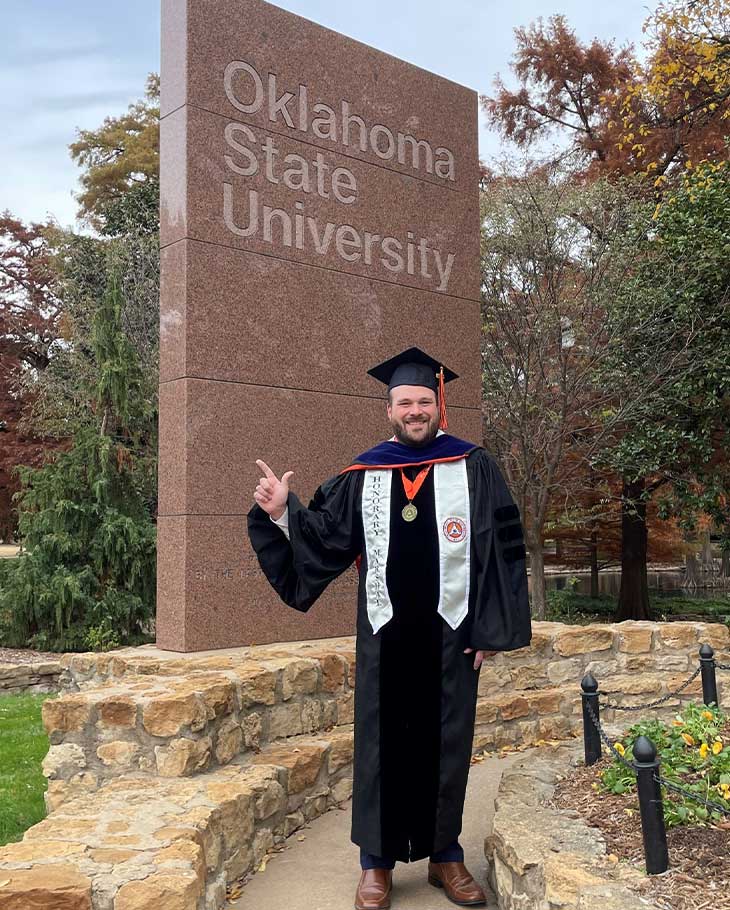
    Physics Ph.D. student named Honorary Commencement Marshal

    Physics Ph.D. student named Honorary Commencement Marshal

    Tuesday, December 5, 2023

    Media Contact:
    Elizabeth Gosney | CAS Marketing and Communications Manager | 405-744-7497 | egosney@okstate.edu

    Jared Austin-Harris, an Oklahoma State University Department of Physics Ph.D. candidate, has been named an Honorary Commencement Marshal for OSU’s fall 2023
    graduate commencement ceremony. Austin-Harris is one of four graduate students selected for the role.  

    This honor tops off Austin-Harris’ time at OSU and adds another distinction to his
    academic career; he has earned two bachelor’s degrees in physics and mathematics,
    master’s degrees in physics and teaching, learning and leadership and he will receive
    his Ph.D. on Dec. 15.
     

    I am excited to be recognized for my hard work and achievements during my graduate
    career by being named as a graduation marshal,” Austin-Harris said. “As a first-generation
    college student, I am humbled to be honored as such.”
     

    As a student, Austin-Harris spent countless hours working in physics professor Dr.
    Yingmei Liu’s lab, dating back to working on his undergraduate degree. The work he
    did as an undergrad is still impacting the lab today.
     

    Since joining our program in 2018, Jared has demonstrated outstanding research ability and potential,” Liu said. “He has successfully
    implemented the first state-of-the-art highly programmable ultracold quantum simulator
    in Oklahoma. T
    his project combines modern developments in cold atom physics with important application-driven
    precise sensor research in a completely unique way.”
     

    His dedication to physics research and advancement has helped him build a resume stacked
    with notable accomplishments and awards. Austin-Harris is listed as the first author
    of four papers published in physics journals and won the 2023 Robberson Summer Dissertation
    Fellowship, 2021-23 OSU Distinguished Graduate Fellowship, the 2022 and 2019 American
    Physical Society Travel Award, the 2021-22 Walt Kolb Graduate Studies Scholarship,
    the Niblack Research Scholarship, and the 2022 Joel Martin Endowed Scholarship.
     

    Jared is a highly motivated student and has been an excellent mentor to several undergraduate students in the physics
    program,” Liu said. “Jared’s work 
    enabled my research group to win major research funds totaling more than $2 million. 

    After graduating with his undergraduate degrees, Austin-Harris pursued a career in
    education, teaching high school students for two years. Following graduation, Austin-Harris
    will continue his work in Liu’s lab in a post-doctoral position that blends his passions
    as an educator and a researcher. 
     

    “This role will allow me to train and guide the next generation of Ph.D. students
    to begin their work in the lab,” Austin-Harris said. “My long-term goals include the
    opportunity to use my skills and love for both education and physics in a tenure-track
    position within academia.”
     

    Story By:
    Erin Weaver, CAS Communications Coordinator | erin.weaver@okstate.edu