Design

BAUX Bio Colors Acoustic Panels Make Noise With Muted Colorways

BAUX Bio Colors Acoustic Panels Make Noise With Muted Colorways

BAUX joins the likes of ABBA, IKEA, and Volvo as an iconic Swedish export cementing itself in the zeitgeist with their inaugural launch into the American market upon the Bio Colors unveiling – six new pastel hues across the Origami Acoustic Pulp range made solely from natural ingredients. The fresh palette, inspired by traditional Nordic architecture, contemporizes their 100% bio-based product that originally launched in 2019 at the Stockholm Furniture Fair.

Individual acoustic tiles in six colors.

Colorways Yellow Terra, Red Mud, Green Soil, Blue Chalk, Natural Wheat, and Rose Clay

The breakthrough builds upon three decades of sustainable design and color theory informing the range’s nuanced narrative, which includes Yellow Terra, Red Mud, Green Soil, Blue Chalk, Natural Wheat, and Rose Clay. Each panel is a particular amalgam of biodegradable raw materials including plant extracts like cellulose fibers and citric acid, chalk, minerals, and earth pigments. Unlike other products that co-opt “green” language, these VOC-, plastic-, and petrochemical-free paints give a unique matte finish while delivering on the promise of a healthier indoor environment.

BAUX acoustic panels in office space.

It’s important to note the “origami” formwork as much as the aesthetic. Available in three linear styles – Sense, Pulse, and Energy – the durable yet lightweight tiles feature a nano-perforated surface, which accepts sound waves then stymied by the honeycomb chambers on the reverse. This architecture also reduces the amount of material used in the manufacturing process making it an inherently sustainable solution.

BAUX acoustic panels in dining space.

“BAUX’s unwavering commitment to sustainability is aligned with the broader design industry’s shift towards responsible choices, contributing to a circular economy,” says CEO and co-founder Fredrik Franzon. “In essence, at BAUX, we transcend the provision of acoustic panels; we humbly shape the future of interior architecture by seamlessly integrating sustainability, functionality, and aesthetics, with a special emphasis on the vibrant possibilities introduced by our Bio Colors range.”

BAUX acoustic panels in auditorium.

From the din of a burgeoning metropolis to the cacophony of a corporate coffee shop, acoustic considerations are becoming increasingly important. Architectural space has a significant impact on emotion with neurophysiological effects on the human brain. The auditory properties of an interior space have noteworthy implications on the design’s success, performance, and how the room is perceived. Sound mitigation is emerging as a fashionable tool to modify those beyond the context of a building requirement to combat noise pollution.

Baux acoustic panels in office space.

And gone are the days of specifiers requesting these products exclusively for the trade. Modern uses range from the traditional implementation in offices, academic settings, healthcare facilities, restaurants, and public forums to accessible applications in the home or even modification of privacy screens and furniture. BAUX seizes on the opportunity to contribute to the greater conversation on its use.

“The positive impact of our proprietary products addresses acoustic challenges in modern spaces and serves as a design element, allowing architects and designers to express creativity,” Franzon continues. “As these considerations become increasingly important, we remain at the forefront of redefining how individuals experience their built environment.”

BAUX acoustic panels in lobby.

For more information on the Acoustic Pulp Bio Colour line, visit baux.com.

With professional degrees in architecture and journalism, Joseph has a desire to make living beautifully accessible. His work seeks to enrich the lives of others with visual communication and storytelling through design. A regular contributor to titles under the SANDOW Design Group, including Luxe and Metropolis, Joseph serves the Design Milk team as their Managing Editor. When not practicing, he teaches visual communication, theory, and design. The New York-based writer has also contributed to exhibitions hosted by the AIA New York’s Center for Architecture and Architectural Digest, and recently published essays and collage illustrations with Proseterity, a literary publication.

Watch the FAV-LE22 Fluid Audio Visualizer Turn Music Into Movement

Watch the FAV-LE22 Fluid Audio Visualizer Turn Music Into Movement

Nanoscale ferromagnetic particles are a truly strange substance. Suspended in an oily fluid, the particles can be made to “dance” under the influence of a strong magnetic source, spasming and gesticulating wildly with movements that almost seem alive. Korean artist and designer Dakd Jung uses the substance to impart his creation, the FAV-LE22 Fluid Audio Visualizer with a mesmerizing and otherworldly level of interactivity to add another dimension to music.

Originally developed by NASA in the 1960s, nanoscale ferromagnetic particles were first used for fuel transport in zero-gravity space, spacecraft, and sealing connections in space suits. Jung notes the substance was also suited as a damper for high-end speakers, alongside use in rotating shafts for motors, and for gas sealing.

“While researching ferrofluids, I discovered their interesting movement and prototyped ferromagnetic particles to respond to music,” explains Jung, “Immediately after posting the production video on social media and overseas community websites, the video spread quickly, and I noted how many people liked it.”

Small square-shaped white audio device with small circular window containing a globule of nanoscale ferromagnetic particles designed to move in relation to music set own top of a glossy white table top desk, surrounded by a pair of monitor speakers, desk lamp, books and other indeterminate objects. Backdrop of large windows in background.

Flooded with requests about collaborative opportunities and custom production designs, the artist/designer went to further develop the design into a production model. Thus began the development of the BurnSlap FAV-LE22 Fluid Audio Visualizer.

Top detail of the speaker grill of the square-shaped white audio device with small circular window containing a globule of nanoscale ferromagnetic particles designed to move in relation to music.

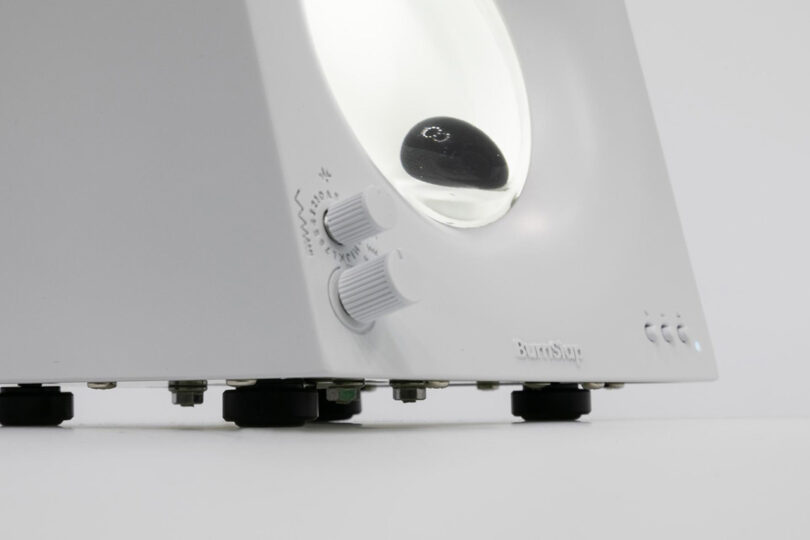
Lower half of the FAV-LE22 Fluid Audio Visualizer's control knobs and circular window showing the globule of nanoparticles at rest.

The biggest challenge proved to be keeping the ferrofluid from sticking to glass. “It is very tricky to keep the ferrofluid from sticking to the glass bottle,” explains the designer. “Most of the existing cheap magnetic fluid toys are difficult to use because the magnetic fluid easily sticks to the glass bottle or the magnetic fluid changes after a certain period of time.” He’d go onto develop a special proprietary glass surface processing technology that prevents magnetic fluid from sticking to the glass surface before moving onto developing the hardware circuit design and software algorithm to make the substance dance.

Detail view of the rear ports and power plug of the FAV-LE22 Fluid Audio Visualizer, alongside its feet stand.

The eventual fruit of his efforts, the FAV-LE22 visualizer, is outfitted with modest 5W speakers and can also be connected for pass-through for more robust audio playback support.

[embedded content]

Unsurprisingly, all of the attention online has made the $985 FAV-LE22 a very popularly sought-after device. Currently sold out with the first batch of visualizers shipped in late November, the designer will hopefully restock soon to bring the magnetic personality of his creation to more admirers.

Gregory Han is a Senior Editor at Design Milk. A Los Angeles native with a profound love and curiosity for design, hiking, tide pools, and road trips, a selection of his adventures and musings can be found at gregoryhan.com.

Watch the FAV-LE22 Fluid Audio Visualizer Turn Music Into Movement

Watch the FAV-LE22 Fluid Audio Visualizer Turn Music Into Movement

Nanoscale ferromagnetic particles are a truly strange substance. Suspended in an oily fluid, the particles can be made to “dance” under the influence of a strong magnetic source, spasming and gesticulating wildly with movements that almost seem alive. Korean artist and designer Dakd Jung uses the substance to impart his creation, the FAV-LE22 Fluid Audio Visualizer with a mesmerizing and otherworldly level of interactivity to add another dimension to music.

Small square-shaped white audio device with small circular window containing a globule of nanoscale ferromagnetic particles designed to move in relation to music.

Originally developed by NASA in the 1960s, nanoscale ferromagnetic particles were first used for fuel transport in zero-gravity space, spacecraft, and sealing connections in space suits. Jung notes the substance was also suited as a damper for high-end speakers, alongside use in rotating shafts for motors, and for gas sealing.

“While researching ferrofluids, I discovered their interesting movement and prototyped ferromagnetic particles to respond to music,” explains Jung, “Immediately after posting the production video on social media and overseas community websites, the video spread quickly, and I noted how many people liked it.”

Flooded with requests about collaborative opportunities and custom production designs, the artist/designer went to further develop the design into a production model. Thus began the development of the BurnSlap FAV-LE22 Fluid Audio Visualizer.

Top detail of the speaker grill of the square-shaped white audio device with small circular window containing a globule of nanoscale ferromagnetic particles designed to move in relation to music.

Lower half of the FAV-LE22 Fluid Audio Visualizer's control knobs and circular window showing the globule of nanoparticles at rest.

The biggest challenge proved to be keeping the ferrofluid from sticking to glass. “It is very tricky to keep the ferrofluid from sticking to the glass bottle,” explains the designer. “Most of the existing cheap magnetic fluid toys are difficult to use because the magnetic fluid easily sticks to the glass bottle or the magnetic fluid changes after a certain period of time.” He’d go onto develop a special proprietary glass surface processing technology that prevents magnetic fluid from sticking to the glass surface before moving onto developing the hardware circuit design and software algorithm to make the substance dance.

Detail view of the rear ports and power plug of the FAV-LE22 Fluid Audio Visualizer, alongside its feet stand.

The eventual fruit of his efforts, the FAV-LE22 visualizer, is outfitted with modest 5W speakers and can also be connected for pass-through for more robust audio playback support.

[embedded content]

Unsurprisingly, all of the attention online has made the $985 FAV-LE22 a very popularly sought-after device. Currently sold out with the first batch of visualizers shipped in late November, the designer will hopefully restock soon to bring the magnetic personality of his creation to more admirers.

Gregory Han is a Senior Editor at Design Milk. A Los Angeles native with a profound love and curiosity for design, hiking, tide pools, and road trips, a selection of his adventures and musings can be found at gregoryhan.com.

The 2023 Isola Design Awards Winner’s Inspiring + Innovative Designs

The 2023 Isola Design Awards Winner’s Inspiring + Innovative Designs

The third edition of the Isola Design Awards has announced its winners!
The competition aims to inspire and empower designers to explore new horizons while pushing the boundaries of their craft. Ten categories explore the latest design trends, with a focus on quality, innovation, and sustainability: Furniture, Seating, Lighting, Tableware, Textile, Product, Material, Sustainability, Outdoor, and Innovation.

Selected by an international jury, each category’s winner was announced at an awards ceremony held at the iconic BasicVillage in Milan on December 1, 2023. Each winner was awarded a trophy designed by the multidisciplinary design studio Tellurico and participation with Isola at Milan Design Week 2024.

The money prize was given to “+/- Brace” by Nils Sorger, the designer most voted by the jurors who also received the highest number of votes from the public. The Community Choice Award went to ProBioGenesis by Hana Cvelbar, Sharifunnisa Mynasabgari, and Mounika Maddipatla, while Sedia 2 by Julia Chiaramonti won the “Selected by Monkey47” award.

Explore the winning projects from each category below!

Furniture + Sustainability Winner: Radiance of Nature with Urushi by Yu Watanabe Photo courtesy Shinji Yagi, Yoshihiro Ozaki + Yu Watanabe

“Urushi lacquer is a sustainable, biodegradable and beautifully glossy natural Japanese sap harvested from the trees in a respectful way. Unfortunately, the traditional craft of Urushi is in decline due to the emergence of alternative materials. This project aims to revitalize this craft and create a space that connects us with nature.”

detail of lighting

Furniture + Sustainability Winner: Radiance of Nature with Urushi by Yu Watanabe Photo courtesy Shinji Yagi, Yoshihiro Ozaki + Yu Watanabe

group of white, beige, purple, and pink ottomans shaped like flowers

Seating Winner: Big Marshmallow (Ottoman) by Paul Ketz Photo: Pim Top

“Big Marshmallow Ottoman is a Louis Quatorze metropolitan fusion. The streams of the segments are like a fountain of youth smoothly flowing around itself. Blush berry bouclette upholstered fellow that serves in many environments from throne room to lounge area.”

pink ottoman shaped like a flower

Seating Winner: Big Marshmallow (Ottoman) by Paul Ketz Photo: Pim Top

yellow, red, and blue posable lights

Lighting Winner: Squeeze Inflatable Lamp by Eva Ausmann Photo courtesy Eva Ausmann

“SQUEEZE is the result of experimenting with air as a design principle. The lamp is made of TPU coated nylon to ensure a constant air pressure. The lamp can be attached to the edge of a table through the pressure created between two air cushions at the bottom of the lamp. The light is controlled by an integrated air pressure sensor which reacts to the light’s membrane being pressed. SQUEEZE is incredibly lightweight and when deflated and folded flat, it keeps transportation costs and emissions low.”

yellow posable light

Lighting Winner: Squeeze Inflatable Lamp by Eva Ausmann Photo courtesy Eva Ausmann

light grey dinnerware collection

Tableware Winner: Circular Ceramics by Sara Howard  Photo: Putu Wiadnyana

“Circular Ceramics is the embodiment of symbiotic relationships and material flows that previously did not exist. Designing a new way of consuming that reduces the harm inflicted on our planet and preserves our natural resources – without compromising on design. The fourteen-piece collection is handmade from locally-sourced materials destined for landfill in collaboration with Kevala Ceramics. The clay body is made from 100% waste sourced from our ceramic factory’s wastewater treatment system. The glaze ranges from 50% to 100% waste, sourced from natural stone factory slurries, glass consumer waste retrieved from rivers, and glaze residue from ceramic factory production, all within a 5 mile radius of the ceramic manufacturing site.”

three black mugs and saucers

Tableware Winner: Circular Ceramics by Sara Howard Photo: Putu Wiadnyana

two people next next to each other wearing a brace around their elbows

Textile + Money Prize Winner: +/- Brace by Nils Sorger Photo courtesy Nils Sorger

“+/- Brace is a pain relieving elbow brace, promoting comfort and reducing the risk of injury or irritation during demanding physical tasks or sport activities. With the +/- Brace app the user can easily customize size, form, structure, and padding. Taking the user’s data and existing users measurements into account, the scripted algorithm calculates the optimal design for your personalized +/- brace. The user could then either fabricate the brace on their own, order it within the maker community, or proceed with buying the brace on the platform.”

flat lay of materials

Textile + Money Prize Winner: +/- Brace by Nils Sorger Photo courtesy Nils Sorger

tall vase with a yellow and black gradiation holding greenery

Product Winner: Paper Stratum Vase by WKND Lab Photo: courtesy WKND Lab

“‘Paper Stratum No. 1’ and ‘Paper Stratum No. 2’ are remarkable pieces created entirely from paper. Through the imaginative repurposing of Harper’s Bazaar Magazine and L’Occitane’s shopping bags, these vases showcase the boundless possibilities inherent in the medium. The construction of these vases involved two distinct techniques, resulting in visually captivating outcomes. One method involved meticulously stacking and layering cut pieces of paper, while the other utilized paper pulp derived from the remnants of the cut paper. The combination of these techniques produced an exquisite interplay of colors and textures.”

tall vase with a yellow and black gradiation

Product Winner: Paper Stratum Vase by WKND Lab Photo: courtesy WKND Lab

two black orbs covered in spots of copper moss

Material Winner: Copper Moss by Piece of Cake Photo: Luda Galchenko

“Using a closed system approach as a starting point, [the] Copper Moss project underlines the similarity between transformation processes observed in non-living matter and living beings, such as flora and fauna, where nothing truly disappears but rather undergoes a metamorphosis into a different substance or material.”

detail of black orb covered in spots of copper moss

Material Winner: Copper Moss by Piece of Cake Photo: Luda Galchenko

three squares of differing substrate materials

Outdoor Winner: BUZZZ – Rethinking the Facade by Emma Johan Photo: Emma Johan

“BUZZZ creates suitable habitats for wild bees within cities by using the untapped vertical potential. By incorporating nesting sites into facade design along with accessible food sources, it provides wild bees a suitable habitat within urban landscapes. By doing so, BUZZZ is not only promoting biodiversity, but also cultivating a harmonious coexistence between people and nature.”

detail of dark brown substrate

Outdoor Winner: BUZZZ – Rethinking the Facade by Emma Johan Photo: Emma Johan

person stands at a table pouring yellow liquid into a large. metal container

Innovation Winner: Biosphere Cellulose Kitchen by Abi Lambert Photo: Austin Presley

“The Biosphere Cellulose Kitchen presents how the production of bacterial cellulose, as a replacement for single-use plastic, can be integrated into our everyday routines. In between doing your laundry and taking out the trash, you could be fermenting, washing, drying, and waterproofing cellulose right at home. This cellulose kitchen is a kitchen island furniture piece that creates storage bags and film cover.”

dark wood kitchen counter

Innovation Winner: Biosphere Cellulose Kitchen by Abi Lambert Photo: Austin Presley

“ProBioGenesis originates from the fusion of words “Pro” (signifying “for”), “Bio” (representing “vīvus” or “living”), and “Genesis” (denoting “creation” and “origin”). When combined together they embody the essence of our philosophy: “For the Biological Rebirth.” The primary focus of our study centered around microorganisms and their mutually beneficial relationships, which contribute to the resilience and effectiveness of greenery. Therefore, we developed a self-sustaining living system that is long-lasting and nurtures a welcoming environment for a diverse range of species to colonize.”

graphically shaped blue and mirrored side table outside a white building

Selected by Monkey47: Sedia 2 by Julia Chiaramonti Photo courtesy Julia Chiaramonti

“The continuous line, a graphical element that usually is infinitely slim becomes a bold object by inflating it. This materialized line forms the backrest and legs and is completed by its own reflection in the mirror polished stainless steel seat. Depending on the observers point of view, the physical and mirrored creates ever changing graphical compositions.”

graphically shaped blue and mirrored side table

Selected by Monkey47: Sedia 2 by Julia Chiaramonti Photo courtesy Julia Chiaramonti

Kelly Beall is Director of Branded Content at Design Milk. The Pittsburgh-based writer and designer has had a deep love of art and design for as long as she can remember, from Fashion Plates to MoMA and far beyond. When not searching out the visual arts, she’s likely sharing her favorite finds with others. Kelly can also be found tracking down new music, teaching herself to play the ukulele, or on the couch with her three pets – Bebe, Rainey, and Remy. Find her @designcrush on social.

IKEA Drops DAJLIEN Collection to Help You Easily Workout at Home

IKEA Drops DAJLIEN Collection to Help You Easily Workout at Home

IKEA aims to transform, or simply aid, the way we exercise at home with the release of its latest collection called DAJLIEN. The limited edition series, comprising 19 versatile products, is designed to support everyday movement in individuals so they can cultivate healthy habits within the comfort of their own home. Scheduled for a global launch in January 2024, the collection hopes to redefine how we view and approach daily fitness routines.

Drawing insights from homes in New York, Chicago, London, and Shanghai, IKEA embarked on a mission to create a collection that seamlessly integrates exercise into everyday life. The result is the DAJLIEN collection, a fusion of smart, adaptable products designed to overcome common obstacles such as motivation, limited space, time constraints, and how traditional exercise equipment tends to clash with home decor.

Angled corner of a room with desk setup with white rolling cart holding fitness gear in front

The name DAJLIEN, derived from Småland (the birthplace of IKEA), translates to “daily” – a nod to IKEA’s commitment of making physical activity accessible to everyone, every day.

closeup down shot of white rolling cart holding fitness gear

down view of rectangular wooden box with green mat on lid which is opened to reveal storage inside

The products are part exercise equipment and part storage, ranging from exercise mats to ring-shaped dumbbells to rolling carts, all of which seamlessly blend into home decor. The focal point of the collection, the DAJLIEN bench, not only facilitates a variety of bodyweight exercises but also doubles as a storage solution and versatile piece of furniture.

down angled shot of man stretching with one leg out in front of young gir stretching on two green oval yoga mats

down shot showing partial view of green yoga mat and weights, as well as a pink strap for stretching

Sarah Fager, Designer at IKEA of Sweden, explains: “Not everyone feels safe or comfortable going to a gym, and at home, we often deal with small space and time constraints. DAJLIEN was born from the desire to find smart solutions that address these limitations and help people create a convenient and motivating place for exercise.”

angled down shot of two light green weight rings on top of darker green fitness mat

angled shot of woman on floor on light green fitness mat with one leg pulled in to stretch

partial view of woman holding herself up from the floor with her arms straight with square green box beside her

older woman with gray hair in light green casual sweatsuit sitting on dark green fitness mat

The collection’s subtle colors and details are deliberately chosen to support its focus on seamlessly integrating into the home, becoming a natural part of the everyday environment.

view from behind woman leaning forward on floor with pink band wrapped around feet stretching

closeup side view of woman on bent arms looking at small green radio

The collection extends beyond traditional fitness gear, incorporating recovery and stress relief products such as an air purifier, yoga straps, kneepads, a massage ball, and a portable Bluetooth speaker, all in soothing shades of green, yellow, pink, and white. Additionally, the collection offers wearable pieces like slippers and ponchos, promoting post-workout relaxation and overall wellness.

woman bent forward with light green ring weight in bent arm while leaning forward on wood blocks working out

looking towards the upper half of a woman in a green shirt holding a light green ring weight with her face showing through center

woman on one knee with other knee bent working out with green ring weight

woman on one knee with other knee bent working out with green ring weight

person standing working out with one leg up holding two green ring weights

woman's torso in white tank with a waist bag in green

partial torso view of person in white tank rolling up dark green yoga mat

two pairs of light yellow slippers propped up on a wall

two metal stands holding clothing and workout gear in room

down view looking at partially open mesh bag

man carrying mesh white bag over shoulder walking away

The DAJLIEN collection will be available for six months or until supplies last starting January 2024 at IKEA stores everywhere.

Caroline Williamson is Editor-in-Chief of Design Milk. She has a BFA in photography from SCAD and can usually be found searching for vintage wares, doing New York Times crossword puzzles in pen, or reworking playlists on Spotify.

The X Gran Berlinetta Vision GT’s Athletic Elegance Is Virtually for Everyone

The X Gran Berlinetta Vision GT’s Athletic Elegance Is Virtually for Everyone

“Our goal was to create a timeless design rooted in the essence of motorsport,” explains John Krsteski, Genesis Senior Chief Designer during the recent Gran Turismo World Series World Finals in Barcelona. With its sweeping flame-like silhouette, the Genesis X Gran Berlinetta Vision GT Concept does indeed embody the movement of a vehicle moving so fast it almost appears to be racing by even when parked.

The X Gran Berlinetta VGT Concept was conceived from the outset for the track – a virtual track – a design study imagined to demonstrate “Genesis’ passion and intent for the Vision Gran Turismo.” Just in case you aren’t a gamer, that isn’t a real world racing event, but a series of concept cars designed specifically for the Gran Turismo video game, each developed by a cross-section of the world’s top automobile manufacturers to compete (but also to peacock their concepts toward an audience already primed for appreciating exploratory and imaginative automotive design).

Overhead angled side view of magma orange paint colored Genesis X Gran Berlinetta Vision Gran Turismo Concept

And the flaming hot X Gran Berlinetta VGT Concept very well might be the Korean automotive brand’s most evocative exploration of what it means to go as fast as possible, comfortably as possible.

On the outside, Genesis designers have sculpted a prowling profile with a bubble topped cockpit. Up front, a dip-lipped large Crest Grill outlined by Genesis’ Two Lines operate as a brand identifier flowing from the sides toward the fascia, with the vehicle’s sizable V-shaped maw and aerodynamic construction sculpted across the car’s body becoming even distinct when the concept’s Quad Lights are illuminated.

Front wheel of the magma orange paint colored Genesis X Gran Berlinetta Vision Gran Turismo Concept

Enormous spider webbed wheels accentuate the low profile of the body while also drawing eyes toward its pronounced haunches.

Rear detail view of magma orange paint colored Genesis X Gran Berlinetta Vision Gran Turismo Concept and its elliptical spoiler

Genesis exterior design team concludes the sculpted volume of the X Gran Berlinetta VGT Concept with an elliptical aerodynamic rear that essentially transforms the tail end into one enormous Genesis emblem framed by a tightly wound spoiler. It’s faintly reminiscent of the Ferrari F40’s signature spoiler from ground level in its commitment to aerodynamics, but instead of an audacious rectilinear tail, this one seems purse-lipped about its intent to direct downward force and mitigate lift.

Rear detail view of magma orange paint colored Genesis X Gran Berlinetta Vision Gran Turismo Concept and its elliptical spoiler

And that riotous paint job? The bright orange – “Magma” to be exact – is a color Genesis says was created to represent Korean culture’s emotive and passionate spirit, and supposedly references the country’s dormant trio of Holocene volcanoes.

Magma orange paint colored Genesis X Gran Berlinetta Vision Gran Turismo Concept parked in a virtual underground lot

The wig-whipping 1071hp concept operates as a hybrid affair, powered by a front mid-mounted Lambda 11 V6 engine good for 870hp aided by an electrically assisted Yasa E motor responsible for delivering an additional 201hp and 196 lb-ft of torque. Inside, the interior cabin is appointed handsomely just north of spartan, with quilted padding and carbon judiciously applied across surfaces to find a balance between the concept’s race track aspirations and the luxury Korean automaker’s more sophisticated proclivities, resulting in the realization of Genesis’ Athletic Elegance design ethos.

Interior driver side of the Genesis X Gran Berlinetta Vision Gran Turismo Concept with yolk steering wheel, quilt padded interior and carbon fiber detailing

Mirroring its exterior, the interior’s body hugging seats communicate the possibilities of maximum acceleration available in an instant, with a yoke-style steering wheel outfitted with its own screen to off-board speedometer, odometer, fuel, and other essential information from the dash to a more intimate proximity and keeps the driver’s view unobstructed. Additionally, a panoramic digital interface supplements the vehicle’s monitoring system with a digital wingspan nearly reaching from one side to the other.

Interior driver side of the Genesis X Gran Berlinetta Vision Gran Turismo Concept with yolk steering wheel, quilt padded interior and carbon fiber detailing

Sketches of the Genesis X Gran Berlinetta Vision Gran Turismo Concept's exterior

Sketches of the Genesis X Gran Berlinetta Vision Gran Turismo Concept's exterior

Sketches of the Genesis X Gran Berlinetta Vision Gran Turismo Concept's exterior illustrating air flow from the front of the car toward the rear.

If you want to eventually get into the Genesis X Gran Berlinetta VGT Concept, we’ve got some good news and bad news. Unfortunately, as is often the case with the most riveting of automotive design, the full-scale concept won’t be hitting dealers any time soon, if ever, joining Genesis’ X Convertible, X Speedium Coupe, and X Concept as purely design language exercises. The good news? Everyone will be invited to test drive the concept virtually as a drivable model in Gran Turismo 7 starting January 2024, undoubtedly a much more affordable route toward the emotional performance promised by Genesis.

Gregory Han is a Senior Editor at Design Milk. A Los Angeles native with a profound love and curiosity for design, hiking, tide pools, and road trips, a selection of his adventures and musings can be found at gregoryhan.com.

Morrama Issé Mixed Reality Glasses Focus on Fitness and Fashion Together

Morrama Issé Mixed Reality Glasses Focus on Fitness and Fashion Together

With augmented and virtual reality wearables altering the way we see and experience the world trending toward mass adoption, industrial design studio Morrama is betting the mainstream will seek mixed reality wearables with a layer of fashionable customization to suit their lifestyle alongside technology embedded to empower their active fitness goals.

Morrama’s Issé smart glasses concept envisions a mixed reality wearable with two customizable bio-materials constructed frames allowing the wearer to easily switch out frame elements from a more fashionably-focused appearance to one optimized for fitness tracking, and vice-versa.

Morrama’s two frame approach – one softer and more lifestyle-led; the other, more sports oriented – allows wearers to swap out their frames according to their activity, whether it be commuting to work or while hiking a trail.

“We see the future of tech as less about data and more about expression,” says Jo Barnard, Founder and Creative Director at Morrama. “Sophisticated data can be turned into beautiful user interfaces, removing information overload and focusing more on experience.”

Morrama's Issé smart glasses concept floating above a charging stand.

Morrama's Issé smart glasses concept with its off-white fitness frame angled and floating the air.

With 95% of the electronics concentrated in the lenses, the frames would remain low-tech and therefore easy to disassemble in case more advanced sensors become available. Additionally, due to their shorter life-span, frames could be manufactured from bio-materials that are digested by bacteria or that simply break down more quickly.

Simulated view while exercising wearing the Morrama's Issé smart glasses concept, projecting the wearer's digital self running ahead to motivate a quicker pace.

Issé’s lenses are envisioned to project augmented reality notifications about daily health stats and biofeedback throughout the day. Many of us already wear a smart watch daily, and the smart eyewear will only magnify attention toward personal bio-data tracking with even greater visibility, and the Issé is engineered to help motivate improvement by projecting our digital selves while doing activities like running.

The studio believes advancements in micro-LED displays, retinal projection, and solid state batteries promise to significantly reduce the size of smart eyewear in the next five to ten years to bring the mixed reality world not only into the mainstream, but out in the open as fashionable eyewear.

Issé concept shown disassembling lens section from arms, allowing wearer to change out frames from fitness to fashionable forms.

Young woman with hair put up in a bun wearing Morrama Issé Mixed Reality Glasses facing her digital counterpart face to face.

Morrama’s timescale may be even be a bit conservative, noting Ray-Ban x Meta’s new smart sunglasses and similar eyewear designs are already coming to market, offering designs both comfortable and more adaptably fashionable and acceptable to be seen out in public.

Ben Melvin, Design Lead at Morrama, notes we’ll soon be comparing ourselves against our digital twins to help motivate ourselves during an exercise, or what our bodies might look like if we stuck to a particular diet or training program. Whether this sounds like a promising motivational tool or the makings of dystopian trend toward dysmorphia is up for debate.

Gregory Han is a Senior Editor at Design Milk. A Los Angeles native with a profound love and curiosity for design, hiking, tide pools, and road trips, a selection of his adventures and musings can be found at gregoryhan.com.

Presenting: The Winners of the 2023 L A M P Competition

Presenting: The Winners of the 2023 L A M P Competition

As the exclusive media partner for the L A M P 2023 International Lighting Design Competition, we’re excited to announce this year’s winning designs! This year’s contest garnered submissions from 110+ cities from 40+ countries, and the designers and their work were juried by Rakuma, Atelier Areti, and the L A M P co-founding partners. The winners of each overall category (Student, Professional, and Manufactured), as well as the winners of each subcategory, are listed below. Congratulations to all!

Student Overall / Floor: Inside by Shevtsova Anastasia (Moscow, Russian Federation)

The floor lamp “Inside” invites you on a journey through the world of sensations and immerses you in a flow of thoughts, detached from everyday life. It is about internal dialogue, the depth of relationships with oneself and the surrounding world, and personal space.

table lamp on desk

Student Portable: Taut by Lieyah Dagan (Los Angeles, California)

Taut is a lamp designed to be played with and changed. Its two-part design features a flexible flat sheet that can be inserted into a pronged base in different ways to create a variety of lamp shade forms and lighting effects. The shade is held in place through tension, making it easy to customize.

two people adjusting pendant lamp

Student Pendant/Sconce (tie): Hortus by Ka Wai Yuen (Hong Kong)

This innovative DIY design set offers fresh opportunities for users to nurture, engage, and revive their intimacy. The lampshade’s wooden structure, free of glue, allows users to weave rattan-shaped fabric onto the frame, creating personalized lampshades. The kit includes flower and bird- shaped magnets and cards, enabling users to infuse sentiments and memories, and fostering shared experiences with their partners.

pendant lamp over black console

Student Pendant/Sconce (tie): Material Objects: PS/PND by Rachel McGovern (Los Angeles, California)

The PS/PND pendant showcases the common yet structurally supportive perforated sheet in collaboration with electrical braided sleeving. Used for general wire management, bundling and identification. The braided sleeving is now used to deform a single LED strip to create a dynamic weaving of light, color and pattern.

white portable lamp

Student Portable (tie): – Mellow by María del Mar González (Almería, Spain)

Mellow is a small portable outdoor lamp designed for a dinner with family or friends in a garden, park or beach. Since the light is emitted around but not upwards, it allows to illuminate the table and the environment without invading the visual field while having a relaxed conversation.

table lamps on white desk

Student Portable (tie): Lume by Chris Jing (China)

Lume is a family of lamps to elevate the coffee-drinking experience. Lume gives people a relaxing mood, sitting quietly beside that cup of coffee. Lume Outdoor is used within coffee stores, and Lume Home is a premium collectible to bring the coffee experience home. They share the exact same lighting unit. The design challenges are incorporating LEDs into a small space and achieving convenient recharging purposes.

white pendant lamp with star patterns

Student Outdoor: Starfall by Haoda Ma (Los Angeles, California)

Starfall pendant works with wind to create memorable starry night effects. The inner perforated brass tube projects starry light effects onto the outer recycled polyethylene tube. The inner tube is fixed in place, while the outer tube hangs from the top of the light fixture and moves subtly and elegantly with the breeze. The subtle movement in the outer tube allows the star projection to flow, creating a magical and transforming starry night, while the downlight provides a steady light source for general usage.

white sculptural lamp

Professional Overall: Minima by PatkauProducts: John Patkau, Zachary Morris (Vancouver, Canada)

The name Minima tells the story of the surface. We developed it through many experiments of stretching, bending, restraining, pulling, warping, and frequently destroying various materials. The complex form that emerged is the minimum 3D surface between 2D curves. It is internally static, manufacturable, and visually dynamic.

minimalist slanted table lamp

Professional Table: Spire by Aris Rubio / Aris Studio) (Banyoles / Spain)

Spire’s design moves away from the traditional ecological product and seeks new alternatives to over-exploited materials such as wood. It is designed to simplify processes and can be made from different materials, such as recycled aluminium, which is presented in indefinitely reusable tubes to reduce the carbon footprint.

pendant lamp next to table with orange soda

Professional Pendant/Sconce: Trapeze by Eric Kirwin (Toronto, Canada)

Trapeze is a fixture that captures suspense. A dance between the pull of the anchor, and the push of the body delivers a sense of kinetic wonder and visual gratification. A moment of tension delivers a composition of stillness and precarity. Physical properties are carefully juggled to capture a precise relationship between gravity, resistance, and resolution.

white sculptural lamp

Professional Floor (tie): Minima by PatkauProducts: John Patkau, Zachary Morris (Vancouver, Canada)

three white sculptural floor lamps

Professional Floor (tie): SONIAH by Victoria Yakusha / Faina Design (Kyiv, Ukraine)

SONIAH from Ukrainian ‘soniah’ means a sunflower. Highly appreciated on Ukrainian land from where comes the author of the collection, a sunflower serves as the main symbol rebirthed in the form of the objects. Primitive Soniah floor lamps stem from the ground stretching their tall sculptural stalks up to the sky.

two white and wood table lamps on black desk next to window

Professional Portable (tie): Cosmos by Myrto Grigori (New York City, NYC)

Cosmos lamps serve as an evocative representation of the theory that the universe is shaped like a donut or a torus. The central axis and two vortices on either end constantly cycle energy and information, while anything introduced into the vortex will continuously cycle around the torus in an endless loop.

blue and red table lamp

Professional Portable (tie): Hero by Gabriele Cappelletti (Carimate, Italy)

Hero is a portable lamp designed for kids. One of the primary goals of the Hero lamp is to ignite child’s imagination. By resembling the shape of a superhero, the lamp becomes a source of inspiration, encouraging kids to create their own stories and adventures. Hero is designed to be more than just a lamp; it’s meant to be a source of comfort and security for children.

grey table lamp with transparent disc

Manufactured Overall / Table: Spegla Mirror Lamp by Jochen Lavéno Mangelsdorff (Stockholm, Sweden)

The two-sided Spegla Mirror Lamp is based on a specific mirror glass that is not completely opaque. The result is an interior object that acts as a mirror when the lamp behind the circular glass sheet isn’t lit.

woman next to three pendant lights

Manufactured Pendant/Sconce: X lamp by Hassene Jeljeli, JK lighting, JK design SARL (Tunis, Tunisia)

X lamp is the result of a project to create a square monolithic lamp by assembling parts from a single material. The collection consists of three table lamps and three smaller pendant lamps, with the aim of producing as minimal waste as possible. The heart of these lamps is made of Tunisian plywood, a very banal material in Tunisia, and the idea was to ennoble it. The light is diffused upwards and spreads warmly through the translucent marble.

textile lamp on brown table

Acoustic: Illumiknotti by Alicia Tam Wei (New York, NYC)

“ILLUMIKNOTTI” seamlessly intertwines form, function, style and sustainability. Warm globes of light are wrapped within soft, inviting knotted forms. Offered in both pendant and table lamp styles, the knit forms are based on mathematical concepts such as torus knots and Borromean rings. Produced using a machine-knit technique, our designs harness mathematics to push the boundaries of conventional production methods to create sound-absorbing soft sculptures with embedded lighting elements.

tabe lamp on wooden shelf

People’s Choice Manufactured (tie): Helios by Studio Zoran Strijbosch (Amsterdam, The Netherlands)

Drawing from ancient concepts, “Helios” pays homage to light’s circular dance. This design invites interaction, allowing you to play with light’s intensity by moving the sphere. Just as Helios shaped the sun’s path, you become the one who controls the brightness, creating a captivating dance of light.

hand turning on blue faucet lamp

People’s Choice Manufactured (tie): Faucet by Blanca Codina (Barcelona, Spain)

The Faucet Lamp pours light instead of water. This luminous object preserves the curved silhouette of a faucet employing it for a different purpose. Functioning as a lamp further allows the faucet-shaped item to be displaced from its usual location in the kitchen or bathroom to other rooms in the home space. This lamp is part of a series of explorations into how existing forms can be employed for different functions, aiming to create new conversations around everyday objects.

wooden table lamp on night stand

People’s Choice Professional: PlankNPlay by Thalis Nicolaou Studio (Nicosia, Cyprus)

Plank N’ Play is an innovative flat-pack lamp that seamlessly merges form and function. Our primary goal was to reimagine lighting design, focusing on sustainability and user engagement. Plank N’ Play challenges convention by harmonizing a natural wood receiver with a contemporary painted-finish base, highlighting material contrast.

hand holding a blue table lamp next to a book and cup and mug

People’s Choice Student: Pepper by Alessa Joanna Grotz and Franziska Antonia Hammer / STUDIO LESSONI (Germany)

Pepper is designed with the intention of creating a portable luminaire that allows atmospheric and functional light. The user is able to adjust the lighting situation by rotating the shell for direct or indirect lighting and the possibility to dim mechanically. The luminaire wraps the room into a soft light by indirect wallwashing, but also offers the option for a direct reading light, which makes it the perfect bedroom lighting.

Please follow @lampthecompetition on Instagram and sign up to receive updates and information about the 2024 competition!

As the Senior Contributing Editor, Vy Yang is obsessed with discovering ways to live well + with intention through design. She’s probably sharing what she finds over on Instagram stories. You can also find her at vytranyang.com.

F5: Anand Sheth Shares a Thoughtful Gathering Structure, Asian Embroidery + More

F5: Anand Sheth Shares a Thoughtful Gathering Structure, Asian Embroidery + More

Anand Sheth is the man creating a sense of discovery through the design process at Studio Anand Sheth, which opened its doors in 2021. The San Francisco-based architecture and interiors firm practices holistic design that’s strong in concept and artful in point of view. From arts-driven hospitality spaces to gathering-focused residences to localized workplace environments, Anand’s work is resourceful and inventive, reframing our perspective by focusing on changemaking. The result is that each project adds energy to – and shifts the dynamics of – our every day.

“The architectural process has been a part of my entire life. My dad is a construction manager, and a former engineer, and I was surrounded by dozens of copies of old school blueprints at home,” Anand shared. “One of the tasks that folks in the industry will know well is “clouding changes” on multiple copies of drawings – and that’s something I helped him do when I was a kid. Not sure if that was my “hobby,” but I definitely enjoyed spending time doing it.”

He continued: “Design, as opposed to the process of architecture, came to me in waves afterward. I recall sketching floor plans of homes for my childhood friends based on their personalities – indoor pools for the athletes, an entire floor of guest rooms for the social ones, etc. As a teenager, I observed the diverse built environment between South LA and the beach cities. And my career in design formally began after I graduated high school and moved to San Francisco to study architecture.”

Anand Sheth Photo: Steph Pann

Anand’s process is cohesive and very communicative, beginning with hand sketches, architectural drawings, and diagrammatic design representations. These phases work together to establish the intent of each project and fuel it to the finish line. It’s through a clarified aesthetic vision and what his clients value individually that allows the individual narratives to emerge.

That narrative is hugely important to Anand, and leads to what he might do professionally in a parallel life. “I would be a writer. I like to see my architectural work as narrative-rich, and I’m often searching for the “story” behind the spaces and objects I encounter. But there’s something very satisfying about literal storytelling. It’s hard work, and I hope I get there one day, to achieve a direct connection with the reader.”

Anand has created numerous hospitality spaces, including Bar Part Time, Hi Felicia, Sluts the Wine Bar, and Popi’s Oysterette, and several private residences in the Bay Area and Los Angeles. Throughout his career, Anand has strived to balance architecture with service, having served as the Design Lead for GROUND, the non-profit urban platform for activating formerly vacant lots and buildings to restore Black use, an artist-in-residence with Ruth Asawa School of the Arts, and a mentor through CCA and NOMA’s Project Pipeline.

We’re happy to have Anand Sheth join us for today’s Friday Five!

geometric architectural sculpture

Photo courtesy Jose Castellar

1. “La Folie” by Tarek Shamma

I’m uncharacteristically satisfied, and mildly obsessed, with “La Folie,” a gathering structure designed by Tarek Shamma in Melides, Portugal, for his client Christian Louboutin. It’s inspired by dozens of art and cultural themes including James Turrell, Rajasthani stepwells, the Jantar Mantar observatory in Jaipur, Carlo Scarpa, and more. Perhaps my favorite aspect is the radically honest name, La Folie, or The Folly, “because it’s just for fun.”

side-by-side images of two people posing for a photo

Photo courtesy Karu Research

2. Contemporary South Asian Embroidery

Emily Bode popularized eastern embroideries in contemporary western menswear, and deserves credit for that, but it’s abundantly clear that she’s tapped into a craft that is centuries old, sacred, and not coincidentally ancestral to her Indian-American spouse. I’m thrilled to see how many South Asian fashion companies are coming online in recent years, focusing on intricate narrative-rich embroidery that transcends boundaries. Fashion brands like Karu Research, Adish, Aomi, Harago, Two Point Studio, Rastah, Darwaza, Wunderhaus, and Johargram. I’m lucky to own some pieces from this emerging movement of designers and they are some of my favorite things to wear.

six images of people and everyday objects

Photos courtesy Miguel Adrover’s Instagram

3. Miguel Adrover’s Instagram

I have no idea how or when I stumbled upon the Instagram page for fashion designer Miguel Adrover, but it hasn’t disappointed. The artist’s compelling and confronting self-portraits amaze me – his proportions, age, and fearless costuming are superb. He’s been ahead of his time since he rose to fame in the aughts. Adrover has an urgency to his aesthetic that is impossible to unsee.

neutral toned tile sculptre resembling a fireplace and mantle

Photo courtesy Jeff Martin

4. “Sarcophagus” Ceramic Sculptures by Jeff Martin

Jeff Martin Joinery has recently produced a series of ceramic sculptures featuring an evocative dimensional tile that appears almost soft, like extruded dough. He’s calling everything “sarcophagus“ (table, console, etc.) and I’m impressed by the volumes and colors that seem to pull together architecture, textiles, ceramics, and viennoiserie.

four depictions of children experiencing difference emotions

Photo courtesy Mooni

5. Ángela Leyva’s Portraits

I first discovered Ángela Leyva’s portraits this spring at Salon Acme, the art fair in Mexico City. Their work scares me, honestly. I’m frightened to see beyond the familiar lines and curves of the human face and into the abject psyche, but not necessarily the psyche of the subject – it’s reflecting onto me as if I’m the only one with this visual perspective. I find myself considering what’s hidden in plain sight. It’s a smash hit and I purchased a piece for my San Francisco flat this year.

Work by Anand Sheth:

Bar Part Time is a visionary wine bar in the Mission District of San Francisco. Three friends and wine nerds ganged together to create something special – a vinyl-driven community dance hall, natural wine dive bar with an eclectic aesthetic honoring all the places and people they love. Together, we took over an abandoned dive bar where we all spent our early 20’s; strategically repairing what worked and replacing what didn’t.

Studio Anand Sheth assembled a team of favorites, including millworker extraordinaire Brandt Hewitt (Medium Small) and go-to hospitality contractor Cookline Construction. We sourced vintage light fixtures from eBay and Stuff (a vintage store around the corner), power-clashed patterns in the flooring and restrooms, and enlisted Meryl Pataky to create the perfectly nostalgic neon pieces above the bar and in the window.

outdoor space with light wood dining table and bench

Photo: Michael Irwin

Studio Anand Sheth teamed up with Bay Area-based landscape architect Dune Hai to create a resourceful and color-driven garden as an extension of this Los Angeles couple’s first home. The result is an outdoor living room concept that came to life as if it always existed within the tranquil hills of Eagle Rock.

Inspired by the forms of the Burle Max rooftops in Brazil, they carved curves into linear cedar elements to allow earth and plantings to take up more space. Now, living greens – from Fan Palms to Monkey Flower to Silver Feather Grass – thrive between the outdoor “rooms” for living, dining, warming, and (eventually) soaking.

front of a commercial space with cement planters, seating, and two coffee tables

Photo: Nicholas Ruiz

The firm’s design of Retool’s Mission District headquarters encourages observation, personal connection, and reflection. Consideration of the potential internal happenings inspired the space’s design foundation: a new perspective of “the workplace,” company culture, and – most importantly – its people.

We transformed 72,000 square feet of commercial office space across four floors of a historic industrial building. Careful design decisions tie the four-floor design program together with purpose and ease — art from architectural artists like Rowan Bouroullec, Natascha Madeiski, Sohan Murthy and Tauba Aerbach fill the walls. All conference rooms feature a painted wainscot application using Farrow and Ball colors that coordinate with Maharam Fabrics upholstery. We added accessories like accent pillows, rugs, coasters, planters, and Japanese toolboxes to complete the space.

interior office space reusing unexpected materials

Photo: Joseph Kramm

The New York iteration of Retool’s workplace design features a palette of wall finishes from repeat vendors and Abnormal Anonymous, smartly reused furniture, and strategic lighting upgrades throughout. The firm broke the typical formal office reception in favor of welcoming guests and employees into a working lounge, outfitted with a second custom neon sign by NY-based Ali Feeney over brand-reminiscent wallpaper. The lunchroom and meeting rooms adopted a unique painted wainscot approach, a favorite for accenting spaces with exposed ceilings, and acoustic materials integrated into ceilings, walls, lighting, and custom curtains.

commercial space with black and white patterned countertops and azure blue tiled sides

Photo: Nicholas Ruiz

Stepping inside Popi’s Oysterette evokes a family dinner setting that’s right on the Northern California coastline – think crashing waves, shimmering reflected daylight, twilight, and sandy boulders traversed in dress shoes. Founders of the popular Tacolicious restaurants spun off to create a jewel-box seafood restaurant for Top Chef alum and local “Seafood Queen” Melissa Perfit (Bar Crudo, Sister) – the buzzy corner spot slings the best oysters, seafood, and crisp wines the region has to offer.

Studio Anand Sheth developed a deep and strategic palette of seaside-inspired elements. A custom blue terrazzo by Concrete Collaborative clads dining counters providing a vibrant backdrop to the Oysterette’s offerings, while stacked azure zellige tiles create a grid of natural texture. Sconce lighting from Cedar and Moss are the pearls, too on-the-nose? The restroom is wrapped in Douglas fir panels that reference the exposed ceiling structure and new furnishings, and ceramic tiles from Zia and fluid wallpaper depicting swimmers. Hand-painted signage by Manny Fabregas adorns the exterior and hearkens back to the historic fish markets of the Marina District. The resulting experience is playful, direct, and memorable.

Kelly Beall is Director of Branded Content at Design Milk. The Pittsburgh-based writer and designer has had a deep love of art and design for as long as she can remember, from Fashion Plates to MoMA and far beyond. When not searching out the visual arts, she’s likely sharing her favorite finds with others. Kelly can also be found tracking down new music, teaching herself to play the ukulele, or on the couch with her three pets – Bebe, Rainey, and Remy. Find her @designcrush on social.

One Sofa System for Saba, Endless Configurations for Us

One Sofa System for Saba, Endless Configurations for Us

Saba’s product catalogue just got a new cozy addition. Designed by Nicola Pavan for the Italian furniture brand, the Metis sofa system is the ultimate solution for flexible seating design that remains elegant, luxurious, and comfortable. Its name is derived from the Greek word “Mètis” which refers to a practical intelligence, one that solves everyday problems with ingenuity and out-of-the-box thinking. The Metis collection eliminates the pain point of needing to find the right-sized sofa with its reconfigurable modular system.

[embedded content]

Metis comprises two bases, a rectangular size and a square version, as well as a back rest and a back cushion. Visible metal hinges connect the different parts through hooks and rotations. By adding and rotating the two different size seat bases, the user can create multiple configurations to easily fit a space and foster a specific kind of environment whether it be intimate or highly sociable. The quilting that sculpts the volumes of the seats, backrests, and armrests gives the sofa system its memorable look.

white sofa in elegant white living room

round grey cushion on white sofa

white sofa in elegant white living room

white sofa below an abstract artwork

terracotta sofa in elegant white living room

terracotta sofa in elegant white living room

brown sofa system in white living room

close up details of brown sofa system

To learn more about the Metis collection, visit sabaitalia.com.

Photography by Mattia Balsamini.

As the Senior Contributing Editor, Vy Yang is obsessed with discovering ways to live well + with intention through design. She’s probably sharing what she finds over on Instagram stories. You can also find her at vytranyang.com.