The School for Advanced Research helps cultivate Native artists.
The journey for each artist may be different, yet the Santa Fe-based educational institution recently named is 2023-2024 Native artist fellows.

The School for Advanced Research helps cultivate Native artists.
The journey for each artist may be different, yet the Santa Fe-based educational institution recently named is 2023-2024 Native artist fellows.


Blue Mountain Lake, NY – Adirondack Experience (ADKX) will hold a grand opening celebration for “Artists & Inspiration in the Wild” on Sat., July 1. This permanent exhibit, which showcases an inclusive and wide-reaching interpretation of Adirondack art, is the most comprehensive showing of the museum’s art and design collections in its history. In celebration of the exhibition unveiling, the day will be filled with art-related activities and programming, including artist demonstrations, live music, live muralling and screen-printing.
ADKX is inviting visitors to the opening with a fun-filled day devoted to art and art-making. Following an official ribbon cutting ceremony featuring Nancy Reardon Sayer, chair of the ADKX Board of Trustees, David Kahn, executive director of ADKX and artists Takeyce Walter and Benjamin “Ben” Benedict, visitors will be invited to explore the exhibit. Guests will also have the opportunity to participate in the wide array of activities that will be available across the campus.
“Five years in the making and we’re finally able to share Artists & Inspiration in the Wild with the public,” said Chief Curator, Laura Rice. “We couldn’t be more thrilled to welcome visitors into the space and give them the opportunity to connect with the Adirondack landscape through multiple generations’ worth of art.”

Adirondack Experience staff on opening day of the new Artists & Inspiration in the Wild exhibit. Adirondack Experience Facebook page photo.
“For ADKX to now house the largest exhibition devoted to Adirondack art in the world is an incredible achievement,” said Kahn. “The collection speaks to the history, culture, and natural beauty of the region, and our grand opening celebration marks the beginning of telling that story from the perspective of our talented artists.”
The day-long event promises to be an interactive and dynamic experience. Throughout the day, ADKX will be abuzz with plein air painters, live muralling, screen-printing, games, and a chance to enjoy ADKX’s premiere new experience. Guests of all ages will get to enjoy live music performed by Jamcrackers and Warden & Co. and engage in activities provided by artists, including:
Print the Park! Botanical Sun Prints with ADK ArtRise (10:00 AM – 4:00 p.m.)
ADK ArtRise will be making a piece of art about summer, sun, and the beauty of nature in the Adirondack Park. The piece will be made by exposing “cyanotype” paper that turns a beautiful blue once developed. ADK ArtRise will supply materials and various botanicals for visitors to create a unique print to take home as well as one to contribute to the overall piece – a one-of-a-kind artwork made of multiple prints, which will have a permanent home at ADKX.
Soul & Ink (10:00 AM – 5:00 p.m.)
Soul & Ink, a live screen-printing team, will be on site all day creating a custom-designed commemorative print, available only on July 1st. The first 500 visitors will receive a free print to bring home.
Write About Art With the Adirondack Center for Writing
At the Adirondack Center for Writing (ACW) table, visiting writer Erin Dorney will be on hand with guided, family-friendly prompts for visitors to reflect on the art they experienced in the new Artists & Inspiration in the Wild exhibit. Visitors can also add their writing to the ACW Poetry Machine to be shared with readers across the Adirondacks.
Some of the exhibition’s featured artists will also be on campus throughout the day, including:
Barney Bellinger – A self-taught painter and sculptor whose work has been exhibited at the National Museum of Wildlife Art and appears in the permanent collections of the Orvis Company and the Smithsonian Institution.
Carrie Hill – A Mohawk basketmaker, Hill is Haudenosaunee from Akwesasne Mohawk Territory and owner of Chill Baskets. In 2014 she began pursuing her family tradition of weaving black ash splints and sweetgrass basket making. Her work has been sent all over the world including an entire collection representing the Haudenosaunee People for the U.S. Embassy in Swaziland, Africa.
Takeyce Walter – A Jamaican native, award-winning contemporary American painter and art instructor, Walter creates paintings that present the landscape in all its glory—flowing rivers, majestic skies, and picturesque lakes. Her work has found homes in many private collections across the country and internationally, including local museum and hospital collections.
This exhibition was made possible in part by Empire State Development Corporation, the New York State Council on the Arts, the Institute of Museum and Library Service and the National Endowment for the Humanities. The Adirondack Experience is extremely grateful to the generous donors, foundations, and corporations who supported Artists & Inspiration in the Wild.
About Adirondack Experience, The Museum on Blue Mountain Lake:
Adirondack Experience, The Museum on Blue Mountain Lake (ADKX), accredited by the American Alliance of Museums, shares the history and culture of the Adirondack region through interactive exhibits, hands-on activities, and culturally rich collections in more than 24 historic and contemporary buildings on a 121-acre campus in the heart of the Adirondacks. The ADKX offers a broad range of programs and activities including special and permanent exhibitions, the 19,000-square-foot Life in the Adirondacks interactive exhibition, and an outdoor hiking and boating experience on Minnow Pond. ADKX offers daily activities with artist-in-residence, workshops, lectures, nature walks, family and educational programs, and signature events like the Rustic Furniture Fair, FallFest, and the Adirondack Artisan Festival. The museum is supported in part with donations from the general public, with some general operating support made possible by the New York State Council on the Arts with the support of Governor Kathy Hochul and the New York State Legislature. For additional information, call (518) 352-7311 or visit www.theADKX.org.
Photo at top: Adirondack Experience website photo.

WHITECLAY, Neb. (South Dakota News Watch) – Within concrete walls that once housed a beer store that fueled alcoholism and death among residents of the nearby Pine Ridge Indian Reservation, renowned Native American artist Evans Flammond Sr. deftly draws lines on a huge buffalo hide.
Sitting at a table in the building in this small village on the South Dakota border, Flammond uses a tool called a chisel brush to lay out straight borders on the hide. The animal skin would eventually contain a sweeping encampment scene with American Indians on horseback running along the bottom.
On that day in May, Flammond was serving as artist-in-residence at the Whiteclay Makerspace, a building where Native and non-Native artists and potential artists gather to create art, share their knowledge and skills and sell pieces of artwork.
The makerspace is one element of a plan to use art instead of alcohol to drive the economic recovery of Whiteclay, which is just yards from the Pine Ridge border town and reservation where alcohol is illegal.
Until 2017, when the state of Nebraska cracked down on the town’s liquor stores, Whiteclay was notorious for selling millions of cans of beer each year, most to Native residents of the reservation, where alcoholism contributes to generational poverty and suffering.
“This place killed many Native Americans — many, many people,” Flammond said. “But now, this building is the very first of its kind, a really groundbreaking place that has so many ways to help artists.”

Part of a bigger effort to help Native artists
The makerspace contains a large front room for artists to work and sell their pieces. It has sewing machines and two giant quilting machines. And it features a retail space with art supplies in a room that once served as a huge beer cooler.
The facility is part of an attempt to rebuild and rebrand Whiteclay as a haven for Native artists and art.
Native America: Leaders in South Dakota forge ahead with educational reforms
But moreover, the studio is part of a sweeping, and increasingly successful, larger effort in South Dakota and beyond to encourage Native Americans to pursue art and creativity, to expand their skill sets and artistic range, and also to monetize their creativity to make a living and strengthen their families and communities along the way.
Another part of the effort, the Rolling Rez Arts Bus, has traveled throughout Indian Country in South Dakota since 2016, bringing a mobile arts studio with experts and supplies to Native communities where art studios are rare or non-existent.
And in May, a grand opening was held for the Oglala Lakota Artspace near Kyle, about an hour north of Pine Ridge. The newly built structure contains art classrooms, a modern music and recording studio, performance spaces and equipment for artists to ply their trades.
Young native artists increasing at time demand is also up
Without pinpointing a single cause, one Native art expert said he has seen a dramatic rise in the past year both in the number of new, younger Native artists in South Dakota and an increasing ability of artists to break artistic barriers within the realm of Native art.
Dan Tribby of Rapid City is the general manager of Prairie Edge Trading Co. and Galleries, a downtown art and culture emporium that’s one of western South Dakota’s largest purveyors of Native American art.
“I’m not sure what was in the water, but in the last year we have been so blessed with the number of new artists and the talent they have. And the future just looks as good or better than it has in the past 20 years, that’s for sure,” Tribby said. “These young people we’ve had step forward in the last year are fantastic, really fantastic.”
Tribby said he has also seen a recent shift in Native art toward brighter colors and use of “bling” that he said is attractive to younger artists and customers.

Flammond theorized that the release of the popular movie “Dances with Wolves,” most of which was shot in South Dakota in 1989, brought a heightened global interest in Native American culture and art that has continued to this day.
But Tribby said he’s seen a recent bump in consumer interest in Native art, and buyers are willing to pay more than ever to own quality works.
“Native art has really come into its own right now, with a whole new audience and an expansion that has been good for everybody,” Tribby said.
Survey: Native art offers opportunity for artists
A 2013 market study by Colorado State University and the First Peoples Fund showed how sales of artwork can boost the incomes of Native Americans. It also found that in many cases, opportunities to improve monetization of art are being missed.
The major findings of the study, which surveyed Native Americans in western South Dakota, included:

Generational talent and a realization that they’re artists
The Lakota artspace in Kyle is the first formal facility on the Pine Ridge reservation where working artists and budding artists can gather to help each other learn and grow in their art, said Bryan Parker, an art program manager with the First Peoples’ Fund.
Parker has run the Rez Arts Bus since its inception, providing a path forward for artists across Indian Country who had no or only limited access to art supplies and training. Now, he said, the bus will refocus its efforts to spur creativity by encouraging aspiring artists to visit the Lakota Artspace.
There, experts in the arts will teach classes through a curriculum designed to both elicit creation of Native art and navigate the process to get their art exposed and possibly sold to the public.
“That curriculum teaches folks how to seek the value of their work and in themselves professionally, and provides other tips and knowledge on how to navigate the professional art world,” he said. “It’s definitely a needed resource because there’s a lot of artists who, on or off the reservation, have no idea where to start or to even to call themselves artists.”
For generations, Parker said, Native Americans have expressed themselves and their appreciation for family, spirituality and the natural world through art that includes drawings and paintings, beadwork, sculpture, weaving and creation of pottery, among other ways.
While it was common for an elder to teach their children or grandchildren how to make the art, it was rare for families to consider themselves professional artists or to try to make a good living through their art, he said.
“It’s just something that people have always done, passing down generationally their creative skill sets and traditional knowledge, and it starts there, with artists acknowledging themselves as artists,” Parker said. “And then we’re giving them that next level information.”

More opportunities to earn a living from art
With new resources in place and a greater willingness among established artists to share what they know, there are increased opportunities for Native individuals and communities to thrive through art, Parker said.
“When one person has this knowledge and these skills, they can pass that onto the next person, their families, their friends and their communities,” he said. “The overall goal is just to build community, to make sure the artist and their families have the knowledge and resources to sustain themselves and better their own communities.”
A strengthening market for Native art, and higher resulting prices paid by the public, will also add opportunity for Indian artists to monetize their craft, he said.
“It’s definitely an ongoing thing where a lot of artists never received the full value of their labor,” Parker said. “Artists are learning to put themselves out there more, but to also talk about why their work should have more value to it.”
Effort also includes tapping the musical talent of Native artists
On a recent afternoon, Talon Bazille Ducheneaux provided a brief tour of the Oglala Lakota Artspace, where he is musical coordinator.
Bazille Ducheneaux stopped briefly to describe traditional art workspaces and classrooms. But he focused mostly on his area of expertise in a music studio that includes instruments, a modern recording studio and spaces for musicians to teach and work.
During the tour, Bazille Ducheneaux paused to perform the first verse of a rap song called “Land Acknowledgement,” in which he rapped about the Native experience and the importance of land, language and identity.
“Sitting in prayer with top of a hill connecting … meditating through all the noise and disrespecting … I hope we all find a way to peace … even if they all hope we fall … when ancestors always with you, you always strong … tell me now, what’s a Sioux to do, when you ain’t even the thing they’ve been calling you … bet you never even know who you were talking to.”
Bazille Ducheneaux said he sees music, as well as other art, as a way for Native people to connect more deeply to their heritage, their culture and to one another in ways that will strengthen individuals and heal both Native and non-Native communities.
“The hope for the future is … for this space to become a hub for all of the community to come and celebrate each other with one another, to value each other for the stars that they really are, for the power that we all really have, and for the creativity we all really have,” Bazille Ducheneaux said. “We want to provide space for people to openly express and share with one another as equals, and communities of mutual support.”

A beer store that robbed talent now invests in it
Like the Lakota Artspace, the Whiteclay Makerspace has a strong focus on providing the critical elements to making artists successful: a place to create, the supplies to make art, knowledge from more experienced artists and a venue to sell their work, according to Holly Albers, manager of the facility.
The building transitioned from beer store to art gallery due to funding and leadership by business owners in Whiteclay who wanted to shed the town’s bad reputation and rid it of the connections to alcohol, Albers said.
To help artists succeed, it features a leather sewing machine that can be hard to find and two new quilt-making machines valued at $17,000 and $12,000 that were supported in part by grants from the local Rotary Club and which can dramatically expedite the ability of artists to make the prized star quilts for sale.
“Instead of someone taking a week to make a star quilt, they can stitch it within a couple of hours,” she said.
Albers said the facility expects to expand its offerings to help more artists who often work from their kitchen tables or small spaces tucked inside their homes.
“What we do here is provide the space and the tools and a platform for all artists, most of whom are Native American … so they can make and sell their art,” she said. “Next we’re going to be offering classes on how to make ribbon skirts, moccasins, star quilts, shawls and other artistic items.”

Teaching artists to use Venmo and social media
Another critical component of the programming helps artists make a living, Albers said.
One expert maker of star quilts sold many of her works but was limited by her inability to take a credit card, Albers said.
In response, the Whiteclay Makerspace now offers programs to teach artists to use social media sites like Instagram, Facebook and Twitter to showcase their art and also to use Venmo and other services that accept credit card payments.
Albers said it is important to note that the makerspace is a place for artists and customers of all backgrounds, not just for Native Americans. The facility is now listed as a stop on the 2023 Nebraska Passport state tourism program that encourages visitors to explore hidden gems within the state.
“This space is for everybody, and we want to help everybody out, to help each other,” she said. “That’s how Native American people are. They help each other out.”

‘I do it to make a living, but it’s keeping my culture alive’
Flammond’s ledger work and other art is featured prominently at Prairie Edge in Rapid City, is exhibited in art galleries across the Midwest and hangs in the state Capitol in Pierre. He’s part of a renowned roster of South Dakota Native American painters that includes Oscar Howe, Arthur Amiotte, Bobby Penn, Richard Red Owl, Mary Sully and others.
Flammond said he feels compelled to share with others what he has learned about how to gain respect as an artist and share ways to make a good living through art.
While that requires a commitment to quality, dedication and hard work, Flammond also believes that budding Native artists need opportunities to create art, instruction to hone their craft, and knowledge about how to monetize their work to have a real shot at success.
“I’ve been so blessed through my career that this now is me giving back to artists who are just starting out,” Flammond said. “We’re here to steer them on the right path.”
As interest and involvement in art takes hold in American Indian communities, Flammond said, expression of Native art will lead to better lives for individuals, their families and communities.
“At the end of the day, every time I pick up this brush or a colored pencil to do my ledger art, I do it for my people,” he said. “I do it to make a living, but it’s keeping my culture alive and it’s my little effort to keep the culture alive.”
New efforts to expand the amount and quality of Native American art will also help drive greater appreciation of Native culture among the population at large, Flammond said.
“Every time someone lays their eyes on a piece of Native art, no matter what it is, they learn something,” he said. “No matter how good or professional the piece is, they learn something from it.”
SUPPORT NONPROFIT INVESTIGATIVE JOURNALISM IN SOUTH DAKOTA
South Dakota News Watch is funded by contributions from readers like you. All content is shared, free of charge, with media outlets across the state. To support our public service journalism, please consider making a contribution today.
Bart Pfankuch, Rapid City, S.D., is the content director for South Dakota News Watch. A Wisconsin native, he is a former editor of the Rapid City Journal and also worked at newspapers in Florida. Bart has spent more than 30 years as a reporter, editor and writing coach. Contact Bart at bart.pfankuch@sdnewswatch.org.
Copyright 2023 KSFY. All rights reserved.

SAN DIEGO (AP) — While ripping out yellow blooms blanketing hillsides in Los Angeles, Max Kingery has been questioned about his fervor for killing flowers.
But the clothing designer who used the plants to dye his spring and summer lines said he takes no offense at being accused of pillaging this part of California’s “superbloom.” Instead, he sees it as an opportunity to raise awareness about a destructive flower that proliferated in the state following an unusually wet winter: wild black mustard.
Mustard was among the most prominent of wild flowering plants that seemingly popped up everywhere in California this spring. As temperatures warm it is starting to die, making it tinder for wildfires in a state that has been ravaged by blazes. Its stalks can act as fire ladders, causing flames to climb.
Mustard also smothers native plants, transforming the landscape. Its leaves and roots inhibit the growth of other species, creating a mono-thicket that spreads rapidly. There are numerous kinds of wild mustards in California, but black mustard or Brassica nigra is considered among the most pervasive.
Kingery is part of a growing group of artists, designers and chefs, who are tackling the invasion by harvesting the plant to use in everything from dyes to pesto.
Foragers have led edible hikes to pick its peppery flower and munch on its leaves. There have been workshops and instruction guides on how to turn it into paper, fertilizer and a spicy version of the well-known condiment by the same name.
Kingery’s line, aptly named “Pervasive Bloom,” features sweatshirts, pants, tank tops and other items dyed naturally using mustard. On the website for his company, Olderbrother, a model embraces the uprooted weed while donning a mustard-dyed jacket. Other photos show the clearing of the land.
The Olderbrother store in Los Angeles is decorated with a huge panel of the plant’s stalks, leaves and flowers that were woven on a loom by designer Cecilia Bordarampe. The material came from the first harvest when Kingery said his team initially harvested about 450 pounds (204 kilograms) to make the dye. They have continued, removing more than a 100 pounds (45 kilograms) a week ever since, mostly from public land in Los Angeles.
Even that amount is only nipping at the problem, Kingery said.
The plant from Eurasia was first brought to California in the 1700s — it has been found in the adobe bricks of missions. But its presence exploded this year after a record amount of rainfall from December to April. Years of wildfires also created more spaces for the plant that thrives in disturbed lands.
State and local agencies remove mustard from managed lands, but it’s spread to places beyond.
At its peak bloom this spring, undulating swaths of yellow lined freeways. Hillsides jutting up from urban landscapes glowed. Sidewalk cracks were abloom.
“Physically, it’s been demanding,” Kingery said. “And yes, there seems in sheer volume, if you zoom out a bit, that there could be enough wild mustard here to make salads and dyed sweatshirts for everyone in the United States.”
But when Kingery sees native plants sprouting in plots that have been cleared, it makes it all worth it, he said. And, he added, to get the hues that he wants requires a lot of mustard, which in this context is a good thing.
“We don’t want to rip a bunch of plants out of the ground for no reason,” Kingery said. “The idea of something being utilized that is growing out of the sidewalk is a pretty cool concept.”
Artist Erin Berkowitz of Berbo Studio makes dyes from invasive species, including the dye for Kingery’s clothing line. She has offered classes along with a chef who crafts pesto from the mustard greens and mashes the flowers into dressing.
“This is an abundant art supply that is all around us.” Berkowitz said.
She said her work with Kingery showed the possibilities of what can happen if more people become aware of its uses.
“Visually we watched a whole hill of a park be denuded of mustard, which was a very hopeful thing,” she said.
Underneath the towering stalks of mustard, which can grow more more than 8-feet (2.4 meters) tall, blue lupine, poppies and other native plants were fighting to reach sunlight. “One public space, one whole neighborhood, returned to having healthy, functional native ecology,” Berkowitz said after the harvest in the working-class neighborhood of El Sereno in east L.A.
Jen Toy of Test Plot, an organization that partnered with Kingery and Berkowitz and helps people restore biodiversity to their neighborhoods, said “it’s really about broadening what we mean by land care, and getting other folks who might not see themselves as like environmentalists interested.”
To that end, ecological horticulturist Alyssa Kahn and artist Nadine Allan made a zine, a digital magazine, about the uses of black mustard, including to make paper, a face mask and even a kind of natural pesticide to till into garden soil.

Kahn said she was motivated to act in part because she has friends who lost nearly everything to wildfires.
“We wanted to incentivize people to do something about it,” she said, and educate them.
“They just look so pretty,” Kahn added. “They have those yellow flowers, and if you don’t really know kind of what’s happening on a larger scale, you might say, oh they’re just a sea of yellow flowers.”
Jutta Burger of the California Invasive Plant Council applauds the ingenuity and suggests people contact land management agencies to gather left-behind seeds when areas are cleared.
“You’ll never completely get rid of it, at least where it’s been established for a long time,” she said.
Still, Burger said similar efforts to creatively use something have made an impact. For example, she said, when chefs started crafting recipes involving the predatory lionfish and serving it in restaurants, its population decreased in areas, and it became widely known that the species was a threat to native marine life.
“One thing we would like to make sure people know is those yellow fields out there, they were once fields of not just yellow — they were fields of yellow, purple, pink, and blue,” Burger said.

Berklee College of Music, Boston, Mass.: “Berklee student and Haymarket native Jackson Ledbetter will be the drummer for Vivienne Artur’s band at the major country music festival Faster Horses in Brooklyn, Michigan on Sunday, July 16 as part of the Berklee Popular Music Institute (BPMI), an innovative class at the college that brings students and Berklee-affiliated acts to major North American music festivals.”
“The BPMI program guides students through every step of going from the classroom to the stage—important preparation for a performance career. While most Berklee classes take place over the course of one semester, BPMI runs on a three-semester, full-year cycle. In the fall semester, the class selects the artists and splits up into management teams.”
“In the spring, students work on artist development, marketing, digital presence, budgets, merchandise, sponsorships, and advancing their assigned festival. For the final semester, in the summer and early fall, teams rehearse with the artists to prepare them for the festival stage—a much different experience than a club show—and accompany them to each festival to handle on-site promotion, production, and tour management.”


#inform-video-player-1 .inform-embed { margin-top: 10px; margin-bottom: 20px; }
#inform-video-player-2 .inform-embed { margin-top: 10px; margin-bottom: 20px; }
WHITECLAY, Neb. — Within concrete walls that once housed a beer store that fueled alcoholism and death among residents of the nearby Pine Ridge Indian Reservation, renowned Native American artist Evans Flammond Sr. deftly draws lines on a huge buffalo hide.
Sitting at a table in the building in this small village on the South Dakota border, Flammond uses a tool called a chisel brush to lay out straight borders on the hide. The animal skin would eventually contain a sweeping encampment scene with American Indians on horseback running along the bottom.
#inform-video-player-3 .inform-embed { margin-top: 10px; margin-bottom: 20px; }

Larissa FastHorse stood stage right and waited for her cue. Behind her, the set of The Thanksgiving Play: three white walls plastered with inspirational posters, some long brown tables and the fluorescent lights that clearly compose the average classroom — smeared and dripping with the faux blood of Native people. Before her, an audience thundering in a standing ovation. FastHorse’s name was announced, along with the title that will forever be hers: The first-known Native woman to have a play produced on Broadway.
This was a premiere-night crowd at the Hayes Theater: a carefully curated group of industry professionals — FastHorse’s peers — all sharply dressed and primed to celebrate. And FastHorse, by virtue of being on stage, her play having completed the first performance in a two-month Broadway run, was primed for their approval. After a moment, smiling, FastHorse raised the microphone and read a message in Lakota from her cellphone. Halfway through, she paused to wipe tears from her eyes. “Sorry,” she said in English to the crowd. “My father just passed recently, and I didn’t expect to cry saying his name. He’d be so proud of me being here.”
Clapping, whistles, shouts. The moment was buoyant; joy seemed to bounce off the theater’s walls. There was history made, and, yes, a bit of compromise to make it.

Courtesy of Second Stage Theater
IN THE FALL OF 2022, FastHorse gathered the theater staff who would be producing The Thanksgiving Play. This is something she does with every theater company she works with, including Second Stage Theater, which has focused on productions by emerging and established American playwrights since it purchased the Hayes in 2015. The group included the designers, front-of-house officials, managers, in-house production management company — everyone involved in the logistics of producing the play, except for the actors, who had not yet been cast. The day was dedicated to what FastHorse likes to call “Indian 101.”
“We spent a couple hours together doing really basic cultural competency training,” FastHorse said. The goal, she explained, was for her and the staff to locate themselves “in our journey of our knowledge of Indigenous peoples and Indigenous audiences and topics.”
The Thanksgiving Play follows four non-Native amateur theater hopefuls tasked with putting on a politically correct Thanksgiving performance for an elementary school audience. Producing this finely tuned satire — particularly within the commercial New York scene, which is short on Indigenous representation — demanded a nuanced understanding of Native issues that FastHorse knew she would have to establish.
Despite having some 15 plays under her belt, FastHorse still finds herself the first Native voice in many of the spaces she occupies. Indian 101 is designed to build community and set a standard that protects rising Indigenous artists and their communities from industry ignorance.

Larissa FastHorse poses for a portrait at Placerville Camp located in the Black Hills of South Dakota.
The time and thought she puts into these gatherings is, as she put it, “extra free labor,” delicately balanced atop the long list of a playwright’s duties to ensure that her material retains its heart and foundational intentions. In addition to advising on production and set and prop design, FastHorse worked daily through rehearsals and the run of preview shows to tweak, tighten and update the play’s dialogue. But the Indian 101 sessions reflect a piece of advice she received from an early mentor, the late, acclaimed Maori filmmaker Merata Mita. “‘Larissa, you can be an educator or you can be an artist; you cannot be both,’” FastHorse recounted. By keeping her education work behind the scenes, FastHorse frees herself on the page. Or at least that’s the idea.
“‘Larissa, you can be an educator or you can be an artist; you cannot be both.’”
Written over the course of a 10-day residency in Ireland in 2015, The Thanksgiving Play is in many ways a rebuke of the forces that necessitate Indian 101. The show, which runs at a tight one hour and 40 minutes, lacks an intermission. Instead, a screen drops down to show four videos, written by FastHorse and directed by Rachel Chavkin, that serve as interstitials — intervening segments that depict real (and really racist) Thanksgiving lesson plans, a truly committed-to-the-bit take on “Twelve Days of Christmas,” and a rendition of “My Country ‘tis of Thee” that includes a teenage Native band member flipping the bird to Teddy Roosevelt. FastHorse’s dialogue satirizes and skewers white, liberal, do-gooder norms, constantly revealing and recontextualizing the four characters’ varying degrees of ignorance of Native experience and history, until its bloody, blindingly white finale lays bare the hopelessness of ever accomplishing a Native-less production.
Like Indian 101, The Thanksgiving Play began as a response to a common problem. FastHorse, who is 52 years old, spent more than a decade writing and working on plays that mostly focused on and cast Native people. Her work was well-reviewed at theaters, including the Kansas City Rep and AlterTheater, but her attempts to convince production companies that any of it was ripe for a wider audience — let alone a Broadway audience — always hit the same wall. Native art performed by Native artists appeared, to non-Native financiers, too risky a gambit. And so, The Thanksgiving Play was born.
“If people are saying they can’t cast Native actors — which we all know isn’t true — then here, I’m going to deal with Indigenous issues in a way that is very presentable for white-presenting actors,” FastHorse told me during a break in rehearsals this April. She sat in a velvet-covered seat in the auditorium, stagehands and theater staff buzzing around her, maintaining the frenetic rehearsal pace even during breaks. “I didn’t want to do this,” she said of the play. “I tried not to for 12 years.”
But FastHorse saw this script as her best opportunity to enter the commercial circuit. It premiered at Portland’s Artists Repertory Theatre in 2017 and was immediately a hit; “Satire doesn’t get much richer than that,” a New York Times critic proclaimed in 2018. The following year, with a total of eight productions, The Thanksgiving Play was one of the nation’s most-produced plays.

Cast members of Wicoun gather with Larissa FastHorse at the chapel at Placerville Camp in the Black Hills of South Dakota.
All the while, the cultural landscape of television and literature — and theater, too — was shifting, ever so slightly. Cheyenne and Arapaho author Tommy Orange’s debut novel, There There, and Seabird Island Band author Terese Marie Mailhot’s Heart Berries exploded onto bestseller and award lists in 2018. A flood of Indigenous writers followed; series like Rutherford Falls and Reservation Dogs broke longstanding barriers for Native television writers and actors; hell, Maori actor and filmmaker Taika Waititi did a damn land acknowledgment at the Oscars. The change has been slow, but the seven-year period between the first Berkeley reading of The Thanksgiving Play and the Deadline announcement for its Broadway premiere marked a significant change in how Native artists were allowed to write and depict themselves and their communities. Native bodies and voices no longer needed to reflect the industry-standard racist, stereotypical caricatures of the past; they could be themselves, proudly.
In mid-February, the Broadway cast for The Thanksgiving Play was unveiled, with D’Arcy Carden, Chris Sullivan, Katie Finneran and Scott Foley hired to play the leads. Finneran, a Tony-winner, was the Broadway stalwart, while Foley and Sullivan were known for film and TV, too. Carden, one of the stars of The Good Place, was making her Broadway debut.
All four actors are white, though Carden’s father is Turkish. Performing this play, particularly its Broadway premiere, with non-Native leads meant everyone had to be in on the jokes, and that everyone needed to be clear about their relationship to FastHorse’s material. (FastHorse’s usual casting notes reads, “POC who can be considered white should be considered for all characters,” however labor regulations prevented the casting agency from including that language in their casting call.)
At Chavkin’s direction and with the advice of FastHorse and associate director Jeanette Harrison, who is of Onondaga descent, the cast and creative team started the first day of rehearsal by gathering in a large circle onstage. The group smudged to begin the session. They looked each other in the face, acknowledging their existence as artists and human beings, the majority white and non-Native. “We had a lot of feelings expressed (by the) people who were digging into these things,” FastHorse said of the actors and their understudies. “It’s hard to play what’s, essentially, the ‘good’ bad guy. So we spent a lot of time (establishing) that it was always a safe space to discuss things.” She worked closely with Chavkin and Harrison to develop an approach to directing and feedback delivery that would empower both cast and crew to ask questions throughout rehearsals.
“(It’s) part of the things that, honestly, I have to do as a Native American playwright who’s almost always the first one in a space,” FastHorse said with a shrug. She let a sigh of hope drift up into the rafters.
“Honestly, I can’t wait for the day when I can just be a playwright.”
THE BURDEN OF BEING FIRST means constantly recognizing how those before you were held back. It’s acknowledging the deep-rooted colorism that dark-skinned Native artists recognize as a closed door, and white-presenting Natives recognize as a slim crack to slither through. It’s also a reminder of exactly what Native artists are allowed to say once they reach the upper echelon of any given artistic industry, particularly those that require a team of non-Native financiers to hold final say over which projects get the green light.
FastHorse’s talent as a playwright means she is able to enter ultra-exclusive rooms within already exclusive spaces that have, for the entirety of their colonial, capitalistic existence, been meticulously designed to present, on rare occasions, a specific kind of Native: someone who can speak firmly, but not too loudly; who is tan, but not too dark; “tradish,” but still, like, down with brunch on Sundays. FastHorse has seen the slivers of light and used her talent to slip through doors that she, by any reasonable measure of her skill, should have been able to kick — if not burn — down. It’s a frustrating and unfair position to put any Native artist in. But the burden of being first comes with blessings, too. It allows you, in those pockets of ovation-backed joy, to reflect on the people that lifted you up, past the limitations put on those who came before and onto those big-city stages.
“People would forget and say things around me that they would never say if they knew I was Native.”
FastHorse was 11 months old when she was adopted by a white couple, Edmund “Ed” and Rhoda Baer in Winner, South Dakota. Her birth father, a citizen of the Rosebud Sioux Tribe, and her non-Native birth mother had separated, and the Baers became her Hunka — her chosen — family. When Ed took a job a hundred miles away in Pierre, Rhoda and FastHorse moved with him. Although she grew up away from her FastHorse family, she had mentors and teachers who were a regular part of her life, and she grew up proudly Lakota. And she learned the passing game. In Pierre, FastHorse learned how white people spoke about Native communities when they perceived themselves to be alone. “People would forget and say things around me that they would never say if they knew I was Native,” FastHorse said. “Then it’d be the panic, and they’d be like, ‘Oh, shit, you know — well, not you.’”
Despite her connection to both her Lakota and adopted families, FastHorse, an only child, felt a sense of isolation that she channeled into writing. She enjoyed crafting conversations between real or imagined characters. “I was writing scenes already,” she said. “I just didn’t know that’s what they were.”

Larissa FastHorse, who for 10 years was a professional ballet dancer, begins her morning with a workout at Placerville Camp.
FastHorse worked as a professional ballet dancer for a decade, performing Balanchine for companies in Atlanta and Los Angeles. After her dance career ended, she worked her way into a paid internship at Universal Pictures, citing experience at a nonexistent Santa Monica film school she made up. But what began as a stab at television writing quickly shifted to the stage. “This was 15 years ago in Hollywood,” she reminded me. “The representation of Indigenous peoples was constantly being watered down; the casting was: Anyone brown was fine.”
In theater, she discovered the sense of agency that Hollywood had denied her. Unlike screenplays, the plays she wrote were not the proprietary assets of film studios; instead, hers, and hers alone, to license as she saw fit. She was able to hire language consultants and commission Native artists like Bobby Wilson (Sisseton-Wahpeton Dakota) to produce lobby artwork that would set the tone for audiences as they entered the theater. She was able to contribute to, and eventually create, Native-driven and -staffed productions, designed for audiences of all backgrounds. “Coming from the ballet world,” FastHorse said, “I was like, ‘This is dancers with furniture, I can do this. I get it.’”
FastHorse’s scripts often reflect an ongoing exploration of the dynamics within intergenerational households and the many ways in which community can be defined, and she’s taken care to build these values into their subsequent creation and performance. As FastHorse began to rack up some of the world’s most prestigious fellowships and residencies and appear on annual best-of lists, she developed a partnership with Cornerstone Theater Company and director Michael John Garcés, for what would become a trilogy of plays entirely developed, written and produced with local Native communities. The first production, Urban Rez, was set and staged in Los Angeles and tackled the issue of federal recognition, while the second, Native Nation, was hosted by the Salt River Pima-Maricopa Indian Community and developed in partnership with tribal communities in and around Phoenix. The third, Wicoun, was set closer to home, with performances in Rapid City and other locations in South Dakota, in late May through mid-June — several weeks after her Broadway premiere.
FastHorse has built a career by acknowledging and exploring the universal experience of awkwardness that can exist between siblings and elders and partners. At the same time, she addressed larger existential questions of belonging, of found-and-curated communities and the lasting emotional impact of paternalism, whether by a loved one or a federal government.
One of her boldest plays, What Would Crazy Horse Do?, occupies the narrow space between black comedy and harrowing drama. The script tells the story of twins Journey and Calvin, who, as the last two surviving members of the fictional Marahotah Tribe, are approached by the Ku Klux Klan with a peculiar offer. The Klan sees the demise of the Marahotah as a perfect symbol: A tribe on the brink of extinction because of the ignoble effects of race-mixing and integration. The precise deployment of humor in the play is required for its high-wire act to pay off. (The twins constantly remind one another of their moribund “womb to tomb,” suicide pact.) But it is unabashedly a Native production. Early in the play, scoffing at the possibility of other Marahotah descendants, Journey cracks, “The only ones that may be left are so mixed they wouldn’t even call themselves Cherokee.”
As I pored over Calvin’s concluding monologue and the play built up to his sister’s decision, in the final scene, to don regalia embroidered with the Klan flag, I found myself muttering, So, this is what it’s like when a Native writer feels unbound.
THE THANKSGIVING PLAY is not unbound.
It is still pretty funny. Sullivan, who plays history teacher and wannabe-playwright Caden, is honored when he’s named dramaturg, “the holy grail of American theater titles.” D’Arcy Carden’s character, Alicia, inquires, “What is that?” to which Caden replies, in a hushed, mysterious whisper: “No one knows.” And the pairing of Finneran and Foley, who depict a seemingly frictionless, granola-ass couple, nail both the physical comedy and the barbs — “and the sex is so … bizarre!” Finneran, as Logan, shouts, finally unleashing on her tantric-style boyfriend, to a wave of laughter.

FastHorse, center, and cast members gather at work in the chapel.
For the first hour, the show is funny in a way that feels familiar, now that sending up white liberals is already something of a cottage industry in the entertainment and comedy worlds. It crisply delivers on the satire of purported Indigenous allies, and the four leads nail every savory line. But the mechanism FastHorse employs to subvert the audience’s expectations is where compromise again rears its head.
Roughly halfway through the show, Jaxton and Caden exit to gather materials for a battle sequence commemorating the Pequot Massacre of 1637 — during the massacre, several dozen Mohegan and Narragansett citizens joined with the English to participate in the slaughter of Pequot families. The pair re-enter the classroom and perform their scene, in which, with full Highlander cosplay and fog machines, they empty a bag filled with blood-soaked, realistic Pequot mannequin heads onto the stage. The two men and Alicia then kick the heads around, toss them back and forth and roll them on the floor. Alicia smears bloody handprints on the back wall, while Jaxton and Caden complete their speeches and spread more blood about the stage, all to the horrified shock of Logan.
“You tell stories differently when it’s your nation, your blood memory. Everything is more weighted.”
This moment, as directed and depicted onstage, is both intensely disturbing and darkly, darkly absurd — both layered and abruptly straightforward. At the two performances I attended, the scene was met at first with groans and a handful of gasps, and then, eventually, a smattering of laughter.
For Chavkin and scenic designer Riccardo Hernández, this was more or less the desired effect. Using the touchstones of The Shining and Cabin in the Woods, they’d played around in early-stage rehearsals with dark-red lighting cues, and, at one point, they even tried what Chavkin described as “this creepy-ass tilt” with the classroom set’s ceiling. The idea was to create a tunnel effect, “almost sucking the audience and the actors in,” Hernández said. But ultimately, Chavkin — crediting a note from FastHorse — decided that pulling the focus away from the actors (and the Pequot heads) would have been distracting. Making the collective call to leave the soft white lighting and the level ceiling, staying in the confines of the classroom, was the kind of decision that “takes trust,” Hernández said. “Trust and instinct.”
It’s an effective scene — for the intended audience. Because, for a Broadway audience or a non-Native audience or even a non-Northeastern Native audience, the heads they see being kicked and rolled around aren’t Pequot heads. Instead, they’re symbolic, an amalgamation that doesn’t represent a specific trauma, but rather the broader consequences of the violence of European- and American-caused genocide — that, and the fact that the lingering impacts of this violent history have not been fully absorbed by today’s artists.
But, as the playwright Madeline Sayet reminded me, “You tell stories differently when it’s your nation, your blood memory. Everything is more weighted.”
Sayet is a citizen of the Mohegan Tribe, a clinical assistant professor at Arizona State University (where FastHorse also teaches), and the executive director of the Indigenous Performing Arts Program at Yale University. Sayet is also a playwright, director and performer, and she recently toured her one-person play, Where We Belong, in which she engages with the division created by colonization and the different expectations of war, including the generational harm caused by the Pequot Massacre.
New York, she told me, is not an easy place to be a Native person in theater. There is community and progress and beautiful art all happening on stage, but the city’s commercial scene feels sometimes stuck in a constant game of catch-up. It’s a conflicting space, both the pinnacle of the industry and a constant reminder of incrementalism, particularly for those from the region.

Larissa FastHorse watches Wicoun cast members during rehearsals at Placerville Camp.
Sayet thought back to Broadway’s long history of pillaging Northeastern Native stories, citing the 1829 premiere of John Augustus Stone’s Metamora; or, The Last of the Wampanoags, at Park Theater, which helped popularize redface in the New York theater scene and historicize the region’s Indigenous population. This thread connects to the slow pace the modern Broadway scene has assumed when it comes to providing true support for Native artists — that FastHorse bears the burden of this particular first in 20-damn-23 is as much a condemnation of the whole operation as it is a hint of what it could yet still be.
Set against the Broadway backdrop, a Lakota-written, white-cast and -directed play that hinges on the punting of Pequot heads is a tricky operation to pull off, particularly when the audience is unlikely to be mostly Native. And the more I teased out the questions that rushed through my head the two times I watched this scene — does this work? Who is this for? What does it mean to mix my silence with others’ laughter? — the more I felt myself coming back to a note Sayet gave me as she reflected on her own play.
“I kept being told it was going to ‘do’ something, and I think for some audiences, I think it did — ultimately, it was at least a Native person telling a Native story,” she said. “But I still wonder, ‘Why that story? Why’d they pick that one?’ Is it because they want to see Native people suffer? Like, ‘How did they get me alone?’ I feel like we ask all these questions because we know that they’re not willing to go all the way at once and so there’s this thing that’s immediately in our minds of like, ‘What have we given into?’”
There is still a perceived gap, real or not, between the amount of Indigenous honesty that the moneybag-holders in American theater believe an audience can handle, and more to the point, what they will shell out cash to be entertained by.
Tara Moses, a citizen of the Seminole Nation of Oklahoma and Mvskoke and a widely produced playwright and director, described this self-imposed sense of risk as stemming from the insecurity built into the commercial theater scene, in New York and beyond. “It’s not just about having us as marginalized people be showcased for the first time, like other marginalized identities,” Moses said. “It’s that our sheer existence is political, full stop.”
FastHorse is forthright about why she wrote The Thanksgiving Play, and she has no regrets, not about the heads or the play’s non-Native director. For her, the play represents both external limitation and possibility: A foot in the door that allows her to wave through the coming generations of Indigenous playwrights, actors and directors.
“Because I did (The Thanksgiving Play) and it’s on Broadway, now my next five plays this year all have Native characters. I couldn’t get that before,” she said. “This play means I’ve got five plays of Native actors that are going to be employed the rest of this year and for all of next year, and three more plays after that, that are already set up.”
This is the compromise that The Thanksgiving Play represents. For better and for worse, it is a Trojan horse of Native art. On the other side of the gate: Wicoun.
“It’s that our sheer existence is political, full stop.”
FASTHORSE STOOD on a different stage now, 1,700 miles away from the Hayes Theater. Once again, there were tears in her eyes.
She was in the Black Hills, creating new stories in what, for her people, is the place of their origin. The play — titled Wicoun and performed in Lakota, Dakota and English by an all-Native cast balanced with local and out-of-town actors — focuses on a Lakota teen, Áya, and their brother, Kȟoškálaka, as the pair navigate their zombie-filled homelands after they summoned a superhero. (FastHorse’s team also put on a second play, for Lakota youth, titled Learning Wolakota.) There was still compromise involved: The rehearsals were held at Placerville Camp, a Christian retreat center, a series of cabins and communal spaces at a former gold-mining outpost that the Wicoun team rented to polish their production. One of the rehearsal spaces, for Learning Wolakota, was a chapel. A cross loomed in the sanctuary above the actors; through the windows behind it, you could see the Black Hills, and all the reminders of home and colonization that come with them.
For days, the Wicoun cast had been running lines, going through staging, running it again and again, FastHorse always quick to huddle with her actors and with Garcés, until each subtlety felt just right — not for a Broadway audience, or for the financiers, or for anyone but the Native communities the play had been created with and for.
But, during a quick break, the playwright’s tears welled. The nominees for the Tony Awards had just been announced, and The Thanksgiving Play was not among them.
On her phone, FastHorse read a New York Times article on the surprises and snubs of the awards that year. Speaking of her play, the critic said: “It is also a parable of Native American erasure, which makes the exclusion disconcerting.” She showed the article to Kumeyaay actor Kenny Ramos and let her tears fall. She took another breath and then another and picked her head up.
“From the top!”
Nick Martin is a senior editor for HCN’s Indigenous Affairs desk and a member of the Sappony Tribe of North Carolina. We welcome reader letters. Email him at [email protected] or submit a letter to the editor. See our letters to the editor policy.
Hi there, reader.
We hope you found value in the article, above.
Before you go, I’d like to ask you for a few dollars of support.
For more than 50 years, High Country News has been funded by readers just like you: citizens of the world who are curious and passionate about the West.
I’m guessing you are the kind of person who stays abreast of news and takes time to keep informed about issues that matter to you. As such, I’m sure you’re well aware that journalism around the globe is in real trouble.
You can help our team of independent writers, editors, illustrators and photojournalists stay focused on the important stories with your tax-deductible donation today. Even $4 – or the cost of a small latte – makes a difference to us.
We hope you’ll return to this website again, and read as much as your tough or tender heart can consume. And you’ll feel better knowing you’ve invested in fair-minded, in-depth journalism.
We need you now, more than ever.
Onward, with courage and resolve!
Greg Hanscom
Executive Director/Publisher
Get our Indigenous Affairs newsletter ↓


Western Spirit: Scottsdale’s Museum of the West has opened a new eye-popping exhibition that features the works of Andy Warhol and Billy Schenck.
“Western Pop: Andy Warhol & Billy Schenck” features 14 screen prints culled from Warhol’s Cowboys & Indians collection, Warhol’s last major production, and 29 oil canvas paintings and serigraphs from Schenck’s “Myth of the American West” collection.
The works were previously displayed at the Briscoe Western Art Museum in San Antonio, Texas.
“We were working with the Briscoe Western Art Museum since 2018 to negotiate and get it here and it’s really a wonderful first-of-its-kind exhibition for us,” said museum Assistant Director Dr. Tricia Loscher.
“It’s just a wonderful exhibition to house two powerful artists in Andy Warhol, who is an iconic name, and Billy Schenck, who is less known globally. The marriage of those two artists made it a perfect fit for us.”
When Loscher first learned that there was a collection of Western artworks made by an artist best known for silk-screen paintings of soup cans and celebrities like Marilyn Monroe, she did a double take.
“I was just fascinated with the idea of this and how it hasn’t been presented how Andy Warhol was part of the West despite being based out of New York and how he influenced the West and other artists,” Loscher said.
Only 250 copies of the Warhol portfolio were printed.
Loscher discovered that Warhol had a strong affinity for Western culture.
He frequently donned cowboy boots, shot the satirical Hollywood western “Lonesome Cowboys” in North Tucson and Oracle, and frequently visited the Gustaf George High Museum and the National Museum of the American Indian in New York to sift through its archives.
Warhol drew inspiration from photographs and postcards he found in the archives and began working on “Cowboys & Indians” in 1985, nearly two years before his death.
He created silk-screen prints of figures like General George Custer, President Theodore “Teddy” Roosevelt and commonly traded items like the buffalo nickel and Katsina dolls made the Hopi tribe.
“It’s very interesting that he was consciously thinking about how he was going to do – and what he was trying to say with – this series,” Loscher said.
“He really spoke through his heart about his love of the American West which didn’t come out of his work that often.”
Loscher hopes that the images draw younger audiences and create a better understanding of the American West.
“It’s really about making those connections between the artists and how the West has influenced different artists working in different ways from silk screens to serigraphs to paintings,” Loscher said.
Once guests turn the corner past Warhol’s work, they are greeted with similarly fashioned works by Schenck, who grew up in Wyoming and was strongly influenced by Warhol.
“He was in New York in the days when Andy Warhol was there working at the same time and he had an opportunity to work a little bit with Warhol,” Loscher explains. “Schenck was really influenced by Warhol and what those artists in New York were doing along with some of the themes shown in Hollywood films.
“That’s when he started to create what we see today in his work with his pop art, iconic imagery that speaks to a vast array of mass consumerism and stereotypes.”
Like Warhol, Schenck was strongly interested in the American West and Native American culture.
The bulk of Schenck’s works pay paying homage to beloved spaghetti westerns.
“Billy Schenck took film stills and reinterpreted it,” Loscher said.
One of the most noticeable characters depicted in the exhibition is Clint Eastwood’s “The Man With No Name” from “A Fistful of Dollars” and “The Good, the Bad and the Ugly.”
“By having an exhibition like this where we can address a lot of topics with our docents, we can reach out to new audiences and address that narrative of traditional Western art or Western realism while telling those stories with different color palettes,” Loscher said.
Loscher also sees this exhibition as a starting point for bigger conversations and events that could take place at Western Spirit: Scottsdale’s Museum of the West in the near future.
“I think there are so many conversations that could and need to happen out of this,” she said.
“It’d be wonderful to do a symposium for a weekend with different speakers on different perspectives that way different generations could give their interpretation.
“What I would like to start doing more is having exhibitions where it’s almost curated by the community where people can come in and talk about works and get so many different perspectives and ways of thinking about pieces.”
If You Go:
“Western Pop: Andy Warhol & Billy Schenck”
When: On display now through Nov. 26 during museum hours.
Where: 3830 N. Marshall Way, Scottsdale
Cost: Admission starts at $25
Info: Scottsdalemuseumwest.org

LL COOL J‘s Rock The Bells festival is returning this year just in time for Hip Hop’s 50th anniversary – and Native Tongues legends including De La Soul, Jungle Brothers and more will be on hand to celebrate.
Going down on August 5 at Forest Hills Stadium in Queens, New York, LL added some major names to the lineup this week with just over one month to go until the annual festival. In addition to the aforementioned names, Queen Latifah, Monie Love and Black Sheep will join the Native Tongues celebration, while LL himself feat. DJ Z-Trip, Brand Nubian and Lost Boyz have also been added.
The artists join a lineup that also includes previously-announced acts including Ludacris, Method Man & Redman, Swizz Beatz with “SUPER special guests,” Salt-N-Pepa, Big Daddy Kane, Rakim, Slick Rick and many more.
Check out a video for the festival below:
LL COOL J founded Rock The Bells in 2018 with a focus on uplifting the culture and elements of Hip Hop. The brand uses content, commerce, merchandise and various experiences, such as the upcoming inaugural festival, to remind fans where the genre came from.
The name comes from LL COOL J’s 1985 hit “Rock the Bells” and the rap icon had to take ownership back after another company had used the name for its own festival in the mid-2000s.

Last July, the rapper explained that he founded the organization because Hip Hop is not “disposable” and that “art/artists don’t have an expiration date.”
“This festival is my way of showing love to the community of Hip Hop and celebrating the incredible journey this culture has taken, going from DJ Kool Herc’s Sedgwick Avenue rec room, to the global phenomenon we all cherish today,” LL COOL J said about the festival in a statement last year.
“Getting to bring some of the most iconic and influential Hip-Hop artists to the same stage, in my hometown and the city that started it all, is an honor and I can’t wait for everyone to see what we have in store for them.”
For tickets and more information on the 2023 Rock the Bells festival, head here.


CC standing, and Castro seated, each wearing traditional dress of their culture. Photo courtesy of the interviewees.
This article was written by Tatiana Suarez Patiño for Muy Waso, and is republished on Global Voices under a media partnership agreement.
Love is in the details, and no one can convince me otherwise. That is why I am fascinated by art, because it is full of details that reflect the artist’s total and boundless dedication.
If we talk about plastic arts, those details can be in the minimal point of light inside the pupil of an eye that transforms it into an observing subject, or in the delicate way in which yellow paint can become the mid-afternoon sun.
I have spent years of my life looking for these signs that reveal love, and without being arrogant, I can consider myself an expert in finding them. I not only see them, but also feel them.
That’s why the first time I saw Castro and CC together I recognized that love that comes from the details, and because of that magic, I was compelled to ask them for an interview to write the story that I share with you below.

Castro (left) and CC (right). Photo courtesy of the interviewees.
I was in Phoenix, Arizona, in the U.S. when I met them. They live there and that’s where they carry out their resistance. I met them at Cahokia, a venture led by Native American women, which works to generate sustainable economies through the development of artistic projects that promote creativity, the recovery of ancestral memory and the strengthening of Indigenous entrepreneurship.
Castro is Stephanie Guillermina’s last name and nickname; she is 32 years old, born in Queens, New York. Her parents are from Colombia and Chile and she is of Muisca and Mapuche descent. She identifies as Queer, and is a multidisciplinary artist, event planner, and doula.
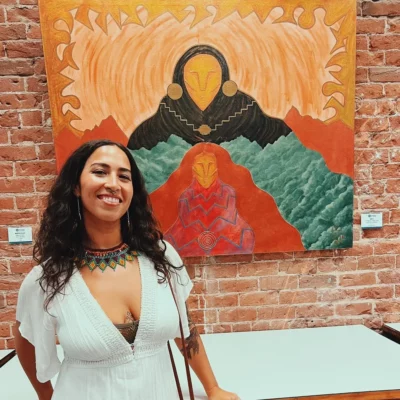
Stephanie Guillermina Castro posing with her work. Photo courtesy of the interviewees.
Carrie Sage Curley, better known as CC, born on the sacred lands of San Carlos Apache in Arizona 34 years ago, is a lesbian, multidisciplinary artist, community organizer, and cultural keeper.

Carrie Sage Curley posing next to her work. Photo courtesy of the interviewees.
In 2020, the two met during devotions at the Apache Stronghold ceremonial center at Oak Flat, a mountain sacred to the Apache. In 2022, after participating in an event, Women of the Desert, in Phoenix, they felt their paths were not two, but one, and they have been walking hand in hand ever since in the same direction.
That direction is everything. They do not have a relationship, they have a healing purpose: to make Indigenous women visible and recover their wisdom through art. Recovering their image taken away by centuries of colonization is not a minor struggle, and that is one of their goals — to build their image away from the visual clichés imposed by the dominant white ideologies, and they do it by painting one mural at a time. Their artwork can be found in the streets of Phoenix, in galleries, in social spaces, and in private collections, portraying strong, free, and autonomous Indigenous women, with their lights and shadows.
In this regard, Castro says:
I hope to capture an authentic representation of my ancestors through the lens of the spirits that guide me and my brush. I hope to provoke a connection to the Andes for those who have been displaced through migration. I hope that my relatives and those who experience my art will feel the power and light that traveled through me. And that they see the beauty and deeper meaning of intergenerational wisdom and love.

CC and Castro during a peaceful protest for the rights of sacred Indigenous lands. Photo courtesy of the interviewees.
For CC, her art is a connection to herself and to her roots through culture. It is interrogating her existence. She says:
I use my art as a weapon for the people. I love to paint my people, especially the women. It is an honor to be Apache. Whoever comes across my work I want them to feel loved by theirself and proud.
There is an ancestral voice that guides them and connects the past and the present to build a future, and those voices are materialized in art pieces, as CC explains:
We are our great-grandmothers, grandmothers, mothers. The clan is passed down from generation to generation. Our connection to the land is through our clan. I paint the strong women of the past and present. My mother is a local seamstress who continues to keep the spirit of dress alive. I photograph her work with my family and the women of the community, and that is why I am like this, I find my strength in my culture and the land.

CC painting a mural on the streets of Phoenix, Arizona, U.S. Photo courtesy of the interviewees.
The story that both are building is deeply inspiring, for it is the story of liberation. The liberation of our bodies and our image, as Castro says:
I feel that colonization has robbed us of our sensuality and connection to our divine sexual power and energy. I work diligently to regain this sensual awareness and connection to my body and my sexual power. The freer we are as individuals, the freer we are as a people. Returning to our ways in which we followed spirit and nature. Because our sexuality is divine nature — as plants and trees pollinate, so do we.
The sexual revolution is a pending issue in Latin America, and in Indigenous communities even more so; however, this story of transformation and light shows us that another reality is possible, where traditions, spirituality, and creativity are not at odds with sexual diversity, but rather complement each other and become one.
In this regard, CC shares the following reflection for all those people who have an internal debate between their sexuality and their traditions:
You should know that there is nothing wrong with you. Our creator gave you the spirit you carry. I know it can be scary to think what others say when they think of you but show them kindness and love because that is who you are. You need prayers, the earth, and people to be supported healthily.

CC and Castro fused in a loving embrace. Photo courtesy of the interviewees.
I thank them for the moments I was able to enjoy their company and I thank them for allowing me to tell their story. I feel it is a duty to share the life of these powerful souls, so that the force that brought them together can be amplified, and their experience can inspire others to live a freer life, far from the shackles of puritanical glances that condemn the healing love between Indigenous women.
As I finish writing this text, and my memory returns to the first day I met them. Castro looked at CC and smiled at her, and a whole universe opened up in the room. Planets, languages, silences, and ecosystems lived there that no one else could understand but them. And so I reassert my stance: love is in the smallest details.





