Native

Health Experts, Artists Discuss Need to Change Media Portrayals of HIV/AIDS at Harvard Medical School Panel | News

Health Experts, Artists Discuss Need to Change Media Portrayals of HIV/AIDS at Harvard Medical School Panel | News

Health experts and artists discussed the need to change the narrative in popular media around HIV/AIDS to avoid stigma and provide true representation in a panel last Friday hosted by Harvard Medical School in recognition of World AIDS Day.

The panel, titled “Portraying AIDS in the Media: How Far Have We Come?”, was sponsored by HMS’ Media, Medicine, and Health program and moderated by physician and award-winning showrunner Neal Baer. The event featured guests actress Gloria Reuben, director Paris K.C. Barclay ’79, artist Kia LaBeija, Yale School of Public Health professor Gregg Gonsalves, and HMS professor Joia S. Mukherjee.

To open the discussion, Gonsalves, who studies epidemiology, showed an advertisement for an HIV drug, Dovato. The ad depicted people with HIV living a happy life while using the medication. Despite the commercial’s joyful appearance, Gonsalves and the other panelists agreed that these media portrayals erase the complexity of HIV/AIDS.

“We have a whole set of issues that we need to deal with, that are obscured by this happy-clappy version of the HIV epidemic that is perpetuated night after night on network television,” Gonsalves said.

“How do we build a critical media discourse about the AIDS epidemic moving forward?” he added. “We didn’t learn the lesson of HIV, we didn’t learn the lesson of Covid, we don’t get three strikes. Three strikes, and we’re out.”

To demonstrate the necessity of “talking, moving, telling your story, getting out there,” Barclay referenced “Pedro,” a film he co-wrote in 2008 about Cuban American television personality Pedro Zamora who died from complications due to AIDS.

Barclay retold Zamora’s story to prove that “even one person who is telling their truth can make some change,” and used the film as a critique against the narrative of silence around Zamora’s illness and the “lie of reality coverage.”

“I wanted to debunk a little bit of what they had done in the real world, which is to disguise and sanitize his story,” Barclay said. “They didn’t show how ill he was.”

Mukherjee, an associate professor of Global Health and Social Medicine at the Medical School, also touched on the power of documentaries in illustrating HIV/AIDS.

“That’s what we’re fighting for — to tell those stories in patients’ own words,” she said.

Reuben, an Emmy Award-nominated actress, said she aimed to portray the stigma faced by individuals living with HIV when she played Jeanie, an HIV-positive character in the popular television series “ER.”

Reuben explained that depicting a character who felt shame and embarrassment from testing HIV-positive helped show the broader stigma in society faced by individuals living with HIV.

“The shame, the secrecy, and stigma. Those are killers,” Reuben said.

She added that combating the stigma of living with HIV is critical to saving the lives of individuals who fear seeking treatment out of stigma — something that can only be accomplished through “the awareness, the access, and the treatment,” Reuben said.

LaBeija, an artist, storyteller, and New York native, spoke firsthand about the need for representation in the media to truly depict the experience of HIV. She developed HIV through perinatal transmission from her mother and has been living with HIV her entire life.

As a long-term survivor of HIV, LaBeija said, her struggle with the illness was “a completely different experience” compared to those who acquired it later in life.

“Sometimes when I sit in rooms with other people living with HIV, I feel a little isolated,” LaBeija said.

As she grew older, LaBeija met others who were similarly diagnosed with HIV perinatally — interactions, she said, “blew my mind.”

“To feel that, my isolation and my grief, and all that time that I felt alone — there were so many others, just like me,” LaBeija said, adding that the experience made clear to her that shifts in the narrative around HIV/AIDS were necessary.

LaBeija referenced the more than 14,000 children born HIV-positive from the late 1970s to early 1990s, underscoring the importance of telling these stories.

“There are way less babies that are born with HIV, which is beautiful and a miracle,” LaBeija said. “But those babies that were born, those babies that are not here, they’re still stories that are just completely lost.”

LaBeija said telling her story and fighting for the representation of people who are HIV-positive is critical to ensure support and inclusion of individuals living with the illness.

“If you don’t tell your story, someone else will tell it and they’ll tell it wrong,” she said, citing a proverb she heard early in her life.

Louisville native opens new downtown spa in the Galt House

Louisville native opens new downtown spa in the Galt House

LOUISVILLE, Ky. (WDRB) — Louisville native Kaitlyn Hubert opened Pelo West in downtown Louisville this weekend. The new luxury spa is located on the 17th floor of the Galt House.

The spa has four treatment rooms, including one for couples, three hair stations, manicure and pedicure areas, and saunas in the women’s and men’s changing areas.

“The support that we’ve gotten from the Galt house and from our friends and people in the community has been really, really awesome,” Hubert said. “And we’re just really happy to play a part in revitalizing downtown. This is super important to us.”

The comfortable yet upscale design is loosely inspired by a salon Hubert worked at in Manhattan.

“I’m so excited to have a wider range of services. We just wanted anyone who was coming to the hotel to be able to get all their services at one place book, multiple services with all of our awesome staff members,” Hubert said.

Hubert also says she is excited to welcome people for the 150th Kentucky Derby in May of 2024.

“They can come get their massage, get their facial, go right back to their room, shower; or shower and come up and get their hair done and makeup done,” she said.

Hubert supports several local artists, including Jason M. Lois, whose art hangs throughout the spa.

Pelo West is Kaitlyn’s third spa and salon in Kentucky. Pelo Beauty Collective includes locations in Middletown and Lexington.


PELO WEST 2.jpg

Pelo West in the Galt House on Dec. 3, 2023. (WDRB photo)


“Being at the Galt house was super important to me because I grew up coming here. My family would bring me as like a little treat, you know, a little staycation and it was so majestic to me at the time and now having a spa inside of the Galt House is like, definitely full circle,” Hubert said.

Pelo West will be open Tuesday-Friday 10 a.m.-6 p.m., Saturday 8 AM-5 PM, and Sunday 8 a.m.-4 p.m. It is closed on Mondays.

Group and single discounts will be offered to those staying at the Galt House, as well as Louisville residents and downtown locals. It also offers e-gift cards.

Pelo West is on the 17th floor of the Galt House, which is located at 140 North 4th Street in downtown Louisville. Hubert is an Assumption High School graduate.

For more information on Pelo West, click here.

Copyright 2023 WDRB Media. All Rights Reserved.

Business Monday: Pilikana Boutique supports local artists, perpetuates Hawaiian culture

Business Monday: Pilikana Boutique supports local artists, perpetuates Hawaiian culture

Step into Pilikana Boutique in Kailua-Kona and you are greeted with shelves of stickers, with flying owls, turtles, Big Island themes and ones with sayings like “Mana Wahine” or “Aloha is a Super Power.”

As you venture further into the shop, it’s a feast for your eyes with Hawaiian-print clothing and hats stacked neatly on shelves, and a collection of locally made soaps and fragrances smelling of pikake and puakenikeni flowers.

Kila Quam started Pilikana Boutique in 2018 after selling her truck and with some family savings. Photo Courtesy: Kila Quam

Jewelry made of black pearls, Ni‘ihau shells and lauhala are artfully displayed on white shelves. Books, journals, cards, key chains, Hawaiian seeds, games, Crocs, lei and toys fill the rest of the shop.

“Nobody really needs anything in this store, but you kind of have to have everything,” Kila Quam, the 36-year-old boutique owner.

Pilikana Boutique opened in 2018 in the Ilima Court off Kuakini Highway and relocated a couple years later to the Brew Block Kona at 74-5606 Pawai Place. Quam started the business as a way to create a space for local and Native Hawaiian creators to display their wares.

  • imageimage

    Pilikana Boutique, located at the Kona Brew Block, solely sells products created by locals and Native Hawaiian artisans. Photo credit: Tiffany DeMasters

  • imageimage

    Pilikana Boutique in Kona hosts monthly workshops teaching the art of lauhala weaving and stringing Ni‘ihau shell jewelry. Photo courtesy: Kila Quam

  • imageimage

    Pilikana Boutique, located at the Kona Brew Block, solely sells products created by locals and Native Hawaiian artisans. Photo credit: Tiffany DeMasters

  • imageimage

    Fresh lei sold daily at Pilikana Boutique in Kona. Photo courtesy: Kila Quam

  • imageimage

    Pilikana Boutique, located at the Kona Brew Block, solely sells products created by locals and Native Hawaiian artisans. Photo courtesy: Kila Quam

  • imageimage

    Pilikana Boutique, located at the Kona Brew Block, solely sells products created by locals and Native Hawaiian artisans. Photo courtesy: Kila Quam

  • imageimage

    Earrings on display at Pilikana Boutique. Photo credit: Tiffany DeMasters

  • imageimage

    Kaya Mockchew, Quam’s niece, works at Pilikana Boutique organizing the shelves Dec. 2, 2023. Photo credit: Tiffany DeMasters

  • imageimage

As a child, Quam’s dream was to open a surf shop. But as she got older and spent time working in the tourism industry at Jack’s Diving Locker, the vision of her business came into focus. 

ARTICLE CONTINUES BELOW AD

While working at the dive shop, she said tourists would ask where they could buy authentic, locally made products. Quam struggled to think of such a place, despite all the souvenir shops in the area.

“Everything you see is typically imported overseas from Indonesia or China,” Quam said.

After selling her truck and using a couple thousand dollars she and her family had saved, Quam built out her tiny shop with 100% thrifted or donated items.

The mission of Pilikana Boutique is to keep “Hawaiians in Hawai‘i and keep Hawai‘i Hawaiian.”

“I definitely want to be a part of the perpetuation in any way I can,” Quam said. “So everything in here, you’re supporting local no matter what you buy.”

ARTICLE CONTINUES BELOW AD

On average, she estimates she spends around $4,000 to $5,000 per month on products at wholesale prices from local vendors. It goes up to about 10,000 a month during the holidays.

She adds new products to her store almost daily. It could be something as small as earrings, a new line of T-shirts or an order of scents.

Quam said there are times it can be difficult to get products because most of the businesses she works with operate on a small scale.

“They’re making it themselves,” she said. “They’re like a one-man show or a family business. So it’s a lot of our vendors aren’t, you know, sourcing overseas and just mass producing it.”

Quam said the relationship with the vendors also is critical.

ARTICLE CONTINUES BELOW AD

Her cousin Ehu gifted the shop’s name Pilikana, meaning relationships. It fit. Quam said it’s important to her that the artists she works with have values that lie with family.

“We always want to make sure that they’re like-minded in the business sense to know that at the end of the day, family is first and it’s got to make sense for us,” Quam said. “It’s got to make sense for you.”

Quam works with at least 60 vendors, most from the Big Island but some from other parts of the state.

Kona-based Brittany Rocha, founder of HiSami Co., makes earrings out of polymer clay and creates a variety of designs related to Hawai‘i from the moon phases to plants to the ocean.

Her jewelry making was a side hustle and hobby until about two years ago when she talked to Quam about carrying her products.

“She was the first person who gave me my first break,” Rocha said. “As a Native Hawaiian, we don’t always feel heard or seen.”

Rocha said Quam is a treasure and considers her to be a mentor who always is encouraging her to keep creating and pursuing her passion.

“I feel grateful to Kila,” Rocha said. “I’m excited to see her boutique continue. It can only expand and get better.”

Lauhala weaver Meredith Buck first met Quam in 2018 when the shop owner reached out to her over Instagram.

Buck said she was accustomed to receiving cold requests from retailers.

“But Kila’s message stopped me in my tracks,” she said. “Instead of asking for wholesale pricing and quantities right off the bat, she approached me with a spirit of friendship and community, seeking to establish a relationship as people first.”

After messaging Quam and getting to know her by spending time in Pilikana, Buck said she felt in her na‘au (gut) that this was someone she could trust — and a place where she could confidently place her creations.

“By supporting the people who carry traditional knowledge passed on from the elders and ancestors, Pilikana helps to ensure that this knowledge makes it to the next generations,” Buck said.

Aside from stocking her shop with Hawaiian-created products, Quam also hosts monthly workshops to spread knowledge of Hawaiian arts, including lauhala bracelet weaving and how to string Ni‘ihau shell jewelry.

Quam survived the COVID-19 pandemic and statewide shutdown by pivoting her business to offer graduation lei. Now, her store is known as a place where you can find fresh, unique, beautiful lei for any occasion. Lei include pikake, pakalana, jade or lanterni lima. Every once in a while the shop will get fresh maile.

Quam purchases flowers from locals, including a 95-year-old man who sells her jade blossoms.

Selling lei, Quam said, makes the boutique a one-stop shop.

“Grab a gift, put it in a cute gift bag, grab a lei and a card and you’re on your way to the party kind of thing,” she said.

Quam said she also envisioned the business as a place to teach her keiki, ages 6, 10 and 18 the behind-the-scenes of finances, their roots and customer service. She hopes someday they will take it over and continue the mission.

New art, nature garden gets kid-approved opening

New art, nature garden gets kid-approved opening
image

It’s been a long road turning a dirt lot into an outdoor education area, but the Grace Lutheran Child Learning Center in Sahuarita celebrated the accomplishment Friday with a ribbon cutting and the first wave of kids putting the grounds to work.

Learning Center Director Laura Heiman found the new addition goes beyond a playground, providing the added benefit of outdoor learning, which she said is beneficial for children. The extra space is also a welcome addition as the center’s enrollment grows.

.link-button {
border-radius: 5px;
border-color: #333;
background-color: #C5D9E2;
color:#333;
width:50%;
align:center;
max-width: 175px;
margin: 5px;
}

.button-text {
font-family: ‘Open Sans’,Helvetica,Arial,sans-serif;
color: #000000;
font-size: 14px;
line-height: 1.42857143;
}

Meow Wolf Announces Inaugural Community Grant Awardees

Meow Wolf Announces Inaugural Community Grant Awardees

The Meow Wolf Foundation, a 501(c)3 nonprofit organization, has announced its inaugural Community Grant awardees, which include nine Texas-based organizations.

While Meow Wolf is a Public Benefit Corporation (B Corp) that focuses both on social impact and profit, in 2022 it established The Meow Wolf Foundation as a private charitable foundation. According to the foundation’s webpage, it supports organizations that provide increased access to arts education and training, utilizes arts as a tool to improve mental and emotional well-being, and conduct research and projects focusing on art and creativity as tools to develop innovative solutions.

In a press release, Jose Tolosa, Meow Wolf CEO and board chair of the Meow Wolf Foundation, stated, “As a company founded by artists, that employs artists, and celebrates the inner creative in everyone, Meow Wolf understands firsthand how creativity, imagination, and play can truly transform lives. Meow Wolf launched the Meow Wolf Foundation to deepen our commitment to communities and help amplify the critical work of those using art and creativity to change lives and build thriving creative communities.”

Julie Heinrich, Chief Impact Officer and head of the Meow Wolf Foundation, added, “Art and creativity has too often been seen as a nice-to-have, instead of a must-have. We want to change this conversation. Art and culture organizations typically receive the least amount of philanthropic giving nationally and we think there’s a tremendous opportunity to use art and creativity to heal and transform lives.”

In its inaugural year, the Community Grant program donated a total of $600,000 to 63 organizations in areas where Meow Wolf currently has (or is developing) locations: New Mexico, Colorado, Nevada, and Texas. With Meow Wolf’s The Real Unreal opening earlier this year in Grapevine and a Houston location scheduled to open next summer, the Texas locations are the newest venues. 

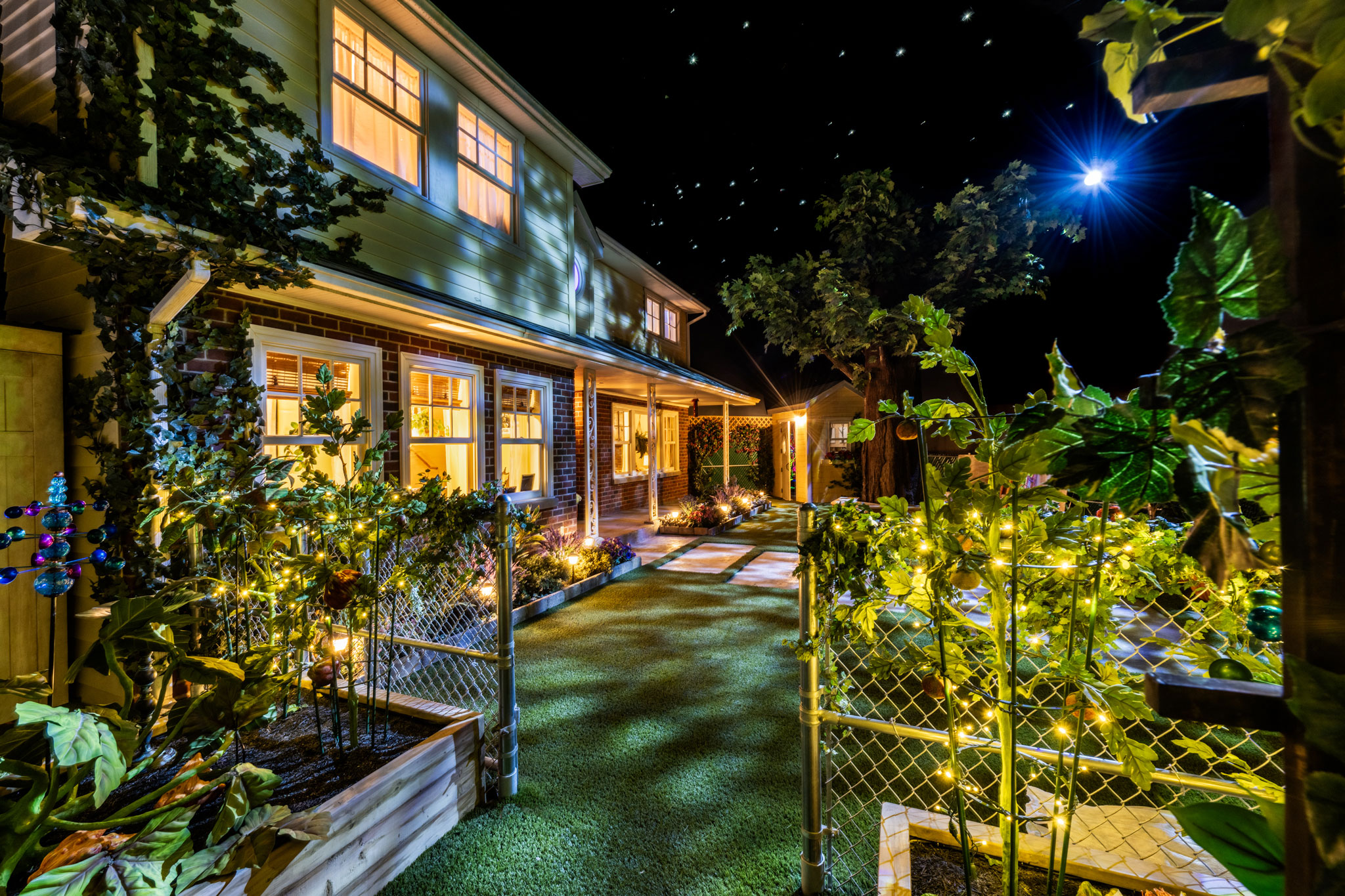
Photo of a lifelike sculpture of the front yard of a home

Exhibition Detail of Meow Wolf Grapevine’s “The Real Unreal,” Photo by Jess Gallo. Photo Courtesy of Meow-Wolf.

The Texas grant recipients include Cara Mia Theatre, Dallas Art Therapy, Spark! Dallas, Forest Forward, House of Shine, Resource Center, the Fifth Ward Community Redevelopment Corporation, The Orange Show Center for Visionary Art, and Project Row Houses.

A photograph of two men holding a large stencil used to spray paint the Meow Wolf logo on a white brick wall.

Harrison Guy, Director of Arts & Culture for the Fifth Ward Cultural Arts District and graffiti artist Mario Enrique Figueroa Jr., known as GONZO247, hold a stencil used to spray paint the Meow Wolf logo on a brick wall.

About receiving the grant, Harrison Guy, Director of Arts & Culture for Fifth Ward Community Redevelopment Corporation, remarked, “We are so excited to see The Meow Wolf Foundation invest in the 5th Ward community. This award will help us to continue our mission of creating an art rich community that celebrates the musical legacy of the 5th Ward with the support of The Mini-Music Museum.” Meow Wolf’s Houston location is set to debut in the Fifth Ward in 2024. 

See the full list of grantees below.

516 Arts – Fulcrum Fund
Access Gallery
ArtWalk Santa Fe
Axle Projects
Cara Mia Theatre
Children’s Hospital Colorado Foundation
City of the World
Cleo Parker Robinson Dance
Colectiva
Colorado Business Committee for the Arts
Creative Santa Fe
Dallas Art Therapy
Denver Art Society
Denver’s Art District on Santa Fe
Discovery Children’s Museum
Downtown Aurora Visual Arts
Earthseed Black Arts Alliance
Fifth Ward Community Redevelopment Corporation (5th Ward Cultural Arts District)
Film Prize Foundation
Forest Forward
House of Shine
Indigenous Ways
IndigenousAF (IAF Inc.)
Keres Learning Center
Keshet Dance Company
La Semilla Food Center
Las Vegas Indian Center
Latino Cultural Arts Center
Left of Center Art Gallery
Make Santa Fe
Marjorie Barrick Museum of Art
Moving Arts Española
Museo de Las Américas
Native Realities
Nevada School for the Arts
New Mexico School for the Arts – Art Institute
Obodo Collective
Opportunity Village
The Orange Show Center for Visionary Art
Parallel Studios, Inc.
Paseo Project
Poeh Cultural Center
Project Row Houses
RedLine Contemporary Art Center
Resource Center
Reunity Resources
Sacred Voices
Santa Fe Portalfest
Solidarity Fridge
Spark! Dallas
Su Teatro
Sun Valley Kitchen + Community Center
Sun Valley Youth Center
Teatro Paraguas
Tewa Women United
The Center
The Neon Museum
Think 360 Arts for Learning
Tierra Nueva Counseling Center
University of New Mexico Foundation (UNM Children’s Psychiatric Center)
Vital Spaces
Working Classroom
Zuni Youth Enrichment Project

Timmins mother and daughter sharing culture through art and learning

Timmins mother and daughter sharing culture through art and learning

Justice Sutherland wants her children to know where they come from.

“Just bringing back tradition to our family has been amazing,” she said.

The local artist has been reconnecting to her Indigenous roots in Moose Factory since becoming a mother. She’s learning from a great source — her mother, Amanda Sutherland.

Amanda’s father, who was a Fort Albany First Nation member, died when she was young, and she lost a lot of her cultural connections.

“Bringing in the culture to us is very important since we weren’t raised in it. I didn’t raise my kids in it,” said Amanda. “It wasn’t until I started working at Northern College and learning from community members, elders in the community.”

Amanda is an Indigenous services administration assistant at Northern College.

“Everybody has been so good at teaching me, at teaching Justice,” she said.

Justice agrees and adds that the community has been incredibly helpful in their journey.

She’s using art to explore her cultural ties and has painted murals at Northern College and Sparks Pizza. It’s a way to connect to her own community and family, and anyone else who wants to enjoy her work.

“The one thing I always could connect to is art and it’s something that translates in every culture, in every language. It connects to everyone in a different way,” she said.

RELATED: Local artist adds a little colour to downtown pizza joint

Having spent time in western Canada, those traditions shaped some of their views.

Becoming a mother has motivated justice to explore her local roots and bring more tradition and culture into her home. 

“It wasn’t until I had my own kids and she started doing her teachings and stuff like that and getting connected to the culture here in Timmins that I was able to realize that I wanted to bring that down to my kids as soon as I had them,” said Justice. 

Her time in Kelowna has influenced her art and she learning more about the local styles.

“It’s weird because I’m always talking about Indigenous culture and I realize I have to bring this side in instead of always bringing what I was raised around,” said Justice. “Because that’s the whole point. I’m trying to reconnect to the Native lines here and bring more of an arts and culture representation from our area.”

Language has been a challenge in reconnecting with family.

“Justice was four years old, and I had not connected to my dad’s side of the family yet, and I went up north to meet my kokum (grandmother) for the first time, and it was very emotional,” said Amanda.

“I couldn’t talk to her though because I didn’t know how to speak Cree, and she only knew how to speak Cree, which is sad because it’s a language that’s being lost, and I wish I had that language so that I could teach it to my kids.”

Amanda said passing on what she’s learned is a healing experience.

“Whatever I am taught, I then go, and I teach students, I teach staff, I teach whoever wants to learn what I know,” she said.

The shift in how Indigeneity and culture are perceived in Canada has impacted Amanda’s growth and education.

“When I was being raised, being Indigenous was something you hid,” she said. “I was glad to hide it at the time, but as I got older, I realized that I was missing out on so much, and learning all of that and bringing it in has helped me grow not just as a person but as a parent, a grandmother, a friend, a colleague, it gets into everything that I do now.”

Justice’s goal in her art and her family is to amplify the feeling of home.

“It’s nice to continue to bring down our teachings and traditions down through our family,” she said. 

ANHC holiday bazaar shares Native cultures with shoppers

ANHC holiday bazaar shares Native cultures with shoppers

ANCHORAGE, Alaska (KTUU) – The Alaska Native Heritage Center (ANHC) Holiday Bazaar kicked off Friday afternoon, delighting shoppers seeking handmade, locally-produced goods.

Organizers say the event is expected to bring in close to 2,000 people. This year’s bazaar features over 60 vendors featuring a different Alaska Native artist’s work — including over 15 artists the center said that are from outside of Anchorage.

“What you have is a sharing of culture, and then that way that can help people understand Alaska Native people a lot better,” ANHC’s Cultural Program Manager Paul Asicksik said.

Artist at the bazaar said the event helps them to keep their culture alive, passing it down to the next generations as they experience and learn about traditional ways. Many are concerned that young people are not as aware of their cultural histories and practices.

Artist Victor Geffe was present on Saturday, selling handmade whalebone masks. He said each one of his masks represents one of his elders.

“When I make them, I make them to represent my ancestors from Iñupiaq culture. I make those they are the ones that pass down generation to generation our culture, and also our values — Iñupiaq values,” Geffe said.

Geffe adds when he sells a piece, he then shares that elder’s story with the purchaser.

“When I make them, I’m hoping they can pass on a story,” Geffe said.

The holiday bazaar runs through Sunday and will run from 10 a.m. to 4 p.m.

Comanche artist weaves past, present, future with new exhibit

Comanche artist weaves past, present, future with new exhibit
image

A new art exhibition featuring a Comanche/Kiowa artist’s contemporary take on traditional imagery kicks off Dec. 9 with a special meet-and-greet event.

The Comanche National Museum and Cultural Center will unveil its latest art exhibition, “Nahmi-A-Piah,” featuring the works of J. NiCole Hatfield.

Indigenous artists and makers gather for Haskell Holiday Bazaar

Indigenous artists and makers gather for Haskell Holiday Bazaar
Share this post or save for later

About 20 vendors gathered to sell art, jewelry, baked goods, holiday decorations and even muktuk Saturday at Haskell’s fifth annual Holiday Bazaar.

One vendor, Sharon Tah Romero, enrolled Apache, Ponca, Tonkawa, and Kiowa, has been an artist for decades.

Advertisement

She studied at Haskell Indian Nations University in the 1970s and now shares her experiential knowledge with other artists. She leads the Native and Indigenous Tribal Artists group, which was formed in April. The intertribal group is a place for Indigenous artists to learn and reconnect with traditional art, including making medicine pouches, beadwork, quilts and ribbon skirts.

The group meets at the Indian Avenue Baptist Church. The funds they earned from the bazaar will go toward supplies for the group.

Molly Adams / Lawrence Times Joel Hernandez holds his niece, Cedar.

Joel Hernandez, Navajo and Sicangu Lakota, learned to bead as a student at Haskell and helped start a beading club.

For Hernandez, beadwork is a way to share cultural knowledge and ways to be, it helps him reconnect with and continue his culture and express himself, and it’s therapeutic. His great-great-grandma, who lived to be 106, was a beader.

Molly Adams / Lawrence Times Tweesna Mills holds her “Indigenous Creatures.”

Tweesna Mills, Shoshone-Yakama-Umatilla Nations of Wyoming, Washington and Oregon, brought some Indian humor to the show in the form of her “Indigenous creatures.” 

Mills made the Grogru/Baby Yoda “Indigenous Creatures” in response to the 2022 incident in which an ABC reporter misspoke and referred to Indigenous people as “Indigenous creatures.” Native social media immediately memed the mishap, many expressing that “we’ve been upgraded” from “something else” to “Indigenous creatures.” 

She said she wanted to make these to “reclaim the negative and make it into a positive.” Mills added that “through our art, we express our artivism — activism through artwork.”

Molly Adams / Lawrence Times Kris Wilson

Kris Wilson, Akimel O’odham, learned to bead in the Haskell beading club while a student.

Learning to bead provided a path for healing and growth for her, despite initially learning artistic elements from tribes other than her own. She has grown as an artist and now has a distinct style.

Advertisement
Molly Adams / Lawrence Times Falonda Henry

Falonda Henry, Navajo, started beading a year ago. Her mother has since passed on, and she said she finds beading therapeutic. She finds inspiration in Diné basket weaving patterns and in fire colors.

Molly Adams / Lawrence Times Joey Tosee

Joey Tosee, Comanche and Kiowa, graduated from Haskell in 2018. After working as a firefighter and EMT, he said he finds creating art to be a therapeutic outlet for stress.

Molly Adams / Lawrence Times Shannon White Hat, Rosebud Sioux, left, learned to bead at Haskell.
Molly Adams / Lawrence Times Shelby Herrod, enrolled Muscogee Creek and Cherokee, vends at the Haskell Holiday Bizarre and the First Nations Student Association powwow. This is her third year vending.
Molly Adams / Lawrence Times Peaches’ Frybread
Molly Adams / Lawrence Times “Indigenous Creatures” by Tweesna Mills
If our local journalism matters to you, please help us keep doing this work.
Don’t miss a beat … Click here to sign up for our email newsletters

Molly Adams (she/her), photojournalist and news operations coordinator for The Lawrence Times, can be reached at molly (at) lawrencekstimes (dot) com. Check out more of her work for the Times here. Check out her staff bio here.

Latest Lawrence news:


August Rudisell/Lawrence Times

Share this post or save for later

The all-horse Old-Fashioned Christmas Parade returned to downtown Lawrence Saturday, drawing spectators who lined Massachusetts Street and beyond to see all the sights.


Molly Adams / Lawrence Times

Share this post or save for later

Art from more than 100 Indigenous students was showcased Friday during the first in-person art show Haskell Indian Nations University has held since 2019.


Contributed

Share this post or save for later

Teen leaders of the Lawrence nonprofit Honor Moon invite community members to drop off a donation and shop awhile during their holiday fundraiser.

MORE …