Native

Seven unique plants, public art, and design elements you can find throughout the 2.5-acre public park at Amazon’s HQ2

Seven unique plants, public art, and design elements you can find throughout the 2.5-acre public park at Amazon’s HQ2

Amazon’s second headquarters in Arlington, Virginia, features a 2.5-acre park that’s open to the public. Metropolitan Park offers serene walking paths, unique public art installations, a dog park, a children’s play area, and an active central green, all nestled inside a horticultural masterpiece partially inspired by the United States Botanic Garden in Washington, D.C.

Image of Metropolitan Park at Amazon HQ2.

The park is home to more than 50,000 understory plants, 300 trees, and 160 native and native-adaptive species. Thanks to the coordinated work of the Amazon Horticulture team, landscape contractors, and landscape architecture firm James Corner Field Operations specialists like Bill McLaughlin, with input from the Arlington neighborhood, Amazon’s HQ2 naturalistic landscape is not only aesthetically beautiful but a masterpiece of sustainability in an urban setting.

HQ2 was built with sustainability at its core, a commitment that includes the campus’ public park. The talented staff members at HQ2 adjust planting techniques based on the most sustainable and beneficial options for the plants. The Horticulture team consults on new construction projects, post-occupancy care, and redesigns, to help plan, carry out, and transition important horticulture across its corporate sites around the world. Keep reading for a walkthrough of the unique design features and diverse plant species that call Metropolitan Park home.

Images of plants at Amazon HQ2.

1. Franklin tree 2. American witch hazel 3. Sassafras tree.

Seven unique plants at Met Park

1. The Franklin tree (Franklinia alatamaha), named for Benjamin Franklin, is known for its brilliant autumn foliage and attractive flowers. Discovered in 1765 by Philadelphia botanists John Bartram and his son, William, the Franklin tree is part of the tea (Theaceae) family. William returned to Philadelphia repeatedly to collect seeds and plants. But since 1790, the tree has not been observed in the wild, possibly having suffered natural disasters, such as flooding, or been eradicated by bulk collection for shipment abroad.

2. American witch hazel (Hamamelis virginiana) can be drunk as a tea, applied topically, or used to wash out wounds. Due to its astringent properties, witch hazel helps to soothe skin, tighten and tone tissue, and lessen inflammation. The flowers have four thin, creamy-to-bright-yellow petals that bloom in mid- to late fall. On this unusual flowering schedule, the fragrant blossoms are the only source of color in the woods when the forest floor is covered in fallen autumn leaves. The stiff, tiny, tan-to-gray capsules remain dormant over the winter months. During the following growing season, they grow, and in the autumn, forcefully eject two lustrous black seeds, which are 10 to 20 feet long. After that, the seeds take another year to sprout. The shrub’s forked limbs have an intriguing application as divining or dowsing rods. Early European settlers saw Native Americans searching for underground water supplies with American witch hazel.

3. Sassafras (Sassafras albidum) has remarkable qualities throughout the year. Early spring brings small aromatic yellow flowers into bloom, followed by bright green leaves in the summer and yellow, orange, or blazing red in the fall. Naming it “kvfi,” “pauame,” or “winauk,” Indigenous peoples have traditionally used  sassafras roots, wood, and bark. Early European explorers believed sassafras was the New World’s wonder medicine. Dried and finely powdered sassafras leaves make up the Creole spice filé, which acts as a thickening agent and gives gumbo its distinct flavor. Chemicals released by sassafras roots have the potential to damage other plants in their root zone (allelopathic).

Images for plants at Amazon HQ2.

4. Allegheny chinquapin 5. Persimmon tree 6. American hazelnut 7. Pawpaw

4. Allegheny chinquapin (Castanea pumila) is a native nut tree that grows from East Texas through Louisiana, Mississippi, and Alabama, through Florida and into the Carolinas. Allegheny chinquapins are closely related to the American chestnut. While chestnut blight, an imported fungal disease, all but eliminated the native American chestnut tree, Allegheny chinquapins persist in places within their native range. Encased in spiky husks, the nuts provide food for wildlife, from squirrels and deer to wild turkeys.

5. The persimmon tree (Diospyros virginiana) is native to the southeastern United States. Indeed, for centuries, the Indigenous peoples of this area have used persimmons for food—drying the fruit for storage or cooking it fresh—and beverages, such as a local beer. Persimmon was also traditionally used medicinally, either topically or ingested. Today, persimmon fruit is still enjoyed as an ingredient in baking. While fairly slow-growing, the persimmon tree can reach great heights and is easily grown from seed. Once it starts producing fruit, a persimmon provides food, shade, and fragrant flowers for people, animals, and birds. The unique flavor and texture of the persimmon fruit is appreciated in breads, custards, and puddings—and enjoyment of this fruit dates back hundreds of years to local Native American communities in the region. Traditionally, persimmons were dried in flattened cakes, sometimes with added cornmeal. Be warned though, eating astringent and unripe fruit is an unpleasant experience you won’t soon wish to repeat.

6. The American hazelnut (Corylus Americana), a member of the birch family, is native to North America, where it has been cultivated for centuries. The name comes from the Old English word for “filbert.” The hazelnut is prized for its ornamental appearance, as well as providing an important food source. People eat the delicious, nutritious nuts raw or roasted, ground into flour, mixed with chocolate, or used for nut milk. Animals and birds eat them, too. The shrub also has botanical uses. In the warm seasons, it produces colorful flowers and long, dangling, pollen-bearing catkins. In the fall, the heart-shaped leaves turn bright yellow. The shrub is adaptable, too. Whether sunny or shady, in a forest or on a rocky hillside, cultivated or in the wild, hazelnuts can thrive.

7. The pawpaw (Asimina triloba) is the only local member of the large, mainly tropical plant family Annonaceae and produces the largest edible fruit native to North America. Technically, it’s a berry, both highly nutritious and valuable in cancer therapies. Growing up to 20 feet tall, the pawpaw is found in Eastern North America and west to Texas. Like many trees in that region, it blooms in the spring and bears fruit in the fall. The bark naturally repels insects. The sweet, custardy fruit, as well as the tree’s accommodating nature—water and mulch it, and it grows—have recently been making the pawpaw very popular. Yet, its popularity goes back centuries, as the tree was prized by Indigenous peoples, who used it as a food source and also as a source of raw materials, such as harvesting the bark to make rope. Animals from raccoons to squirrels eat the fruit, while the fragrant leaves are the only food source for Zebra Swallowtail butterflies.

Public art installations

An image of Queen City public art at Amazon's second headquarters.

Views of public art entitled Queen City at Amazon HQ2.

Queen City by Nekisha Durrett (Washington, D.C.)

Standing tall and vigilant, Queen City confronts the 1941 seizure of Black-owned land by the federal government for the construction of the Pentagon. Within this work, 903 displaced residents of Queen City are represented by handmade ceramic vessels made in the shape and color of a drop of water.

In the spirit of collaboration, the artist commissioned Black ceramicists from the local area and beyond while working with historians, living descendants of Queen City residents, and local art spaces.

Images of public art at Amazon's second headquarters.

Public art at Amazon HQ2 entitled Untitled Perched Objects by Inigo Manglano-Ovalle (left) and Shhh by Aurora Robson (right).

Untitled Perched Objects by Inigo Manglano-Ovalle (Chicago, IL)

Untitled Perched Objects populates one’s journey along the forest path with a series of events. The assortment is familiar yet unexpected—a balancing umbrella; a telescope arrested mid-fall; a canted stool with a mug peering over its seat; a bird house perched on its own perch with dangling binoculars, and a disposable cup with its lid and straw weighted by its contents. They invite the viewer to consider all the objects that surround us, those overlooked and those that may hold our focus. Each is a part of the everyday and yet extraordinary, recognizable, and inexplicable.

Shhh by Aurora Robson (New York, NY)

To create Shhh, the artist scanned both mushrooms and hand-sculpted forms then 3D-printed them with upcycled plastic. At night, each component responds to movement by glowing softly from within, reminiscent of the bioluminescent mushrooms found in nearby forests.

Shhh invites us to step out of everyday life to marvel at the incredible diversity of nature and the many things we often don’t see or hear, unless we are quietly paying attention. Visitors can scan a QR code near the installation to find out more about the kinds of mushrooms, their locations, and the creative fabrication method used to create the artwork.

Unique facts about Met Park

Our watering system
The majority of the park sits on top of concrete, and each soil type has been carefully engineered and positioned. To produce a realistic and impactful show, the team designed a bespoke drainage system and selected long-lasting soils. From powering buildings and lighting in the park by 100% renewable energy, to its biophilic design and deploying unique ways to conserve and reuse water both inside and outside of the buildings, HQ2 was built with sustainability at its core. The park’s irrigation system uses water reclaimed and recycled from various sources, such as showers and sinks, inside of Amazon’s Metropolitan Park buildings. The system also actively tracks precipitation, humidity, and temperature to know when water is needed and when it’s not, allowing the multiple zones to provide the trees and various plantings with a tailored amount of moisture. Combined with other water-saving measures in Amazon’s buildings, including low-flow fixtures and the recycled rainwater used to supply the buildings’ cooling towers, Metropolitan Park uses 50% less water than similar projects and will recycle 7.5 million gallons of water per year.

How the plants were chosen
The first plant palette was developed by the landscape architect team, who also took inspiration from several local native habitats and the respected U.S. Botanic Garden when defining and perfecting the layout and experience. Virginia and the National Capital Region are home to the Potomac River, Chesapeake Bay, and the Virginia Blue Ridge Mountains—all of which provided inspiration for the plantings at Metropolitan Park. Then, specialists and the Amazon team determined which species would thrive best in this urban environment.

Horticultural specialists regularly advise Amazon on how to enhance the park’s plant life. This is part of Amazon’s commitment to ensuring the continued thriving of these plants and this space.

Learn more about working at Amazon’s second headquarters.

New SLC airport art installation pays tribute to Utah’s five Native American tribes

New SLC airport art installation pays tribute to Utah’s five Native American tribes
image

The new outdoor art sculpture, “The Peaks,” now sits near the gateway to the airport, greeting travelers while paying homage to the original custodians of the land.

The 90-foot-tall steel structure was imagined by California-based artist Gordon Huether at a cost of about $6 million. It’s part of Huether’s seven architecturally-integrated installations for the airport. He says it’s his most complex commission to date.

Huether said, “Our Peaks installation is one of the largest airport gateway sculptures in the country and we are both humbled and proud to have created it for the community of Salt Lake City.”

The five peaks, inspired by the Wasatch Mountains, are made of weathering steel ranging from 90 feet to 40 feet high. Each peak represents one of Utah’s five Native American tribes as well as the five elements of the natural world.

Atop the tallest peak is a glass orb which pinpoints the location of Utah on the globe.

Huether is based in Napa, California, and specializes in large-scale, site-specific permanent art installations. He also created “The Canyon” installation at the SLC Airport’s main terminal and “Canyon 2.0” and “Northern Light” scheduled to be installed in 2024.

Acclaimed Native American theater artist Leland Faulkner coming to Castleton

Acclaimed Native American theater artist Leland Faulkner coming to Castleton


rapp-2a-web.jpg

Leland Faulkner will lead a performance and workshop Nov. 11 at Castleton.


In celebration of Native American Heritage Month, master mime artist, actor, magician, filmmaker and storyteller Leland Faulkner is coming to Castleton Festival for a workshop and performance on Saturday, Nov. 11, from 11:30 a.m. – 1:30 p.m. in the Great Room at Castleton.

Faulkner is a tribal member of the Bad River Band of Chippewa who has lived and traveled all over the world. He was born in Afghanistan, lived in Iran and Tanzania and has toured to Japan, Russia, and China. 

This page requires Javascript.

Javascript is required for you to be able to read premium content. Please enable it in your browser settings.

Iowa native and New Artist nominee Hailey Whitters to present at the 2023 CMA Awards

Iowa native and New Artist nominee Hailey Whitters to present at the 2023 CMA Awards

Iowa will have its place on The CMA Awards stage Wednesday.

Hailey Whitters, whose debut single, “Everything She Ain’t, made it to the Billboard Hot 100, is nominated for New Artist of The Year. The Shueyville native is joined in the category by Jelly Roll, Parker McCollum, Zach Bryan, and Megan Moroney.

Whitters will also present at the awards show, according to Billboard. The awards are broadcast live from Bridgestone Arena in Nashville.

Hailey Whitters walks the red carpet at ASCAP's 2023 Country Music Awards at The Twelve Thirty Club in Nashville, Tenn., Monday, Nov. 6, 2023.

The CMA Awards are widely recognized as country music’s biggest night. The 2023 show will be co-hosted by NFL football legend Peyton Manning and famed country star Luke Bryan.

Whitters’ CMA nod comes after the rising country star was nominated as co-writer for Alicia Keys’ “A Beautiful Noise” in the “Song of the Year” songwriting category at the 2022 Grammy Awards.

She is also the reigning New Female Artist of the Year at the ACM Awards, which took place in May. She performed “Everything” at the spring ceremony.

Hailey Whitters finds success after ‘Everything She Ain’t’ takes off on streaming platforms

Whitters was also honored at the ASCAP’s 2023 Country Music Awards, which is held by the American Society of Composers, Authors, and Publishers, on Nov. 6.

Whitter has long been open about her journey in the 10-Year Town, dubbed as a nickname for country artists who toil for ten years to find mainstream success in the genre. A song of the same name appeared on her 2020 album, “The Dream.”

More:Country musician Hailey Whitters returns to Des Moines with a ring, a new album and more

Whitters found streaming success with “Everything She Ain’t,” her hit single which received radio play with its twangy sound that evoked nostalgia among listeners of The Chicks’ “There’s Your Trouble.”

Whitters kicked off her solo tour in March 2023 with a sold-out show at Wooly’s in Des Moines’ Historic East Village after releasing her third album “Raised.”

The CMA Awards will be broadcast at 7 p.m. central time Nov. 8 on ABC.

Jay Stahl is an entertainment reporter at The Des Moines Register. Follow him on Instagram or reach out at jstahl@gannett.com.

Winter Park Resort, CO, Partners with Native Skiers and Artists to Honor our Connection to Snow, Water, and Land

Winter Park Resort, CO, Partners with Native Skiers and Artists to Honor our Connection to Snow, Water, and Land

The backdrop of the snow stake incorporates the same four outlines of Longs Peak, Mount Blue Sky, Byers Peak, and Parry Peak — grounding us in the four directions that anchor Winter Park. A river reminds us of the snow’s journey: from powder day to runoff in the Colorado River which then sustains all living things downstream. The ruler and backdrop feature patterns created by artists Jordan Craig and Vernan Kee. Credit: Resort

Winter Park Resort in Colorado has unveiled a new art installation in partnership with Native and Indigenous artists, skiers, riders, and outdoor stewards. The project was developed after four years of discussions, designs, and collaboration on ways to raise awareness of Winter Park’s sense of place, original Native and Indigenous heritage, and snow’s vital importance that extends far beyond recreation.

Winter Park Resort partnered with NativesOutdoors, a Native-owned athletic and creative collective, to identify artists and Indigenous views to guide the project.

The project is named There Is Snow On The Ground, which is the English translation of the Arapaho word “heniiniini’ (pronounced hee nee nee neh).” Comprised of four separate elements, the multifaceted installation tells the story of snow and acts as a catalyst for critical conversations on water, recreation, and land. The four components are: 1. a focal piece installed in front of Sunspot Mountaintop Lodge, 2. a redesign of the Winter Park snow stake, 3. redesigns of Eagle Wind trail signs, and 4. the addition of Native and Indigenous perspectives to historical trail markers.

The focal piece showcases four mountain outlines – Longs Peak, Mount Blue Sky, Byers Peak, and Parry Peak – a nod to prominent peaks to the north, south, west, and east of Winter Park. Those peaks are part of the watersheds that collect melting snowpack each spring and provide life-sustaining resources to ecosystems and communities for hundreds of miles downstream. The piece also incorporates the outline of a river winding down from the peaks to nourish a garden bed that will house native plant species in the summer. The word “heniiniini’” is boldly displayed with a pattern created by artists Jordan Craig, Tesuque Pueblo/Diné/Southern Ute, and Vernan Kee, Diné/Navajo and visual art director for NativesOutdoors.

The structure exists to remind us of the role snow plays in our lives, cultures, and ecosystems. The use of the word “heniiniini’” embeds the Arapaho language into the project and serves to honor the longstanding relationships Indigenous peoples have had with the landscape long before it was called Winter Park. It is the hope of the artists and the resort that this installation sparks conversations about surrounding landscapes and the role we all play in them.

To complement the main piece, the Winter Park snow stake has been redesigned to include the same four mountain outlines as well as patterns created by Native artists. The purpose of the snow stake is to measure daily snow accumulation throughout the year. The other two components of the project, the trail signs and historical markers, are still works in progress.

“Snow on the ground here at Winter Park is important for much more than just fun and recreation. Snow on the ground creates a vital resource — water — for communities and millions of people downstream. There Is Snow On The Ground is a project that will hopefully make people stop and think about the intersection of snow, water, recreation, heritage and history, and sense-of-place here at Winter Park, and join in our collective effort to steward this amazing mountain community.”

– Sky Foulkes, president of Winter Park Resort

“Native nations and people have deep roots when it comes to connecting with the land and water and all the natural resources they provide. It’s been embedded in our culture for centuries and continues to this day. For Native people, skiing can be a space for that connection and to experience the joy with these elements that have always been a part of our cultures.”

– Connor Ryan, Lakota professional skier, filmmaker, and Winter Park ambassador

In 2021 Winter Park published a statement that acknowledged the resort was on historical and ancestral Native and Indigenous land. While the land acknowledgment was a foundational step toward recognizing the role Native and Indigenous people play in our past, present and future connection to the land and water, There Is Snow On The Ground builds on that and deepens the resort’s commitment to keeping access open to all people, regardless of gender, ancestral background, race, ethnicity, or religion.

Winter Park 23/24 trail map with new Wild Spur Express chair.

Oosahwee uses art as an educational tool

Oosahwee uses art as an educational tool
image

TAHLEQUAH – Cherokee National Treasure Harry Oosahwee has studied and created art in different mediums for nearly 50 years, creating drawings, paintings, wood carvings, stone carvings, and more recently, sculptures.

Oosahwee is locally known as an artist and an educator of the Cherokee language. He melds Cherokee culture into his art for the purposes of education. 

He never had any formal training in art until he attended Bacone College in Muskogee. His early influences came from his mother who demonstrated how Cherokees utilized clay and drawing Native-inspired sketches as a young child. 

“I drew some Native pictures when I was in high school, but I never really knew that such a thing as art existed at that time, calling it art, until I got to Bacone,” he said. “It was eye opening for me because I never painted before, and I never had any formal instruction in art. So, when I got into the classroom, man, I met some artists, and they were pretty well-established at the time.”

After selling his first pieces of art to Nettie Wheeler, a former Muskogee business owner, he realized that maybe he could continue pursuing art. 

“She bought my first ones you know, and that kind of brought me to think that I could probably do this,” he said. 

From there he started entering art shows and his work became recognizable, winning several awards, and his art was sold to private collections across the nation and abroad.

After retiring from teaching at Northeastern State University about six years ago, he dove into sculpturing, taking classes with fellow Cherokee National Treasure and sculpture artist, Bill Glass.

“He’s the one that actually got me into clay sculpture because of his class I took,” Oosahwee said. “I enjoy working with clay more … it’s more forgiving than stone and wood. Once you cut into stone and it chips, it’s hard to work around that. But with this you could maybe manipulate it more and get exactly what you want.”

Oosahwee uses Cherokee symbolism in his sculptures from the hairstyles, tattoos and piercings, down to the texture of skin, to accurately portray historical Cherokee people. 

“I kind of make the skin in some places real smooth and the other places a little rough and rugged, and that’s just the way skin is sometimes,” he said. “(Historically), they didn’t have the luxury of all the things we have today like oils and lotions. So, we were just a rough and tumble people. That’s what I like to project in my work.”

Using his work as an educational tool is why he likes to create more traditional-style sculptures.

“I try to educate the public on art and make sure they at least have an idea that this is Cherokee art and a Cherokee subject. They can start thinking about their own history or their own culture and whatnot because at this point we’re losing it pretty fast,” he said.

Oosahwee said at one point earlier in his career, he used art to express his anger and frustration from growing up in a society ‘that was not our making but we’re a part of it.”

“I think I had a chip on my shoulder. In fact, I know I did,” he said. “I used to put U.S. government somewhere in my paintings, just a little sign, ‘U.S. GOV,’ somewhere in the painting. That was my way of saying ‘hey, you need to pay attention to Native Americans, and we got treaties that were never acted on.’ But I used to do that and just to show people that the government had a lot to do with where we’re at today. They didn’t live up to their obligations.”

Oosahwee said getting back into painting, he is moving toward more contemporary and abstract styles but still using traditional ideas to keep the educational aspect at the forefront.

“That’s part of our contribution to our society, I think, is to make people aware,” he said.

Oosahwee’s art can be viewed at the Spider Gallery in downtown Tahlequah. 

Native American Speculative Fiction #NativeAmericanHeritageMonth #NAHM #AINAHM

Native American Speculative Fiction #NativeAmericanHeritageMonth #NAHM #AINAHM

Today we celebrate Native American speculative fiction! Here’s more from Talking Texas Books Blog:

In celebration of Native American Heritage Month, we have collected some speculative fiction with Native American protagonists. Speculative Fiction includes stories with a setting in a place other than the real world, involving supernatural, futuristic, or other imagined elements. Whether you’re interested in science fiction, fantasy, dystopian fiction, or straight up horror, we’ve got something you’ll love in the list below.

MARROW THIEVES by Cherie Dimaline

In a future world ravaged by global warming, people have lost the ability to dream–except the Indigenous population in North America. Their marrow holds the cure for the rest of the world, but it means death for the unwilling donors. Unrated. Commercial audiobook. For senior high and older readers. 2017.

See more!

‘Reservation Dogs’-inspired artwork created by Indigenous artist

‘Reservation Dogs’-inspired artwork created by Indigenous artist
image

In celebration of Native American Heritage Month, and on the heels of the critically acclaimed series finale of FX’s award-winning series “Reservation Dogs,” Hulu has engaged Anishinaabe artist Blake Angeconeb to create artwork embodying the spirit of the show.

The artwork can be seen in a variety of placements throughout the month, according to a news release.

The release said Angeconeb’s moving piece will be on display as a one-of-a-kind mural painting through Dec. 4 at the First Americans Museum in Oklahoma City. “Reservation Dogs” featured an all-Indigenous cast and creative team.

Nothing to do with the college athletic conference, the north Tulsa venue has hosted Ella Fitzgerald, Count Basie, Ike and Tina Turner, The Temptations, Jackie Wilson, James Brown, Ray Charles, Duke Ellington, Little Richard and Etta James.


Fans will also be able to see the artwork on Hulu’s social channels, as well as in limited edition “wild postings” in Los Angeles and Seattle, where fans can tear away commemorative copies to take home for themselves.

People are also reading…

“This mural is meant to acknowledge the journey that the main characters went on over the show’s three seasons, and all the youth they’ve inspired across Turtle Island,” the artist said.

“It is done in my traditional Anishinaabe woodlands art style, which is used to tell stories, but with a contemporary twist. The four main friends are depicted as Thunderbirds, often considered the most powerful entities, representing strength and protection, with their friend Daniel watching over them. I named my piece ‘Young Warriorz’ because I wanted to honor how groundbreaking ‘Reservation Dogs’ was for Indigenous representation, and how important it was for me personally to see my community and culture portrayed on screen.”

The release said there are several Easter eggs from the show woven into the artwork.

Users can customize the app so you see the stories most important to you. You can also sign up for personalized notifications so you don’t miss any important news.

If you’re on your phone, download it here now: Apple Store or Google Play


#lee-rev-content { margin:0 -5px; }
#lee-rev-content h3 {
font-family: inherit!important;
font-weight: 700!important;
border-left: 8px solid var(–lee-blox-link-color);
text-indent: 7px;
font-size: 24px!important;
line-height: 24px;
}
#lee-rev-content .rc-provider {
font-family: inherit!important;
}
#lee-rev-content h4 {
line-height: 24px!important;
font-family: “serif-ds”,Times,”Times New Roman”,serif!important;
margin-top: 10px!important;
}
@media (max-width: 991px) {
#lee-rev-content h3 {
font-size: 18px!important;
line-height: 18px;
}
}

#pu-email-form-breaking-email-article {
clear: both;

background-color: #fff;

color: #222;

background-position: bottom;
background-repeat: no-repeat;
padding: 15px 0 20px;
margin-bottom: 40px;
border-top: 4px solid rgba(0,0,0,.8);
border-bottom: 1px solid rgba(0,0,0,.2);

display: none;

}
#pu-email-form-breaking-email-article,
#pu-email-form-breaking-email-article p {
font-family: -apple-system, BlinkMacSystemFont, “Segoe UI”, Helvetica, Arial, sans-serif, “Apple Color Emoji”, “Segoe UI Emoji”, “Segoe UI Symbol”;
}
#pu-email-form-breaking-email-article h2 {
font-size: 24px;
margin: 15px 0 5px 0;
font-family: “serif-ds”, Times, “Times New Roman”, serif;
}
#pu-email-form-breaking-email-article .lead {
margin-bottom: 5px;
}
#pu-email-form-breaking-email-article .email-desc {
font-size: 16px;
line-height: 20px;
margin-bottom: 5px;
opacity: 0.7;
}
#pu-email-form-breaking-email-article form {
padding: 10px 30px 5px 30px;
}
#pu-email-form-breaking-email-article .disclaimer {
opacity: 0.5;
margin-bottom: 0;
line-height: 100%;
}
#pu-email-form-breaking-email-article .disclaimer a {
color: #222;
text-decoration: underline;
}
#pu-email-form-breaking-email-article .email-hammer {

border-bottom: 3px solid #222;

opacity: .5;
display: inline-block;
padding: 0 10px 5px 10px;
margin-bottom: -5px;
font-size: 16px;
}
@media (max-width: 991px) {
#pu-email-form-breaking-email-article form {
padding: 10px 0 5px 0;
}
}
.grecaptcha-badge { visibility: hidden; }

Taiwan’s Austronesian Art Triennial Traces Indigenous Roots

Taiwan’s Austronesian Art Triennial Traces Indigenous Roots

The event’s inaugural edition showcases works by indigenous contemporary artists across the region, including New Zealand’s Lisa Reihana and Taiwan’s Yuma Taru.

Taiwan’s Austronesian Art Triennial Traces Indigenous Roots

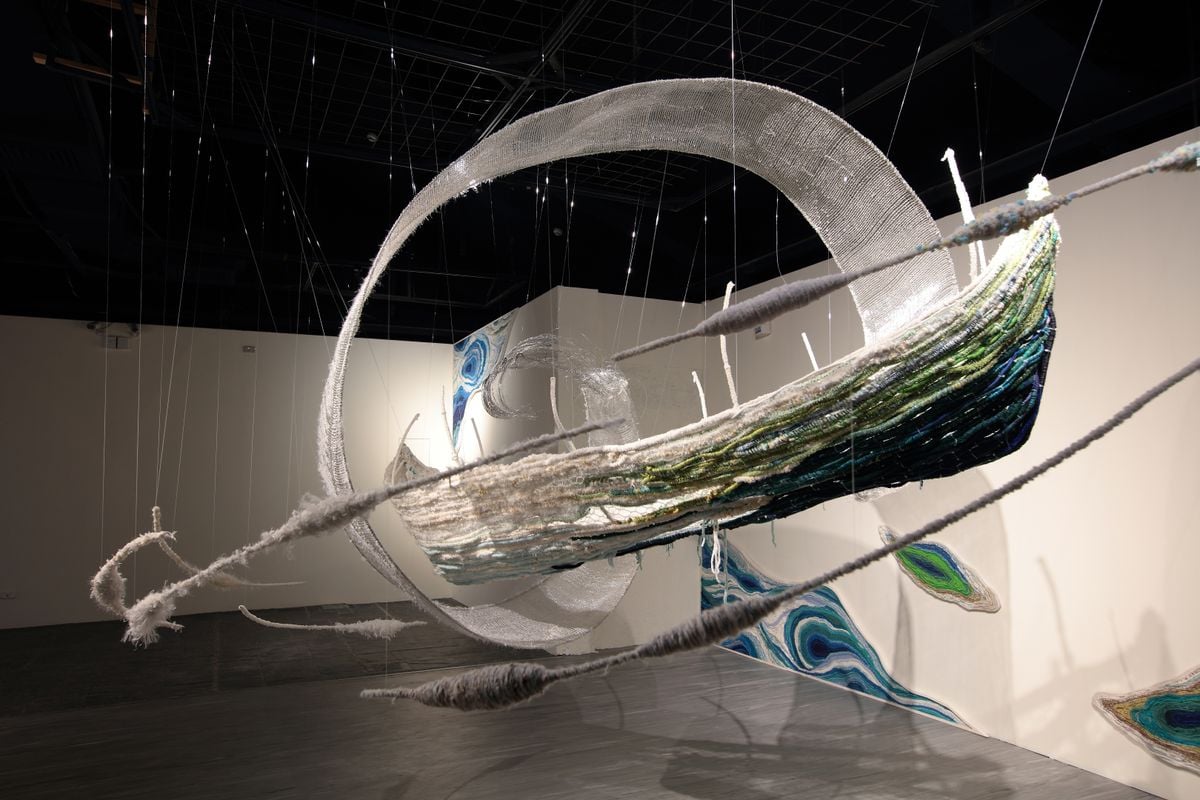
Milay Mavaliw, Dalan (Road) (2023). Huge hemp rope, knitting device, dimensions variable. Courtesy of Taiwan International Austronesian Art Triennial. Photo: Jing Dean Commercial Photography.

The first Taiwan International Austronesian Art Triennial 2023 opened on 29 October at the Taiwan Indigenous Culture Park in Pingtung. It continues through 18 February 2024.

The Triennial’s inaugural theme is RamiS: Tracing Origins. RamiS means ‘root’ in the Proto-Austronesian language, encapsulating the cultural and ecological practices that relate the indigenous people of Taiwan to those of the Australaisa and the Pacific.

Nakaw Putun, an Indigenous Taiwanese Pangcah artist and co-curator of the Triennial, described the title as a ‘reflection of the idea that we perhaps need to actively become spiritual to collaboratively think about the sustainability of humanity.’

Lisa Reihana, Nomads of the Sea (2019). Video, 17 min.

Lisa Reihana, Nomads of the Sea (2019). Video, 17 min. Courtesy of Taiwan International Austronesian Art Triennial. Photo: Jing Dean Commercial Photography.

Lisa Reihana, who represented New Zealand at the 57th Venice Biennale, is one of 25 artists from Taiwan and across the Pacific who feature in the show.

Her multi-channel video installation Nomads of the Sea (2018) weaves a narrative that explores colonialism while re-examining traditional Maori culture and gender roles. It’s displayed under the Triennial’s sub-section, Becoming Spiritual, which was curated by Putun and delves into how Austronesian people’s animistic beliefs exemplify a sustainable relationship with nature.

Indigenous Taiwanese artists exhibiting under this theme include Truku-Atayal artist Idas Losin, who will feature in the 24th Biennale of Sydney next year, and Makotaay artist Iyo Kacaw, whose wood sculpture Between You and Me (2023) deals with the degradation of the ocean.

Yuma Taru, Sea・Rise, and River・Flow (2023). Mixed media, dimensions variable.

Yuma Taru, Sea・Rise, and River・Flow (2023). Mixed media, dimensions variable. Courtesy of Taiwan International Austronesian Art Triennial. Photo: Jing Dean Commercial Photography.

In the Triennial’s other sub-section, Why We Are Us, co-curator Etan Pavavalung curates an impression of ‘the Austronesian “us”,’ as he describes it, shaped by colonialism, trauma, common challenges, and shared solutions.

Atayal artist Yuma Taru‘s installations Sea·Rise and River·Flow (2023), for instance, are part of a 50-year creative plan that involves weaving and chanting based on observations of shared issues among Austronesian communities.

‘The exhibition shares experiences of existence and attempts to guide viewers into contemplating our affinity with the Austronesian realm’ and ‘our communal trajectory towards a sustainable future,’ Pavavalung said. —[O]

Brooklyn Park artist’s design featured in Target’s tech accessories line

Brooklyn Park artist’s design featured in Target’s tech accessories line

BROOKLYN PARK, Minn. — A Twin Cities artist is making a splash in Target stores across the country.

Brooklyn Park native Ameen Taahir has been drawing and designing ever since he could hold a pencil.

“Literally since I could pick up a pencil,” he smiled.

Creating art on a blank canvas quickly became an outlet for him to express himself. His vibrant illustrations and paintings caught the attention of Target.

“It’s amazing,” Taahir said. “I think it’s such a special experience to work with a brand from where I’m from.”

Taahir was asked to create a design for Heyday, Target’s line of tech accessories. He designed his collection of accessories for phones and computers among other items. It is now being sold in stores.

The collaboration features artists who defy expectations by using visual styles to redefine voice, culture, and identity, according to Target’s website.

Taahir said there’s a lot of symbolism in his work.

The X on the hand on all iPhone cases represent his birthday, May 10. Five fingers and X stands for 10 in Roman numerals. He was also intentional with the artwork because he said certain items show different parts of his artwork.

“When I first initially made the artwork, it was a way for me to be able to express myself and tell my story,” Taahir said.

Now, he’s hopeful his style inspires younger creatives.

“People who look like me being able to see themselves in this art when they walk into Target is important for me,” Taahir said.

Through his art, he hopes important conversations can be had.

You can find Taahir designs in the electronics section of Target stores.