Photography

Afghan photographer shares ‘positive side’ of home country in library exhibition

Afghan photographer shares ‘positive side’ of home country in library exhibition
image

There are familiar images: a man selling balloons, kids flying a kite, the passion captured in the throes of playing the national pastime, people walking past a religious place of worship, or a group of children excitedly scrambling to look at the digital images a photographer just took of them. The difference is that they were all taken in Afghanistan.

Omer Khan is a photojournalist who was born and raised in Kabul, earning a journalism degree there and selling some of his photography out of a space at the U.S. Embassy since 2015. In 2021, he and his wife, son, and brother evacuated on a military flight after U.S. troops withdrew and the Taliban resumed power. Among the tens of thousands of refugees who left the country, they settled in San Diego where he began exhibiting images from his self-published 2019 book, “Hidden Treasure,” which he created “to show the positive side of Afghanistan to the world.” Previously on display in Oceanside, where he also answered questions about his home country and his work there, about 20 of the 250 pictures from his book are currently on display at the El Cajon Library through Wednesday.

Initially here on humanitarian parole, which provides two years of benefits to Afghan nationals set to expire Sept. 30, Khan says that he, his wife and their 3-year-old son were granted permanent resident status this past June. Although the couple was working at a local Subway, they moved to Dallas in April for a job he found as a sound technician with an event production company; their plan is to return to San Diego in October. He took some time to talk about his photography, sharing an often unseen side of his home country, and the kind of life he would like to build in America. (This interview has been edited for length and clarity.) Khan’s quotes have been edited to maintain the way that he spoke during our interview as a non-native English speaker.

Q: Before leaving Afghanistan in 2021 when the Taliban resumed power, you had worked as a photographer at television stations and nongovernmental organizations. What inspired your photography when you were taking pictures back home?

A: My background was I was a calligrapher myself. I love arts, and when I joined the [department] of journalism, the first semester of university I read about a camera and photography that made me inspired and become in love with the camera. Then, I started photography, but since I saw the people that they feature of Afghanistan, I saw they just have bad in the media for Afghanistan. All the world, the media of Afghanistan [was negative] and that made me to photograph positive side of Afghanistan. I published a photo book in 2019 by the name of “Hidden Treasure” and I published that photo book because I want to show the positive side of Afghanistan to the world.

Q: What catches your eye/inspires your photography since arriving in San Diego?

A: Whenever I become free from work, I do street photography. I love street photography a lot. The main reason I still do photography is because it is my passion and I love it. It makes me feel free, makes me feel comfort to do photography. Yeah, so whenever I become free [from work] I just take my camera and walking sometimes in the beach, taking pictures. Sometimes, early morning, going downtown and to take a picture of daily life, like people running to their jobs, and find a good subject for photos. Outside of that, small events, big events; depends on the people, what kind of contract I get.

For myself, usually, I like street photography, a sunset, landscape photography, the beach, landscape photography of the city. These kinds of photos. When I take my camera, I feel comfortable with my passion. Whenever I take pictures, I feel very comfortable. I love to take pictures. I search a lot to work in my own field, but it’s still a little hard to work in the U.S. in the same field and find a job, but I don’t want to lose, to forget my passion. That is why I do it, to continue my own passion.

Q: Your book features photographs from across Afghanistan and was something you created to “show the positive side of Afghanistan.” How would you describe what that positive side is to people who’ve never been there? To people who’ve only seen news images of war and the Taliban?

A: When I was working at the U.S. Embassy, whenever people saw my pictures at the coffee shop, they say, ‘Oh wow, Afghanistan is that much beautiful?’ I say, ‘Yeah, you never hear about this location?’ He or she say, ‘No, we just saw all the news, the explosion, the fighting, war.’ It gave me the main reason I shoot the photos. Afghanistan have very beautiful landscapes, beautiful national parks, and also a lovely people. Every day, tourists and people come and they are surprised, saying, ‘We never seen such beauty in other countries.’ A lot of countries, they have the same thing, but every country has a different view from each other. Afghanistan has lots of beauty, the mountains of Afghanistan. Afghanistan is a mountain country, so the mountains are very beautiful and this is the beauty side of Afghanistan. I’m going to show the people. Whenever you search about Afghanistan, at first, the pictures in the internet come to war, so my main purpose is to show the actual location of Afghanistan, the beautiful landscape of Afghanistan, the national game of Afghanistan, the people of Afghanistan. It never shows the people. Whenever you search about Afghanistan it always shows, the first pictures from the internet come? The war in Afghanistan. So, it was my main purpose to show the ancient location of Afghanistan; the beautiful landscape of Afghanistan; the national game of Afghanistan; the people of Afghanistan, that they are very kind and they’re just people. The world, they know Afghanistan as a war country and the people can look not like normal people, they all grow up in the war or these things, but actually, the people are very kind. Whenever I had some friends, tourists or journalists from other countries, when they walking with me around Kabul, taking pictures, they were surprised that shopkeepers or restaurant people will offer them free food or something. They say, ‘Oh, we never had something in other countries. They never offered like that. [People here] have too much kindness.’ This was the main purpose [for my photos], to show the positive—landscape, people, ancient locations.

Xiaomi’s 13 Ultra camera kit is more fun than it should be

Xiaomi’s 13 Ultra camera kit is more fun than it should be

Camera grips are back, baby.

As long as there have been smartphones, there have been goofy-ass mashups between phones and cameras.

We’ve had cameras that clamp to your phone or attach by magnets. We’ve had accessory lenses and shutter grips to make your phone act more like a camera. We’ve had cameras that were also kind of phones. None of them have been good enough to convince the masses, and everyone seems to have settled into an agreement that phones can just look like phones and cameras can just piggyback on your mobile data as needed. A sane world is a just world, etc.

I was ready to close that particular chapter of the digital photography history book when Xiaomi announced its 13 Ultra with a for an extra 999 yuan (about $137, though eBay resellers are asking for around $200). “Oh ho ho!” I chuckled smugly. “Not this old chestnut again!” Six months later, the joke’s on me because it’s actually really good — it’s just a shame that the camera and kit aren’t officially sold in the US and likely never will be.

Photo of Xiaomi 13 Ultra with camera grip and wrist strap attached.

Photo of Xiaomi 13 Ultra with camera grip and wrist strap attached.

a:hover]:text-black [&>a:hover]:shadow-underline-black dark:[&>a:hover]:text-gray-e9 dark:[&>a:hover]:shadow-underline-gray-63 [&>a]:shadow-underline-gray-13 dark:[&>a]:shadow-underline-gray-63″>It looks kind of normal, right?

The key to this particular phone / camera mashup’s success — and I can’t overstate the importance of this feature — is that you don’t look like an absolute dingus using it. It’s all relatively low profile, at least until you start using the filter holder, but that’s on you.

At its core, the kit includes a normal-looking phone case and a shutter grip that slides on when you want it and clicks into place. It’s easy to take the shutter off when you want to use your phone like a normal phone. The grip’s two-stage shutter connects to the camera via Bluetooth. There’s also a wrist strap attachment, and if there’s a single most underrated camera accessory, I think it’s the humble wrist strap. I want one on every phone.

There’s a mostly ornamental screw-on lens cap and the aforementioned 67mm filter adapter. I snapped the grip into place and headed to one of Seattle’s favorite tourist destinations to Do Photography for a couple of hours.

Photo of reflection of the Space Needle in a window.

Photo of reflection of the Space Needle in a window.

a:hover]:text-black [&>a:hover]:shadow-underline-black dark:[&>a:hover]:text-gray-e9 dark:[&>a:hover]:shadow-underline-gray-63 [&>a]:shadow-underline-gray-13 dark:[&>a]:shadow-underline-gray-63″>Two telephoto lenses is twice the fun.

I once heard a description from a mushroom forager that you need to “get your eyes on” when you’re on the hunt. You go to your foraging spot and start looking, but at some point, another sense kicks into gear. You start spotting the morels or whatever you’re after more easily.

In my experience, photography is like that, too. Anytime I go into a situation intent on Doing Photography, I’ll struggle for a bit, and then I “get my eyes on” and start seeing better photos. And there’s something about having a camera-shaped thing in my hand that helps me get my eyes on.

That was the case at least when I walked around Seattle Center on a sunny Tuesday afternoon with the Xiaomi 13 Ultra. Sure, the camera grip makes it more comfortable to hold the phone while you take a photo. And the physical shutter button helps you keep more attention on your subject rather than on the screen. But at least 50 percent of the kit’s utility — at least for me — is straight-up in my head. It helps put me in a photography mindset faster, much like a dedicated camera does.

Crucially, the 13 Ultra is also an absolute unit. There are four rear-facing cameras, one of which features a huge one-inch-type sensor. There are 5x and 3.2x telephoto lenses, plus an ultrawide. The main camera also includes a 2x crop zoom. It’s a smorgasbord of camera hardware, and the software backing it up ain’t too shabby, either. It’s all Leica-branded, down to the color processing, which you should take with a grain of salt. But I’ll be damned if I didn’t take some of my favorite portraits of the past year with this thing.

Portrait mode photo of a child playing with legos.

Portrait mode photo of a child playing with legos.

a:hover]:text-black [&>a:hover]:shadow-underline-black dark:[&>a:hover]:text-gray-e9 dark:[&>a:hover]:shadow-underline-gray-63 [&>a]:shadow-underline-gray-13 dark:[&>a]:shadow-underline-gray-63″>I’d be so obnoxious with this portrait mode if I had access to it all the time. I mean, come ON.

Of course, the 13 Ultra suffers from the same problems that trip up even the best modern phone cameras. It has a hard time freezing moving subjects in dim light, occasionally goes HAM on color saturation, and doesn’t always hold onto fine detail as well as a camera with a bigger sensor. (Take a look at the kiddo’s hair in the shot above.) And the vignetting in some of the portrait mode settings goes a little hard for my taste. But it’s easily one of my favorite mobile cameras of the past year, and I dearly wish we could buy it in the US.

You don’t need a top-of-the-line camera to take nice photos. You certainly don’t need a fancy camera grip for your phone to enjoy taking photos with it. But Xiaomi’s take on the old phone-is-a-camera concept is the smartest one I’ve come across, and I think it helped put me in a mindset to take better photos. If there’s an accessory — magnet, clamp, grip, or whatever — that helps you enjoy taking photos with your phone, then that’s a pretty good thing in my book. It’s just a nice bonus if it doesn’t make you look like a huge dingus.

Photography by Allison Johnson / The Verge

Five best travel photography spots in Jackson Hole

Five best travel photography spots in Jackson Hole

Jackson Hole, Wyoming is one of the most beautiful, yet pricey places you might consider visiting. It’s a popular spot for wealthy millionaires and billionaires to spend a few days in their second home during summers and ski seasons, as well as ordinary folks who love the skiing and national park touring.

While winter is what Jackson Hole is known for, more people actually visit in the summer, despite the expense. Fall is an even better time to visit, before the snow starts to drop. 

So what’s the attraction for Jackson?

It’s a really fun, classic Western town that wears its history on its sleeve, (“The Last of the Old West” is the town motto). You’ll find live shootout recreations in the center of Jackson Square, the classic Million Dollar Cowboy Bay right in the heart of town, where patrons can sit at the bar on a saddle, and dozens of Western wear shops lining the streets.

Also, it’s near not just one amazing, major national park, but two. Jackson is a ten-minute drive to the Grand Teton National Park, and 40 minutes from Yellowstone National Park. The Tetons is arguably even more impressive, at least in the summer and fall. Both parks attract just under 4 million visitors yearly.

The area has “exceptional wildlife” said Zeb Hermanson, a local photographer who works at the Jackson camera store, Wyoming Camera Outfitters. “Outside of Africa or Alaska, we have some of the most diverse wildlife you’ll find anywhere.”

Wildlife and smartphones? Yes, it can be done! As always, I filmed the latest episode of #PhotowalksTV on two iPhones, the 13 and 14 Pro Max models, the Samsung Galaxy S23+, a GoPro Hero 11 and my DJI Mavic Air 2S drone.

The Galaxy really came in handy for the moose shots, as it has a stronger, 10x optical zoom that just knocks the 3x of the iPhone out of contention in these types of situations. (Note the close-up of the moose below!) The iPhones did great for the traditional widescreen landscape scenes one would associate with visiting a national park. I couldn’t fly my drone in the park (a no-no) but I got great shots in Victor and Teton Valley, over the hill.

Did I miss having the big camera and huge zoom lens? Sure, but my body appreciated not having to lug them. And besides, how much closer did I really need to be to the moose? If I zoomed in any closer, I wouldn’t catch the antlers.

Top 5 Jackson Hole photo spots

Schwabacher’s Landing

About 16 miles from Jackson, this is a popular place for picnickers to sit and watch the moose graze in the mornings and early evenings. It’s a pretty safe bet you’ll find the moose if you come during those times.

Mormon Row

Dating back to the 1870s, these old barns belonging to settlers still look incredible today against the backdrop of the Tetons.

Jenny Lake

Known as the centerpiece of the park, here you’ll get your best view of the Tetons themselves. If you want to go beyond your basic sighting, you can hop a boat here (for a fee) and take a little ride to another part of the lake, where a short hike will bring you to a wonderful, huge waterfall.

Jackson

Downtown is a fun old Western town for walking around — but hold onto your wallet! Everything is pricey. Ice cream cones at the popular Moo’s start at $7.50!

Ansel Adams

The Snake River Overlook— Ansel Adams. The Snake River Overlook is where the legendary photographer captured the image of the Teton Range meeting the waters. But when he did it, he had an unobstructed view, which today is covered in trees. A drone would solve the issue, but that’s a no-no! If you can get high (like on a stepladder) when you visit, you’ll get a better shot.

5 Photography Cheat Sheets for Shooting Portraits You’ll Love

5 Photography Cheat Sheets for Shooting Portraits You’ll Love

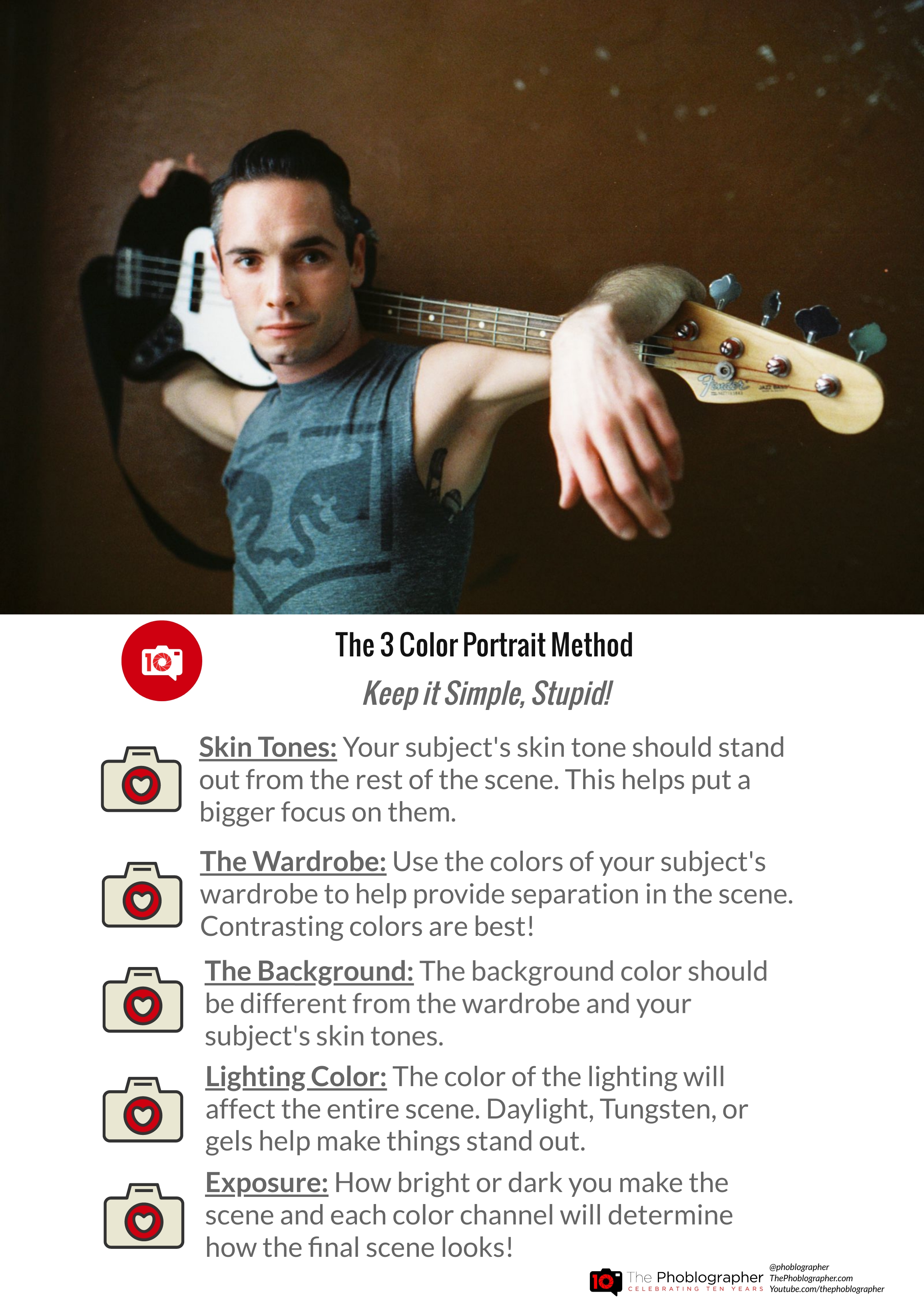
There are tons of tutorials out there for shooting portraits. But many don’t get into the specifics that help you truly love the portraits you shoot. So we dove into our archive of original cheat sheets and infographics to find exactly this sort of stuff. How many of you use the three-color portrait method? Alternatively, what do you know about placing a nose in a portrait? Or lighting?

View this article with minimal banner ads in our app for iOS, iPad, and Android. Get no banner ads for $24.99/year.

Well, guess what! Over the years, we produced all these photography cheat sheets ourselves. And we’re helping you find exactly what you want by assembling a select few. We hope you get all you need for shooting portraits right here.

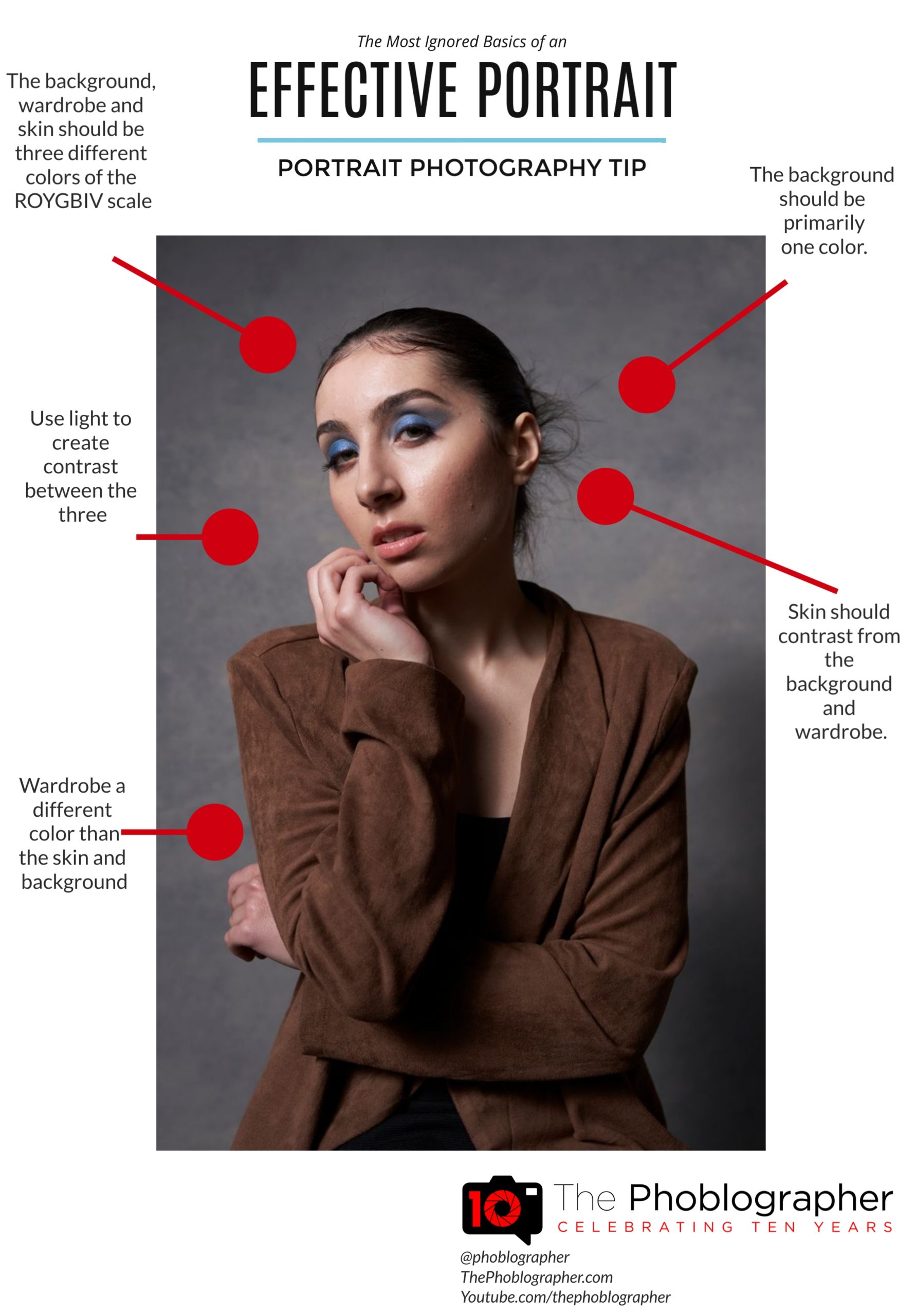
The Three Color Portrait Method

“The approach for many portrait photographers is arguably lazy. Instead of genuinely creating, many rely on the model to do something. But besides giving them instruction, try giving wardrobe input. Using the Behance platform to develop storyboards and mood boards helps a lot. It can dictate things like lighting and more. Plan to go above and beyond by using the three color portrait method. Add props into the scene to give the model something to do. Try flowers or candles. Create a story. Don’t just sit there capturing a model vibing in front of a camera. Those photographers tend to do nothing else but copy the work of others. If you’re looking to create work to feed the Instagram algorithm, stop. Put the camera down, thumb through a few photo books, and get inspired.”

Check out more in our blog post!

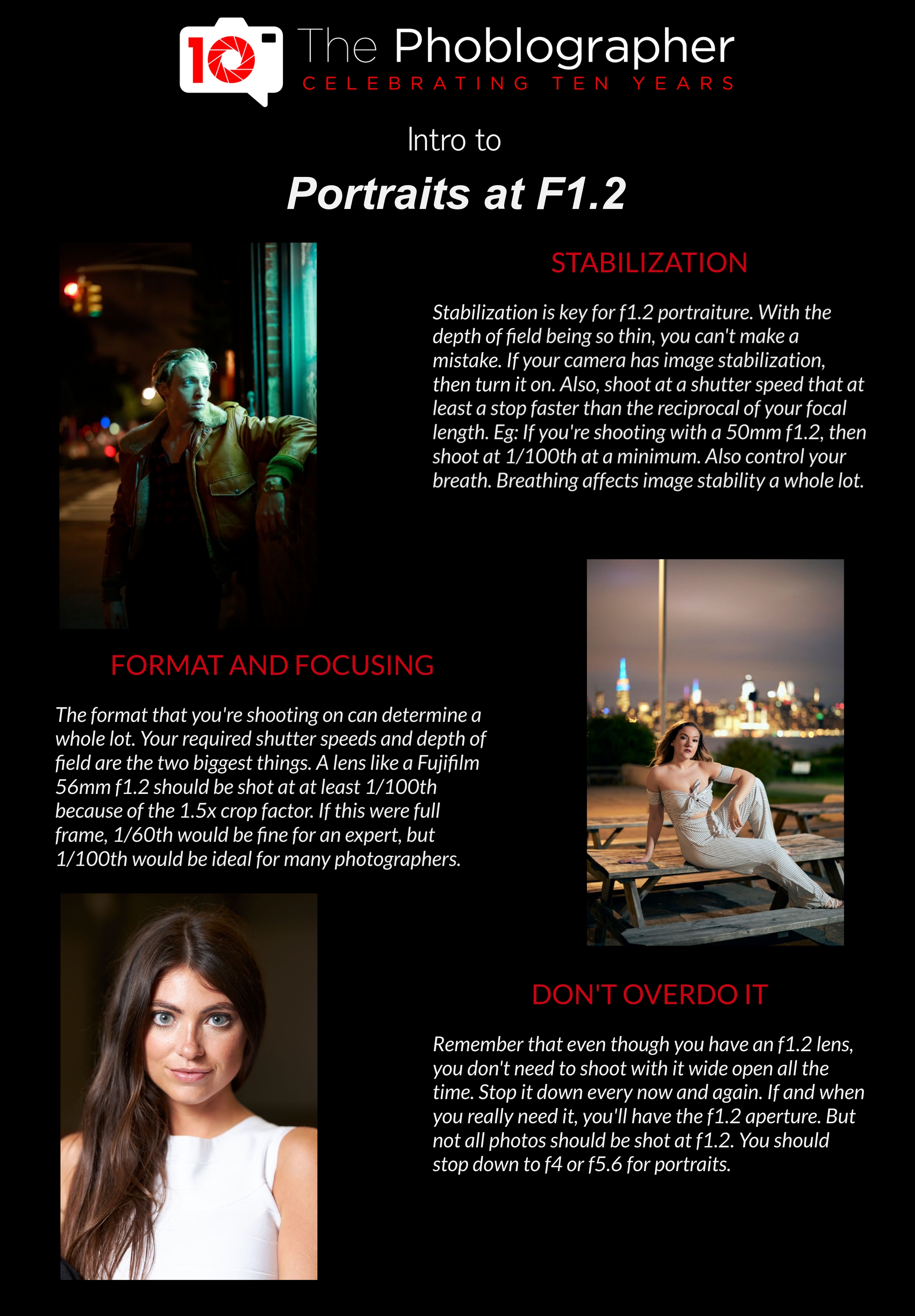
Shooting Portraits with an f1.2 Lens

“When shooting wide open with an f1.2 lens, you’ll get a sharp yet soft look. This soft look makes everyone appear lovely and it’s very addicting. But you can deliver more sharpness by just stopping down a tad. We already talked about this, but the ultimate point is to find the balance. Personally, I like the softer look with a Polarizing filter on the the lens, which enhances the colors and contrast more. It’s a similar tactic to what many f1.2 lenses have with their APD variants. With these variants, there is an extra element that brings even smoother bokeh to the photos. Give it a shot!”

Check out more in our blog post.

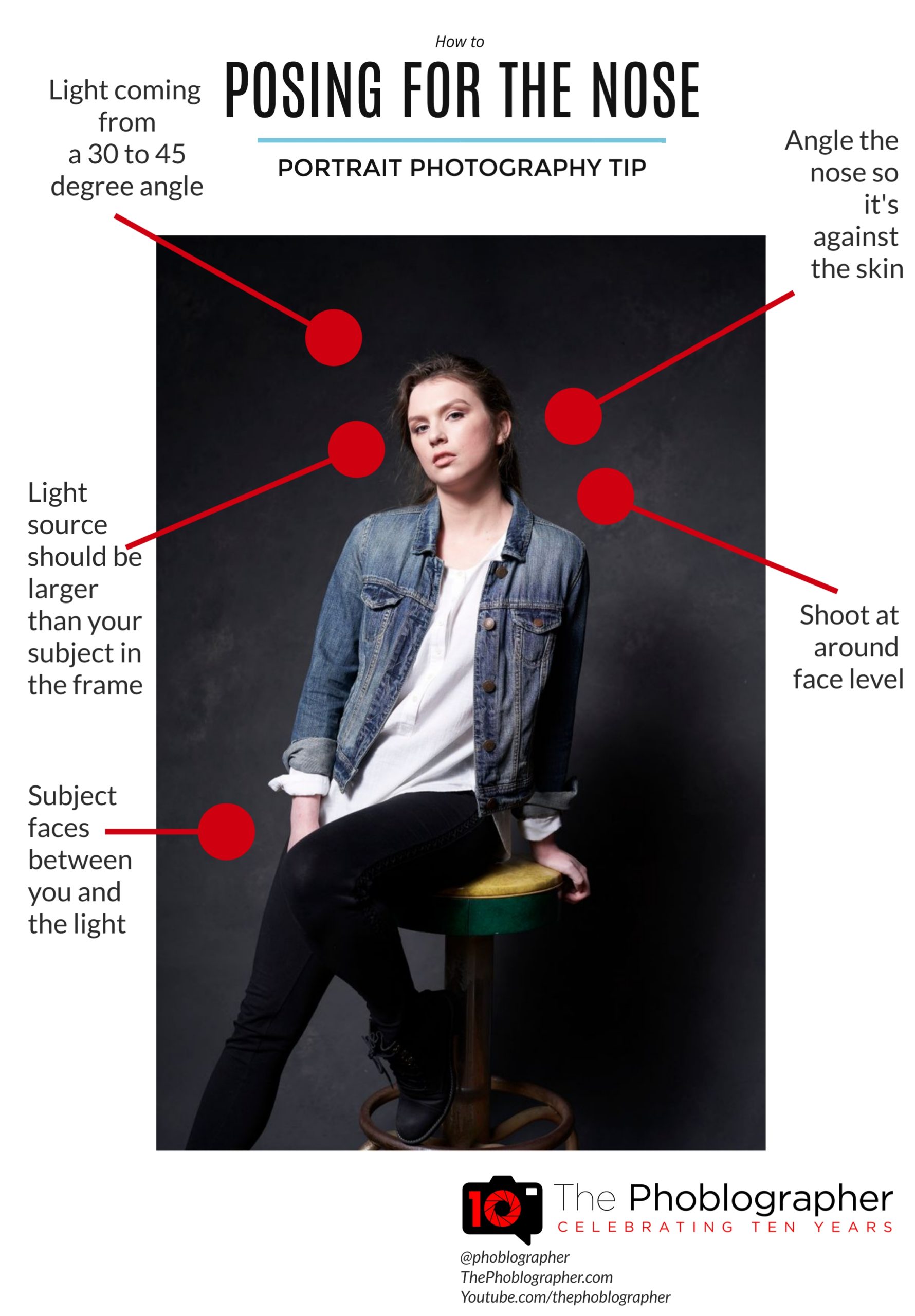
Positioning the Nose While Shooting Portraits

“In addition to this, give the nose a background. By that, we mean to place it against the skin. Notice how, in the image above and our lead image, the nose is against the cheek? That’s what you need to do. This makes the nose pop out less and makes it look more flattering. From here, you’ve got a variety of techniques and poses you can use. You can fold their arms, put their arms down, etc., but our focus here is the face, and it’s best to adjust this last. Don’t worry, that still means you’ve got a whole lot of posing options. Your subject’s face just needs to be posed a specific way.”

Read more in our blog post.

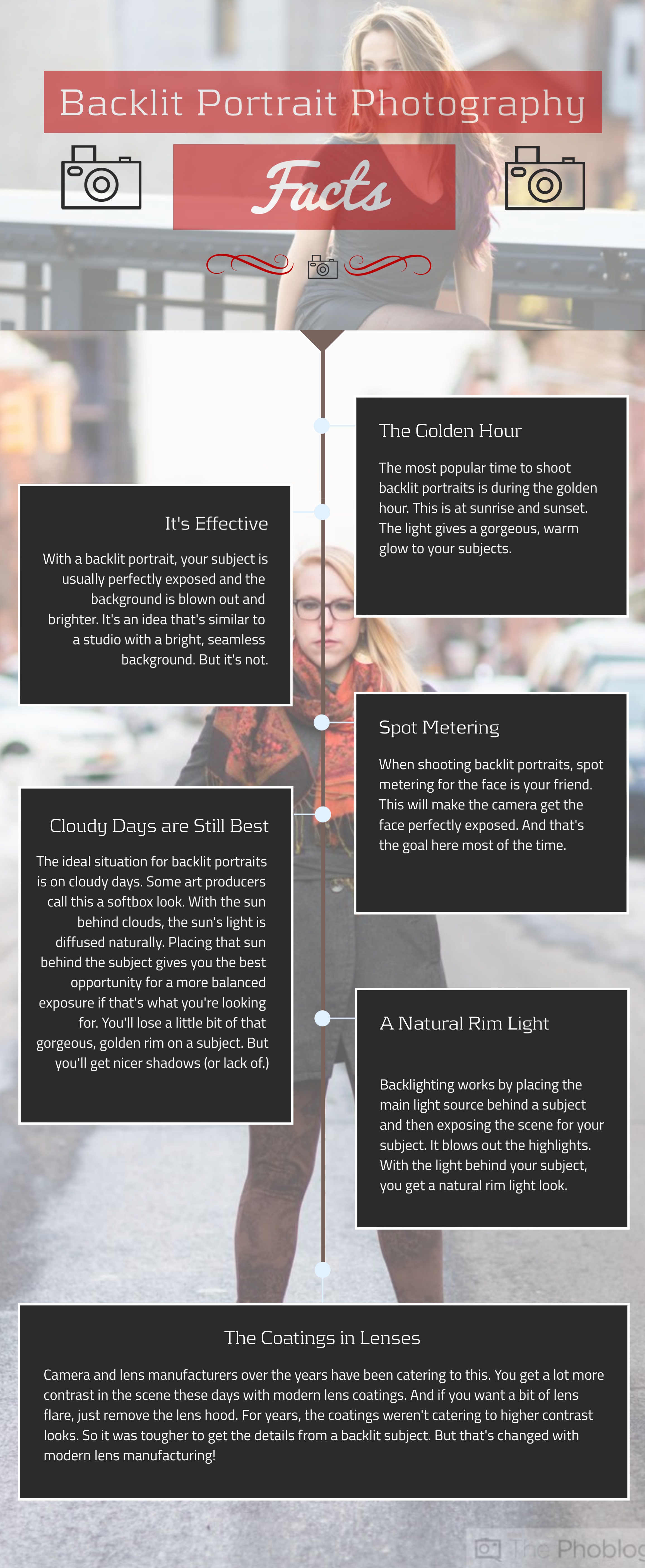
Backlit Portraits

“One of the most important elements in creating a great backlit portrait is to make sure your subject is properly exposed. The default metering mode for most cameras will meter the entire frame rather than focus on your subject. For the best results, set your camera to spot metering and meter for your subject’s face to ensure it’s properly exposed.”

Read more in our blog post.

Important Elements of Portrait Photography

“In my experience of shooting folks of every race, everyone is rendered by cameras in the orange and red channels. Those are typically associated with the skin. You need to find a color that contrasts with the skin. You’ve got five other colors or so to pick from. Once you’ve gotten that, figure out the background. A person shot against a red brick background will inevitably be affected by the red light reflecting off the background. If it’s your intention to get that effect, cool, move forward, but chances are it’s not. Lastly, you need to separate the person from the background. That’s typically done using lighting, wardrobe, and depth of field.”

Read more in our blog post!

Van Life and Photography is Not an Easy Mix

Van Life and Photography is Not an Easy Mix

Between my partner blaming me for never being around, getting older and less excited about jet lag from long flights, I have been transitioning towards wedding photography. Covid most certainly strengthened my resolve as there was not much traveling going on anyway. Life is getting back to normal. I admit that I still make a small part of my income with travel photography, so I was thinking about a way to make the best of both worlds. Why not shoot weddings primarily and travel during the off-season? It would not be more than three months a year while staying close to home. This was when the idea of van life kicked in.

We hate banner ads too. Download our app for iOS, iPad, and Android and get no banner ads for $24.99/year.

I wanted to travel at a slower pace, and the idea of sleeping next to my shooting locations was appealing. I shoot a lot of early mornings. Waking up at 5am is hard enough; I don’t need to account for one extra hour of commuting from my hotel. The more I thought about it, the more a van made sense. Until I actually started experiencing the road.

I took the road last month for a week-long trip. I was excited to check whether this was doable. Being an outdoor person, being on my own and out in the wild is something I enjoy quite a bit. The van itself and the outdoor experience are not for everybody. Some people need the hustle and bustle of city life and the afternoon drinks with colleagues. But if you are more into the peaceful and quiet nature of remote places, it is lovely. The bottleneck for me was making my photography work with it.

The act of taking pictures accounts for probably 20% of my time. The rest is shared between editing, writing, marketing, and other administrative duties I wish I can delegate at some point soon. Multitasking has become a thing. I write on my notepad when I am out with friends; I edit most of my shots on Lightroom mobile while riding the metro, and I can deliver an entire wedding album if I am stuck on a plane long enough. I think we all do that one way or another. For those of us who freelance, we breathe our photography, and it becomes an integral part of our daily routine, even without a camera in our hand.

I drove a total of 15 hours on that trip. 15 hours may not sound like much for an entire week, but driving is the one thing you cannot squeeze into a multitasking routine. There is no writing when you are driving! There is no culling, editing, or answering customers’ inquiries. Suddenly, I realized 15 hours was a luxury I could not afford with my current workload. I can zombie walk to a shooting location at 5am with minimum sleep and nothing but my grit. Crossing the country at 70 mph in that shape is something I am not willing to try.

I wish my troubles stopped there, but the lack of decent wifi came to be another nail in my coffin. Once again, I rely on a lot of editing and emailing. The bandwidth required for the 200MB GFX files is massive. Do not get me wrong, you can find phone service and wifi in many places. Free ones tend to be weak and strong ones get really expensive really quick.

A lot of people are making it work. Some can focus for a few days at a time on the experience and be completely cut off from the world. I think it just requires a different organization and workflow and, in my case, mixing it with a high-volume and communication-heavy wedding business is certainly not helping. I have a little too much commitment packed in a single day. Working from the road means it will never be the absolute freedom one can imagine as you will always need to set up somewhere with a decent network service. I also understand a little more why most people I meet on the road are couples who can split responsibilities. It is a different world out there, and it requires a different organization.

Despite those two points being huge hurdles, the one thing that hurt my photography the most was the reduced social encounters. Public transportation and hotels are the best way to meet locals or fellow travelers. Out of those encounters will rise ideas, stories you are willing to tell, or recommendations of must-see locations in the area. This is, for me, what travel photography is about, not jumping from one Instagram location to the next. It is about the people.

The one benefit of spending a fortune on a van is that you do not need to pay for a hotel room, therefore, those encounters will pass you by. Besides, there are so many limitations on where you can park that you will always find yourself a little more isolated.

My dreams of van life are not dead, I will just need to look at it harder and figure out the proper workarounds for me, and when I do, you can bet I will make a blog post about it.

London woman trades banking career for dog photography

London woman trades banking career for dog photography
Emma Slade with her cockapooEmma Slade

A woman says she gave up a 16-year career in banking to become a dog photographer because her puppy gave her “a new perspective on life”.

Emma Slade, from Canning Town, east London, left her role at Goldman Sachs in 2019 after she got her cockapoo.

The 43-year-old said: “I realised I wasn’t as happy as I had been… there was more to life than money.”

She has now raised more than £1,600 for a north London dog charity by photographing dogs it has helped.

Ms Slade is planning to publish a book in November featuring 36 dogs she has photographed that were rescued by All Dogs Matter, which is based in Haringey.

“Some of them have had horrible starts to life,” she said.

Ms Slade explained her interest in photography had been limited to taking holiday snaps until she got her puppy Schlappohr, who she named after the German word for “floppy ears”.

She said the arrival of the “little puppy” in her life had given her a “new perspective” on work.

Byron, one of the dogs adopted from All Dogs Matter

Emma Slade

Ira Moss, founder of All Dogs Matter, said the money raised would be used to fund the vet bills for one or two dogs at the centre.

“A lot of dogs coming in have medical issues,” she said. “People are spending £2,000 to buy them, but when they get ill, they don’t want to spend money at the vet.”

Ms Moss added that dog abandonment is at the highest rate she has ever seen after the pandemic-led rise in ownership.

Presentational grey line

Follow BBC London on Facebook, Twitter and Instagram. Send your story ideas to hellobbclondon@bbc.co.uk

Related Topics

Related Internet Links

The BBC is not responsible for the content of external sites.

The big picture: ​praise dancers ​in Edna, Texas

The big picture: ​praise dancers ​in Edna, Texas
image

Praise dancing, a response to the biblical injunction to “Praise him with dancing and tambourines!”, is deep-rooted in Baptist and Pentecostal churches in the American south. Rahim Fortune took this picture of praise dancers in the town of Edna, Texas in 2020. It was part of a series focusing on the family of a young creative director, Chasidy Chevonne, for a book project in which Chevonne reflected on Black womanhood and the lives of the women she grew up among. The photographs were originally released to mark Juneteenth – the federal US holiday commemorating the end of slavery – a month after the murder of George Floyd in May that year; they were intended “as a form of visual healing”. Texas had been the last state to hear the Emancipation Proclamation, in 1865.

Rahim Fortune has been photographing in the southern states for the past six years; his work, including this picture, will feature in the inaugural PhotoFairs exhibition in New York next month. His pictures often examine different elements of his own heritage – his father was an African American living in Austin, Texas and his mother part of the Chickasaw Nation in Oklahoma. He thinks of his photographs as “a love letter to the place I grew up in” and a series that speaks to the “mythic quality of culture” in the American south-east. As well as his praise dancers, Fortune’s work celebrates blues musicians and rodeo queens, tracing the contributions of Black and Native American traditions to contemporary Americana and folklore. His ambition, he says, is to produce a body of work that can “ascend [beyond] any narrative around rural Black identity in America as one of simply servitude or oppression. Rather, I intend to highlight the boundless creativity and possibilities of the music and people who still contribute to this culture.”

Justus Fine Art Gallery hosts ‘Seeing’ photography exhibit

Justus Fine Art Gallery hosts ‘Seeing’ photography exhibit

em {
display: contents !important;
}
label em {
display: none !important;
}
.photo {
width: 100%;
max-width: 50rem
}
a.fr-file {
color: #0274b7 !important;
}

Justus Fine Art Gallery will host “Seeing: a Photography Exhibition” in September.

The exhibit will feature work by artists including Beverly Buys, Robbie Brindley, George Chambers, Don House, Carey Roberson, Andie Roberts and Eli Vega.

“Along with the individuality of artistic styles, a range of photographic processes will also be displayed. In conjunction with the photography show, a Haiku poetry competition, inspired by the works on display, will be held throughout the month,” a news release said.

The opening reception will be held from 5-9 p.m. Friday as part of the monthly Gallery Walk in downtown Hot Springs. The exhibit will be on display through Sept. 30.

Selections from Roberson’s “Morning Stroll Surprise” series will be featured in the exhibit.

“‘Morning Stroll Surprise’ is an iPhone-based side-project, that began while on a trip to New York in 2015, and was originally intended only as a creative exercise to get out of an artistic rut, and to lose some weight while taking morning walks (but that is a whole other issue),” Roberson said in the release.

Eight years later, “it has developed into part of my creative practice and is a major influence in all of my other work. The premise of the project is to study the unnoticed through a process of subtraction, framing, and questioning. Poetic connections are created through little shifts in perspective. Hidden arrangements wait to be subtracted by the camera’s frame and brought into a new life. Disparate forms and objects generate into new contexts and meanings, and framed assortments of circumstances give significance to the often unremarkable. Unfortunately, the weight loss part hasn’t gone as well as the project,” Roberson said.

Roberson earned a BFA in Studio Art from Henderson University in Arkadelphia and a MFA in photography from Louisiana Tech University. He is an associate professor of Art at Ouachita Baptist University in Arkadelphia, where he is the gallery director for the Rosemary Adams Department of Art & Design Galleries, and teaches art foundations, photography, sculpture, printmaking, and other studio art courses. He previously served as an associate professor of Art at the University of Arkansas at Little Rock from 2002 to 2018, where he headed the Photography Program, along with serving as the BFA coordinator and interim chair of the Department of Art & Design.

“Roberson’s artwork integrates traditional studio media with new digital technologies and methods to create quiet personal narratives,” the release said.

Roberson has exhibited in over 70 competitive, invitational, and solo exhibitions. His work has been exhibited at the University of North Texas, Ithaca College, Huntsville Museum of Art, Mobile Museum of Art, the Arkansas Museum of Fine Art, and numerous other university and private galleries around the nation. He is a winner of the Arkansas Arts Council Individual Fellowship Award and has works in a number of collections, including the Mobile Museum of Art in Mobile, Alabama. Roberson’s artwork has also been featured in the national publications of New American Paintings and CMYK Magazine.

“Using a film camera and an enlarger, nothing is digital in Buys’ process of creating cyanotype prints. Each print is one-of-a-kind — no two prints from the same negative are ever the same,” the release said.

“Cyanotype prints are made when sensitized paper is exposed to ultraviolet light. It is simple and direct in execution,” Buys said in the release.

“I strive for perfection at the beginning and embrace, even encourage, the imperfections that the process brings. The photographs are grid-like in that I enlarge each negative on six separate pieces of film that I have pieced together kind of like tile on a floor. The resulting negatives are placed on cotton rag paper that I have coated with the simple cyanotype chemistry. On sunny summer days, I make the prints by exposing this sandwich of sensitized paper, negative and a heavy sheet of glass to hold all in place under the sun. The prints are developed and washed in a large tray in my backyard using a garden hose. The simple tools and processes that I use to make the photographs reflect back on the type of ingenuity that I appreciate in the subjects of my Delta imagery,” Buys said.

Buys’ cyanotypes have been showcased in solo exhibits at Arkansas State University in Beebe; the Delta Cultural Center in Helena; the Russell Fine Arts Gallery at Henderson State University; and the University of Memphis Art Gallery in Memphis. Buys’ work has also been included in group exhibitions including the annual “Delta Exhibition” at the Arkansas Museum of Fine Art in Little Rock; “artSpark 2013” in Raleigh, North Carolina; the “2011 Winthrop Rockefeller Institute Legacy Art Exhibition” at Petit Jean; and “Selections From the University of Arkansas at Little Rock Permanent Collections” at the University of Arkansas in Little Rock.

Buys earned a BSE in Art Education from Henderson State University, an MA in Photography from the University of Arkansas at Little Rock, and an MFA in Photography/Printmaking from the University of Memphis. Buys served as a professor of photography at the Ellis College of Arts and Sciences at Henderson State University prior to retiring in 2014.

Chambers’ photographs focus on the landscape in an attempt to “look beneath the symbolic language we overlay the world with and glimpse what’s there” will be included in the exhibit, the release said.

“Place a tiny human face somewhere in the landscape and the eye will find it immediately. Any text in the scene and the eye wants to read it,” Chambers says in the release.

“Avoiding these symbols, I try to create a blank slate that is still visually dynamic, leading the eye into ever deeper levels of textures and detail. If the viewer connects with the image, they project their own feelings and meanings onto the piece.”

Chambers earned a BA in Commercial Photography from the Brooks Institute of Photography in California and currently maintains an active studio in Little Rock. His work has been included in a range of group and solo exhibitions, including “Beyond Symbol” solo exhibit at the Baum Gallery of the University of Central Arkansas in Conway in 1999; “Small Works on Paper,” 2003, 2002, 2000 and 1998; “Visual Anthropology: Welcome to our Neighborhoods” group show at the Laman Public Library in North Little Rock, 2016; two-person show, Anna Eaton Stout Gallery, Brescia College, Owensboro, Kentucky in 1996; “Trappings Exhibition,” Hot Springs Arts Center, Hot Springs, 1991; “Lightwriters,” Kresge Art Center, Michigan State University, East Lansing, Michigan, 1984; and “Prints, Drawings, Crafts Exhibition,” Arkansas Museum of Fine Art, Little Rock, 1991, 1984 and 1983. Collections include Arkansas Fine Art Museum, Henderson State University, University of Arkansas Medical Center, Kimberly Clarke Corporation, and LSI (GMAC Financing).

House “is respected for his dramatic black-and-white portraiture and rural scenes, along with his altered Polaroid prints. His work has been included in numerous solo and group exhibitions throughout the U.S., along with a wide range of publications. His photography has been featured in The Wall Street Journal, American Forests, Boy’s Life, Persimmon Hill, First Freedom, Free Hunters, Outdoor Oklahoma, Wood, Traditional Bowhunter, Backpacker Magazine, and Woman’s World, along with a variety of university textbooks, and covers for fiction and nonfiction books. Two collections of his work, “Buffalo Creek Chronicles” and “Not a Good Sign,” have been published by Phoenix International Press.


Selections of Brindley’s spare landscapes will also be included in the exhibit. “He only shoots with film using a Mamiya RB67, which requires a tripod and careful attention when composing his photos,” the release said.

“My work is a slow process. Sometimes driving all day over many miles of back roads and dirt paths, passing small towns and empty fields … to take one picture,” Brindley said in the release.

“Roberts has been photographing since she was a child and more seriously for the past 15 years. Her images reflect her interest in finding beauty in the abandoned. She doesn’t manipulate the imagery she finds, but creates engaging compositions from what she sees. This exhibit will be the first time Roberts has shared her work publicly,” the release said.

Vega was first exposed to art while attending Texas Tech University “where he gained a foundation in color theory, design, and composition. It wasn’t until 20 years later that he first began to explore photography,” it said. He currently teaches private and group photography workshops, along with writing. His books include “Renditions of Famous Paintings,” “Right Brain Photography (Be an Artist First),” and “I Always Wanted to Be Somebody (But, I Settled for Much More: Me).”

Owned by artist Dolores Justus, Justus Fine Art Gallery, 827-A Central Ave., is open from 10 a.m. to 5 p.m. Wednesday through Saturday. Call 501-321-2335 or visit http://www.justusfineart.com for more information.


photo


“My Garden,” by Beverly Buys. – Submitted photo


photo


“Morning stroll surprise in red rock, black asphalt, and white reflective plastic,” by Carey Roberson. – Submitted photo


Wildbuzz: Her eyes, a kingfisher blue

Wildbuzz: Her eyes, a kingfisher blue
ByVikram Jit Singh

Aug 27, 2023 03:07 AM IST

Just two years into her pursuit of weekend wildlife photography, Sophie Luby, had snuggled into a kingfisher hide at Kirkcudbright in Scotland when a kingfisher landed on her camouflaged head

They made for a matchless pair: a dazzling little kingfisher with wings of calm-sea blue and a self-taught wildlife photographer possessed with a pair of keen blue eyes.

Wildlife photographer Sophie Luby with a kingfisher. (Photo: Sophie Luby Instagram)

Just two years into her pursuit of weekend wildlife photography, Sophie Luby, 29, had snuggled into a kingfisher hide at Kirkcudbright in Scotland when the bird landed on her camouflaged head. Luby was floored. The next day, she put another camera focused on her in the hope that the bird would alight again. The bird obliged, brought a fish and beat it on her head to stun it before gobbling it. The video caught the kingfisher’s jaunty actions along with the soft pitter-patter of its small feet on Luby’s concealed head. All this while, Luby was laughing, her face melting into all manner of indulgent smiles, like a mother mooning over her newborn. She was also trying very hard not to quiver at the surreal avian odyssey taking place just above her. Luby did not want to frighten the unsuspecting kingfisher.

The bird graced Luby with “lady luck” and she was instantly crowned the “Princess of Good Times”. Luby’s reel of the kingfisher prancing on her head secured viral success with more than a million views since she posted it on Instagram on August 3, 2023, fetched her 1,33,872 likes and accounted for the overnight growth of her followers to 30,400.

Apart from the kingfisher inveigled so artfully by the hide, it was Luby’s personal charm radiating from the smiles gracing her salmon-pink lips and “eyes of clear skies” that exerted a magical draw on viewers. Would a kingfisher draw such attraction were it to alight on the world’s best wildlife photographer but one saddled with sagging white-grey moustaches, weather-beaten skin, a paunch arising from long, sedentary hours in hides, squinty eyes and a dour ‘seen it all’ expression? Never!

Leopard and gazelle kill, Masai Mara. (PHOTO: TARUN KAKAR)

Unwanted, whiffs of Chanel

Could a male leopard find himself imprisoned in a tree situated in the sprawling openness of the Maasai Mara (Kenya) with “noxious fumes” of expensive perfumes drifting up the big cat’s nostrils? Well, Chandigarh-based wealth management consultant and passionate photographer, Tarun Kakar, has quite a tale to narrate. His startling picture of the leopard on a thorn tree with his kill, a Thomson’s gazelle, impaled on the branches was on display at the recent TPAS Drishti Photo Exhibition at Punjab Kala Bhawan.

At first glance, Kakar’s frame captures the essence of leopard behaviour: to fetch the kill up a tree and safeguard it from lions, hyenas, wild dogs and other scavengers. But not humans, there’s much more to that supposedly natural exposition of behaviour. “I was on a game drive when I saw a jam of tourist vehicles around a tree in the far distance. Just as flocking, circling vultures send a visual signal of a carcass to other creatures, I also made for the tree. I had to wait an hour in the queue as there were so many vehicles. Tourists were clicking and ogling at the leopard with its kill. Some were sporting perfumes and the wild air was thick with artificial scents. Perfumes disrupt the receptive and sensory abilities of wild creatures. When our turn came, I spent about 2.5 hours taking pictures. I was myself a culprit, of tourist invasion of habitat and disruption of wild animals’ behaviour,” Kakar told this writer.

Kakar’s frames captured the bamboozled expression in the eyes of the leopard. It was restlessly traversing the branches from one end to another in a vain effort to spot an opening in the tourist vehicle cordon and flee the tree. The cat had been reduced to a prisoner pacing the cell, albeit, in the vast openness of his Masai Mara home.

“The leopard had killed the gazelle at night and must have been thirsty by now. But its movement from the tree to the waterhole was blocked,” Kakar added.

1.