
World Sports Photography Awards 2023 winners revealed | Sky Sports


NEW HAMPTON — “Alternative Process Photography,” an exhibit by the New Hampshire Society of Photographic Artists, will be on display in New Hampton School’s Galletly Gallery from Monday, Aug. 28 through Saturday, Oct. 14, and a public reception will be held on Thursday, Sept. 8, from 5:30 to 7 p.m.
This exhibit celebrates photographic images that use an alternative process in an especially expressive, compelling or innovative way. The images on display combine modern and historical technologies, including photopolymer gravure, cyanotype, gelatin silver, wet-plate collodion (tintype), platinum-palladium, albumen, anthotype, palladium, Van Dyke brown, near-infrared and mixed media imagery. The carefully crafted artworks illustrate the expressive potential of alternative process photography.

The first time I heard this quote years ago, it stopped me cold: Men are afraid women will laugh at them. Women are afraid men will kill them. Sometimes things feel too close to the bone. All those times you’ve had to take the long route home, spend extra for a taxi, laugh at someone’s bad jokes to avoid anger, retaliation. Done something you didn’t want to do just to get out of the fight over doing it. And worse.
Men are afraid women will laugh at them. Women are afraid men will kill them.
Not surprisingly, it’s a paraphrasing of something Margaret Atwood once said. Of course she did.

, a new monograph from photographer Kristine Potter, embodies and investigates exactly this in a series of black-and-white images set in the Gothic South and juxtaposed with the lyrics of 19th- and 20th-century “murder ballads,” wherein girls and women meet their ends over and over again, most often by a river or a roadside. That Atwood quote came to mind as I turned each page of the exquisitely constructed book, copublished by Aperture with Images Vevey and The Momentary.

From the moment crime scene photography infiltrated our daily intake of news, what was once an image of the bucolic side of a country stream could also, now, represent violence in the popular imagination. Something too empty, lonely, not populated with witnesses, could easily be the place women have long known to fear. Context is everything, we have learned. And the great gift of good art is that it can shift lenses and generate cognitive dissonance to push us into recognizing how wrong (or violent) the status quo can be. In Potter’s richly layered and noirish photographs, we are confronted with those haunted sites with titles like Troublesome Creek, Hangman’s Curve, Bloody Fork, and Murder Creek 1. The unsettling landscapes are interspersed with portraits of reimagined victims like Knoxville Girl, dressed in antique clothes and wringing out her hair, and others of possible perpetrators, like a man walking shirtless down a road. Our bone-deep knowledge makes us fear the worst.

Facing some of the plates on opposite, deep green pages are the lyrics to songs like “Delia’s Gone” and “Down in the Willow Garden,” only two among the murder ballads that have entered our mainstream via stars like Johnny Cash, Dolly Parton, and Art Garfunkel. The genre traveled from Scotland and England and became part of the American folk firmament, especially in Appalachia. They are songs of murder and hauntings and retaliation and very often, as Potter writes, “the murder of a woman at the hands of a man, for whatever inconvenience she represented.”

Potter does something small but significant on those pages. You’d miss it if you were just leafing through. She has crossed out the words and lines that describe the moment of the act of murder. In “The Jealous Lover,” the last four lines read:
Down on her knees before him,
She pleaded for her life,
But deep into her bosom,
He plunged the fatal knife.
Across from the lyrics is a photograph titled After the Struggle, the empty bamboo-lined shore of a stream. Our experience of violence (and crime scenes, sung or pictured) imbues the piece with our dark, accrued knowledge. A knowledge we wish we didn’t have to have. And yet, there is something hopeful, unflinching, and powerful in Potter’s act of crossing out. The book closes with “Blood Harmony,” a short story by that matches Potter’s tone with her own brilliant tale of Southern madness and pain and men and women and little girls who sing the murder ballads their father taught them. There is danger, fear, volatility and the preceding photographs hover in the mind’s eye. But as with Potter’s strike-throughs, we see a glimmer of agency in Bengal’s girl. May it be so.

A photographer has created an epic showreel of his timelapses filmed all around the world over the course of 10 years.
Matthew Vandeputte put together a selection of his best work and it is a great example of a seasoned photographer who has mastered their craft.
“I’m pretty much always shooting a timelapse or a hyperlapse wherever I am,” Vandeputte writes on his website.
“The result of this is dozens and dozens of hard drives filled with an enormous amount of clips of all kinds of styles and subjects.
“When you’re shooting and editing for ten years straight, you’re going to end up with a ton of footage.”
Vandeputte says that shooting is the easier part, editing is where the challenge begins.
“It’s truly a mountain of content you have to sift through,” he explains. “Luckily I’ve always had a great file management system, which makes this a lot easier.”
Vandeputte’s philosophy is “the best camera is the one you have with you,” However, he has used an array of brilliant cameras including a Canon 5D Mark III, a Canon 1DX Mark II, a Canon 6D Mark II, a Panasonic Lumix S1, a Lumix S5 II, and a Lumix S5 II X.
“I have been shooting on all sorts of cameras over the last decade,” he adds.
Vandeputte employs various timelapse techniques, including Holy Grail timelapses, hyperlapse photography, motion control timelpases, and astrophotography timelapses.
“The art of photography encapsulates a lot of different styles of shooting like street, studio, portrait, wildlife, macro, travel, etc,” he writes.
“It shouldn’t come as a surprise that the subgenre of timelapse photography holds many different styles of shooting as well.”
The Holy Grail timelapse is when the light begins to change, such as when the sun sets or rises, and the camera’s setting needs to be adjusted. While mounting the camera to a moving platform to create a parallax effect is known as a motion control timelapse.
“Move the camera even further and you start talking about one of my favorite styles of shooting: Hyperlapse photography,” says Vandeputte.
“With clever editing, you can combine all these different styles and more to create a captivating and immersive experience for your audience.”
PetaPixel featured Vandeputte’s timelapse work 10 years ago when he took a photo trip around the world. And earlier this week, PetaPixel featured a timelapse photographer who left three cigarettes in a mason jar filled with soil for an entire year
Vandeputte offers his knowledge on various courses he sells on his website. More of his work can be found on his Facebook, Instagram, and Twitter.
Image credits: All photos by Matthew Vandeputte.

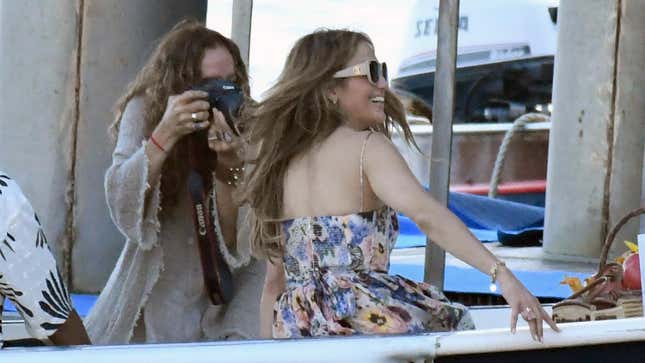
In the early hours of Friday morning, Jennifer Lopez (aka J.Lo—or is it J.Aff now??) posted three Instagram photos of herself lounging in the Amalfi Coast sun—as celebs are wont to do. She’s wearing a white-hot bikini and has five goblets of ice, a bucket of alcohol, and a big-ass plate of fruit set up next to her. She gives a “candid” laugh and a smoldering, mouth-agape duck pout. They’re great photos! And, of course, we love to see celebs being themselves on social media, especially celebs who sing about being “real.”
Except, wait a minute, these carefree vacation photos are—gasp—actually just an ad for her alcohol brand, Delola (more on that in a sec). In photos obtained by the Daily Mail, we can see a photographer directing this little late-afternoon aperitivo. The same photographer also appears to be capturing plenty more “candid” moments of J.Lo and her friends on an Italian boat.
To be fair, J.Lo did tag the photographer—Ana Carballosa—in the aforementioned Instagram post, so she’s not exactly hiding it. And by the looks of Carballosa’s own Instagram, she seems to be J.Lo’s longtime photographer. (Also because she’s credited as the only photographer on True Love, J.Lo’s 2014 book.)
Plus, if I’m a rich celeb on a fancy Italian vacation, I’m for sure not going to rely on my bitch-ass friends or worse, my dumbass husband, to take any grid-worthy photos of me.
Personally, I’m more so questioning why Jenny from the Block, who’s long bragged that she doesn’t eat sugar or carbs or drink alcohol, is now shilling for a cocktail company. “I know that a lot of people have been talking about like, ‘Oh she doesn’t even drink. What’s she doing with a cocktail line?’ And to tell you the truth, that was true for a long time. I didn’t drink,” she said in an Instagram video in July (which does look like she filmed herself!).
But that’s apparently all changed now. (Maybe Ben Affleck said they should diversify their marital revenue streams??) “I do drink responsibly,” she added. “I don’t drink to get shitfaced.” Sounds boring.

Tilt-shift lenses are considered standard equipment for architectural photography, allowing you to correct common geometric issues to ensure your images both realistic and of the highest possible quality. But with modern cameras and software, do you really need a tilt-shift lens, or can you get by using other techniques? This excellent video discusses the issue to help you decide.
Coming to you from Matthew Anderson, this great video discusses whether you really need a tilt-shift lens for architectural photography. There is no doubt that tilt-shift lenses are tremendously useful and that once you get used to working with them, they can save you a lot of time in post and ensure the highest levels of image quality. On top of that, they can allow to create some rather neat creative effects. That being said, tilt-shift lenses are some of the most specialized options out there and are quite expensive, so if you do not regularly have a need for their capabilities, it is worth considering if you are better served by post-processing techniques for dealing with the issues they address. Check out the video above for the full rundown Anderson.
If you would like to learn more about architectural photography, check out our “Where Art Meets Architecture” series!

Portrait photography goes beyond just capturing faces. Every element in a portrait contributes to the narrative, emotions, and depth of the image. The eyes may be the windows to the soul. However, fingers and toes play an equally vital role in telling a story through a portrait. These seemingly insignificant details have the power to enhance the connection between the subject and the viewer. As such, they can make the pose seem forced or natural.

Fingers and toes are extensions of our emotions and personality. They are also capable of communicating more than words sometimes can. In portrait photography, the positioning and movement of fingers can reveal a myriad of emotions. Clenched fists can symbolize determination or rage or simply being comfortable. Gently touching the lips can evoke contemplation, and fingers interlocked can represent connection and unity. These gestures bridge the gap between the subject and the viewer. In turn, they allow us to resonate with the emotions portrayed and fostering a deeper connection.

Incorporating fingers and toes into portrait compositions adds depth to the narrative. A portrait isn’t just a picture; it’s a visual story. Including these details helps to weave a tale about the subject’s environment, interests, and experiences. For instance, a musician’s calloused fingertips tell of countless hours spent perfecting their craft. Meanwhile, a hiker’s slightly worn toes narrate adventures taken on rugged terrain. These minute features become essential storytellers, enriching the overall context of the image.
But it can go beyond that. I am often telling my subjects to soften their fingers (for women) and unclenched fists (for men). Soft fingers and pointed toes can add an element of grace and beauty to a woman’s portrait. In contrast, straight shoulders and slightly clenched fists for men can add strength.

The presence of fingers and toes in portrait photography offers a relatable and personal touch. We all have them, and seeing them in a photograph humanizes the subject. The vulnerability and rawness they portray make the subject tangible and relatable, inviting viewers to step into their shoes. This human connection is what sets impactful portrait photography apart from mere snapshots.
In an era of digital perfection, embracing the imperfections of fingers and toes adds authenticity to a portrait. Imperfections are beautiful; they make us who we are. Capturing the natural lines, wrinkles, scars, and nail colors on fingers and toes is a celebration of individuality. These distinctive details remind us that each person is a unique story waiting to be explored, and that’s where the true beauty lies. Sometimes, the hands or even the feet can tell a vital role in a person’s story and should be captured on their own.
I love to incorporate rings, and other jewellery, even gloves can add a sense of luxury, especially when dealing with vintage or glamorous looks.

From a technical standpoint, focusing on fingers and toes can present challenges that push a photographer’s skills to new heights. Achieving the right depth of field to keep the subject’s face sharp while also maintaining a subtle blur on their extremities requires mastery of camera settings and composition techniques. Moreover, creatively integrating fingers and toes into the frame demands an artistic eye that understands balance and harmony within the overall composition.
Remember, anything closer to the camera will look larger and sometimes distorted, having hands and feet on the same focal plane can stop these distracting elements.
In portrait photography, fingers and toes are not just appendages; they are threads that weave together stories of emotion, experience, and individuality. These often-overlooked details can become powerful tools for photographers seeking to create captivating and evocative portraits. The next time you pick up your camera, remember the significance of those delicate gestures and rugged toes. They unlock the essence of your subject and invite viewers to embark on a visual journey filled with authenticity and emotion.
And remember, point those toes and soften those fingers. Trust me, they really can make a huge difference.
Models: Holly Mackenna, Matthew Pick, Emily Reinhard and Andrea Gardiner


The annual Comedy Pet Photography Awards highlight amusing pictures of pets and their hilarious antics.
After the finalists were announced in July, the winners were decided by a panel of judges including photographers, comedians, and veterinarians. Fans also voted online for their favorite snapshot to win the People’s Choice Award.
Here are the 11 funniest pet photos of the year.

Photography lets us capture unique moments that any other art form can’t, and that is true for sports photography as well. So today, we would like to share the best sports photos of this year.
The World Sports Photography Awards has announced their winners out of 700 participants. In total there were 24 categories ranging from basketball to motorsports, to urban and extreme. The winners of each category were awarded gold, silver, or bronze prizes.
Furthermore, there were 3 exceptional photographers awarded as overall winners, who secured gold prizes in their category. The gold winner of overall winners is Patrick Smith, winning with a photograph of a golf player in the clouds. The silver winner is Octávio Passos, and the bronze overall winner is Phil Noble.
We encourage you to go and see special merit images too on the World Sports Photography Awards website, but as for the winners, scroll down below and let us know which photo is your absolute favorite.
More info: worldsportsphotographyawards.com | Instagram | Facebook | twitter.com





