Photography

TikTokers offer free photography sessions to woman who cried over wedding photos

TikTokers offer free photography sessions to woman who cried over wedding photos

TikTok viewers have offered one woman free photography sessions after her expensive wedding photos turned out to be a disappointment.

On 10 May, Brooke () posted a video, which has now attracted over 2.5m views, to expose “the worst first dance wedding photos” from her big day. The woman explained that she was “floored” when she got her $3,000 photographs back because they were out of focus, and the other photographers were caught in them too.

“They’re just bad, all the way around bad,” Brooke admitted. She said she contacted the photographer to see if they could be fixed, and they couldn’t be. “All it really did was piss her off. Still haven’t really gotten my stuff that I’ve been owed,” she continued.

To convince her followers of the poor quality, Brooke displayed the three images that she received of her first dance. The photos were not only blurry, but Brooke was seen making an odd face in all of them. According to Brooke, her husband and mother-in-law have since tried to contact the wedding photographer multiple times, but she’s not picked up. The photographer reportedly told Brooke she was only allowed to communicate with her via email.

“I just don’t even know what to do at this point,” she cried. “Any help would be welcomed. Please send help, don’t scroll. I beg you. Please if there is a God, let this end up on lawyer Tok.”

Over 6,400 commenters flooded Brooke’s video, with many admitting how bad her photos were.

“When I say my mouth dropped!!! Those are terrible!! Girl… I’m so awfully sorry! I’d sue,” one viewer noted, while another wrote: “I’m sorry, girl. In my experience, ghosting you means she has nothing else to give you. She’s not hiding the good photos. They don’t exist.”

“Please tell me you signed a contract and you have a copy – that is a LOAD of money. Definitely look at consulting a lawyer,” one individual suggested.

Brooke pointed out that her wedding took place back in October. She said she emailed the photographer in April and again two days before making the video, but did not receive a response.

Other TikTok users couldn’t stand to see Brooke left with images that didn’t capture the beauty of her day with her husband, family, and friends, with multiple photographers offering to give her a free “wedding attire session”.

“I’m a photographer in Colorado, if you’re ever here and would like to do a wedding attire session, I’d love to do them for free. I’m so sorry this happened,” one woman proposed, while another commented: “Not sure where you’re located but I’m a wedding photographer in Ohio. If you’d like to do a session in your wedding attire it’s on the house.”

Brooke posted a follow-up video later that day to expose more of the stills she received back. One image had her head cut off, while a different photo of her next to a wine barrel was taken from a “bad angle,” which she said made her self-conscious.

After seeing multiple examples of the final shots, viewers began questioning Brooke’s research on her photographer. She posted a separate video addressing these concerns, confessing she met the woman at a wedding fair and got “glowing recommendations” from friends who had used her. Still, some TikTokers couldn’t believe the woman was a professional.

“Always ask to see at least two complete galleries of past weddings. That should be a more honest representation of their work,” one individual added.

The Independent has reached out to Brooke for a comment.

Today’s Photo from Ted Grussing Photography: Random Beauty

Today’s Photo from Ted Grussing Photography: Random Beauty

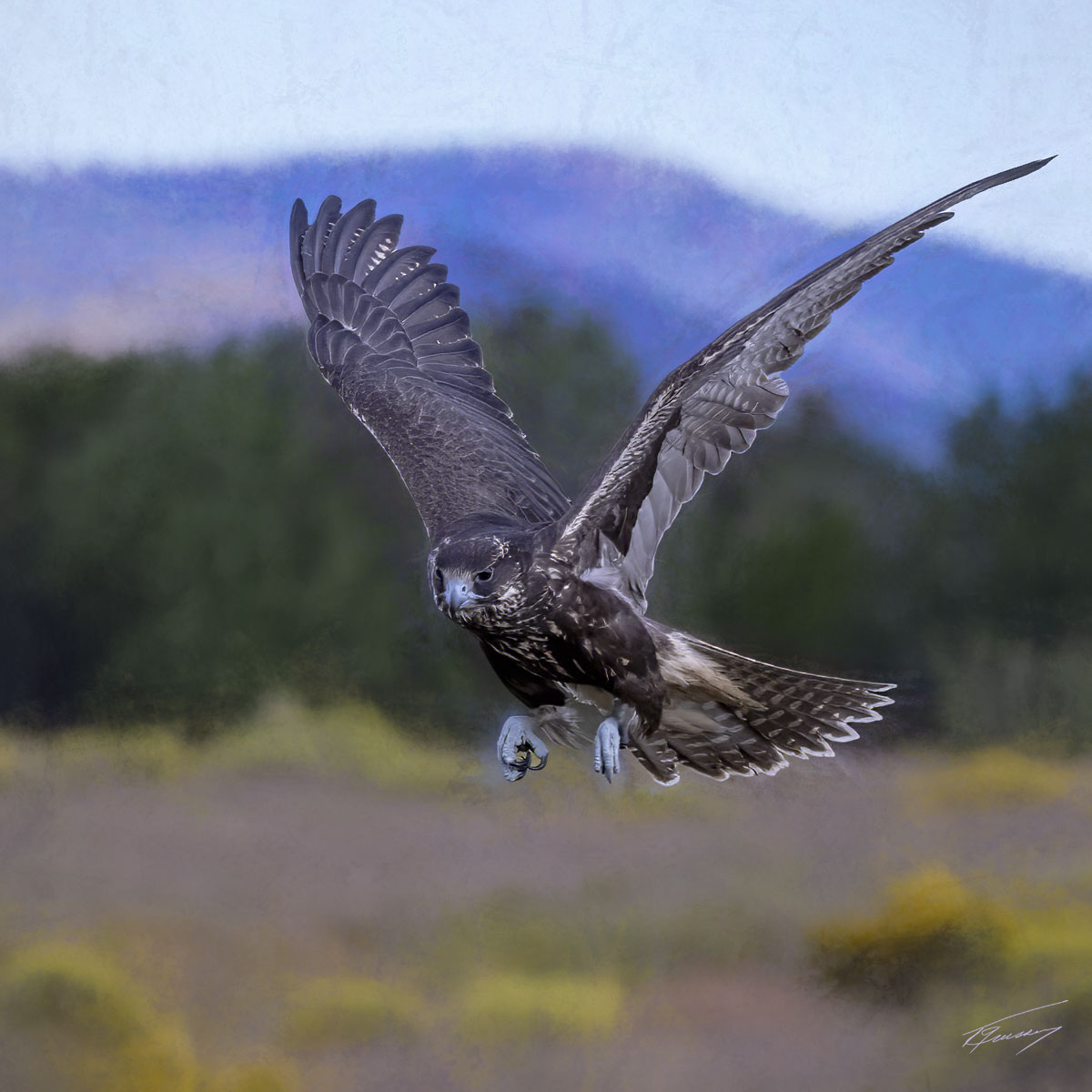
… just wandering through some photo folders tonight and came upon the Echinacea flower that I shot in a garden at Lowell Observatory a few years ago and below a photo I took of Enedina, Michele’s Saker Falcon in a field east of Flagstaff … unrelated images of the temporal beauty to be found here on our little planet … it is here daily just waiting to be viewed and become a part of your life experience … head out and enjoy all that earth has to offer you.

Another new and exciting week underway and methinks it shall be a very good one. The replacement power supply for my new computer build will be here tomorrow and with any kind of luck it will be operational late afternoon … then the prep of this one for my friend who will be taking it over. The challenge is having to re-install all my apps (formerly “programs”) and transfer the extensive libraries of images … expecting no problems with that though.

Have a beautiful day … you are here!

Cheers,

Ted

The book of day and the book of night burst with
wonder, testifying that there is more in the world than
we, and that we shall yet be other than we are.

excerpt from Lamentations by Max Ehrmann

###

photo_tedgrussingThe easiest way to reach Mr. Grussing is by email: ted@tedgrussing.com

In addition to sales of photographs already taken Ted does special shoots for patrons on request and also does air-to-air photography for those who want photographs of their airplanes in flight. All special photographic sessions are billed on an hourly basis.

Ted also does one-on-one workshops for those interested in learning the techniques he uses.  By special arrangement Ted will do one-on-one aerial photography workshops which will include actual photo sessions in the air.

More about Ted Grussing


Healing Paws

Healing Paws

This is an advertisement

Should we look? Professor helps shed light on atrocity photography

Should we look? Professor helps shed light on atrocity photography

Scholar Valerie Hébert served as an author and editor for a new book called Framing the Holocaust: Photographs of a Mass Shooting in Latvia, 1941.

The Lakehead University professor is one of eight contributors to the book, which takes a deep dive into 12 photographs that document a mass shooting of Jewish people on a beach in Latvia in December 1941.

“When a lot of people think about the Holocaust, they think of Auschwitz and they think of trains,” Hébert said. “Before the death camps were built, the mass killings began with mobile shooting squads that combed through the Eastern Front as the Nazi army advanced.”

Hébert says the mobile shooting squads would gather alleged racial and political enemies and shoot them to death. More than a million people were killed using this terrorizing tactic.

“These 12 photographs show the sequential steps in one of these shooting actions,” she explained. “Jews were brought to this place, were made to undress. They were separated into smaller groups and brought to a ditch that was dug parallel with the sea, and they were shot. Their bodies fell into the ditch.”

Four men are connected to the photographs, but it’s unknown for sure who took them. The photos were turned in to the Soviet investigators by a Jewish Latvian man and are commonly used today in Holocaust museums but are rarely attributed to the correct time and place.

“This book provides an in-depth study and the historical context for these photos,” Hébert said.

In 2017, Hébert organized a workshop at the United States Holocaust Memorial Museum in Washington, D.C. on atrocity photography.

“Photographs are sort of at the cutting edge of Holocaust research in particular,” she said. “There is more and more interest in this field of atrocity photography.”

She invited scholars from Canada, the U.S., Germany and Australia to the two-week workshop to talk about their work in atrocity photography and to look at materials from the museum.

“The idea was to put together a book where we are all speaking about the same images,” she said. “We chose these 12 photos because it’s rare to have so many in a clear sequence.”

The images show partially clothed and naked women and children caught in moments of terror.

“They really push us to the edge of what it is we can bear to look at,” she said. “The key question of the book is if they are so unbearable to look at, why should we even engage with them? What can we gain from them? And what can they tell us?”

Each author in the book brings a different question to the photos.

For Hébert, studying photos goes back to her childhood. Her interest in history comes from looking through her grandfather’s Time Life coffee table book of photographs from the 20th century.

“From the time I was little, I would look at this book and would be really drawn to photographs,” she said.

Hébert, who has a PhD in history, uses photographs often in her teaching at Lakehead University.

“I’ve taught Holocaust courses, I’ve taught courses on the world wars, and at first I was always uneasy about showing photographs of dead bodies and people in distress,” she said.

“There are some really important questions around these people not giving their consent to be photographed. A lot of times, the photographs are a part of the torture and humiliation because the photographer is using the moment to deepen their suffering.”

Through the process of creating the book, Hébert asked herself if bringing light to the photographs continued the humiliation and horror of victims. She also asked herself if the pictures were important evidence that help people understand history.

“The chapter that I contributed to the book looks at that ethical question,” she said. “Should we look at these? Should we not? And what are the arguments on both sides?”

The chapter sets the stage for all of the following chapters in the book, and Hébert hopes readers who pick up the book will gain a new appreciation for how rich and complex photographs are.

“We have this idea that photographs tell us everything, the truth is on its surface, and we understand everything by looking at the photograph, but we don’t,” she said. “So, it’s really important to consider who took the photograph, who was the intended audience, and what that might mean.”

While the photographs in the book were taken as a celebration of the crime, they’re also an indictment, which makes it important to understand the many meanings photographs hold, Hébert says.

“It helps us think more critically about historical photographs that we see,” she said. “We are a more visual culture now with social media and Instagram. It’s all image based now.”

She says photographs can transcend language, time and geography, which makes it important to have a more critical and nuanced way of understanding pictures while being aware of their ethical complications, which makes people better consumers of present-day photojournalism.

“The ones in the book help us understand this particular event in the Holocaust,” she said. “The way that the authors model how we read and interpret these photographs, there is a lot of crossover to how you may engage in photographs of other historical events or present-day crises and human rights issues.”

Framing the Holocaust: Photographs of a Mass Shooting in Latvia, 1941 will be available for purchase on Amazon starting Aug. 22.

Learn photography or carpentry, go paddling, meditate, more for your West Seattle Monday

Learn photography or carpentry, go paddling, meditate, more for your West Seattle Monday

Thanks to John Skerratt for the photo of canoes that landed on Alki Sunday for the Paddle to Muckleshoot journey (WSB coverage here) and remain there while canoe families share a week of protocol at the Muckleshoot Community Center in Auburn. Here in West Seattle, highlights for today/tonight include:

LOW-LOW TIDE: It was out to -3.1 feet at 10:20 am, so it’s still way out right now (and even lower the next two days – here’s the chart).

SUMMER MEALS FOR KIDS: Here’s the list of local sites where free food is available for kids on weekdays this summer, 11:30 am-1 pm lunch, 2-3 pm snacks.

WADING POOLS OPEN: Noon-7 pm. Today’s scheduled pools in West Seattle: EC Hughes (2805 SW Holden) and Lincoln Park (8011 Fauntleroy Way SW).

COLMAN POOL OPEN: This outdoor salt-water pool at Lincoln Park is open noon-7 pm daily through Labor Day. See the session schedule here.

LEARN TO PHOTOGRAPH ISS SOLAR TRANSITS: West Seattleite Kevin Freitas‘s free 2:30 pm event for interested photographers has moved to Magnolia because the International Space Station‘s path moved, but you’re still invited – info including location map is in our calendar listing.

LEARN BASIC CARPENTRY SKILLS: Skillshare event at The Heron’s Nest, 4 pm – more info in our calendar listing. (4818 Puget Way SW)

COMMUNITY PADDLE: Monday nights all summer long, get out on the water with Alki Kayak Tours, 6 pm. (1660 Harbor SW).

CRAFTING AND CREATIVITY NIGHT: 6-10 pm at The Missing Piece (9456 35th SW), info here.

OPEN MIC: Weekly BedHead Open Mic continues at West Seattle Church of the Nazarene (4201 SW Juneau), 6:30 pm – info in our calendar listing.

D&D: Open D&D starts at 6:30 pm at Meeples Games (3727 California SW), all welcome, first-time players too. $5.

FAUNTLEROY MEDITATION: Free weekly Zen sitting/meditation event at the chapel at Fauntleroy UCC (9140 California SW), 7 pm-8:30 pm.

PLAY TRIVIA! Here are three Monday night options for trivia – 7 and 8 pm Sporcle Pub Quiz at Three 9 Lounge (4505 39th SW); 7 pm at The Good Society (California/Lander), 7:30 pm at The Skylark (3803 Delridge Way SW)

MONDAY MUSIC: Live music with The Westside Trio, 8 pm at The Alley (behind 4509 California SW), 21+, no cover.

Have a West Seattle/White Center event to add to our calendar ? Please send info to westseattleblog@gmail.com – thank you!

Spruce to share New England photography at LeConte Photographic Society

Spruce to share New England photography at LeConte Photographic Society
image

The LeConte Photographic Society will host Barry Spruce on Saturday, Aug. 12, at 10 a.m. at the King Family Library in the Burchfield Room for a photo program titled “Photographing New England”. The program is free and open to the public.

Barry Spruce is a nature and wildlife photographer based in Townsend. He owns and operates the Cades Cove Gallery and Spruce Photo Tours. Barry has been a professional photographer for 17 years and does presentations around the Southeastern United States.

Viewers are offering free photography sessions to a woman who went viral saying her $3,000 wedding photos made her want to cry

Viewers are offering free photography sessions to a woman who went viral saying her $3,000 wedding photos made her want to cry
  • A TikToker said she paid $3,000 for her wedding photos and hated the result.
  • She shared some images in a viral video, and viewers flocked to her defense.
  • Some viewers said they were photographers and offered to re-shoot the wedding for free.

TikTokers are flooding a creator with sympathy and offers of free photography services after she said she was unhappy with her wedding pictures.

On May 10, a TikToker who goes by Brooke posted a video asking viewers for their help, saying she paid $3,000 for her wedding photos, but what she received made her want to cry “every single day.”

She also shared some images that appeared to be taken at her wedding which were blurry or taken from unusual angles, saying they were the images she paid for.

Her story quickly blew up, receiving 2.5 million views, and over 6,400 comments as TikTokers rallied around her.

“I’m a photographer in CO, if youre ever here and would like to do a wedding attire session, I’d love to do them for free I’m so sorry this happened,” wrote one viewer.

“Not sure where you’re located but I’m a wedding photographer in Ohio. If you’d like to do a session in your wedding attire it’s on the house,” another commenter offered.

Each of these comments received a wave of praise from fellow viewers who applauded them for stepping in, and a further commenter wrote that they were going to suggest the same thing. Many sympathised with her story, saying they would not be happy with the quality of the photos she showed if they came from a professional photographer.

In a follow-up video, Brooke shared more photos she said she was unhappy with, including an image where her head had been cut out of frame, and another of her standing next to a wine barrel which she said, although she was aware was taken from a “bad angle,” still made her feel self-conscious about her appearance. 

In a further upload Brooke said she’d been a wedding photographer herself since 2015, had met the photographer she said she’d hired at a wedding fair, had liked their style of photos, and checked in with mutual friends who she said gave the photographer “glowing recommendations.” 

Some viewers questioned whether the images shown were taken by a professional photographer at all. 

Storytime videos of TikTokers sharing shocking or surprising anecdotes they say occurred at a wedding often go viral on the app, and Brooke did not provide any evidence in her viral video that the photographer in question had taken these images, or that she had paid $3,000 for them.

Brooke has 5,000 followers on TikTok where she posts painting and decoration-themed videos which generally receive several thousand views. Her wedding photography saga was by far her most viral moment, as she made over 12 videos on the topic which received over 3 million total views. She did not immediately respond to Insider’s request for comment. It’s unclear whether she will be taking up any of her viewers’ offers of a free photoshoot.

Viewers often come to the aid of people who have shared their bad experiences or struggles online. In April, a TikTok dad was inundated with donations when he said he needed to raise $6,000 to buy a large van he and his kids could move into after living on the road for over a year, and in March a struggling bookstore owner was able to pay her bills after she appealed to Twitter users to help keep her business afloat.

For more stories like this, check out coverage from Insider’s Digital Culture team here.

The Best Lens Kit for Landscape Photography

The Best Lens Kit for Landscape Photography

The 16-35mm lens is the standard workhorse of landscape photography, but it is far from the only lens you can use for the genre, and, in fact, you are probably doing yourself a disservice if you rely exclusively on those focal lengths. If you are new to the genre and wondering what makes for a good lens kit, check out this helpful video tutorial sure to put you on the right path. 

Coming to you from Michael Shainblum, this fantastic video discusses the ideal lens kit for landscape photographers. I strongly agree with adding a superzoom or telephoto zoom lens to your kit. You might balk at the sharpness you will get from something like a 28-300mm lens, but such lenses have come a long way in recent years, and furthermore you will usually use them at the optimal apertures for sharpness. Furthermore, the weight and cost savings you get from such a lens make them extremely convenient and cost-efficient, and the focal length range will allow you to get far more varied images from each scene you encounter. Check out the video above for the full rundown from Shainblum.

And if you really want to dive into landscape photography, check out “Photographing The World 1: Landscape Photography and Post-Processing with Elia Locardi.” 

Augusta’s Mark Albertin revives film photography, chronicles history with video

Augusta’s Mark Albertin revives film photography, chronicles history with video

Not far from Augusta’s old Powder Works, just off downtown proper and under a brilliantly shining sun, is a place of complete darkness. Within this darkness is the magic of creating something from nothing – creating something from what is less than nothing, a negative.

Mark Albertin’s darkroom is a rare outlier in this age of digital photography. There’s a plastic-y smell of the black-and-gray Kodak canister, and there’s a fridge well-stocked with both the edible (ginger ale, peanut butter pie) and the inedible (all that Kodak film).

An enlarged negative awaits exposure. Not that its image is visible, not until the lights go off and a low red glow is all that’s left. A faint depiction, almost sketch-like, now emerges in the darkness.

You have to find the grain, Albertin says, putting his eye to the scope and turning a knob a couple ticks counter clockwise. 

He’s running through a series of test prints, trying to gauge the right amount of exposure and taking note of those areas he’ll have to further finesse either through “dodging” (blocking exposure to keep a section of the image lighter while the rest continues to darken), or “burning” (increasing the exposure for a darker effect while protecting the rest of the image).

“All it is, is light manipulation,” he says. “And how creative you want to get with it.”


Mark Albertin_photo.jpg

“All it is, is light manipulation. And how creative you want to get with it,” said Mark Albertin of film photography.


A thousand-plus interviews: From stills to video

Albertin moved to Savannah in 1986 and then to Augusta in 1995. Before that, the Wisconsin-born Albertin was “a northern boy knowing nothing about the South; knowing only about bratwurst and sauerkraut and cheese and beer and frozen custard.”

But the tightly intimate nature of his professional work, both in film photography and video production, has since provided some edification of life here, and the man now calls Augusta home.

Albertin estimated he’s interviewed more than 1,000 people during his career with Morris Communications and, since 1999, through his own Scrapbook Video Productions company.

His freelance documentaries alone have brought him into the more personal folds of history in Augusta but also in Aiken. And Savannah. And Jacksonville. And St. Augustine and Topeka, Kan.

Each one of these films has involved interviews with 50 to 100 people.

“I think it’s really cool to preserve these oral histories, to preserve these stories and then put them into a format that people can really digest,” Albertin said.

Albertin’s documentary of Augusta from fin de siècle through the 1990s, “Finding Home – A Journey Through Augusta’s 20th Century Past,” is a work that’s been 20 years in the making.

The Fire of 1916. The Flood of 1929. The Cracker Party. Eisenhower’s visit. These are all segments of the 2-hour film and told through the voices of those who lived them or who knew closely someone who did.

“Those people are all gone, they’ve been gone for years, for 20 or 30 years now. I’ve got their stories,” said Albertin. “When the Augusta National was nothing, and the kids would go swim in the ponds there – there was no fence – and they were trying to get you to come…”

The documentary builds on the one he started with Morris in 1999 and called “Augusta Remembers.” That film had ended with 1940.

Albertin’s since expanded it to include the local histories of WWII, Vietnam, the Augusta Riots and the fading of downtown.

“It’s a century of oral history and memories. It is a 20th century time capsule; that was the whole intent,” he said.


Mark Albertin_finsihed print.jpg

Much of Mark Albertin’s photography is nature photography, and that interest in the outdoors has made its way into his video projects, too.


‘Something for the next generation’

The past 10 years have found Albertin more engaged with environmental topics, and his documentary on the Okefenokee Swamp and the nearby Twin Pines mining venture in southern Georgia has won him multiple honors, including the Humanitarian Award at the Beaufort International Film Festival.

Both Albertin’s “Finding Home” on 20th century Augusta and his more environmentally political work on the Okefenokee, “Sacred Waters,” will run in this month’s Black Cat Picture Show, the ninth annual Augusta film festival hosted by Le Chat Noir Aug. 17-20.

Albertin’s environmental oeuvre also includes a film on the suspended, 360-mile Kinder Morgan Palmetto Pipeline that was to run from Belton, S. Car. through Georgia and down to Jacksonville. The pipeline had come under fire after an oil leak near Belton that eventually prompted the Georgia state legislature to place a moratorium on approving the necessary permits for those parts of the project that would come through Georgia.

“My passion behind these documentaries is to try to help people learn and to try to educate them and to try to show people through my eyes why we need to protect this planet, why we need to slow down,” Albertin said. “We need to not develop and destroy these places that are so unbelievable and so beautiful – leave something behind, leave something for the next generation.”

“We don’t think this planet has any value except for ‘how can we make money from it, how we can gain from it?’ Yet, to me, getting away from that – getting away from all the noise – is really what’s good for us – mentally, physically, and in our soul; everything,” he said.

Then, with a laugh, “Not saying throw all that [man-made tech] away and hug trees for the rest of our life. But anytime I feel like my compass is out of whack, I go someplace and I camp or I get away.”


Mark Albertin_loupe.jpg

Mark Albertin uses a loupe to look for imperfections in a finished print. If he finds any, he can correct them with a daub of monochrome paint mixed to the exact tone he needs.


The ‘Christmas morning effect’

More often than not, that camping and getting away involves a secondary getting away: the many hours it takes Albertin in that edge-of-downtown darkroom to develop the photographs he takes.

“It’s that Christmas morning effect. You take a picture, and you don’t know if you’ve got something good or not and you don’t know if it’s going to be really wonderful, if it’s going to be really beautiful,” he said. “When you go to the dark room and start processing those negatives, it’s an exciting event when you go down there, and you find something.”

Albertin said it can take him a full day just to get one image right.

From the first shutter of the lens to the last drops of hand coloring (a delicate process of mixing monochrome paints to the correct shade and daubing it onto the finished image), film photography is a means for “slowing way down.”

He said he hopes to expand his studio in the future to better accommodate the four photography aficionados who’ve regularly been coming there to develop their own skills over the past year.

At least two of them, mother and daughter and bringing with them that peanut butter pie, have already allowed the art to take hold of them in a way that has them chasing down the perfect shot (still elusive, the mother confides).


Mark Albertin_final print.jpeg

The final print, painstakingly created hour after hour in the darkroom.


“You start looking at the details, the textures, the bark,” Albertin said of how this analog form of art has connected him more to the natural world.

That’s what he’s spent so many hours doing, getting those details to reflect on paper as close to exact the image his own eyes had seen.

The print is a 20×24. The image, captured outside his his other darkroom, Preservation Studios in Harrisburg, Ga. shows a rare occurrence: the roots of two trees have grown toward each other and begun to combine, something that normally wouldn’t be seen for a layer of soil or water.

.asset-tags {display:none !important;}
input#fieldEmail {width:100%; border: 1px solid #b0b6bb; box-shadow: inset 0 1px 2px rgba(0,0,0,0.1); border-radius:3px;}
button.js-cm-submit-button {width:100%; font-family:”adelle-sans”, sans-serif; color: #fff; background-color:#6caf6b; padding:3px 0; border:0px;}
h5.description {font-family:”adelle-sans”, sans-serif; line-height:inherit;}
label {font-size:smaller; font-family:”adelle-sans”, sans-serif; font-weight: 400;}

Sign up to receive weekly roundups of the latest Post and Courier North Augusta stories.

Handpicked by our editor, as well as breaking news, business profiles, and government recaps from North Augusta.

The Winners of the 2023 iPhone Photography Awards

The Winners of the 2023 iPhone Photography Awards
2023 iPhone Photography Awards
Heroe by Ivan Silva (Mexico). Image shot on iPhone 12 Pro. | 2023 iPhone Photography Awards

The winners of the 2023 iPhone Photography Awards (IPPAWARDS) have been announced, headlined by the Grand Prize Winner, Ivan Silva of Mexico, for his image, Heroe, showing a boy standing up in a heroic pose on the back of a truck.

The 16th edition of the iPhone Photography Awards includes winners across 14 categories, selected from thousands of submissions.

“Many of this year’s winning shots celebrate photography’s power to capture the power and the joy of what comes next, whether a frond preparing to unfurl, a morning mist hovering over a sleepy farm, or a flock of gulls heading to their next destination,” explains the iPhone Photography Awards.

Founded in 2007, the IPPAWARDS is the first and longest-running iPhone photography competition. In its 16 years, IPPAWARDS has showcased the narrative power of the iPhone and highlighted the incredible photos that talented photographers can take with mobile devices.

In addition to the Grand Prize Winner, the competition also names First Place, Second Place, and Third Place Overall Winners.

This year, the First Place Photographer of the Year Award goes to Thea Mihu of Germany for her image, Soy Sauce Village, which uses a top-down perspective and repeating patterns to incredible effect.

2023 iPhone Photography Awards
Soy Sauce Village by Thea Mihu (Germany). Image shot on iPhone 12 Pro Max. | 2023 iPhone Photography Awards

The Second Place Photographer of the Year is Sasa Borozan from Bosnia and Herzegovina. Borozan’s image, Taming Waves, shows a boy working alongside the ocean.

2023 iPhone Photography Awards
Taming Waves by Sasa Borozan (Bosnia and Herzegovina). Image shot on iPhone 13 Pro. | 2023 iPhone Photography Awards

Rounding out the overall winners is American photographer David Hager for his image Tuscon Morning. The monochrome photo delivers fantastic dynamic range, shadows, and texture.

2023 iPhone Photography Awards

Alongside these overall awards, the winners of each of the 14 categories are featured below.

Abstract

2023 iPhone Photography Awards
The Long Wait by Tim Wheeler (Sweden). Shot on iPhone 7 Plus.| 2023 iPhone Photography Awards

Animals

2023 iPhone Photography Awards
Once en Rosa by Skye Snyder (United States). Shot on iPhone 12 Pro Max. | 2023 iPhone Photography Awards

Architecture

2023 iPhone Photography Awards
Shadows of History by Edwin Cabingan (Australia). Shot on iPhone 11 Pro Max. | 2023 iPhone Photography Awards

Children

2023 iPhone Photography Awards
Girl by Sofia Ershova (United States). Shot on iPhone 13 Pro. | 2023 iPhone Photography Awards

Cityscape

2023 iPhone Photography Awards
Life in Tube-shaped Building by Jinsong Hu (China). Shot on iPhone 12 Pro Max. | 2023 iPhone Photography Awards

Landscape

2023 iPhone Photography Awards
Early Morning Farm by Ton Ensing (Netherlands). Shot on iPhone 12 Pro. | 2023 iPhone Photography Awards

Lifestyle

2023 iPhone Photography Awards
Summer by Shusen Jia (China). Shot on iPhone 12 Pro Max. | 2023 iPhone Photography Awards

Nature

2023 iPhone Photography Awards
Wonder Wheel by Scott Galloway (United States). Shot on iPhone 12 Pro Max. | 2023 iPhone Photography Awards

Other

2023 iPhone Photography Awards
Old School Iron and Steel Plant by Tao Fan (United States). Shot on iPhone 11. | 2023 iPhone Photography Awards

People

2023 iPhone Photography Awards
Sunset Years by Daniel Heilig (Germany). Shot on iPhone 12 Pro Max. | 2023 iPhone Photography Awards

Portrait

2023 iPhone Photography Awards
Girl by Ramazan Çirakoglu (Türkiye). Shot on iPhone 13 Pro. | 2023 iPhone Photography Awards

Series

2023 iPhone Photography Awards
Body Extensions by Dominic Dahncke (Spain). Shot on iPhone XS. | 2023 iPhone Photography Awards

Still Life

2023 iPhone Photography Awards
Viet Memories by Robert Lie (Indonesia). Shot on iPhone 14 Pro Max. | 2023 iPhone Photography Awards

Travel

2023 iPhone Photography Awards
Last Night before Xmas by Long Nguyen (France). Shot on iPhone 12 Pro. | 2023 iPhone Photography Awards

Second and third-place winners for each category and honorable mentions can be viewed on the IPPAWARDS website.


Image credits: All photos are individually credited and provided courtesy of the IPPAWARDS.