Photography

Redefining Success: What Truly Makes a You A Successful Photographer

Redefining Success: What Truly Makes a You A Successful Photographer

Success in photography is a fairly vague metric. Some measure it by the number of followers on Instagram, others by ratings on photography forums, and some people by the gear you use. However, none of these three things mean success. In fact, a photographer who shoots on the latest gear, gets 5-star ratings on forums, and has a million followers is not necessarily successful. Here is what an actually successful photographer is.

I had a period where I was really trying to measure my success as a photographer using the wrong metrics. I don’t have a huge following on Instagram, nor are my images particularly liked on photography forums. If anything, I hear a lot of photographers saying that my work is fairly simple and anyone can do it. This led me to believe that my work is, at most, middle grade. This is because I was looking at it from a point of view that was not appropriate for measuring success. I am not the next Jordi Koalitic or Peter McKinnon when it comes to social media and photographer appreciation. If you are in the same boat, you might just feel better about yourself after reading this article.

Client List

Who is hiring you? Take this as an example. You are aiming to shoot for National Geographic, and the local wildlife magazine, as well as nature reserves, are hiring you. While not National Geographic, this is the right track to being hired by your dream client. The important thing is to have a clear distinction between who is your client and who is not. For example, someone who wants to hire you to do their LinkedIn picture, and your goal is to shoot wildlife for National Geographic, they are not your client. Unless they work within the wildlife industry and it is a good connection. This relates closely to another point in my article, niche. You need to have a distinct look and genre in your work; you can’t be working with anyone who needs pictures in your city. Successful photographers have a very selective approach when it comes to taking clients and only work with the people who are relevant to the work they do. If the client is within the genre/industry you are pursuing, they are for you.

Soft Skills

Another trait I see successful photographers have is excellent soft skills. As photographers, we may be creating the most incredible work; however, at the end of the day, it is ourselves that we are selling. You need to be a memorable and ideally likable person. This means having empathy, being able to read the room, being approachable, but also not being shy to state your own opinion when asked. Things such as professional email communication, dressing appropriately, and being able to hold a conversation not about work also add to this. After all, when someone hires a photographer, they hire a human, not just a photo machine. Successful photographers are both great at their art and also good to be around. If you are like me, and your soft skills are not the best, seek help and work on it, as it will help you develop your ability to land more jobs.

Publications

As photographers, we rely on editorial content to show off our work. Be it portrait, fashion, landscape, or train photography, there is a magazine for everything. Be sure to note that it is not easy to get into the biggest magazine about any subject. People can easily spend decades before they shoot their first Sports Illustrated or Car magazine cover. Successful photographers have editorial publications all the time, be it in a small or a large magazine. The main thing is that the magazine is not read by other photographers, but the people interested in the subject of your photography. The reason I say this is because what photographers like might not be what the clients need. The amount of fake product commercials is there to show that. Just look up “epic product commercial” on YouTube, then look that product up on Google, and I promise you that the actual commercial looks nothing like the thing you saw. This is all because what photographers think is commercial photography has nothing to do with actual commercials. The analogy can be made with any genre of your liking.

Relevance

Having a sense of zeitgeist and knowing if your work is relevant to today’s market is another trait of successful photographers. Just look at how trends have changed in the past 20 years. We went from liking super smooth skin tones to almost no retouching. The list goes on and on. Epic lay-flat food photography got replaced by pop-art advertisements, etc. While you should not change your work to fit the pop culture, be sure to include elements of the visual style that is popular and steer in the direction of what is popular at the moment.

Niche and Style

Photographing in the style that you like is also a significant factor that contributes to your success as a photographer. Knowing what influences you and what you like seeing in visual imagery is crucial. Creating personal work that follows your visual aesthetic is one of the components that will help you book bigger clients and get more money. Take Elizaveta Porodina’s approach. She considers herself an artist and photographs campaigns, editorials, and personal work in the same exact way and approach. The same applies to every other successful photographer. You should not be able to tell that it’s a campaign if the photographer was hired for what they do rather than for the ability to set a light and press a button.

Don’t Let Your Ego Get in the Way

One of the things I hate about modern success culture is the amount of feel-good content. It is crafted in the most generic way to make anyone feel good about themselves. This results in a bunch of lazy folks who just feel good about themselves. It’s almost like watching a motivational video instead of doing something about your life. This article is not one of those feel-good pieces. I strongly encourage you to swallow your ego and be as humble as you can be. In other words, you are as special as the next person. Keep your ego down, and remain an approachable person. Even if you are told that you are great every day. Don’t let the hype get to you. As an artist, you must question yourself all the time.

Closing Thoughts

So there you have it, success in photography is measured by the people you work with, your ability to sell yourself as a photographer, how relevant your work is in the current market, as well as which market publishes it. Last but not least, it is also important to have a niche and style, which are perhaps the most important factors to your becoming a successful photographer.

8 tips to take better pictures on your smartphone

8 tips to take better pictures on your smartphone

People have tried to calculate how many photographs are now in existence — one estimate putting it at a mind-boggling 12.4 trillion — with the vast majority snapped since the invention of the smartphone.

I have 14,524 photographs on my phone. But that pales in comparison with Nicholas Cullinan, the director of the National Portrait Gallery (NPG), who, as of last week, has 35,220. “I have all these family photos up until ten years ago, and then everything is on my phone,” he says.

How many thousands more will be created this summer? Trips to the seaside, city breaks, children and families gathered around a pool — all captured on 6in of glass. Squinting eyes, blurred bodies, smudged sun loungers — most, we already know,

5 Revolutionary Advances in Modern Photography

5 Revolutionary Advances in Modern Photography

Alex Coleman covers the 5 biggest advances in modern photography in this article for Photography life. Check it out to learn about the film to digital transition, sensor technology developments, vibration reception and image stabilization, computer-aided lens design and of course machine learning and AI.

Photo finish may elude Kentucky wedding photographer

Photo finish may elude Kentucky wedding photographer
image

What could have been a slam dunk for a Louisville, Ky., wedding photographer’s federal appeal was sidetracked Thursday by a last-minute play by attorneys for the local government.

Chelsey Nelson sued the Louisville Metro government in November 2019 over a public accommodations ordinance she contended would require her to photograph and create blogs for same-sex weddings. She believes marriage is designed only for one man and one woman and the city’s law would have compelled her to speak messages that violated her religious convictions. In August 2020, a federal district court judge agreed with Nelson, barring Louisville from enforcing the law against her. The city appealed.

On Thursday, on the eve of Friday morning arguments before a federal appeals court, Louisville Metro attorneys filed a motion asking to send the case back to a lower court. They argued that the Christian wedding photographer’s move to Florida removed her standing to sue the government over its potential enforcement of the law.

The case appears nearly identical to facts in the Supreme Court’s recent ruling in 303 Creative LLC v. Elenis, where the high court upheld the right of Colorado website designer Lorie Smith not to create websites for same-sex weddings. The appeals court is the first court to address the effect of the June 30 ruling in 303 Creative on similar cases, many of which were put on hold by courts waiting to see the Supreme Court’s guidance.

Three judges on a panel of the 6th U.S. Circuit Court of Appeals grilled attorneys on the effects of the Florida move. Yet in an interview after the hearing, Jonathan Scruggs, the Alliance Defending Freedom attorney who argued on Nelson’s behalf, was nonplussed. He admitted the contention about the move “slanted the argument, but to the extent that the argument was about how this was different than 303 [Creative] … it seems identical,” he said. Scruggs elaborated on his arguments in a pre-hearing supplemental brief filed July 13.

Judges wrestled with whether the case should be sent back to the district court for fact-finding due to the move. Circuit Judge Jane Branstetter Stranch seemed stuck on whether there was a credible threat of enforcement against Nelson given her relocation to Florida and lack of any enforcement action against her.

“I’m just struggling with the facts that already exist in this case,” said Stranch. “Ms. Nelson has received nothing—no enforcement notes, no challenge to what she’s done, no stating of an intention to take action against her.”

Scruggs argued that his client did not need to prove actual enforcement action against comparable activity in order to have standing to sue. He referenced circuit precedent allowing a case to proceed even when there had been no prior enforcement action. “What’s key is not standing doppelgangers but credible threats,” argued Scruggs, pointing to the city’s refusal to disavow any intention to pursue enforcement against his client.

Scruggs said the court will likely give Nelson until at least mid to late August to respond to the motion filed by Louisville Metro asking the appeals court to send the case back to the district court. Afterward, the appeals court could deny the motion and rule in his client’s favor or send the case back to the district court for further fact-finding.

“Photographs have been held to be protected speech in the 6th Circuit and other courts, so we are just hopeful that the 6th Circuit will rule in Ms. Nelson’s favor,” Scruggs said.

Famed skateboarding photographer shares iconic images in Encinitas

Famed skateboarding photographer shares iconic images in Encinitas

Sure, J. Grant Brittain could kick and push his way around on a skateboard, too, but he fell in love with the click of the camera that allowed him to capture the artistry of the sport.

“I skated and surfed as a kid, and was lucky enough to live next door to a pro skateboarder, Wally Inouye, and he got me a job at the Del Mar Skate Ranch when it opened in 1978,” says Brittain. “About six months later, I borrowed my roommate’s camera and was immediately hooked. I just wanted to shoot my friends skating and it looked like a cool thing to do (and the chance of getting hit in the head by a bailed board just added to the excitement).”

Those friends from the 1980s would catapult skateboarding to the global stage and include names like Tony Hawk, Natas Kaupas, Mark Gonzales, and Steve Caballero. They’re among a number of others featured in Brittain’s book, “PUSH: J. Grant Brittain—‘80s Skateboarding Photography,” and he’ll be at the Encinitas Library at 1 p.m. Sunday to share some of his photos, answer questions about his career, and sign copies of the book.

Brittain, 68, lives in Encinitas with his wife, Laura, and has a daughter, Zoe, and a son, Sage. He took some time to talk about his career, his book, and proving people wrong when they tried to discourage his talent.

Q: Your book, “PUSH: J. Grant Brittain — ‘80s Skateboarding Photography,” focuses on the beginning of your photography career, capturing iconic skaters and images during the 1980s. Why was it time to publish your photos in this book?

A: Every photographer dreams of publishing a book of their photography and I first discussed it with my designer friend, Josh Higgins, in 2003. When the pandemic hit, I had a lot of free time to pull it together. I knew that I needed to share my photos all in one place — a book for the skaters who grew up with these photos on their walls, and to expose the younger skateboarders to a bit of skateboarding history.

Q: As you were going through 40 years’ worth of photos, what was it about those images from the ‘80s, specifically, that stood out to you?

A: I originally wanted to do a 40-year retrospective of my work, but there were just too many important photos. We realized that we needed to narrow it down and focus on one decade of my skateboarding photos, and the 1980s were a very important period in skateboarding. It was the era that birthed modern street skating and vertical skating went from the basic aerials and boards, and boards were being flipped and spun. Skateboarding evolved from the toy and sidewalk surfing, to a multi-dimensional self-expression; the skateboard is the paintbrush or guitar. I consider the 1980s to be the golden age of skateboarding, which was actually our working title for the book.

What I love about Encinitas…

I grew up in Fallbrook and started surfing at 14 years old, and all I could ever think about was getting to the beach. I moved to Cardiff in 1974, fresh out of high school, and knew I had finally made it. Every time I drive over the hill from my house in Encinitas and see the Pacific, I count my lucky stars.

The Bones Brigade in “Four Handplants on the Chin Ramp,” by skateboarding photographer J. Grant Brittain

In this photo, taken in Oceanside in 1986, skateboarding photographer J. Grant Brittain captures The Bones Brigade in “Four Handplants on the Chin Ramp,” among the many photos in his book, “PUSH: J. Grant Brittain — ‘80s Skateboarding Photography.”

(Photo by J. Grant Brittain)

Q: The photos you were taking created a cultural legacy; was there ever a point when you realized that this was happening? That your work was meaningful in this way?

A: When I began, I was just shooting my friends, locals, and the pros for fun. I worked at the park every day and would sneak out to shoot photos during my shift. In 1983, Larry Balma, the owner of Tracker Trucks (the axle component on skateboards), asked me if I wanted to submit some of my photos for a “newsletter” that they were working on, which turned out to be the codename for the first issue of Transworld SKATEboarding magazine. For the first couple of years, we didn’t really know if the magazine, or even skateboarding, would last. Skateboarding has a history of booming every few years and then retreating from public view. We were just stoked we could pay rent, travel, and get free film. We saw skateboarding go from an activity that only skateboarders even cared about, to the Olympics and the X-Games moneymaker that it is now. I never thought that I would be riding this wave 44 years later. I am very lucky to have been in the right place at the right time.

Q: In the introduction to the book, Miki Vuckovich (one of many photographers who praise your mentorship), says that you’ve shaped generations of photographers in the visual telling of the story of skateboarding. From your perspective, what is the story of skateboarding? How would you describe it?

A: Through my photos, I always just wanted to get people to want to go skateboarding or pick up a camera and start shooting. I always shared the technical side of it freely with the younger photographers and I’m stoked that many of them went on in their own photographic careers.

The story is that anyone can learn to roll on a skateboard, regardless of size, gender, race, or economic status, and you don’t need a skatepark, team, or uniform. A board, two trucks, four wheels, and grip tape is all you need to roll down the sidewalk and feel free: it’s quite liberating. A lot of skaters talk about how skateboarding has given them purpose and direction and even saved their lives, I am not kidding. It’s a great outlet for kids who feel like they don’t fit in because they’re a little different or aren’t a jock — you know, the outcasts, or artists, musicians, or yes, photographers. Being a skateboarder automatically puts you in that club and you have an immediate connection to a whole lot of friends.

Q: We hear about fashion designers and photographers finding models as muses for their work — who are some of the skateboarders who’ve really helped inspire your creativity over the years?

A: I have to hand the credit to my friends and the Del Mar Skate Ranch, locals who let me shoot them throwing their bodies around, over and over. In the beginning, my photos were terrible, but they were kind enough to let me practice on them. I didn’t have much money, so lots of times, I gave them the color slides that weren’t quite as good as the ones I kept. My teacher at Palomar College, Kean Wilcox, became my mentor and he taught me photo history and pre-visualization, or what’s in my head before even clicking the camera shutter. Also, working with the art director at Transworld (David Carson) really got me thinking and seeing in a more graphic way. I started thinking more about the layout and shooting the photo to work with the printed space.

Of course, working at the skatepark, and then at the magazine, gave me the perfect position to shoot every one of the world’s greatest skateboarders: Tony Hawk, Christian Hosoi, Chris Miller, Steve Caballero, Rodney Mullen, Natas Kaupas, Mark Gonzales— and that was just the ‘80s. The skaters made my job easy, in a lot of ways. They knew what looked good in a photo and there weren’t many that I could take a bad photo of. A couple of the photos that stand out as collaborative projects are the Chris Miller pole cam photo and the Bones Brigade “Four Handplants on the Chin Ramp” photo. Everything just all came together perfectly.

Q: What has this work taught you about yourself?

A: Perseverance, that everyone starts at the bottom in any endeavor, and to never give up.

Q: What is the best advice you’ve ever received?

A: I had a college photo instructor tell me that I had no talent and that I should give up photography — that made me want to prove him wrong. My art teacher, Doug Durrant, told me to start signing my name with my first initial, “J” (for Jordan) up front. He introduced me to everyone as J. Grant Brittain.

Q: What is one thing people would be surprised to find out about you?

A: I grew up in Fallbrook.

Q: Please describe your ideal San Diego weekend.

A: Hanging out with my family, friends, and my dog; listening to music; maybe go for a surf; and take some photos, if possible.

Unusual photos at MoMA conjure the beaches, bustle and history of Nigeria’s capital

Unusual photos at MoMA conjure the beaches, bustle and history of Nigeria’s capital

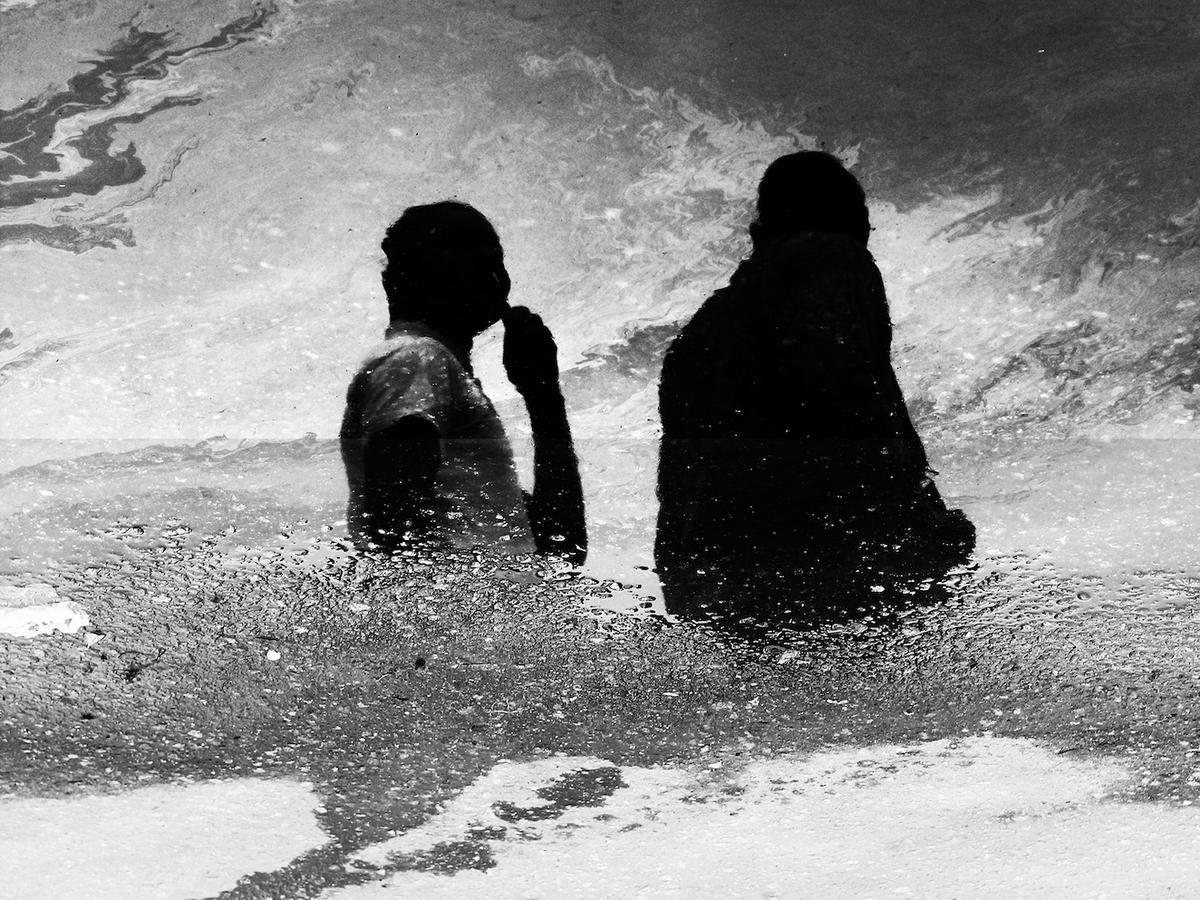
Logo Oluwamuyiwa: Oil Wonders II, from “Monochrome Lagos.” This series offers a vibrant vision of the city in black-and-white images.

Logo Oluwamuyiwa

Logo Oluwamuyiwa

You don’t expect to walk into one of the world’s great art museums and hear car horns honking.

It’s a soundtrack for New Photography 2023, an ambitious new exhibit of 151 works at New York’s Metropolitan Museum of Modern Art (MoMA) that seeks to capture the essence of Lagos, Nigeria, the bustling home to upward of 17 million people.

The exhibit, which runs through September 16, is notable for other reasons. With seven photographers represented, the exhibit marks the first time MoMA has presented a group show by living West African photographers. And it’s the launch of an ongoing series of exhibits that MoMa says will focus on “specific art scenes across the globe.”

Oluremi C. Onabanjo, associate curator of MoMA’s department of photography, who organized the show with the assistance of curatorial fellow Kaitlin Booher, welcomes the shift to international perspectives. “Lagos until now hasn’t had a home at MoMA. Why not let this be the moment of encounter?”

What you’ll encounter is a compelling collage of a massive cityscape whose clogged congestive sprawl co-exists with serene waterscapes and beaches, where ultra-modern skyscrapers tower over the abandoned buildings and artifacts of the colonial past — and where as many protesters as pedestrians sometimes fill the streets.

These contrasting photos create a conversation in the three galleries. In the first gallery, for instance, the gritty, vibrant black-and-white photos of Logo Oluwamuyiwa lining one wall are pitted against Amanda Iheme’s colorful photos of colonial-era buildings in decay.

Oluwamuyiwa’s “Monochrome Lagos” series shows how vibrant Lagos is – and how cameras and cellphones are everywhere. One of the first images a visitor sees is iPhone, in which a stylishly dressed young woman reluctantly raises her eyes from her cell phone to meet the gaze of the photographer.

Like the sounds of honking horns that boom through the gallery, many of the photos display a cacophony of heavily trafficked streets and bridges, flowing water, hazy smoke from a nearby fire, people of all ages and classes.

There are two stacks of large-sized prints for visitors to take home as souvenirs: one a wide-angle shot of a highway bridge so uncharacteristically empty one wonders if it has been abandoned, the other a super-close-up of the back of a bus bearing a poster declaring “Lagos Hosts the World.”

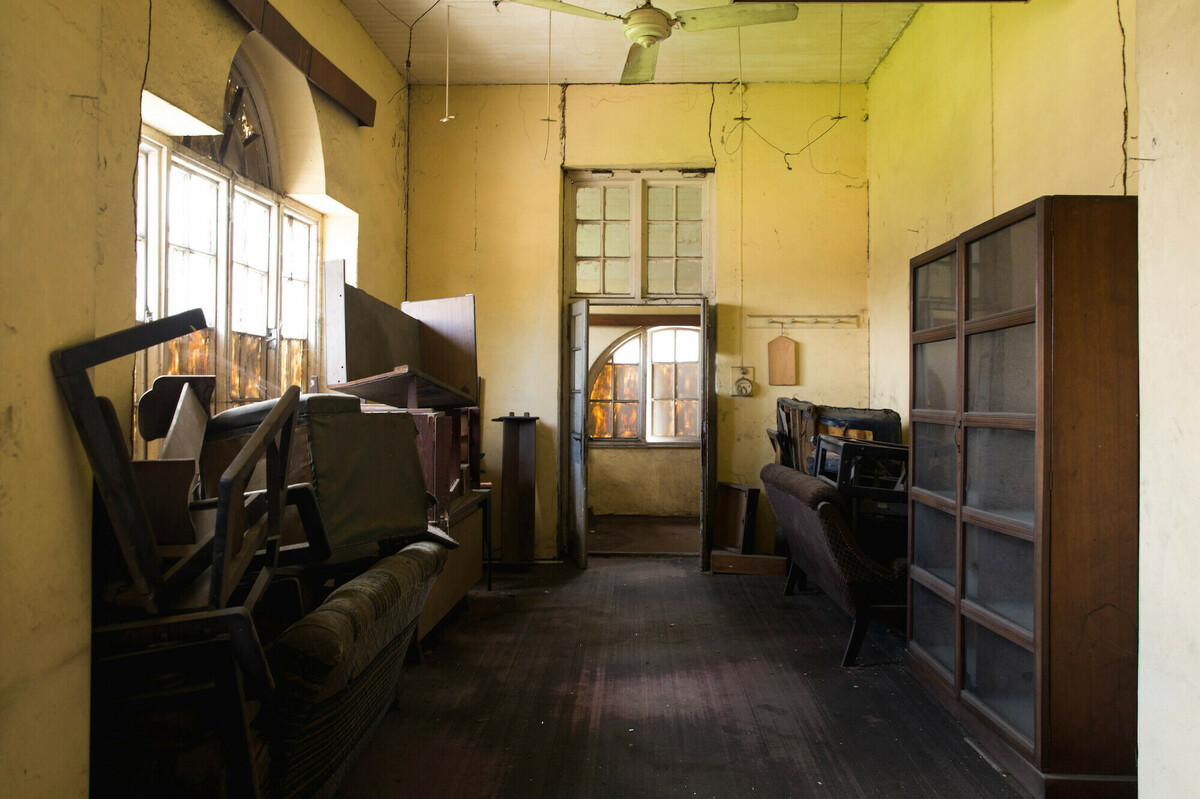
By contrast to Oluwamjhkwa’s bustling modern urban scenes, Iheme in her series “The Way of Life explores the past that remains embedded in the present. Her large color photos portray older buildings that have fallen into states of decay and abandonment. In addition to her focus on their current neglect, the buildings she depicts share a common origin, dating to Nigeria’s years under British rule, from 1851 to the country’s independence in 1960.

“She is attuned to how the houses hold the traces of history and the impact of history on our beings,” Onanbanjo comments. The most intriguing photo focuses on a single brownish-red brick, which Iheme, who is a psychotherapist in addition to a photograher, herself recovered from an 1846 house as it was being torn down. It had been built for an Afro-Brazilian slave-trading family and was later refitted for use as a post office, restaurant and bar.

Amanda Iheme: Old Secretariat – Stagnation – 12, from “The Way of Life.” Iheme explores the past of Lagos that lingers on in older buildings from the colonial past.

Amanda Iheme

Amanda Iheme

Another photo captures shadowy stairs inside an abandoned building, a scene that evokes shadows lurking from the past. In yet another, pedestrians in Western and traditional African dress walk side by side down a street whose pavement is in visible disrepair. She also shows a sense of humor in her depiction of a grand pink building with no evidence of anyone living there 00 but with laundry drying on the outside hedges.

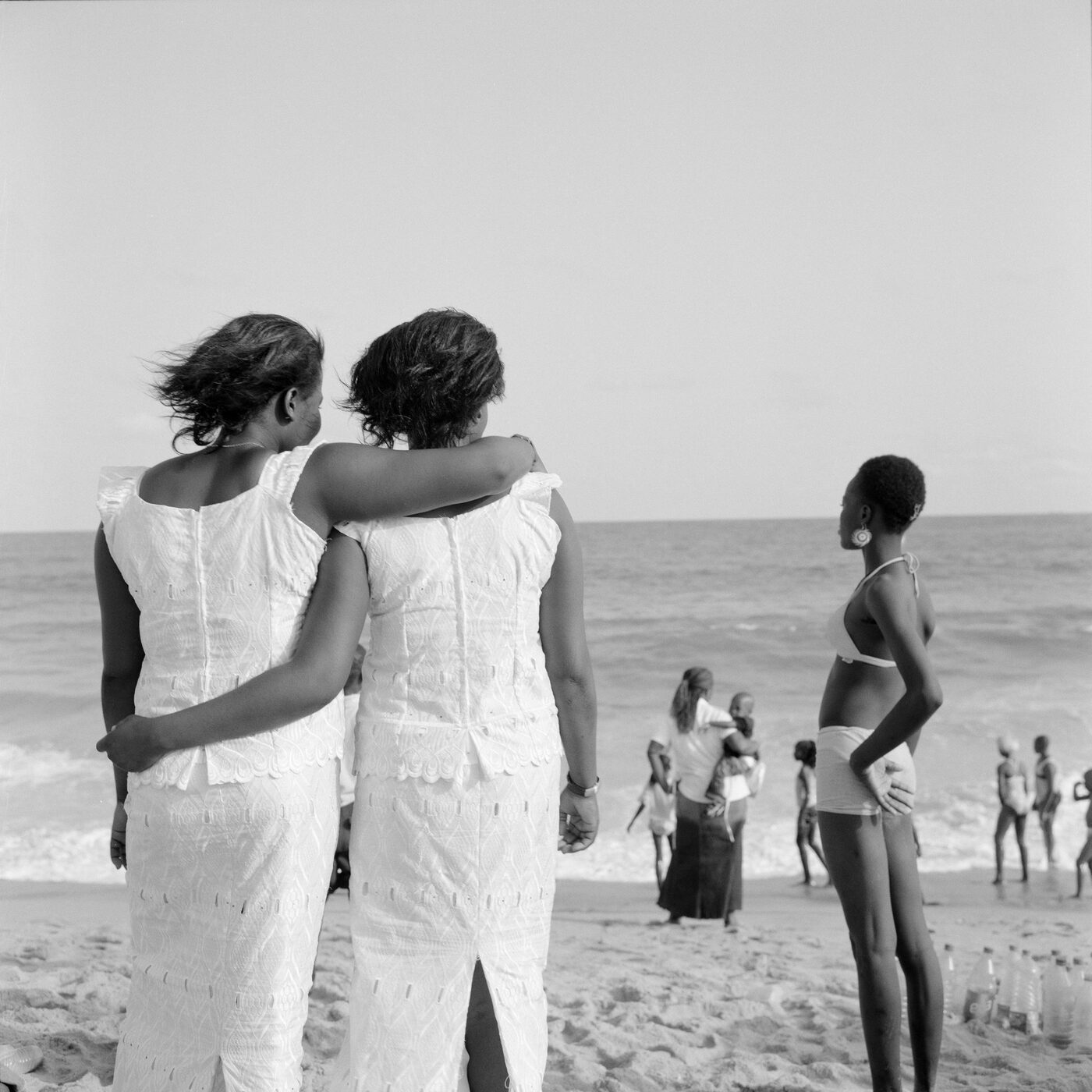
The next gallery emphasizes the sensual beauty of the city. In his finely detailed black-and-white series, “Sea Never Dry,” Akinbode Akinbiyi conjures the sense of an unending ebb and flow of life in Lagos, which is located on a lagoon and consists of several islands famed for their beaches. Onabanjo describes this series as “photographic constellations of people, animals, and objects” found at Bar Beach on Victoria Island in Lagos. Among the most striking is a woman dressed all in white, holding a book (perhaps a Bible) as she strides alone by the surf’s edge, a place where the foam from the sea and the gritty grains of sand blend one into the other.

Akinbode Akinbiyi: Bar Beach, Victoria Island, Lagos, from the series “Sea Never Dry.” The photos depict the ebb and flow of life in Lagos, which is located on a lagoon and consists of several islands famed for their beaches.

Akinbode Akinbiyi

Akinbode Akinbiyi

On display nearby is what Onabanjo calls “the spectral spine of the exhibit,” a series of collages that artist Abraham Oghobase, calls “Constructed Realities.” The photographer juxtaposes blurrily reconfigured archival images of local African and colonial figures with legal documents and lawbook pages that spell out the racist basis of imperial rule.

Abraham Oghobase: Untitled 01 from “Constructed Realities.” He juxtaposes archival images of local African and colonial figures with legal documents and lawbook pages that spell out the racist basis of imperial rule.

Abraham Oghobase

Abraham Oghobase

The second work in the set, shows Ọba Ọvonramwen, the last king who ruled the independent Benin Kingdom, in 1897, as the British rulers to whom he has just surrendered prepare to send him into exile. “He was humiliated. You could see the leg chains, you could see the security guards,” the photographer notes on the MoMA website. Oghobase uses the same historic image of Ọba Ọvonramwen in another piece in the series, but here, he says, “I’ve scaled it down to the point that you can’t even see the leg chains … I cut things up, scan them, digitally crop them” in order to tell the story from an African point of view.

The exhibit’s final gallery further illuminates the interplay between the city’s fading past and vibrant political present. Nostalgia and memory from the early decades of Nigerian independence are the dominant themes of “Casing History” by Kelani Abass and “The Archive of Becoming” by Karl Ohiri.

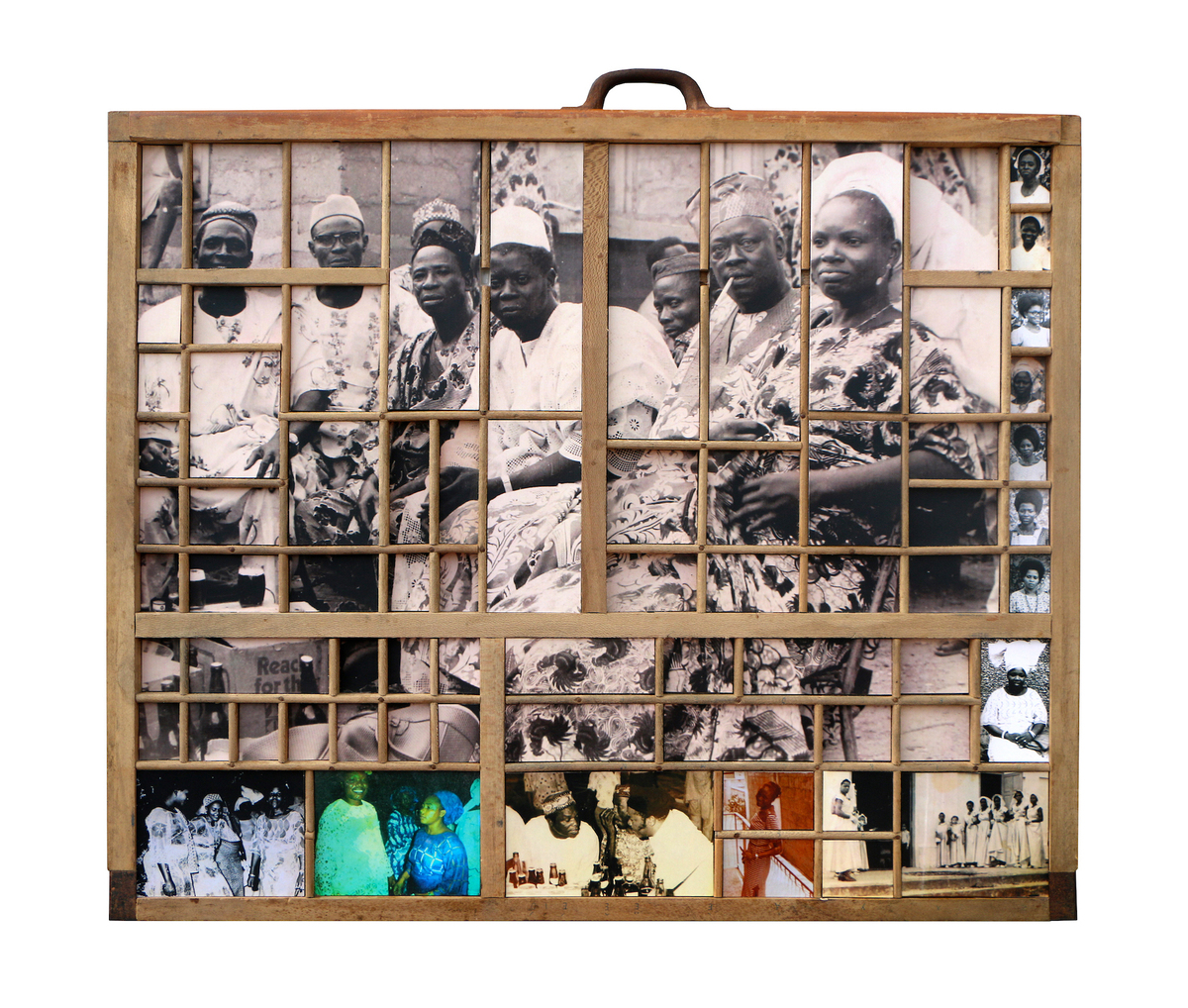
Abass repurposes the tools of his late father’s printing trade: Thin wooden letter press cases, whose compartments were commonly used to sort out printers’ letters. Abass transforms them into display cases for snapshots from the 1960s and 1970s documenting all manner of life, work and educational celebrations and milestones of people of different ages and generations. Time itself has aged the photos, giving them different shades and tints of yellow and sepia. Mixed together this way, the cases and images form a kaleidoscopic landscape of the early years of Nigerian independence, notes Onanbanjo.

Kelani Abass: Unfolding Layers 6, from “Casing History,” using a letterpress type case and digital print. Abass uses the thin wooden cases to display snapshots from the 1960s and 1970s.

Kelani Abass

Kelani Abass

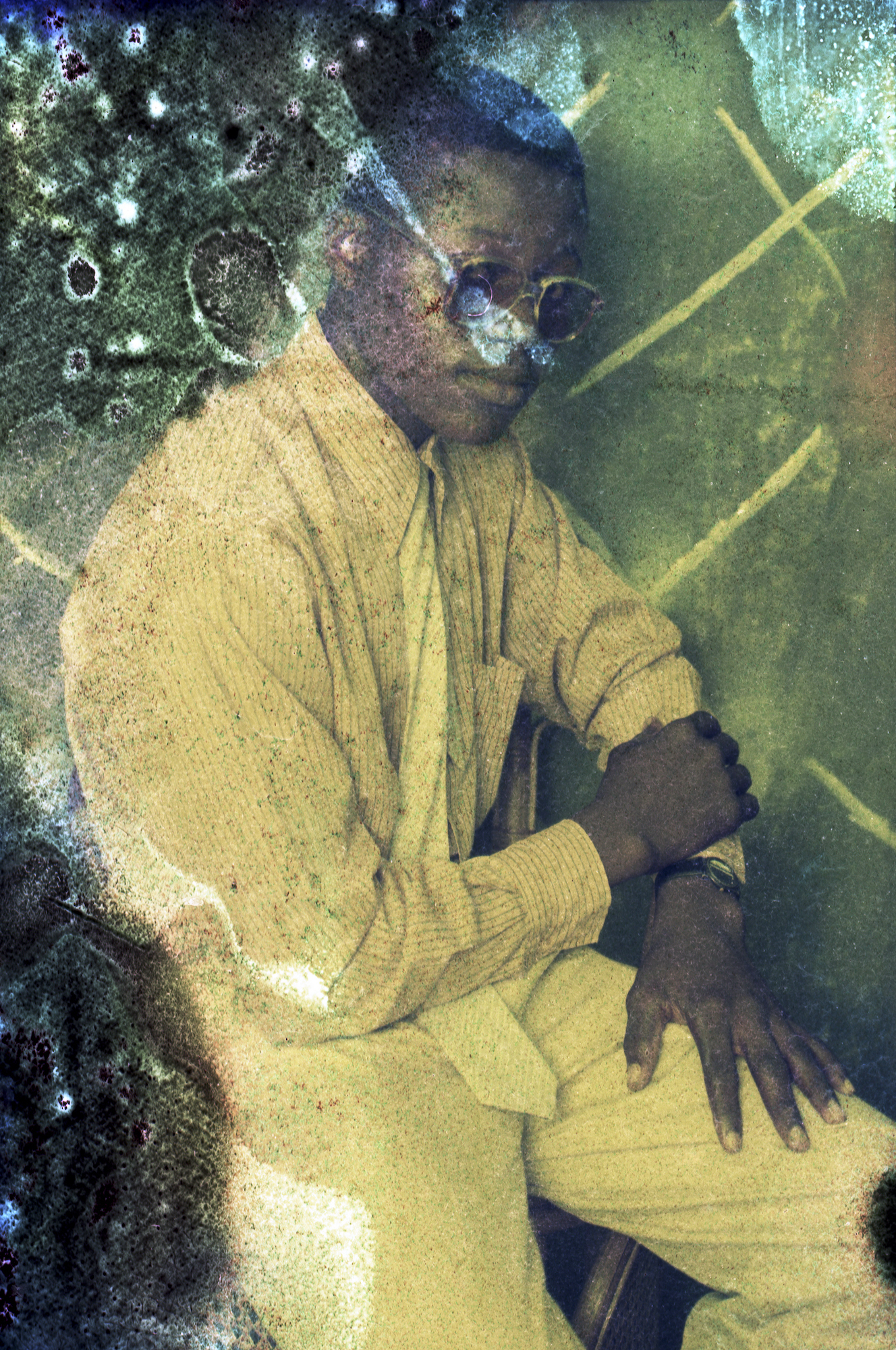
Ohiri call his collage of old negatives and prints, collected from commercial photographers, “The Archive of Becoming” — a reference to the often psychedelic colors and transformations wrought by heat, humidity and time. “They are also unbelievably striking, strange, beautiful, swirling, unexpected pictures,” says Onabanjo.

Karl Ohiri: Untitled, from “The Archive of Becoming.” Ohiri features old negatives and prints that have been transformed by heat, humidity and time.

Karl Ohiri

Karl Ohiri

Ohiri’s two-pronged video, “Rolling Footage” also offers a social critique, in its depiction of a Lagos community of the homeless and the disabled who are forced to construct their own makeshift vehicles — in this case, a skateboar, which is also on display — to navigate the congested streets of an indifferent-seeming city.

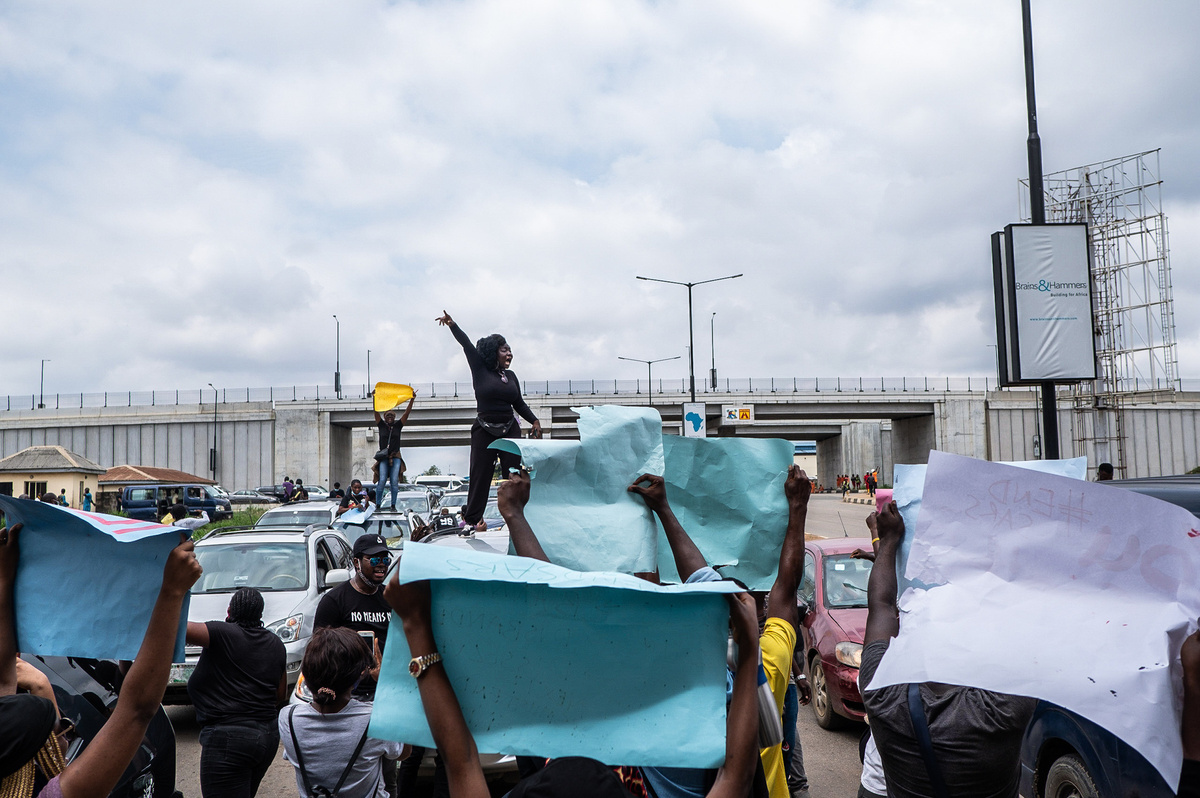
The exhibit closes with the photos of photojournalist Yagazie Emezi documenting Nigeria’s October 2020 country-wide protest of the police brutality of the country’s Special Anti-Robbery Squad (SARS). These photos document her own participation in the protests and contain “extraordinary power. They show the anger, joy and celebration inside a political movement feels like,” says Onanbanjo.

Yagazie Emezi: Untitled, from “#EndSARS Protests.” PHotojournalist Emezi documents Nigeria’s October 2020 protests of the police brutality of the country’s Special Anti-Robbery Squad (SARS).

Yagazie Emezi

Yagazie Emezi

In these photos, Emezi has said, “It’s like the crowd breathes in and out.” In the same way, visitors to the show can see, feel and hear the breath and pulse of the city of Lagos.

Diane Cole writes for many publications, including The Wall Street Journal and The Washington Post, and is book columnist for The Psychotherapy Networker. She is the author of the memoir After Great Pain: A New Life Emerges. Her website is DianeJoyceCole.com.

Unusual photos at MoMA conjure the beaches, bustle and history of Lagos

Unusual photos at MoMA conjure the beaches, bustle and history of Lagos

Logo Oluwamuyiwa: Oil Wonders II, from “Monochrome Lagos.” This series offers a vibrant vision of the city in black-and-white images.

Logo Oluwamuyiwa

Logo Oluwamuyiwa

You don’t expect to walk into one of the world’s great art museums and hear car horns honking.

It’s a soundtrack for New Photography 2023, an ambitious new exhibit of 151 works at New York’s Metropolitan Museum of Modern Art (MoMA) that seeks to capture the essence of Lagos, Nigeria, the bustling home to upward of 17 million people.

The exhibit, which runs through Sept. 16, is notable for other reasons. With seven photographers represented, the exhibit marks the first time MoMA has presented a group show by living West African photographers. And it’s the launch of an ongoing series of exhibits that MoMa says will focus on “specific art scenes across the globe.”

Oluremi C. Onabanjo, associate curator of MoMA’s department of photography, who organized the show with the assistance of curatorial fellow Kaitlin Booher, welcomes the shift to international perspectives. “Lagos until now hasn’t had a home at MoMA. Why not let this be the moment of encounter?”

What you’ll encounter is a compelling collage of a massive cityscape whose clogged congestive sprawl co-exists with serene waterscapes and beaches, where ultra-modern skyscrapers tower over the abandoned buildings and artifacts of the colonial past — and where as many protesters as pedestrians sometimes fill the streets.

These contrasting photos create a conversation in the three galleries. In the first gallery, for instance, the gritty, vibrant black-and-white photos of Logo Oluwamuyiwa lining one wall are pitted against Amanda Iheme’s colorful photos of colonial-era buildings in decay.

Oluwamuyiwa’s “Monochrome Lagos” series shows how vibrant Lagos is – and how cameras and cellphones are everywhere. One of the first images a visitor sees is iPhone, in which a stylishly dressed young woman reluctantly raises her eyes from her cell phone to meet the gaze of the photographer.

Like the sounds of honking horns that boom through the gallery, many of the photos display a cacophony of heavily trafficked streets and bridges, flowing water, hazy smoke from a nearby fire, people of all ages and classes.

There are two stacks of large-sized prints for visitors to take home as souvenirs: one a wide-angle shot of a highway bridge so uncharacteristically empty one wonders if it has been abandoned, the other a super-close-up of the back of a bus bearing a poster declaring “Lagos Hosts the World.”

By contrast to Oluwamjhkwa’s bustling modern urban scenes, Iheme in her series “The Way of Life explores the past that remains embedded in the present. Her large color photos portray older buildings that have fallen into states of decay and abandonment. In addition to her focus on their current neglect, the buildings she depicts share a common origin, dating to Nigeria’s years under British rule, from 1851 to the country’s independence in 1960.

“She is attuned to how the houses hold the traces of history and the impact of history on our beings,” Onanbanjo comments. The most intriguing photo focuses on a single brownish-red brick, which Iheme, who is a psychotherapist in addition to a photograher, herself recovered from an 1846 house as it was being torn down. It had been built for an Afro-Brazilian slave-trading family and was later refitted for use as a post office, restaurant and bar.

Amanda Iheme: Old Secretariat – Stagnation – 12, from “The Way of Life.” Iheme explores the past of Lagos that lingers on in older buildings from the colonial past.

Amanda Iheme

Amanda Iheme

Another photo captures shadowy stairs inside an abandoned building, a scene that evokes shadows lurking from the past. In yet another, pedestrians in Western and traditional African dress walk side by side down a street whose pavement is in visible disrepair. She also shows a sense of humor in her depiction of a grand pink building with no evidence of anyone living there 00 but with laundry drying on the outside hedges.

The next gallery emphasizes the sensual beauty of the city. In his finely detailed black-and-white series, “Sea Never Dry,” Akinbode Akinbiyi conjures the sense of an unending ebb and flow of life in Lagos, which is located on a lagoon and consists of several islands famed for their beaches. Onabanjo describes this series as “photographic constellations of people, animals, and objects” found at Bar Beach on Victoria Island in Lagos. Among the most striking is a woman dressed all in white, holding a book (perhaps a Bible) as she strides alone by the surf’s edge, a place where the foam from the sea and the gritty grains of sand blend one into the other.
Akinbode Akinbiyi: Bar Beach, Victoria Island, Lagos, from the series “Sea Never Dry.” The photos depict the ebb and flow of life in Lagos, which is located on a lagoon and consists of several islands famed for their beaches.

Akinbode Akinbiyi

Akinbode Akinbiyi

On display nearby is what Onabanjo calls “the spectral spine of the exhibit,” a series of collages that artist Abraham Oghobase, calls “Constructed Realities.” The photographer juxtaposes blurrily reconfigured archival images of local African and colonial figures with legal documents and lawbook pages that spell out the racist basis of imperial rule.

Abraham Oghobase: Untitled 01 from “Constructed Realities.” He juxtaposes archival images of local African and colonial figures with legal documents and lawbook pages that spell out the racist basis of imperial rule.

Abraham Oghobase

Abraham Oghobase

The second work in the set, shows Ọba Ọvonramwen, the last king who ruled the independent Benin Kingdom, in 1897, as the British rulers to whom he has just surrendered prepare to send him into exile. “He was humiliated. You could see the leg chains, you could see the security guards,” the photographer notes on the MoMA website. Oghobase uses the same historic image of Ọba Ọvonramwen in another piece in the series, but here, he says, “I’ve scaled it down to the point that you can’t even see the leg chains … I cut things up, scan them, digitally crop them” in order to tell the story from an African point of view.

The exhibit’s final gallery further illuminates the interplay between the city’s fading past and vibrant political present. Nostalgia and memory from the early decades of Nigerian independence are the dominant themes of “Casing History” by Kelani Abass and “The Archive of Becoming” by Karl Ohiri.

Abass repurposes the tools of his late father’s printing trade: Thin wooden letter press cases, whose compartments were commonly used to sort out printers’ letters. Abass transforms them into display cases for snapshots from the 1960s and 1970s documenting all manner of life, work and educational celebrations and milestones of people of different ages and generations. Time itself has aged the photos, giving them different shades and tints of yellow and sepia. Mixed together this way, the cases and images form a kaleidoscopic landscape of the early years of Nigerian independence, notes Onanbanjo.

Kelani Abass: Unfolding Layers 6, from “Casing History,” using a letterpress type case and digital print. Abass uses the thin wooden cases to display snapshots from the 1960s and 1970s.

Kelani Abass

Kelani Abass

Ohiri call his collage of old negatives and prints, collected from commercial photographers, “The Archive of Becoming” — a reference to the often psychedelic colors and transformations wrought by heat, humidity and time. “They are also unbelievably striking, strange, beautiful, swirling, unexpected pictures,” says Onabanjo.

Karl Ohiri: Untitled, from “The Archive of Becoming.” Ohiri features old negatives and prints that have been transformed by heat, humidity and time.

Karl Ohiri

Karl Ohiri

Ohiri’s two-pronged video, “Rolling Footage” also offers a social critique, in its depiction of a Lagos community of the homeless and the disabled who are forced to construct their own makeshift vehicles — in this case, a skateboar, which is also on display — to navigate the congested streets of an indifferent-seeming city.

The exhibit closes with the photos of photojournalist Yagazie Emezi documenting Nigeria’s October 2020 country-wide protest of the police brutality of the country’s Special Anti-Robbery Squad (SARS). These photos document her own participation in the protests and contain “extraordinary power. They show the anger, joy and celebration inside a political movement feels like,” says Onanbanjo.
Yagazie Emezi: Untitled, from “#EndSARS Protests.” PHotojournalist Emezi documents Nigeria’s October 2020 protests of the police brutality of the country’s Special Anti-Robbery Squad (SARS).

Yagazie Emezi

Yagazie Emezi

In these photos, Emezi has said, “It’s like the crowd breathes in and out.” In the same way, visitors to the show can see, feel and hear the breath and pulse of the city of Lagos.

Diane Cole writes for many publications, including The Wall Street Journal and The Washington Post, and is book columnist for The Psychotherapy Networker. She is the author of the memoir After Great Pain: A New Life Emerges. Her website is DianeJoyceCole.com.
Photography: Braid and Signals Midwest

Photography: Braid and Signals Midwest

Posted: 29th July, 2023 by The Editor

You know how there are bands you wish you would’ve known about since they first started putting out tunes, but maybe you were too young or not even born yet? Legendary Emo band, Braid is that band for several people that showed up at The Echoplex in Los Angeles this past Saturday. The crowd was a mixed batch of younger and older fans and they were ready for a damn good time as Braid is currently going around the country celebrating 25 years of Frame & Canvas by playing the album in its entirety.

Along for the ride on a portion of the tour is Punk/Indie band, Signals Midwest. This was the first time in a few years that the Cleveland-based band were to perform in Los Angeles. The fans that were familiar with the music were not hesitant in showing that they knew the songs as Signals Midwest played fan favorites such as “Your Old New Apartment,” “You’re Gonna Be Golden,” “West Side Summer,” and “GOLD IN THE GREY.” The band couldn’t end their set without thanking Braid for having them on board to play some of the anniversary shows.

With the energetic performance Signals Midwest gave, the crowd braced themselves for the set Braid would deliver. As expected with the band playing Frame & Canvas, the band started off with the first track off the album, “The New Nathan Detroits” followed by “Killing A Camera” and “Never Will Come For Us.” Every chance the band could get, they thanked the fans for sticking with them and for coming out to the show. Fans continued to show their energy as they sang along to the rest of the album as the band played “First Day Back,” “Collect From Clark Kent,” “Milwaukee Sky Rocket,” “A Dozen Roses,” “Urbana’s Too Dark,” “Consolation Prize Fighter,” “Ariel,” (Bob Nanna asked if there were any Ariels in the crowd. There were none, but there were a bunch of Aries, so the band dedicated the song to anyone who was an Aries) “Breathe In,” and finally “I Keep A Diary.”

With Braid performing the entirety of Frame & Canvas, an album that’s over 40 minutes long, the band treated us to more bangers. Off The Age of Octeen, we got treated to “My Baby Smokes” and “The Chandelier Swing”. The band also played “East End Hollows,” “No Coast,” and “Damages!” off No Coast.

Overall, it was such an awesome show with both bands playing their hearts out. Braid sounded phenomenal. I was only a kid when Frame & Canvas was released, but the beauty of music is that we are able to learn about bands later on in life that we didn’t know of before. The unfortunate circumstance that we may find ourselves in sometimes is that the bands may no longer be together for whatever reason. Lucky for us, Braid has been able to play these anniversary shows and they’re not done. The band is scheduled to play at Riot Fest in Chicago and Furnace Fest in Birmingham in September and THE FEST in Gainesville in October. If you’re attending any of these festivals, please do yourself a favor and go see Braid. They are ready to melt faces.


Photos by Jazmin Lemus

The Alternative is ad-free and 100% supported by our readers. If you’d like to help us produce more content and promote more great new music, please consider donating to our Patreon page, which also allows you to receive sweet perks like free albums and The Alternative merch.

‘I might have been told off if I had pulled out a proper camera’: Johny Pitts’ best phone picture

‘I might have been told off if I had pulled out a proper camera’: Johny Pitts’ best phone picture
image

“Britain looks most like itself on an overcast day,” Sheffield-born photographer Johny Pitts says. He shot these three men – and three pigeons – outside partly renovated flats on London’s Jamaica Road in Bermondsey. At the time, he was constantly on the lookout for “big architectural ideas from the postwar period”.

“I was using my phone as a sketchbook to record what I found,” says Pitts, whose work can be seen at the Photographers’ Gallery in London until 24 September. “You’d be surprised how quickly things disappear. Many photographers think capturing a decisive moment is about people, but a lot of the time it’s the street furniture and buildings that can suddenly change and alter the atmosphere that attracted you in the first place.”

He doubts he would have stopped to capture this scene with one of his 15 professional cameras (including a Fujifilm X-Pro3, Ricoh GR III, Konica Hexar and Yashica T4). “I might have been told off by these men if I had pulled out something less subtle,” Pitts notes.

While he sometimes prefers going out to shoot without the distraction of his phone’s other features, when he does use it, he shoots with Instagram sharing in mind, and provides followers with the geolocation. “I like to honour the phone as a device that is more than just a camera, but something connected to satellites and maps. You can search the geotag of this image [lat 51.49843123838731, long –0.061613484250885635] and see what’s there right now. The men will be gone, and there’s a ghostliness to that. But this photo provides a portal.”

Highland Park Cars photography exhibit (2023-08-06)

Highland Park Cars photography exhibit (2023-08-06)

When:

August 6, 2023 @ 3:00 pm – 5:00 pm

2023-08-06T15:00:00-07:00

2023-08-06T17:00:00-07:00

Where:

Highland Park Corner Store
7789 Highland Park Way SW
West Seattle

Highland Park Cars:

Two Highland Park photographers team up for the August show at the Highland Park Corner Store. Veteran artist Peter de Lory will feature images of vintage Detroit steel from around the neighborhood. West Seattle High School sophomore Franklin Stauffer will showcase his pictures of die-cast cars from his collection.

Meet the artists at the opening on Sunday, August 6th from 3-5 pm. Show runs through September 9th.