Photography

Amherst board OKs permit for photography, events venue in Gladstone

Amherst board OKs permit for photography, events venue in Gladstone
image

The owner of a Gladstone home has received the Amherst County Board of Supervisors’ zoning approval to operate a photography venue and special event place for weddings, tea parties and similar uses.

The board approved a special exception permit during its July 18 meeting for Phyllis Maire, the applicant, to operate the venue at her property at 2409 Riverville Road. The site of just more than 80 acres zoned Agricultural Residential, A-1, has two single-family dwellings and the surrounding area is generally agricultural-zoned property with a single house to the southeast, a CXS yard to the east and vacant land to the north and west, according to county officials.

Maire will not have special events on the lot across from the railroad tracks, according to Tyler Creasy, director of community development.

“Any events over 75 people will require a parking attendant,” Creasy said.

People are also reading…

Maire said she bought her beautiful farmhouse property in 2017.

“We fixed it up and we’re really making it our haven and we just thought we want to share this beautiful property with everyone with this spacious 81 acres,” Maire said. “The things we’ve done to it to enhance it — we just felt like we wanted to share with other people.”

The permit includes a condition that guests at events are required to park on Maire’s property and not on neighboring lots or on any right-of-way outside the site unless given written permission.

Maire expressed excitement for the home’s use as an events venue during a public hearing.

“I love to serve people,” Maire said. “It’s a passion of mine. I love hosting so I want to do the tea parties and smaller events such as weddings and reunions, any type of small gatherings like that.”

Supervisor Claudia Tucker said she appreciates residents who take older homes with character, pour time and passion into fixing them up and sharing them with people, telling Maire: “Bless you.” Tucker also said she appreciates Maire’s willingness to work with the county on the railroad issue and not holding events near that land.

Carol Frazier, a local resident, said she supports Maire’s plan and will offer her help any way possible.

“I think this is a wonderful idea,” Frazier said. “It’s a wonderful place — beautiful.”

Kathy Blanchard, a neighbor of Maire, also supported the event venue.

“I’ve been a recipient of her hospitality,” Blanchard said. “She’s got a neighbor that’s all about it and I would love to be a part of helping her make good use of the property. It’s beautiful and I’m just all for it.”

Justin Faulconer,

(434) 473-2607

jfaulconer@newsadvance.com

#lee-rev-content { margin:0 -5px; }
#lee-rev-content h3 {
font-family: inherit!important;
font-weight: 700!important;
border-left: 8px solid var(–lee-blox-link-color);
text-indent: 7px;
font-size: 24px!important;
line-height: 24px;
}
#lee-rev-content .rc-provider {
font-family: inherit!important;
}
#lee-rev-content h4 {
line-height: 24px!important;
font-family: “serif-ds”,Times,”Times New Roman”,serif!important;
margin-top: 10px!important;
}
@media (max-width: 991px) {
#lee-rev-content h3 {
font-size: 18px!important;
line-height: 18px;
}
}

#pu-email-form-breaking-email-article {
clear: both;

background-color: #fff;

color: #222;

background-position: bottom;
background-repeat: no-repeat;
padding: 15px 0 20px;
margin-bottom: 40px;
border-top: 4px solid rgba(0,0,0,.8);
border-bottom: 1px solid rgba(0,0,0,.2);

display: none;

}
#pu-email-form-breaking-email-article,
#pu-email-form-breaking-email-article p {
font-family: -apple-system, BlinkMacSystemFont, “Segoe UI”, Helvetica, Arial, sans-serif, “Apple Color Emoji”, “Segoe UI Emoji”, “Segoe UI Symbol”;
}
#pu-email-form-breaking-email-article h2 {
font-size: 24px;
margin: 15px 0 5px 0;
font-family: “serif-ds”, Times, “Times New Roman”, serif;
}
#pu-email-form-breaking-email-article .lead {
margin-bottom: 5px;
}
#pu-email-form-breaking-email-article .email-desc {
font-size: 16px;
line-height: 20px;
margin-bottom: 5px;
opacity: 0.7;
}
#pu-email-form-breaking-email-article form {
padding: 10px 30px 5px 30px;
}
#pu-email-form-breaking-email-article .disclaimer {
opacity: 0.5;
margin-bottom: 0;
line-height: 100%;
}
#pu-email-form-breaking-email-article .disclaimer a {
color: #222;
text-decoration: underline;
}
#pu-email-form-breaking-email-article .email-hammer {

border-bottom: 3px solid #222;

opacity: .5;
display: inline-block;
padding: 0 10px 5px 10px;
margin-bottom: -5px;
font-size: 16px;
}
@media (max-width: 991px) {
#pu-email-form-breaking-email-article form {
padding: 10px 0 5px 0;
}
}
.grecaptcha-badge { visibility: hidden; }

Photographer John Fielder shares his life’s work with History Colorado, and we can all be thankful

Photographer John Fielder shares his life’s work with History Colorado, and we can all be thankful

John Fielder and his approach to life


Photographer John Fielder and his approach to life

06:39

When you spend time in the great outdoors, your perspective often changes. That has certainly been true for Colorado nature photographer and conservationist John Fielder, who is battling cancer.

Fielder has spent a lifetime capturing the beauty of the Rocky Mountain in thousands of remarkable photos. His eyes and cameras have recorded images that show majesty of mountains…

john-fielder-5.jpg

CBS


The whisper of winter…

john-fielder-10p-pkg.jpg

JohnFielder.com


… and the rebirth of spring.

john-fielder-9.jpg

CBS


Along the way, Fielder has learned from nature’s timeless cycles of life, and he’s putting the lessons he’s learned to use now as a matter of necessity.

Reporter Barry Petersen first met Fielder in 2015 in Rocky Mountain National Park for a report on CBS Sunday Morning, long before he was diagnosed with pancreatic cancer. He said “I never get tired of being in places like this” and called it “his medicine.” He said it gets better every single time he visits. That was a big statement for someone who had at that time visited the breathtaking park in northern Colorado more than 100 times.

History Colorado is now showcasing some of his work in an exhibit at the History Colorado Center in Denver called “REVEALED: John Fielder’s Favorite Place.” History Colorado in their description of the exhibit says Fielder has “embraced the incredible solace to be found in spaces of complete vulnerability, and captured the magic of the moment.”

It’s one of a series of exhibits that will be coming to the museum in future years thanks to a massive gift from Fielder. Fielder went through 200,000 of his transparencies and winnowed them down to 7,000 negatives showcasing the best of his work. He’s donating all of those 7,000 to History Colorado.

“40 years ago all I wanted to do was one thing, and that is quit my department store job cold turkey. And with a wife and child and another one on the way turn my passion and hobby — photography — into a new career,” Fielder said. “And I pulled that off.”

john-fielder-2.jpg

CBS


Fielder’s pictures and calendars have drawn thousands to the wilderness. Unfortunately, some of those people have damaged the beloved nature he photographed. But now he believes they will also help nature survive.

“If you don’t smell it — the smell of decaying aspen leaves in the fall. Taste it — the taste of that cold, metallic, freshly melting snow water up high at 12,000 feet. You don’t listen to the hummingbirds in the meadow at 11,000 feet … you never really develop an appreciation for the sensuousness of nature and the fact that this is a 4.3 billion year process of evolution.”

“In our American democracy that’s why we’ve protected more wilderness than any other country on the planet. And I want people to vote that way and unless they care, they won’t do it.”

Fielder now faces a greater challenge than any he faced in nature.

“You have probably seen as much as any man of nature — birth, life, death,” Petersen asked Fielder in a visit to his house recently. “I sometimes have the sense talking to you, John, that it informs the way you are approaching death as part of life. Help me understand this.”

“My mind always tends to think scientifically, you know, logically and deductively and analytically,” Fielder said. “Trying to understand what’s around me. Living in a moment sounds like a cliche, but living in the moment, living in the present is medicine for me. And it allows me to appreciate the past and the future by always being focused on what I’ve been given today. Not yesterday or the day before.”

What Fielder has given today is for all of us. Those 7,000 photographs in the History Colorado collection “John Fielder’s Colorado Collection” will be for anyone to freely browse and download.

“You know, I never felt that I owned my photos. I felt that was kind of selfish,” he said.

Fielder hopes his photos will inspire more people to be conservationists. He also says they can serve as a benchmark for those who document climate change, since he has captured natural areas at specific moments in time over the recent decades.

Ballet on Bonneville Salt Flats Beautifully Shows Story of ‘Swan Lake’

Ballet on Bonneville Salt Flats Beautifully Shows Story of ‘Swan Lake’

Brad Walls aerial ballet photography

Award-winning Australian aerial photographer Brad Walls has continued collaborating with the New York City ballet to capture beautiful, artistic images of a professional dancer on the famous and picturesque Bonneville Salt Flats in Utah.

The photo shoot, like much of Walls’ other work, was conducted entirely from the air. Through the unique photo series, Walls aims to explore humanity’s light and dark aspects from an unusual perspective.

Brad Walls aerial ballet photography

The shadows convey different emotions. “Depending on your state of mind, your shadow could offer comfort or reflect a darker mood,” says Walls. The series, inspired by the story of Swan Lake, is fittingly photographed on a salt lake.

Brad Walls aerial ballet photography

“While theater ballet performances are undoubtedly breathtaking, there exists a captivating harmony between the natural wonders of our world and the art of Ballet — it’s a seamless fusion,” explains Walls.

Brad Walls aerial ballet photography

Brad Walls aerial ballet photography

For his latest series, Walls worked alongside Sasonah Huttenbach, a former member of New York City Ballet’s Corp de Ballet member.

Huttenbach was raised in Tokyo and New York City, and connected personally with Walls’ pitch. “I connected with the idea. The white and black swans depicted on the salt reflected my inner conflicts that I’ve grappled with throughout my journey as a Ballet dancer living between Japan and now the US,” Huttenbach says.

Brad Walls aerial ballet photography

Walls used a single dancer for the series, with Huttenbach playing the role of the black and white swan alike. Walls says that using different dancers, as he has done with other ballet series, would have “diminished the poignant symmetrical struggle that I aimed to convey in my photography.” Clever compositing techniques show Huttenbach multiple times in many images.

The new series will be featured alongside other ballet photoshoots, including a recent one that Walls also shot using a drone, in a coffee table book next year. Much more of Brad Walls’ work is available on his website and Instagram.

Brad Walls aerial ballet photography

Brad Walls aerial ballet photography

The aerial photographer has many other interesting photo series that have been featured on PetaPixel, including minimalist photos of empty swimming pools from above, a conceptual series based on 1940s fashion, symmetrical squash courts, and hypnotic synchronized swimming.


Image credits: All images © Brad Walls

Today’s Photo from Ted Grussing Photography: The Timeless and The Unknown

Today’s Photo from Ted Grussing Photography: The Timeless and The Unknown

… days when I learn new things are terrific, days when I am introduced to new ways of looking at life and everything I have experienced are pure bliss! I had lunch with a friend at Brandy’s in Flagstaff today … Rich is a Physicist and spent the bulk of his career at Lowell Observatory and one of the most fascinating individuals I know. Somehow the conversation swung towards objects in the sky, UFOs, UAPs and other mostly unexplained phenomena. Rich introduced me to a theory of his that electromagnetic flux tubes are responsible for many and varied phenomena that cannot be easily explained and then into the origins, existence and properties of the electromagnetic flux tubes. He had a paper he has written on the subject and gave me a copy of it. While I do not fully comprehend these electromagnetic flux tubes, after reading the paper a couple of times I can kinda comprehend the concept. If you have an interest in investigating them, write me and I’ll put you in touch with Rich … tips on photographing them too!

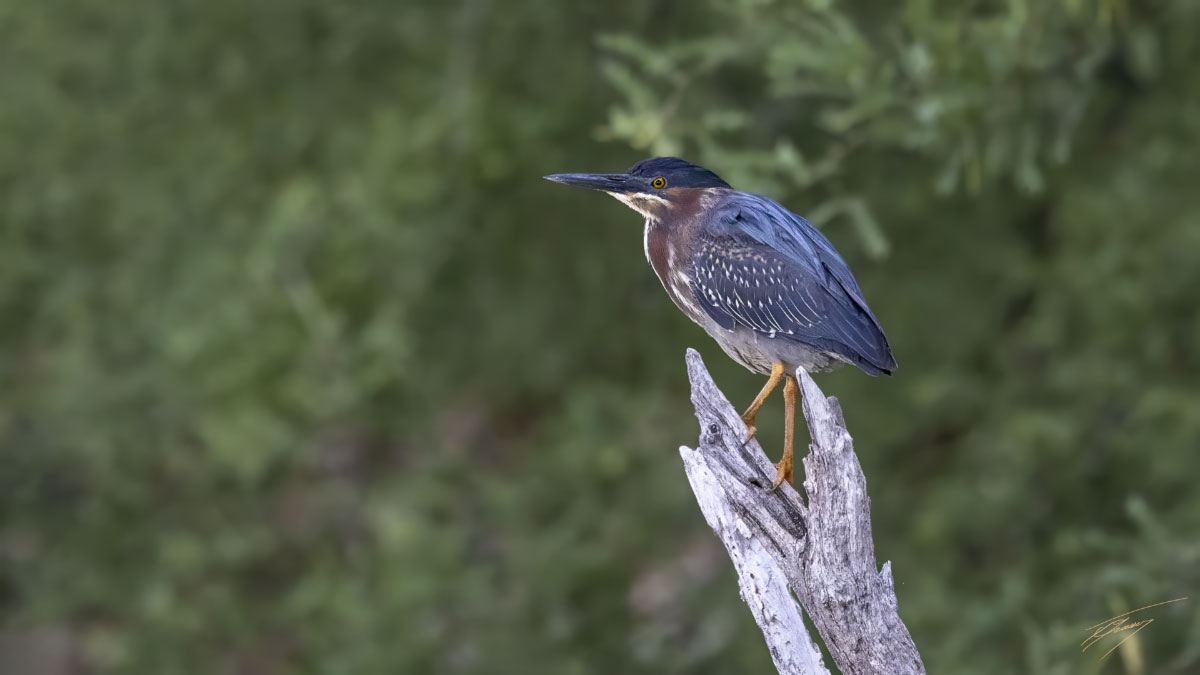
The photo above is a partial of a sycamore tree trunk that I shot earlier this year … perhaps a memory of or look at another life frozen in time and to be appreciated or remembered. Below is a shot of a green heron perched on a limb in the water and looking for a meal to appear. Lake Pleasant is down eleven feet since I was last down there and the bulk of that water is going to farms which grow crops that help us meet the new day with food on the table.

Time to wrap the day … have an absolutely beautiful day and be amazed as you look around!

Cheers,

Ted

So each one to his wish, and as for me,
I sit tonight and wait
To find the answers to my soul in me,
And in the beauty of the sky and sea.

excerpt from I Sit And Wait by Max Ehrmann

###

photo_tedgrussingThe easiest way to reach Mr. Grussing is by email: ted@tedgrussing.com

In addition to sales of photographs already taken Ted does special shoots for patrons on request and also does air-to-air photography for those who want photographs of their airplanes in flight. All special photographic sessions are billed on an hourly basis.

Ted also does one-on-one workshops for those interested in learning the techniques he uses.  By special arrangement Ted will do one-on-one aerial photography workshops which will include actual photo sessions in the air.

More about Ted Grussing


Healing Paws

Healing Paws

This is an advertisement

8th Annual Shakespeare at the Lake Photography Contest

8th Annual Shakespeare at the Lake Photography Contest

If you’re searching for a way to support local community theater and make a little money at the same time, look no further. The 8th annual Shakespeare at the Lake is just around the corner, and the production team is hosting a photography contest. 

The rules are simple. Attend one (or more) of our free performances, take some amazing pictures of the show, and then post them to the Shakespeare at the Lake Facebook page.

Free performances of this year’s play, “Measure for Measure,” will take place July 29 and July 30 at Library Park in Lakeport and August 4, 5, and 6 at Austin Park in Clearlake. Photos must be posted by August 8 at 11:59 p.m.

The photos that get the most reactions on our Facebook page will win. Voting closes on August 12 at 11:59 p.m. Three photographers will be awarded prize money. First place will receive $150, second place $100, and third place $50. The photography contest is sponsored by Clear Lake Campground. 

Actors will take the stage at 7 p.m., but don’t miss pre-show entertainment featuring a string quartet, “Faire Measure,” at 6 p.m. Food and drink from some of your favorite local vendors will also be available an hour before the play begins. 

Shakespeare at the Lake is a joint production of Mendocino College and the Lake County Theatre Company and is made possible by generous support from the Lake County Friends of Mendocino College, the City of Lakeport, the City of Clearlake, and the Clear Lake Chamber of Commerce. 

A Community Member

We always welcome community input. If you have a press release, event, or idea you would like to share with The Bloom’s readers, send us a note.

Publish Your Photography Book

Publish Your Photography Book

Provided by Mark Gilvey Creative LLC

Mark Gilvey Creative announces the creation of two photography books to help advanced and professional photographers self-publish photo books. Mark Gilvey takes his 25 years of experience in prepress, photo-retouching, and design to create two books aimed at helping photographers grapple with the issues of printing Black & White and Color photography in books, and magazines (and zines). He calls this his first two in a series of publications called This Is A Test (TIAT). The publications are called Blurb For Photographers Using Adobe® InDesign®, Lightroom® and Photoshop® Part 1 and 2.

“If you ever wanted to make a test book, before you go all-in, these guides will give you a great head start for preparing your files for press. When I started this project, there really weren’t many books out there that could give me a good idea of what my-own photography would look like using a print-on-demand service, like Blurb.” Gilvey said. “If you enjoy researching new gear you will buy, or a photography class you want to take, then you should research print-on-demand. I’ve got it all here in two volumes.”

Each publication covers the ins-and-outs of preparing your digital files. Gilvey said, “Did you know there are many colors of black that can affect how your B&W image will look? Do you know how white, white is on paper? Have you checked your black on black densities? What would your image look like with a 300 max ink density, vs. a 260 max ink density.” He also goes into areas that photographers typically avoid such as page design, how to make silhouettes, avoiding rivers, streams, orphans, the gutter, and how to check for “blobbage.”

“The publications have to be purchased as real, hard copy for you to see the actual results from each of the tests I do—a PDF will not illustrate the same way as print will.” Gilvey continues, “you can download a free sample as a PDF from my website, to see what it looks like, but to really understand what you are looking at, and to be able to compare it to what your minds-eye desires for your-own work, you need to have it in print.” He adds, “If you are only doing B&W, you only need the B&W version, but you’ll miss all the information about layout, and text that is in the Color version. If you are planning to only do color photos, you need both publications, they are both vital to color work.”

Click here to purchase or download samples of these two guides.

Mark Gilvey Creative, LLC offers commercial photography including product, food and restaurant photography, architectural, headshots, passports, photography of your services, and industrial photography.

Behind the Lens: Meet the Photographers Capturing the Museum’s Most Stunning Moments.

Behind the Lens: Meet the Photographers Capturing the Museum’s Most Stunning Moments.
At the National Museum of Natural History, captivating photography opportunities can be found everywhere you look, even the ceiling of the iconic Rotunda.  
James Di Loreto, NMNH

On the National Museum of Natural History’s photography team, the answer to nearly every request is yes.  Can you capture every tiny vascular detail in the wing of a fly? Yes. Can you photograph a gigantic stegosaurus skeleton in an exhibition full of visitors? Yes. Can you travel thousands of miles with unwieldy camera gear to bring vital field research to life? Yes.

In a museum brimming with astounding collections, diverse research, constantly changing exhibitions, and events that attract visitors from around the world, photographers need to be ready for anything.  And if their stunning shots are any indication, they always are.

none

Members of the museum’s Photography and Media team step out from behind the camera to pose for a rare self-portrait in 2019. From left to right: Lucia Martino, Sarah Bradley, James Di Loreto, James Tiller, Brittany Hance, Fred Cochard, and Kristen Quarles. 

James D. Tiller, NMNH

A common saying among the Photo and Media team members is that their office has photographed everything you can find between 190 feet below the surface and 35,000 feet above.  “I spend most of my time with rocks and dead stuff,” said NMNH photographer Brittany Hance with a laugh. “But we have done such a wide variety of work from digitizing specimens of birds and gems to human forensics, underwater expeditions, field research, events, staff photographs, and exhibits.”

none

The Uncle Sam Diamond from the museum’s gem collection was fashioned from the largest diamond ever found in the United States.

James D. Tiller, Brittany M. Hance and Timothy F. Reynolds, NMNH

Although they can spend days or even weeks on a single photo shoot, the team doesn’t always know where their images will end up.  The photographs can often be found in books, research studies, articles for popular publications, documentaries, and a select few have even been used as Facebook profile photos. Team members keep tabs on their work by searching their names on the internet, often discovering that their photos have appeared in new digital and physical locations years after they were taken.

none

The photography team works to document the museum’s constantly changing exhibitions and displays, like this miniature model of a prehistoric cat from the Hall of Fossils in the Deep Time exhibition

James D. Tiller and Lucia R. Martino, NMNH

The museum maintains the largest and most unique collections of natural science objects in the world, and the team’s photography methods have become equally unique as a result.  “As a commercial photographer, you are used to taking some hot glue and positioning your subjects exactly the way you want them,” said NMNH chief photographer James Di Loreto.  “But here, every specimen we photograph is a one-off, and there is no other object exactly like it in the world.” To prioritize the safety of all collections and staff, the photographers have become experts at designing non-destructive mounts on the fly – without hot glue.

none

Legendary ornithologist Roxie Laybourne inspired the creation of the museum’s renowned Feather Identification Lab.  Laybourne stands in the NMNH’s bird collection with the ID Lab’s current director, Carla Dove. 

Chip Clark, NMNH

Every couple of years the team buckles down for a series of oversized photography days.  This is an opportunity for the museum’s curators to pull out some of the enormous objects in their collections that have never been photographed.  Most of these items have not been moved in decades, and the team stresses that their goal is to disrupt the delicate specimens and artifacts as little as possible. 

“Every specimen we photograph is a one-off, and there is no other object exactly like it in the world.” — James Di Loreto, NMNH Chief Photographer

In order to get high quality shots without manipulating and destabilizing these towering wonders, which range from Easter Island Moai and canoes to sprawling whale skeletons, the photography team has learned to adapt their equipment to fit each situation. They now manufacture their own mounts to hold the objects and have developed a cache of camera creations that swing across vast collection spaces and rotate to capture every possible angle.

none

Large collection pieces, like this 25-foot oil painting from the museum’s Anthropology Department, can take weeks to photograph, requiring custom camera rigs and hours of preparation. 

James Di Loreto and Brittany M. Hance, NMNH

Some of the largest items that the team has ever had to photograph were murals by artist Ely Kish that were installed in the museum’s old fossil hall.  In order to take uniform shots across the entire length of the murals, the team had to build an entirely new camera rig.  “His name is Frank N. Stand, and he’s really cool,” said Hance.  “He is two camera stands that we combined to create cross polarized lights that travel simultaneously with the camera, and the whole thing is rolling down a janky train track we built.”  The largest mural, Life in the Ancient Seas, took the team over 16 hours to photograph, and the resulting image is a combination of 307 photographs that were stitched together on a high-performance computer.

While many of their photographs are carefully orchestrated with every detail planned, the team admits that some of their favorite shots come when they have time to let their creativity run free.  After a particularly long day of photographing a Tyrannosaurus rex skull in the middle of a tourist-filled exhibition in 2013, the photo team decided to pull out their color gels and have fun with their equipment.  The resulting image features a haunting red glow that illuminates the frightening fossil.  The T. rex jack-o’-lantern has remained a Halloween favorite around the museum ever since.

none

The above T. rex images emphasize a juxtaposition between light and dark, highlighting the photography team’s creativity and lighting skills. 

Brittany M. Hance and Donald E. Hurlbert, NMNH

The photography team is essential not only to public engagement, but also to the research functions of the museum.  In the past, researchers spent extraordinary amounts of time photographing each of their specimens for inventory records.  Now NMNH photographers can document the museum’s vast collections and allow researchers to spend their time in the field rather than taking photographs in the office. 

none

The United States National Herbarium holds over 5 million specimen records, including the colorful algae samples above. 

Chip Clark, NMNH

A little-known but extremely important aspect of the team’s work is their participation in active forensic cases with the FBI or local and state law enforcement. NMNH photographer James Tiller has a background in biological anthropology and has accompanied numerous Smithsonian anthropologists as they conduct field studies on skeletal material.  

“I have firsthand knowledge of skeletal anatomy, so I have been able to help implement actual forensic procedures to design a process for how to handle these types of photographs,” Tiller said.  “It has to be very specific because the pictures are used as evidence in court.”  Although these forensic images are rarely seen by the public, the photography team agrees that their ability to aid in legal procedures is one of the most unique and meaningful aspects of their work.

none

The NMNH Skeletal Biology Program staff assists with a sunrise excavation of a surgeon’s limb pit at Manassas National Battlefield.  

James D. Tiller, NMNH

While the museum’s photographers spend most of their time behind the lens, another team is hard at work processing and archiving the images to make them accessible for future generations.  The digital asset management team cares for an archive of over half a million digital image files, contributing to the preservation of an essential record of the museum’s collections and history that can be viewed for public interest and used to further research efforts across the globe.

“My hope is always that our photos inspire anyone who sees them,” said Kristen Quarles, a digital collections specialist at the museum.  “I want the public to appreciate the surprising beauty of our natural world, the awesome diversity of human cultures, and the profound importance of caring for and learning from both.”

Related Stories:
Iconic Photos Give Rare Glimpse of Smithsonian’s Storage Rooms
See Past Winning Photographs From the Wildlife Photographer of the Year
How to Take the Perfect Selfie at the Smithsonian
Lucy’s Legacy: Celebrating the 48th Anniversary of Her Discovery with a Selfie

Studio in Phoenix is bringing back a vintage photography practice

Studio in Phoenix is bringing back a vintage photography practice

Throwback media like records, cassette tapes and CDs have been making a huge comeback recently.

The same goes for Polaroids and traditional film cameras. But there’s an even older practice of physical photography that’s growing in popularity.

The ferrotype method involves printing a photograph onto a thin sheet of iron. It’s more commonly known as tintype, because of the tinny feeling of the material. It was invented in the 1850s, but became mostly obsolete in the early 20th century with the invention of film rolls.

One portrait studio in north Phoenix specializes in this type of old-time photography. The Show’s Amber Victoria Singer spoked with photographer Matthew Stella more about it. 

Matthew Stella

Morgan Kubasko/KJZZ

Matthew Stella

The photo process involves a camera older than both Stella and his assistant combined. After developing the photo in his tiny, closet-sized darkroom, he brought out the rectangular film. The colors were inverted and the woman in the photo had white hair and dark skin. 

Stella placed the plate into a deep tray and poured a chemical over it. As he swished the liquid back and forth over the sheet of aluminum, the unexposed silver washed away. The white hair and facial features darken, and a clear face emerged. 

“That’s what got me; the minute I saw the fixing videos, I was just like, I want to do that. It’s just the coolest thing,” said Stella.

Tintype portraits were popular in the 19th century for being cheap and durable. Now the method is considered more of a novelty or folk art. It’s a way of preserving tradition, and it’s cool. There are tintype photography studios around the country offering similar services. 

[embedded content]

Stella first started experimenting with the process for a popup booth at a tattoo convention.

“I bought everything I kind of thought I needed and it was all wrong, and I just kept just trial and error,” said Stella. “I just had tons of buddies over and we stayed up ‘til 2, 3 o’clock in the morning every single night just shooting and shooting and shooting. And then we did the tattoo convention and people were super stoked about it. And I just didn’t want to lose momentum, so I just went full force with it. And the rest is this.”

“This” is Silver and Cedar, Stella’s photography studio. It’s a small studio.

There’s room for a portrait area, a tiny darkroom and Stella’s desk, but not much else beyond displays of old cameras and some taxidermy. 

The whole tintype photo process takes less than fifteen minutes. It starts off in the darkroom, which is barely big enough for two people to stand inside.

Stella claims it’s a simple process, but I’m lost after the first step. All I know is there’s peeling, pouring, shaking and tapping. 

All of this turns the sign engraving aluminum he started out with into actual silver, ready to capture the likeness of Stella’s assistant.

Stella estimates that he’s created around 4,000 portraits since starting his business in 2020. He’s compiled his favorite ones into a book called “When Silver Talks to Light.”

More stories from KJZZ

Frame Within a Frame Tips For Creative Photography

Frame Within a Frame Tips For Creative Photography

In photography, interesting compositions can transform an ordinary scene into a work of art. One compositional technique that adds depth, context, and visual intrigue to your photographs is “frame within a frame.” By incorporating natural or man-made elements around your subject, you create a secondary frame that draws attention to the main focal point, making the photograph more captivating and engaging. In this article, we will explore various ways photographers can use this technique to elevate their photography. Whether you’re shooting in nature or amidst architectural wonders, these tips will help you unleash your creativity and craft visually stunning images.

All of the photographs in the article were provided by the photographers at Wedding Maps and used with their permission.

Find Multiple Frames within Frames for Advanced Compositions

Take this technique to the next level by seeking multiple layers of framing. This creates a multi-dimensional effect, adding depth and complexity to the image. Composing with multiple frames requires attention to detail, but the results can be truly breathtaking. See more examples in the slideshow at the top of this page.

© Jason Vinson

Use Doors, Gates, and Elevators as a Frame

Urban settings provide a plethora of opportunities for using doors, gates, and elevators as frames. These elements not only create visually appealing compositions but also symbolize transitions and new beginnings. For instance, photograph a couple embracing behind an open gate, symbolizing the journey they are about to embark on together. See another example in the slideshow at the top of this page.

© Finn and The Fox 

Look for a Frame within a Frame in Nature

Nature offers an abundance of opportunities for using this technique. Seek out natural elements such as trees, foliage, and rock formations that can serve as a frame around your subject.  By incorporating nature’s beauty, you add a touch of serenity and romance to your compositions.

In the image below, notice how the lake perfectly frames the adventurous couple. See more examples in the slideshow at the top of this page.

©  Larsen Photo Co 

Look for a Frame within a Frame in Architecture

Architectural structures provide a perfect canvas for finding frames. Look for archways, windows, artwork, fixtures and other elements that can serve as frames for your subjects. Position the couple in a way that they are framed by these elements, highlighting their connection and adding a sense of grandeur to the shot. Experiment with different angles to find the most compelling composition. See more examples in the slideshow at the top of this page.

© Laurentiu Nica

Stack this Compositional Technique with Other Compositional Techniques

This framing technique complements and enhances other compositional techniques. Consider combining it with the rule of thirds, leading lines, or symmetry to create visually powerful images. This approach of composition stacking adds balance and visual interest to your photographs.

Leading Lines

© Stefani Ciotti

Balance

© BridgetQ Photography

Perfect Symmetry

 © Luzye Photography

Repetition

© Kivus and Camera

Negative Space

© Party of Two

Silhouettes

© One Love Texas

Leading Lines

© Andreas Pollok

Foreground Elements

© Danni Lea Photography

Find Frames in Mirrors and Reflections

Incorporating mirrors and reflections into your concepts can create captivating compositions that add a unique dimension to your photographs. When seeking mirrors as frames, look for decorative mirrors on walls or handheld mirrors that can frame the couple or the subject of your portrait. Position the mirror strategically so that it not only reflects the subject but also surrounds them within the frame.

© Sofia Camplioni 

Seek Frames within Frames with Arches

Arches are beautiful architectural elements that lend themselves perfectly to this technique. Arches have a way of guiding the viewer’s eye towards the main subject, making them an ideal element to incorporate in your compositions. They add a sense of depth and structure, creating visually pleasing images that leave a lasting impact. See another example in the slideshow.

© Roc Focus

Find Frames in Wedding Photojournalism

While this framing technique is often associated with posed portraits, it can also be effectively utilized in photojournalism. Capturing candid and authentic moments is a hallmark of photojournalism, and incorporating frames in these moments can add an extra layer of storytelling and visual interest.

This in wedding photojournalism goes beyond aesthetics. It helps to guide the viewer’s focus, making the subject of the photograph stand out amidst the dynamic and often busy wedding environment. By thoughtfully incorporating frames in your candid shots, you create compelling narratives that tell the story of the couple’s special day. See more examples in the slideshow.

© Jorge Santiago 

Other Creative Examples of Frame within a Frame

Don’t limit yourself to conventional frames. Explore unconventional elements that can be used for framing. This might include reflections in water, silhouettes, or even other people in the background. Unleash your creativity and experiment with different elements to discover unique and captivating compositions. Find more examples in the slideshow.

© Sonju Photography

Conclusion

The frame within a frame technique is a valuable addition to every photographer’s toolkit, particularly in wedding and portrait photography. By incorporating natural or architectural frames, you can elevate your images, add depth, and guide the viewer’s focus to the main subject. Whether you’re shooting in nature, amidst urban landscapes, or in the studio, this technique offers endless creative possibilities.

Remember to keep experimenting, push the boundaries of your creativity, and use this compositional technique in combination with others to craft stunning and memorable photographs. As you continue to refine your skills, the frame within a frame technique will become an integral part of your artistic vision, enabling you to create images that leave a lasting impression on your audience. Happy shooting!

Secrets of a forested car graveyard unveiled by night photographers

Secrets of a forested car graveyard unveiled by night photographers

What’s it like exploring and photographing 4,000 vintage automobiles at night in a forest? We explored rare rusty vehicles with trees growing through the hood, vines, mist and more.

Tim Little and I photographed there one December evening, just hours after a torrential downpour. Here’s how the weirdness and adventure in the foggy trees went down.

Night photo with Pentax K-1. Old Car City, GA

Where is this forested car graveyard?

Old Car City USA is located in White, Georgia, not far from Atlanta. It’s the world’s largest known classic car graveyard. Imagine a beautiful forest with vines and other vegetation of the Deep South, intertwined with the thousands of automobiles, trucks, vans, buses, and even an ice cream truck. There are 34 acres of this in rural Georgia, about an hour north of Atlanta. The same family has owned Old Car City since 1931, when it began as a general store.

34 acres of trees and collectible rusty vehicles is a lot to explore. But it seems like five times that size when enshrouded in the inky veil of night!

“I’m walking in circles!”

In the farthest reaches of the forest are clusters of beautiful, decaying 1930s vehicles. I wanted to photograph that first. So many beautiful cars. I began by setting my tripod down on the damp December forest floor. I used a rugged Ants on a Melon RGB Critter for light painting the rusted automobiles

Moving on, I attempted to find some 1940s DeSotos and Clippers, the latter made by the Studebaker-Packard Corporation. I had passed them on the way in. No problem. I would just walk back the same way.

Wherever that was.

After a while, I realized that I had passed some cars before. It was difficult to tell in the dark. More rusty cars, more trees.

Night photo with light painting, Old Car City, rural Georgia.

That’s OK. I knew there was a road on one side. I would follow the sound and know where I was.

Except that there were no longer any cars in the distance. I walked further. The mooing of cows from far away echoed off the trees. I walked around some trails, pretty sure I was going in the correct direction, only to come across the same group of cars again.

I called Tim on the two-way radio. “I’m walking in circles!”

He wasn’t far away, but in this place, you could be only several hundred feet away and never realize it.

“Yeoooowwwww, that’s COLD!”

I had set up my camera and tripod to take a photo of one of the vintage grilles of these amazing automobiles. I was still in a state of enchantment. Trees intertwining with 1940s automobiles, growing through hoods and rust, the amazing hood ornaments, twisting vines, and strange, mysterious, foggy surroundings — it was magical.

I wanted to scoot around to the back and backlight one of the cars. I carefully stepped around some of the roots, vines and branches. However, I shook some of the vines. KHRISSHHHHHHHH! The leaves and branches above trembled. This immediately brought down a cascade of shivering cold water. This poured onto my head and neck and ran down my back.

“Yeoooowwwww, that’s COLD!”

Light painted with a ProtoMachines LED2.

“That looks amazing!”

The fog grew thicker, wrapping around the trees and cars. Ordinarily, night photographers might not want this. It would block the stars. But we were in a forest. And we had dew heaters to keep condensation off the lens.

But more than that, we embraced the fog. 

I mostly photograph in the Southwestern desert. There’s rarely any fog there. But I quickly discovered that we could backlight the car and light the very air around us. This created a greater sense of mystery. 

When Tim and I caught up with each other again, we peered at each other’s LCD screens.

“That looks amazing!”

Being able to light up the air was an added bonus I never expected. I still saw the night sky. It was still there. But the fog hugging the trees and the lake was so special.

Night photo with light painting, Old Car City USA in Georgia.

“Can I move here for a year?”

Time zoomed past. We had been tromping through the forested car graveyard for hours. For me, it had been a blur of rusty automobiles, trucks, ice cream trucks, buses, motel signs, and old buildings. But it was time to go.

Ice cream truck, Old Car City USA in Georgia. Night photo with light painting.

We met the owner by the gate.

“How did it go?”

“I barely scratched the surface,” I replied. “Can I move here for a year?” He laughed. He did live there.

What a dream it would be to photograph here, night after night after night. Lakeside, forest, open meadows, open sky, forests with vines, and so many vintage and unusual vehicles.

Old Car City USA Georgia Night Photography Workshop Adventure Tim Little Ken Lee October

Three nights at a night photography workshop

Tim and I are holding a three-day night photography workshop here. We can all at least photograph there for three nights, if not a year.

The Old Car City USA night photography workshop will include one day and three nights (with a fourth night add-on at a location photographing abandoned school buses). It will be from Oct. 25-28, 2023. We will be staying just 10 minutes away at a nice hotel.

And we’ve figured out a way to make sure no one gets lost. Actually, several ways.

For a variety of reasons, this will be the only time we ever offer this night photography workshop. And to the best of our knowledge, no other workshop has granted this much access and lessons ever. If this sounds enticing for you, I would encourage you to find out more about the Old Car City night photography workshop here.

Old Car City night photography workshop

Where’s Waldo? Well, he certainly didn’t get lost in the forest during our night photography workshop!