Photography

Portland street photographer making waves on social media

Portland street photographer making waves on social media

PORTLAND, Ore. (KPTV) – A photographer is cultivating creativity and connection on the streets of Portland, and you may have seen his work.

“I do impromptu portraits, photography portraits of strangers,” said Ryan.

Capturing the many faces of Portland, creating interaction and art on the street with total strangers.

“I will approach, randomly, just people on the street and then do a mini photoshoot right there,” he said. “Sometimes it’s like a minute, sometimes it’s 10 minutes. I’ve had some go even longer, where we’re like completely vibing and having a fun time.”

“I create these reels for social media. It’s the video of me approaching, which is why I have the GoPro on. Then I interlace the portraits into the video, so it’s kind of a whole package experience for people,” Ryan continued.

FOX 12 was able to tag along with Ryan for one of his sessions.

So, what – or who – exactly is he looking for?

“I have a sensation, a pulling sensation when I cross someone, like, alright that’s who I want to do a portrait of,” he said. “It’s like impossible to describe because it’s a feeling.”

After about 15 minutes of walking, he found his first subject.

Ryan says it might look easy but approaching strangers takes guts.

“I think like, ‘wow, why am I doing this to myself, that is so painful,’” he said. “It’s like jumping into an ice bath. You just have to commit to it. Once you’re in, it’s shocking at first, then you calm down and you’re part of the experience.”

About 80% of the time, people are happy to spare a few minutes to create a new memory.

“I was a little caught off guard at first, but no, it was great,” Katie, one of the model’s, told FOX 12.

While FOX 12 tagged along, we noticed he kept getting recognized, and that may be because millions of people are watching his work, mostly on his Instagram page, Pale Blue Wave. It’s a metaphor for the ups and downs in his life, including hip surgery.

Hitting that low point is how Ryan discovered finding beauty in the mundane.

“Coming back from hip surgery, I had to do a lot of walking,” he said. “Throughout that walking, I realized I was neglecting a huge artistic part of my life.”

Now, he’s trying to do this full time: cultivating connection in a world of disconnect.

“One big theme, most people have big headphones on, or on their phones a lot,” he said. “But it’s nice to surprise someone out of that, bring them into the moment and create something together.”

So, lookout for Ryan if you’re walking around the city.

His work reaches 4 to 5 million people every month. Some of his videos have as many as 15 million views. He says 10% of his audience is from Portland, that’s nearly 20,000 people.

To see more of Ryan’s work, visit his Instagram page here.

Spotted at Les Rencontres D’Arles, festival of photography

Spotted at Les Rencontres D’Arles, festival of photography

Last week the World Photography Organisation team had a chance to spend a few days at Les Rencontres D’Arles, a festival of photography that’s been held in the city of Arles in the south of France since 1970.

It’s one of the biggest photography festivals in the world, taking over museums, churches, heritage sites, homes and other beautiful spaces in this sun-soaked city, from early in the morning to late at night. 

The diversity of venues in which exhibitions and other events are held is a welcome challenge to curators, which is reflected in the myriad of creative ways images are displayed, hung and projected. It’s a perfect opportunity to discover established and emerging lens-based artists from around the world, providing visitors a chance to immerse themselves in all things photography.

For a city that has inspired the likes of Vincent Van Gogh and Henri Cartier-Bresson, it’s no wonder photographers, artists, curators and culture enthusiasts flock to it every year to network, discover incredible art and to find inspiration for their next project. 

While we strolled from one exhibition to another, we couldn’t help but notice some familiar names. Discover below our Les Rencontres D’Arles highlights featuring past winners of the Sony World Photography Awards.

Cristina de Middel

In 2012, Cristina de Middel won 2nd Place in the Conceptual category in the Sony World Photography Awards Professional competition for her series ‘The Afronauts’ which tells the story of Zambia’s involvement in the 1960s space race. Her award-winning project had gone on to feature in the 2013 edition of Arles.

In the 2024 edition of Arles, visitors can explore Cristina de Middel’s new series ‘Journey to the Center.’ An image from this project was also chosen as the leading image on Les Rencontres D’Arles’ marketing material.

JOURNEY TO THE CENTER
ÉGLISE DES FRÈRES PRÊCHEURS
1 JULY – 25 AUGUST 2024

Journey to the Center is a series that borrows the atmosphere and structure of the Jules Verne book Journey to the Center of the Earth to present the Central America migration route across Mexico as a heroic and daring journey rather than a runaway.

In this version of the journey, the starting point is Tapachula, the Southern border of Mexico with Guatemala, and the journey ends in Felicity, a small town in California that is  officially the “Center of the World”. The absurdity of this landmark, from where you can see the border fence, just adds a layer of dystopic disappointment and becomes the perfect colophon for a contemporary version of a heroic jest, where the final destination is little less than a roadside touristic attraction.

With a language that combines straight documentary photography with constructed images and archival material, the narrative becomes multi-layered to complete the simplistic approach that media and official reports provide to the complex phenomenon that migration is.

Cristina de Middel

Key Lime Photography, LLC Achieves Prestigious Better Business Bureau® Accreditation

Key Lime Photography, LLC Achieves Prestigious Better Business Bureau® Accreditation

Key Lime Photography, LLC, a premier Las Vegas commercial photography and videography firm, is proud to announce its accreditation by the Better Business Bureau, or BBB, a coveted endorsement that recognizes the company’s commitment to integrity, ethical business practices, and customer service. Established by a passionate husband-and-wife team, Key Lime has evolved from capturing weddings and concerts to a flourishing B2B provider specializing in commercial photo and video services, including professional food and product display shots, captivating architecture and real estate photos, covering tradeshows and events, and more.

World in Focus: Catherine Bauknight’s Photography Exhibit Premieres with High Praise

World in Focus: Catherine Bauknight’s Photography Exhibit Premieres with High Praise

Burbank Mayor Nick Schultz
Burbank Vice Mayor Nikki Perez
Larry Namer, Founder of E! Entertainment
Nick Ut, Special Guest – Pulitzer Prize-winning photographer (known for his iconic photograph that contributed to ending the Vietnam War)
Camille Nighthorse, Actress and AZ Hualapai Tribe Member
Kamaka Brown, Comedian, Actor, and Writer, owner of Sandwich Island Network
Rodney Allen Rippy, Actor and former child star
Patrika Darbo, Emmy-winning Actress (Days of Our Lives), and her friend Donna White
Visual Arts Guild Members including Ann Lau, who were also Gold Sponsors of this event
Joey Zhou, LABA Founder, Journalist, and International Celebrity TV Host
Jaime Monroy, Comedian and Entertainment Correspondent (Owner of Multi-Media Content Studio)
David Laurell, former Burbank Mayor and current Burbank Leader Journalist
Peter Foldy, Writer, Director, Filmmaker
Bella Trost, Fitness Champion, Actress, and Producer
Dawna Shuman, President of Lighthouse Public Relations
Richard Greene, International Speaker and Political Consultant
Damain Dovarganes, AP Staff Photographer
Special Appearance by Robot RT-ZK with his creator Walter Martinez Marconi 

These dreamy photos subvert ‘straight masculine norms’

These dreamy photos subvert ‘straight masculine norms’

Cy Klock and Nico Carmandaye’s new zine Play/Fight explores the delusions and homoeroticism of straight masculine culture

12July 2024

For German photographer Cy Klock and Polish stylist-filmmaker Nico Carmandaye, their zine Play/Fight is a form of wish fulfilment. Like so many queer people, both had fluctuating relationships with masculinity as kids and they decided to channel their experiences into Play/Fight. “I am a little obsessed with the homoeroticism of straight masculine culture and its self-delusion,” Klock explains. 

The pair met when they worked on a zine Carmandaye created and they discovered they overlapped when it came to their thoughts on men. “We met for a coffee and started chatting about how weird straight men are to us,” Carmandaye says. “We wondered what they do when they are on their own and how they behave – and I think the idea was born.” 

Klock has had a long-term fascination with the softer and harder edges of masculinity. “I have been interested in visual embodiments of masculinity and generally in the performativity of gender for a long time,” Klock says. “Especially in the moments when something shifts into the ambivalent and fragile or soft.” Carmandaye was a fan of Klock’s approach to photographing men and thus the zine was born.

Play/Fight is gently lit and shot mostly outdoors, seemingly taking place on one long summer’s day. There are boys in football strips, boys wrestling, boys with bloody noses, boys reclining onto each other. It is, appropriately, as playful as it is intimate; Klock was inspired by photographers like Collier Schorr, Torbjørn Rødland and Jeff Wall. For Carmandaye, who was in charge of casting, he wanted to cast “boys I would like to be friends with or guys I wish I was more like”. Everyone was styled to reflect the model’s personality and appear as if they were wearing their own clothes. 

Carmandaye has been hounded by expectations around masculinity his whole life. “When I was younger, I always felt I wasn’t masculine enough, and I was ashamed of that,” he says. “Then when I got older, moved to London, and started fully exploring my queerness, I was ashamed of being too masculine and wanted to rid myself of any of it. Now, I think I am trying to reclaim it and make it my own.”

Klock explains that they had a “positive relationship” to masculinity growing up but their understanding of it has shifted over the years. “A friend told me once how as a girl dating a guy, it feels like you will never be loved with the same depth with which he loves his bros,” they say. “There is a lot of sweetness in this bond of friendship. Simultaneously it seems tragic, even a bit comical, in its intertwinement of self-censorship and its love language of playful competition.” 

There’s a vicarious element to Play/Fight, with its tender vignettes representing something of a masculine ideal for the pair. “I felt like the zine was some sort of fan fiction,” Carmandaye says. “I always wondered what would have happened if I played football like all the other boys in my class.” The title was also taken from childhood, directly from an experience Klock had when they had to fight a girl in their class in order to join her club. Klock lost but was still allowed to join; “I just find it so funny, the play acting, the competition, how badly we both wanted to overpower each other, as if we were fighting back against each other’s pull.” 

Ultimately, Klock explains, Play/Fight is intended to push back against your assumptions about men. “My favourite works of photography are the ones that make the viewer question their own projections,” they say. “For example, when a gesture of intimacy seems transgressive, it leaves you wondering if it’s your projection and why you assume what you assume.”

Play/Fight is available to order now. DM Cy Klock here to request a copy. 

Houston Photographers Highlight the Power of Home — FLATS Challenges Viewers to Think

Houston Photographers Highlight the Power of Home — FLATS Challenges Viewers to Think

There’s no place like home. While walking through FLATS photography collective’s recent “Interwoven” exhibition in Houston, Dorothy’s infamous proclamation as she clicked her heels to return to Kansas from Oz came to mind and rang true. With the clicks of their cameras, this collection of Houston-based photographers captured the essence of their homes and made viewers think about theirs.

The event was organized by Jessi Bowman and Ryan Francisco, the founders of FLATS, Houston’s sole community photography development lab. The familial centric theme of the show encouraged the sharing of stories behind the intimate portraits included in the showcase. 

Mary Margaret Hansen’s exhibition in particular made attendees feel as though they were stepping into Hansen’s own home. A collage of photos her children took on Instamatic cameras throughout the 1980s evokes feelings of nostalgia in viewers. Their smiling faces tinted by a sepia filter remind viewers of their own childhoods.

Hansen also bared her soul and body through several nude portraits taken in the early 1980s with photographer Patsy Cravens. Hansen says the duo was inspired to experiment with nude photography by their professor George Krause, who founded the University of Houston’s photography department.

“We were like two little kids playing, and we had a really good time for three or four years making all these photographs,” Hansen tells PaperCity

Mary Margaret Hansen’s photos from her “Finding Our Way” series captivated attendees at FLATS’ exhibition.

Hansen mounted those images to a refrigerator door, surrounding them with poetic musings about breaking gender roles of the era. The photos allude to the limited options available to women at the time as Hansen and Cravens contort their bodies to hide behind cleaning supplies and cooking wares.

“It’s about cooking and homemaking and being a mom and carpooling and all the things we did back then,” Hansen says. “It was the whole roleplaying we had to do at that time and women breaking out of that.”

FLATS’ Freeing Photography

Briana Vargas, another featured photographer in the exhibition, praised Bowman and Francisco for their careful curation of the show. Vargas says she often photographs her family and offered them a selection of images. Fortuitously, Bowman and Francisco selected one of her favorite works, Alejandro, después de cirugia, 2021.

Briana Vargas’ “Alejandro, después de cirugia,” 2021, depicts a moment of calmness and joy.

The black and white portrait of a young man with a crescent shaped scar on the back of his head, arms stretched towards the sky, is a photo of Vargas’ brother Alejandro, who has epilepsy and underwent brain surgery to reduce his seizures. Vargas says the image captures “a fleeting moment of peace” following Alejandro’s difficult medical and emotional journey. 

“I love photographing my family, and this portrait is a culmination of that because I grew up with my brother and I’ve known his journey, moments of freedom, and acceptance,” Vargas says. “The gist of my work is: I love my family and I want to preserve their essence.”

Pulgas and Portraits

Fellow photographers focused on representing home, Darío De León and Max Hummels, took free portraits of attendees in the courtyard. De León and Hummels run D-18, a photo studio in Houston’s northside flea market dubbed Pulgas (the Spanish word for flea), which is based at 8720 Airline Drive. At the flea market, they capture the culture of shoppers and vendors one portrait at a time.

“Our goal is to document, archive and celebrate the culture of Houston’s northside Pulgas. People are the lifeblood of these markets, so we take an anthropological approach to our work,” De León says.

FLATS’ next exhibition “Ephemeral Vistas” is set to tackle the varied impacts of human innovation on the earth and will be on display from Sunday, September 1, through Sunday, September 29 at 5601 Navigation Street. Drawing inspiration from the historic World’s Fairs, this show promises to be an interrogation of industrialization, filled with landscape photography. Check out FLATS’ website to learn more.

Novoflex adds specialist tripod heads to give more precision to your photography

Novoflex adds specialist tripod heads to give more precision to your photography

German camera accessory specialist Novoflex is launching two specialist tripod heads – both aimed at providing precision camera positioning for different types of photography. 

The new Novoflex Kopf2 is a gimbal head that provides fine movement control in two separate axes – a design favored by architectural and studio photographers.

The Novoflex Qube, meanwhile, is a goniometer tripod head—and even more specialist tripod accessory—that provides arc-shaped camera movement in one or two planes. These swiveling controls are said to be particularly useful for macro and close-up photography. The Qube will compete with similar goniometer heads made by Alpa and Swebo.

The two new heads are on display at Global Birdfair 2024, which opens today and runs until July 14 in Rutland, UK.

Novoflex Qube

Novoflex Qube ganiometer comes in three different configurations (Image credit: Novoflex)

The Qube can be bought in three different configurations. The base model offers one swiveling function, allowing precise movement of attached cameras, bellows, and other devices by 15° to the right and left. The Qube-Duo is essentially a pair of Qubes stacked to provide movements in parallel to each other or in planes at 90° to each other. 

The device is not just meant for use with DSLRs and mirrorless cameras, but can also be used to control SLR technical cameras, bellows units and other complex macro setups, binoculars, telescopes, and rangefinders.

The third option, the Qube-Pro, adds a panoramic base that fits on top of the Duo set-up – providing third axis of adjustment. This has attaches to the Arca-Swiss mounting of the Qube, and has its own Arca-Swiss plate at the top.

The Qube is now on sale for $949 / £660. The Qube Duo will set you back $1,559 / £1,100, and the Qube Pro is $1,759 / £1,250.

The top-of-the-range option for the Novoflex Kopf2 gimbal head comes with fine adjustment handles (Image credit: Novoflex)

The Novoflex Kopf2 has two fine-tuning knobs with zeroable scales offering 0-90° of movement both directions), enabling extremely fine adjustments. There are built-in spirit levels and the head is equipped with Arca-compatible profiles to aid compatibility with a variety of accessories. The head is designed to be able to support a camera and lens combination weighing up to 5kg / 11 lbs. 

The Kopf2 is available in three different versions. The base model comes without coupling and panoramic rotation. The Kopf2-Basic is supplied with a  Q=MOUNT quick-release plate and a panoramic head. The Kopf2-Pro then adds a pair of  CAST-FINE-K handles that offer even finer control over movement.

The Kopf2 sells for $1,819 / £1,340 – with the two kits costing $2,079 / £1,500 and $2,219 / £1600 respectively.

See our guides to the best gimbal heads, best panoramic tripod heads and the best ball heads.

In pictures: 50 years of everyday Bengali life in East London

In pictures: 50 years of everyday Bengali life in East London

Running until 3 August 2024 at the Four Corners gallery in London, ‘I Am Who I Am Now’ is a celebration of the Bengali East End.

ADVERTISEMENT

A stunning new photography exhibition in Bethnal Green, London, is showcasing the everyday lives of the Bengali community in East London over the past 50 years.

Titled ‘I Am Who I Am Now’, the exhibition brings together intimate family snapshots and striking images of community solidarity, revealing the intricate connection between personal stories and the wider socio-political landscape of the East End.

The images are drawn from the Bengali Photo Archive, a new collection of personal and family photographs donated by local people. They are shown alongside work by photographers who have documented the working lives, activism and anti-racist struggles of the Bengali community, including Raju Vaidyanathan, Mayar Akash, Anthony Lam, Paul Halliday, Sarah Ainslie, David Hoffman and Paul Trevor.

The archive has also inspired collaboratively-created works, such as photographs embroidered by mothers and daughters.

‘I Am Who I Am Now’ runs until 3 August 2024 at the Four Corners gallery.*

Eight photos that make us question what we see

Eight photos that make us question what we see

2 hours ago

By Deborah Nicholls-Lee, 

imageMIT and Halsey Burgund Poison Glen by Richard Mosse (Credit: Richard Mosse)MIT and Halsey Burgund

“The effect that scares me most is not that we’ll be fooled by fake photos but that we’ll ignore the real ones” – how photographers are dealing with shifting perceptions of reality.

“I think it’s getting harder to know what is true,” says Jago Cooper, the director of the Sainsbury Centre for Visual Arts in Norwich, which is part-way through a six-month series of interlinked exhibitions based around the question What is Truth?

It’s a theme that’s being taken up by a number of museums. In Maastricht, Fotomuseum aan het Vrijthof’s Truth is Dead is currently displaying Alison Jackson’s amusingly misleading photographs of celebrities, for example; while Foam Amsterdam is exploring how the intersection of art and technology can change our perception of reality with Photography Through the Lens of AI.

“People genuinely want to know how they know what is true in the world today,” says Cooper. “Truth is so hard to find and it’s a really interesting question.” Unsurprising, then, that it’s become a prevalent theme for many contemporary artists, eager to open up conversations about the trustworthiness of visual media.

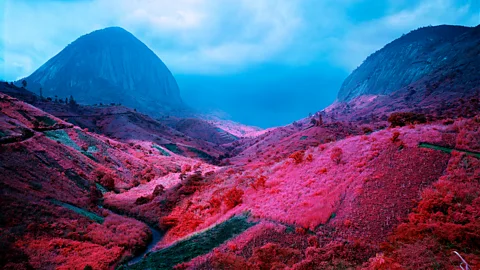
imageRichard Mosse Poison Glen, 2012, Richard Mosse (Credit: Richard Mosse)Richard Mosse

One such artist is the Irish film-maker and photographer Richard Mosse. His photograph Poison Glen (2012) from The Enclave series features in the Sainsbury’s Centre’s newest exhibition The Camera Never Lies: Challenging images through the Incite Project. The eastern Congolese landscape in the frame ought to appear as green as the Donegal valley it is named for, but by using infrared film, a device normally intended to reveal information, Mosse has instead deceived us. A landscape populated by armed rebels, who are part of a conflict which has cost over 5 million lives, is turned an inviting sugar pink: the nightmare now looks like a fairytale.

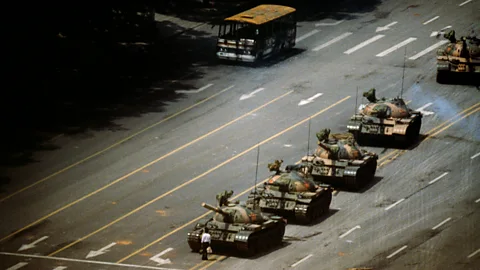
imageStuart Franklin/Magnum Photos 'The Tank Man' stopping the column of T59 tanks, Tiananmen Square, Beijing, China, 4 June 1989, Stuart Franklin (Credit: Stuart Franklin / Magnum Photos)Stuart Franklin/Magnum Photos

Also in The Camera Never Lies – which re-evaluates the most iconic images of the past 100 years – is Stuart Franklin’s The Tank Man (1989). In the photo, a lone protester in Beijing’s Tiananmen Square stands in the path of tanks just minutes after the Chinese authorities gunned down anti-corruption and pro-reform demonstrators.

Over time, different truths have been attached to the image – a key part of the exhibition’s purpose, exploring how photos have become the memory bank of our lives and how far they are a true reflection of history or merely the images that form our perception of it. Initially, Franklin told Vice in 2020, the captured moment was “a very useful event politically … because, in a sense, it was all about restraint. They [the Chinese authorities] didn’t kill him … and it managed to play itself over the top of all the pictures of dead bodies.” 

Later, as the collective memory of the massacre faded, it became more expedient to airbrush it out of history. “In the Western world, it’s an iconic image of protest and the dangers of autocracy and the suppression of free speech,” says Cooper. “Whereas, within China, you don’t see the image at all.”

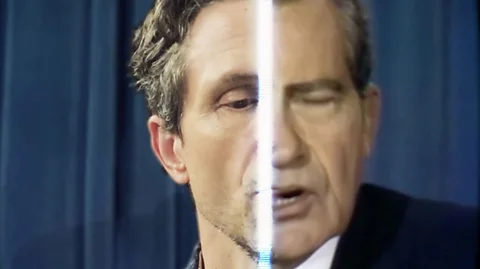
imageMIT and Halsey Burgund President Nixon appears to read out the In Event of Moon Disaster speech, using an actor's voice and AI, in Halsey Burgund and Francesca Panetta (Credit: MIT and Halsey Burgund)MIT and Halsey Burgund

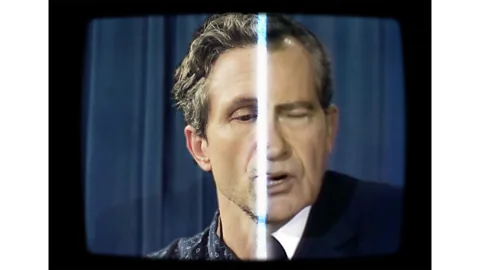
The Emmy award-winning In Event of Moon Disaster (2019), created by American new media artist Halsey Burgund and British digital artist Francesca Panetta, is also on show at the Sainsbury Centre. The film, shown on a vintage TV as part of an immersive installation of a 1960s living room, plays on the many conspiracy theories surrounding the first Moon landing by presenting an alternative version of reality and asking if viewers can spot a deepfake.

Some elements are real – the script prepared in case the astronauts on Nasa’s Apollo 11 mission in 1969 died, for example – while others, such as the deepfake of President Richard Nixon reading out the script created by synthesising an actor’s voice using AI, are not. “All of the footage we used was real archival footage from Apollo 11,” the quiz explains at the end. “However, we used techniques of misinformation to tell a story vastly different from what actually happened.”

“The effect that scares me most is not that we’ll be fooled by fake photos but that we’ll ignore the real ones, or choose which to believe based on our presumptions,” Athens-based photographer Maria Mavropoulou tells the BBC. In 2023, interested in how new image-making tools may shift our perception of reality, she used the prompt “A Self-Portrait of an Algorithm” to invite AI to introduce itself.

imageMaria Mavropoulou A self-portrait of an algorithm no89, 2023 (AI-generated image), Maria Mavropoulou (Credit: Maria Mavropoulou)Maria Mavropoulou

The portraits that emerged, some of which are currently on show in Photography through the lens of AI at Amsterdam’s Foam Museum, were different every time she asked. AI’s identity was shifting − the truth of what it really was, intangible. “It seems to me that truth is an idea that is sometimes too difficult to pin down and that it is not to be found on the surface of an image,” she says.

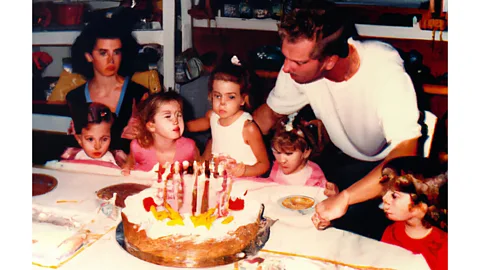
For years, Mavropoulou’s own portrait was rarely taken, her itinerant childhood leaving much of her early life undocumented. In Imagined Images (2023), she used what she knew about her family history as prompts for text-to-image software and created the family photo album she never had. At first, the photographs seem unremarkable, but looking closely at A five-year-old girl blowing out birthday candles, we see that the children’s faces are distorted, a bowl floats off the tablecloth and “party food” has become a hybrid of cake and chips.

imageMaria Mavropoulou A girl, 5 years old, blowing out the candles of her birthday cake with all her family around her at a party in Greece, 1990s (Credit: Maria Mavropoulou)Maria Mavropoulou

The album’s images are made up of what she calls “statistical truths” based on typologies, such as “mother”, “party” and “holiday”, synthesised from a multitude of data sources. Yet though real photo albums have “no clear intention to lie or deceive”, the story they tell is also unreliable, says Mavropoulou. “Only happy moments, celebrations and milestones make it in the album, while difficulties, struggles, and loss are left unphotographed.”

imageNouf Aljowaysir Where am I from, Nouf Aljowaysir (Credit: Nouf Aljowaysir)Nouf Aljowaysir

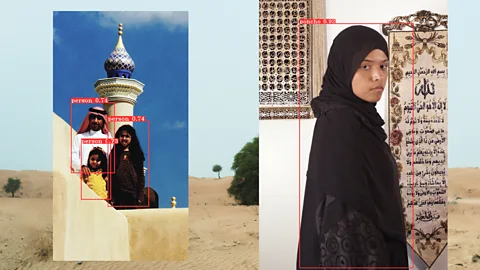
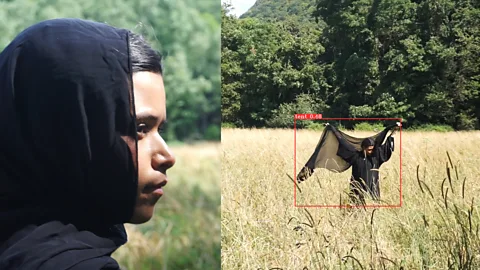
The in-built biases in AI are also the subject of Where Am I From (Ana Min Wein?) (2022), a short film and visual diary created by New York-based visual artist Nouf Aljowaysir. The work forms part of the Saudi-born artist’s exploration into a genealogical journey led by two narrators: the artist and AI. “Through my mother’s beautiful story, I felt belonging,” she tells the BBC.

imageNouf Aljowaysir Where am I from, Nouf Aljowaysir (Credit: Nouf Aljowaysir)Nouf Aljowaysir

“However, as I processed these images through computer vision techniques, this revealed failures in the form of generalisations and stereotypes, uncovering systemically embedded prejudice within commercial AI tools.” Desert scenes were interpreted as military operations, for example, and AI cannot decide if a hijab is “a poncho”, a “costume” or a “tent”. There’s an element of comedy and surprise, but the overall effect is unsettling. “The film shows how artificial intelligence sees my culture through a simplistic and biased Western lens, reducing my identity, culture and erasing collective ancestral memories,” she says.

BBC Verify

With misinformation on the rise, the BBC has launched a brand aimed at countering fake news. BBC Verify is dedicated to examining the facts and claims behind a story to try to determine whether or not it is true, bringing together journalists with a range of forensic investigative skills and open-source intelligence (Osint) capabilities. As well as fact-checking, verifying video, countering disinformation and analysing data, the team transparently shares their evidence-gathering with the audience, explaining complex stories in the pursuit of truth.

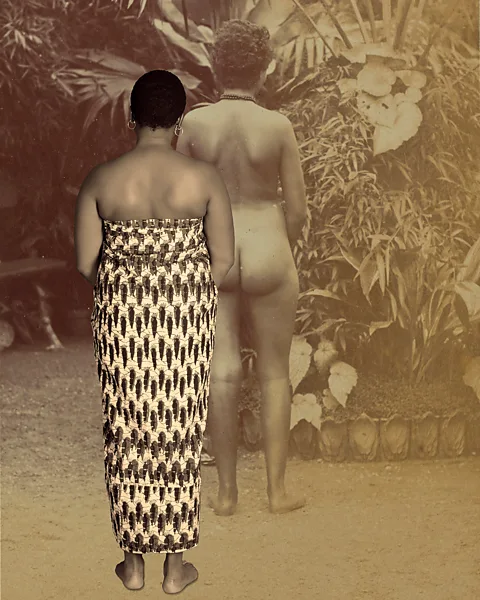
Reclamation of the Exposition (2020), by British-Nigerian visual artist Tayo Adekunle, exposes the colonial lens behind the 19th-Century “truth” about the black female body expressed in the archival images of Prince Roland Napoleon Bonaparte. “The Bonaparte images were actually taken in the botanical gardens in Paris, and these were South African women who were brought over and put on animal skin [made to pose standing on it] to replicate an exotic environment,” Adekunle tells the BBC.

imageTayo Adekunle Artefact 1, Tayo Adekunle (Credit: Tayo Adekunle)Tayo Adekunle

These staging elements also included removing the women’s clothes. Their images became curios for what she describes as “pseudo-science” and were distributed as pornographic postcards. “They perpetuated the idea that black women were more sexual and that people from Africa were savages because they didn’t wear clothes,” says Adekunle.

Her decision to place herself in the image and mimic their pose is a gesture of solidarity and a symbol of the timelessness of these mistruths. “There’s a power struggle that happens when you have a photographer and a sitter, and even more so, when that photographer is a white man and the sitter is a black woman,” she says. “I didn’t want the images, this legacy in the relationship, to feel like it was only existing in the past.”

While misrepresentation, as in the case of Bonaparte, can be disturbing, deception is something different in the work of British photographer Alison Jackson more than a century later. In her solo show at the Vrijthof, Royal Selfie appears to show Elizabeth II taking a family snap, while Trump and Money features an open-shirted Donald Trump lookalike with his arms around two women, and is one of several images in the show that play with public perceptions of the US presidential candidate.

Such realistic images – placing famous lookalikes in amusing or compromising situations – are a reminder, says the museum, “that we cannot trust our own eyes when it comes to photography”. Even the best-known faces in the world can fool us.

“The truth is dead,” Jackson says. “Nothing we are shown can be trusted; everything can be faked and nothing is authentic.” Jackson’s work was initially inspired by the mourning of the death of Diana, Princess of Wales by a public that had never met her, which she felt exposed a tension between perception and reality. Speaking to Euronews in 2020, she said: “We’ve got mistaken over what is real and what is not and that is what interests me… We’re prepared to go along with a bunch of media narratives – we’re all so surface.”

Truth is Dead is at the Fotomuseum aan het Vrijthof, Maastricht until 15 September.

WePresent | Photographer Jess T. Dugan talks about the specific challenges of building an artistic career

WePresent | Photographer Jess T. Dugan talks about the specific challenges of building an artistic career

I’ve always had a clear idea of the career I want to build, but I hit a significant learning curve after ten years of aggressively building. At that point, I had been saying yes to every lecture opportunity, teaching opportunity, commercial assignment and every opening. I hit a point where that was no longer sustainable, and I’d also had enough initial success to take my foot off the gas for a minute. And yet, I struggled with learning to say no. It felt so counterintuitive. I had to learn to trust my gut and overcome the fear of missing out. 

Becoming a parent also required honing my priorities because my ability to travel, my work time and my money all became more limited, and that has forced me to be really intentional about my work. This was never a limitation; it actually provides a kind of structure that’s been positive for me. 

My strategy has always been to get my work in front of as many people as possible and meet as many people as possible, knowing that any connection could take a long time to yield something. I’ve always had this blind faith that things will happen if you put yourself out there enough. When I was younger, I would also reverse engineer the CVs of artists I admired. I would look at artists five or ten years ahead of me and see where they exhibited, what grants they got, and what collections they were in. It gave me all these avenues to pursue and insight into how I could craft my career.