Photography

New photography exhibition challenges how western art depicts Black women

New photography exhibition challenges how western art depicts Black women

For centuries, western art has objectified black women, depicting them as exoticised and enslaved. Challenging that is a new photography exhibition at Somerset House called ‘Black Venus’.

At its heart are three Venuses, including a South African woman who was paraded around Europe as a freak show exhibit called the ‘Hottentot Venus’.

The show displays these historic stereotypes and invites contemporary artists to confront them with their own works.

Kiran Moodley went to meet its curator, Aindrea Emelife.

Enormous $30,000 Photography Grant is Now Accepting Entries

Enormous $30,000 Photography Grant is Now Accepting Entries
From the project “Culture of Confrontation,” 2013-2014. Riot police prepare for the assault of Kyiv’s Independence Square (in Ukrainian ‘Maidan Nezalezhnosti’), Kyiv, Feb. 18, 2014. © Maxim Dondyuk

The W. Eugene Smith Fund has announced it is now accepting applications for its 44th annual Grant in Humanistic Photography which carries a top prize of $30,000, one of the most valuable grants for photographers in the world.

In addition, a second $10,000 grant will be awarded as a fellowship while a third finalist that the organization deems worthy of special recognition will earn a $5,000 grant. Finally, the Smith Fund is also accepting applications for its 6th annual Eugene Smith Student Grant, which will honor the top student entry with a $3,000 grant and it is open to all collegiate level students enrolled in full or part-time programs.

Since 1979, the Smith Fund has awarded over $1.2 million to photographers for their past work or proposed projects.

“The W. Eugene Smith Grant in Humanistic Photography is presented annually to a photographer whose past work and proposed project, as judged by a panel of experts, follows the tradition of W. Eugene Smith’s dedicated compassion and humanistic approach to his subjects throughout his career as a photographic essayist,” the Smith Fund says. “Past recipients have included Maxim Dondyuk (2022), Nicolò Filippo Rosso (2021), Sabiha Çimen (2020), Mark Peterson (2018), Krisanne Johnson (2011), Stanley Greene (2004), Graciela Iturbide (1987), Donna Ferrato (1985), and Eugene Richards (1981).”

Last year, the fund awarded its mammoth grant to Maxim Dondyuk for the series “Ukraine 2014/22,” of which one of the photos can be seen above. It is a chronicle of Ukraine’s fight for independence that has been ongoing for more the better part of a decade and most recently through Russia’s full-scale invasion of the country in February of last year. That series can be seen on the Smith Fund’s website along with the other finalists from last year’s grant.

“None of the grants presented by the Smith Fund are endowed, and rely entirely on corporate contributions, foundation grants, and individual donations to fund its grants and fellowships. This year, funding was drastically reduced due to the global economic downturn, leaving the Board of Trustees with a difficult decision for this year’s grant cycle,” the Smith Fund says. “The annual Howard Chapnick Grant, which is presented to an individual or entity for their support of photojournalists, will not be presented this year. This will allow the Smith Fund to support its core Smith Grant and Fellowships in the short term while raising additional funding to re-establish the Chapnick Grant and build its reserves for future grants.”

Interested photographers can submit their applications for the 44th annual Grant in Humanistic Photography as well as for the Student Grant on the organization’s website.

Veteran photographer remembers covering moon mission

Veteran photographer remembers covering moon mission

BREVARD COUNTY, Fla. — Fifty-four years ago, man set foot on the moon for the first time, this after launching from NASA’s Kennedy Space Center.


What You Need To Know

  • Veteran photographer Julian Leek remembers covering the Apollo 11 mission in 1969
  • Leek still has memorabilia from the mission, including an Apollo 11 team patch and his press pass
  • He’s continuing his 50+ year photography career by documenting the NASA Artemis mission

Julian Leek, a Space Coast-based photographer, was there to cover the mission and captured history on film.

A veteran photographer, Leek was witness to the first time Americans launched from Earth and landed on a new world.

Leek has taken thousands upon thousands of pictures in his career. He has seen life through a unique lens, and he’s always ready to point and shoot.

“Anywhere I go, it is always in the car,” Leek said of his camera.

Leek has lived in Melbourne Beach since the 1960s. He was a young lens-slinger when he was assigned to cover what would become one of the most historic events in human history: the Apollo 11 moon mission in July of 1969.

“What are you doing up here today? ‘Oh, we’re just going to the moon (sarcastically),’ yeah, going to the moon,” he recalled. “No, we are going to the moon! This is a really, really big thing.”

Leek has memorabilia from the mission, including a model of the lunar lander and service module, an Apollo 11 launch team patch, and, of course, his press pass.

In those days, everything was shot on film, which required a painstaking process of sending it by bus or other means to be processed.

And unfortunately, photographers like Leek don’t often get their negatives back.

“I have a lot of history I’d like to get my hands on,” he said.

But he did capture the moment when Armstrong took that giant leap.

“Took a picture of a television set of him stepping out of the LEM,” he said.

Despite it being his job, Leek will always have the memories of watching Americans land on the moon and the most amazing story he’s ever covered.

“Apollo 11 has to be it,” Leek said.

Leek is continuing his 50-plus years of photography documenting the NASA Artemis mission as we return to moon to stay.

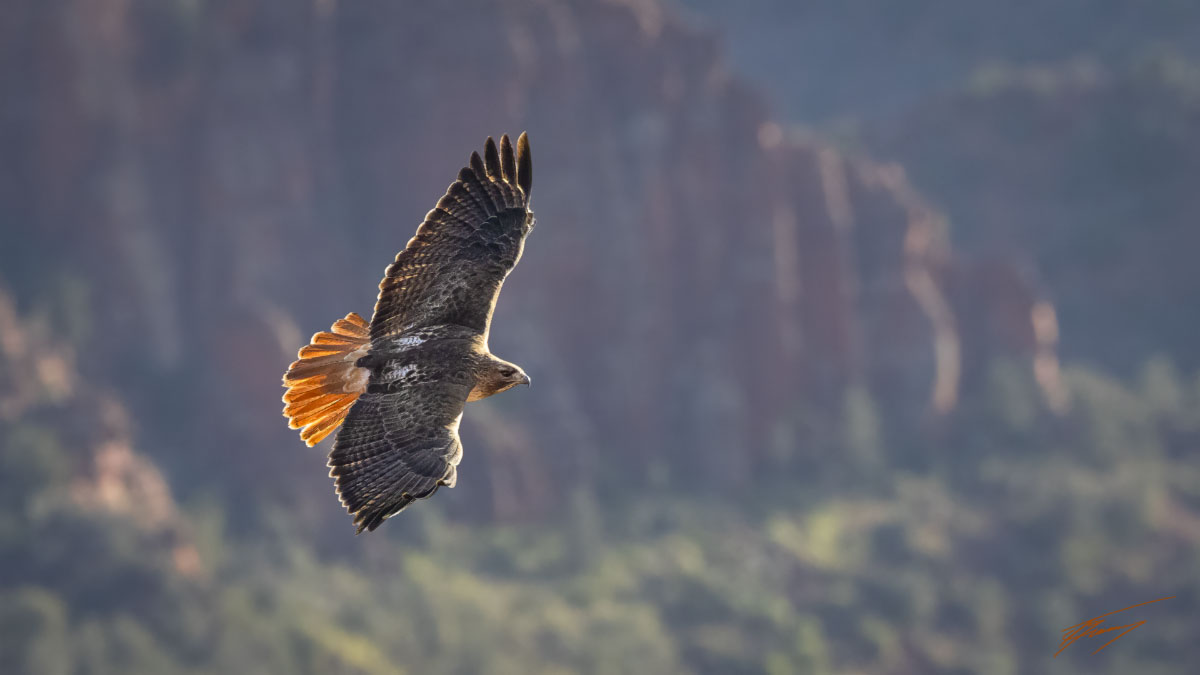
Today’s Photo from Ted Grussing Photography: Contemplating Parenthood

Today’s Photo from Ted Grussing Photography: Contemplating Parenthood

… it seems as though this red tail hawk is contemplating the months that lie ahead as she prepares for the mating season that is just ahead … she and her mate have a lot of work ahead as they clean out and rebuild the nest for this year.

Days later the two of them were bringing in new sticks to repair and finish the nest in the cliff about 150′ above the surface. Then came the laying of the eggs and the commitment to stay on the nest for the next four to five weeks until they hatch … next comes five or more weeks to feed the young ones until they are ready to fledge (first flight) and then help feed them to the extent that they need help for the next weeks until it is time for them to leave and seek a life of their own.

Below the male is cruising over the valley in the Loop area and a lot of work will be on him too … shared responsibility!

The first year is a very rough year for raptors … the mortality rate approaches 80% in the first year … and the cycle is repeated year after year whilst they live.

Up to Lake Mary early in the morning, so this is going out unbelievably early … on the water before 7AM and it is much cooler up there. Weather is largely dependent on elevation. The temperature drops roughly 3 degrees Celsius per thousand feet (dry adiabatic lapse rate) or roughly 5.4F … the lake is about three thousand feet above home 🙂 105F here today.

Into the weekend for me and the plan is to be back Monday morning … enjoy life and smile … you are here!

Cheers,
Ted

Forbid that I should judge others
lest I condemn myself.
Let me not follow the clamor of
the world, but walk calmly
in my path. Give me a few friends
who will love me for what
I am, and keep ever burning
before my vagrant steps
the kindly light of hope.

excerpt from A Prayer by Max Ehrmann

###

photo_tedgrussingThe easiest way to reach Mr. Grussing is by email: ted@tedgrussing.com

In addition to sales of photographs already taken Ted does special shoots for patrons on request and also does air-to-air photography for those who want photographs of their airplanes in flight. All special photographic sessions are billed on an hourly basis.

Ted also does one-on-one workshops for those interested in learning the techniques he uses.  By special arrangement Ted will do one-on-one aerial photography workshops which will include actual photo sessions in the air.

More about Ted Grussing


Healing Paws

Healing Paws

This is an advertisement

Capturing a 21st-Century War With 19th-Century Technology

Capturing a 21st-Century War With 19th-Century Technology
image

Edward Kaprov’s wet-plate technique is producing some of the most memorable and timeless photographs of the war in Ukraine close up.

The news coverage from Ukraine has been so intense and widespread over the past 16 months that it may seem that the war has been covered to the point of saturation. Yet for all the wealth of film and photographs to come out of the war, there have been significant gaps, most notable a shortage of combat photography.

That is not so much for dint of trying, but because of the difficulty of access to the front lines. Photographers are often restricted to press tours and kept well back from the zero line, as the first line is known. As a result, the most memorable photography emerging from the war has been the civilian aspect, urban destruction and the human cost.

A new photo exhibition by the Israeli freelance photographer Edward Kaprov goes a significant way to remedy that, and stands out for its timeless images of war at the front.

Kaprov, self portrait, March 2022. In the collodion technique, the subject has to stand or sit still for 10-15 minutes. Edward Kaprov

Kaprov, 48, has turned to one of the earliest of photographic techniques, wet plate collodion photography, invented in 1851, to produce images — mostly portraits of soldiers, medics, morgue workers and a smattering of civilians — that his peers are describing as one of the most powerful collection of images of the war in Ukraine to date.

He happily points out that wet plate photography, which produces unique images on A4 size glass plates, is an absurdly complicated and cumbersome method in the digital age and in a war zone, but it is one he embraces for all kinds of personal and historical connections.

One of the earliest wars documented with photographs was the Crimean War, in the middle of the 19th century. The British photographer Roger Fenton used the same wet plate technique to record the participants and the landscape of war, including a celebrated image, “the Valley of the Shadow of Death.” “I wanted to close a certain logical circle,” Kaprov said in an interview this week.

Anatoliy Michailovich and his wife, Vera Sergeevna, sit in the ruins of their house that was destroyed in March 2022. The picture was taken that December.Edward Kaprov

The first photographs that exist of the Holy Land are also from the same technique, he added.

Born and raised in the Soviet Union, Kaprov moved to Israel 30 years ago, where he embarked on a career in photography. Much of his work has focused on themes of his motherland, the Soviet Union, and the homeland, Israel, both of which he describes as shattered utopias.

He has used the wet plate technique for a seven-year project documenting life along the borders of Israel and found it an obvious choice to produce something distinctive in Ukraine.

“This technique is doing something else,” he said. “It’s how I can go deeper.”

He kitted out a Ford Transit van, turning it into a mobile laboratory, and loading it with 300 kilograms of chemicals and water and more than 100 glass plates, driving it into Ukraine soon after the full-scale invasion by Russia last year.

“Personal War,” an exhibition of frontline photos from Ukraine by Kaprov, opened at the Academy of Fine Arts in Sarajevo on July 15 as a part of WARM Festival 2023.Damir Sagolj

He uses a box camera that he compares laughingly to an accordion “with all its bells and whistles.” The subject has to stand or sit stock-still in order for him to produce a sharp image and the photographer has 10 to 15 minutes to develop the photograph before the emulsion on the glass plate dries.

Most of his subjects are soldiers or in units attached to the military. They are photographed not in action, as much modern war photography focuses on, but nevertheless at their positions, in their tanks and armored vehicles, in trenches or under the trees.

They are poised with a stillness that is a necessary part of the process to ensure a clear image with a lengthy exposure. The viewer is drawn in by the sharp clarity of the face of the subject, or the white of a cigarette or the glint of an eye, while the surrounds and even the companions are blurred in a timeless, other worldly landscape. Some of the images are unforgettable: a morgue physician bent over a corpse looking at the camera, a soldier smoking in a trench, an old couple hugging in the ruins.

“When you look at them the first impression is this was 100 years ago,” Kaprov said. On a closer look it is clear the soldiers have modern weapons and equipment. “I want to confuse the audience,” he went on. “I want the act of comparing them with past wars, because in fact nothing has changed. Maybe the weapons and cellphones have changed, but the essence of war does not change.”

Natalie, a paramedic in combat uniform, with the 80 Brigade, poses with her colleagues at an evacuation point near Bakhmut in May.Edward Kaprov

When Russia invaded Ukraine last year, there was no question for Kaprov that he would travel there to report on the war, even if he had no assignment. He has worked alone, without editorial feedback or financial backup, working “like an obsessive,” as he described it himself.

“It was like war came to my house, it’s my people,” he said. “Actually it’s my people on both sides.”

His family history makes it deeply personal. His grandparents were from Zhytomyr in Ukraine, and he was born and raised in Chelyabinsk, in Russia. When he was born it was all one country, the Soviet Union, but now the current leaders of his motherland, Russia, is attacking the land of his grandparents.

“The Ukrainians suffer the most and what Russia is doing is not right,” he said. “But they are my family and friends also, and some politicians are trying to steal my motherland, taking the last that I have.”

Ukraine: A Personal War

Through July 23, at the WARM Festival, the Academy of Fine Arts in Sarajevo, Bosnia and Herzegovina; Oct. 9 through Nov. 12 at the Musée d’art et d’histoire Baron Gérard, Oct. 9-Nov. 12, as part of the Bayeux Calvados-Normandy Awards festival for war correspondents in Bayeux, France.

Victorian-era photography flashes at 717 Vintage Fest

Victorian-era photography flashes at 717 Vintage Fest

Maurene Cooper, the owner of Vanity Tintype, brought her portable darkroom to the FOX43 studio for a sneak peek at the process behind her Victorian-era photography.

YORK, Pa. — Shoppers at the 717 Vintage Fest this weekend will have the chance to take home an antique memory as well as tons of clothing and knickknacks.

Maurene Cooper, the owner of Vanity Tintype, is bringing tintype photography to the Fest. Tintype is a Victorian-era style of photography.

“It is essentially making a photograph on a piece of metal,” Cooper explained. “You could think of it as the elegant grandmother to a polaroid.”

She brought her portable darkroom to the FOX43 studio for a sneak peek at her creations. 

Cooper began her journey into the craft with the thought that since she had grown up using similar technology, learning a skill like tintype could be an interesting teaching tool.

“I’m in that weird micro-generation, like a very old Millennial but not a GenX-er, where I grew up with analog but the digital switch happened really quickly while I was in college,” Cooper said. “So I came of age using cameras like this, using film, but then professionally, I had to switch to digital really quickly because I have had a teaching career.”

Cooper says tintype was the second large photographic development of the 19th century. She explained the process:

“The wet-collodion process is an intricate photographic technique invented by Englishman Frederick Scott Archer in 1851 involving adding a soluble iodide to a solution of collodion and coating a glass plate with the mixture. From there, the plate is immersed in a solution of silver nitrate to form silver iodide in the darkroom, exposed in the camera, developed and fixed. A modification of the process, in which an underexposed negative was backed with black lacquered metal, known as a tintype, became very popular in the mid-to-late 19th century.”

The photos come out in black and white, but Cooper says it does matter what color her subjects wear because different colors turn out differently in photographs. 

Tintype has become a popular option for commemorating special occasions with a nod to the past. One occasion that lends itself well to this type of photography is a 10th wedding anniversary—the tin anniversary.

Cooper will offer appointments and walk-ins at the 717 Vintage Fest this weekend. The Fest takes place at New York Wire Works July 22-23 and is open from 10 a.m. – 6 p.m. on Saturday and 10 a.m. – 4 p.m. Sunday.

FOX43 Morning News anchors Jackie De Tore and Sean Streicher sat down for their own portrait to get the full experience.

More Videos

Those interested can keep up with Vanity Tintype on Instagram. Anyone interested in being photographed by Cooper can check out her website.

Download the FOX43 app here.

[embedded content]

Sophie Conran left ‘scared and vulnerable’ after being stalked by photographer

Sophie Conran left ‘scared and vulnerable’ after being stalked by photographer

The designer and food writer Sophie Conran was left feeling vulnerable and scared after being relentlessly stalked by a retired society photographer.

Mrs Conran, 57, had no idea who Peter Warner was when he began pestering her with messages on social media, a court was told.

In May last year, Warner repeatedly drove almost 100 miles to visit her Grade II-listed Georgian manor house so that he could try to invite her for dinner.

Salisbury Magistrates Court heard that despite being warned away by a family friend, the 76-year-old Warner persisted and later returned, claiming to have a personal invite to a charity garden event.

On Thursday, Warner was handed a restraining order by Salisbury Magistrates Court, instructing him to stay away from Mrs Conran, the daughter of groundbreaking British designer and restaurateur Sir Terence Conran and food writer Caroline Herbert.

Peter Warner


Warner pleaded guilty to harassment


Credit: Ollie Thompson/Solent News & Photo Agency

Mrs Conran told the court that Warner’s persistent harassment left her feeling “anxious, unsafe and vulnerable” in her own home near Swindon, Wiltshire, eventually forcing her to seek counselling.

Warner claimed he knew the Conrans via one of her two half-brothers, Sebastian and Jasper. He told magistrates that he struggled with modern technology and had only sent repeated messages after getting automated responses and believed he was in a conversation with the designer.

He pleaded guilty to harassment and was handed a year-long restraining order and 12 month conditional discharge.

The court heard that the photographer, from Bridport, Dorset, travelled 94 miles to Mrs Conran’s house, which she had bought for £3 million in 2013.

She was away at the time, but after Warner was allowed into Mrs Conran’s kitchen, her concerned housekeeper sent her employer a photo of the unexpected visitor.

The designer, whose father founded the innovative design and furniture firm Habitat in 1964, replied saying she had no idea who Mr Warner was.

The court was told that Warner also repeatedly sent heart emojis to her Facebook business account and asked her to dinner on numerous occasions over several months.

‘He made me feel unsafe’

David Fosser, prosecuting, said: “Mrs Conran tells us that she didn’t know Mr Warner before May 20, but she was aware of him as an acquaintance through one of her friends.

Mr Fosser added: “Having turned up to her home address, he sent her persistent messages that she was made aware of, and he turned up to her address again in June.

“Mrs Conran got in touch with her friend who knew him, Mr Shuckburgh. He contacted Mr Warner and told him that she didn’t want him to contact her. He didn’t seem to take this on board.”

The court heard that he nevertheless turned up to her home yet again in September, insisting that he had received a personal invite to the charity event, and Mrs Conran’s son Felix, 28, had to tell him to leave.

In Mrs Conran’s victim impact statement, she said: “He made me feel unsafe, turning up uninvited. He was persistent. It made me feel anxious. I live alone and feel vulnerable.

“As a result, I have had some counselling. I still feel worried about it – he was told not to come back, but he returned. It reduced my trust in people. He could turn up at any time.”

In mitigation, Mark Glendenning told the hearing that Warner “believed Mrs Conran wanted to see him and had extended an invite. He has said that he struggles with modern technology and thought that it was Mrs Conran who was responding.”

During sentencing, magistrates noted the severe “distress” he had caused to the celebrity designer. Warner apologised repeatedly as he left the court.

Photography Awards Celebrating ‘Grit, Passion, And Play’ Announces its Finalists

Photography Awards Celebrating ‘Grit, Passion, And Play’ Announces its Finalists

AOP awards

The Association of Photographers (AOP) in the U.K. has unveiled the finalists of its 38th Photography Awards.

732 photographers entered 914 photos with 10 categories on offer to the entrants with a judge from the Sports category commenting on the diversity of the entries.

“Different bodies are captured during a variety of physical activities with strong visual narratives of grit,
passion and play,” says Dr. Rashmi Becker.

A wife checks on her husband who has dementia as he walks in their garden. | Terry Graham
Africa’s largest landfill site in Nairobi, holding 30 acres of toxic waste. It reached the limit of the site in 2001 and is now run by cartel gangs, which rule the bizarre habitat in which thousands of adults and children live and work. | Sam Baker.
A young basketball player on a warm London day. | Philip Suddick.
A junior yarl during the fire festival in Shetland, off the coast of Scotland. | Euan Myles.
Identical twins wearing identical outfits. | Gabrielle Motola
A person leaps into the sea on the hottest day of the year in Britain in 2022. | Andy Lopy
The actress Saoirse Ronan in London. | Sebastian Nevols
Tyler does dips in a gym. The photo is from a project called Gymstars which captures people with prosthetics and amputated limbs working out. | Pete Muller
A game of rugby in Hackney Marches, London. | Ben McDade
A closeup of blue lips, white teeth, and a pink tongue. | Nadia Correia.
A woman and her favorite chicken. | Dan Burn Forti
Amazon parrots in a bathroom. | Jo Sax
Hikers scale a hill in the Scottish Highlands. | Ed Smith
The Notting Hill Carnival in 2022. The London event was canceled for two years because of the Covid pandemic. “I wanted to capture that jubilation as well as the feeling of community and togetherness.” | Sam Hicks
A man who cares for a racehorse in Istanbul, Turkey. | Urs Bigler
Two children enjoying an electric car as it is charging. | Eleanor Church
A child who works in Africa’s biggest landfill site wearing an old boxing head guard. | Sam Barker
A young girl with a balloon on a bicycle in Thailand. | Will Hartley
A driver during the World Banger Championships at The Mendips Raceway, in Somerset. | David Ryle
Jonathan Gregson.
Sarah Louise Ramsay.

The winners will be announced on Thursday, September 28 in Shoreditch, London. The event will be streamed live. For more information visit the AOP’s website.

Meet the woman who took 12,795 photos of everything she owns

Meet the woman who took 12,795 photos of everything she owns

The woman who’s taken pictures of everything she owns: Photographer puts snaps of all 12,795 of her possessions on display

A photographer who spent four years photographing every single thing she owns has revealed she had ‘no idea’ how much work was involved when she started.

Barbara Iweins, from Belgium, decided six years ago to start taking snaps of everything in her possession, from medicine bottles, old sunglasses to mugs, knives and forks.

The complete work, which consists of 12,795 photos, is the subject of a show at the Cortona on the Move photography festival in Tuscany.

Speaking to the Guardian, the artist said her she made the decision after a divorce which lead to her moving house for the 11th time.   

‘I was exhausted to have all these objects to pack once again. I really wanted to see what it was like – a houseful of objects. I decided to photograph room by room and drawer by drawer. I was putting Post-its on the drawers because I was scared of photographing the same thing again,’ she said.

Barbara Iweins, from Belgium, decided six years ago to start taking snaps of everything in her possession, from medicine bottles, old sunglasses to mugs, knives and forks (a shoe is pictured)

The complete work, which consists of 12,795 photos, is the subject of a show at the Cortona on the Move photography festival in Tuscany. A comb is pictured

Pillows, shoes and bags are among the items that have been snapped

She snapped pictures of bags and shoes

Dozens of dolls made up part of the display

Masks, toys and trinkets made up hundreds of snaps in the display

Bottles were part of the display

Among the photos are a mix of intimate items, valuable gifts, and every day disposal necessities like medicine,  toilet roll, socks and clingfilm.

Barbara, a mother-of-three, also snapped many of her children’s possessions.

She added that she hopes people realise we ‘hide things we are buying’.

‘Everything is in closets – that’s the thing. I was rediscovering skirts and thinking: ‘I haven’t worn this – it’s really quite nice. Now I’m going to use it and use it’.’ 

She also discovered that 21 per cent  of bathroom objects are metallic, 43 per cent are plastic.

By categorising the items she found that one per cent of her clothes are a colour she hates – purple.

Toys were in the display

Family photos were also part of the exhibit

Old letters were also featured by Barbara

She also shared photos of her sofa

She also discovered that 21 per cent of bathroom objects are metallic, 43 per cent are plastic

Perhaps more poignantly, she realised just one per cent of her objects are important – and that she can get rid of 99 per cent of them.

‘Most of the objects I really care for are the things I cannot replace,’ she said, adding that she hasn’t bought new clothes in five years.  

‘I’ve had a divorce and I’ve lost a boyfriend to cancer. These objects – the 1 per cent that are important to me and my children – I know they are going to be there. I realised – it’s pathetic, I know – that you can rely on things.,’ she added.

Cortona on the Move international photography festival, Tuscany, runs until 1 October. Katalog is published by Delpire 

Photography: black midi at Bells’s Beer Garden

Photography: black midi at Bells’s Beer Garden

Posted: 20th July, 2023 by The Editor

Black Midi performed an inspired set at Bell’s Beer Garden in Kalamazoo, MI. The London trio along with one of their session and touring members put on an incredible show for the Michigan crowd. Geordie Greep, also known as Mickey Mouse, played the guitar and rattled off lyrics at high-speed. Cameron Picton, or The Machine as he is lovingly known, provided second guitar and vocals. Morgan Simpson, often referred to as Slim Simpson, is the drummer that holds the whole band together. Playing bass and keys is touring member Seth Evans who the band just call Shank.

The four-piece put on an impressive performance filled with laughs. The band, who you would expect to take themselves very seriously, are often messing with each other on stage. If you weren’t watching, you’d never notice. Despite lunging at each other with their instruments, it feels like the musicians never miss a note. The band, who are no strangers to covers, played a short tease of The Beatles’ “Taxman” during some technical difficulties. They also led into their song “Lumps” with a tease of Metallica’s “Enter Sandman.”

They are an act that you do not want to miss. As they wrap up their North American summer tour, keep an eye out for future dates near you!


Photos by Alec Moore

The Alternative is ad-free and 100% supported by our readers. If you’d like to help us produce more content and promote more great new music, please consider donating to our Patreon page, which also allows you to receive sweet perks like free albums and The Alternative merch.