Photography

Today’s Photo from Ted Grussing Photography: The Little Ones

Today’s Photo from Ted Grussing Photography: The Little Ones

… in a sense, today was terrific because I got so much done … I was working with beautiful photographs and that is a pleasure, but the day was spent going through folders deleting photographs and that is not so much fun … more like unpleasant work! This is the second time through these folders, the first time is after the shoot and typically 85% end up in the bit bucket and on the second time about 65% of the remaining ones are being deleted and for the most part they are good enough to be published, but there are those that are a little better and that is the hard choice … they still only have about two or three seconds to talk to me and make the case that they should stay before I delete and move on to the next one. Over 150 GB gone today!

More of the same tomorrow, but a break to have lunch with longtime friends … and to finish up a superb 35 to 40 carat gem silica (gem quality of chrysacolla), it is an oval approximately 30mm x 18mm x 8mm and an incredible translucent robin egg blue color … that will bring a smile to my face any day of the week … I’ll send a photo of it out tomorrow evening. For a special friend 🙂

The photo above is a rock wren coming in for a landing on a tree branch poking up out of the water down at lake Pleasant … the water level is down about six feet from a few weeks ago as the stored water is released for agricultural purposes (80+%) and over the next eight weeks it will go down another 25 feet or so … a totally new lake again and trees and islands will once again appear … and I will find the ones almost at the surface with my hull as I get used to the changes again.

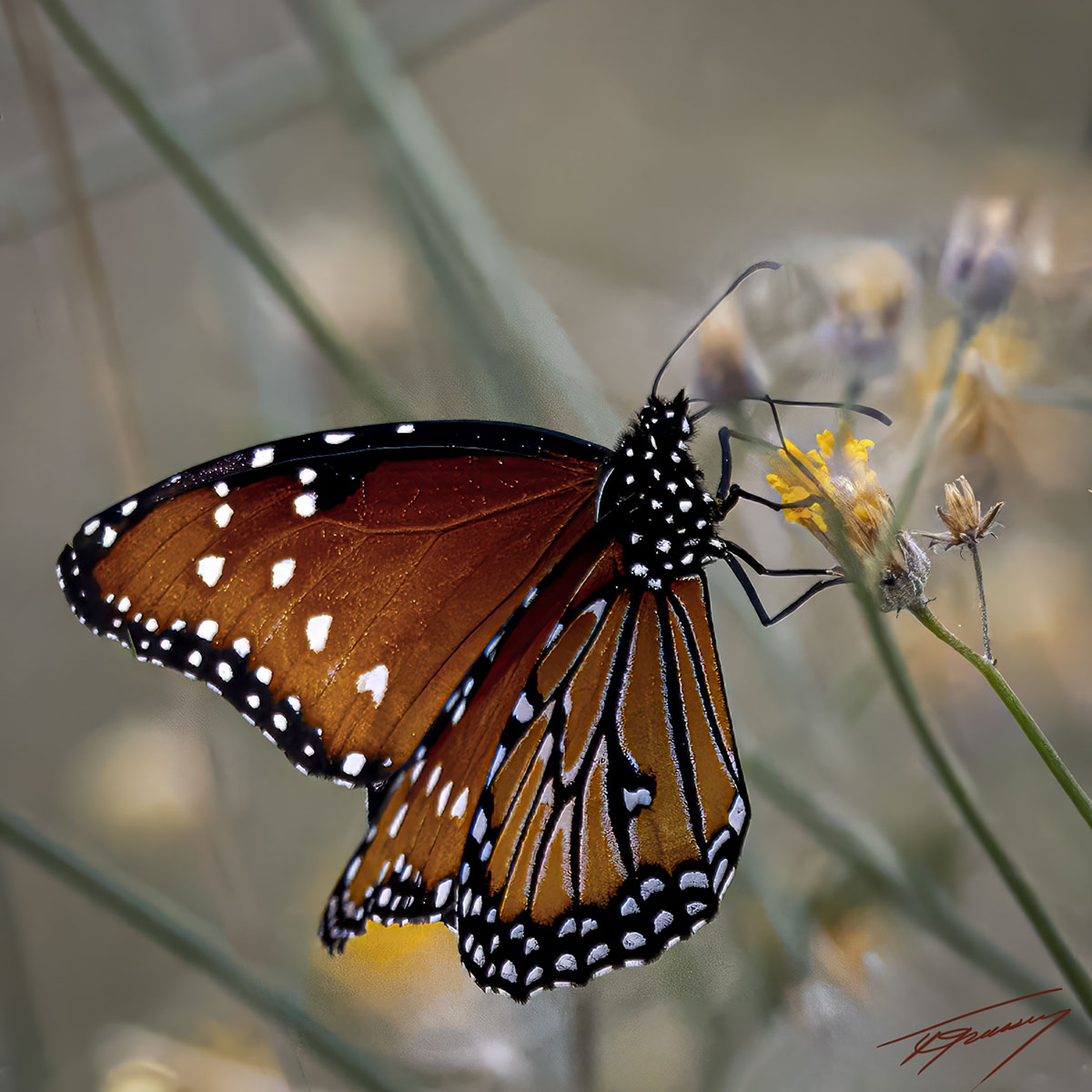
Below is a butter fly coming in for a landing and a snack … they play a very important roll in life as well as being beautiful. Not sure what it is, but I took this shot down at the lake also. Kinda looks like a monarch, but not certain … a lot of life is like that … uncertain, that is, all we have is now and no promise for more … is there a better reason to smile and treat others well? With only this moment, we make choices that will shape us over time if we are so lucky as to have it.
Have an absolutely beautiful day, keep breathing and smiling … we are alive!

Cheers,

Ted

A bird flies through the sky, and I fly with it. I am in
each pearl of moisture sparkling in the sun. I lie lazy
on the clouds. And I acknowledge my kinship with
each winged thing.

I see all as one, and nothing repels me, as this new
day climbs noiselessly out of the valley of night.

Peace lies over the world and over the world of my soul.

excerpt from On A May Morning by Max Ehrmann

###

photo_tedgrussingThe easiest way to reach Mr. Grussing is by email: ted@tedgrussing.com

In addition to sales of photographs already taken Ted does special shoots for patrons on request and also does air-to-air photography for those who want photographs of their airplanes in flight. All special photographic sessions are billed on an hourly basis.

Ted also does one-on-one workshops for those interested in learning the techniques he uses.  By special arrangement Ted will do one-on-one aerial photography workshops which will include actual photo sessions in the air.

More about Ted Grussing


Healing Paws

Healing Paws

This is an advertisement

The Best Noise Reduction Software for Landscape Photographers

The Best Noise Reduction Software for Landscape Photographers
[embedded content]

Landscape photographer Michael Shainblum’s latest video takes a very close look at noise reduction software, specifically when using noise reduction on landscape images. Shainblum published an article on his website that includes sample images and crops, which are more beneficial than viewing comparisons in the YouTube video featured below.

Shainblum compares two images, a high ISO night sky image and a daytime landscape photo, using Topaz Labs’ Denoise AI and Adobe Lightroom’s built-in Denoise Tool. Like Topaz Labs’ Denoise AI, Adobe’s newly announced Denoise feature uses artificial intelligence (AI) and promises improved results compared to Lightroom’s standard noise reduction sliders.

Shainblum does not talk about DxO PureRAW 3 in his video, but he includes numerous comparison images in his article and writes, “DxO performed well for the most part, and I did enjoy the simplicity, similar to Lightroom. All I had to do was input the RAW file, and the software did the work for me.”

Michael Shainblum noise reduction for landscape photography
The original night sky image has nice color and detail, but also includes a fair bit of visible noise that Shainblum wants to remove with noise reduction software.
Michael Shainblum noise reduction for landscape photography
Shainblum tested a pair of images, including this daytime landscape shot.

Lightroom Denoise is a straightforward noise reduction tool. When enabled, a single slider adjusts strength from 0 to 100. “I personally wouldn’t go over 50%,” Shainblum explains when editing a Milky Way shot. “On images with less noise, maybe 30 or 40%,” he adds.

Michael Shainblum noise reduction for landscape photography
Lightroom’s new Denoise tool is very simple. Its user interface includes a single slider to adjust the strength.

As Shainblum shows, Lightroom Denoise delivers impressive results, doing a great job at removing visible noise without removing much fine detail. Night sky images are particularly challenging for noise reduction software, as night photos are typically shot at high ISO and include a lot of very faint stars. Aggressive noise reduction can smudge larger stars and completely remove smaller ones, which is not ideal.

Michael Shainblum noise reduction for landscape photography
On the other hand, Topaz’s Denoise AI app has quite a few controls and tools.

Compared to manual noise reduction in Lightroom, Shainblum explains that Denoise does a better job preserving detail and colors, all while being easier to use.

Topaz Labs’ Denoise AI is considered among the best noise reduction solutions on the market, so how does it compare to Lightroom’s new Denoise tool? Compared to Denoise AI, Shainblum thinks Lightroom’s Denoise feature “Did a much better job retaining the color and details here, while still removing a bit more noise than Topaz.”

Michael Shainblum noise reduction for landscape photography
Lightroom Denoise (left) versus Topaz Denoise (right)

“I really have to hand it to the Lightroom team here. This tool is absolutely fantastic, and there is something to be said about the simplicity here. All I had to do was move one slider, and it came out perfect every time,” Shainblum concludes.

Michael Shainblum noise reduction for landscape photography
Shainblum also tested DxO PureRAW 3, which like Lightroom Denoise, is quite simple to use.

Many more insights and head-to-head comparisons are available in Shainblum’s complete write-up. Photographers seeking to use other versatile AI-powered tools in Lightroom can learn about five Lightroom masking techniques in another of Shainblum’s recent videos.


Image credits: All images © Michael Shainblum

Real Photo Disqualified From Photography Contest For Being AI

Real Photo Disqualified From Photography Contest For Being AI
A real photo that was disqualified from a photo competition for being an AI image
Suzi Dougherty’s photo of her son Caspar with two mannequins that was deemed to be AI by a panel of judges.

A genuine picture taken on an iPhone was thrown out of a photography competition after the judges suspected that it was generated by artificial intelligence (AI).

Suzi Dougherty had captured a striking photo of her son with two smartly-dressed mannequins in an intriguing pose while visiting a Gucci exhibition. Happy with her creation, she entered it into a photo competition.

Dougherty didn’t think much more of it until a friend showed her an Instagram post declaring her photo ineligible because the competition’s organizers suspected it to be an AI image.

“I wouldn’t even know how to do an AI photo,” Dougherty tells The Guardian. “I’m just getting my head around ChatGPT.”

The photo competition was held by Charing Cross Photo, a store in Sydney, Australia. In their Instagram post disqualifying Dougherty’s photo, the judges say they were “first intrigued” but then “suspicion set in.”

“We want the images to come from your real-life experience, and not sourced from cyberspace,” writes Charing Cross Photo.

“There is no way we can be completely sure the image submitted was made by AI but you really can’t ignore the gut instincts of four judges.”

Charing Cross Photo owner Iain Anderson tells The Guardian that the judges looked at the metadata on the image but weren’t able to tell if the image was AI-generated or not.

“When this image came up, we all loved it, then I said ‘Hang on it looks a little AI-ish’, then we all started talking about it and went well, we can’t know for sure it is or isn’t, but on the basis we’re suspicious we can’t allow it in,” says Anderson.

“It gave us an opportunity to reinforce that this is about taking the image yourself, being present in the environment.”

An Apology, Of Sorts

Yesterday, Charing Cross Photo made an Instagram post saying they spoke to Dougherty and confirmed the photo is real.

They called the photo a “great play on what is real” and what is not. But it was too late for Dougherty to win the $333 (500 Australian dollars) prize because her photo had already been rejected from the competition.

However, Charing Cross Photo has offered to waive Dougherty’s entry fee for the next photo competition.

“I probably will [enter] — just for fun,” she adds.


Image credits: All photos by Suzi Dougherty.

Behind the lens: BYU student named Student Photographer of the Year

Behind the lens: BYU student named Student Photographer of the Year

Brooklynn Kelson Portrait 1

BYU student photographer Brooklynn Jarvis Kelson was named UPAA Student Photographer of the Year.

Photo by

Nate Edwards/BYU Photo

Brooklynn Jarvis Kelson remembers the moment Elder Jeffrey R. Holland greeted her as he was leaving the Marriott Center after speaking at a BYU devotional. Kelson, a student photographer who was assigned to take photos of the event, was standing in the tunnel, camera in hand, when the Apostle smiled at her and asked her how she was doing.

“As the photographer I don’t approach General Authorities, but I had been wanting and praying for the chance to meet him,” she recalls. “It was really cool and there is no way I would have had that experience if I wasn’t there as a photographer.”

It’s one of many special moments Kelson has witnessed as a student employee for BYU Photo. Now a senior in BYU’s photography program, Kelson was recently named Student Photographer of the Year by the University Photographers of American Association at the annual UPAA symposium in South Bend, Indiana.

“I was really grateful to be recognized, it was a little overwhelming because as I walked up to accept the award, they gave me a standing ovation,” she said. “It felt really special to have others appreciate my work.”

As part of the symposium, she taught a breakout session with BYU’s director of photography, Jaren Wilkey; and had the chance to network with a host of professionals in the industry.


“Brooklynn has grown so much in the time in which she has worked at BYU Photo. The practical experience that she has gained as a student photographer has really paid off,” said Wilkey. “Two years ago, she didn’t know how to use studio lights. Two weeks ago, she helped teach a studio lighting workshop to dozens of full-time professional photographers.”

But Kelson didn’t start college intending to become a photographer. “My first year of college I studied music,” she recalls. Still, an undeniable prompting to pick up a camera couldn’t be ignored.

Following the impression to study photography was the best decision she could’ve made, she says. After applying to the BYU Photo position after a suggestion from a supervisor at BYUtv, Kelson has spent the past two and a half years under the tutelage of award-winning university photographers Wilkey and Nate Edwards. She’s been trusted with hands-on opportunities to photograph major university events, devotionals, and athletic contests.

“It is one of my greatest joys to see our students gain confidence in themselves and their work,” said Edwards. “This is a testimony to Brooklynn’s work ethic, desire to learn, and the time she has dedicated to improving her skills and education.”

“It’s grown my love for BYU to a very deep level. There are so many moments where I’ve seen why Heavenly Father wanted me to come here and I’m really grateful I did because BYU Photo is the best job I’ve ever had, and Jaren and Nate are the best mentors I’ve ever had.”

Brooklynn Jarvis Kelson

Kelson, who is set to graduate in 2024, says it’s a satisfying feeling to see her photos used across BYU websites or in other university publications; and she’s grateful for the experiences she’s had at BYU that have prepared her to lead, serve, and lift.

“It’s grown my love for BYU to a very deep level,” she said. “There are so many moments where I’ve seen why Heavenly Father wanted me to come here and I’m really grateful I did because BYU Photo is the best job I’ve ever had, and Jaren and Nate are the best mentors I’ve ever had. I’ve been blessed to do what I love and that’s a really special thing.”

Kelson Collage 2

A collage of Brooklynn Kelson’s award-winning images.

Photo by

Brooklyn Kelson/BYU Photo

To view more award-winning photos from the BYU Photo team, click here.

Youth photographers capture the vibrancy and everyday hustle of 3 street vendors

Youth photographers capture the vibrancy and everyday hustle of 3 street vendors

At De Los, we’re making it a mission to highlight the voices, stories and experiences of our community. So we asked young L.A. photographers to capture their communities through their lenses.

Through a collaboration with Las Fotos Project, a nonprofit that uses photography to mentor teenage girls and gender-expansive youth from communities of color, student photographers featured three street vendors in Los Angeles.

The students wanted to share not only the street vendors’ struggles but also their humanity, vibrancy and joy.

“Growing up in L.A., you see street vendors everyday hustling. Day or night, hot or cold, they are always out there making it happen, despite how many tickets they get or how many bad days they have,” student Meyuh Gonzalez said. “My grandma who’s a street vendor herself always told me she’d rather be out there making her own money than to be sitting at home which is something I’ve always respected.”

Get Involved

Eva Orozco

“Es bonito (vender) por que no dependes de nadie,” says Eva Orozco, a street vendor who began her vending journey about 25 years ago.

She describes the times where she would walk down the callejones in downtown L.A. and see vendors who sold a variety of foods: esquite, fruta, aguas frescas and hot dogs. One day, Orozco noticed a churro vendor, which was an unusual sight at the time. Intrigued, she asked where they were sourcing them, but none of the vendors were open to share. Orozco had no idea how to begin selling churros, but she was determined to learn. When her son connected her with one of his friends’ parents, she was finally able to source high-quality churros for everyone to enjoy. At first she vended at those same callejones but has since found a place among the stars on Hollywood Boulevard, where she’s sold churros for six years. The latest struggles, she says, are the rising prices and the competition. “Vendes poco y todo está muy caro.”

Photos by Aranza Trujillo, 18, Uzuri Ray, 15, and Ketzally Alcala, 17
Caption by Ketzally Alcala, 17

Clara Estrada Vasquez

Clara Estrada Vasquez has been a street vendor in the U.S. for about 18 years. Before coming to Los Angeles, she vended in Guatemala. Her sisters were the first of her family to migrate to the U.S. so when she joined them in Southern California, they helped her start out in different areas like the L.A. fashion district. The start of her career wasn’t easy. The police fined and arrested her, even though she felt she was just trying to support her family. She struggled to find other lines of work because she couldn’t speak English. While recent legislative changes have offered greater protections from police harassment, she looks to a future in which she’s free of ticket debt and granted official permission to vend in certain locations.

Photos by Sawyer Sariñana, 16
Caption by Meyuh Gonzalez, 18

Merlin Alvarado Reyes

For the past 16 years, Merlin Alvarado Reyes has been a street vendor in Los Angeles, selling fruit, hot dogs, tacos de canasta, churros and more. Growing up in Honduras, she worked with her mother, who was also a vendor, and was constantly surrounded by other vendors. For her, street vending is like riding a bike; once you learn, it’s something you don’t forget. Her experience came in handy when she decided to continue her work in the United States. Being a street vendor on Hollywood Boulevard lets her share a bit of herself and what she sells with tourists from all over the world. She especially likes being her own boss and setting her own work schedule. She never grew up with the perception that many in Los Angeles have — that street vendors and their stands are a problem. Here, her job is difficult, demanding, and can even be dangerous. She’s thankful for the changes in laws that have made street vending legal and have assuaged the fear of police.

Photos by Meadows Stevens, 17, and Lauren Cho, 17,
Caption by Celeste Umana, 18

Additional contributions from Ashley Romero Gomez, 16, and Adria Marin, 18.

This Photographer Offers A Glimpse Into His Creative Process And Here Are His 43 Backstage Photos

This Photographer Offers A Glimpse Into His Creative Process And Here Are His 43 Backstage Photos

Today, we are excited to share some incredible images by Canadian photographer Benjamin Von Wong. Through his work, Ben focuses on highlighting environmental issues that affect the world. He can be considered a photographer-activist as his pieces, apart from being art pieces and requiring extensive planning, also carry important messages for everyone. Von Wong initially focused his photography work on capturing complex and extreme shots, such as those taken on building walls or in breathtaking underwater settings. However, the artist expressed his desire to create an impact and hopes that his audience not only finds his images shocking but also finds the underlying messages they convey.

In addition to sharing the final photographs on social media, Benjamin offers his fans a glimpse into his creative process by revealing some of the behind-the-scenes shots that showcase the backstage of his photoshoots. If you’re interested in seeing more of this artist’s unique work, previously featured on Bored Panda, you can click here, here, or here.

More info: Instagram | Facebook | 500px.com | blog.vonwong.com

‘Do You Put Motor Oil on Pancakes?’: Food Photographer Debunks Myths

‘Do You Put Motor Oil on Pancakes?’: Food Photographer Debunks Myths
[embedded content]

A commercial photographer has taken to YouTube to debunk some of the myths that exist around high-end food and drink photography — perpetuated by a TikTok account.

Scott Choucino from Tin House Studio based in the U.K. hit back at a viral video from 5-Minute Crafts and reveals what actually happens on the set of a food commercial.

Milk

In the video from 5-Minute Crafts, they advise would-be food photographers to use PVA glue instead of milk — Choucino says this is nonsense.

He explains that when shooting for a milk brand, he will use the exact brand of milk — stressing that he is legally required to do so.

However, if he is shooting for a cereal brand then the photographer will often mix cream and milk together so that it pours slower enabling him to capture the splash.

“Also, milk has a distinct yellow tint to it and this [with the cream] makes it look very white,” he says.

“But we certainly aren’t pouring PVA glue onto cereal; because it looks like PVA glue on cereal.”

Cheese Pull

A video put out by 5-Minute Crafts shows a pizza being drilled onto a board and then glue painted onto the pie to get a shot of a slice being lifted up with the “cheese” dangling below. Choucino says this is a “half truth.”

“We’ll often slice the pizza raw, do a lattice of cheese over the slices cook it and then pull it out,” he says.

“We’re trying to show the stringy cheese, how beautiful it is and to do that we often cut it, lattice the cheese, and then pull it out.”

He says when shooting pizza, he will only use as much cheese as the pizza comes with because “we have to.”

“If it says these pizzas come with 2.6 ounces of cheese (75 grams) we have to distribute 2.6 ounces of cheese,” he says.

“We might just distribute it in a slightly tactical way to make sure the cheeseboard looks appealing.”

Fake Ice

Choucino says that for years photographers used “very expensive” fake ice and it is still used sometimes.

“If you need a drink to be on set for a very long period of time you will use fake ice because it stops the condensation happening,” he says.

“On film sets where they’re doing multiple takes, they’ll probably be using fake ice.”

However, Choucino insists that real ice looks better and the condensation from real ice also looks better.

“There’s a real shift in the industry where we’re bringing real ice into glasses and shooting it that way.”

Ice Cream

One of the accusations leveled at ice cream adverts is that it’s just mashed potato. However, Choucino insists that when he is shooting for an ice cream brand — he uses that exact brand of ice cream.

But under the hot studio lights, the ice cream has to be “double frozen.” Meaning the ice cream is taken from a freezer, scooped, and then put into a deep freezer.

However, Choucino says that sometimes ice lollies are “fabricated” and fake ice cream will be used when shooting for a cone brand or a sauce brand.

Motor Oil and Pancakes

Choucino says he was “triggered” by 5-Minute Craft’s claim that motor oil is poured onto pancakes.

“Motor oil does not look as syrupy as syrup does. And, motor oil doesn’t pour as syrupy as syrup does,” he says.

“There is no reason why you would want to put motor oil on pancakes when you could just pour syrup. It makes no sense.”

The photographer also warns having a highly flammable substance on set with high-power flashes going is not a smart move.

“One, it’s incredibly dangerous, both to the set and the shot and also to peoples’ lives,” he adds. “But also, it’s completely pointless.”


Image credits: Header photo licensed via Depositphotos.

A guide to finding your photography style: Part four

A guide to finding your photography style: Part four

While photography can be a powerful medium for creative expression, true inspiration knows no boundaries. As photographers, we can enrich our artistic vision by exploring other art forms and drawing inspiration from other sources. By venturing beyond the realm of photography, we open ourselves up to new ideas, perspectives, lighting and techniques that can greatly influence our work. Let’s take a little look and explore the benefits of finding inspiration beyond photography with some practical tips for embracing other art forms to enhance our creative journey.

Surrender
Surrender

Painting

Painting has a long and rich history, offering a wealth of inspiration for photographers. Study the works of renowned painters, both classical and contemporary, and analyze their use of color, composition, lighting and visual storytelling. Pay attention to their brushstrokes, color palettes and techniques for creating depth and texture. You can then use these painting techniques in your photography and add a painterly quality to your images and bring a new level of expression to your work.

Audrey Hepburn inspiration

Cinema

Cinema is an art form that combines visual storytelling, sound, and motion. By studying films and cinematography, photographers can learn valuable lessons in composition, lighting, framing, and narrative structure. Pay attention to how filmmakers use camera angles, movement, and editing techniques to evoke emotions and create compelling visual narratives. Incorporating cinematic elements into your photography can transform your images into dynamic and cinematic visual stories. Using LUTs and Color Grading to add additional elements to your images.

Inspired by Alice in Wonderland

Literature

Literature holds a treasure trove of storytelling techniques, symbolism, and thematic exploration. Explore different genres and literary works to discover how authors craft narratives, develop characters, and evoke emotions through words. Consider incorporating elements of storytelling, symbolism, or themes from literature into your photography. This can add depth and layers of meaning to your images, inviting viewers to engage with your work on a deeper level.

I personally love to delve into fairy tales and other fantasy elements to inspire some of my more creative photoshoots. Alice in Wonderland, in particular, is a big favorite of mine.

Moulin Rouge
Moulin Rouge

Music

Music has the power to evoke emotions, set moods, and create a sense of rhythm. By listening to various genres and paying attention to the emotions they stir within you, you can harness the power of music to inspire your photographic choices. Experiment with capturing the essence of a song through visual storytelling, exploring how melodies, lyrics, or the overall atmosphere of a piece can be translated into compelling imagery. Let music guide your compositions, choice of subjects, or even your editing process.

I find that listening to different styles of music while editing. Scientific research has shown that different types of music can improve focus, reduce stress and alter moods. So it might be worth taking another look at what you are listening to.

Exploring Sculptures

Sculpture and architecture

Sculpture and architecture can offer unique insights into form, structure, and the interplay between light and space. Study the works of sculptors and architects to understand how they manipulate form and space to create visually captivating structures. Observe the interplay between light and shadow and how it shapes the overall aesthetics. By incorporating elements of sculpture or architecture into your photography, you can develop a heightened sense of form, geometry and spatial awareness in your compositions.

Dance & Movement
Dance and movement

Dance and performance art

These two dynamic art forms excel in capturing movement, emotion, and human expression. Observe the fluidity, grace, and energy of dancers or performance artists and learn how to capture these qualities in your photographs. Experiment with techniques like panning, long exposures or freezing motion to convey the sense of movement and evoke a feeling of liveliness and energy. Indeed capturing this grace and movement can be quite enlightening in itself.

Final thoughts

Exploring other art forms can ignite fresh perspectives, expand our creative horizons and add depth to our photography. By immersing ourselves in painting, cinema, literature, music, sculpture, architecture, dance, and performance art, we gain valuable insights into color, composition, storytelling, symbolism, form, and expression. The fusion of these artistic influences with photography opens up new possibilities for creative expression and helps us develop a unique visual language.

Remember, finding inspiration beyond photography is not about replicating other art forms but rather about discovering new ways to infuse their essence into your work. So, immerse yourself in different art forms, embrace experimentation, and let the influences from these diverse sources guide your creative journey.

Happy exploring and creating!

In case you missed it:





