Photography

Raajadharshini documents the spirit of an Indian community rebuilding after flooding

Raajadharshini documents the spirit of an Indian community rebuilding after flooding

Many great photographers have confessed to being a witness long before they picked up a camera. From bustling metropolitans to rural villages, the drive to document is in their milieu. And, in Raajadharshini’s case, it’s all about the people.

The Tamil-born, London-based image maker captures ceremony and custom with equal forte; fusing fashion, documentary and portraiture to explore narratives of visibility and representation. “What empowers my work is the strong sense of vibrant colours and energy that reflect my cultural background, as well as capturing a variety of raw emotions within real people and real communities,” she tells us. Her series The Sun Came Up does exactly that, by documenting the people of the Chadong Village in Manipur, India, as they rebuild their community.

The project traces their psychical and cultural rebuilding after their village was submerged due to a mega dam project that started in 2014, seeing them move to Kamjong Village, some 80 miles away. “From their newly constructed tin roofs to the new roads still unpaved, there are many symbols of their collective efforts and slow-paced life within their tight-knit community,” Raajadharshini says. There is a wide variety of styles captured, in front of landscapes that give us an enhanced view of their devotion to each other and their new surroundings. In one of the images, a man in a grey suit and cattleman-style hat is seen looking out into the mountains and reflecting on a large simmering body of water. He appears serene and secure, with Raajadharshini emphasising their spirit as something that goes beyond location.

CAMERA WORK Virtual Gallery : Precisionism in Photography – The Eye of Photography Magazine

CAMERA WORK Virtual Gallery : Precisionism in Photography – The Eye of Photography Magazine

CAMERA WORK Virtual Gallery presents the exhibition Precisionism in Photography. The art movement Precisionism was especially widespread in the USA between the World Wars and can be classified as part of American Realism.

The artists of Precisionism were inspired in particular by deserted industrial landscapes, which they interpreted realistically, but also with elements of Cubism and Futurism. The best-known representative of Precisionism is the artist Georgia O’Keeffe, who at the same time occupies a special position within the art movement, since her work is the only one to include depictions of floral objects.

The exhibition in the CAMERA WORK Virtual Gallery takes up stylistic characteristics of Precisionism and presents them through 18 works by photographic artists such as Ellioa Erwia, Olaf Heine, Thomas Hoepker, Robert Polidori, and Albert Watson, among others. Influences of painting on photography and vice versa become visible.

In 2020, CAMERA WORK established the CAMERA WORK Virtual Gallery — an innova[ve, high quality online gallery where art collectors and art lovers can experience exclusive exhibitions: www.camerawork.de/en/virtualgallery/


CAMERA WORK Gallery
Kantstrasse 149
10623 Berlin · Germany
www.camerawork.de/en

The Timeless Appeal of Analog Photography: Why Photographer Sophie Miya-Smith Shoots on Film

The Timeless Appeal of Analog Photography: Why Photographer Sophie Miya-Smith Shoots on Film

Sophie is a New Zealand-Japanese photographer who’s all about capturing the connection between people and place through her lens. She’s got some serious artistic credentials, earning her bachelor’s degree in Communication Design from The Auckland University of Technology before gaining a scholarship to study BFA Photography at The Academy of Art University in San Francisco, California.

She’s spent time developing her career on both sides of the Pacific Ocean, making waves with her fashion-forward, youthful aesthetic that blends portraiture with contemporary style. 

Whether she’s in the studio or out and about on a lifestyle shoot, Sophie’s all about capturing candid moments and playful expressions. And when she’s not busy shooting, you can find her splitting her time between the surf town of Raglan and the bustling metropolis of Auckland, living her best life in New Zealand.

We asked her about her love of shooting her projects on film whenever she can. We delve into her personal journey with film photography, from inheriting her grandfather’s camera to experimenting with different formats. And touch on the unique challenges of shooting on film compared to digital.

LBB: Tell us why you love to shoot on film.

Sophie> I visited Japan to see my Ojiichan (Grandpa) when I was around 17. Although I already had a DSLR camera, I had never tried film photography before. During my visit, he showed me a photo album from his honeymoon in Tokyo during the ’60s, filled with stunning pictures of my newly married Obaachan (Grandma). It turns out he had captured these moments himself using a 35mm Konica Auto S, which he bought for their honeymoon. I was unaware that his keen eye for detail and beauty had been inherited by me. As a gift, he passed on the Konica, giving me my first film camera.

LBB: When did you first begin to shoot on film?

Sophie> I accumulated numerous 35mm cameras, mostly from family members and friends’ parents who had old cameras boxed away in storage. I played around with them and would take them on trips, but it wasn’t something I was initially obsessed over. Probably because there was such a hit-and-miss in the quality of photos and the quality of film cameras that I had access to. I ended up putting the focus back onto shooting digital for a while.

LBB: So it was something that has evolved over the years?

Sophie> At 18, my best friend gifted me a 1988 Polaroid Impulse. It was a fun way to delve into point-and-shoot photography, although film for it was expensive ($50 for 8 sheets). Whenever I could afford it, I took it out to play around with.

During university, I pursued Cinematic Arts as a minor and worked with 16mm film, using Bolex cameras. This was my first encounter with the darkroom and the challenges of working with moving images in complete darkness. It involved a lot of trial and error, but even the mistakes turned into happy accidents. However, shooting 16mm outside of university was too costly for a young graduate, so I shifted my focus back to digital photography and building my career in that field.

It wasn’t until after the pandemic that I rediscovered film, this time with medium format. On a post-lockdown first date, my date had a Fujica GW690 with him and left it with me as collateral for another meet-up (which worked). Initially, I was afraid to use it, knowing it only had eight shots per roll due to its larger frame size. I waited until I had the right subject matter before shooting.

Exploring medium format during the pandemic felt fitting. We were immersed in a digital world, with screens dominating our lives. Having a mechanical, analog camera that slowed down time provided a humbling contrast to the digital and instant environment we were living in.

LBB: Can you share any examples of work where film stock really came to the fore and elevated the final production?

Sophie> My first roll on Medium Format was during the Black Lives Matter solidarity march in Auckland. Despite the fast-paced environment, shooting on Medium Format made everything feel like slow motion, allowing me to focus on details and be methodical with each shot. It heightened my awareness of surroundings, lighting, and the mechanics involved in capturing the perfect shot.

Similar to my 16mm film experiments, there were moments that weren’t seamless. Yet, these imperfections bring an authenticity that digital can never replicate. Staying true to filmstock also provides a unique quality that no amount of filters or adjustments can achieve in the digital realm.

Over time, I had the opportunity to borrow and rent various Medium Format cameras from different sources. Recently, I purchased my own medium format kit, a Mamiya RZ67 previously used by the New Zealand Air Force. Interestingly, film photography wasn’t an immediate obsession for me but a passion that slowly developed through cherished cameras passed down by loved ones in my life.

LBB: What are the most interesting debates or conversations you are having around film versus digital?

Sophie> As we enter a world where AI seems to dominate technology, I think it has instilled some fear within the industry. Will our jobs be taken away from us? There are constant camera upgrades that are released every year, but will it get to the point where the entire camera and the people behind the lens will be replaced too? As we get more futuristic with creativity, I think we will also miss the human element that is consequently removed from it. Something that has been created with human connection, something that is tangible, something that carries emotion. In the same way, people collect records now and appreciate the weight of the wax and the sound of the faint crackles, I think the appreciation of authenticity that analogue photography produces won’t be dead anytime soon. 

LBB: For anyone wanting to follow your lead, what advice would you share?

Sophie> I would say to remember that this process can be frustrating or even devastating when a roll comes back completely blank! But they all end up being little learning curves that I try to take away and appreciate in another light. And I think all of these elements have made me become a better photographer.

Please enjoy a sample of Sophie’s work: HERE

Kentucky AG wants Louisville mayor to drop First Amendment challenge in photographer case

Kentucky AG wants Louisville mayor to drop First Amendment challenge in photographer case
image

Kentucky Attorney General Daniel Cameron is calling on Louisville Mayor Craig Greenberg to drop his appeal in the case of a Louisville photographer’s First Amendment rights.Chelsey Nelson sued the city of Louisville in 2019, arguing that the city’s Fairness Ordinance violated her constitutional rights by making it illegal to refuse her services for same-sex weddings. Nelson also said that Louisville made it illegal for her to explain her beliefs against same-sex marriage on her studio’s website.In August of 2020, a federal judge ordered Louisville not to enforce the Fairness Ordinance against Nelson. The judge said that photography is protected by free speech.Watch in the player above: Federal judge sides with wedding photographer, says Louisville law violates free speech “Just as gay and lesbian Americans ‘cannot be treated as social outcasts or as inferior in dignity and worth,’ neither can Americans ‘with a deep faith that requires them to do things passing legislative majorities might find unseemly or uncouth.’ ‘They are members of the community too,’” wrote the U.S. District Court for the Western District of Kentucky, Louisville Division in their ruling.Now, Cameron is asking for Greenberg to drop the city’s challenge after the Supreme Court ruled in favor of a Christian graphic artist who makes wedding websites being able to refuse working with same-sex couples.Cameron’s office said that this decision is “evidence that the mayor’s challenge is an exercise in futility and will further burden the taxpayers of Louisville and Jefferson County.” He says that Nelson’s case is no different than the 303 Creative LLC v. Elenis case.Greenberg’s office says it will keep working to defend the ordinance and make Louisville “an inclusive city where everyone is welcome.””For decades, the Louisville Fairness Ordinance has expressed the will of our community and it enshrines our commitment to ensuring every member of our diverse city is treated with respect and dignity,” Greenberg said in a statement. “In short, it offers protections for every person in Louisville to be full and complete citizens. The arguments against the Fairness Ordinance and against treating all citizens with respect are not new – they are tired and old arguments from a past that most of us are happy to leave behind. “To read Cameron’s full letter to Greenberg, click here.

Kentucky Attorney General Daniel Cameron is calling on Louisville Mayor Craig Greenberg to drop his appeal in the case of a Louisville photographer’s First Amendment rights.

Chelsey Nelson sued the city of Louisville in 2019, arguing that the city’s Fairness Ordinance violated her constitutional rights by making it illegal to refuse her services for same-sex weddings. Nelson also said that Louisville made it illegal for her to explain her beliefs against same-sex marriage on her studio’s website.

Advertisement

In August of 2020, a federal judge ordered Louisville not to enforce the Fairness Ordinance against Nelson. The judge said that photography is protected by free speech.

Watch in the player above: Federal judge sides with wedding photographer, says Louisville law violates free speech

“Just as gay and lesbian Americans ‘cannot be treated as social outcasts or as inferior in dignity and worth,’ neither can Americans ‘with a deep faith that requires them to do things passing legislative majorities might find unseemly or uncouth.’ ‘They are members of the community too,’” wrote the U.S. District Court for the Western District of Kentucky, Louisville Division in their ruling.

Now, Cameron is asking for Greenberg to drop the city’s challenge after the Supreme Court ruled in favor of a Christian graphic artist who makes wedding websites being able to refuse working with same-sex couples.

Cameron’s office said that this decision is “evidence that the mayor’s challenge is an exercise in futility and will further burden the taxpayers of Louisville and Jefferson County.” He says that Nelson’s case is no different than the 303 Creative LLC v. Elenis case.

Greenberg’s office says it will keep working to defend the ordinance and make Louisville “an inclusive city where everyone is welcome.”

“For decades, the Louisville Fairness Ordinance has expressed the will of our community and it enshrines our commitment to ensuring every member of our diverse city is treated with respect and dignity,” Greenberg said in a statement. “In short, it offers protections for every person in Louisville to be full and complete citizens. The arguments against the Fairness Ordinance and against treating all citizens with respect are not new – they are tired and old arguments from a past that most of us are happy to leave behind. “

To read Cameron’s full letter to Greenberg, click here.

How to get into sports photography | West Orange Times & Observer

How to get into sports photography | West Orange Times & Observer

My journey into sports photography began two years ago as a 15-year-old videographer for my school’s girls volleyball team. I created a video from all the footage I got and posted it on a new Instagram account, which got a ton of love from everyone at school.

Motivated by that response, I started doing other sports, which led me to my school’s soccer team. I realized soccer was my favorite sport to cover.

With experience in sports videography, I naturally transitioned into photography, sharing my work on various social media platforms, which led to recognition from more prominent athletes and organizations and gave me a good reputation among the locals. From my humble experience in sports photography here are a few tips on how to get started.

1

UNDERSTANDING THE SPORT

Before you step onto the field, court or stadium, familiarize yourself with the sport you are photographing, Understand the rules and recognize the most valuable players. This will allow you to position yourself in the right place at the right time.

2

EQUIPMENT

Investing in a mirrorless camera or a DSLR with a fast burst rate and good low-light performance is the definite way to go. A budget recommendation would be the Canon EOS M50 II because it is easy to learn on and provides a quick FPS shooting rate. However, a camera is not enough. A telephoto lens is very much needed; grab a 70-300mm or a 55-250mm for amazing results.

3

MASTER SHUTTER SPEED

Sports photography demands freezing the action, and that’s where shutter speed comes in and plays a role. Set your camera to manual mode to get full control over your settings. Generally, a shutter speed of 1/800th of a second is recommended for most sports. However, adjust the shutter speed based on the sport, lighting and the effect you are trying to achieve.

4

APERTURE AND ISO SETTING

A wide aperture (small f-number) creates a shallow depth of field emphasizing the subject while blurring the background. Regarding ISO, choose the lowest possible setting to minimize digital noise but be ready to bump it up to correspond to your shutter speed and low-light settings.

5

CAPTURE EMOTION AND TELL A STORY

While action shots are crucial, don’t forget to capture the surrounding atmosphere and surrounding moments, focusing on the players expressions, interactions and celebrations. Also, include the fans, coaches and referees because they play a crucial part in the story.

6

POSITIONING

On the field, don’t stay in one place but be sure to move around and experiment with different angles. Shoot from low angles, sidelines or even above the action if possible. Look for leading lines, symmetry and interesting backgrounds to add depth and context to your shots.

7

ANTICIPATE THE PEAK MOMENTS

Timing in sports photography is everything. Anticipate the peak moments and be ready to capture them so you don’t miss out on anything. A special moment can make all the difference.

8

EDITING

Get your hands on editing software like Adobe Lightroom to enhance your images. Adjust the exposure, contrast and colors and crop the images to emphasize the subject. However, be careful not to overdo it; strive for a natural look.

Sports photography requires technical skills, knowledge of the sport and a creative approach to capture the essence of athletic competition. By following these tips, you can elevate your sports photography portfolio and capture unforgettable moments. Remember to stay passionate and keep refining your skills. Good luck on your journey to sports photography!

Every Landscape Photographer Needs This Filter

Every Landscape Photographer Needs This Filter

I follow a decently minimalist mindset when it comes to landscape photography, yet this is something I never leave home without. In some situations, this photography accessory single-handedly makes an image possible.

Polarizers, ironically, are not a very polarizing topic in the world of landscape photography. The blunt fact is you should have one, and I personally believe you cannot photograph some scenes without them. Currently living full-time on the road, I have been exploring the eastern region of the United States, which has resulted in photographing a lot of waterfalls. In that time, I’ve recognized how often my camera permanently has a polarizer attached to it and truly believe many waterfall images just don’t work without one.

Why?

So, what does a polarizer do exactly, and why is it so important in a photographer’s kit? It allows the photographer to manage and control reflections on surfaces such as water, enhance colors and contrast in foliage, and even cut out atmospheric haze in the sky. It’s an incredibly versatile tool that cannot be replicated in post-processing. You can find an in-depth look into everything it can do right here on Fstoppers, but for this article, I want to focus mainly on its strengths when photographing waterfalls. 

Polarizers almost feel like magic when you’re capturing waterfalls. Notice the difference in these two captures, which is caused just by enabling the polarizer to 100% (more on this later). Pay close attention to the foliage and how much saturation, contrast, and life gets added back into those areas. 

Notice how nearly every aspect of this image changes using a polarizer. Unlike the first example, we have wet rocks within the image, which you’ll notice just how much clarity and detail comes out when enabling the polarizer. The pool of water also drastically changes, although we don’t gain much detail, considering the result is a pretty dark area. The idea is to showcase another variable in your creative expression as a photographer.  

How?

Using a polarizer is simple, but there are a few things I’ve learned over the length of my career that will help you understand both its strengths and limitations out in the field.

Polarizers typically also act as a 1-stop ND filter, meaning they’ll bring your exposure down by a single stop. Many times, this is helpful for photographing waterfalls, as I want a shutter speed between 1/5th of a second to half a second, but it might not be in other scenarios where you’re trying to capture as much light as you possibly can. 

Something to keep in mind when using a polarizer is that it will have varying results depending on how you position yourself between your subject and the sun. Typically, if your scene is facing away from the sun, you’ll have great results. But if you’re ever shooting in the direction of the sun, you won’t be able to cut out as many reflections. This is the case because polarizers essentially cut out reflected and refracted light at specific angles.

I find this occurs most often closer to sunrise and sunset because the angle of the sun is lower on the horizon. Thankfully, sunrise and sunset also tend to mean far less harsh light, so your polarizer isn’t as critical. This does not imply that you need direction light on your scene for a polarizer to function, though. Many times, my best results come from mildly overcast light, where enabling the polarizer cuts out a lot of reflections within the foliage of my scene (the first example in this article is overcast light).

Keep in mind that if you’re working with a very-high-contrast scene, you might not want to use the maximum amount of polarization. This was a mistake I made for a long time: approaching my polarizer like an on-off switch rather than incremental adjustment. Sometimes, polarizing to about 50-70% and leaving reflections on dark spots of water or rocks can help keep those areas from disappearing into darkness, but this will totally vary based on your scene and lighting situation. 

A great tip when using your polarizer is to make sure you are always rotating it counterclockwise or “left” when you’re adjusting the polarization from behind the camera. Make sure to reverse this if you’re standing in front of the your lens! This will ensure that you’re never accidentally loosening the filter from your lens. This works especially great with magnetic filters, because it’ll also never over-tighten the filter because your only force on the actual filter ring is the magnetic force between the ring and the filter. Speaking of magnetic filters, you might be asking what polarizer you should pick up yourself?

Which is Best?

There are a lot of options out there for filter system. The first you’ll likely encounter is a filter that simply screws on to the front of your lens. Then, you might dive down the rabbit hole of filter systems and discover square filter systems like the one above. I’ve used them all, and magnetic systems are, by far, my favorite type of filters to use in day-to-day shooting. Every system has strengths and weaknesses, but overall, a magnetic system is what I recommend to most people. 

The kit I’m currently using is made by Maven and is my current favorite filter system. Their magnets are more secure than any other magnetic system I’ve used. They’ve innovated filters in really smart ways with color coded rings, lens caps with 50% gray on the inside of them to set proper white balance, and even deliver in a convenient 3D-printed case to keep everything organized.

Regardless of what system you decide on that is best for you, just make sure you’re buying something of high quality. You don’t want to invest lots of money into taking high-quality photos and then put a cheap polarizer in front of your lens to potentially ruin your image quality. 

I’d love to see your waterfall shots in the comments or your own words on polarizers in the comments. Am I wrong? Do you ever shoot waterfalls without a polarizer? Let me know!

Today’s Photo from Ted Grussing Photography: Big ‘uns

Today’s Photo from Ted Grussing Photography: Big ‘uns

… after the festivities today it was back to the portfolio … not so much for organization, but to relish past memories and there were many in the scans of old slides and film scans … maybe I’ll work a couple of them up for tomorrow, but today was just for pleasure … no processing, just viewing.

One shot I came across after dinner was this squirrel who certainly had a find … they were big ‘uns and he scampered off with them … not sure what they were, but he was a very happy guy.

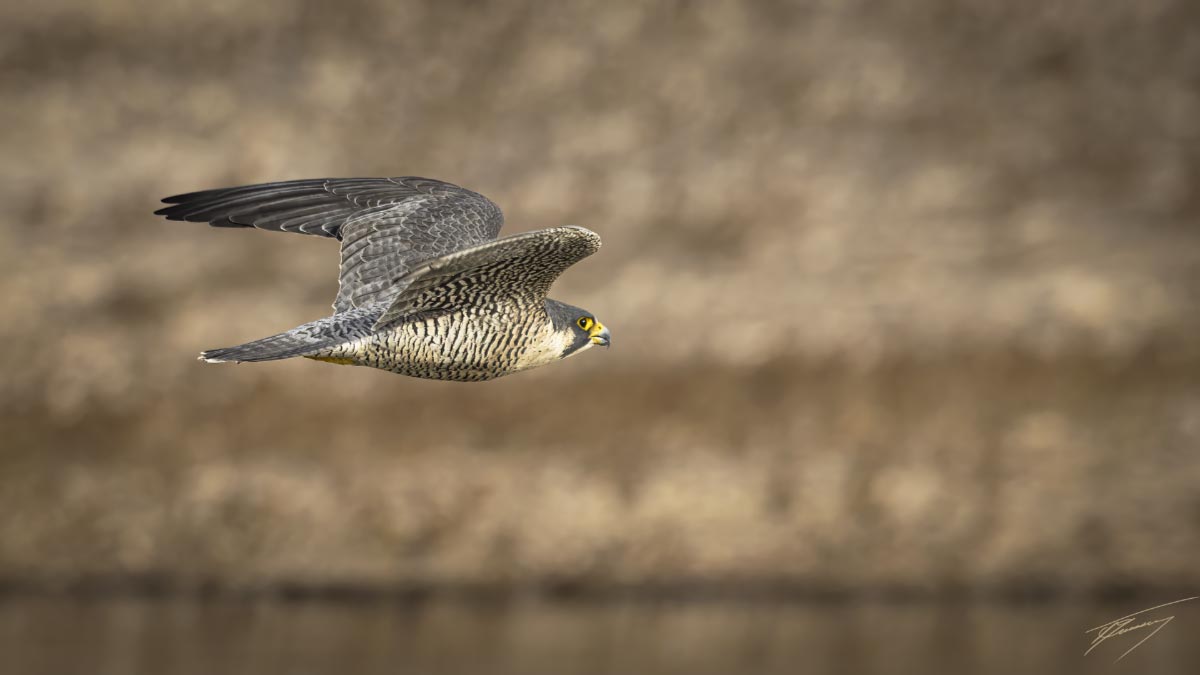
Below is a shot of a peregrine falcon in flight down at the lake … it is amazing how quickly these falcons fly in level flight, not to mention the speeds they attain in a dive! They are the worlds fastest creature reaching speeds in excess of 100 mph in level flight and 240 mph in a dive … they look fast even when perched.

Michele has her new male American Kestrel at her ranch now and I’m hoping to get up and shoot him within the next week … his name is Lennox and has a totally different personality than Finley had. A Eurasian eagle owl is being added the end of this month, so there are two new raptors to introduce to you. Also thinking a fund raiser at the Mary Fisher Theater in August with the birds and a photographic presentation of her birds and some wild ones. This will be a chance to meet the birds and see some great shots of them in action. Will keep you posted on this upcoming event as plans are finalized.

Time to wrap the day … I had four hotdogs, one hamburger, beans with hamburger and some delicious salads and cookies … I skipped the buns so not so bad 🙂

Have a beautiful day, keep breathing and smile … we are alive!

Ted

Therefor, while yet you have
the strength, cherish a desire to do
some useful work in your
little corner of the world, and
have the steadfastness to labor.
For this is the way to the
happy life; with health and
endearing ties, it is the way to the
glorious life.

excerpt from Happiness by Max Ehrmann

###

photo_tedgrussingThe easiest way to reach Mr. Grussing is by email: ted@tedgrussing.com

In addition to sales of photographs already taken Ted does special shoots for patrons on request and also does air-to-air photography for those who want photographs of their airplanes in flight. All special photographic sessions are billed on an hourly basis.

Ted also does one-on-one workshops for those interested in learning the techniques he uses.  By special arrangement Ted will do one-on-one aerial photography workshops which will include actual photo sessions in the air.

More about Ted Grussing


Healing Paws

Healing Paws

This is an advertisement

Photographer Sets Record for Deepest Underwater Photo Shoot

Photographer Sets Record for Deepest Underwater Photo Shoot

Deepest Photo Shoot Ever

Photographer Steven Haining and model Ciara Antoski together set the record for the deepest photo shoot ever recorded when the two of them and a team of professionals completed a shoot 32 feet below the surface near Tobermory, Ontario, Canada.

The photo shoot took place last year and was originally born from a desire to make something visually interesting during the COVID-19 pandemic.

“I was already diving and messing around with underwater portraiture in pools and controlled environments when the lockdowns and business shutdowns happened,” Haining tells PetaPixel.  “At the time, they were saying we couldn’t work in studio because we would be in each others air space so jokingly I was bugging my team to get suited up in their dive gear so we could each have private air and be safe while we shoot.”

That joke turned into real plans to put together a photo shoot in the cold waters of Tobermory, Ontario. Haining describes the area as the shipwreck capital of the world and it would be there that his passion project would eventually be recognized by the Guinness World Records as the deepest underwater photo shoot with a model.

Deepest Photo Shoot Ever

“What would have normally just been a pipe dream for me kind of became a reality out of the sheer drive to simply do something cool during a time in history where I was unable to create artwork by no choice of my own,” he says.

Hainig explains that he practiced with one of his favorite underwater models, Antoksi, who is also a diver for over a month in pools so she could get used to holding her breath in cold water. He and Antoski also visited and shot in a few other locations just to practice ahead of the planned deeper dive.

Deepest Photo Shoot Ever

Haining says he also recruited the best dive safety professional he knew — a master diver who also worked as a professional underwater escape artist for Penn and Teller — to assure that the shoot would be conducted safely.

Deepest Photo Shoot Ever

Deepest Photo Shoot Ever

The shoot took place at the wreck of the W.L. Wetmore, a ship that was driven ashore and sank in November of 1901.

Deepest Photo Shoot Ever

Deepest Photo Shoot Ever

Deepest Photo Shoot Ever

Deepest Photo Shoot Ever

“The deepest dive we did with the model was 32 feet for an incredible 30 minutes at depth, with [Antoski] borrowing air and navigating the W.L. Wetmore wreck,” Haining says.

When planning the shoot, Haining says it wasn’t his intention to do it for the record, but after it successfully concluded, he and his team decided to submit it for consideration.

“The extent of evidence they require, video proof of the entire process, documented depths, nautical charts approved by the government and proof of the location it was probably the most paperwork I’ve done in my life,” Haining says of the process for submission.

Deepest Photo Shoot Ever

Deepest Photo Shoot Ever

“At the end of it, Guinness approved the record for 16 minutes at 21 feet at a higher part of the Wetmore. It wasn’t the deepest spot [we shot at] but I was excited and beyond happy to take it simply because I couldn’t prove the dive computers and information for the deeper dive. Had I known I needed better documentation [was needed] I certainly would have been prepared but this was about the photos, not about the record.”

Deepest Photo Shoot Ever

Deepest Photo Shoot Ever

Deepest Photo Shoot Ever

Deepest Photo Shoot Ever

Haining says that he’s not done with his deep dive shoots, especially since he knows he went deeper than he could prove for the current record. At present, The Guiness World Records has a published recognition of the feat on its website, but Haining already has plans to force an update to that page later this year.

Deepest Photo Shoot Ever

“I have forever been thinking about proving the actual depth and it got me to a point where I am setting off this September with my team as well as some cool friends at Fujifilm who just love that I like to push their cameras to oblivion, and we are heading back to Tobermory one more time, but this time were going to beat our own record by a seemingly impossible amount,” he promises.

[embedded content]

“This time we’re going to invite Guinness to be there in person to witness it.”


Image credits: Steven Haining

One of Photography’s Earliest Inventors Had an Ingenious Trick to Stop His Images From Over-Developing, Scholars Say

One of Photography’s Earliest Inventors Had an Ingenious Trick to Stop His Images From Over-Developing, Scholars Say

A pioneer of photography may have used urine to create his historical images.  

That was one of the revelations a group of conservation experts from Brazil, Portugal, and the U.S. took away upon re-examining a series of what are believed to be among the oldest surviving photographic artifacts in the Americas, all created by the 19th-century artist, adventurer, and inventor Hercule Florence. 

A man of French-Italian-Monegasque origin who settled in Brazil, Florence was one of the first to permanently fix images onto paper using chemicals. His innovations in this area preceded those of Louis Daguerre and Henry Fox Talbot, two scientists widely credited with developing photographic technology, but came after the ground-breaking innovations of Nicéphore Niépce. 

Unlike those two scientists, who were internationally heralded in their time, Florence went comparatively unrecognized for his work. Fortunately, his achievements are getting an even greater shine now. 

Working out of the HERCULES Laboratory at the University of Évora in Portugal, the researchers recently applied a number of analytical techniques to three surviving graphic prints made by Florence: a decorative border for a masonic diploma and two design templates made for pharmacy labels. All three objects are nearly two centuries old.  

Photomicrography revealed that the paper Florence used to create the images was similar to that found in previous experiments of his. X-ray fluorescence, meanwhile, showed that silver nitrate or silver chloride was used for the diploma design and gold chloride was used for pharmacy labels. These materials proved crucial in the inventor’s quest to not only capture light, but to record it permanently.  

The early studies of Thomas Wedgwood and others likely led Florence to use papers coated with light-sensitive chemicals. On top of these he placed blackened pieces of glass with designs etched into them. 

This process created a positive image, but he still needed a way to stop the picture from continuing to darken when exposed to light. For this solution, he experimented with some unconventional materials.  

Through a technique called ATR-FTIR spectroscopy, the researchers identified a greater amount of protein in the pharmacy labels—a finding that suggests the presence of urine. In other words, to stop his pictures from developing, Florence peed on them. 

For the conservation experts, the finding speaks to the ingenuity of the 19th-century scientist, who worked without the resources of his European contemporaries.  

“What Hercule Florence accomplished is really a prehistory of photography,” said Art Kaplan, an associate scientist at the Getty Conservation Institute in Los Angeles, who co-led the research effort with António Candeias of the HERCULES Laboratory. “He was one step ahead, employing certain elements that were commonly used in the photographic process.”  

The analyzed photographs, Kaplan added, “are believed to be the only survivors of that time period.” 

More Trending Stories:  

In Pictures: Black Artists Use A.I. to Make Work That Reveals the Technology’s Inbuilt Biases for a New Online Show 

A Tourist Who Was Arrested for Carving His and His Girlfriend’s Names Into the Colosseum Is Begging for Forgiveness 

Bronze Statues and Artifacts From a Long-Buried Etruscan Site—Uncovered With the Help of a Garbage Man—Are Now on View in Rome 


Archaeologists Found an Ancient Marble Bust That May Have Belonged to Caligula at the Bottom of an Italian Lake 

German Archaeologists Find a 3,000-Year-Old Bronze Age Sword So Well Preserved That It ‘Almost Still Shines’ 

See Erwin Wurm’s Absurdist Sculptures Take Over a U.K. Park, From a Birkin Bag on Legs to a Bendy Truck Climbing the Wall 

Susie Barstow, a 19th-Century Artist Who Hiked Mountains in Bloomers to Paint Stunning Landscapes, Finally Gets a Museum Retrospective 


Follow Artnet News on Facebook:
Want to stay ahead of the art world? Subscribe to our newsletter to get the breaking news, eye-opening interviews, and incisive critical takes that drive the conversation forward.

Shutterstock is Paying ‘AI Photographers’ to Promote its Image Generator

Shutterstock is Paying ‘AI Photographers’ to Promote its Image Generator
Shutterstock AI photographer
An image created by “AI photographer” Tim Tadder with Shuttertock’s generative AI tool.

Shutterstock is paying online influencers and photographers who generate images with artificial intelligence (AI) to promote its image generator.

The photo stock library launched its AI image generator using DALL-E’s technology at the beginning of this year and it appears the company is attempting to attract customers by paying people with large Instagram followers to advertise the AI image generator.

They include commercial photographer Tim Tadder who has enthusiastically embraced AI and recently made a post promoting Shutterstock’s image generation tool. The post is marked with “Paid partnership.”

“As AI increasingly permeates the workflow of every creative soul, I eagerly await the outcome, ever enthralled by the possibilities it unveils,” Tadder writes to his 132,000 followers on Instagram.

Tadder isn’t the only person promoting Shutterstock’s new tool, an AI generative artist named Grace also posted a video where they laud the technology that can “create an image in the style of a photo.” A digital AI fashion page called Fashion Coupids also made a post on Instagram.

Not Everyone is Happy

Shutterstock, which has been a stalwart of the photo industry for a number of years, is seemingly doing what other photo giants such as Adobe are doing and that’s shifting their attention toward AI imagery.

Photographer Jodan Butters left an irate comment beneath Tadder’s promotional post for Shutterstock taking aim at the stock library and the AI industry as a whole.

“So, tired of ripping photographers off with measly royalty rates for stock images, they’ve decided to do away with them completely and let the end user create images that are, essentially, harvested from the bones of everything everyone has uploaded over time. Nice.”

Butters is highlighting the fact that AI image generators rely upon millions of photos taken by real photographers which have been used to build generative AI tools without the photographers ever being asked — or paid.

What is Shutterstock’s AI Image Generator?

The image generator is part of Shutterstock’s Creative Flow suite allowing users to create an image that can be downloaded for a fee.

A single download costs $19, however discounts are added if the user is purchasing multiple images — five images cost $49 for example. There is also a subscription model, for $29 per month the user gets 10 credits ranging up to 350 credits for $169 per month.

Shutterstock did not immediately respond to PetaPixel’s request for comment.