Photography

Capturing the Essence: Why Dog Photography With Families Is a Golden

Capturing the Essence: Why Dog Photography With Families Is a Golden

In a world full of a little bit of crazy one thing remains constant – our unwavering love for our furry companions. Dogs hold a special place in our hearts, becoming cherished members of our families. They warm our hearts from being mischievous mutts to regal pedigrees, our four-legged friends bring joy, companionship, and a whole lot of slobbery kisses.

As a photographer, tapping into the gold mine of dog photography with families can be a rewarding, fun, and profitable venture. After all, who can resist capturing the boundless love between a family and their beloved fur baby?

Dogs have an incredible ability to bring out genuine emotions and create lasting memories. Whether it’s a playful romp in the park, a quiet snuggle on the couch, or a delightful moment of chaos during mealtime, dogs effortlessly infuse life into every frame. When you combine these precious moments with the love and laughter of a family, you have a recipe for pure photographic gold.

When a family welcomes a dog into their home, they aren’t just gaining a pet; they are bringing in a new family member. The emotional connection between humans and dogs is unparalleled. It’s a bond that deserves to be celebrated and immortalized in beautiful photographs. As a dog photographer, you have the power to capture those fleeting moments, freezing them in time for families to treasure for generations to come.

Why is dog photography with families such a profitable business? The answer is simple; almost everyone loves their dogs. For many families, their furry companions are their children. Just like parents cherish photographs of their human kids, they want to proudly display images of their fur babies too. Dog photography has evolved from a niche market to a booming industry, fueled by the immense love and pride people have for their canine companions. People love their dogs — period, end of story — and as a photographer, you have the unique ability to capture those treasured memories that families can treasure forever. 

To succeed in this golden opportunity, a professional yet fun approach is key. Set yourself apart by creating a welcoming and relaxed environment during your sessions. Let your clients know that their dogs are not just subjects but stars in their own right. Encourage the whole family to participate, capturing candid interactions and spontaneous laughter. After all, some of the best moments happen when everyone is simply being themselves.

When it comes to dog photography, creativity knows no bounds. Experiment with various settings, props, and lighting techniques to capture the unique personality of each furry friend. From action shots in the great outdoors to intimate portraits in cozy corners, the possibilities are endless. Use your technical skills to compose visually stunning images, but always remember to embrace the playful and lighthearted nature that dogs bring to the table.

Building a profitable business in dog photography requires more than just technical prowess; it demands a genuine passion for both dogs and people. Take the time to connect with your clients, understanding their individual stories and the role their dogs play in their lives. By immersing yourself in their world, you can create photographs that not only capture beautiful moments but also evoke a deep emotional connection. Don’t be intimidated if you have never done this before. For anyone who has photographed family sessions with 2 and 3-year-olds and kept their sanity would do just fine photographing dogs. Just remember dogs do not wear diapers, so you will have to be ready to clean up their messes if they are in a studio, and if you are on location be sure to not leave any surprises for someone else to find. 

In the realm of dog photography, there is a gold mine waiting to be discovered. Families adore their dogs, and they want nothing more than to showcase their furry companions in stunning photographs. As a professional dog photographer, you have the opportunity to turn their heartfelt emotions into a thriving business. So, grab your camera, open your heart, and embark on a journey that celebrates the extraordinary love between families and their dogs. After all, who could resist the allure of capturing that magical bond, one click at a time?

Angelbird CFexpress Type B SE and SX memory cards NEW higher capacities & improved performance

Angelbird CFexpress Type B SE and SX memory cards NEW higher capacities & improved performance
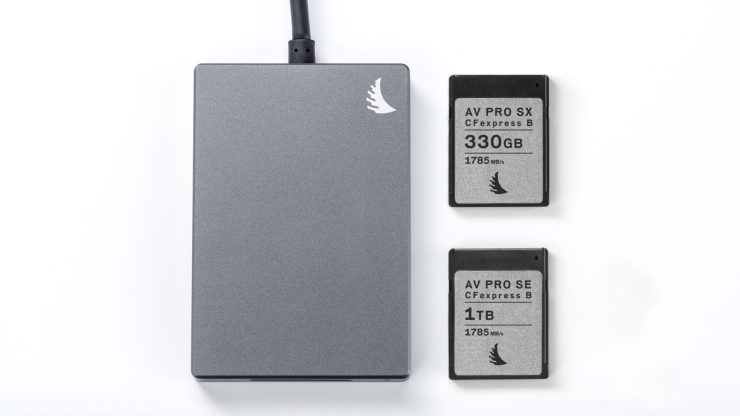
2023 Angelbird Photography CFexpress Type B SE 1 TB SX 330 GB Card Reader 01

Angelbird Technologies has expanded their entry-level CFexpress Type B SE and SX memory card lines with an all-rounder capacity 1 TB SE card capable of 8K+ RAW production and a 330 GB SX card engineered for limitless burst photography. Both cards offer gateway access to industry-leading technology that invites next-generation content creators and professionals to upgrade to CFexpress Type B technology.

1 TB AV PRO CFexpress B SE

AV PRO CFexpress B SE 03 1TB Web 20230508

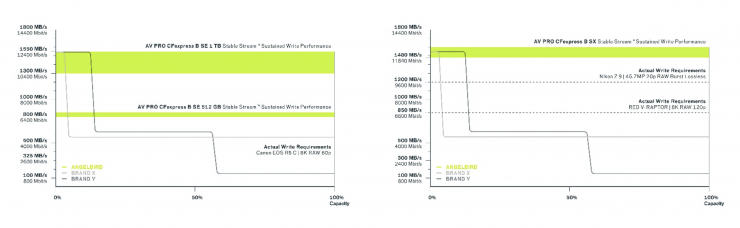
Angelbird’s NEW 1 TB AV PRO CFexpress B SE card is built on advanced technology with performance exceeding the data demands required for recording up to 12K+ RAW. By sustaining high write speeds of 1300 MB/s.

The new higher-capacity AV PRO CFexpress B SE card puts first-class, uninterrupted recording quality into the hands of an exciting new pool of creative talent for even more production possibilities. Visual creators of all levels can capture seamless high bitrate video and detailed images without hesitation of missing the shot due to limited capacity. The 512 GB AV PRO CFexpress B SE card has been firmly established as one of Angelbird’s most popular media cards since its introduction last year. With Stable Stream™ uninterrupted sustained write speed of 800 MB/s, consistent recording performance is maintained throughout the capacity of the card, with no lags or speed throttle. The exceptional recording

AV PRO CFexpress B SX

AV PRO CFexpress B SX 04 330GB Web 20230508 copy

The
NEW AV PRO CFexpress B SX  330 GB
joins the AV PRO CFexpress B SX 160 GB, offering ideal capacities and
critical speed for continuous burst photography and high-res video clips.

Angelbird states the cards are engineered with low latency and a sustained write speed of 1480 MB/s, capable of capturing multiple high-resolution images without hitting buffer limits or experiencing lag. Get extended card endurance for professional nature and events photography with high-speed performance that exceeds data needs of high bitrate video clips and continuous mode photography in 12K+ RAW.

Screen Shot 2023 06 27 at 8 02 34 AM

Stable Stream™ Sustained Speed Performance ensures uninterrupted read/write performance for the entire capacity of the card.

Key features

  • Y2 Processor – Exceptional processing power for RAW video and photo content creation.
  • Advanced Thermal Management – Eliminates potential damage or loss of frames, protecting card and content during a potential camera overheating event triggered by long-duration shooting or continuous burst photography.
  • Minimal Power Drain – Bus-powered components place minimal drain on the camera´s battery supporting improved run time.
  • Power Loss Protection – Signals a safe shutdown to protect against content loss or damage in the event of a sudden power loss.
  • Rock-Solid Build Quality – Protection from moisture, x-ray/magnets, shock, dust, and extreme operating temperatures of -10 °C to 70 °C and
  • storage temperatures of -20 °C to 85 °C.
  • Sticker-Free™ – Smooth sticker-free card surface. 
AV PRO CFexpress B SE 1TB and SX 330GB 01 Web 20230605

Pricing

AV PRO CFexpress B SE 1 TB
299.99 EUR/USD 

AV PRO CFexpress B SX 330 GB
299.99 EUR/USD
*Prices excl. VAT 

Paul McCartney’s rediscovered photos show Beatlemania from the inside

Paul McCartney’s rediscovered photos show Beatlemania from the inside

LONDON (AP) — Is there really a new way to look at The Beatles, one of the most filmed and photographed bands in history?

Yes, says Britain’s National Portrait Gallery, which is providing a fresh perspective with an exhibition of band’s-eye-view images that Paul McCartney captured as the group shot to global fame.

Gallery director Nicholas Cullinan said the exhibit, subtitled “Eyes of the Storm,” is a chance “to see, for the very first time, Beatlemania from the inside out.”

Paul McCartney says artificial intelligence has been used to extract John Lennon’s voice from an old demo to create “the last Beatles record,” decades after the band broke up.

The seed for the exhibit was sown in 2020, that year of lockdown projects, when McCartney dug out 1,000 forgotten photos he’d taken in 1963 and 1964, as the Fab Four went from emerging British celebrities to world megastars. He and his team asked if the National Portrait Gallery was interested in displaying them.

“I think you can probably guess our response,” Cullinan said as he introduced the exhibition to journalists in London on Tuesday.

The show includes 250 photos taken in England, France and the United States that illustrate The Beatles’ journey from cramped dressing rooms in provincial British theaters to stadium shows and luxury hotels.

“It was a crazy whirlwind that we were living through,” McCartney writes in a note present at the start of the exhibit. “We were just wondering at the world, excited about all these little things that were making up our lives.”

Rosie Broadley, who curated the show, said the gallery soon realized the trove “wasn’t just interesting pictures by a famous person.”

“It’s actually telling an important story about cultural history — British cultural history and international cultural history,” she said. “This is a moment when British culture took over the world for a while.”

The display begins in late 1963, shortly after McCartney acquired a Pentax 35mm camera. The early black-and-white images include portraits of The Beatles, their parents, girlfriends, crew and colleagues, including manager Brian Epstein.

Broadley said these images depict “a parochial postwar British celebrity” — concerts in provincial cinemas alongside now-obscure bands like Peter Jay and the Jaywalkers, 16-night variety-style Christmas shows at London’s Finsbury Park Astoria.

Cullinan said the photos convey a “sense of intimacy” missing from professional photos of the band.

“This wasn’t The Beatles being photographed by press photographers of paparazzi but peer-to-peer,” he said. “So there’s a real tenderness and vulnerability to these images.”

In January 1964, McCartney took his camera with the band to Paris, capturing the city at the height of its French New Wave cool. While there, The Beatles learned that “I Want to Hold Your Hand” was a No. 1 hit in the United States.

Within days, they were on a plane to New York, where their Feb. 9 performance on “The Ed Sullivan Show” was watched by 73 million people, and nothing was ever the same again.

The U.S. section of the exhibit shows the band’s increasingly frenetic life. Many of the shots were taken from planes, trains and chauffeur-driven automobiles and show crowds of screaming fans and rows of police. Sometimes, McCartney turned his lens back on the newspaper and magazine photographers looking at him.

One striking shot was taken through the back window of a car as a crowd chased the band down a Manhattan street, a scene echoed in the band’s first feature film, “A Hard Day’s Night,” made later that year.

McCartney also took pictures of strangers – a girl seen through a train window, ground crew at Miami airport goofing around.

The band’s final stop was Miami, where McCartney switched to color film. The results, Broadley said, “look like a Technicolor movie, like an Elvis film.” The photos show John, Paul, George and Ringo swimming, sunbathing, water skiing, even fishing. From a hotel window, McCartney photographed fans writing “I love Paul” in giant letters in the sand.

McCartney, 81, spent hours talking to curators about the photos and his memories as they prepared the exhibit, one of the shows reopening the National Portrait Gallery after a three-year renovation.

The images were preserved for decades on undeveloped negatives or contact sheets, and McCartney had never seen them in large format until the gallery had them printed.

The project was not without risks. McCartney acknowledges he’s not a professional photographer – though his late wife, Linda McCartney, was, as is their daughter Mary McCartney. Some of the photos are blurry or hastily composed. But what they lack in technique they make up for in spontaneity.

Broadley said McCartney “was nervous about showing some of the less formally composed ones or the less in-focus ones.”

“But I think we persuaded him that we liked those because of the story that they tell,” she said. “It’s quite nice to have those ones where they’re sitting around with a cup of tea before the event.”

___

“Paul McCartney Photographs 1963-64: Eyes of the Storm” is on at the National Portrait Gallery in London from Wednesday until Oct. 1.

Paul McCartney Photographs 1963-64 at the NPG: Beatlemania up close

Paul McCartney Photographs 1963-64 at the NPG: Beatlemania up close

Over 250 Pentax 35mm photographs the Beatles legend took in the four months between November 1963 and February 1964 – just as their star ascended at home and Beatlemania struck America – have been selected for the Paul McCartney Photographs 1963-64 exhibition.

They come from over 1,000 shots unearthed, all but forgotten, from McCartney’s personal archive in 2020. Between them, and the accompanying photo-book 1964: Eyes of the Storm, they provide a wonderfully candid trip inside a phenomenon, mid-explosion.

Taking in the noirish focus and filmic framing of McCartney’s shots of early support acts and his nonchalant, cigarette-drooling self-portraits in hotel mirrors, you can better understand the affinity he’d go on to have with his first wife, the photographer Linda. And there are plentiful insights into the easygoing nature of the Hamburg-hardened Fab Four, found lounging in dressing rooms or guesting on Jukebox Jury largely unfazed by the gathering storm.

Amid plenty of pensive Ringos, awkward Georges and cheery Brian Epsteins, John Lennon is a flitting figure, sometimes serious and bespectacled, sometimes playful, clowning through his pre-show grooming routine or gooning to camera.

imageJohn Lennon in Paris , January 1964″ height=”1629″ width=”2490″ srcset=”https://static.standard.co.uk/2023/06/26/13/%20Paul%20McCartney%20P1964-8_18a.tif?width=320&auto=webp&quality=100&crop=2490%3A1629%2Csmart 320w, https://www.mecreates.com/story/news/wp-content/uploads/2023/06/20Paul20McCartney20P1964-8_18a.jpg 640w, https://static.standard.co.uk/2023/06/26/13/%20Paul%20McCartney%20P1964-8_18a.tif?width=960&auto=webp&quality=100&crop=2490%3A1629%2Csmart 960w” layout=”responsive” class=”i-amphtml-layout-responsive i-amphtml-layout-size-defined” i-amphtml-layout=”responsive”>

John Lennon in Paris , January 1964

/ Paul McCartney

Side-of-stage shots from 1963, taken on McCartney’s Pentax by crew members, offer an electric new angle on their live show and, backstage, moments of largely headwear-based fun emerge: George wearing a stack of top hats, or Ringo and John sporting Napoleonic bicorns.

As the media tumult descends in Paris in 1964 you can see the showmen in them leap to life, while the Paul’s-eye-view of The Beatles’ first visit to the US is a priceless historical document. From inside the chaos we witness hordes of blurry girl fans – some dressed as beauty queens; one, if you look closely enough, holding a chimpanzee – swarming over the roofs and runways of JFK airport or crammed against barriers outside New York’s Plaza Hotel. Portraits of bemused, overrun cops. Fans, through the rear window, chasing the band’s car through Manhattan on foot.

What we’re looking at is the first generation of teenage pop fandom, having cut its teeth howling at Elvis’s every gyration, now losing itself in full-blown hysteria and pushing at its limits, clawing at the boundary between fan and idol. Meanwhile, behind the camera, The Beatles are also fathoming how global superstardom works – or can work – in any sort of un-claustrophobic manner, bewildered by all their dreams coming true overnight.

image‘The crowds chasing us in A Hard Day’s Night were based on moments like this. Taken out of the back of our car on West Fifty-Eight, crossing the Avenue of the Americas.’ New York, February 1964 ” height=”1370″ width=”2000″ srcset=”https://static.standard.co.uk/2023/06/26/14/P1964-10-10_DS_cover%2012.54.10.jpg?width=320&auto=webp&quality=100&crop=2000%3A1370%2Csmart 320w, https://www.mecreates.com/story/news/wp-content/uploads/2023/06/P1964-10-10_DS_cover2012.54.10.jpg 640w, https://static.standard.co.uk/2023/06/26/14/P1964-10-10_DS_cover%2012.54.10.jpg?width=960&auto=webp&quality=100&crop=2000%3A1370%2Csmart 960w” layout=”responsive” class=”i-amphtml-layout-responsive i-amphtml-layout-size-defined” i-amphtml-layout=”responsive”>

‘The crowds chasing us in A Hard Day’s Night were based on moments like this. Taken out of the back of our car on West Fifty-Eight, crossing the Avenue of the Americas.’ New York, February 1964

/ Paul McCartney

As Paul switches his film to colour in Miami, a surreal tone sets in. There’s “shy one” George accepting a cocktail from a bikini-clad waitress in the very image of first-generation rock star luxury – an image the 1970s would solo itself senseless trying to emulate – but with the distant expression all four share as they calmly try to fish, swim or lounge on Miami Beach while police hold back baying hordes. The modern pop dynamic is born in these pictures and, coloured by the seismic cultural impact of the era, it’s both humanising and beautiful to watch.

National Portrait Gallery, June 28 to October 1; npg.org.uk

This Norwegian couple’s playful, gender-defying portraits were discovered by chance after their deaths

This Norwegian couple’s playful, gender-defying portraits were discovered by chance after their deaths

Editor’s Note: Untold Art History investigates lesser-known stories in art, spotlighting unsung and pioneering artists you should know, as well as uncovering new insights into influential artworks that radically shift our understanding of them.

At the turn of the 20th century, the studio run by Norwegian photographers Bolette Berg and Marie Høeg had a secret second purpose. During the day, it operated as a conventional atelier where locals in the coastal town of Horten, Norway, could come have their portraits taken for pocket-sized cartes de visite, the era’s tradeable profile pictures. After hours, though, it became a clandestine gathering space for politically-minded women, as equality movements were burning brightly around the country.

Berg and Høeg lived life on their own terms, both as romantic partners in a time of little LGBTQ visibility and as business partners running a studio and publishing company when women were highly restricted in their careers — and beyond. But decades after their deaths in the 1940s, another radical aspect of their lives resurfaced, tucked away in boxes of glass negatives marked “private”: the couple eschewing traditional gender norms in playful portraits they took of themselves and loved ones.

Bolette Berg pictured with a handlebar mustache. Little is known about Berg, and she has received less attention than Høeg, though they were lifelong creative, business and romantic partners.

In the photos, Berg and Høeg dress up in womenswear and menswear, using props and painted backdrops to set their irreverent scenes. In one, Berg dons an oversized fur-lined wool coat, a mustache and spectacles, eyes glimmering with mischief. In another, Høeg and one of Berg’s sisters light cigarettes while sitting in a rowboat; a small dog peeking over the edge.

Bought at auction in the 1970s by the photographer Leif Preus, these personal negatives went unnoticed within his larger collection for years. But since the first exhibition of Berg and Høeg’s work was shown in the mid-1990s, the women have become cult figures in queer art history, and continue to gain wider international acclaim — most recently through the exhibition “Like a Whirlwind” at the major international festival PhotoESPAÑA, on view until August 24 in Madrid.

Berg & Høeg, Marie Høeg dressed as a boy, 1894-1903.

The couple’s self-portraits are striking because they were captured “in a way that seems so modern,” according to curator Kristin Aasbo, who works at the Preus Museum in Horten and has led research and exhibitions on the pair. (The museum, founded from Preus’ collection in 1976, was later acquired by the Norwegian government and now serves as the country’s national photography museum.) She loves their dynamic, apparent even in their solo portraits, when they are “having fun for the person behind the camera,” she said.

One of Aasbo’s favorite images features the couple in their prop boat, with Høeg ‘rowing’ its oars. It’s one of the only known photographs of the couple posing together.

“Both of them have their hands visible, and you can see there’s a ring on each of their fingers,” Aasbo noted. “It’s almost like a wedding photo, so I’m very fond of that.”

Energizing a town

Though much of Berg and Høeg’s lives remain a mystery, a handful of academics and curators have slowly pieced together some details from newspaper clippings and other documents of the era.

Høeg, who was from a family of fishermen, grew up in the small town of Langesund, and began photographing after traveling with her brother to Finland. It’s believed she met Berg, who was studying photography at the time, while in Finland; they relocated to Horten in 1894 to run their studio. Berg, born in Nannestad, was the daughter of a village priest, and one of six sisters — only one of whom ever married.

Høeg also bucked conventions, with her gender non-conforming style and an inherent magnetism, according to Aasbo. “Marie came to (Horten), this sleepy little town, and she just started making things move,” Aasbo said. “She smoked and she wore trousers — she was a very outgoing and outspoken woman.”

Berg & Høeg, In the studio: Marie operating the camera, Bolette photographing the scene, 1894-1903.
Berg & Høeg, Marie Høeg and Bolette Berg's sister Ingeborg, 1894-1903.

At their studio, Berg & Høeg Fotoatelier, Høeg hosted the intentionally enigmatically named “Discussion Club,” where women in the community learned how to discuss politics during the suffrage movement — they were granted full rights to vote in 1913 — as well as meetings for a group called “the Sanitary Ladies,” which focused on environmental causes.

While at work, Berg and Høeg primarily produced the smaller cartes de visite and larger cardboard-mounted cabinet cards that were popular portrait options of the time. But they closed the business and moved to Oslo in 1903, shifting their focus to printing postcards of landscapes and Norwegian art as the postcard market was booming, as well as publishing books on art and society, including career-focused books for women.

Berg & Høeg, Marie Høeg and her brother Karl crossdressing, 1894-1903.

“I see them as businesswomen,” Aasbo explained. “They were conscious about what was in the air at the moment, and then they found their way of life.”

The photographers’ relationship was likely an open secret, according to Aasbo.

“It was quite well known that they were living together as partners, as lovers,” she said. “They lived together their whole lives,” though some may have thought they were simply “best friends forever,” she said with a laugh.

Exactly where the photographers’ negatives came from is another piece of the puzzle Aasbo is hoping to solve. Their whereabouts during the 30 years between their deaths and the auction in which Preus acquired them remains a question mark, though it’s believed Berg and Høeg left the boxes in their farmhouse in Lunner, where they often vacationed, and were only discovered after the home’s sale, she explained.

In a serendipitous moment, the museum acquired hundreds more of their negatives by accident last year, when they were discovered within a collection of work by the Norwegian photographers (and brothers) Thorvald and August Brunskow. And just like those purchased by Preus, among the batch of negatives was a small “private” box, containing more lively and intimate self-portraits. Altogether, there are now around 700 known negatives of Berg & Høeg’s work, some 80 of which chronicled their “private” lives.

Berg & Høeg, Three facettes of Marie Høeg, 1894-1903.

“It was just by chance that we got these,” Aasbo said of the recent acquisition. “It’s almost like there’s something bigger than us that wants us to find more on these ladies.”

The quietly radical images would have likely been controversial during Berg and Høeg’s lifetimes, and are exhibited with that context in mind today. Though some critics online have debated whether the designation “private” meant the photos should have remained out of the public eye, Aasbo has a different interpretation.

“I don’t think that ‘private’ means ‘don’t touch,’ I think that it means that it’s not a part of their business,” she said.

Aasbo is hoping to find more on their lives as their reputation grows. So far, their photographs have only exhibited in Europe, but will debut in the US next year at the gallery Wrightwood 569 in Chicago.

“It would have been wonderful for a diary to be discovered, but I don’t think we’ll find that,” she said “But we have grown so fond of these ladies… They get into your heart.”

Local veteran’s Vietnam photography to be showcased in Jackson

Local veteran’s Vietnam photography to be showcased in Jackson

JACKSON, Tenn. — A showcase of a local veteran’s photography will be on display in Jackson later this week.

Tennessee Industrial Printing (TIPS) will showcase the photographs of Larry Atherton and his time in the Vietnam war during regular business hours on Friday, June 30.

Atherton is a Tennessee native who started his career as a photographer for The Jackson Sun before leaving for the Marine Corps.

A release says during his time in Vietnam, he was named combat photographer, taking honest and inspiring photographs that “capture the essence of the Vietnamese people and Marines there.”

“Having Larry exhibit his photographs of Vietnam at TIPS is incredibly special. We are privileged to view the unique history and perspective of that time period,” said Wayne Chambers, owner of Tennessee Industrial Printing.

According to the release, visitors will also be able to receive free printed copies of the Declaration of Independence, pocketbook copies of the Constitution of the United States, and printed copies of their eagle poster.

Tennessee Industrial Printing is located at 51 Miller Avenue in Jackson, and will be open from 8 a.m. to 4:30 p.m. on Friday.

Click here for more information on TIPS.

For more news in the Jackson area, click here.

Incredible Composite Lightning Photography Lights Up Turkish Sky

Incredible Composite Lightning Photography Lights Up Turkish Sky

Lightning is no doubt one of nature’s most impressive creations, from the 11-hour lightning marathon after the Tonga eruptions to bright green lightning bolts captured on Jupiter. Down on Earth is no exception with this spectacular composite image taken in the Turkish sky.

Amateur astronomer Uğur İkizler made this incredible image by combining images of the different lightning strikes that lit up the sky in Mudanya, Turkey. On June 16, between 10:58 and 11:48 pm, Uğur photographed the night sky and the different lightning bolt patterns as they struck over the water.

Advertisement

This video shows the different elements that make up the final image. 

Lightning is a rapid discharge of energy from the clouds, usually formed when negative charges in the bottom of a cloud are attracted to positive charges in the ground; these charges have to be great enough to overcome the insulating properties of the surrounding air. When a connection is made, the positive and negative charges rush to meet each other, and lightning heats the air along its path, making it expand. Thunder is the sound of the expanding air. According to NOAA, lightning can occur between charges within a cloud, known as intracloud lightning, or between opposite charges in the cloud and the Earth’s surface, known as cloud-to-ground lighting.

Advertisement

Research has shown that lightning was crucial to the formation of life by converting nitrogen into a usable form. Lightning has also been found to create new materials even recently like this new phosphorus material that was created in Florida. 

Xiaomi 13 Ultra Photography Kit White Version Official Now

Xiaomi 13 Ultra Photography Kit White Version Official Now

Xiaomi 13 Ultra Photography Kit White Version

Xiaomi’s recent release of the Xiaomi 13 Ultra smartphone brought with it a surprise. Alongside the smartphone, Xiaomi introduced a set of professional photography accessories that have garnered even more attention than the flagship device itself. Priced at 999 yuan, this photography kit quickly became a hot commodity, with limited availability driving up its resale value to around 1800 yuan. Responding to the overwhelming demand, Xiaomi recently increased its production capacity to meet the market’s needs.

The success of this photography kit can be attributed to its ability to transform the Xiaomi 13 Ultra into a professional camera. The kit includes a technology nano-protection case, wireless camera grip, lens cover, and a 67mm filter adapter ring. By attaching the wireless camera grip, users can enjoy a camera-like operating experience, unlocking new possibilities for mobile imaging creation. This has made the photography set a must-have accessory for anyone interested in capturing high-quality photographs with their handheld device.

Recognizing the popularity of the original green version, Xiaomi has now introduced a white version of the Xiaomi 13 Ultra photography kit, offering users more choices in terms of color. The white variant maintains all the features and functionality of its predecessor, ensuring a seamless experience for users who opt for this new option.

ADVERTISEMENT

In conclusion, the Xiaomi 13 Ultra photography kit has become a sensation in the market, surpassing the popularity of the smartphone itself. Its ability to transform the Xiaomi 13 Ultra into a professional camera, coupled with its limited availability, has driven up its demand and resale value. With the introduction of the white variant, Xiaomi aims to provide users with more options while maintaining the exceptional features and capabilities that have made the photography set a favorite among photography enthusiasts.

Source

Christie’s : Madonna x Meisel – The SEX Photographs – The Eye of Photography Magazine

Christie’s : Madonna x Meisel – The SEX Photographs – The Eye of Photography Magazine

30 years ago appeared: SEX, Steven Meisel‘s erotic book on Madonna.
It was madness. In France, no known or important publishing house wanted to publish the book and it was a young publisher, Michel Birnbaum who dared and made a fortune.

As part of this event, Christie’s is presenting the Madonna x Meisel – The SEX Photographs sale next October 6th in New York. This sale includes a selection of more than 40 single-print photographs, all taken from the famous book.

Since its publication in 1992, the book has been a resounding worldwide success. Personal expression of a liberated sexuality, its erotic content arouses controversy. Imagined by one of the most disruptive pop icons of all time, SEX brings together cult images by Steven Meisel and texts by Madonna, in which appears, Dita, her alter ego created for the album Erotica. This publication still holds the absolute record for sales in the “coffee-table books” category. In this field, no work had ever been sold so quickly.

In 2022, Madonna and Anthony Vaccarello, Artistic Director of Maison Saint Laurent, celebrated the 30th anniversary of the publication with a first reissue limited to 800 copies, accompanied by a unique exhibition organized on the occasion of Art Basel in Miami Beach.

Darius Himes, Vice President and International Director of Christie’s Photography Department: “In the early 1990s, the book received well-deserved hype. Steven Meisel knew how to immortalize Madonna’s sex appeal and transpose it into his photographs. He managed, like no other, to capture the sensuality and sexual freedom of the queen of pop. Thirty years after the release of the highly controversial SEX, these portraits, produced exclusively in collaboration with Steven Meisel, remain iconic from every point of view. Playful, subversive and precursory, they summarize a period in the history of late 20th century art, illustrating the process of mythification of celebrities and the cult of the image. These photographs are simply exceptional.”

Auction proceeds will be donated to Raising Malawi, a charity supporting orphans and vulnerable children in the country with essential resources.

From June 27 to July 6, Christie’s Paris presents around forty photos!
Christie’s Paris
9 Avenue Matignon
75008 Paris, France
https://www.christies.com/

Exhibition in New York :
30 September 30 – October 6, 2023
Christie’s New York
20 Rockefeller Plaza
New York, NY 10020
https://www.christies.com/

Vente
Madonna x Meisel – The SEX Photographs
6 October 02:00 PM EDT | LIVE AUCTION 22700
Christie’s New York
20 Rockefeller Plaza
New York, NY 10020
https://www.christies.com/