Photography

Malashock Dance + Outside the Lens: Free Dance Photography Exhibit

Malashock Dance + Outside the Lens: Free Dance Photography Exhibit

malashock-doug-m-cal.jpg

Courtesy of Outside the Lens

Friday, June 9, 2023 from 6 PM to 8 PM

Dorothea Laub Dance Place

Free

Malashock Dance & Outside the Lens, in partnership with Doug McMinimy, present a free exhibit and reception featuring dance photography created by students in grades 8-12. Students participated in a workshop with renowned dance photographer Doug McMinimy to explore technology and techniques for capturing dance on camera. The students worked with educators from Outside the Lens and Malashock Dance Company dancers. Enjoy a beautiful exhibit and complimentary beverages and snacks.

Location:

ARTS DISTRICT LIBERTY STATION

Dorothea Laub Dance Place Greenroom (1st Floor)

2650 Truxtun Rd

San Diego, Ca 92106

This project/program was made possible by the NTC Foundation with generous support from RiverRock Real Estate Group and The Parker Foundation.

Through their eyes: See Boca High students’ photography at Downtown Library

Through their eyes: See Boca High students’ photography at Downtown Library

Next time you visit the Downtown Boca Raton Public Library to pick up some summer reading materials, take a minute to look around the front lobby.

A new photography exhibit, “Through Our Eyes: Boca Raton Community High School Student Photography,” is on display through July 31 showcasing photographs taken by students in the school’s photography program.

Over 500 Boca High students are enrolled in as many as four photography and digital media courses for college credit through the College Board in the United States and Cambridge University in England.

Leila Levy’s digital photo “Umbrellas” is part of “Through Our Eyes: Boca Raton Community High School Student Photography” exhibit at the Downtown Boca Raton Public Library. (Leila Levy/Courtesy)

“The students work diligently all year to prepare their AP Portfolio for College Board,” said Rob Sweeten, the school’s AP and AICE photography teacher. “We do have the largest AP 2D Art and Design program in the county.”

He teaches them the elements and principles of art; how to properly use cameras and photographic techniques; and how to create and process their images using Adobe Illustrator and Photoshop. In addition to winning photo contests, the students also serve the school’s yearbook, newspaper and athletic programs.

“Visitors will be impressed with the high standard of artistic merit, creativity and expression in the diverse collection of photos from the Boca High School photography students,” Program Services Librarian Lisa Testa said in a statement. “Congratulations to photography teacher Rob Sweeten for his ability to bring out the best in his students to produce exceptional photos for our community.”

Digital drawing “In the Balance” by Katherine Oberle is featured in the front lobby at the Downtown Boca Raton Public Library through July 31. (Katherine Oberle/Courtesy)

The Downtown Library, 400 NW Second Ave., in Boca Raton is open from 9 a.m. to 8 p.m. Mondays through Fridays and from 9 a.m. to 5 p.m. Fridays through Sundays.

Library patrons also can sign up for the free Summer Reading program at bocalibrary.readsquared.com, on the READSquared app available through Google Play or the Apple Store, or at the Downtown or Spanish River (1501 NW Spanish River Blvd.) library locations. Incentives such as weekly prizes, wireless earbuds, pins, a raffle to win a Nintendo Switch Lite or an Imagine Your Story Beach Bag with Bluetooth speaker and beach towel, and book lovers’ gift sets are available to babies through fifth grade, grades 6-12 and adults who log their reading hours. A library card is not required to participate.

Visit myboca.us/2020/Library.

The Impact of AI on Wedding Photography: A Contemporary Perspective |

The Impact of AI on Wedding Photography: A Contemporary Perspective |

Photography has long been an evolving art form, and the advent of artificial intelligence (AI) has introduced a new wave of innovation. As in many fields, AI has begun to shape the landscape of wedding photography, changing how photographers capture, edit, and deliver photos. 
Though this technology is exciting, it raises questions about the future of the creative industry. What happens when AI-generated content becomes indistinguishable from human-created content? This is a question that continues to intrigue and concern many in our industry. However, there’s a consensus that most genres of photography, which revolve around capturing specific moments in time or specific people, will continue to have a unique value that AI cannot replicate.

AI in Photography: A Brief Overview

Image Recognition and Autofocus

One of the key areas where AI has found application in photography is image recognition. Image recognition allows the camera to identify subjects within the frame, which can help with autofocus and exposure settings. For instance, many modern cameras use AI to recognize human faces or even specific animals and focus on them automatically. This feature is especially useful in dynamic environments, like sports or wildlife photography, where the subject is moving quickly and unpredictably.

Scene and Light Recognition

AI is also employed to identify different types of scenes and adjust camera settings accordingly. For instance, many smartphone cameras can detect whether you’re taking a close-up shot, a landscape, a portrait, or even a night scene, and adjust the exposure, color balance, and other parameters automatically to get the best possible image.

AI algorithms can also analyze the lighting conditions and optimize the camera settings for those conditions. This is particularly valuable in challenging lighting conditions, such as backlit scenes or low-light situations.

Post-Processing and Editing

In the realm of post-processing, AI is helping photographers save time and enhance their photos more effectively. Adobe’s Sensei AI, for example, powers features like Select Subject and Select Mask in Photoshop, making it easier to isolate subjects from the background. It also assists with tasks like pattern recognition, making content-aware fill more accurate.

AI-powered software can also automate the editing process by analyzing an image and suggesting adjustments to improve it. These can range from basic adjustments like exposure and contrast to more complex edits like removing unwanted objects or even replacing the sky.

Generative AI

Generative AI, as demonstrated by AI image generators like DALL•E 2, can create new images from scratch based on text descriptions. This could potentially be used for creating conceptual art or assisting in commercial photography, where a specific scene or object is needed but not readily available.

AI and Wedding Photography: The Intersection

Wedding photography, with its demand for capturing intimate and fleeting moments, might seem a far cry from the world of artificial intelligence. However, AI is not only making inroads into this field, but is becoming a valuable tool for wedding photographers. AI technologies have the potential to drastically enhance the work of wedding photographers in several ways.

Streamlined Post-Processing

AI software can greatly streamline the post-processing work, which is often the most time-consuming aspect of wedding photography. With thousands (sometimes tens of thousands if you cover multi-day celebrations like Indian weddings) of photos to sort through, cull, and edit, this phase can be a significant bottleneck in a photographer’s workflow.

AI-powered software can speed up this process by automatically selecting the best shots based on predefined criteria such as focus sharpness, exposure, and even the subjects’ expressions. Adobe’s Lightroom, for instance, offers a feature called “Auto Tone” that can automatically correct the color balance and tone of an image, saving photographers valuable time.

I am in no way, shape, or form saying that you should only use AI when culling or color grading your images. AI can be a powerful tool (just like any other tool photographers already use, such as autofocus) to streamline post-production by providing a quick and efficient starting point.

Enhancing Image Quality

AI can also help enhance the quality of images. Noise reduction, sharpening, and upscaling are just a few areas where AI algorithms excel. They analyze the image content, understand the scene, and apply corrections that are fine-tuned to the specific image rather than using a one-size-fits-all approach.

Advanced Camera Features

Camera manufacturers are increasingly integrating AI into their hardware. AI-driven autofocus systems, such as those found in Canon’s EOS R3 and Nikon’s Z9, can track subjects more accurately and quickly, ensuring no crucial moments are missed. AI can also assist in optimizing camera settings in real-time based on the lighting conditions and the scene’s content, thereby enabling wedding photographers to focus more on the art of capturing moments and less on the technicalities of camera settings.

AI in Creating Albums and Slideshows

AI can be a great tool for creating wedding albums and slideshows. Some AI systems can analyze images and select the most emotionally resonant moments, creating a narrative that might take a human hours to develop. AI can even generate music that matches the mood of the images, creating a personalized and engaging slideshow.

Closing Thoughts

AI is playing an increasingly important role in the field of photography, including in wedding photography. It’s providing tools and capabilities that can help photographers to streamline their workflow, enhance image quality, and focus more on the creative aspects of their work.

However, while the potential of AI in photography is immense, it’s important to remember that these technologies are tools to aid photographers, not replace them. The art of photography is inherently human; it’s about capturing moments and emotions, telling stories, and creating a connection between the viewer and the subject. These are aspects where the human touch is irreplaceable.

AI can assist by taking over more tedious tasks like culling and basic editing, or by providing real-time guidance on technical aspects. But the creative decisions — the choice of the perfect moment to press the shutter, the framing of a shot, the interpretation of a scene — these will always require the human touch.

Moreover, as AI technologies continue to evolve, ethical considerations also come into play. It’s crucial to use these tools responsibly, ensuring that the authenticity of images is maintained and that the privacy and consent of subjects are respected.

In conclusion, AI is an exciting development in the world of photography, offering numerous possibilities for improving and enhancing the work of photographers. By embracing these new technologies, photographers can not only improve their technical skills, but also potentially unlock new avenues of creativity. However, the heart of photography remains in the hands of the photographer — their vision, their creativity, and their ability to capture a moment in time.

Color and Composition Explained by a Pro Landscape Photographer

Color and Composition Explained by a Pro Landscape Photographer
Greg Boratyn landscape photographer interview
© Greg Boratyn

Award-winning landscape and nature photographer Greg Boratyn is known for combining brilliant photography with a penchant for educating photographers through presentations and his international workshops.

Boratyn’s portfolio contains colorful landscape photos that transport viewers to a time and place. His work places significant emphasis on capturing the essence of the spirit of a scene while maintaining a strong sense of realism.

Greg Boratyn landscape photographer interview
© Greg Boratyn

PetaPixel spoke with Boratyn about his career, portfolio, passion for helping other photographers improve their work, and artistic vision.

Becoming a Serious Photographer During the Analog to Digital Transition

“For many photographers, myself included, the transition to digital photography brought about significant changes and opportunities,” Boratyn tells PetaPixel.

Advances in digital photography enabled Boratyn to grow and develop as a photographer in numerous ways. Digital photography provided instant feedback, allowing him to get a real-time view of a scene and check his images. With the instant feedback provided by digital cameras, Boratyn found it much easier to develop his technique.

There were other benefits for Boratyn as digital cameras took over, including significant reductions in cost, significantly easier post-processing and editing, a streamlined workflow, and improved accessibility. Being able to capture, view, edit, and share images quickly proved vital for Boratyn as he built his career.

A Naturalistic Approach in the Digital Age

One of the benefits of digital that Boratyn expressed is that it allowed him to edit and digitally manipulate his images easily. However, with great power comes great responsibility.

“When it comes to my artistic approach and relationship with post-processing, I strive to maintain a balance that preserves the authenticity and essence of the scene while utilizing digital tools to enhance the final result,” Boratyn explains.

“For me, the ultimate goal of post-processing is to bring out the inherent beauty and emotional impact of the captured moment rather than creating an artificial or heavily manipulated image. I view post-processing as a means to refine and fine-tune the photograph, not to drastically alter or distort the reality I experienced at the time of capture,” he continues.

Greg Boratyn landscape photographer interview
© Greg Boratyn

To that end, he’s careful to avoid excessive or heavy-handed edits that reduce the authenticity of a scene. He wants to use digital technology to strengthen the connection between the viewer and the photograph, but excessive or unnaturally editing techniques can serve to sever that bond. For Boratyn, a successful photograph immerses the viewer and keeps them focused.

“Of course, every artist has their unique approach to post-processing, and there is no right or wrong way to do it. It’s a personal choice based on one’s artistic vision and intent,” he adds.

Greg Boratyn landscape photographer interview
© Greg Boratyn

“In my case, I value the balance between the power of digital tools and the preservation of a natural aesthetic. It is this approach that resonates with me and, apparently, with viewers like yourself who appreciate that sense of authenticity and timelessness,” Boratyn explains.

His goal is to evoke emotion, and digital cameras and the accompanying post-processing software are tools in his kit. No matter how successful professional photographers such as Boratyn achieve their results, and there’s a diverse range of approaches to that goal, they all have something in common — intention and consistency.

Within a Consistent Artistic Vision, Boratyn Uses Diverse Lenses

When viewing Boratyn’s portfolio, a few things are immediately apparent. He relies heavily upon technically-sound photographic techniques, loves color, aims to enhance reality in subtle ways, and he uses many different lenses.

A lot of landscape photography is captured using wide-angle lenses. They’re a popular first choice for budding landscape photographers. However, photographers like Boratyn show that there’s a place in every landscape photographer’s bag for long lenses.

Greg Boratyn landscape photographer interview
© Greg Boratyn

“The choice of lens and focal length plays a crucial role in creating compelling compositions and visual storytelling,” he says.

Wide-Angle Lenses

“Wide-angle lenses, typically with focal lengths below 35mm, allow me to capture expansive scenes and convey a sense of grandeur. They are useful for landscapes, architecture, and environmental portraits, as they emphasize the foreground and provide a broad view of the surroundings. Wide-angle lenses can create a sense of depth, leading lines, and a sweeping perspective that immerses the viewer in the scene,” Boratyn explains.

Standard Lenses

There’s a place for standard lenses, such as 50mm primes, in his kit, too.

“Standard lenses, typically with focal lengths around 50mm, are versatile and closely mimic human vision. They offer a natural perspective and are well-suited for documentary-style photography and street photography. Standard lenses are often my go-to choice to capture scenes with a sense of normalcy and authenticity, allowing the viewer to feel as if they are present in the moment,” says Boratyn.

Greg Boratyn landscape photographer interview
© Greg Boratyn

Telephoto Lenses

“Telephoto lenses, with focal lengths above 70mm, are valuable tools for compressing distance and isolating subjects from their surroundings. They are excellent for capturing details, portraits, and wildlife photography. When I reach for a long lens, it is often because I want to emphasize a specific subject or element within a scene while minimizing distractions. Telephoto lenses help me create a more intimate and focused composition by narrowing the field of view and drawing attention to the subject,” he explains.

Specialty Lenses

Boratyn’s tricks of the trade don’t stop there. He also occasionally uses macro lenses and even fisheye lenses.

Picking the Right Lens

“Ultimately, the choice of lens depends on the story I want to tell and the visual impact I aim to achieve. Each focal length offers a distinct perspective and allows me to convey emotions, guide the viewer’s attention, and create a specific atmosphere within the frame. By carefully selecting the right lens for each situation, I can enhance the composition, emphasize important elements, and evoke the desired response from the viewer,” Boratyn explains.

Greg Boratyn landscape photographer interview
© Greg Boratyn

There are many ingredients to compelling landscape and nature photographs, including lighting, framing, and subject positioning. However, while these compositional elements ultimately comprise the final photo, the lens a photographer selects is an integral part of the process. The choice of focal length affects how an artist can compose the scene and determines what can be included. But, perhaps most importantly, focal length also affects what a photographer can omit from a frame.

Color is a Powerful Component of Composition

For Boratyn, “color is a powerful compositional element.” He uses it to evoke certain emotions in the viewer in specific ways.

Color Harmony and Contrast

“I pay close attention to the interplay of colors within a scene. I seek out color harmonies, where colors complement and reinforce each other, creating a sense of unity and balance. Conversely, I also look for color contrasts that add visual interest and grab the viewer’s attention. By using complementary colors (opposite hues on the color wheel) or contrasting warm and cool tones, I create dynamic compositions that draw the viewer in,” Boratyn explains.

Color theory has long been critical to the success of color photographers and artists. The digital age of photography has only made it easier to make precise adjustments to hues and saturation to achieve the desired result.

Color as a Narrative Element

As for the emotional qualities of colors, Boratyn explains that different colors include certain symbolic meanings. He takes advantage of this by strategically using color to reinforce the desired narrative of a photograph.

Greg Boratyn landscape photographer interview
© Greg Boratyn

“For example, warm tones like golden hues or fiery reds may evoke feelings of warmth, energy, or passion, while cool tones like blues and greens can evoke calmness, tranquility, or melancholy. By aligning the color palette with the intended emotional response, I strengthen the connection between the viewer and the image,” he tells PetaPixel.

Selective and Dominant Colors

“Sometimes, I employ the technique of selective color, where I highlight a specific color amidst a predominantly neutral or desaturated palette. This technique directs the viewer’s attention to a particular subject or element within the frame,” Boratyn explains.

He combines this approach with a dominant color technique. Dominant color refers to photographs where a single color “dominates the composition,” which, Boratyn continues, “Can create a bold and impactful visual statement, emphasizing the subject or creating a distinctive atmosphere.”

Greg Boratyn landscape photographer interview
© Greg Boratyn

Post-Processing and Color Grading

To achieve specific colors and enable color-dependent compositions, Boratyn utilizes post-processing and color grading. He fine-tunes particular colors to achieve the desired result, including adjusting color temperature, saturation, and contrast.

Like other aspects of his post-processing workflow, Boratyn works to balance realism and artistic expression.

“Color grading techniques allow me to stylize the images further, adding a signature look and feel that aligns with my artistic vision,” he explains to PetaPixel.

Greg Boratyn landscape photographer interview
© Greg Boratyn

“By utilizing color consciously, I aim to elicit emotional responses from the viewer and enhance the overall impact of my images. Color can convey many emotions, from joy and excitement to tranquility and introspection. Through careful consideration of color harmonies, contrasts, and the narrative potential of each hue, I strive to create visually captivating and emotionally resonant photographs,” Boratyn says.

He adds that it’s worth considering how colors can mean different things and evoke varied emotions depending on the viewer. Nonetheless, he uses color thoughtfully and intentionally to produce certain emotional responses, even if these individual reactions to color can depend upon personal and cultural associations.

Greg Boratyn landscape photographer interview
© Greg Boratyn

Composition and Scale in Landscape Photography

One of the most challenging aspects of capturing vast landscapes is instilling a sense of scale for the viewer. Even a massive mountain can look relatively small in the frame, especially with a wide-angle lens.

Boratyn employs numerous techniques to capture the grandeur of imposing landscapes, including leading lines and foreground elements.

“I look for natural lines, such as rivers, paths, or mountain ridges, to guide the viewer’s eye through the frame and create a sense of depth. This helps draw the viewer into the scene and gives a sense of scale,” Boratyn explains, adding, “Including a compelling foreground element adds depth and dimension to the image. It could be a rock formation, a tree, or any other object that adds interest and leads the viewer’s eye into the image.”

Greg Boratyn landscape photographer interview
© Greg Boratyn

He tells PetaPixel that other effective ways to demonstrate scale in landscape photographs include showing atmospheric elements like clouds, mist, or fog, and composing images with a specific point of reference. Examples of reference points include trees or distant structures. He also likes to experiment with different angles and vantage points.

Familiar to photographers of all experience levels, the “rule of thirds” is also essential for seasoned pros like Boratyn. “I often apply the rule of thirds to place key elements, such as the horizon or prominent features, along the intersecting lines or their intersections. This helps create balance and visual interest,” he says.

Key elements can include dramatic clouds, mountains, or waterfalls. Elements like these create dynamism and make photos more interesting.

However, there’s such a thing as “too much.” Simplicity is common among successful photographs across all genres.

Greg Boratyn landscape photographer interview
© Greg Boratyn

“I isolate the subject by eliminating distracting elements, focusing on its unique characteristics, textures, or patterns. This simplification allows viewers to appreciate the details and beauty that might otherwise be overlooked,” explains Boratyn.

“I strive for a balanced composition, utilizing negative space and carefully placing the subject within the frame. This creates a sense of harmony and allows viewers to focus on the subject itself,” he adds.

Framing is frequent throughout much of his work as well. Throughout this interview, there are images that utilize elements like branches and rocks to help frame a photo’s subjects.

Greg Boratyn landscape photographer interview
© Greg Boratyn

Filters are a Landscape Photographer’s Best Friend

Filters can be powerful tools for enhancing and controlling light, adding creative effects, and achieving desired results straight in-camera,” Boratyn says.

Even as image editing software has become more advanced and make it easier than ever to completely change a photo’s look and feel, specific filter effects are very difficult or outright impossible to replicate digitally.

For example, polarizing filters, which enable photographers to reduce reflections in a scene, are impossible to implement digitally. “They are particularly effective when photographing landscapes with water, foliage, or skies. Polarizers can remove glare from water surfaces, deepen blue skies, and make colors appear more vibrant,” Boratyn says of polarizing filters.

He also uses neutral density (ND), graduated neutral density (GND), and color-enhancing filters in his work. ND filters help photographers control exposure times and balance light and can be used to smooth water and add movement to clouds. GND filters apply an ND effect to only part of the image and are often used to darken the sky in challenging light, allowing photographers to expose the foreground better.

Boratyn’s filter company of choice is Singh-Ray, a manufacturer he works with. PetaPixel readers looking to add high-quality filters to their kit can use Boratyn’s personal discount code, “GREG10,” to get 10 percent off an order from Singh-Ray.

Education is Important to Boratyn’s Business

Like many professional photographers, Boratyn offers workshops. Offering Boratyn a chance to “pitch” his workshops, he tells PetaPixel that he designs his workshops to be immersive and deliver extensive hands-on learning and instruction.

Greg Boratyn landscape photographer interview
© Greg Boratyn

His workshops take small groups of photographers to beautiful and diverse locations worldwide. Boratyn tries hard to incorporate local culture into his workshops. “Beyond photography, my workshops often incorporate elements of local culture, enabling participants to connect with the people, traditions, and history of the destination. This adds depth to the experience and can inspire unique perspectives in their photography,” Boratyn explains.

He wants his clients to return home with great photos, improved photographic skills, new friends, and fantastic memories of incredible locations.

More details about Boratyn’s workshops are available on his website.

Greg Boratyn landscape photographer interview
© Greg Boratyn

More from Greg Boratyn

Boratyn tells PetaPixel that he hopes his answers provide insight into his photography and offer practical tips that readers can use to improve their landscape and nature photography. “My answers may sound very ‘educational,’” Boratyn explains, “But that was my intent.”

Much more of Greg Boratyn’s beautiful and award-winning landscape photography is available on his website, Instagram, and 500px.


Image credits: All images © Greg Boratyn

Spectacular Hamptons from the Sky: Maxwell Alexander’s Aerial Drone Photography Reveals New Heights | Hudson Valley Style Magazine

When it comes to drone photography, the Hamptons provides a stunning canvas, and few understand this better than ace photographer Maxwell Alexander. Bringing a fresh perspective to aerial photography, Alexander, the lensmaster behind Alluvion Media, recently embarked on an awe-inspiring expedition to the Hamptons, transforming ordinary landscapes into magnificent aerial masterpieces.

Spectacular Hamptons from the Sky: Maxwell Alexander’s Aerial Drone Photography Reveals New Heights – Presented by Alluvion Media

Spectacular Hamptons from the Sky: Maxwell Alexander's Aerial Drone Photography Reveals New Heights – Presented by Alluvion Media
Spectacular Hamptons from the Sky: Maxwell Alexander’s Aerial Drone Photography Reveals New Heights – Presented by Alluvion Media

Renowned as a fine art nature photographer, Alexander’s organic and authentic style shines through his work. His drone photography avoids exaggerated renditions, choosing instead to showcase the landscapes’ true colors and textures, thus turning every photograph into a visceral experience for the viewer.

Spectacular Hamptons from the Sky: Maxwell Alexander's Aerial Drone Photography Reveals New Heights – Presented by Alluvion Media
Spectacular Hamptons from the Sky: Maxwell Alexander’s Aerial Drone Photography Reveals New Heights – Presented by Alluvion Media

His aerial tour of the Hamptons perfectly captures this philosophy. From the cerulean waves and sun-bleached sands of East Hampton’s beaches to the iconic majesty of the Montauk Lighthouse to the luxurious pools and gardens throughout the very end of Long Island, Alexander’s drone captured these vistas in their most genuine and intimate form, bringing the Hamptons’ unique rhythm of life to the fore.

Spectacular Hamptons from the Sky: Maxwell Alexander's Aerial Drone Photography Reveals New Heights – Presented by Alluvion Media
Spectacular Hamptons from the Sky: Maxwell Alexander’s Aerial Drone Photography Reveals New Heights – Presented by Alluvion Media

The drone technology used by Alluvion Media, when paired with Alexander’s artistic prowess, offers a fresh narrative to Hamptons’ iconography. His images extend beyond traditional representations, inviting viewers to appreciate the Hamptons’ raw beauty. The resulting aerial drone shots are more than just images – they’re a visual narrative, a story of the Hamptons told from the heavens.

Spectacular Hamptons from the Sky: Maxwell Alexander's Aerial Drone Photography Reveals New Heights – Presented by Alluvion Media
Spectacular Hamptons from the Sky: Maxwell Alexander’s Aerial Drone Photography Reveals New Heights – Presented by Alluvion Media

The journey continued with an exploration of the Montauk Lighthouse, a beloved landmark dating back to 1796. The aerial shots of the lighthouse, surrounded by the azure Atlantic, blend heritage and natural beauty in a striking manner, echoing Alexander’s commitment to portraying honest and authentic landscapes.

Spectacular Hamptons from the Sky: Maxwell Alexander's Aerial Drone Photography Reveals New Heights – Presented by Alluvion Media
Spectacular Hamptons from the Sky: Maxwell Alexander’s Aerial Drone Photography Reveals New Heights – Presented by Alluvion Media

Maxwell Alexander’s aerial drone photography has breathed new life into the well-worn tropes of Hampton’s iconography. His work disrupts the traditional narrative, encouraging viewers to perceive the familiar through a renewed lens. His work is a testament to the potential of aerial drone photography, and it’s clear this venture into the Hamptons is just the beginning.

Spectacular Hamptons from the Sky: Maxwell Alexander's Aerial Drone Photography Reveals New Heights – Presented by Alluvion Media
Spectacular Hamptons from the Sky: Maxwell Alexander’s Aerial Drone Photography Reveals New Heights – Presented by Alluvion Media

In the world of lifestyle and travel photography, Maxwell Alexander and Alluvion Media are proving that the sky isn’t the limit – it’s the platform. His journey through the Hamptons offers a compelling insight into the potential of drone photography and inspires us to re-envision the spaces we inhabit and explore. We’re excited to see where Alexander’s drone takes us next – because if the Hamptons were this beautiful from above, just imagine the potential of other scenic hotspots through his authentic aerial perspective.

Today’s Photo from Ted Grussing Photography: Breakfast and Then The First Flight

Today’s Photo from Ted Grussing Photography: Breakfast and Then The First Flight

… a large cup of pure Kona Coffee, a Canon R5 with a 100/500 lens and a 1.4 extender giving me a reach of 700mm and a wood plank to rest the camera on when not shooting and at about 6:45AM it was time to take the tram up to nest level about 150′ above the ground … a stop and then checking the nest out which is in a niche in the cliff about two football fields away.

The top photo is of my camera resting on the plank pointed at the nest … I drew a red circle around the nest … a beautiful morning and a few minutes to enjoy my coffee before the action started.

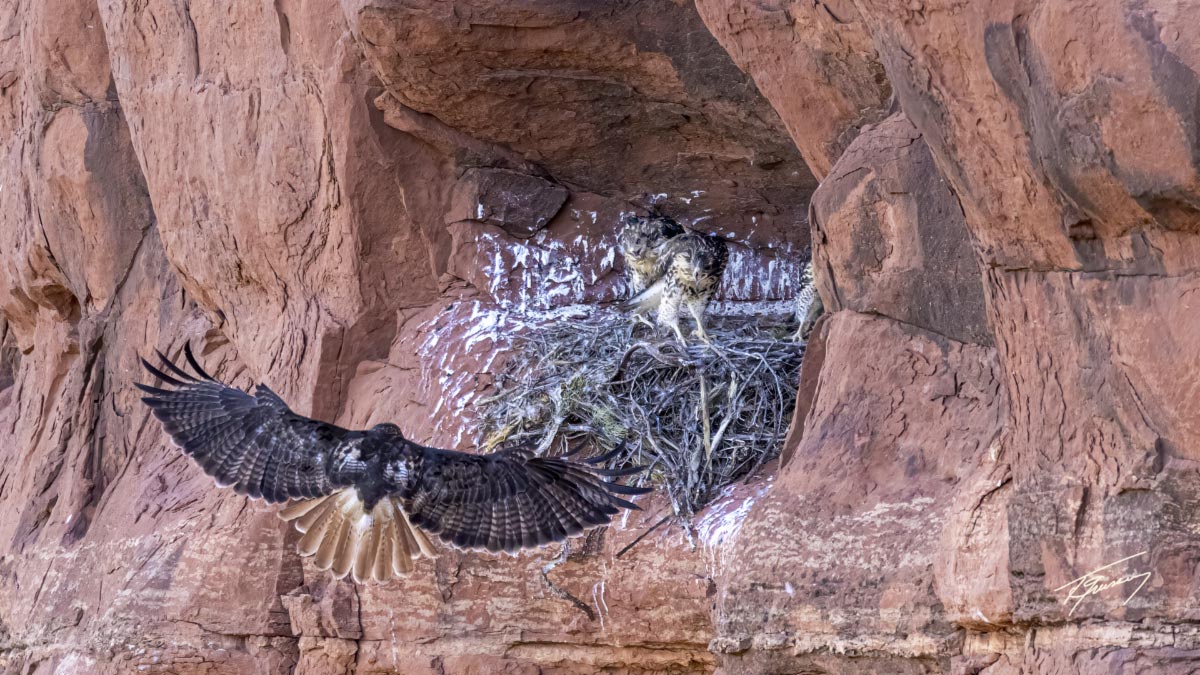
The next photo shows mom bringing a bit of breakfast into the nest for the kids … a tip for you if you want to shoot raptors in and around their nests, they will almost always fly into the nest from below it, as they can fly upwards into the nest area whilst dropping airspeed and kind of stall into the nest. Good to dissipate speed when flying into a cliff wall. When shooting the incoming bird, do not try to get a shot of it alone, rather when you see it coming in, get a focus on the nest and begin shooting and you will get it as it swoops upwards and into the nest.

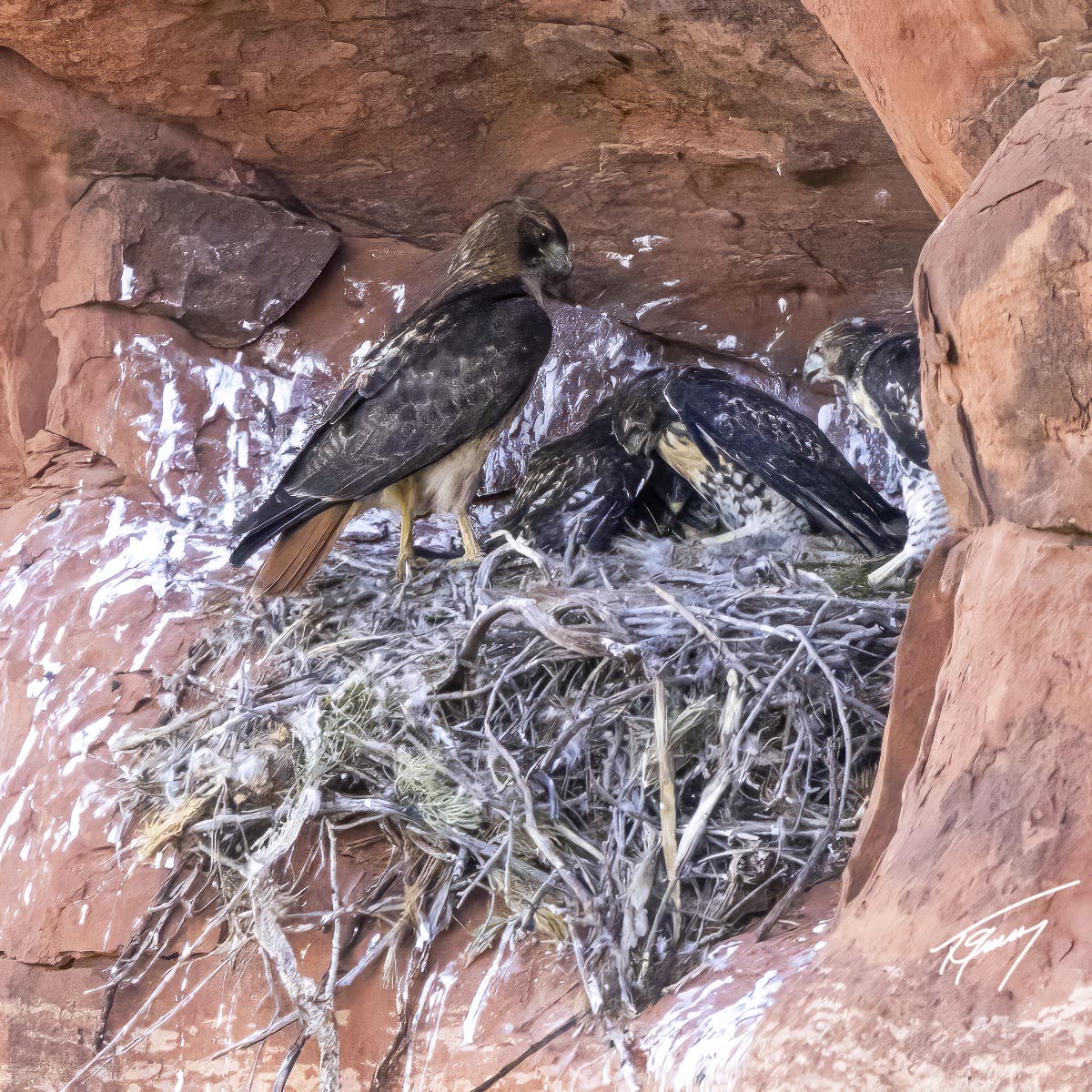
The next shot below that is of one the kids mantling breakfast (covering it up with his wings) this is done to keep others from seeing the food … taking a meal away from another bird is pretty common, but if others cannot see it, perhaps they will get to keep their food. Shortly after this mom left the nest to go find more food for the family.

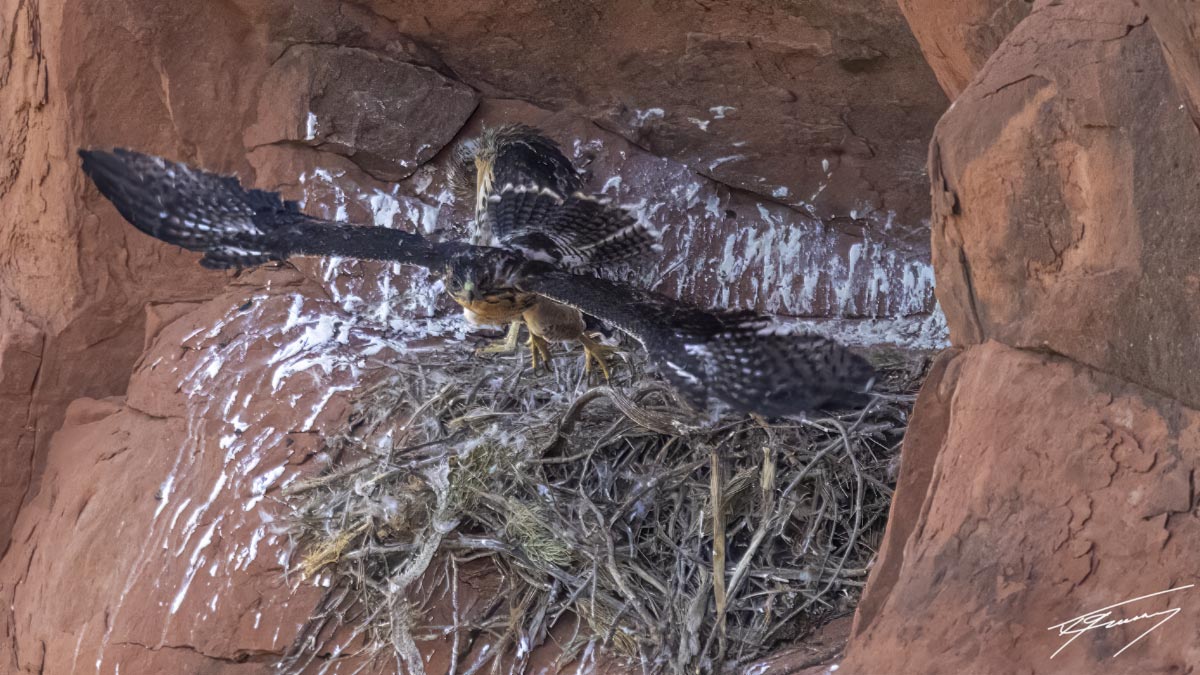
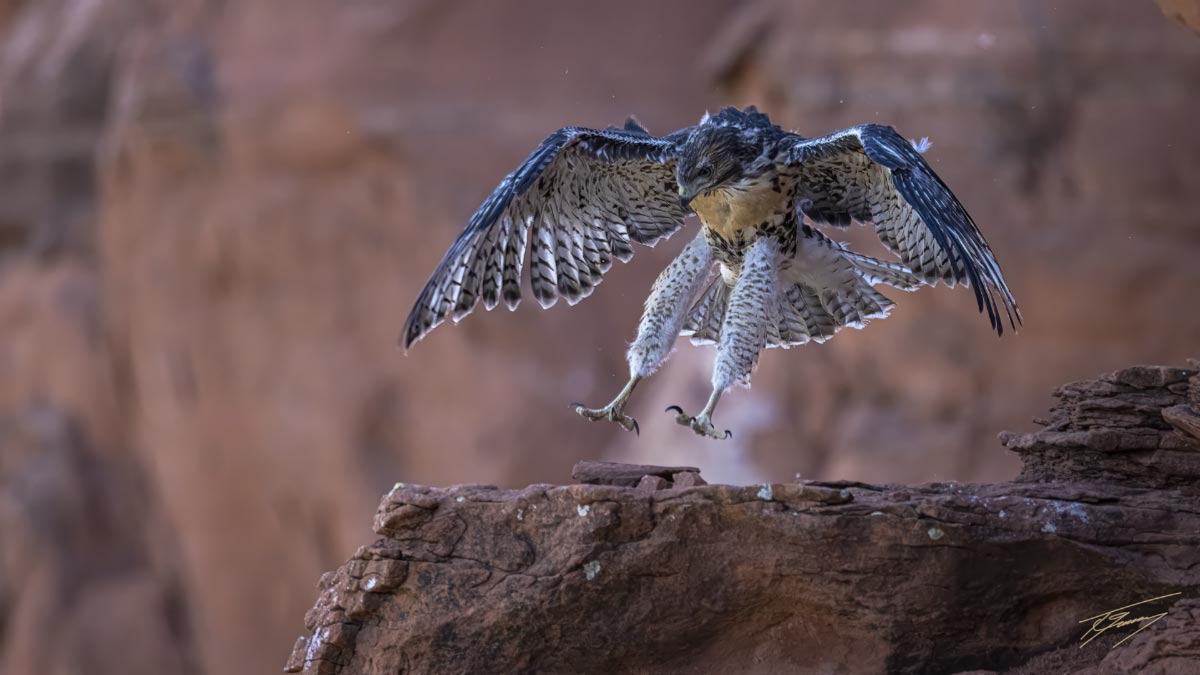
About ten minutes later, one of the kids made a couple of runs with wings flapping to the edge of the nest, but stopped short of going airborne … on the third try, he steeped into the abyss and went airborne … he ended up coming into an outcropping from the cliff about 40 feet from me and stuck a perfect landing. He played around on this outcropping for about fifteen minutes before making the flight back to the nest. I spoke with Michele at International Raptor and Falconry Center and she told me that it is common when making a first flight that there there will be a few false starts … after that it is a push off and go! Only deleted half of the photos … so many good ones.

Check the last photo out carefully and you will see remnants of his baby feathers on his head and wings … they will likely hang out around the nest for a couple of more weeks and the adults will still provide food as the young learn the skill of providing for themselves. Life is so terrific!

Into the weekend for me and the plan is to be back Monday morning … keep breathing, smile and make someones day a little better because you are here..

Cheers,

Ted

Whatever else you do or forebear,
impose upon yourself the task of happiness,
and now and then abandon yourself
to the joy of laughter.

excerpt from Whatever Else You Do by Max Ehrmann

###

photo_tedgrussingThe easiest way to reach Mr. Grussing is by email: ted@tedgrussing.com

In addition to sales of photographs already taken Ted does special shoots for patrons on request and also does air-to-air photography for those who want photographs of their airplanes in flight. All special photographic sessions are billed on an hourly basis.

Ted also does one-on-one workshops for those interested in learning the techniques he uses.  By special arrangement Ted will do one-on-one aerial photography workshops which will include actual photo sessions in the air.

More about Ted Grussing


Healing Paws

Healing Paws

This is an advertisement

Hayes Library holding nature photography contest

Hayes Library holding nature photography contest

Hayes, LA (KPLC) – The Hayes Library invites all teens to enter their nature photography contest.

The contest aims to encourage young adults to explore and show off the beauty of Louisiana through photography.

To participate, teens can use a camera or their cell phone to take a photo and submit them to the Hayes Library, located at 7709 Perier Street. Staff at the library will print the photos for free.

The deadline to submit photos is June 13 at 5 p.m.

The photos will be displayed in the library for visitors to vote on.

Winners will be announced at a party on Tuesday, June 27.

John Fielder’s lifetime of Colorado photography can now be viewed online

John Fielder’s lifetime of Colorado photography can now be viewed online
image

Anyone at home can now view the vast and varied beauty of Colorado through the eyes of the state’s most celebrated landscape photographer.

History Colorado on Tuesday announced it had finished digitizing, cataloging and organizing a repository of more than 6,500 images of John Fielder’s illustrious career spanning close to 50 years. History Colorado had previously announced Fielder donating his life’s work in hopes of inspiring an appreciation of nature and climate action.

The photos found on the John Fielder’s Colorado Collection webpage can be pulled for private and commercial use. The site includes curated lists for viewers to explore the mountains and plains of every county in the state just as Fielder did.

For decades, the photos have been seen in coffee table books and across walls of homes and offices everywhere. That includes the office of Gov. Jared Polis.

“This photograph is a constant reminder of the natural wonders found in our state, which generations of conservationists, lawmakers and everyday people have fought to protect for the enjoyment of future generations,” Polis said in a news release. “This collection, and the exhibitions that will come from it, are a chance for us to celebrate John and all he has accomplished, but more importantly, to honor the legacy he has created and the gift he is giving to the people of Colorado.”

Later this summer, History Colorado expects to open an exhibit at its downtown Denver center affording a more intimate journey through Fielder’s career. Much of that career has been dedicated to conservation; Fielder has always sought lands and waters to photograph and show to lawmakers in charge of protection.

The collection “is a profound opportunity for Coloradans to see the breathtaking vistas that define the Centennial State,” History Colorado Executive Director Dawn DiPrince said in the news release, “and evaluate if the relationship we have with the land will allow for our grandchildren to experience the same wonders.”

Upon the announcement of his donation, Fielder in an interview explained how he had seen landscapes change since he started photographing in the 1970s. In a life that saw him lose his wife to illness and son to suicide, Fielder described the loss of nature as heartbreaking as well.

“It’s like losing a wife and son, you think about them every day,” he said. “So too do I think about the impact humans have on Earth and what it’s going to be like here.”

In preparation for the donation, sifting through tens of thousands of files from his pre- and post-digital camera days gave him that reflection. It has been a deep time of reflection for Fielder, 72.

After months of quietly battling pancreatic cancer, he recently went public with the diagnosis.

One “incredible asset to (organizing the collection) is I revisited all these places that have defined my life, the most sublime places in Colorado,” Fielder said in a previous Gazette interview. “That was an incredible treat.”

He thought back to his father from his North Carolina childhood. He remembered the man for volunteering and raising money for charitable causes.

“He was a man who believed you have to give back to your community,” Fielder said. “I’ve been able to give back to my community, and I feel like no matter what happens to me, I’ve achieved all of my goals.”

John Fielder’s lifetime of Colorado photography can now be viewed online

John Fielder’s lifetime of Colorado photography can now be viewed online
image

Anyone at home can now view the vast and varied beauty of Colorado through the eyes of the state’s most celebrated landscape photographer.

History Colorado on Tuesday announced it had finished digitizing, cataloging and organizing a repository of more than 6,500 images of John Fielder’s illustrious career spanning close to 50 years. History Colorado had previously announced Fielder donating his life’s work in hopes of inspiring an appreciation of nature and climate action.

The photos found on the John Fielder’s Colorado Collection webpage can be pulled for private and commercial use. The site includes curated lists for viewers to explore the mountains and plains of every county in the state just as Fielder did.

For decades, the photos have been seen in coffee table books and across walls of homes and offices everywhere. That includes the office of Gov. Jared Polis.

“This photograph is a constant reminder of the natural wonders found in our state, which generations of conservationists, lawmakers and everyday people have fought to protect for the enjoyment of future generations,” Polis said in a news release. “This collection, and the exhibitions that will come from it, are a chance for us to celebrate John and all he has accomplished, but more importantly, to honor the legacy he has created and the gift he is giving to the people of Colorado.”

Later this summer, History Colorado expects to open an exhibit at its downtown Denver center affording a more intimate journey through Fielder’s career. Much of that career has been dedicated to conservation; Fielder has always sought lands and waters to photograph and show to lawmakers in charge of protection.

The collection “is a profound opportunity for Coloradans to see the breathtaking vistas that define the Centennial State,” History Colorado Executive Director Dawn DiPrince said in the news release, “and evaluate if the relationship we have with the land will allow for our grandchildren to experience the same wonders.”

Upon the announcement of his donation, Fielder in an interview explained how he had seen landscapes change since he started photographing in the 1970s. In a life that saw him lose his wife to illness and son to suicide, Fielder described the loss of nature as heartbreaking as well.

“It’s like losing a wife and son, you think about them every day,” he said. “So too do I think about the impact humans have on Earth and what it’s going to be like here.”

In preparation for the donation, sifting through tens of thousands of files from his pre- and post-digital camera days gave him that reflection. It has been a deep time of reflection for Fielder, 72.

After months of quietly battling pancreatic cancer, he recently went public with the diagnosis.

One “incredible asset to (organizing the collection) is I revisited all these places that have defined my life, the most sublime places in Colorado,” Fielder said in a previous Gazette interview. “That was an incredible treat.”

He thought back to his father from his North Carolina childhood. He remembered the man for volunteering and raising money for charitable causes.

“He was a man who believed you have to give back to your community,” Fielder said. “I’ve been able to give back to my community, and I feel like no matter what happens to me, I’ve achieved all of my goals.”

Botanical Photography by Jeri Eisenberg

Botanical Photography by Jeri Eisenberg
image

Jeri Eisenberg works primarily with non-traditional and alternative photo-based techniques. She subverts traditional photography’s emphasis on the representational qualities of the medium, and emphasizes instead the medium’s expressive nature.

Digital captures of flowers, foliage, clouds and shorelines track the four seasons. Compositions are printed on Japanese Kozo paper before it is coated with a thin layer of encuastic (beeswax). There is a strong sense of materiality and seductive surfaces in her work to evoke sense memories and visceral connections. Eisenberg’s photographs steadfastly serve as an affirmation of beauty in the everyday natural world, but is tinged with the bittersweet – a reminder of the temporal condition and an elegy for life.

As an Amazon Associate I earn from qualifying purchases.