‘I’m drawn to absence’: the book that changed artist Sharon Lee’s life


In her first museum show in the United States, this Finnish artist uses her own XL body to bring a new emotional depth to the genre of setup photography.

The strange, discomfiting photographs and videos of the Finnish artist Iiu Susiraja push so many buttons that her provocative exhibition at MoMA PS1 should have been staged in an elevator — to paraphrase the theater critic Peter Marks. These powerful works take aim at a dizzying array of contemporary body image issues, obsessions and taboos, and from different angles, including fat shaming, fitness, obesity, standards of beauty, dysmorphia, self-loathing, self-love and of course sex.
Ambiguously titled “Iiu Susiraja: A Style Called a Dead Fish,” the show features 49 photographs and 13 short videos dating from 2008 to 2022. Most are self-portraits that show her wryly using as props a variety of domestic items — stuffed animals, kitchen utensils and especially food. But the main character is Susiraja, a blond woman nearly six feet tall, who is extremely large, if not morbidly obese, and usually stares out at us with lofty indifference. Like most artists whose work matters, Susiraja has no shame. She also presents something of an emotional blank, knowing that her viewers will fill it in.
Born in 1975 in Turku, Finland, where she still lives, Susiraja (pronounced ee-you susi-rah-yah) started out as a textile designer. In 2007, she took up photography and, turning the camera on herself, began to make starkly direct, somewhat humorous, painfully vulnerable self-portraits. They are complex yet widely appealing, even magnetic. Easy resolution of their meanings is impossible, which creates a rich internal narrative in the viewer, often starting with one’s feelings about one’s own body.
This richness may account for the extensive writing on Susiraja’s art, both inside and outside the art world, despite her relatively brief career. Her first solo gallery shows occurred in 2016 in Finland and the United States — the latter at Ramiken Crucible on the Lower East Side. (A show of new work and small sculptural objects is at Nino Mier Gallery in TriBeCa, through June 17.)
Susiraja’s pictures and videos riff on pornography, fashion photography and art history, while bringing a new emotional rawness to postmodern photography. The precedents for her D.I.Y setups include the French modernist Claude Cahun, and Americans like Hannah Wilke, Cindy Sherman, Jimmy DeSana, Laurie Simmons and James Casebere. In Susiraja’s performative use of her own body she seems most closely related to Wilke, whose final works fearlessly chronicled her unsuccessful fight with cancer, and to DeSana, whose visualization of gay beauty and fantasy, delineate, like hers, a region of otherness.
The show opens with several photographs from 2010, when Susiraja seems to have found her footing. Opposite the entrance, the declarative “Woman” confronts us directly. Seated, wearing all black, she is a monumental, forceful presence.
Crucial to this power is the helmet-like headgear she devised from a white knit cap with herrings stuck in the band, which resemble ear flaps. More herrings peek out of the purple knit gloves she wears, further enhancing the ritualistic stillness of the image. Nothing settles down here: man, woman, athlete, warrior, monarch, deity — all fomented by the artist’s size and her ingenious use of negligible materials.
A Valkyrie awaits in “Training” (also 2021), this time as a headdress embellished with braids (of bread) that turn Susiraja into a Wagnerian heroine. This is not to ignore the treadmill or the work’s title, but to suggest that the cudgel of exercise will be met with resistance.
It may be that Susiraja’s art divides into two halves: proud and heroic, and abject and heroic. As “Training” demonstrates, parts of both can often be found in the same artwork.
Nearby “Bad Legs,” also from 2010, goes mostly abject, although with undeniable belligerence. Evoking an early 1970s William Wegman video, it takes aim at the widespread obsession with legs as a measure of attractiveness and value. Here only the artist’s thick feet and calves are shown. Duct-taped to each leg is a clear plastic bag containing a dainty, slim-heeled pump, which doesn’t seem likely to fit the artist — a painful recognition that is stated with brutal honesty.
In “Gloves” (2019), Susiraja exaggerates the already extreme female ideal endemic to old masters painting. She appears in form-fitting underwear and strikes a Three Graces pose, touching a wood coat tree — like Eve proposing some apple tasting. A pair of yellow rubber gloves tucked into the bottom edge of her bra, and startling bruises that the artist has declined to explain, complete her outfit.
Susiraja displays a marked indifference to aesthetics, which may explain the “dead fish style” of the show’s title. Most of her photographs have an ersatz blandness; they are often inspired by whatever she finds around her apartment or her parents’ home where most of them are also taken. Their life stems from her mountainous body, and what she does to it.
But she juices up several images here by using brightly patterned fabrics as backdrops. For example, the expanses of exuberant plaid in “Sausage Cupid” (2019) are so overwhelming that you almost lose sight of the artist. She rises to the occasion, in a dark blue bathing suit, holding a blue umbrella festooned with strings of sausages, perhaps for Cupid to bestow on deserving couples.
Susiraja’s videos extend her images into short resonant actions, usually around a minute in length, and provide a kind of comic relief. In “Cow” she evokes an udder with a yellow rubber glove, a quart of milk and a shiny milk bucket. In “Stand,” possibly the most humiliating piece in the show, Susiraja fits a wire hanger around her head and hangs it on a coat tree, which requires her to stoop awkwardly. And in “Mirror,” she stands in the kitchen, laying curled pieces of bacon on the glass of a small hand mirror. Fastening the pieces together with some dozen yellow-headed hat pins, she creates a charming little thing: a temporary, miniature Post-Minimal sculpture that was probably soon eaten.
In her essay for the show’s catalog, Jody Graf, assistant curator and organizer of the show, writes of Susiraja, “Her photographs may be funny, but they are never a joke.” It’s slightly gnomic, this distinction, but it suggests that while Susiraja’s works can be amusing, unexpected and shocking, they are never at anyone’s expense. Funny in Susiraja’s case pulls us in, makes us sympathetic and possesses a depth whose bottom we may never reach.
Iiu Susiraja: A Style Called a Dead Fish
Through Sept. 4 at MoMA PS1, 22-25 Jackson Avenue, Long Island City, Queens, (718) 784-2084); momaps1.org.

The first time Markus Klinko was in Dallas, he was practicing his art with a harp and a symphony. Now he seeks it out with a camera and studio lighting — and he’s pursuing some of the most famous artists in the world.
Klinko has built an impressive portfolio of celebrity and fashion photoshoots of musical royalty such as Beyoncé, Lady Gaga, Britney Spears and David Bowie in the time between his first trip to Dallas and the one he’ll take Friday, June 9, for his exhibition at Markowicz Fine Art (1700 Oak Lawn Ave.), which runs through June 22.
“This is a homecoming for me,” Klinko says. “Even though I only lived in Dallas for six months, it was a very important junction of my life.
The exhibition, titled Icons: Bowie to Beyoncé, will show some of his work with famous subjects, but that’s not all. The collection also shows the photographer’s ideas of personal expression and the stories he tells about people who have shaped the steady march of art, fashion, music and popular culture for the last three decades.
“Most of the work you see is by assignment, where record labels and magazines hire me to shoot these projects,” Klinko says. “However, in the last six or seven years, I’ve been more focused on my art career. I’ve been working with 50 galleries all over the world. It’s an exciting aspect of my career, so I have my own ability to create my own assignment.”

Markus Klinko started his American music career in the mid-1980s in Dallas as a classical harp soloist.
Courtesy of Championship Management
Klinko, a native of Switzerland, started his artistic journey as a classical harp soloist at places such as the Conservatoire National Supérieur de Musique et De Danse in Paris and playing with orchestras such as the Paris Opera Bastille. He came to Dallas in the mid-1980s to continue his soloist career in the U.S., playing with the Dallas Chamber Ensemble. He remembers the walls of his apartment being particularly thin. He had to practice 10 hours a day, and the landlord kicked him out of his place.
“Dallas has become such a big city,” Klinko says. “When I was living there, it was more intimate. There was a nightclub called Sam Simeon and I would go a couple of times a week and people would come up to me because they knew I was the harpist.”
In less than a year, he signed a deal with EMI Classics and Columbia Artists Management that took him across the country and around the world. His recording of French harp music with the orchestra at the Paris Opera Bastille won him the prestigious Grand Prix du Disque award.
Then, a hand injury in 1993 derailed his music career at the young age of 33. Unable to play the harp, he sold his instruments and decided to pursue a career in photography “despite the fact I had never owned a camera,” according to a column he wrote in The Guardian.
He didn’t intend to shoot musicians for a living but his agent urged him to take offers, and his cover shoot for Vibe magazine in 2000 of Beyoncé while she was a member of Destiny’s Child supercharged his career and made him one of the most sought-after photographers in the music industry. Beyoncé would call on Klinko several times after that — most famously, to shoot the diamond-studded cover of her Dangerously in Love album.
“When I first shot Beyoncé in 2003, exactly 20 years ago, at that time when it first came out, I don’t know if people immediately looked at it and thought it was iconic but I said she looks cool and she became iconic over time as people kept seeing it everywhere,” Klinko says. “It’s probably my most famous image. I adore photographing her. There’s a give and take, not like discussing in words so much. It’s more like a dance. I understand what she’s going to be doing next. I think she understands what I’m seeing and doing.”
The list of celebrities Klinko has photographed is a lengthy one. Mariah Carey tapped him to shoot the cover for her album The Emancipation of Mimi and her Playboy magazine cover in 2007. His portraits and photographs of cultural icons include model Chrissy Teigen, comedian Chris Rock, singer Alicia Keys, actor Channing Tatum and Rolling Stones guitarist Ronnie Wood.
The late David Bowie asked Klinko to shoot the cover for his 2002 album Heathen, which sparked a partnership that produced some of Bowie’s most memorable and thoughtful images. Klinko’s series of portraits of Bowie are so moving and personal that when Bowie died in 2016, they stood as a tribute to the glam rock icon and his contributions to mankind.
“He scared me,” Klinko says. “It was like too much. I was into Deep Purple and Jethro Tull. David Bowie was too sophisticated for me, and then 40 years later, he calls me up on the phone says, ‘Hi, it’s David. I want you to shoot my album cover.’ It’s pretty phenomenal. I like it a lot.”
Klinko’s connection to fame doesn’t stop at the edges of the photo frame. Some well-known names, including some of the people he’s photographed, are some of his biggest fans and collectors of his work.

The cover for Markus Klinko’s new catalog of photographs features Beyoncé’s famous Dangerously in Love cover, which Klinko calls his “most famous” work.
Markus Klinko/Courtesy of Champion Management
“I’m very fortunate that people like The Weeknd, Beyoncé and Tom Cruise have started collecting my work,” Klinko says.
Thanks to his success, Klinko can also pursue his photographic vision on his terms with more artistic pursuits such as The Angel Factory, a photo series that satirizes the unrealistic beauty standards pushed on men and women using “high-tech medical brands” with a Black Mirror-esque view of the cult of celebrity and fashion. It’s an interesting way to cap a career spent documenting the looks and style of celebrity while making a statement with his impressive body of work.
“As a society, we pretty much created this religion and the religion is that our society of following celebrities and worshipping celebrities almost as if they were deities,” Klinko says. “I feel with my work, I’m always holding up a mirror to society reflecting it back to them and documenting it.”

advertisement


Every day, I use the camera attached to my phone to capture memories and feelings – yet never quite achieve it. I’ve tried to store them in my phone, but they sit there unloved, taking up space in cloud storage and little in my mind. For real reminiscing, I turn to the albums I’ve collated since starting shooting on film. I feel the tangible weight of the book in my hand and flick through soft images of my friends and family, all taken on a second-hand point-and-shoot camera from 1998. Taken over the four years since I first discovered analogue photography, these photos are hazy and often out of focus, yet enable feelings and moods to flood back far more than an iPhone ever could.
As the imminent return of HMV to Oxford Street and the horrifying re-emergence of low-rise jeans can attest to, we’re firmly in an age of Nineties nostalgia. Film photography, whether taken on a cheap disposable camera, a fancy vintage model, or a new, pastel-coloured model from Urban Outfitters, is just another analogue artform seeing a resurgence among Gen Z. Phillip Grey works at Darkroom London, a community photography darkroom in north London. The studio also runs analogue photography courses, and he tells me that the vast majority of people who take part fall into the 20 to 35 age bracket. “[For] most of them, this is often their first encounter with a darkroom,” he tells me. “Even though they may have been shooting film now for a few years, they’ve certainly not had hands-on experience”. Those at the younger end might have been born in a post-film world, but are now eager to step into the past.
While high-quality digital photos can be captured in bursts via our phones, film photography is more precarious – there is a grit to the images, and an uncertainty baked into the process. Photos from a good roll can serve as a time capsule; incorrectly loading a camera can amount to an expensive pile of nothing.
Growing up, I never had much interest in photography (besides the pink digital camera I would take to concerts, later uploading all 180 photos from the night to Facebook albums called things such as: “McFly Bristol!!! Best day of my life!!!”.) Film photography was first dabbled with before I really knew what it was. In the big Boots in town, I would track down the last disposable camera for festivals and parties; the fuzzy, blurry pictures mimicking the hazy, Smirnoff Ice-fuelled memories. In 2019, I decided to give it a proper go, buying a cheap secondhand camera on eBay that broke halfway through the first roll. It was a learning curve (one I’m still on), but that was part of the fun! This was the first hobby I’d found as an adult – I wanted to invest my time.
Many factors are drawing young people to film photography, but primarily it’s to do with nostalgia. There is a film “aesthetic” that users of social media have always gravitated towards – filters were the norm in early Instagram, for instance, designed to emulate the grainy, golden-hour feel of 35mm film or vintage Polaroids. Today, the popular Huji app can lend digital photos the look of shots taken on a disposable camera, giving them a warm, saturated glow and even a 1998 timestamp in the corner.
Here, the appearance of film photos is the crucial factor, rather than the photographic act itself. Calum, a 26-year-old director who takes photos both casually and professionally, says that “everyone sort of knows the ‘film look’ – it can be hard to put your finger on at times, but something in the grain, the colour palettes, and the occasional light leaks or errors are far more emotionally engaging than an immaculate digital image.” Nothing sums this up more than the “iPhone versus Film” TikTok trend, where users take the same photos on their smartphones, then immediately again on film, highlighting the aesthetic difference in the images. The phone may have the technical quality, but film has the feeling.
There’s nothing wrong with using an analogue medium to post online – it is a truth universally acknowledged that everyone looks hotter on film, so why not? But taking old-school photos today can also allow us to push back against technology. Hugh, 25, works in theatre production and takes photos on film in his free time. He says that analogue photography makes the act feel like an art form again, where you’re focused on capturing the perfect picture rather than taking the same photo repeatedly. “It makes those images you capture feel a bit more precious,” he says.
I used to take film pictures much more regularly than I do now. It’s upsetting… The reality is that costs just keep going up
The popularity of film photography offers a brief respite from our “hurried and harried” digital age, Phillip suggests. “I think a lot of people just want to jump off that bandwagon and do something that’s a little bit more reflective and slow,” he says.
It takes time to use up a roll of film – whether your roll can capture 24 or 36 pictures – while trying not to waste any shots. The wait can leave you feeling excitement, anticipation, and even a sense of dread. When I went through a break-up halfway through a roll of film, I forwarded the developed photo file to a friend, asking her to take out any photos of my ex taken before my heartbreak began around photo 16. Some things you don’t need to see.
From purchasing your first camera to getting those images back, analogue photography can be a complex, costly process, though. You have to figure out how to use the camera, shoot an entire roll before you can get any developed, and get prints made before you can put together an album to pass around like an embarrassing parent. There have been ways to do it fairly cheaply, from buying used camera models on eBay to finding an affordable independent development lab. What cannot be avoided now, however, is the skyrocketing cost of colour film itself. In recent years, even the cheapest film has tripled in price, making this fun hobby inaccessible to most.
When I started shooting on 35mm four years ago, the film itself was the cheapest element. Three rolls of Kodak’s beginner-friendly ColorPlus, each giving 36 photos, could be picked up for less than £3 each. Now, though, the same film has more than tripled in price on even the cheapest of outlets. Naturally, we’re in a cost of living crisis, and inflation is making everything more expensive. But it’s an issue specific to analogue photography, too. Film is expensive to produce, while certain resources needed in the process are growing difficult to source for cost and environmental reasons.
For many amateur photographers, the price of film means the hobby is being put on hold – or at least slowing down
FujiFilm, one of the few colour film producers, virtually ceased production in the last decade, while industry leader Kodak filed for bankruptcy in 2012. Kodak, however, has been able to profit from our nostalgia, dominating the colour film market once again. Their prices have steadily risen since 2019, which photography magazine Silvergrain Classics blamed on “the surge in demand for film and the subsequently necessary investment in machinery and personnel to keep up with production”.
Since then, Kodak has seen increasing profits, with Grey suggesting that their lack of competition has played a large role in the rising costs. Black and white film, which his lab specialises in, has also slightly increased in cost, but nowhere near the extent of colour. Calum has seen it with his own eyes. He’s stopped using Kodak’s premium Portra colour film – “the classic Instagram film stock” – which will set you back £20 a roll, and largely now uses black and white film from companies such as Ilford instead.
For many amateur photographers, the price of film means the hobby is being put on hold – or at least slowing down. Hugh, once a keen photographer, says he now largely saves film photography for special occasions, not wanting to waste expensive stock on less important pictures. “I used to take film pictures much more regularly than I do now,” he says. “It’s upsetting… The reality is that costs just keep going up.” Calum agrees, adding: “Half the fun of film photography is the experimentation. If your experiments cost you £20 a roll, plus development and scanning, it becomes quite hard to justify on grounds of ‘fun’.”
It’s a trend we’re seeing across the board. When everyday items are tripling in price and people are struggling to heat their homes, photography, naturally, isn’t a priority. But in a world where we’re increasingly pressured to work long hours and eschew hobbies – or, alternatively, to monetise them – it’s not just the hobbies we lose. It’s allowing yourself the time to learn a skill for fun, and in the case of analogue photography, capture moments you will cherish. Learning to shoot on film is a process of trying, failing, and trying again; I’d hate to lose that.

Robin Layton’s new photography book “rain” contains 146 pictures of droplets, puddles, reflections and other images celebrating wet weather. #k5evening
SEATTLE — A Pulitzer Prize-nominated photographer from Seattle has done what some think is impossible: make the Northwest’s notoriously wet weather a thing of beauty.
Robin Layton’s new photography book “rain” includes nearly 150 images of droplets, puddles, reflections and other imagery.
“Rain has a very negative connotation, right?” Layton said. “I actually think rain is beautiful because it distorts reality. And when you really look at what rain can create, either right before or right after, it’s quite amazing.”
It’s also nothing new to Layton, who’s shot in all manner of Northwest weather – first, during her work as a photojournalist for the Seattle P.I. (she once snapped a famous front page image of Ken Griffey Jr. under a celebratory pile.)
After 16 years with newspapers, she became a visual artist and started working with celebrity clients like Jennifer Aniston, Oprah Winfrey, Tom Hanks and Barack Obama.
She also published photography books about everything from basketball to the natural wonders of Lake Washington.
She was inspired to create “rain” after 2022’s record precipitation.
“After it rained for three months, I was like, ‘Oh my gosh,’” Layton said. “Rain! Hello, I live in Seattle. Seattle equals rain.”
She shot images for the book exclusively for about a year.
“There are 146 (pictures) that I love that are in the book,” she said.
The cover photo is one of the most striking, taken through a clear umbrella at Mount Vernon’s tulip festival. Bursts of color make up the background, and each individual raindrop in the foreground reflects tulips. It’s completely real – no Photoshop involved.
“I was a photojournalist for 16 years so I have that mentality of making it real and not Photoshopping,” Layton said. “Everything I shoot is from camera to paper, which I’m really proud of.”
With only 750 copies of the book available, “rain” is a special edition fine art coffee table book.
Any of Layton’s images can be purchased as fine art pieces, and she also creates original one-of-a-kind works combining her photos with found objects (mostly vintage and antique.) Examples include pictures framed by foundry pieces and video installations mounted in the window space of old car doors.
Her own house is decorated by her work.
“I think the creation comes first, and then I’ll find a spot for it,” Layton said. “I need more walls.”
Layton believes passion equals purpose in art and life.
“Everything I’ve done since I left the newspaper world has been a personal project,” she said. “It doesn’t matter if you’re full-time working at another job, find a personal project that you love and just dive in. You’ll be surprised what can come from it.”
“rain” costs $395 and every copy is signed and numbered. It’s available on Layton’s website.
She will also take the stage at Benaroya Hall on Saturday, Nov. 18 for a book and concert event with guitarist Todd Boston. Tickets go on sale later this year.
KING 5’s Evening celebrates the Northwest. Contact us: Facebook, Twitter, Instagram, or Email.

MASON CITY, Iowa (KTTC) – An Arizona man is on a mission to photograph every Frank Lloyd Wright property in the world and he is stopping in Mason City next month.
Andrew Pielage is an internationally published architectural and travel photographer and gallery owner based in Phoenix. His mission is to photograph all of Frank Lloyd Wright’s remaining designs.
Pielage offers photography workshops year-round, which are supported by Canon USA, and is also an Adobe Contributor.
While in Mason City, Pielage will host an advanced photography workshop at the Historic Park Inn Hotel June 2-4, 2023.
The 3-day workshop includes a tour and exclusive photography access not usually given at each of the three Wright sites: Historic Park Inn Hotel, Stockman House, and Cedar Rock.
Students will have the opportunity to photograph, experience, and stay in the last remaining hotel designed by Frank Lloyd Wright.
Due to high demand and the limited rooms available, the hotel reached its occupancy for the weekend of the workshop. The cost of the workshop was adjusted to $999 for those who are not able to stay in that hotel. Other hotel options are available.
More information can be found here.
Copyright 2023 KTTC. All rights reserved.


… one more from Tuesday … a Great Blue Heron was successful in his dive for a fish and is getting out of Dodge before any of the competition tries to take it away from him … occasionally eagles will see a heron, osprey or other large bird with a fish and take it away from him … if the other bird is smart, it drops the fish and flees lest it join the fish as food.
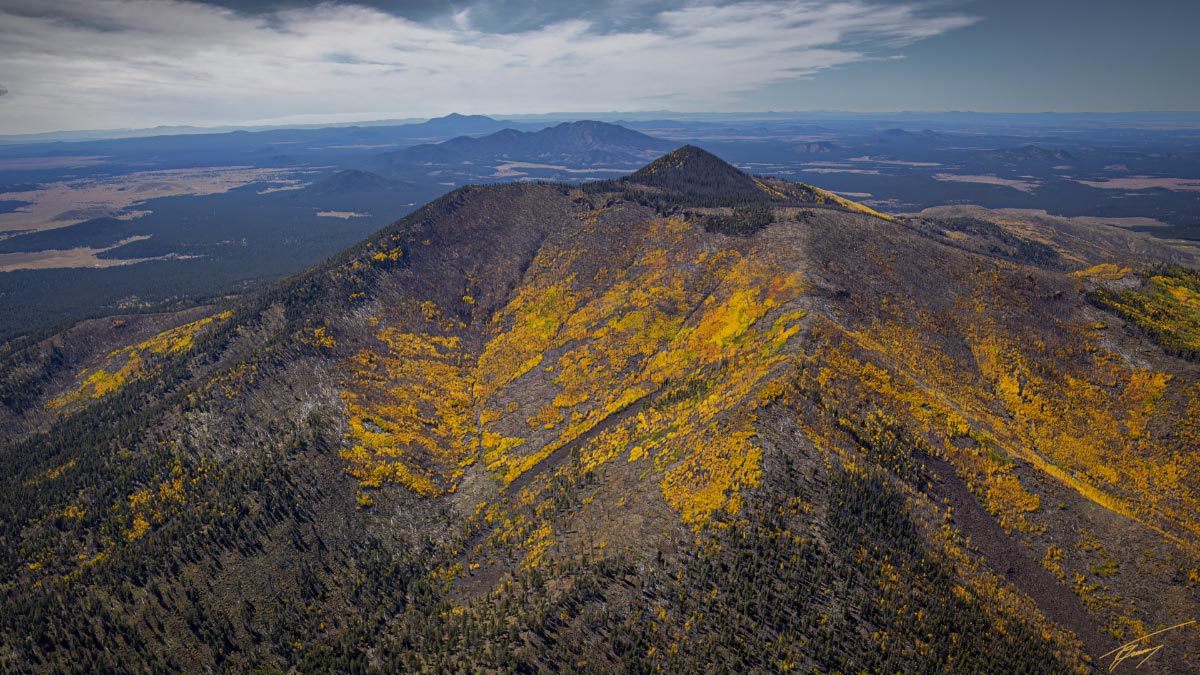
Below is a lineup of Kendrick Peak in the foreground, then Sitgreaves Mountain and finally Bill Williams Mountain … about 3 million years of history in the San Francisco Volcanic Field … and the field remains active today.

Shooting the Red Tail Hawks and young ‘uns early in the morning, so this is a wrap. Have a beautiful day and tomorrow evening you’ll get a look at how they are doing.
Heads up for the September issue of Sedona Monthly … it will feature a multi page article with plenty of photos … subject is the San Francisco Volcanic Field and this is a project that Wayne Ranney and I are collaborating on. Consider a subscription to Sedona Monthly to get this special and more in the future!
Have a beautiful day … share a smile with someone and above all else … keep breathing!
Cheers,
Ted

The green of all the fields is mine,
The stars, the night, the wind at play,
A peaceful heart , while quietly
I go m way,
excerpt from My Way by Max Ehrmann
###
 The easiest way to reach Mr. Grussing is by email: ted@tedgrussing.com
In addition to sales of photographs already taken Ted does special shoots for patrons on request and also does air-to-air photography for those who want photographs of their airplanes in flight. All special photographic sessions are billed on an hourly basis.
Ted also does one-on-one workshops for those interested in learning the techniques he uses. By special arrangement Ted will do one-on-one aerial photography workshops which will include actual photo sessions in the air.
More about Ted Grussing …

Many photographers who get into medium format come to it with large collections of full frame lenses, and as such, it would be great if they could work on their new gear. Two of the best candidates are Canon’s TS-E 17mm f/4L Tilt-Shift lens and TS-E 24mm f/3.5L II Tilt-Shift lens, and these helpful videos take a look at how they hold up on a Fujifilm medium format sensor.
Coming to you from Keith Cooper, these awesome videos take a look at how the Canon TS-E 17mm f/4L Tilt-Shift lens and TS-E 24mm f/3.5L II Tilt-Shift lens hold up on a Fujifilm GFX medium format sensor.
The problem with using a full frame lens on a medium format sensor is that the image circle normally will not cover the entire sensor, leading to unusable levels of vignetting. However, the difference with a tilt-shift lens is that due to the tilt and shift functions, manufacturers build them to have much larger image circles to maintain full sensor coverage, which means they can often handle a medium format sensor as long as you limit their movements a bit. Check out the video above for the full rundown from Cooper.





