Photography

Photos From Turkey’s Convulsive Decade

Photos From Turkey’s Convulsive Decade

The Magnum photographer Emin Özmen remembers the day in 1993 when radical Islamists set fire to the Madımak Hotel in his hometown of Sivas, Turkey, killing 37 people. Intellectuals and artists had gathered there for a festival honoring a 16th-century Alevi poet.

Many of those who died were themselves Alevis, members of a Muslim sect that is a minority in Turkey. During the 1970s, right-wing Sunni groups often fought Alevi leftist groups in the streets. The violence eventually subsided, but tensions remained—the horror at Madımak, when Özmen was 8 years old, was the result. It made Özmen want to become a witness.

Picture of a mourning crowd at the Kocatepe Mosque in Ankara; a day after a failed coup attempt by the Turkish military.
A mourning crowd at the Kocatepe Mosque in Ankara, the day after a failed coup attempt by the Turkish military in which at least 265 people died, including soldiers, police, and civilians, July 2016
Picture of Syrian children playing in Istasyon neighbourhood of Mardin.
Syrian children play in the Istasyon neighborhood of Mardin, October 2, 2020.
Picture of protests to support Bogaziçi students who were arrested for displaying a rainbow flag.
Protesters support Bogaziçi students who were arrested for displaying a rainbow flag at another protest, in Istanbul, March 2021.

On Sunday, May 14, Turkey’s first Alevi candidate for president, Kemal Kılıçdaroğlu, faced off against Turkey’s longtime autocrat, Recep Tayyip Erdoğan, a Sunni Muslim who rose to power in 2003, five years before Özmen became a working photojournalist. Over the course of Özmen’s career, he has watched and documented as Erdoğan has transformed Turkey from an aspiring democracy into a polarized autocracy with a failing economy.

Those Turks who have suffered from repression, violence, and hunger these past 20 years believed Kılıçdaroğlu might have a chance at winning this week, despite the vociferous opposition to him from Turkey’s right-wing populace, which disdains him because he is an Alevi liberal and because he is not Recep Tayyip Erdoğan. But neither candidate gained the required 50 percent of the vote. The election will go to a runoff on May 28, and Erdoğan still has a chance—many Turks see it as a foregone conclusion—to prevail as president for another five years.

“A whole generation and I were only going to know this shadow,” Özmen writes in his beautiful new book, Olay. “To grow up despite this shadow, to try to build ourselves despite this shadow. This shadow is still there, twenty years later.”

Left photograph showing a fire seen near a gas station. Right photograph showing the covered bodies of 12 people kept in a slaughterhouse in Sirnak.
Left: A fire seen near a gas station in Hasankeyf, 2020. Right: The bodies of 12 people are kept in a slaughterhouse in Sirnak.
Picture of Turkish riot police using tear gas while Syrian Kurds cross the Turkish -  Syrian border.
Turkish riot police use tear gas as Syrian Kurds illegally cross the Turkish-Syrian border in Suruc, September 2014.
Picture of a boat full of migrants illuminated by the flashlights of Turkish coast guards in Bodrum, Turkey
A boat full of migrants is illuminated by the flashlights of Turkish coast guards, who have come to rescue them near the Greek-Turkish border. This small boat’s engine failed, and seven refugees from Syria, ‎Pakistan, and Afghanistan were stranded in the middle of the sea near Bodrum, 2015.

Özmen sought to capture in his photographs the sense of constant terror his generation and his people have endured, particularly in the past 10 years. As he writes, many Turks have been silenced under Erdoğan, and his photos, even those of active violence, have an eerie quietness to them, as if the volume has been turned off on a TV. (His work recalls Gilles Peress’s influential Telex Iran.) Özmen uses this quality to evoke what he describes as a sense of “powerlessness in the face of so much injustice and violence.”

The events (olay can mean “event” or “incident” in Turkish) he depicts are famous ones: the 2013 Gezi Park protests, in which thousands of people revolted over the construction of a mall on one of Istanbul’s last stretches of green space; the war between the Turkish state and the Kurdistan Workers’ Party (PKK) in the southeast in 2015; the attempted military coup against Erdoğan in 2016; the continuing Syrian-refugee crisis.

Most of the photos are black-and-white and without captions, choices that foster the strange effect of universality—documenting the tragedies as ones the Turkish people experienced collectively, even if they themselves never marched in the streets, or ran from bombs, or attempted to sneak illegally across the Greek border. The events are what Turks carry inside them; they are what their country has become. Özmen calls his own mind “the victim of a violent wind.”

Left picture showing smoke and tear gas fill the sky as Turkish police and protesters clash near Taksim Square on the first day of the Gezi Park protests. Right: The minaret of a sunken mosque emerges from the reservoir of the Birecik dam.
Left: Smoke and tear gas fill the sky as Turkish police and protesters clash near Taksim Square, in Istanbul, on the first day of the Gezi Park protests, June 2013. Right: The minaret of a sunken mosque emerges from the reservoir of the Birecik dam, in Gaziantep, 2019.
Picture of people watching the confrontation from a building as protesters clash with Turkish police during the Gezi Park protests.
People watch from a building as protesters clash with Turkish police during the Gezi Park protests, in Istanbul, June 2013. The civil unrest began in May 2013, when a sit-in protesting an urban-development plan was violently evicted from the park.
Picture of a women laying down on the ground as police used tear gas to disperse crowd at Taksim square on the first day of Gezi Park protests in 2013.
A women lies down on the ground in shock as police use tear gas to disperse the crowd at Taksim Square on the first day of Gezi Park protests, in Istanbul, May 2013.
Picture of people gathering to show solidarity with Palestinians after Israel's assault on Palestinian civilians at the Gaza border.
People gather in Istanbul to show solidarity with Palestinians after Israel’s assault on Palestinian civilians at the Gaza border, May 2018.

Over the course of the decade that Özmen recorded, Turkey endured several natural catastrophes: earthquakes in Van, Elazığ, and Düzce, as well as raging wildfires in the Aegean region. The government’s responses to these events struck many Turks as a surprising failure. They were a harbinger of the country’s future.

In February, two devastating earthquakes struck southern Turkey in 24 hours, killing at least 50,000 and as many as hundreds of thousands, while making millions homeless. By now much has been written about why the earthquake was so deadly. Erdogan had built his authoritarian system on a corrupt construction economy and centralized the state so much around himself that many of its institutions failed to respond to the disaster. In many ways, the weeks after the earthquake felt like the culmination of the Turkish people’s psychological experience of the past 20 years.

Turks were not only grieving or terrorized in February. Many knew that the 21st-century dystopian future that haunts our collective dreams, whether because of climate change or war or authoritarianism, had come for them. Thousands of people, rich and poor, lay crushed under their own possessions, and as day turned to night, in rain and snow, dead bodies lay in the street with no one to bury them; men, women, and children cried out from the rubble with no one to save them.

Those left alive were forced to witness this new world: Their families were gone, their houses were gone, food and water were gone, the roads were gone, the airports and ports were gone, the police were gone, the fire department was gone. They now lived in a wasteland, the kind we often say only nature is powerful enough to create. But only man could have created such a magnificently rigged apocalypse, and in 2023, the 100th anniversary of the Turkish republic, this act of creation was the work of one.

Turks always remind me that their country has been around for a long time. The Erdoğan era has lasted only 20 years, and even this strongman couldn’t crush the Turkish people’s history—that enduring, democratic desire to live and love that Özmen portrays so heartbreakingly in his photos.

Left photograph showing a religious frame with the inscription “God” on the wall of a house in Hasankeyf. Right photograph showing civilians hang a white flag on their house to show they are unarmed in Nusaybin, Turkey. Right photograph
Left: A religious frame with the inscription “God” remains on the broken wall of a house in Hasankeyf, an abandoned historical town in Batman that was engulfed a few months later by the Ilisu Dam project, in 2020. Right: In January 2016, civilians in Nusaybin hang a white flag on their house to show that they are unarmed. Since October 2, 2015, Turkish authorities have imposed seven very strict curfews in this Kurdish town in southeastern Turkey.
Picture of people removing the bodies of their loved ones and relatives from the village cemetary as water levels rise at Ilisu Dam reservoir lake in Sirnak, Turkey.
People remove the bodies of their loved ones and relatives from the village cemetery after a government hydroelectric project causes water levels to rise in the Ilisu Dam reservoir lake, in Sirnak, September 2019.
Picture of people fleeing in shock, flee from homes as mortars continue landing in several locations in Akcakale, Turkey.
People in shock flee their homes Akcakale during fighting between the Turkish military and Kurdish PYD rebels the day after Turkey launched its military operation in northern Syria, 2019.
Picture of a a fire raging on in Dalaman, Turkey over a village near the airport.
A fire rages in Dalaman over a village near the airport, August 2021. In July and August 2021, 299 forest fires ravaged the Mediterranean region of Turkey in the worst-ever wildfire season in the country’s history.

One month after the earthquake, I was eating dinner on the terrace of my hotel in İskenderun, where a group of men and women sat at a nearby table drinking and smoking. A car pulled up and a woman got out, screaming, and a blond woman from the table ran to help her sit down.

“How could I not have known they were dead!” she cried. “I just saw on Facebook … How could I not have known!”

They consoled her. She kept crying. They tried sterner words.

“Sister, calm down,” one man said. “We have to be strong. Look, I have buried 40 friends.”

They were stealing sips from a bottle of spirits under the table, ordering more wine. The woman was still weeping. The blond woman spoke to her again with a clear voice.

“Sister, God is testing us,” she said. “Look at her.” She nodded at another woman across the table, who bowed her head. “Her friend is in the hospital. When they found her children in the rubble, they were hugging.”

in MAST, andreas gursky captures globalization in the world of work from bahrain to arizona

in MAST, andreas gursky captures globalization in the world of work from bahrain to arizona

‘Visual Spaces of Today’ by Andreas Gursky

Starting May 25th, 2023, German photographer Andreas Gursky exhibits 40 of his images that document  globalization and mass consumption at Fondazione MAST in Bologna. Titled ‘Visual Spaces of Today,’ the exhibition, co-curated by Urs Stahel, spotlights the photographer’s thematic images that suggest perspectives on work, the economy, and globalization.

Each photograph reveals the concrete spaces of production plants, goods-handling centers, temples of consumption, transport hubs, energy and food industries, and financial centers across the world. Gursky selected the images as he kept the acronym MAST in mind, which stands for Manifattura di Arti, Sperimentazione, Tecnologia (Factory of Arts, Experience and Technology).

Included in the exhibition, which overlaps with Fondazione Mast’s 10-year celebration, are 40 images by the artist, dating from his early works (Krefeld, Hühner, 1989) to his more recent production (V&R II and V&R III, 2022), travelling great lengths, from Salerno (1990) to Hong Kong (2020), and combining the modern tourism industry (Rimini, 2003) with age-old production processes (Salinas, 2021).

in MAST, andreas gursky captures globalization in the world of work from bahrain to arizona
Andreas Gursky, Lehmbruck I, 2013, image © designboom | | header image: Andreas Gursky, Salinas, 202 © ANDREAS GURSKY by SIAE 2023, photo by Sprüth Magers | images courtesy of Fondazione MAST

Salerno marks Andreas Gursky’s landscape photography

Andreas Gursky sits inside Fondazione MAST, a solemn expression crossing his face, and ponders the selection of images that are dear to him. One of them is Salerno (1990), the first image in the exhibition, greeting the viewers into his documentary den of photographs. He was cruising along the Italian coast by the seaside one holiday, and all of a sudden, the uniformed rows of vehicles and stacked port containers came into view. Gursky had learned the ropes of black-and-white photography in art and even crossed the path early on in his career. This time, in Salerno, he took out his camera and captured the industrial landscape in full color.

‘I wanted to photograph that landscape, and I told myself, it is time for me to do what I want. I used a tripod for this one and quickly snapped the images because the sun was already setting. Then, I was not sure if it would become an image of mine, but when I got back to my workshop and looked at the result, it also seemed like a postcard. I must say this image is important to me because it inaugurated my landscape photography. When I look back at this image, I recognize the moment I shifted my approach to large-scale photography. This image was a turning point for me,’ says Gursky during the press conference at Fondazione MAST.

in MAST, andreas gursky captures globalization in the world of work from bahrain to arizona
Andreas Gursky, F1 Boxenstopp I, 2007, image © designboom

Globalization in the world of work

Large-scale photographs of Andreas Gursky grace the exhibition space of Fondazione MAST. The intentional size encourages viewers to step beyond the designated line view to scrutinize the images and find details that plain sight may miss at first glance. Globalization in the world of work brews gradually in mind until the viewers come to terms with the world they live in running on mass consumption and the ever-transmuting economy influencing the way people work. Yet beyond the social and political themes Gursky has captured, a poetic and nostalgic tone shadows the photos through the details viewers might look past when they glimpse at the shots for the first time.

For Kamiokande (2007), Gursky flew to Japan and photographed the neutrino detector research facility and observatory. ‘It was around 1,000 meters below the sea level to prevent catching radiation,’ says Gursky. He adds that normally, the facility would be full of water, but during his visit, the cavernous observatory seemed to lack it. Tiers of golden spheres lure in the viewers and retain their attention as they gaze at the image, floating yet attached to the wall of the facility. In Gursky’s image, the globes seemingly glow in sequence, almost tricking the viewers of the detail that makes the image odic. Glancing on the lower right, two oars with rowers paddle through the still water. ‘Without these boats, the image would have been scientific. I was moved by this detail. It gives the image a romantic and musical perspective,’ says Gursky.

in MAST, andreas gursky captures globalization in the world of work from bahrain to arizona
installation view | image © designboom

Compositions and uniformity in art photography

Composition matters to Andreas Gursky. While post-editing can help, being in the moment and snapping the shot at the right time and angle are deemed essential to the photographer. At times, Gursky looks for fragments that can piece the whole picture together, an attempt viewers can see in Bahrain I (2005). Here, he hopped on a helicopter and armed with his camera, he circled around the Bahrain International Circuit raceway like a vulture waiting for its prey. Past the photos and into the editing, Gursky created a snaking racetrack that slopes down from a sandy mountain, every car and person disappearing from the pictorial canvass. 

Uniformity follows balance, and such a style is seen in many of Gursky’s images. In RHEIN II (1999), a chance encounter occurred. ‘It is not how I imagined the final result would be, but after that, I started to reflect on how I took photographs and was working along the theme of abstract expressionism,’ he says. The image oozes tranquility in nature. Gursky was on a hike and jog when he found himself running along the bank of the Rhine River. At some point during his run, he paused and saw an image of a large abstract horizon in nature with the green grass and water flow stretching endlessly like a seamless tape. There, he knew it would be an image showcasing the stillness on the horizon that is free from disruption.

in MAST, andreas gursky captures globalization in the world of work from bahrain to arizona
installation view | left: Andreas Gursky, Toys’R’Us, 1999, image © designboom; right: Andreas Gursky, Tokyo Stock Exchange, 1990, image © designboom

Salinas in Ibiza as an image of respite

Serenity within rapid globalization and pocketed quiet moments in times of city frenzy come into play inside Fondazione MAST. Andreas Gursky masters pulling the viewers into the painterly compositions of his images for visual purposes while pushing them into the sphere of social and political nuances pervasive in his industrial and landscape photographs. One moment, the viewers bask in silence, reveling in the transient stillness, then seconds later, gradually rather than abruptly, they see the world they live in, back to the ground from the temporary high.

The last image that Gursky discussed at Fondazione Mast was Salinas (2021). The photographer went to Ibiza and captured the landscape of salt pools at the feet of rugged, rocky hills. No unmistakable details spring into view; just silhouettes of the grided pools and mountains. The obscure lines and slopes underline the picturesque landscape, snapped at the right time and at the right angle. The sun has sunk but painted the sky with orange hues, and the halcyon of the water reflects the surroundings. Gursky, his camera ready, captured the respite, breathing in the wondrous silence and breathing out globalization in the world of work for a while.

in MAST, andreas gursky captures globalization in the world of work from bahrain to arizona
installation view | photo by Luca Capuano

in MAST, andreas gursky captures globalization in the world of work from bahrain to arizona
installation view | photo by Luca Capuano

in MAST, andreas gursky captures globalization in the world of work from bahrain to arizona
installation view of Andreas Gursky, Kamiokande, 2007 | photo by Luca Capuano

‘An incredible experience’: Forty years of Cannes film festivals through one man’s camera lens

‘An incredible experience’: Forty years of Cannes film festivals through one man’s camera lens

When Eric Gaillard first went to photograph the Cannes Film Festival in 1981, it was a smaller, more intimate affair.

It was the kind of place where you could see the greats from Hollywood’s Golden Age like Lauren Bacall or Ava Gardner wandering alone on the esplanade or having fun on the beach without bodyguards.

Aishwarya Rai poses on the red carpet at the 70th Cannes Film Festival, 2017. ()
Morgan Freeman poses at the 58th Cannes Film Festival, 2005. ()

Returning for his 40th time,  Mr Gaillard found a different beast — larger, more multicultural, with more restrictions on where photographers could stand to try and get that viral snap or capture the moment when a movie star gets caught off-guard sharing an intimate smile, striking a goofy pose, or having a bad hair day.

Elizabeth Taylor and George Hamilton arrive at the 40th Cannes Film Festival, 1987. ()
Diego Maradona plays with a ball while promoting the film Maradona by Kusturica at the 61st Cannes Film Festival, 2008.()
Actor Penelope Cruz waves as she leaves the screening of Pedro Almodovar’s film Volver at the 59th Cannes Film Festival, 2006. ()
The 2021 edition of the festival looked a little different. ()

The 76th edition of the festival, taking place from May 16 to May 27, has seen Cannes’ usual population triple to 230,000 people to watch films, rub shoulders with celebrities and — in some cases — compete for the coveted Palme D’Or.

Actor Kristen Stewart removes her heels on the red carpet at 2018 festival.()
Director Michael Moore holds the Palme d’Or for his documentary Fahrenheit 9/11 in 2004. ()
Actor Nicole Kidman signs autographs while promoting the film The Killing of a Sacred Deer in 2017.()
Late director Agnes Varda is seen on a screen during her tribute ceremony at the 72nd Festival,  2019.()

Gaillard, who is retiring after this festival, was there for Reuters, snapping Michael Douglas pointing at the camera with a cheeky grin and a besuited Harrison Ford receiving an Honorary Palme D’Or.

Harrison Ford poses with his Honorary Palme d’Or Award at the The 76th Cannes Film Festival, this year. ()
Director Emmanuelle Bercot poses during a photocall for the film La tete haute out of competition before the opening of the 68th Cannes Film Festival.()
Actor Sharon Stone arrives for the screening of British director Peter Chelsom’s film The Mighty in 1998. ()
Actor Pierce Brosnan poses as he promotes the James Bond film Die another day in 2002.

He was there in 1997 when Michael Jackson was in attendance, in 2008 when Diego Maradona showed off soccer tricks, and in 2018 when Kristen Stewart kicked off her heels on the red carpet.

Quentin Tarantino laughs with actor Uma Thurman  as they promote their film Kill Bill Vol. 2 in 2004.()
Actor Woody Harrelson is held by director Michael Cimino and actors Alexandra Tydings, Jon Seda  as they arrive for the screening of their film Sunchaser at the 49th Festival in 1996.()
Photographers surround Michael Jackson as he arrives for the midnight screening of his movie short Ghosts in 1997. ()
Elizabeth Taylor pins a red ribbon on Sylvester Stallone’s tuxedo during the Cinema for AIDS evening in 1993. ()

A shot from the 48th edition of the festival in 1995 shows a disarmingly young Johnny Depp, while a black-and-white photo from 1987 depicts a tanned, bejewelled Liz Taylor with one-time flame George Hamilton.

Actor Christophe Lambert looks surprised as Emmanuelle Seigner and Stefania Rocca kiss him on the cheek in 1997. ()
Actor Jean Pierre Leaud promoting the film La Mort De Louis XIV (The Death of Louis XIV) at the 69th Cannes Film Festival, 2016. ()

More recent photos show cinemagoers wearing masks (the festival was cancelled in 2020 because of the COVID pandemic but came back the following year with restrictions), increasing numbers of women among the phalanxes of photographers, and attendees using phones to create their own social media posts.

Actors Jennifer Aniston and Brad Pitt arrive for the screening of Wolfang Petersen’s Troy in 2004.()
Actor Angelina Jolie arrives for the screening of the animated film Kung Fu Panda at the 61st Cannes Film Festival, 2008. ()

But the essential glamour and fascination of the occasion has not changed — for the stars, or for the journalists. Mr Gaillard said Cannes is “an incredible experience.”

Reuters

Fashion Photography with a Pistol and a Pulse

Fashion Photography with a Pistol and a Pulse

A barechested Brad Pitt lying on his back.

“Fight Club, Brad Pitt No. 24,” Los Angeles, 1998.Photographs by Steven Klein

Fashion Photography with a Pistol and a Pulse

“This book I offer you is the book of desire, my dream of leaving my mark on you, in you,” Steven Klein writes in a note at the beginning of his self-titled massive career survey from Phaidon. His words can be read as a warning of sorts: brace yourself. The book—first published late last year and just released in a case-bound, gilt-edged, limited “Luxury” edition—includes several hundred pictures taken over the past three decades; most are printed in a super-saturated color that looks sticky on the page. This selection can only skim Klein’s hyper-prolific œuvre in and outside the editorial pages of Vogue, W, i-D, and Dutch, among other publications. Still, the volume is very deliberately too much; for many viewers, it would feel indigestible at half the size. That’s mostly because Klein’s way of leaving his mark teeters between the seductive and the sadistic: the spectacles he engineers often involve stage blood, gaping wounds, contorted limbs, and gratuitous nudity. Usually, something’s burning; at times, it’s the model.

Madonna reclining on a bed.
“Madonna,” St. Regis Hotel, New York City, 2021.

Klein, who is fifty-eight, is the photographer who gave Justin Timberlake a bloody nose, pulled Brad Pitt’s pants down, smothered Kanye West in a plastic bag, and put Madonna in an electric chair, on a stripper pole, and in bed with a group of anonymous studs. (Next to Steven Meisel, her collaborator on the book “Sex,” Madonna has teamed up most regularly with Klein, turning out photographs and films—commercial, promotional, and private—that now constitute a substantial body of work.) His fashion sittings, many on manicured suburban lawns, tend to veer into the absurd and include bizarre masks and prosthetics and incongruous props (a horse, a baby, a pistol, a wheelchair). There’s a comic undertow to much of this: Edward Gorey meets David Lynch. But Klein’s most obvious predecessors on the fashion front, Helmut Newton and Guy Bourdin, were having a lot more fun. Klein’s humor is pitch-black and effortful. The moods he creates are typically dark and ominous; he often seems to be shooting a slasher film rather than a Vogue spread. In Klein’s ritzy version of the horror-movie cul-de-sac, fashion victims are damaged, wounded, left for dead.

A woman and a horse swimming in a pool.
“Horse Pool, Guinevere Van Seenus,” Windsor, Connecticut, 2005.
A fashion photograph of a woman breastfeeding a toddler.
“Suburban Woman No. 10,” 2008.
A fashion photograph of a woman in a gown holding up a car on a freeway.
“Mechanic,” New Jersey, 2006.

In his introduction to Klein’s book, the photographer Mark Holborn writes that “to open this book is to enter criminal territory. Here, the police are busy. Transgression, too, has its allure.” If Klein’s transgression doesn’t seem as thrilling as it once did, you can’t fault the work. It remains tough, subversive, and “difficult” at a time when few magazines—and even fewer advertisers—value anything remotely challenging. Sadly, that makes “Steven Klein” feel like a period piece, a memorial slab to an era when fashion photographers—including Klein, Meisel, Nick Knight, David Sims, Bruce Weber, Collier Schorr, Matthias Vriens, Juergen Teller, and Wolfgang Tillmans—were leading an adventurous, sophisticated, queer-centric avant-garde. They broke old-guard magazines wide open, spearheaded new ones, and changed the way we thought about the medium and the message. Because Klein was one of that group’s most radical members, especially in retrospect, his work looks more outrageous now than it did when it first appeared. How dare he photograph a nude woman with surgical scars on her stomach and breasts as if she were a body dumped on the grass? Or conjure a pregnant male nude, a Los Angeles porn set, a model submerged in a tank like one of Damien Hirst’s sharks, or Tom Ford buffing a man’s bare ass like it was a car hood? Odd to think that this is now history too rude to be repeated.

A bloodied man wearing a suit holding a dog on his shoulders.
“Riccardo Tisci,” New York City, 2011.
Kim Kardashian bending over with no pants on.
“Kim Wears Prada, Image No. 15,” Motel 6, Los Angeles, 2014. 

Holborn’s introduction describes a short film Klein made for Alexander McQueen that reworked the opening scene from Michael Powell’s 1960 movie “Peeping Tom,” with Kate Moss as the doomed focus of an “obsessive predatory stalker” played by Klein himself. A still from that short, of a small camera clutched in Klein’s tattooed hands like a weapon, is one of the book’s most charged and contained images. Klein is hardly a lone stalker. He has a huge support staff—editors, stylists, hair-and-makeup people—to help realize his obsessions. But his most lurid visions rarely make the editorial pages these days. His transformation of the singer-songwriter Ethel Cain into a vampiric Victorian queen, for the cover of the Spring issue of V, is merely alarming. Subversiveness—the transgressive vision—might be old-school, but Klein hasn’t given it up. His monograph suggests that it’s still a force that can thrill and disturb.

A staged photograph of a person being arrested.
“Underwear Campaign,” Brooklyn, 2004. 
A hand holding an apple.
“Still Life with Apple and Helmet,” New York, 1996.

Why Every Photographer Should Create a Series of Images

Why Every Photographer Should Create a Series of Images

I usually don’t speak in absolutes, but in this case, I do believe that every photographer should create a series of images at some point. What might surprise you is that the content of the series is wholly unimportant.

There is a vast array of skills in photography that we must work on to improve. The usual suspects that are rolled out in educational articles and videos are composition, mastery of settings, and techniques such as long exposure. But, if you are truly serious about photography, there’s another pursuit that runs as an undercurrent below every other skill and morsel of knowledge: consistency.

Consistency is the beating heart of successful photographers, and it is absurdly difficult to truly achieve — that is, to be capable of creating images of the same quality, time and time again, with few to no misses. It’s difficult to work on consistency other than putting in the hours, deliberate practice, and self-reflection, but there is one way.

A Great Photo Doesn’t Make You a Great Photographer

In the summer of 2012, I created the above image at 3 am on a quiet road near a friend’s house. The table, the phone, and the pencil sharpener on the left of the image were all antiques and accidentally ruined. The umbrella was so severely melted that it served no purpose at all after this frame, and the suit took a few hits, too. On the drive home, I had to swerve off the road to put out a fire in my car’s passenger footwell after the huge wheel of steel wool I had bought caught fire again. It was a truly chaotic shoot to bring to life a chaotic idea in the form of a chaotic image.

This was the first image I took that saw any true success. It was featured in several exhibitions, including in Times Square, New York, and the Louvre, Paris. It was selected for multiple awards and features, it was plagiarized, its copyright was repeatedly infringed, and I sold limited edition prints to collectors. I do not see it as a great image, particularly not after 11 years of looking at it, but by most metrics, it probably qualifies. What’s important to note here, however, is that I was not a great photographer — I’d argue I’m still not.

The image involved a reasonable amount of planning and a good idea, but most importantly, a lot of luck; I was still pretty new to photography and there were many guesses involved. In all honesty, I captured an image way above my station and couldn’t replicate its originality or quality. I learned that the hallmark of a great photographer is consistently being able to create high-end results, but the hallmark of a good photographer is being able to consistently create good results, too. I knew I wasn’t the former, but how could I become the latter?

Why You Should Create a Series of Photographs

If you are inexplicably a devout reader of mine and have a great memory, you may recall I have written about this some years back, but I didn’t truly understand the importance. I knew that creating a series of photographs taught you valuable skills, and I even had a sense of what those skills were, but I wanted to revisit the topic with new eyes.

Creating a series of photographs means creating multiple images that share something — a theme, a subject, a style, etc. There should be something that ties all the images together, a thread that runs through them all and makes them identifiable as part of that series. This is significantly more difficult than it sounds and requires planning and forethought to pull off.

The important consideration here is that the series doesn’t have to be high art, it just has to be a coherent and consistent collection. Although I was very fond of my headshot series six or seven years ago, now it looks plain and uninspiring to me. Nevertheless, it is a coherent collection where each image clearly derives from the same series, although I can find myriad faults.

I knew I had to start simple with my first series, and so I decided to do a headshot series, in macro, of insects. I got two worthy images in six months and aborted the idea, vowing to stick to true simplicity this time. I decided to create a natural-looking headshot series of people, always face-on, always neutral expressions, and always the same depth of field. After I had roped a few friends into standing in front of my camera, I realized that the consistency had to flow through everything; I had to keep the crop the same, the post-processing the same, and the mystical “feel” of the image. I soon ran into problems I hadn’t even considered: to have a uniform series, I wanted to have each subject’s head around the same percentage of the frame. The problem? People have vastly differently sized heads. You cannot replicate the same pose, crop at the same point below the shoulders and at the top of the head, shoot from the same distance, and have the head take up the same amount of real estate.

I learned far more from creating a relatively bland series than I had from the many other shoots I had performed. Everything had to be considered, and sloppiness led to images that didn’t fit in the series (which happened a handful of times). I was no longer snapping away with a rough notion of what I wanted to capture. Instead, I was carefully trying to recreate an image over and over, in different conditions, with different subjects.

So, this is my call to all photographers, new and veteran, who have never tried to create a series of images: do it. It doesn’t have to be National Geographic-worthy, or warrant its own exhibition — you don’t even have to publish the results. What it teaches you is the invaluable skill of consistency and what it takes to achieve it.

If you’ve created a photo series, please share it in the comments below. I’d love to see them!

McAllister enjoys giving artistic photography his best shot

McAllister enjoys giving artistic photography his best shot

Photographer Craig McAllister says he was given his first “big boy” camera in 2010 by one of his best friends, a big-time bookseller with five New York Times best sellers, who had witnessed him taking pictures with his iPhone.

“Half of what had made this man famous were the pictures he had taken on his ‘Walk Across America.’ He gave me the camera he had used. I started taking pictures, first of my friend’s ’54 Chevy at the beach. I also got into birds. Birds of prey were one of my major things. I wanted to try everything you could try,” McAllister says.

Originally from Greenwich, Conn., and more recently from San Francisco, McAllister retired from marketing and advertising and has been a serious photographer for about 10 years.

Currently, he says he has become, sort of, possessed with boats.

“If you look hard enough, you find new stuff and the new stuff is like these little gems.

When I find a boat, I will fall in love with the boat,” says McAllister.

He explains that he often camps out, waiting for the sun to rise, itching to get those “first light” shots where he can capture craft in unique and spectacular fashion. In some of his photos, it is difficult to tell which is the boat and which is its reflection in the water.

McAllister says his approach is just to attack, taking multiple shots before determining which are the best ones. While living in California, for example, he had access to thousands of boats in the water. “I would go out and take 500 shots and then pick out 10 or 15 shots that were the best,” he recalls.

While there, McAllister experimented by taking pictures of sunsets, sunrises, hummingbirds, views from their home. He also tried nighttime shots on rainy days and wet surfaces, getting some wonderful reflections on the pavement from neon lights. “I wanted to take all the pictures that everyone takes, I wanted to do all of that.”

He had a Bird’s Eye View series, including one shot of a large bird holding a lizard, its catch for dinner, with some parts already consumed. In another, the eye of a large and beautiful osprey is captured looking straight back at you.

Visually, his work straddles the line between paintings and photographs. On first view, his photos resemble contemporary paintings, with vibrant colors and crisp lines. But further review reveals that they are photographs, imbued with glimmers of sunlight and reflections and, in some cases, edited with pops of color.

McAllister says he thought his first boat photo, taken in 2011 in Hyannis Harbor, Mass., was interesting, but filed it away. It wasn’t until a visit to Naples, Fla., that he and wife, Suzanne, came upon a little inlet with a group of boats.

“It was so calm, and it was like the lightbulb went off. The resulting picture wasn’t a big deal, but to me, it said, ‘OK, I can do this.’ And that was the picture that really got me going,” he says.

On a trip to Auckland, he says, “The picture I took there was a major breakthrough, the back of the boat, the reflections off the side of the boat. I just loved that.”

Encouraged by Suzanne, his brother and a childhood friend, he decided to take the art form seriously. He says Suzanne is a strong partner in this team. With an amazing sense of what works and doesn’t, she assists with the entire process.

“My buddy had a show, the San Francisco Art and Antique Show, and in 2018 I put up two pictures. Those sold for a decent amount, and I thought, ‘OK, we’re on our way.’”

That same year he sent in his work to the Sausalito Art Festival, which he says is “a big deal,” attended by upwards of 30,000 people. It was the first time he entered a serious show, adding that being considered as an artist was a hard moniker for him to accept.

“But all of a sudden, I’m putting my pictures out, it’s a juried thing, and I got picked,” he says.

McAllister did really well at that show and the one the following year, but the pandemic put a halt to festivals for the next few years.

However, it gave him time to listen to an inner voice that guided him to act on instinct, developing a photographic style that is both interesting and unique. Each time he takes a picture, he says he is totally reinventing the wheel.

“Finding a new boat with a new angle, you never know what you’ll find.”

Locally, McAllister participated in the Sea Oaks Art Stroll this past March, his first “face to face” show in nearly three years. “That was great, and I sold a number of pictures.”

He and Suzanne have traveled the world, scouting out a variety of places, including Honolulu, where he took hundred shots of one particular boat, experimenting with sunlight and flash over three days. “I just focused on this boat I named ‘In The Pink.’ It had so many different looks,” McAllister says.

In Picton, a small town in New Zealand, there were two marinas and another about 5 miles away, each with spectacular boats, clean water and colorful boats.

“You look at the boats and it tells you about the people, about the place.”

A boat in Sausalito, featured in his photograph, ‘Sunda,’ was “so photogenic” he says it could be taken from any angle.

“It was just incredible. The owner of the boat wanted a cleaned-up copy of the boat,” says McAllister, but he felt that leaving the imperfections gave the photo a depth, a “realness.”

His printer in San Francisco showed him how to edit photos, to the point where he could essentially redo the whole picture. But, he says, “you lose the soul. The defects add to the picture, giving it depth, reality, keeping it from becoming too clean, too stiff.”

Some, though, do require extensive editing. “A picture of a boat in very still water had so many dust particles on the water, it took me six hours to edit the specs out.”

Another time he edited a piece to too great an extent.

“It was too clean. I stripped it back to what the photo had been, and it’s so much better, seeing the lines, the moisture on top of the paint, the current on the water. It is the imperfections that add to it and make it,” McAllister says.

His photographs are printed on Hahnemuhle, a museum-quality, digital fine art paper from Germany, and he limits most editions of his work to 20, which keeps it in a higher-end market.

His work is on display in marinas in New Zealand, California and South Carolina, and in galleries in New York, Washington, D.C., California and Massachusetts.

Recently, his photograph ‘Hyannis 6:15’ was shown at the Vero Beach Art Club’s Art by the Sea event at the Vero Beach Museum of Art, where it received an Award of Merit. It will also be shown at the Vero Beach Art Club, where McAllister is a member, starting May 25.

Photos by Joshua Kodis

Why You Should Not Be a Fine Art Photographer

Why You Should Not Be a Fine Art Photographer

Fine art photography can be very lucrative, but it is a business and may not be for everyone.

What is fine art photography, and is it worth pursuing as a career? I recently started my journey of creating and selling fine art prints of my work online and at markets. It’s a somewhat passive income business once you have the photos up on your website that you are going to sell as prints. Now, you do still need to have the photos printed and shipped to your customer, and you are constantly updating your website, social media, and other sales channels; creating email marketing campaigns; advertising ads and dealing with Google for the best SEO; selling at art fairs and other markets; and shooting new work to sell. So, I lied. It’s not actually passive at all; it’s a business, just like any other photography genre is a business. However, it is a great way to earn some extra money on the side or even go at it full-time. You just have to put in the work.

Fine art photography consists of images created with the intention of being sold as art. Fine art photography is a way for the photographer to express a vision, theme, or concept. Sometimes, it’s personal or maybe a worldwide issue, like climate change. Typically, to be considered a fine art print, it needs to be part of an edition, which is a set number of prints sold for each image and size, such as 1 of 25. Limited edition prints are for art collectors or anyone looking for a special, one-of-a-kind art print. Limited edition prints are limited so that the value of the print will go up once all prints in the edition are sold. Once an edition is sold out, a collector can choose to sell their print at a profit, as there will not be any more printed by the photographer.

Online presence is crucial for selling photography prints. Creating an e-commerce website is number one, but that is just the first step. For me, Shopify has worked the best as my e-commerce website. It integrates with many other sales channels and marketing sites. From there, you need to get your name out with advertising and meeting people, yes, meeting people! I do the latter by selling my prints at local flea markets. I set up my booth and have my smaller “open edition” prints for sale, something easy for people to carry around. I have really great business cards with my images on them, and people love them! Two months from now, that person might come across my card sitting on their dresser and decide to buy a piece of art from me. I also gain Instagram followers every time I do a market, and I collect emails addresses as well.

I also am constantly contacting websites that sell art, and I try to become one of their artists. They take a commission, but it’s a great way to get your name out and hopefully make a sale. I also reach out to interior designers who always need art for their clients. It’s all a hustle, but put in the work and some things will stick and others won’t.

I do a lot of research and watch a lot of tutorials and documentaries on photographers/ I think it’s a great way to learn and see other people’s processes. It’s also just great inspiration to see what other photographers are creating and what has worked for them. I get inspired by some of the great photographers, such as Helmut Newton (he is known as a fashion photographer, but his work is art), Ansel Adams, Cindy Sherman, and Robert Mapplethorpe, to name a few.

It’s not just about taking beautiful photos that you think will sell, it is also a business. So, you have to get your name out there, getting your art in front of people and creating relationships. It’s very easy for us photographers to get comfortable with working from home on our computers all day without a lot of interaction with people. But it’s important to network and make connections. This goes for any genre of photography. No one is going to come knocking on your door asking if you want to photograph their new fashion campaign for $10,000 or to have a show of your photography at their gallery. It just isn’t going to happen. Think outside the box and try different things also keep shooting and experimenting. This is usually where your best work comes from or the next great idea from something that maybe you thought was a failure, but it was actually a stepping stone to the next great image. It’s up to you to decide if fine art photography is right for you. I do like the fact that I’m my own boss and there is no client to tell me what to do. This is good and bad, as you need to be your own motivator. So, is it worth it? I know some fine art photographers are getting $15,000 or more for a print. So, there is definitely a market for photography prints and money to be made if you want to put in the work.

Church-sponsored photography exhibit shows value through God’s eyes

Church-sponsored photography exhibit shows value through God’s eyes
image

CHARLESTOWN, Mass. (BP) – The neighborhoods around Boston have an eclectic mix that simultaneously express unity as well as differences. They show the former in their love for the Sox, Celtics, Bruins and Pats. The latter has more to do with where they’re from, who they are and where they would like to go.

And each year, Christ Church hands out 100 disposable cameras in an effort to catch it all.

JD and Natalie Mangrum spent their first year in Charlestown – the oldest neighborhood not only in Boston, but in the United States – becoming part of the community. 

Serving at Charles River Church in Boston’s Roslindale neighborhood, the couple immersed themselves in Boston life. Locals, they saw, value things like patience, kindness and loyalty. Trust must be earned. They learned names at the grocery store and park.

The process brought results.

image

Six months in, they had made contact with about 1,000 people. Natalie was asked to lead the parent council at their sons’ elementary school. JD coached Little League and was invited to join the neighborhood council.

They eventually established Christ Church in Charlestown. After bouncing around to different meeting spots, the congregation was gifted the building of First Church in Charlestown in March 2022.

The location gave Christ Church a prominent location in the community as the only Protestant church in the immediate area. It also instantly connected them to the town’s history. The Battle of Bunker Hill monument is a five-minute walk from the church’s front doors. First Church, founded in 1632 and which joined the Baptist Churches of New England in 2017, counts John Harvard (yes, that Harvard) as one of its former pastors.

Christ Church’s steps to grow its congregation include participation in Through Our Eyes, a photography outreach/exhibit.

Through Our Eyes originated at Church at the Mill, a Southern Baptist congregation in Moore, S.C. Mangrum reached out to Jason Williamson, Church at the Mill’s missions pastor, for more information on doing something similar at Christ Church.

“They had done this in several cities in the Carolinas to address homelessness,” said Mangrum, who envisioned the project helping in a different way.

Williamstown consists of approximately 19,000 people across one square mile. There are a lot of cultural differences represented, but three groups emerge.

Townies are fourth-generation Irish Roman Catholic. “Toonies” are those who have moved in and generally don’t make an effort to become part of the area. The third group is those who live in income-adjusted housing.

Native Bostonians are fiercely proud of that heritage, with Townies a term specific to those in Charlestown.

“We’re living in the midst of each other, but there is a gap between those three,” Mangrum said. “Our heart as a church is to bring the community together around the Gospel and do events and church services where all three groups are welcome and can be served.”

Through Our Eyes, which is expanding to the United Kingdom and Africa, promotes dignity, he added. The assignment is a simple one – take photos of others in your neighborhood.

The result is an image of a person, not a label.

“Where you live in this one square mile brings a different experience of Charlestown than others,” he said. “We wanted to do something that would help people understand life in this community from a perspective that wasn’t their own.”

Through Our Eyes takes place in the fall, with Christ Church participating since 2019. Typically, half of the cameras are returned and bring about 1,000 photos to sift through. All are displayed as 4X6s in an exhibit, with the top 25 blown up and presented on canvas. Inappropriate ones are screened out.

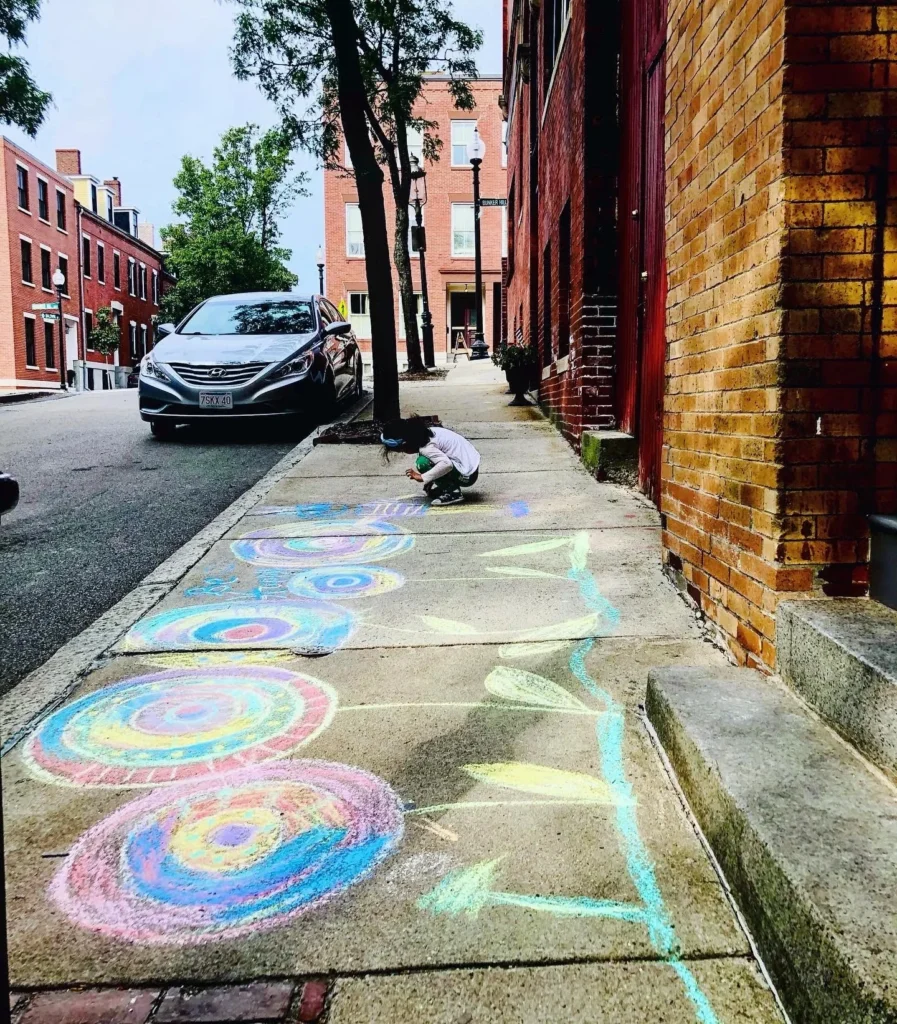
Favorites include a woman who runs a deli at one of the income-adjusted housing complexes. Another is a little girl sketching with sidewalk chalk during the pandemic.

Support for the effort comes from inside and outside the church.

“We have some really good friends who aren’t interested in church, but they see the value this project brings to the community and they’ve become big advocates,” Mangrum said.

A native of Macon, Ga., Mangrum first visited the area on a church youth group trip to Boston’s South Shore when the 14-year-old helped with backyard Bible clubs.

“New England got in my blood,” he said. “God just gave me a love for this place.”

That love eventually led him back. Mangrum isn’t a Toonie, as his personal investment in the area testifies. He’s more like a Townie who got there late.

Now, he wants others to see – whether inwardly or through a photo – the intrinsic value everyone shares.

“Our strategy is to love Christ, love the church and love Charlestown,” said Mangrum. “This is a key part of how we do that.”

Additional reporting by Dan Nicholas.

image

Amazing Images of African Diaspora on Display in CAP Prize Shortlist

Amazing Images of African Diaspora on Display in CAP Prize Shortlist

Contemporary African Photography Prize 2023

The Contemporary African Photography Prize (CAP Prize) has announced the 25 short-listed photographers being considered for the CAP Prize 2023.

In partnership with the Eiger Foundation, the 25 shortlisted photographic projects comprise a diverse range of incredible images.

On July 7 in Arles, France, five photographers will win the CAP Prize. The CAP Prize is awarded annually to highlight photographic work created in Africa related to the African diaspora. This year’s edition of the competition is the 12th.

The shortlisted photographers, and eventual winners, are selected by a panel of 20 judges. Winning projects will be exhibited in Africa and throughout the rest of the world.

Each entrant was required to submit at least 10 images as part of a photo series, although photographers could enter up to 25 photos.

The Shortlisted Photographers

A selected image from each of the 25 shortlisted photographers is featured below. The photographers are listed in alphabetical order, and the full gallery of images is available on the CAP Prize 2023 website. Each photographer’s photo series can also be viewed in the video at the bottom of this article.

Contemporary African Photography Prize 2023
© Robin Bernstein
Contemporary African Photography Prize 2023
© Charles Bright
Contemporary African Photography Prize 2023
© Kwasi Darko
Contemporary African Photography Prize 2023
© Yagazie Emezi
Contemporary African Photography Prize 2023
© Nadja Ettwein
Contemporary African Photography Prize 2023
© Yassmin Forte
Contemporary African Photography Prize 2023
© Maheder Haileselassie
Contemporary African Photography Prize 2023
© Carlos Idun-Tawiah
Contemporary African Photography Prize 2023
© Jonathan Jasberg
Contemporary African Photography Prize 2023
© Bontle Juku
Contemporary African Photography Prize 2023
© Issam Larkat
Contemporary African Photography Prize 2023
© Mohamed Mahdy
Contemporary African Photography Prize 2023
© Alisa Martynova
Contemporary African Photography Prize 2023
© Merji
Contemporary African Photography Prize 2023
© Obakeng Molepe
Contemporary African Photography Prize 2023
© Kriss Munsya
Contemporary African Photography Prize 2023
© Neec Nonso
Contemporary African Photography Prize 2023
© Emeke Obanor
Contemporary African Photography Prize 2023
© Leonard Pongo
Contemporary African Photography Prize 2023
© Lamees Saleh
Contemporary African Photography Prize 2023
© Antonia Steyn
Contemporary African Photography Prize 2023
© Jono Terry
Contemporary African Photography Prize 2023
© Geremew Tigabu
Contemporary African Photography Prize 2023
© Elliott Verdier
Contemporary African Photography Prize 2023
© Kyle Weeks

More on the CAP Prize

Last year’s CAP Prize 2022 winners were Amina Kadous, Remofiloe Nomandla Mayisela, Lee-Ann Olwage, Mahefa Dimbiniaina Randrian Narrivelo, and Pamela Tulizo.

[embedded content]

Lee-Ann Olwage’s recently popped up on PetaPixel, as the South African photographer won the African region – Singles award in the 2023 Sony World Photography Awards.

Another familiar name is Mohamed Mahdy, who is shortlisted for the CAP Prize 2023. Mahdy won the Open Format Award in the 2023 World Press Photo Award contest.

While the precise locations of exhibits for the five photographers that win this year’s CAP Prize have not yet been detailed, prior CAP Prize winners have been shown Basel, Switzerland; Tbilisi, Georgia; Auckland, New Zealand; Berlin, Germany; Kampala, Uganda; and Essaouira, Morocco, among many other locations around the world.


Image credits: Contemporary African Photography Prize 2023 | Individual photographers credited in captions

Five Fits With: Creative Producer and Photographer Frederik Darre

Five Fits With: Creative Producer and Photographer Frederik Darre

During the Tumblr era, I made a good deal of friends through the #menswear pipeline. There were only so many of us interested in a subject that felt extremely insular and unique at the time. Today—and I think I can speak for some of my Internet friends—that sense of community is a bit harder to come by. But sometimes, Instagram brings people together, and that’s how I met this week’s subject, Frederik Darre, a creative director and photographer based in Copenhagen. I don’t fully remember how I stumbled on Frederik’s page—maybe through Danish brand Another Aspect, or perhaps just through the algorithm—but I really admired his look and attitude. When Frederik told me he was going to be in New York, I figured it would be a brilliant opportunity to shine some light on his sense of style, grab a few glasses of wine, and learn more about him.

Below, Frederik and I discuss buying Margiela sneakers in Berlin, the perpetual influence of the elderly, his cherished Seiko watch, and plenty more.


Fit One

frederik darre

Shirt and boots by Our Legacy, jeans by Levi’s.

Christopher Fenimore
frederik darre

“I studied landscape architecture and figured out that couldn’t work for me. I had to do something else, not sitting in front of the computer all day,” Darre says. “So, I started producing—lots of photo shoots and fashion shows. Then it just evolved into shooting on my own. Now I do a little bit of both.”

Christopher Fenimore
frederik darre

“I just wasn’t as cool as a teenager,” Darre says. “Now, whenever I see a bunch of high school kids walking around Copenhagen, I get really nostalgic. They look way cooler than I did, for sure, but a lot of stuff we used to wear back then is back into the cycle now.”

Christopher Fenimore
frederik darre

Christopher Fenimore

Where are you from, and what do you currently do for a living? Tell me a little bit about your work history as well.

I’m from Copenhagen, Denmark, and I work as a photographer and a creative producer. I studied landscape architecture and figured out that couldn’t work for me. I had to do something else, not sitting in front of the computer all day. So, I started producing—lots of photo shoots and fashion shows. Then it just evolved into shooting on my own. Now I do a little bit of both.

How did you develop your own style?

I grew up in a little town called Lyngby, just 10 kilometers north of Copenhagen. I played a lot of sports there, which had a pretty huge impact on my style. I also had a big interest in design and architecture, and I think it just evolved from those interests. Back in the day I used to watch a lot of skate and ski videos and found that interesting. I didn’t skate myself, but I loved the vibes. I just wasn’t as cool as a teenager. Now, whenever I see a bunch of high school kids walking around Copenhagen, I get really nostalgic. They look way cooler than I did, for sure, but a lot of stuff we used to wear back then is back into the cycle now. Later in life I did follow some Tumblr pages for inspiration, back when that was a thing. Bring Tumblr back!

Fit Two

frederik darre

Jacket by Ami, vintage shirt, trousers by Our Legacy WorkShop, and shoes by Our Legacy.

Christopher Fenimore
frederik darre

“I feel like Copenhagen has evolved so much the past 15 years,” Darre says. “Back in the day, it was just a small town. We had a few cool stores which meant everybody was wearing the same things.”

Christopher Fenimore
frederik darre

“When I got into this industry back in 2015, I did my first fashion week,” he continues. “Before that, fashion didn’t really interest me. But I always found clothing interesting.”

Christopher Fenimore
frederik darre

Christopher Fenimore

Did Copenhagen have any influence on your style?

I feel like Copenhagen has evolved so much the past 15 years. Back in the day, it was just a small town. We had a few cool stores which meant everybody was wearing the same things. You had to travel a lot to shop specific brands. I’m pretty sure you couldn’t find any Rick Owens items in Copenhagen in 2010, for example. Once I bought a pair of sneakers from Margiela in Berlin, just because I never had seen anything from Margiela in real life before. When I got into this industry back in 2015, I did my first fashion week. Before that, fashion didn’t really interest me. But I always found clothing interesting. I knew nothing about who was designing for who and facts like that. One of the first jobs I did was a U.S. Vogue production with Gigi Hadid and Imaan Hammam. I didn’t know who they were.

Growing up, I just followed the trends. I had a period when I just wore Rick Owens and that kind of clothing. Then I changed into another phase of my life when I actually got a job at the Acne store in Copenhagen, and then that meant something as well.

Has fatherhood changed your style?

Definitely. After I had kids, I started dressing a lot more comfortably. I’ve been wearing hiking boots for the last two years. When you are out walking with the stroller all day, you don’t want to be cold and uncomfortable. You just want to be nice and comfy and warm. And Denmark is a cold place, especially in the wintertime.

Fit Three

frederik darre

Shirt and shoes by Our Legacy, pants by Hope, backpack by And Wander, and sunglasses (worn) by Mykita.

Christopher Fenimore
frederik darre

“I wouldn’t say that I am in love with fashion but I do like style and clothing,” Darre says. “You know the difference? I like how you can express something about yourself without using words.”

Christopher Fenimore
frederik darre

What it takes to be stylish is, “confidence and the ability to mix and match shapes, colors, and materials, for sure,” Darre says. “That’s probably why some many old gentlemen look so cool. You get more confident the older you get.”

Christopher Fenimore
frederik darre

Christopher Fenimore

Can you remember the first moment you fell in love with fashion?

When I met Gigi and Imaan. Nah, I’m not in love with fashion. I remember during that same production I showed in a white T-shirt and was told by the executive producer that I couldn’t show up like that. I had to find the closest H&M to buy a black t-shirt. That’s apparently what you need. Very important shit. I remember thinking, “This is stupid but also pretty fascinating.” So, I wouldn’t say that I am in love with fashion but I do like style and clothing. You know the difference? I like how you can express something about yourself without using words. Of course, you can have a haircut and you can get some tattoos as well. But clothing is a big part of telling who you are.

What do you think makes someone stylish?

Confidence and the ability to mix and match shapes, colors, and materials, for sure. That’s probably why some many old gentlemen look so cool. You get more confident the older you get. I love to sit around in [New York’s] Chinatown just to watch the elderly on their daily errands. That’s very inspiring. Actually, old people in general are a huge inspiration when it comes to style. The page @gramparents delivers some good content in that regard. I was recently given my grandfather’s old Seiko watch from my grandmother and it’s already very special to me. The watch itself is nothing fancy, but the way it makes me remember him and his calm and happy nature is so important to me. My grandparents were a huge part of my upbringing and he was a very influential figure in my life. Unfortunately, he died from dementia in 2019 and it makes me sad to think about that he never got to meet my children. On the very same date last year, my youngest son was born. It’s kind of weird how life works. My son was named Ole, after his great grandfather, and they are already kind of similar in their nature.

Fit Four

frederik darre

Sweater by E. Tautz, shorts by Unna, and slides by Keen.

Christopher Fenimore
frederik darre

“They’ve created a brand that’s just right down my alley and I feel I could wear almost everything they make,” Darre says of Our Legacy. “It’s a Scandinavian feel without that boring Scandinavian minimalism.”

Christopher Fenimore
frederik darre

An avid skiier, Darre says that, aside from his go-to fashion brands, “I also love sports brands in general.”

Christopher Fenimore
frederik darre

Christopher Fenimore

Do you have any favorite brands, and why?

Our Legacy. You can tell from the photos, I think. They are brilliant with materials and only use deadstock fabrics for their WorkShop line. They’ve created a brand that’s just right down my alley and I feel I could wear almost everything they make. It’s a Scandinavian feel without that boring Scandinavian minimalism. They draw a lot of inspiration from music and movies and urban culture as well. Another Aspect is another of my favorite brands. They’re Danish and they’re creating some of the best everyday items you can find. They don’t follow the season of the fashion calendar. I would describe it more as a lifestyle brand. I also love sports brands in general. I always skied a lot, so I love these kinds of mountaineering brands, like Klättermusen. District Vision is doing great as well.

Fit Five

frederik darre

Shirt by Our Legacy WorkShop, jeans by Levi’s, and boots by Our Legacy.

Christopher Fenimore
frederik darre

“I’m way more consistent now than I used to be,” Darre says of his style as he gets older. However, “my interest in stuff in general changes every third year.”

Christopher Fenimore
frederik darre

If he could wear only one outfit for the rest of his life? “It would probably just be Levi’s jeans, light or blue wash, and not too tight, not too baggy. Like the 501 or 505. Then just a blue shirt, like the one I’m wearing now. Probably I would wear black leather boots or black loafers.”

Christopher Fenimore
frederik darre

Christopher Fenimore

How old are you?

33.

Has that changed things for you? As I’ve gotten older, I’m starting to stay more constant.

Absolutely. I’m way more consistent now than I used to be. My interest in stuff in general changes every third year. I had a period where I was totally into road biking for three years. I go all in. Have to have the best gear, coolest clothing, and read everything about aerodynamics and all kinds of stuff that doesn’t matter at my level. Now it’s more running and climbing that does it for me, with all that follows. I still take the bike for a ride every now and then, and still love it, but just don’t obsess about any more.

If you had to wear one outfit for the rest of your life, what would be the items?

It would probably just be Levi’s jeans, light or blue wash, and not too tight, not too baggy. Like the 501 or 505. Then just a blue shirt, like the one I’m wearing now. Probably I would wear black leather boots or black loafers.

Headshot of Christopher Fenimore

Christopher Fenimore is a writer and photographer living in New York. Working with clients ranging from clothiers to vineyards, he’s also covered street style for a number of outlets. Follow him on Instagram at @c.fenimore.