Photography

Yuri Mechitov – Grandmaster of Fine Art Photography

Yuri Mechitov – Grandmaster of Fine Art Photography

Fine-art photography is something more than regular photo-effort, and is a genre that is highly developed in this country. In the last 100 years Sakartvelo has given the world tens of names in the field that have gone down in the history with the mark of their genuine professionalism, and Yuri Mechitov is one of them, whose black-and-white portraits were recently on display at the exhibition hall of the Georgian Academy of Arts, a magical show of old and new works preserved in his vast portfolio. Literally each portrait of that impressive indoor vernissage is marked with the photographer’s individual aesthetic quality and imaginative faculty, each piece going beyond plain camera mastery to perpetuate the captured image in the mind of the spectator with incisive sharpness. Mechitov talks to us through those images, as if he is rewriting human history in painfully memorable facial expressions to forever leave an indelible impression in the minds of those who found time to go to the event.

Yuri will be 75 next year. Oddly enough, he was trained as a mining engineer, but photo-art is what has infatuated his inquisitive personality beyond the imagination of anybody around him, including his family members. Little Yuri started shooting when he was hardly eight. He began exhibiting his photo-material as early as 1979, and today boasts having almost 100 authorized exhibitions under his belt. Mechitov’s artistic biography accounts for several documentaries and roles in some feature films. He was lucky enough to have worked with Sergei Parajanov, an outstanding film director of soviet times. He has written books and lectured for university students, and even functioned as Deputy Minister of Culture of Georgia, but I am not surprised – after all, the great Goethe himself used to be a finance minister!

The latest exhibition we are talking about was opened in the presence of a huge crowd. The curiosity of further attendants lasted for about a fortnight, which is quite an indicator in today’s busy world. Among the photo-exhibits, there were many famous faces, thus building the amazingly vivid photo-annals of Sakartvelo. Some of the personalities reflected in Mechitov’s works are no longer among us, but the author has perpetuated their memorable images as if writing them in stone. Writes Maia Deisadze, who has specialized in interpreting, evaluating and promoting Mechitov’s prolific legacy: “Outstanding photo-artist, peerless portraitist, and not just that . . . my closest friend and guru; his art is versatile; he is our nation’s genuine chronicler; his love for fellow-humans knows no limits, and this is clearly felt in all his masterpieces.”

But nobody can be more precise than Mechitov himself in describing his creative sense: “I have tried a variety of photographic genres, and was not unsuccessful. And yet, the genre closest to me is portraiture. This is an image of a man/woman who, alone in the entire animal world, knows for sure that he/she is mortal. This knowledge is especially evident when photographing very old or terminally ill people who are already aware of their imminent end. They think, not without reason, that this may be their last photographic image.”

Yuri Mechitov is always in the public eye, and the public in his eye, never missing a chance to freeze in time and digitalize the most attractive and shocking moments of our lives, especially the faces of our compatriots, this, in most cases, happening accidentally; the creative grandmaster’s spontaneity always clear, present and poised. Incidentally, judging by his childlike nature, when I see him at work, I can’t help throwing my imagination back into his childhood, thinking that he is still there, only with a somewhat honed sense of picture and seriously matured possession of the camera’s technical eye. On top of all that, Yuri Mechitov is a well-known public figure who the people never desist to talk about because he is always deeply in the swim of the most important matters of society. Aren’t we all lucky to have around a man who can do both – comment on current events and reflect the self-same proceedings in his artistic photo escapades? What an enduring service to the country!

By Nugzar B. Ruhadze

21 Beautiful Shots Of Nature And Animals, By This Year’s Winners Of GDT

21 Beautiful Shots Of Nature And Animals, By This Year’s Winners Of GDT
ADVERTISEMENT

Nature is the most beautiful ever-changing phenomenon, and many photographers try to capture its fleeting moments. To celebrate those artists, The German Society for Nature Photography (GDT) has announced their winning pictures of the year 2024.

Contestants were able to submit their work in the following seven categories: Birds, Mammals, Other Animals, Plants and Fungi, Landscapes, and Nature’s Studio. In this year’s competition, Dieter Damschen was nominated as the photographer of the year with the photo “Winter flood in a riparian forest”.

Down below we have shared other 21 winners from all the categories, and if you would like to see more photos, take a look here.

More info: gdtfoto.de | Instagram

NextechAR Sets New Standards with It’s AI-Driven Lifestyle Photography

NextechAR Sets New Standards with It’s AI-Driven Lifestyle Photography

NextechAR Elevates AI Photography with Advanced Lifestyle Image Creation Sees large opportunity in ecommerce

TORONTO, ON / ACCESSWIRE / June 6, 2024 / Nextech3D.AI (OTCQX:NEXCF)(CSE:NTAR)(FSE:1SS), a patented 2D-3D Generative AI-Powered 3D model supplier (Patent #11,948,248) for Amazon, Miele, P&G, Kohls, Wesfarmers Group “Bunnings” and other major e-commerce retailers has been adding Digital Photography and dynamic product visuals as part of its 3D model offerings. Nextech3D.ai proudly announces a significant advancement in its AI-powered photography technology: the ability to create dynamic lifestyle images from 3D models or CAD files, representing a significant leap from 2D photography to 3D renders and photos. AI is transforming the virtual photography landscape for ecommerce, as the company is producing tens of thousands of 3D models annually it expects to produce hundreds of thousands of 3D model renders to its same customer base and expand with new customers. The company believes that its AI Photography with Advanced Lifestyle Image Creation is a large opportunity for revenue growth.

This page requires Javascript.

Javascript is required for you to be able to read premium content. Please enable it in your browser settings.

This ad unit is new and hasn’t been set up yet for your publication. Contact support@empowerlocal.com and we’ll get the item set up.

Instagram is now labeling real photos as “Made with AI”

Instagram is now labeling real photos as “Made with AI”
real photos made with ai instagram

After labeling photos with Generative Fill as AI, Instagram has gone even further. It’s now labeling real photos with its new tag “Made with AI,” and photographers are rightfully losing their minds over this.

I first noticed the issue brought up by Monika Rohfeld (Instagram | Facebook) in a Facebook group I follow. She took a photo of a man on Coney Island, an actual photo, with “nothing artificial about,” as she describes it. “Props are real, person is real, location is real,” Monika writes. She used an AD 300 Pro on full power to fill because her model was backlit on full power: and that’s all! “I did pull the contrast from the background and the usual D/B but that’s it,” she notes.

However, after posting the photo on Instagram, the social media labeled it “Made with AI.” How annoying is that?!

made with aimade with ai

Commenting on Monika’s post, Kevin Patrick Robbins noted that “If you use ANY AI tools in your edit, such as Generative Fill or the remove brush, it gets tagged in the metadata and IG will flag it.” And the problem is – the new crop tool fills after straightening the image. “There was a tiny sliver in the corner that needed content aware fill,” Monika replied. “That is outrageous.”

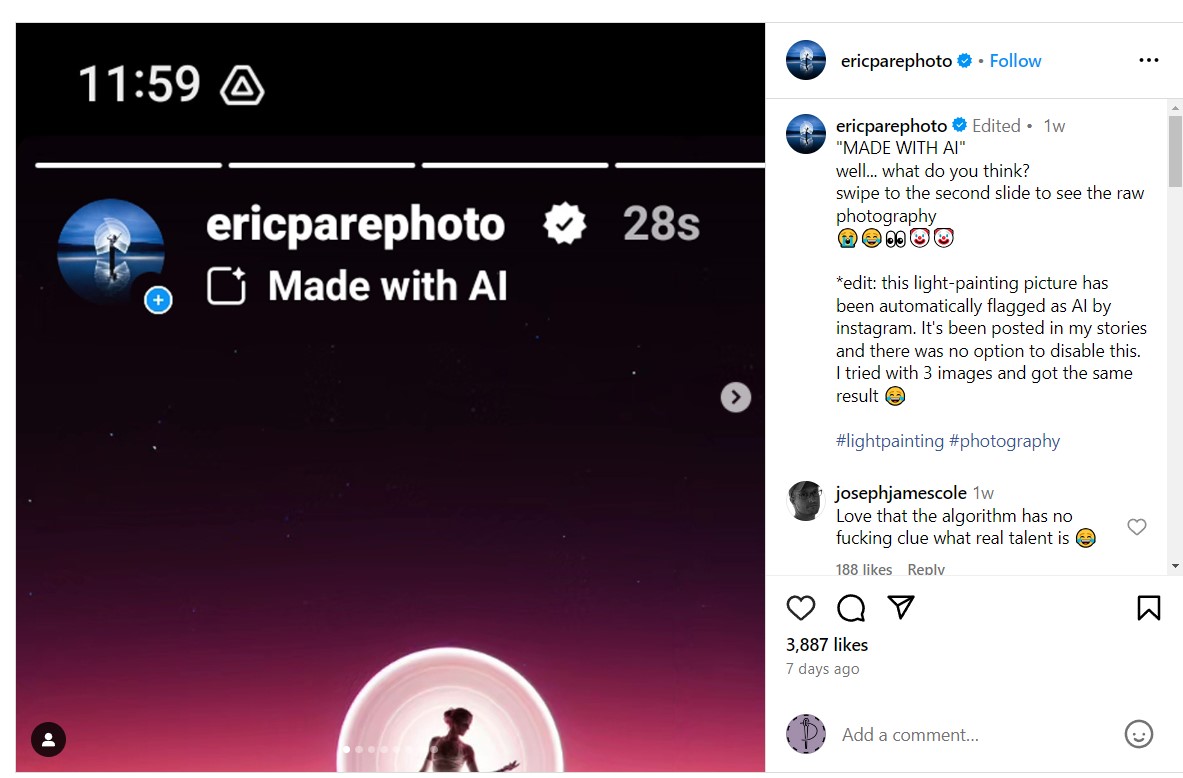
This reminded me of the time when a photographer got banned from 500px for “posting non-photographic content,” because 500px apparently can’t tell between light painting and AI/composites. Speaking of light painting, I noticed another example of Instagram mislabeling images. Our buddy Eric Paré had the same situation as Monika, as one of his light-painting photos was automatically flagged as AI by Instagram. “It’s been posted in my stories and there was no option to disable this,” he writes on Instagram. “I tried with 3 images and got the same result.”

made with aimade with ai

Getting around Instagram’s “Made with AI” label

Honestly, I find this super-annoying. Imagine investing your time, effort, money and whatnot to create the look and the result that you want. Then, removing a blemish or filling in a tiny corner of the photo – bam, your photo is flagged as AI, just like someone’s image created in 5 seconds by writing a prompt. It’s simply not fair, especially since all editing tools are constantly shoving AI up our noses.

I don’t see how and if Instagram can address this and tell AI images apart from real photos with slight AI-based editing. There are sometimes nuances between the two, and it can be hard to tell how much AI is too much AI – but it doesn’t make this issue less frustrating. Pratik Naik shares some tips on getting around this issue – at least until algorithms become more sophisticated if they ever do.

YouTube video
[embedded content]

Have you had a similar experience with your photos on Instagram? Do you have any idea how to overcome this?

39 Delicious Photographs From The 2024 Pink Lady® Food Photographer Of The Year Awards

39 Delicious Photographs From The 2024 Pink Lady® Food Photographer Of The Year Awards
ADVERTISEMENT

The World’s Best Food Photographs have just been announced by the Pink Lady® Food Photographer of the Year. This year’s global judging panel, tasked with assessing the thousands of entries submitted from over 65 countries across the world, was chaired by legendary food photographer David Loftus and includes Clare Reichenbach, Tom Athron, Asma Khan, Fiona Shields, and Rein Skullerud.

A haunting image, Red Bean Paste Balls, by Chinese photographer Zhonghua Yang, has won the overall prize of Pink Lady® Food Photographer of the Year 2024, the world’s leading celebration of food photography and film. The Chinese photographer has been crowned Overall Winner of Pink Lady® Food Photographer of the Year 2024 and awarded the prize of £5,000 (GBP) for his image capturing a woman entering a room to add her latest creation to a mountain of steaming dim sum, all prepared for a feast to celebrate Lunar New Year.

To see the online gallery of all the 2024 finalists, visit the Pink Lady® Food Photographer of the Year website. Entries for the 2025 edition of the competition will open later this year in September.

More info: pinkladyfoodphotographeroftheyear.com | Instagram | Facebook | x.com

Overall Winner (And Champagne Taittinger Food For Celebration Category): Red Bean Paste Balls By Yang Zhonghua

In the rural area of Xiangshan, Zhejiang people are busy with preparations for a feast to celebrate Spring Festival, also know as Lunar New Year. This includes the tradition of making dim sum, such as red bean dumplings, steamed rice cakes and glutinous rice cake, each of which has a legacy of traditional craftsmanship.

Pink Lady® Food Photographer of the Year Report

1st Place, Hotel Art Group Cream Of The Crop: Chestnut Season By Tailai Obrien

Chestnuts symbolise Autumn harvest. In our family with strong Celtic roots, they are considered guardians of men and animals. The antique chestnut roaster is a family heirloom and a nod to our farming heritage. The crested dove symbolises harmony and virility. Chestnuts are highly nutritious and a delicious food for celebrations.

Pink Lady® Food Photographer of the Year Report

1st Place, Politics Of Food: Empty Shop, Cuba By Jo Kearney

A shopkeeper resting in a greengrocer’s shop in Cuba. The state shops tend to be pretty empty. When food arrives there’s a queue because they are subsidised by the government and so food is much cheaper than in the private stores.

Pink Lady® Food Photographer of the Year Report

ADVERTISEMENT

1st Place, Pink Lady® Food Photographer Of The Year (Chile): Oh Beautiful Crumb By Antonia Larrain Eyzaguirre

Handmade sourdough bread with a crispy crust, fluffy and airy crumb and with the perfect humidity. Just feeling its smell makes your mouth water and you cannot leave it or change it just like that. It’s a deep, unconditional and loyal love.

Pink Lady® Food Photographer of the Year Report

ADVERTISEMENT

1st Place, The Philip Harben Award For Food In Action: Rice Grain Threshing By Kishore Das

As the sun gracefully descends on the horizon, casting a warm and magical golden glow with an ethereal radiance, a tribal lady engages in the ancient practice of threshing rice grains in the courtyard of her home with rhythmic movements by skillfully tossing the harvested rice into the air.

Pink Lady® Food Photographer of the Year Report

1st Place, Food Influencer: Hanging Buri (Yellowtail) By Matteo Alberti

Buri is Japanese for the fish Seriola quinqueradiata, known in English as ‘yellowtail’. For centuries, fishermen filleted buri, salted them, dried them for about ten days, and finally wrapped them in leaves and long rice-straw ropes before hanging them in front of their houses, exposed to the sea breeze.

Pink Lady® Food Photographer of the Year Report

ADVERTISEMENT

1st Place, Pink Lady® Moments Of Joy: Breakfast With The Brokpas By Debdatta Chakraborty

The Brokpas are a small ethnic group mostly found in the union territory of Ladakh, India. The Brokpas traditionally claim themselves to be descendants of Alexander’s lost army. The Brokpa diet is based on locally grown barley and wheat, prepared most often as tsampa (roasted flour) and Gur-Gur Cha, a brewed tea made of black tea, butter and salt.

Pink Lady® Food Photographer of the Year Report

1st Place, Unearthed® Food For Sale: Tribal Farmers Sell Their Fruit By Azim Khan Ronnie

Boats fan out across a stretch of the lake, creating a floating market selling an array of fresh fruit. This is a floating market of seasonal fruits such as jackfruit, pineapple, mango etc. at Rangamati, Bangladesh. The tribal farmers sell their fruit every early morning at minimum price on a wholesale basis.

Pink Lady® Food Photographer of the Year Report

ADVERTISEMENT

1st Place, Young - 13 - 17: Banana Haul By Sam Eichenholz

Under a bridge that spans the red river in Hanoi, Vietnam, residents have transformed public lands into bountiful gardens. As I descended the stairs to explore this hidden corner of the city, I came upon this man carrying his banana haul and was struck by the soulfulness of his eyes.

Pink Lady® Food Photographer of the Year Report

1st Place, Champagne Taittinger Wedding Food Photographer: Let Them Eat Cake! By Lynne Kennedy

Lucy and Tony and their children made the long journey from Kent to the Isle of Skye to get married. They didn’t want to transport a traditional wedding cake all that way, so their cakemaker produced these fabulous little ‘cakes in containers’ for them. We found a spot by the historical Sligachan Bridge and they tucked in!

Pink Lady® Food Photographer of the Year Report

ADVERTISEMENT

1st Place, The James Beard Foundation Photography Award: Pitmaster, Big Bob Gibson's, Decatur, Al By Simon Urwin

Chris Lilly is the multi-award-winning pitmaster at Big Bob Gibson’s in Decatur, Alabama. Big Bob (Lilly’s great-grandfather-in-law), opened the business in 1925 and found fame for his revolutionary white barbecue sauce (at a time when most BBQ sauces were red and tomato or chilli-based.) His recipe of mayonnaise, black pepper, vinegar and lemon has since become hugely popular worldwide.

Pink Lady® Food Photographer of the Year Report

ADVERTISEMENT

See Also on Bored Panda

1st Place, Claire Aho Award For Women Photographers: B.l.t. Contemplation By Delaney Mcquown

This photograph is part of my ongoing self-portrait project, urging women to find liberation through unidealized self-images. Excessive self-documentation fosters familiarity, enabling women to exist unapologetically in photos. Capturing myself eating a B.L.T. without inhibition felt fitting, given the complex relationships women often have with their bodies and food. I’m passionate about women embracing their cameras, leading to liberation and self-love.

Pink Lady® Food Photographer of the Year Report

1st Place, Food At The Table: Pork, Laughter, And Red Wine By Virginia Morán

Chef Antón bids farewell to his beloved restaurant, after 30 years of service, inviting his closest family and friends to a simple yet heartfelt feast. The main dish, sourced from a pig slaughter: liver with onions, served with sourdough bread and a fine Rioja. A poignant farewell to a culinary era filled with laughter, joy and good red wine.

Pink Lady® Food Photographer of the Year Report

1st Place, Street Food: Fighting To Save Life By Mohammad Reaz Uddin

Every evening, Ayesha makes packets of Hawai sweets by herself. The next day, at six in the morning, Ayesha and her daughter Hanufa go to different streets in the village and children’s schools and sell the Hawai sweets. They earn about 300 taka per day and with this money she maintains her family and business.

Pink Lady® Food Photographer of the Year Report

See Also on Bored Panda

1st Place, Young - 12 And Under: Bee's Breakfast By William Dewhurst

I caught this bee having breakfast on a large sunflower at Bignor Roman Villa in West Sussex, England. Without bees to pollinate, there would be far less food in the world.

I caught this bee having breakfast on a large sunflower at Bignor Roman Villa in West Sussex, England. Without bees to pollinate, there would be far less food in the world.

Pink Lady® Food Photographer of the Year Report

1st Place, Pink Lady® Food Photographer Of The Year (Europe): The Pig's Testament By Diego Marinelli

The killing of the pig is a real ritual of Italian rural culture. I was struck by the elderly man’s sense of respect towards the sacrificed animal and I hope that the image makes us reflect on how man’s relationship with food has changed in the last 70 years.

Pink Lady® Food Photographer of the Year Report

This Photographer Uses Long Exposure To Create Mysterious Pics Of Illuminated Trees (35 Pics)

This Photographer Uses Long Exposure To Create Mysterious Pics Of Illuminated Trees (35 Pics)

We were also wondering how nature influences Schietti’s work. He told us: “I’ve always loved being in nature, and one of my other passions besides photography, climbing, brings me into constant contact with natural environments, with stone. I’ve also always enjoyed traveling around Brazil and abroad in search of natural beauty: national parks in the USA, islands in Panama, volcanoes in Guatemala, beaches in Australia, and safaris in South Africa. I was lucky enough that my parents allowed me to travel to some places while I ventured to others on my own, bitten by the bug of discovering this beautiful planet that we inhabit, and that we are destroying at the expense of individualistic pleasures.

ADVERTISEMENT

My landscape photography has always been linked to this relationship of reverence towards Mother Nature and our smallness and audacity in front of her, the rebellious children that we are. When I have the opportunity, I seek to draw connections between our thoughts and our actions in the natural environment, but in a subtle, poetic way, focusing on the beautiful rather than the shocking to bring about positive changes.”

David Armstrong’s Poignant Photographs Offer Insight Into a Bygone Era

David Armstrong’s Poignant Photographs Offer Insight Into a Bygone Era

If David Armstrong hadn’t been a photographer, he would have made a brilliant writer. He was a keen lover of words, wisecracks, and stories, and to this day, a decade after his death, friends still quote his pithy observations or the stray bits of droll dialogue he repurposed from turn-of-the-century novels or 1950s films. In his genteel, matronly singsong voice, he’d be as apt to deliver a fragment from Edith Wharton or a verse from the Bible as he would a personal saga from the late 1980s involving a friend in the East Village who’d jumped from his fire escape. Looking back at his five decades of work, you can sense an almost literary penchant for character and atmosphere. In his deceptively straightforward portraits, he captured not only the complicated personas of his sitters but also their entire social milieus.

Armstrong grew up in Arlington, Massachusetts, six miles northwest of Boston. He was one of four siblings; his father was in construction, and his mother worked for an insurance agency. In the late ’70s, he attended the School of the Museum of Fine Arts at Tufts University, in Boston, alongside the rising like-minded photographers Mark Morrisroe, a punk visualist and performance artist who died in 1989 of AIDS, and Nan Goldin, whose powerful documentation of the private lives of an entire subculture and her recent anti-opioid activism have made her one of the most important living American artists. (Armstrong was the one who originally shortened her name from Nancy.) Curiously, while Armstrong often seemed like a creature from a previous century, he was very much at the center of a radical, bohemian group that couldn’t have been more attuned to the moment. “David was like someone out of a novel,” recalls the artist Jack Pierson, who met Armstrong in 1981 in Boston, when Pierson was attending the Massachusetts College of Art and Design. Pierson, Armstrong, Morrisroe, and Goldin would eventually be known as the “Boston school” for their unnervingly direct photography styles that captured the beauty, sexual charge, and countercultural mess of their everyday lives. Nonetheless, for many, Armstrong remains one of the most under-recognized photographers of the late 20th century.

Hairstylist Mary Cruz and a friend, 1979.

Courtesy of the estate of David Armstrong.

Hairstylist Mary Cruz and a friend, 1979.

A young Nan Goldin in Provincetown, Massachusetts, late 1970s.

Courtesy of the estate of David Armstrong.

A young Nan Goldin in Provincetown, Massachusetts, late 1970s.

Curator Klaus Biesenbach in Berlin, early 1990s.

Courtesy of the estate of David Armstrong.

Curator Klaus Biesenbach in Berlin, early 1990s.

That could soon change. This June, at the Kunsthalle Zürich, one of the most prestigious contemporary art spaces in Switzerland, an extensive collection of Armstrong’s early portraits will be on view in the first major show of his work since he died of cancer, in 2014. The exhibition is cocurated by the New York artist Wade Guyton, a friend of Armstrong’s, and the Kunsthalle’s director, Daniel Baumann. In addition to showcasing 100 of the artist’s own vintage prints, the retrospective will include several vitrines of contact sheets that highlight how Armstrong approached his portrait shoots and how he ultimately selected the final images. Part of the reason Baumann felt drawn to Armstrong’s artistry—particularly his work from the 1970s, ’80s, and ’90s—is the potent sense of vulnerability encoded in the material. “We don’t have that anymore,” the curator says about our current relationship to the still image. “Having your picture taken has been totally changed by social media. We are living in a post-authentic world—today people stage intimacy as a form of self-promotion or special standing.”

Early on in college, Armstrong developed the habit of photographing his friends, creating emotive compositions so mesmerizing that they could only have been drawn from shared experiences. “In the summer of ’81,” Pierson recalls, “I rented an apartment in Provincetown with Mark Morrisroe and Stephen Tashjian [the artist Tabboo!]. David came out and stayed with a friend of his who was a clammer and friends with the whole John Waters crowd. The fact that David not only knew people like John Waters and Cookie Mueller but also had taken photos of them was a huge deal to us. We were clutching our copies of Shock Value [Waters’s 1981 memoir] to tell us how to live and become famous.” Armstrong shot his merry band of misfits smoking, swimming, and sunbathing, their lithe bodies on full display. He was known for his wizardlike ability to capture natural light, and in his portraits a gorgeous, atmospheric radiance gives the impression of a moment lasting much longer than the time it takes to press a button. These would become some of his most enduring images—the denizens of the underground beautifully libidinal en plein air.

Actor Bruce Balboni, scenic artist George Kousoulides, Max Mueller (son of actor Cookie Mueller), and a friend in Provincetown, late 1970s.

Courtesy of the estate of David Armstrong.

Actor Bruce Balboni, scenic artist George Kousoulides, Max Mueller (son of actor Cookie Mueller), an...

John and Evan Lurie, of the band the Lounge Lizards, in New York City, 1980.

Courtesy of the estate of David Armstrong.

John and Evan Lurie, of the band the Lounge Lizards, in New York City, 1980.

Hairstylist Jimmy Paul in New York City, 1991.

Courtesy of the estate of David Armstrong.

Hairstylist Jimmy Paul in New York City, 1991.

Provincetown offered the decidedly urbane, cramped-apartment-dwelling characters in Armstrong’s orbit the backdrop of a classic seaside idyll, but neither he nor his gang could resist the pull of New York City. In the mid-1980s, Armstrong photographed East Village friends, lovers, painters, actors, writers, musicians, and strangers who caught his eye. Several of these young artists would go on to have legendary careers—Jean-Michel Basquiat, Vincent Gallo, John Lurie, Teri Toye, Rene Ricard, and Christopher Wool among them. The names of others have been lost to time, but in these pictures the sitters—whether they are famous or not, people Armstrong had known his entire adult life or simply had a brief crush on—usually pose in a casual, unaffected manner, sitting on an unmade bed, leaning against a wall, or resting on a pillow. The bond that Armstrong felt with them leaves a strong emotional imprint. We, too, can fall in love with his friends.

Armstrong’s portraits are not reportage, and they don’t have Nan Goldin’s feeling of raw, caught-off-guard ephemerality. His subjects are clearly posing, but there is always a sense that their authentic selves are coming through, as full human beings with complicated contradictions, aware of the then unusual experience of having their photo taken. “David’s photographs show a certain melancholy in the way people look into the camera,” Baumann notes. “Melancholia is a mood of the 20th century that I don’t see so much these days. There’s also a degree of boredom that has disappeared—imagine it’s a Wednesday afternoon and having no clue as to what to do and finding someone in the streets who is also utterly bored to hang out with.” There is little urgency or hurry in Armstrong’s photographs. These are not young New Yorkers late for work or rushing on their lunch hour. And even though Armstrong’s subjects tend to have a strong personal style, there is no self-promotion, no proto-influencer trying to advertise a lifestyle. The only message is: Be young, alive, and free.

Actor Sophie Vdt in New York City, 1979.

Courtesy of the estate of David Armstrong.

Actor Sophie Vdt in New York City, 1979.

Artist Jack Pierson in his New York City studio, 1991.

Courtesy of the estate of David Armstrong.

Jay Johnson, once a Warhol Factory regular, in New York City, late 1970s.

Courtesy of the estate of David Armstrong.

Jay Johnson, once a Warhol Factory regular, in New York City, late 1970s.

Balboni with underground icons (from left) Linda Olgeirson, Sharon Niesp, and Cookie Mueller at Herring Cove Beach, Provincetown, 1975.

Courtesy of the estate of David Armstrong.

Balboni with underground icons (from left) Linda Olgeirson, Sharon Niesp, and Cookie Mueller at Herr...

Armstrong continued to make work up until his death. In the new millennium, he expanded his practice, shooting fashion campaigns and editorials, as well as a portrait series on New York hustlers, and developing his ongoing suite of blurred landscape photographs that have the classical beauty of European painting. For much of this time, he sequestered himself in a rambling, curio-filled brownstone in Brooklyn. In his last years, he moved up to the Berkshires, in Western Massachusetts, to convalesce as the witty maiden aunt he seemed destined to become. By then, a younger generation of artists and photographers had found inspiration in his bohemian spirit and idiosyncratic photography, adopting him as a spiritual or aesthetic guide. The photographer Ethan James Green began assisting Armstrong in 2011, after meeting him on a shoot a few years prior, when Green was modeling. The relationship quickly developed into a close mentorship. “I’m not really sure where I would be without David,” says Green. “He taught me about light and the importance of integrity, but his influence extended beyond photography. He showed me who I could be as a person and mirrored an acceptance that allowed me to embrace my full self. He changed my life.”

There was an ineffable, magical quality to Armstrong, a generosity of spirit that spilled over into everything he did and left a mark on everyone he touched. He remained, to the end, wise and kind and open-hearted, but no less shrewd and discerning. He hated phonies. Pierson recalls the many times he spotted Armstrong in New York City, running around with a box of prints under his arm. “David,” he says softly, “always had the aura of a star.”

Poet and artist Rene Ricard at home in New York City, 1979.

Courtesy of the estate of David Armstrong.

Poet and artist Rene Ricard at home in New York City, 1979.

Magazine editor Lisa Love in Provincetown, mid-1970s.

Courtesy of the estate of David Armstrong.

Magazine editor Lisa Love in Provincetown, mid-1970s.

Cookie Mueller in New York City, 1978.

Courtesy of the estate of David Armstrong.

Cookie Mueller in New York City, 1978.

Artist Christopher Wool in New York City, 1980.

Courtesy of the estate of David Armstrong.

Artist Christopher Wool in New York City, 1980.

“Double Exposure” sheds light on the life of Civil War-era Western photographer

“Double Exposure” sheds light on the life of Civil War-era Western photographer
“Double Exposure,” by Robert Sullivan (Farrar, Straus & Giroux)

“Double Exposure,” by Robert Sullivan (Farrar, Straus & Giroux)

Timothy O’Sullivan came west after the Civil War to take pictures of the landscape and the indigenous people for the Clarence King and George Wheeler geological surveys.  The photographs he left behind are both documentation and art.

Ansel Adams, who discovered O’Sullivan’s work in the late 1930s, called the photographs “surrealistic and disturbing” (although he complained that they were “technically deficient”).

Although O’Sullivan’s photographs are well known, the photographer’s life is largely undocumented. He left behind no letters or diaries. He died of tuberculosis in 1882 at the age of 42, and even his gravesite is unknown. So Sullivan’s “Double Exposure” is not a biography but a “survey,” he writes.

A photographer himself, the author set out on a years-long search for the sites of O’Sullivan’s most famous photographs. The result is a book that includes a personal journey, observations, history, photographs and their interpretation, and available biographical information.  Much of that comes from Clarence King’s highly romanticized and exaggerated account of O’Sullivan and his work.

Most of O’Sullivan’s time in the West was spent in California and Nevada, but he did photograph the Colorado River as part of the Wheeler survey. Sullivan calls the survey a “fraud” and a “hyped up adventure,” since the river already had been explored. In fact, for O’Sullivan, it was likely a commercial venture since he hoped to sell copies of his photographs to the public. Those copies are now in libraries and art museums.

Sandra Dallas is a Denver author and book reviewer. 

Subscribe to our weekly newsletter, In The Know, to get entertainment news sent straight to your inbox.

This is the quickest way to finding your photography style

This is the quickest way to finding your photography style
[embedded content]

In this era overflowing with digital photography and AI, most of us want to stand out, have our own unique style, and be recognizable. And it’s tough. Alex Kilbee knows the struggle, and in his recent video, he shares his insights. He gives you a relatively quick process of discovering and establishing your unique voice.

Unearthing your natural preferences

You may feel that the signature lies in editing. You’re not wrong – but only up to a certain point. Alex warns you that you shouldn’t rely on this only, and forget about the perfect preset: A photographer’s style is rooted in their inherent tendencies. So, revise your existing work. Print out your photos and spread them out. Look for recurring themes or compositions. You might be surprised by what emerges!

Through this process, Alex himself discovered a love for angular shapes. He hadn’t realized this was his signature until he saw it reflected in his work. By stepping back and analyzing your existing portfolio, you can discover the foundation of your unique style.

Building on your foundation

Once you have a grasp of your natural tendencies, it’s time to refine your style. Alex suggests looking to photographers you admire. He, for instance, draws inspiration from architectural photographers like Ezra Stoller and Julius Shulman while also finding unexpected connections to the work of music photographer Anton Corbijn.

Think of the photographers you admire. Analyze their work, not to mimic it entirely, but to see if there are elements that resonate with you and can be incorporated into your own vision. It’s not easy, and if you’re new, you’ll probably copy others, at least subconsciously. But have this in mind and actively try to avoid it. The key is to be a “magpie,” borrowing inspiring elements while staying true to your core identity.

Last but not least, Alex emphasizes the importance of community in developing your photographic voice. Being around other photographers who challenge you and offer constructive criticism can be a powerful accelerant. Alex mentions his experience in a supportive online community where he learned more in a few years than in the previous decade.

There are many photography communities available online and in person. Look for groups that align with your interests and provide a space for feedback and exchange of ideas. It can be your local photo clubs, Facebook groups, workshops… Find what suits you best.

Following Alex’s process, you won’t wander around mindlessly while discovering yourself as an artist. You can safely embark on an exciting journey to develop your unique photographic style and stand out from the crowd.

15 award-winning photos of animal antics from this year’s Comedy Pet Photography Awards

15 award-winning photos of animal antics from this year’s Comedy Pet Photography Awards

15 award-winning photos of animal antics from this year’s Comedy Pet Photography Awards

A dog leaps in the air

Angle down icon
An icon in the shape of an angle pointing down.

“Dancing Queen” by Vera Faupel.

© Vera Faupel/Comedy Pets


  • The annual Comedy Pet Photography Awards highlight hilarious pictures taken by pet owners.
  • The winning photo shows a dog trying to stick its face through a cat flap.
  • A photo of a cat swinging from curtains won the contest’s People’s Choice award.
Advertisement

Some photography contests award images of stunning natural landscapes or poignant portraits that capture the essence of humanity. The Comedy Pet Photography Awards have a unique mission: to highlight the best in pet shenanigans.

On Thursday, the Comedy Pet Photography Awards announced the winners of its 2024 competition. The top photos include snapshots of cats and dogs as well as a horse, a donkey, and a tortoise.

“In a world that can be hard to fathom, our pets are the one constant in our lives that make sense and are a vital source of support, joy, and sometimes, great hilarity,” Michelle Wood, who helps run the contest, said in a statement. “We would have a competition to celebrate them every single day if we could, and to be able to share these brilliant winners with you and laugh out loud with these loveable creatures is the reason this competition exists!”

The contest’s overall winner receives £500, or about $638, a ThinkTank camera bag, and a trophy naming them Comedy Pet Photographer of the Year.

Take a look at this year’s funniest pet photos.

Advertisement

Highly Commended: “Peek-A-Boo” by Sylvia Michel

A dog buried in snow with just its ears sticking out

image

“Peek-A-Boo” by Sylvia Michel.

© Sylvia Michel/Comedy Pets


“I took this great picture in deep snow in Grindelwald,” Michel captioned the photo. “My dog, Raasta, spontaneously hid so that only his ears were sticking out of the snow.”

Highly Commended: “You Didn’t Hear This From Me” by Kenichi Morinaga

A cat appears to whisper to another cat

image

“You Didn’t Hear This From Me” by Kenichi Morinaga.

© Kenichi Morinaga/Comedy Pets


“These cats are having a secret talk about where to fish,” Morinaga wrote.

Advertisement

Highly Commended: “Dancing Queen” by Vera Faupel

A dog leaps in the air

image

“Dancing Queen” by Vera Faupel.

© Vera Faupel/Comedy Pets


“What can I say, this dog loves to jump!” Faupel wrote of the photo.

Highly Commended: “Everybody Was Kung Fu Fighting” by Sylvia Michel

A dog jumps up to catch a snowball

image

“Everybody Was Kung Fu Fighting” by Sylvia Michel.

© Sylvia Michel/Comedy Pets


“I threw a few snowballs and my dog jumped after them with great enthusiasm,” Michel wrote.

Advertisement

Highly Commended: “Kitty in the Kitchen” by Atsuyuki Ohshimo

A cat yawns in a bowl in a kitchen

image

“Kitty in the Kitchen” by Atsuyuki Ohshimo.

© Atsuyuki Ohshimo/Comedy Pets


“He stayed there as if he was one of the kitchen tools,” Ohshimo wrote.

Highly Commended: “Grumpy Dog” by Luiza Ribeiro

A Yorkie dog appears grumpy

image

“Grumpy Dog” by Luiza Ribeiro.

© Luiza Ribeiro/Comedy Pets


“Meet Nick Barry, a 5-year-old Yorkie with a special talent for hilarious expressions,” Ribeiro captioned the photo. “This may not be his most flattering photo, but that frown is undeniably captivating — a true portrait of a dog who doesn’t need smiles to win our hearts.”

Advertisement

Highly Commended: “I Believe I Can Fly” by Julie Smith

A poodle leaps through the air

image

“I Believe I Can Fly” by Julie Smith.

© Julie Smith/Comedy Pets


“Flying poodle,” Smith captioned the photo.

Highly Commended: “Nosy Neighbors” by Emma Beardsmore

Two cats peer over a fence

image

“Nosy Neighbors” by Emma Beardsmore.

© Emma Beardsmore/Comedy Pets


“These are my two cats during the COVID-19 lockdown,” Beardsmore wrote. “They are spying on the neighbors who are breaking the rules!”

Advertisement

Cat Category Winner: “Cat in a Trap” by Kenichi Morinaga

A cat stuck in a wall

image

“Cat in a Trap” by Kenichi Morinaga.

© Kenichi Morinaga/Comedy Pets


“It looks like a Super Mario World video game,” Morinaga wrote.

Horse Category Winner: “I Think I Saw A Mouse” by Debby Thomas

A horse jumps in the air

image

“I Think I Saw A Mouse” by Debby Thomas.

© Debby Thomas/Comedy Pets


“This beautiful and athletic gelding loves to try to fly off the ground!” Thomas wrote. “This is one of the series of leaps he performs.”

Advertisement

All Other Creatures Category Winner: “New Rose” by Jonathan Casey

A tortoise holds a flower in its mouth

image

“New Rose” by Jonathan Casey.

© Jonathan Casey/Comedy Pets


“Edgar loves to eat flowers, and her favorites are dandelions for spring, snapdragons for summer, and here she can be seen gobbling a whole Gertrude Jekyll rose last September,” Casey wrote. “We grow them for her, and since she is elderly, we hand-feed her and sometimes snap her in between bites.”

Junior Category Winner: “Tired Donkey” by Charlotte Kitchen

A donkey yawns

image

“Tired Donkey” by Charlotte Kitchen.

© Charlotte Kitchen/Comedy Pets


“After sprinting around and completing some training, Benji was exhausted and wanted an afternoon nap!” Kitchen wrote.

Advertisement

Pets Who Look Like Their Owners Category Winner: “The Proud Pup And His Best Friend” by Darya Zelentsova

A dog poses with its owner. Both appear to have beards.

image

“The Proud Pup And His Best Friend” by Darya Zelentsova.

© Darya Zelentsova/Comedy Pets


“Ludo von Lickenface, the sweetest 16-year-old rescue pup, strikes a pose alongside his beloved guardian, David,” Zelentsova captioned the photo.

People’s Choice Award Winner: “Tarzan” by Kazutoshi Ono

A cat swings from curtains

image

“Tarzan” by Kazutoshi Ono.

© Kazutoshi Ono/Comedy Pets


“It’s like being in the jungle,” Ono captioned the photo.

Advertisement

OVERALL WINNER: “Not Just For Cats” by Sarah Haskell

A dog sticks its face through a cat flap

image

“Not Just For Cats” by Sarah Haskell.

© Sarah Haskell/Comedy Pets


“Hector saw the cat do it, so he thought he would give it a try, and this is about as far as he got before reversing out the way he came,” Haskell captioned the photo of her dog attempting to pass through a cat flap. “The cat made it look so easy.”

When asked what she would do with the prize money, Haskell joked that she would buy a bigger cat flap along with some new camera equipment.

“These Comedy Pet Photo Awards have been a good-natured, friendly competition with comical animal characters that you feel you can somehow relate to, that make you smile, and that you want to know more about,” she said. “Delighted that Hector and I have been part of it, and tremendously proud to be a winner.”

Advertisement