Photography

This Instagram Account Features Amusing Street Photographs And Has More Than 85K Followers (65 Pics)

This Instagram Account Features Amusing Street Photographs And Has More Than 85K Followers (65 Pics)

With the advancements in technology and the portability of photography gear, it is impossible not to recognize the work of street photographers. These modern-day nomads traverse the city, capturing images and videos of people, animals, objects, and nature itself. Their approach serves as a powerful reminder that allowing life to unfold naturally, without excessive planning or control, can yield stunning outcomes.

“The Decisive Moments Magazine (TDM)” is an Instagram account that showcases the remarkable work of various skilled street photographers. They share these captivating images with their audience of nearly 85,000 followers on a daily basis.

With that being said, if you’d love to see TDM’s photography contest entries from 2021, make sure to click here!

More info: tdmawards.com | Facebook | Instagram | twitter.com

Derek Schrock Faced a Photographer’s Worst Nightmare and Won

Derek Schrock Faced a Photographer’s Worst Nightmare and Won

“Glaucoma was a shock to the nervous system,” photographer Derek Schrock shares with me, the legally blind Editor in Chief of the Phoblographer. “It allowed me to contemplate a loss and to compensate going forward with methods of gain. When you’re young and fortunate, you’re also a dependent. Dependent on something. Dependent on someone.” This was the first time in life that Derek felt cut off, weak, vulnerable, and without control. This happened to Derek when he was young, and most wouldn’t even consider being photographers or would consider ending their careers.

All images in this interview are by Derek Schrock. Used with permission. If you’re interested, pick up his book A Sum of One. Please also visit his website.

However, Derek grew from this after the initial blow to the gut.

The contemplation was good for me. I could grow from the imperfection. Criticism can be constructive, and it made me look intently at myself. My weaknesses. Alter my makeup. Psychologically change from a situation I had no control over. Heighten my surrounding senses and grow in my humanity. I worked on myself. I began to see myself clearer than ever. As it just so happens, simultaneously the images accumulated.  Everyone is going through something. Glaucoma limits one nerve but gave me another to reach out. There became a comfortability in being vulnerable, and in doing so I’ve seen more than I ever imagined. 

Getting into Photography

Derek’s love of photography comes from what he calls his “awkward years.” This was during middle school tech class where he’d do things like take a photo of traffic at an intersection then develop it in the darkroom. It later helped bring his travel work so much more meaning as he used the camera on all this trips.

The chemicals mixed and created an image. It worked out. Nothing about the process was difficult. I remember that happening as if it was in slow motion. The swell of the photograph. I can still feel the swell of my eyes as though it was yesterday. I wish I had stuck with it and developed that fascination I felt in that moment.

Derek admired the work of Irving Penn, Sebastião Salgado, W. Eugene Smith and James Nachtwey. However, he never took the time to carefully study their work until he was already very deep into photography himself. “Yet, I never studied them nor any other photographers until I was already too deep into it. “I had already taken thousands of photographs and been to dozens of countries,” he tell us.

A Sum of One, Derek’s latest book, is one that he hopes is received well. He says that he hasn’t gotten rich off of photography, but that he cares more about the fact that the work is genuine. “When I get too deep in the weeds, too overwhelmed in the expectations I tell myself W. Eugene Smith died with $18,” he says. “Perfect.” 

2. Give us a list of your essential camera gear and how it helps you achieve your creative vision. This will be a section in and of itself.

A Love for Fujifilm

For me to work true it’s a camera body and lens dangling from a leather strap and that’s it. No artificial lighting. No set. No assistant. Bare and minimal. Perhaps I belonged in another era? 

Derek, like most of the staff here, loves Fujifilm. This stems from the romance it produced in his childhood. So, of course, nostalgia contributed to it. Derek is a man of culture and shoots with an X Pro 1 and X Pro 2 — which he says feel like an extension of his body. “The density of the camera body weighs on me and I feel relays a sense of importance to the image,” he tells us. Mostly he wanted something that would inspire him to go shooting. He paired thee cameras with the Fujinon XF 14mm, 18mm, 23mm and 35mm. Yes, he’s an all primes guy — a man of culture, as we said. And recently, he’s gotten into the Fujifilm GFX 50R.

Prime lens(es) demand getting close. Literally being part of the image. Taking an image not just with your eye, but also your body. They demand you move your body to synchronize with the image. I like that feeling. Being in motion with the subject creates an intimacy of risk. I’ve missed a lot of images because I don’t zoom. I’m at peace with that. Because I’ve gotten close, I’ve made a lot of eye contact and shaken a lot of hands. Had a lot of experiences otherwise I would not have had. I feel proud when I make an image where it demands I tear my jeans because I take a knee or dirty my shoes because I walk through mud or best yet scrape my elbow because I lie parallel. For me, photography is about being in the conditions of others. The conditions can’t be on my terms. 

His work is about instinct and immediacy. He sees it as photographing with his whole body. Despite his love of cameras and lenses, it’s still not everything. A huge part of it all is his excellent work with people.

Working with People

Derek, who admits he hasn’t had formal training, approached situations as if he were a guest with no entitlements. He understands that he’s going to be judged on who he is in his interactions with people. So Derek checks himself to always make sure that he’s kind, respectful, a good listener, vulnerable, etc. He goes for what he calls a common ground in all of humanity. These include calm movements, inviting tones, a soft pitch, eye contact, no sunglasses, gratitude, sincerity, etc. Essentially, he work to make himself someone that others want to be with.

5

All images in this interview are by Derek Schrock. Used with permission. If you’re interested, pick up his book A Sum of One. Please also visit his website.

Photography exhibit explores the diminutive world of hummingbirds

Photography exhibit explores the diminutive world of hummingbirds
Photographs by Nirmal Khandan featuring hummingbirds will be on display as part of “Grace in Motion.” (Courtesy of the New Mexico Farm & Ranch Heritage Museum)

Nirmal Khandan has an interesting point of view.

The images he captures are pieces that spark conversations.

His latest exhibition, “Grace in Motion,” will open at the New Mexico Farm & Ranch Heritage Museum in Las Cruces on Saturday, April 15.

The exhibit will then run through July 30 at the museum.

New Mexico Farm & Ranch Heritage Museum is a 47-acre interactive museum which brings to life the 4,000-year history of growing food and fiber in this region. The museum also features livestock, indoor and outdoor exhibits, barns, greenhouse, gift shop and demonstrations.

There will be 36 portraits of hummingbird species common to the region interacting with local flora.

According to museum officials, the exhibit captures the world of hummingbirds from their incredible movement to the critical work they do as pollinators.

Thirty-six photographs by Nirmal Khandan featuring hummingbirds will be on display as part of “Grace in Motion.” (Courtesy of the New Mexico Farm & Ranch Heritage Museum)

“As a nature/wildlife photographer, I have been sharing with my family, friends and social media the joy and pleasure of creating photographs of hummingbirds,” Khandan says. “Through this print exhibit, I hope to share my photography with wider audiences fascinated by hummingbirds and their aerial acrobatics. I hope viewers will appreciate the up-close view of nature’s mutualism as the hummingbirds take just what they need from the flowers without harming them in any way, while helping them with pollination.”

Khandan is a civil engineering professor at New Mexico State University. He is also the Ed and Harold Foreman Endowed Chair at the university.

He began photographing birds in Sri Lanka, where he is from.

Khandan moved to Las Cruces in 1998, where he continued to work on his craft.

Thirty-six photographs by Nirmal Khandan featuring hummingbirds will be on display as part of “Grace in Motion.” (Courtesy of the New Mexico Farm & Ranch Heritage Museum)

Through this exhibit, Khandan hopes to raise public awareness about the valuable ecosystem services that hummingbirds provide through pollination.

Admission to the opening reception is free. Regular admission is required to see the rest of the museum.

The week in wildlife

The week in wildlife
image

Louis the osprey, who became an online star during the first lockdown, arrives back from migration at his nest at Loch Arkaig pine forest in Lochaber, Scotland, on 2 April. For the last two years, he has arrived back from migration on 11 April, with 4 April the earliest date before that. A live nest camera has filmed the ospreys at Loch Arkaig pine forest since 2017. Viewers are now hoping that Louis will soon be joined by his mate, Dorcha

Mountains, a lemon and 1930s China at Photofairs Shanghai

Mountains, a lemon and 1930s China at Photofairs Shanghai
image

Bonian Space Beijing, established in 2019, presents the works of important figures in 20th-century Chinese photography, including Luo Bonian and Jin Shisheng, who were prolific in the 1930s, capturing daily life in China’s urban centres and tracing the history of these rapidly growing cities

Studio Harcourt : Francoise Huguier : Séries de Mode – The Eye of Photography Magazine

Studio Harcourt : Francoise Huguier : Séries de Mode – The Eye of Photography Magazine

Until June 28, Studio Harcourt presents Séries de Mode by Francoise Huguier. She present it this way:

I started the fashion series with Marie Claire Bis. The artistic director at the time had seen my fashion show photos in Liberation. He asked me if I was interested in doing fashion series. I told him that I didn’t know anything about it. He told me that he would put me in collaboration with a talented stylist, who would choose the dresses with me. She also taught me how to select hairdresser, make-up artists and models and I had the idea of ​​the theme.

One of the first trips we took together was to Martinique, hence the photo of the return from the burial. The model is wearing a Cacharel dress and sweater. The scene took place in a pineapple field after the rain, where three Martinicans are present in black hats and black suits, whom I had spotted during the funerals. When I show this photo now, everyone thinks it’s news. Which is normal because I come from reportage.

The collaboration with Marie Claire Bis lasted 10 years. Then the newspaper closed and I worked for Marie Claire, always with the same perspective of reporting and film framing. My best memories are the scouting and the collaboration with the stylist, the hairdressers and the make-up artists and the discovery of certain countries.

Francoise Huguier

Francoise Huguier : Séries de mode
Until June 28, 2023
Studio Harcourt
6 rue de Lota
75016 Paris
www.studio-harcourt.com

Photography Awards Judges Need To Do Better

Photography Awards Judges Need To Do Better

The Sony World Photography Awards is one of the more prestigious annual photography contests we’re familiar with. With widespread worldwide coverage for its winners, it’s an award that many professional and amateur photographers enter. Winning one or more of its category awards can be a shot in the arm for a photographer’s career. But one particular result in the recently announced Open Category Awards of the 2023 contest shocked me. It’s made me question the judging process and the future of photography contests in general. You might not seem alarmed by it now. Without a doubt, it could escalate out of control in the years to come.

The Contest

The 2023 Sony World Photography Awards Open competition was free to enter. There were 10 categories that entrants could choose from. One of the main criteria for entry into this category was that the images needed to be taken in 2022. From the possibly hundreds, if not thousands, of entries, fourteen images made it to the final shortlist of the Creative category of the Open competition.

The Rules

A breakdown of the rules is available on the Open Category page. Let me run through a couple of them here that are pertinent to the topic of this piece:

  • You confirm that each person depicted in the Entry has granted permission to be portrayed as shown
  • You are the sole owner and author of each Entry

The Shortlist

I think the name of the contest itself clearly puts it out there that this is a photography contest at its core. Looking at most of the entries in the Creative category, one might be tempted to argue that they aren’t photography in the most traditional sense of the word. Undoubtedly there are elements of layering and possibly digital manipulation of photos. But all elements involved in the shortlist here appear to be composed of one or more photos. There seems to have been considerable effort to photograph each element and create the final output submitted.

The Winner

German photo-media artist Boris Eldagsen was adjudged the Creative category winner in a press release that TPB received on March 14. He won it for his image “PSEUDOMNESIA | The Electrician, “a haunting black-and-white portrait of two women from different generations, reminiscent of the visual language of 1940s family portraits.” Undeniably, the winning image does evoke memories of photographs that I’ve seen of my grandparents in their heyday, as well as of my parents from a handful of decades ago.

Photographer Name: Boris Eldagsen
Image Name: Pseudomnesia | The Electrician
Year: 2023
Image Description: From the series Pseudomnesia.
Copyright: © Boris Eldagsen, Germany, Winner, Open Competition, Creative, 2023 Sony World Photography Awards

The Problem

Take a closer look at Boris’s winning image. Especially the skin texture (or lack of it) and the details in the fingers. This isn’t because this was taken on a very old camera or using a vintage lens. Boris Eldagsen himself has come out and stated after the winning result was announced that this isn’t a photograph at all. It’s an image generated by inputs he provided to the Open AI photo tools. I am shocked and surprised that the Sony World Photography Awards didn’t spot this. In an interview with the publication Talking Pictures, Boris states that he emailed the awards committee openly saying that his image wasn’t a photograph but an AI creation. When writing this article, he’s still listed as a winner on their page, almost 3 weeks after the announcement.

Boris released a statement on April 1 about his image, The Electrician winning the Creative section in the Open category at the Sony World Photography Awards. For anyone wondering if it was an April Fool’s joke, he came clean about the AI part of this image on March 14 in an Instagram post.

The work SWPA has chosen is the result of a complex interplay of prompt engineering, inpainting and outpainting that draws on my wealth of photographic knowledge. For me, working with AI image generators is a co-creation, in which I am the director. It is not about pressing a button – and done it is. It is about exploring the complexity of this process, starting with refining text prompts, then developing a complex workflow, and mixing various platforms and techniques. The more you create such a workflow and define parameters, the higher your creative part becomes.

You can read his entire statement here.

I Don’t Blame Boris

In all fairness to Boris, he’s clearly shown that there is a problem here in the photography industry. For starters, most people have a tough time distinguishing AI-generated images from photographs (at least at first glance). In a few months, it will probably become even harder to determine critical differences unless scrutinized. With this intention, Boris has stated that he wants photography contest organizers to have separate categories for AI images. I appreciate him for wanting this distinction in photo contests. Yes, he entered an AI image into the competition, but it doesn’t seem he was out to defraud anyone. He wanted to highlight an issue that certainly needs a lot more attention from everyone.

Of course, the truth was bound to come out soon after the announcements. How was Boris’s image allowed to get this far in the contest? If anything, he’s clearly shown that even experienced photographers and art experts can be fooled. It’s essential to realize the key issue here.

Where’s The Diligence?

Any photography awards contest with some credibility needs to have a specific set of steps to determine an image’s authenticity. For a worldwide competition of this scale, judges certainly can’t inspect each entry inch by inch at 100% magnification. Yet you’d think, being a contest of such repute, that the judging committee would have asked for the raw files from shortlisted photographers. This should be the minimum that should have been done before the winners were announced. Haven’t previous fiascos taught us that this is absolutely necessary by now? Had this been done, Boris’s entry would have been disqualified well in advance. This would then open up another spot for a worthy shortlist and winner.

I wish we had more clarity on the judging process for this year’s results. This has now shone an unwanted spotlight on the whole process, and rightly so, in my opinion. Because the question has clearly arisen over what steps were taken to ensure that entrants had the copyrights to their entries. Merely having them sign off a form isn’t enough. At least when it came to the final shortlisted entries, more should have been done.

I call my images “images”. They are synthetically produced, using “the photographic” as a visual language. They are not “photographs”.

Boris Eldagsen

How Many More SWPA Entries Are Dubious?

I haven’t gone through the winners in the other categories so far, but this question is at the back of my mind. How many other entries aren’t photos in the 2023 Sony World Photography Awards? The onus is on the SWPA to clear this out and not rush to announce the overall winners. There’s already been a spate of AI-generated images winning photo contests this year, albeit in smaller contests. To allow an AI image to win the World Photography Awards is not something serious photographers would take lightly. Another key point is that this opens up the playing field for anyone to type a few words into an AI program and generate a potential winner.

Where’s the fairness in allowing such images to be entered into photography contests? That’s as bad as letting someone run a “paintbrush” action on a photo in Photoshop and printing that out on canvas as an entry to an art contest. Judging a prestigious contest is a privilege and not something that needs to be taken lightly. I’m very keen to see the official statement from the Sony World Photography Awards committee. In the event that more such AI entries made their way to the contest, it’ll be very interesting to see what they say.

The lead image is by Boris Eldagsen and is used with permission from the SWPA communications team.

Computational Photography: What is It and Why Does It Matter?

Computational Photography: What is It and Why Does It Matter?

There’s a reason why my iPhone is often the only camera I’ll carry with me. Its imaging quality allows me to take good photos without having to carry any additional gear.

My DSLR still beats my smartphone considerably in terms of quality, but I don’t mind the quality loss in lots of non-professional scenarios. There’s a lot more happening besides good optical quality in my smartphone, however, and its camera wouldn’t be great if it didn’t have help from computers.

While DSLR and mirrorless technology is evolving, recent photography has seen some of its most revolutionary changes in places like the smartphone and compact-camera worlds. Since there are size and cost limits to the imaging hardware that can be used in these cameras, innovation has come in the form of computational imaging processes. With recent rises in the accessibility of artificial intelligence, computational photography is evolving and will continue to grow. This article will provide an overview of computational photography and why it matters in many different contexts.

What is Computational Photography?

If you’ve never heard the term before, you’re not alone. Computational photography uses computing techniques such as artificial intelligence, machine learning, algorithms, or even simple scripts to capture images. This is usually in conjunction with or after optical image capture. Although it might sound obscure, nearly every smartphone camera uses computational photography in some way. Without it, smartphone imaging capabilities would be much lower.

Examples of Computational Photography

Chances are good that you’ve used computational photography if you own a smartphone. If not, you’ve probably seen people use it in lots of different ways.

Portrait mode on a smartphone

In most professional cameras, the portrait-looking effect comes from using a wide lens aperture. This creates a shallow depth of field and, without getting too complicated, blurs the background of the image.

A portrait without portrait mode (left) and a portrait with portrait mode on to simulate a shallower depth of field (right).

Most smartphone cameras have fixed apertures or apertures that don’t open wide enough to naturally create the portrait-esque blur. This would be really hard and expensive to implement using hardware, so smartphone manufacturers use computational photography to create a simulated background blur. Portrait mode recognizes subjects and essentially overlays a blurry filter on the background. This uses computational processes to recognize, isolate, and focus on the subject in the image in real-time.

Panorama modes on smartphones and cameras

Many smartphones and newer cameras have built-in panorama modes. With the push of a button, the imaging device will direct the photographer to move and keep their camera along a straight line so that the device can take multiple images and stitch them in near real-time. This creates a panorama in-camera, rather than having to manually stitch the images.

A panorama captured with the iPhone’s Panorama feature.

Computational photography is at work guiding the photographer, stitching the images, and creating a single panorama file that can be viewed instantly. Since most smartphones and smaller cameras have electronic shutters with minimal moving parts, the shutters can be activated very rapidly, allowing for quick panorama capture.

High dynamic range (HDR) modes on smartphones and cameras

With the press of one button, this feature uses algorithms and even machine learning to recognize the brightest and darkest parts of a scene. The camera will take photos at different exposures and combine them seamlessly, leading to a final product with detail in the brightest and darkest parts.

Modern smartphones can capture HDR photos that properly expose both the darkest and lightest regions of a scene.

This all happens quickly in most smartphones because a smartphone camera is always imaging when the camera app is in use. Otherwise, the live “preview” couldn’t be shown. Only the images that you press the shutter button for are saved to your device’s photo album, but there is always a buffer of photos that your smartphone hangs onto for a little bit and then discards. This is how Live Photo works in iPhones, and this is why you will probably see movement from before you actually pressed the shutter button in any Live Photo. In smartphones, the shutter button is very much like a “pause and save” button in a continuous imaging stream.

Daytime “long exposures” on your smartphone

Similar to Apple’s Live Photo feature, many smartphones offer a feature to actually stack multiple buffered images to create a long exposure effect. This is a similar concept to time-stacking, which many landscape photographers use to get long exposures of water when it’s too bright to take a long exposure. The technique involves taking many shorter exposures and combining all of the imaging data using post-processing. Smartphones will use computational photography to align and combine shots from the buffer and create a long exposure effect.

How to do this on an iPhone: First, take a Live Photo in your Camera app. Then, find the image in your Photos app and click on the icon that says “Live” in the upper left corner. The Long Exposure button will combine all of the buffered images that comprise the Live Photo into one stacked image.

Night mode in many recent camera systems

Images at night are hard to make because there’s not enough light to create a well-exposed image with good contrast. In professional cameras, slow shutter speeds, wide apertures, and high ISOs help, but those usually require a tripod to minimize camera shake. Most people don’t want to use their smartphone camera with a tripod.

Many recent smartphone manufacturers have implemented a similar process to the buffering and stacking outlined above, which takes shorter exposures (minimizing motion blur) and combines them to create an overall higher-quality and brighter image because there is an increase in the total amount of data captured. If you combine that technique with images that are brighter and darker to capture more dynamic range (which some smartphone cameras do), you get images that look like they might have been taken with a DSLR when they were really taken with a tiny lens and sensor.

A low-light photo captured with the iPhone’s Night mode.

Computational Photography Uses Many Different Processes

This article is simply providing an introduction to computational photography, so the technical details of algorithms and other techniques are beyond its scope. However, there are some really interesting techniques being used in the context of photography.

Neural networks and machine learning

In many recent cases, manufacturers have implemented neural networks (basically, simulated brains that use “neurons” to “think”) in computational photography. By showing artificial intelligence images that are too bright, too dark, or discolored, the system will be able to recognize when an image has those characteristics and attempt to fix it. Although it won’t always be perfect, the billions of images that are made each day make for a huge database to use to teach systems how to judge and correct images.

A slide shown during an Apple launch presentation that shows how the iPhone’s image signal processor and Neural Engine automatically enhances each photo captured. Image: Apple.

Pixel shifting

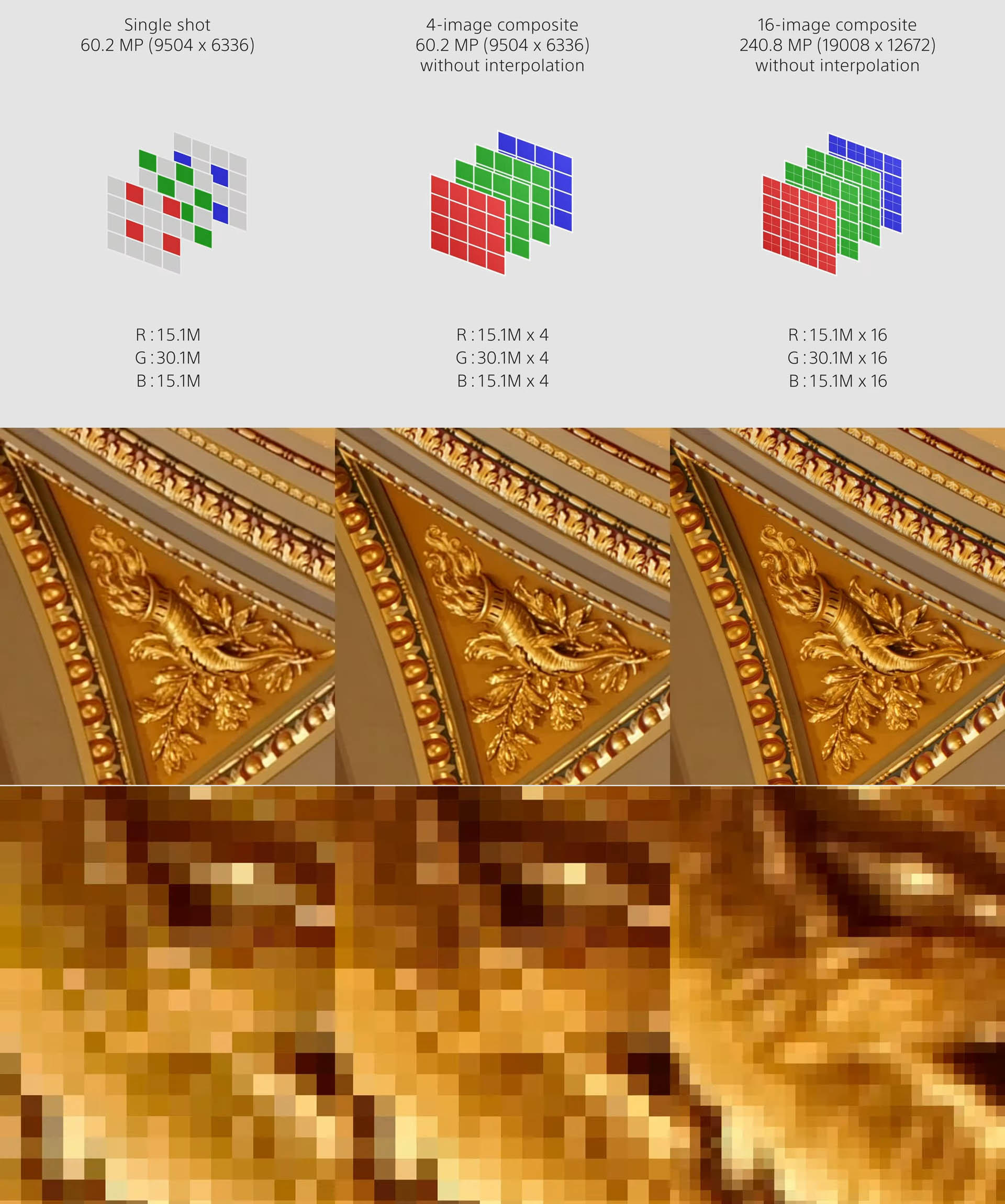
In computational photography, image-making is often an additive process. In other words, one image is rarely the product of a single image. Rather, an image is a combination of many different images with different parameters. Pixel shifting is another example of this. This is often available in smartphones and very high-resolution mirrorless cameras. This process physically (using a mechanism or making use of naturally shaky hands) shifts the sensor one pixel at a time. By combining multiple images just a pixel apart, there is more overall information captured.

An illustration by Sony showing the difference in process and output of a traditional single shot with a digital camera (left) and a pixel shift multi-shot (right). Image: Sony.

The exact means for how this happens is beyond the scope of this article, but the important thing is that this is all made possible by computer processes to shift, combine, and output one higher-resolution, sharp image.

A comparison of a scene captured by a Sony mirrorless camera using a single shot (left), a 4-image pixel shift composite (center), and a 16-image pixel shift composite (right). Click to enlarge. Image: Sony.

Pixel binning

Very basically, pixels help capture light, and larger pixels capture more light. However, smartphone cameras need to be small, and therefore their pixels need to be small. Pixel binning allows the data from four pixels to be combined into one, which increases the overall quality of the image without sacrificing low-light capabilities. Without computational photography, this technology wouldn’t be as accessible.

A concert photo captured with an iPhone.

Focus stacking

This is fairly simple and used to be a very laborious process that only extreme macro photographers would do often since they work with extremely shallow depths of field. This involves taking different images at different focal points and combining them to create one image with greater depth of field and detail. Smartphones and other cameras will do this automatically with the click of a single button and use computer algorithms to align and stack the images in seconds.

Why Does Computational Photography Matter?

Manufacturers are finding ways to make 12-megapixel sensors produce similar results to 50-megapixel sensors (although there are still limitations). This is all because of the power of algorithms, machine learning, scripts, and other computer-enabled processes that maximize the imaging capabilities of traditionally lower-grade hardware.

It’s not a perfect analogy, but a professional racecar driver could probably beat a novice driver in a race even if they swapped cars. The racecar driver, just like computational photography, uses skills to make the most out of the lower-grade hardware, while the novice driver has the hardware and lacks the skills. Computer processes are quick and efficiently taught, and they are being developed to maximize hardware that would typically not give great results. This lowers materials cost for expensive hardware and makes more possible with what we already have.

In some ways, this is a frightening aspect of modern photography. Traditionally, photographers have been championed because they have the knowledge, equipment, and experience to create stunning images in many different environments. If computational photography makes it possible to do more with less hardware, photographers need to compete with everyone who has a smartphone. There will always be the artistic side of photography, however, which will belong to photographers for at least a little bit longer. The rise of AI has brought important questions to the art world, and photography is no exception.

Computational photography is also making its way into the professional photography world. DSLRs and mirrorless cameras are seeing changes in autofocus systems that involve AI subject-identification, HDR, panorama, and other processes described above. It’s not just a smartphone thing, anymore, and technology is changing – for better or worse.

Conclusion

We’ve come a long way from loading film into a camera and advancing it to get to the next shot. Significant advances in computer technology have recently made their way into smartphones and other image-making devices, something that many would’ve never thought possible.

Computational photography has traditionally been used to make high-quality photographs using hardware that would otherwise not produce such quality, and it’s making its way to professional cameras. Regardless of anyone’s opinion on the innovation happening today, it’s important to stay informed on technology and how imaging processes work so that photographers can use the tools available to them.


Image credits: Header photo by Ted Kritsonis for PetaPixel

How to Improve Your Sports Action Photography

How to Improve Your Sports Action Photography

When it comes to sports portraits and action photography, employing a bit of artificial light can make a huge difference by giving you the ability to shape the look of the frame and add a lot of drama to the image. If you are ready to get started working with artificial light in your sports action portraiture, check out this excellent video tutorial that will give you a range of helpful tips and advice sure to put you on the right track. 

Coming to you from Matt Hernandez with Westcott Lighting, this awesome video tutorial discusses the ins and outs of working with artificial light for sports action photography. The beauty of adding a bit of artificial light to this sort of portraiture is that you can overwhelm the sun, making it easy to control the drama in the frame. While you might normally think that it is easier to work in a studio in this sort of scenario (and from a technical perspective, it is), working outside allows you to photograph your subjects on the tennis court, the baseball diamond, the football field, etc., lending your images a much higher level of realism. Check out the video above for the full rundown from Hernandez.

How Roope Rainisto’s AI Photography Redraws Artistic Boundaries

How Roope Rainisto’s AI Photography Redraws Artistic Boundaries

On April 5, Web3 photography platform Fellowship dropped Post Photographic Perspectives, its inaugural group show headlined and curated by designer and AI-collaborative artist Roope Rainisto. Featuring 500 new pieces from Reworld, Rainisto’s latest collection, and a further 1,000 works from 10 AI artists hand-picked by Rainisto and Fellowship, Post Photographic Perspectives is one of the most highly-anticipated NFT drops of the year. 

The show sits at the center of several exciting technological and cultural developments that have sparked intense debate both within and outside of Web3’s walls in recent months. We sat down with Rainisto and Fellowship’s Co-founder, Alejandro Cartagena, ahead of the drop to get their views on the discussions surrounding AI art and the importance of pushing technological and artistic boundaries forward. 

Rainisto’s vision meets Fellowship’s mission

Rainisto has seen a monumental rise to fame in both the NFT and AI art spheres in the aftermath of Life In West America, his successful BrainDrops release from February 2023 that presented a fever-dream vision of the idea of the American West. That collection helped cement BrainDrops’ status as one of the premiere platforms for AI art in Web3 and has done nearly 1,800 ETH in trading volume on the secondary market since its release.

An AI photo of a man at a food stand in an aesthetic the recalls 1960s Americana.
Sunday Service from Life In West America. Credit: Roope Rainisto

Rainisto’s style is both immediately recognizable and compellingly bizarre. Rather than try to hide the fact that his works are the product of AI art tools, his AI photography leans hard into the “AI-ness” of his image outputs, creating something at once familiar and alien. Rainisto’s work, more so than perhaps any other artist’s in the space, plays with the brain’s inherent pattern-seeking capabilities, presenting viewers with scenes that they have both seen a million times and yet have never come across. 

“There’s something [in Rainisto’s work] that I’ve never seen before.”

Alejandro Cartagena

“In my many years of studying photography and art, there’s something [in Rainisto’s work] that I’ve never seen before,” Cartagena said of Rainisto’s unique aesthetic while speaking with nft now. “He’s the only person doing the things he’s doing with AI. His vision is very particular, concise, and technically sound. What he has done is embrace the tool and its glitches, its defects, and found expression in precisely that.”

Fellowship’s goal is to capitalize on the opportunity that Cartagena sees in building a photography collection like no other on the planet. Himself a photographer with decades of experience in creating, curating, and collecting photographs, Cartagena believes Fellowship can be the organization to consolidate 180 years’ worth of photographic history into one cohesive and unique collection, unbound from the limits of the museums that store 1/1 physical photographic work in vaults and halls that few people will ever see. 

In November 2022, Fellowship collaborated with none other than Dmitri Cherniak for the release of the artist’s 100-piece generative photography collection, Light Years. Experimental releases like these align perfectly with Cartegena and Fellowship Co-founder Studio137’s vision, making the platform’s partnership with Rainisto a perfect fit.

“We see Fellowship as this core collection that is the base to build into the future what photography can be,” Cartagena elaborated. “We love the fringes of photography and the things that have made photography, photography. Because the NFT space moves so quickly, we can experiment in a very sophisticated and fast way. We’re a gallery, a collection, we commission work, and we want to be a charity to support marginalized artists. We want to be a lot of things because the NFT space permits that flexibility.”

Cartagena and Studio137 began collecting Rainisto’s work in early 2022. Connecting with the artist shortly after, they agreed to work together on Rainisto’s follow-up to Life In West America — Reworld. 

REWORLD and Post-Photographic Perspectives

The 500 pieces in Reworld thematically recall those from Life In West America but are distinct in their particular focus. Whereas the images in the latter centered on individuals and small-scale personal relationships, Reworld deals with grander concepts, forming a commentary on societal issues at a much higher level. 

REWORLD. Credit: Roope Rainisto

Starting April 5, the pieces in the collection will be sold in a Dutch Auction format, starting at 10 ETH and dropping 0.4 ETH every minute until the price reaches a low-end cap of 4 ETH. After this, the price will drop 0.1 ETH each minute until it hits a floor of 2 ETH, after which the sale becomes public if any inventory remains. The first 35 minutes of the auction is reserved for Patron Pass holders, Fellowship’s annual membership token released in March. 

On the show’s second day, Rainisto switches from featured artist to curator, presenting 10 AI artists who were chosen for their ability to show the range of what AI tools can do in the post-photographic arena. While some artists in the show’s second stage are known for their own approaches to AI photography, others take the very concept “to the edge,” as Cartagena puts it. Selected artists for this part of the show include AI. S.A.M, Andres Hernandez, Antti Karppinen, Charlie Engman, Jess Mac, Julie Wieland, Katie Morris, Simon Raion, Ben Millar Cole, and Pierre Zandrowicz. 

The group show will also include at least one IRL activation, including an exhibition in May at an as-of-yet undisclosed gallery in Los Angeles and the Paris photo fair. 

An AI photograph of several figures in a textile factory wearing pink.
Pink. Unidentified. Such a useless color! Credit: Simon Raion

An artist like no other

At 43 years old, Rainisto is only recently beginning to explore artistic expression on his own terms. Having worked as a designer since the late 1990s, Rainisto’s artistic journey reached a tipping point two years ago when he started seriously considering how VR and AI technologies would begin to drastically change how the world works.

“I found the failures to be much more interesting.”

Roope Rainisto

“I thought I can be either one of the first people on this bandwagon or I can be one of the last,” Rainisto explained of his interest in AI tools while speaking to nft now. “I’m always excited about new technologies, trying to figure out how you can then use [them] to create something meaningful. That was my inspiration.”

The 500 pieces in REWORLD, a collection he has been working on for the better part of the past year, are the final cuts from over 50,000 outputs Rainisto created while building the series. They feature Rainisto’s singular style: a surreal photo-realistic familiarity steeped in Americana inspired in part by Robert Frank’s photographic book, The Americans. Rainisto also attributes the project’s origins to the idea of a road trip as seen through an algorithm’s eyes, technology that, he says, represents a shared understanding of the world.

An urban scene in an imagined setting of Southwestern United States featuring cars and adobe-like buildings.
REWORLD. Credit: Roope Rainisto

“They see in five billion pictures. In some ways, [the collection] is a road trip into a shared kind of humanity,” Rainisto offered as an insight into his project and vision.

Rainisto is fond of his approach to AI photography, something rapidly becoming known as post-photography, precisely because of the way it embraces the imperfections and outright otherworldliness of the way algorithms “envision” the prompts given to them. 

“Rather than try to hide the ‘AI-ness,’ what would happen if I tried to explore it?”

Roope Rainisto

“We’ve all seen that AI can do photos where you can’t really tell if it’s a real photo or not,” Rainisto continued. “I think that’s fine, but my kind of reference point is the camera. When Stable Diffusion came out, my idea was to make the outputs resemble a photo. I had successful renders and things that had ‘failed.’ But I found the failures to be much more interesting. Rather than try to hide the ‘AI-ness,’ what would happen if I tried to explore it?”

Reworld will be Rainisto’s last large-scale collection in 2023. Apart from the time and energy it took him to create and release two series in the span of a few months, he is hesitant to saturate the market with his work. Interested collectors can look forward to him continuing to experiment with AI art and working on 1/1s, animations, and potentially even small-scale limited editions. For now, Rainisto advises fans of his work to pick up a Patron Pass on the secondary market so they don’t miss out on the rest of Fellowship’s 2023 shows.