Photography

A 20th-Century Nanny and Amateur Street Photographer Gets Her Due

A 20th-Century Nanny and Amateur Street Photographer Gets Her Due

In 2007, an amateur historian and flea-market enthusiast named John Maloof purchased the contents of a storage locker—sight unseen—at auction. It contained approximately 150,000 prints, negatives, transparencies, and rolls of undeveloped film. This stash was the work of a professional nanny who was obsessed with photography but who chose to show her pictures to no one. Her name was Vivian Maier, and after Maloof’s astounding discovery of her oeuvre she was soon acclaimed as an important 20th-century artist. On May 31, Fotografiska New York becomes the first institution in the United States to present a major retrospective of Maier’s work. Offering a complex portrait of this enigmatic figure, who died in 2009, the exhibition includes more than 200 photographic prints, Super 8 footage, and sound recordings.

While biographical information on the mysterious Maier is scant, we know that she was born Vivian Dorothea Maier in 1926, in the Bronx, New York. After her parents separated, and when Vivian was still young, her mother moved them to her native France, where her daughter began to hungrily document the world with her cardboard Kodak Brownie. In 1951, Maier came back to New York and the next year procured a twin-lens Rolleiflex. With the square-format camera held inconspicuously at hip height, she flourished photographically.

A Photographer’s Notes | The Famous ‘Slam Dunk’ Crossing in Photos

A Photographer’s Notes | The Famous ‘Slam Dunk’ Crossing in Photos

A few weeks ago I was working in the Shonan/Kamakura area taking photos for a client. There, I noticed a lot of tourists taking pictures at what I thought was just a simple little train crossing along the coast. This crossing was close to the Enoshima line‘s Kamakurakokomae Station. From what I could see it was nothing special, just a regular train crossing that you see literally everywhere around Japan. My curiosity got the better of me though, and after a quick Google search, I understood what all the buzz was about. I found that this particular crossing was actually shown in the famous Shonen Jump anime and manga Slam Dunk

(©Jason Halayko)

The series recently had a movie in theaters and is very popular both here in Japan and around the world. It seems that many fans of the series (both Japanese and international) visit this crossing to take pictures and reenact the scene shown in the anime. Sounds like fun!

A Strategy for Solitude

Now I don’t usually shoot photos of trains, but I am a fan of all things anime and manga. I decided I wanted to head back in my free time and try photographing the crossing and the Enoshima trains as they go through. But I really didn’t want to have to deal with all the tourists when doing this. This is a big issue in Japan right now, dealing with the huge increase in inbound tourists. And the one way to deal with it is to arrive before everyone else.

(©Jason Halayko)

So before the crack of dawn, I was off on my bike riding along the Shonan coastline. I was hoping to arrive at the crossing before the first train at about 5:40 am and before anyone else as well. 

It was a cool morning and a great bike ride in the pre-dawn calm of Shonan. I was able to get there with plenty of time to spare before the first train, but I wasn’t the first person there. 

As I rode up and parked my bike, another photographer came around a corner and started to get ready to capture the first few trains of the day. Oh well, at least we were the only two people there, and the other photographer had their own ideas for shooting so we didn’t cross paths for most of the morning. 

Embracing the Early Hours

Since I was basically alone (except for the odd local heading to the beach) I really wanted to get back away from the tracks. From there, I wanted to try and capture the crossing and the train within the local environment. This would be something impossible to capture once all the tourists started showing up. They would be all over the place and for sure get in any images I wanted to capture. 

So from that first train at 5:40 am till about 6:00 am, I was able to shoot and move and just enjoy capturing the trains coming through the crossing at my own pace. With each passing train, I changed positions and slowly moved down the street closer and closer to the crossing. This allowed me to get a surprising variety of images at such a simple location. 

(©Jason Halayko)

As I already said, I am not a “train photographer” but I had a very enjoyable and quite relaxing time while working in the area. Thanks to the train app I have on my phone, and the fact that trains rarely arrive late here in Japan, I always knew how much time I had to change positions between trains. Plus if I did happen to lose track of time, the crossing bells would remind me another train is soon to arrive! It was great fun! 

Early Bird Gets the Worm

Unfortunately, as time went by and the sun rose above the houses behind me, the inevitable march of the tourists began. The crossing slowly started to get a little more crowded than I wanted. Jumping on my bike around 6:30 am to head home, I caught the eye of the photographer who had arrived at the same time as me. We exchanged nods of recognition while I rode off back down the Shonan coastline. 

I really enjoyed my little morning shoot and learned a valuable lesson: the early bird does get the worm. As Japan is just extremely popular for inbound visitors, the only way to get photos of popular spots without a million people is to get there as early as you can. And I mean way earlier than you think. In the end, you may get sleepy in the afternoon like I did, but isn’t that what the large coffees are for?

(©Jason Halayko)

RELATED:

Author: Jason Halayko

Jason Halayko is a professional photographer specializing in action sports and portrait photography. Follow him on X (formerly Twitter) and Instagram.

Advertisement

vivo unveils V30e, their best mid-range smartphone for photography lovers

vivo unveils V30e, their best mid-range smartphone for photography lovers

Global smartphone brand vivo announced the arrival of the highly anticipated vivo V30e, the final addition to its acclaimed mid-range V30 Series. 

Priced at just P17,999, the vivo V30e is designed to deliver the best mobile photography experience without compromising on style and performance. 

Here are the top reasons why vivo V30e is perfect for people who love taking photos.

Unmatched camera quality

The vivo V30e is equipped with a state-of-the-art camera system that sets new standards for mid-range smartphones in its price range. It boasts a 50MP Sony IMX882 main camera, which is renowned for its accurate color reproduction, ensuring that photos are vibrant and true-to-life with no color cast.

It also has a 32MP selfie camera that guarantees stunning, poster-like selfies with just one tap, and an 8MP wide-angle camera that supports a 120-degree field of view, capturing every detail even in group photos.

Revolutionary portraits with Aura Light 3.0

Experience the best portraits with the innovative Aura Light 3.0. This industry-leading light-filling tool ensures perfect portraits even in the darkest environments. 

With smart adjustments for cool and warm tones, your photos will always have harmonious and vibrant colors, bringing both subjects and landscapes to life.

Extended battery life for endless photography

Never worry about running out of battery during a photo session. The vivo V30e features the largest battery capacity in the Ve Series with a massive 5500 mAh battery. 

Also, you can enjoy up to 22 hours of video streaming, 15 hours of social media usage, nine hours of gaming, or 53 hours of music playback on a single charge.

Superior durability for adventurous photography

Capture memories without hesitation, thanks to the vivo V30e’s robust durability. It boasts an IP64 rating for dust and water resistance, which ensures it can survive accidental submersion in up to five feet of water for 30 minutes.

The vivo V30e offers seamless performance with 8 GB RAM and 256 GB of internal storage, expandable up to 1 TB. The 8 GB RAM with up to 8 GB extended RAM ensures smooth multitasking even with 27 apps running in the background. It also has a 120 Hz AMOLED 3D curved screen display that provides an immersive viewing experience – perfect for gaming, streaming, and browsing.

The vivo V30e is now available in two stunning colors: Cloud White and Coco Brown. You can purchase the vivo V30e at any vivo physical store nationwide, or online on Shopee, Lazada, and TikTok.

Don’t miss out on the vivo V30e, the best mid-range smartphone designed for photography lovers and those seeking exceptional performance. Visit the vivo website to learn the full features of the vivo V30e. – Rappler.com

PRESS RELEASE

‘Documenters of our time’: Exhibition celebrates Herald photography

‘Documenters of our time’: Exhibition celebrates Herald photography
Lightning strikes twice on the Western Plains of NSW for storm chaser and Herald chief photographer Nick Moir.

Lightning strikes twice on the Western Plains of NSW for storm chaser and Herald chief photographer Nick Moir.Credit: Nick Moir

Whether it’s an image of the most famous person on the planet, or a little-known victim of tragedy, the best of the Herald’s photography will stop you in your tracks.

“A good photo will jolt you from your day to day, force you to pause and look,” says the Herald’s managing editor, photographic, Mags King.

A collection of arresting images from the Herald will be on display in the Photos1440 exhibition at the NSW State Library from May 25.

Triple treat: Taylor Swift, centre, is dwarfed by her twin images during her series of gigs at Accor Stadium in February 2024.

Triple treat: Taylor Swift, centre, is dwarfed by her twin images during her series of gigs at Accor Stadium in February 2024.Credit: Wolter Peeters

Wolter Peeters’ image of the most photographed person in the world, Taylor Swift, still finds a way to tell an unfamiliar story.

“Wolter has framed Swift as a mere human in the middle of a massive stage, while the humungous projections on either side show us how the world sees her,” King, who curated the exhibition, says.

Less recognisable but no less arresting is Theresa Ardler, a member of the Wreck Bay PFAS contamination class action, captured in a stunning portrait by Rhett Wyman.

Advertisement
Artist Theresa Ardler in Wreck Bay on the NSW South Coast.

Artist Theresa Ardler in Wreck Bay on the NSW South Coast.Credit: Rhett Wyman

Through Wyman’s lens, we see what Ardler has endured as carcinogenic chemicals poisoned her home. After losing both her parents before her 18th birthday, the 51-year-old now fears for her own health. She suffers from coronary heart disease and has had a cancerous cyst removed from her pancreas.

The Herald’s photography is grounded in the wealth of experience of photojournalists like Kate Geraghty, who has been with the organisation for 25 years.

Geraghty’s unique ability to cover conflict was evident again last year, when she travelled to Israel and Palestine after the October 7 attacks, capturing female mourners as they surrounded the body of a teenager killed by an Israeli soldier.

Female mourners during the funeral of Suhaib Al-Sous, aged 15. Suhaib was shot dead by Israeli soldiers while participating in a peaceful demonstration.

Female mourners during the funeral of Suhaib Al-Sous, aged 15. Suhaib was shot dead by Israeli soldiers while participating in a peaceful demonstration.
Credit: Kate Geraghty

“It was a beautiful but upsetting moment,” Geraghty says.

“These final goodbyes and touches of tenderness and love between mother and child, sister and brother. It was heartbreaking.”

Advertisement

But, as King explains, the beauty of the exhibition is how it demonstrates the Herald’s role as “documenters of our time”; not just of important global events, but also of unique local phenomena.

Flavio Brancaleone was on the scene at Bronte Beach on Christmas Day when a huge crowd of expats descended to celebrate a sun-drenched Aussie Christmas.

Revellers flock to Bronte pool for a Christmas Day bash.

Revellers flock to Bronte pool for a Christmas Day bash.Credit: Flavio Brancaleone

“The way [Brancaleone] positioned himself in the water, among all the bodies, and then you can see the one distinct local flanking the image on the right,” King says.

While King says the speed of the news cycle “doesn’t always allow for artistry to happen”, she commends the photographers when they find ways for creativity to come through.

“That’s the intention of this exhibition, to show that artistry within the pace of the newsroom … and to display our images on a different scale from what our readers are used to.”

Photos1440 is at the NSW State Library from May 25 to July 7. Admission is free.

Most Viewed in Culture

‘People were the stars’: Rennie Ellis, the photographer who captured how Australians dressed, danced, loved and felt

‘People were the stars’: Rennie Ellis, the photographer who captured how Australians dressed, danced, loved and felt

There are no “stunning sunsets” in the work of Rennie Ellis, or “breath-taking” views. He never said, “There are no words”. If he witnessed something unusual, he wouldn’t have said, “It was like a movie”. Rennie hated flat, meaningless language and cliches, whether in his photography or his writing. And he never took a single cliched shot.

All of this helps to explain why Rennie has been described as one of Australia’s “most prolific and gifted social documenters”. He was an original. He didn’t care for the wide shot; he was about photographing the look on a face; the unposed moment of elation, excitement, apprehension. Someone showing off, someone bored.

These thoughts struck me when I recently went to the State Library of Victoria to see Melbourne Out Loud: Life through the lens of Rennie Ellis.

Rennie, who died in 2003 aged 62, was a brilliant Melbourne identity who photographed the city for decades. No event was complete without him. (Nearly a cliche there, sorry Rennie.) But while he loved Melbourne, Rennie took his camera everywhere. I was fortunate to watch him in action many years ago in Italy and northern Africa when we travelled together for a few weeks.

On one luminous blue day in Capri, we climbed up a seemingly never-ending set of steps and arrived at the ruins of Emperor Tiberius’s Villa Jovis. When you’re sitting at the edge of an emperor’s beach shack with a bowl of spaghetti vongole in front of you, it’s hard to get to your next commitment, especially when your lunch companion is Rennie. We lost track of time and missed a press briefing, which earned us a sharp dressing down – but it was worth it.

In Tunis we wandered through the markets and stopped at a cafe. Watching people walking by wearing the most sublime colours, Rennie’s eyes darted around, his camera on the table next to our espresso glasses. I wish I’d seen the photos he took that day.

Travelling with Rennie underlined that the best travel photography doesn’t have to be churches and monuments. Everybody’s got those shots. But Rennie shot anything that caught his eye: the human moment, a real emotion, daily life. The small details that tell a wider story.

Rennie’s work is powerful because it shows the ordinary. Sure, some of his photographs depict glamour, but they are often about the person standing next to the celebrity.

People were the stars. This is why Rennie’s photos have become a valuable record of our social history, about how we dressed, danced, loved, celebrated, barracked, protested and sunbathed. How we felt. How we reacted.

Just like everyone with an iPhone today, Rennie was never without his camera. He bowled up to people and asked if he could photograph them, including one day when I was with him on the Paris Métro. No one he approached said no, at least when I was there. He had a business card, an infectious smile, a gentleness and genuine curiosity. That seemed enough.

The show at the State Library of Victoria is a superb encapsulation of Rennie: his sense of humour, his mischief and his interest in people, on the street, at the beach, at the Melbourne Cup, the Grand Final, at a fashion show or on a dancefloor.

There’s Chris Bailey of The Saints playing with a young Nick Cave in the front row of the crowd. There are cheer squads at the footy. There’s Richmond player Robbie McGee sitting on the ground at the MCG, having a smoke after a game.

There’s Molly Meldrum riding a bike and wearing some sort of cape; there’s Sir Rod Carnegie dancing; there’s wildly dressed revellers at Inflation when that King Street nightclub was at its louche peak.

Celebrities were OK, if they were in situ. But it was regular people Rennie enjoyed photographing most. Some of them probably couldn’t understand why Rennie was so interested in taking their photo. They might not have thought they were important enough. They couldn’t know their image would one day tell a great story; to be frank, neither could many photographers.

But years later, it’s clear that the stories he told with his camera connect strongly with us today. It’s the thrill of the familiar, the recognition of the fashions or the hair or sometimes the backdrop. That’s us.

I bumped into Rennie at a cafe in Fitzroy a year or so before he died. As ever there was the huge smile, the tangled mop of long hair, the stories at the ready. We cackled about getting into trouble that day in Capri. The questions tumbled out. He was always more interested in talking about someone other than himself.

His death was a shock to a city that was so used to seeing him everywhere. He seemed so full of life and energy. Melbourne – and Australia – was so much poorer for this loss.

But his photos live on. We should all take a bit of a Rennie with us when we travel. Don’t shoot the sunset: find a face or two.

Rennie’s images are priceless. He knew that. It just took the rest of us a while to catch up.

Statue honoring war photographers dedicated on Memorial Day Weekend at Veterans Park

Statue honoring war photographers dedicated on Memorial Day Weekend at Veterans Park

War Photographer Memorial statue recently installed at Veterans Park. Photo/Carol Robidoux


MANCHESTER, NH – A funny thing happened on the way to the dedication of a War Photographer Memorial in Manchester on Friday.

Eric Bailey of Phoenix Precast Products was out on an early septic tank installation in Barrington. He built in enough time to get from Barrington to his Concord office so he could change clothes, and then drive down to Veterans Park in time for the installation of the statue.

Turns out Phoenix Precast works with cement for all sorts of projects – from septic tank installations to heavy bronze statues in need of a sturdy base.

Bailey not only made it to the ceremony in time, but so did his septic tank customer, Marshall Bishop.

“I wasn’t acquanted with Mr. Bishop before today, but as I was doing the installation at his house I noticed he had a military background so I mentioned I was heading to Manchester next for the dedication of a statue honoring military photographers. Turns out he was a military photographer, with the Marines,” said Bailey. 

The odds of that are hard to calculate but Bishop knew a call to action when he heard it.

PXL 20240524 145954868 scaled
The war photographer statue seems to be keeping a watchful eye on the crowd at the ribbon cutting on May 24, 2024. Photo/Carol Robidoux

PXL 20240524 145944605 EDIT scaled
Close-up of inscription on the back of statue recognizing SP4 George J. (Josh) Denoncourt, who served in the 1st Infantry Division as an Army war photographer during his time in Vietnam. Photo/Carol Robidoux

He synchronized his watch for ten-hundred-thirty hours, hopped in his car and made it from Barrington to Manchester inside of 45 minutes – right on time to see Josh Denoncourt snip the ribbon on the freshly-installed statue, its shadow already moving across the park with the Memorial Day weekend sun. 

Bishop’s gut reaction to the statue?

“Oh shit – that’s me,” said Bishop, with a hearty laugh. He leaned in on one of his crutches as he reminisced about his time in the trenches. It’s not often veterans who chronicled war from behind the lens see themselves reflected in public spaces, and especially not like this.

The statue was a gift to the city from Denoncourt who attended the brief dedication and cut the ceremonial ribbon after reflecting on his own service, and the meaning behind the statue. Denoncourt, 76, volunteered for the draft in 1967. 

PXL 20240524 145025182 scaled
Josh Denoncourt, left, and Marshall Bishop, right, just a couple of Vietnam combat photographers. Photo/Carol Robidoux

During his remarks he told of how, before he left for the recruiting office, his father took him aside and urged him to save some of his $75 monthly paycheck. “They’ll give you everything you need; you’re not going to need all the money they give you,” said his father – who was the one who taught him photography.

Denoncourt vowed to his father that he’d save half his paycheck and so when a sergeant advised the new recruits during basic training to buy U.S. Bonds “or they’d be in a world of hurt,”  Denoncourt purchased a $50 bond for $37.50. He further explained that those who enlisted usually got their pick of jobs based on what the recruiter promised them, while those who were drafted replicated their day jobs in some way, or accepted whatever was assigned.

His generous investment of half his salary in a U.S. bond so impressed the brass that the sergeant said “give him whatever he wants” for a job. Denoncourt, whose civilian job was a customs import broker, decided instead to say he was an amateur photographer. 

“I guess the ‘amateur’ didn’t catch with him and that’s how I got to carry that camera,” he said, a note of pride ringing in his voice. He nodded toward the replica of the military-issue camera portrayed in the statue. “The camera looks big, but it’s 150 percent to scale and that camera is the end of an era – everything’s digital now but they continued to use some aspect of that technology up until about 10 or 15 years ago; so the time now is right to honor these individuals,” he said. 

PXL 20240524 144823544 scaled
Josh Denoncourt, left, talks with Eric Bailey, center of Phoenix Preset, and Kate Waldo, right of the city Parks department. Photo/Carol Robidoux

Historically Denoncourt noted that the 1st Infantry Division, aka “Big Red One” with which he served (so named for the large number 1 in their insignia), deserves credit for deploying more combat still photo specialists than any other, going back to WWI.

He praised sculptor Matt Glenn of the Utah-based Big Statues, who got it all just right, Denoncourt said, from the nuances of the uniform and helmet right down to his watchful expression based on photographs he provided.

Denoncourt credited Phoenix Precast for saving the day, as Ray Popsie and Ryan Dore offered a “concrete solution,” after the quarry said they couldn’t provide a big-enough slab for his project until 2028. 

His “thank-you list” also included former Mayor Craig, who was in attendance, along with Mayor Jay Ruais and the aldermanic boards from both administrations, Phoenix installers Eric Bailey and Bill Corson, Swenson Granite, David Noonan Wrought Iron, which will provide a small protective fence, shout-outs to city Parks Director Mark Gomez and Parks Project manager Kate Waldo,  and U.S. Senators Jeanne Shaheen and Maggie Hassan.


[Click image to enlarge]

Prior to the ribbon cutting, the Ruais recognized the timing of the installation and what it means to include those who served as combat phographers as part of the array of memorials at Veterans Park:

“Today’s dedication holds special significance as it coincides with Memorial Day weekend, a day when we pause to honor and remember the courageous men and women who have made the ultimate sacrifice in service to our nation. It is a day of reflection and gratitude and respect for those who have laid down their lives to protect the freedoms that we hold dear,” Ruais said.

“Combat photographers occupied a unique and vital role within our armed forces. With cameras as their weapons, they capture the stark realities of war –  the triumphs, the tragedies, and the raw emotions found on the battlefield. Their work not only documents history but also brings the stories of our service men and women into the public eye ensuring that their bravery and sacrifice are never forgotten. The statute we dedicate today is not just a tribute to a singular individual, but a representation of all combat photographers who have risked their lives to bring their truth of war to the world. It stands as a reminder of their courage, their skill and their unwavering commitment to their mission. Through their lenses they have shown us the true cost of freedom, and the resilience of the human spirit.”


Below, a video of the ribbon cutting. Video/Carol Robidoux

Vintage look in modern glass – The Thypoch Eureka 50mm f/2

Vintage look in modern glass – The Thypoch Eureka 50mm f/2
[embedded content]

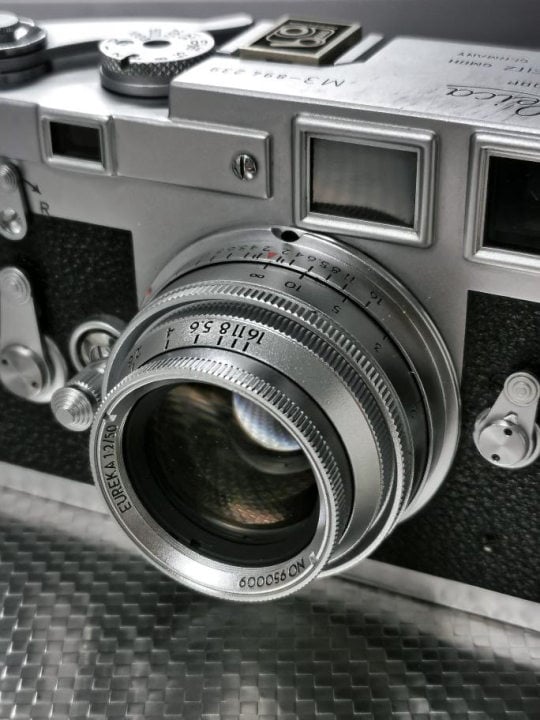
If you don’t know Thypoch, they are a rather new company, which only launched their first set of lenses last year. These lenses were the Thypoch Simera series, which looked like old Leica glass. Not only that, but the Simera lenses had great optics as well. Because of this, I’m happy that Thypoch is back with its second-ever series, the Thypoch Eureka. Currently, this series is composed of only one lens, the M-mount Eureka 50mm f/2, a lens with a look so retro to fool anyone into thinking it’s from the 1950s.

The Thypoch Eureka 50mm f/2

Seeing the Thypoch Eureka 50mm f/2 on an old camera makes even a vintage lens geek like myself feel like it belongs to the same era—almost like it was bundled with cameras such as the Leica M3. The lens uses a metallic finish and a collapsible design, which, as you would expect from Thypoch, looks like an old Leica Summitar. Even if you don’t care about retro designs, this design is still hard to hate with its compact and convenient nature.

The Eureka 50mm f/2 aperture is plenty fast for a lens this size. It has a 12-blade diaphragm design, which has more blades than most vintage 50mm lenses. In images, this will translate to smoother bokeh circles. The lens has a 0.9m close focus distance, which is just slightly better than the 1-meter distance of the Summitar 50mm f/2 the Eureka is based on.

The M-mount is easily adaptable, and because the Eureka can cover a full-frame sensor, it can be easily adapted to any mirrorless camera. But it would still feel a bit retro on a digital sensor, thanks to Thypoch interesting coating, which simulates the coating of old glass. This should translate to flares similar to vintage lenses. (And I hope that this series follows the same release path of the Simera line to expand to extra mounts as well)

Thypoch Eureka 50mm f/2 samples

Thypoch Eureka 50mm f/2 specs

Name Eureka
Colour Silver
Focal Length 50 mm
Mount M-Bayonet
Aperture f/2 – f/16
Image Circle 43.2 mm (FF)
Construction of Optics 6 Elements in 4 Groups
Flange Distance 27.8 mm
Hood Eureka Lens Hood
Angle of view
(diagonal, horizontal, vertical)
46° / 39° / 27°
Type of focusing Manual focus
Close Focus 1m / 3.3ft
Front Dia. ∮35.9mm / 1.4″
Filter Size A36
Length 41.2mm / 1.6” (Before Collapse)
27mm / 1.1” (After Collapse)
Iris Blade 12
Weight (Product) ≈120g (Aluminum Alloy)
≈218g (Brass)
Accessories Attached UV Filter
Hood and Lens Front Ca

Price and availability

Eureka 50mm f/2 comes with a front cap, a rear cap, a UV filter, and a photo book. The lens is available in aluminum and brass versions for $579 and $859, respectively.

Winnie Au Photographs 60 Pups with Pizzazz in Her New Book ‘Cone of Shame’

Winnie Au Photographs 60 Pups with Pizzazz in Her New Book ‘Cone of Shame’


Books
Photography

#dogs
#humor
#Winnie Au

May 24, 2024

Grace Ebert

All images © Winnie Au, designs © Marie-Yan, shared with permission

Protecting an injured paw or pesky stitches never looked so good. Winnie Au (previously) upends the humiliating nature of Elizabethan collars as she photographs hounds sporting stylish takes on the medical devices for her series Cone Of Shame.

Au began the project back in 2017 in collaboration with designer Marie-Yan Morvan as a way to showcase dogs’ unique personalities and turn otherwise torturous ruffs into spectacular accessories. Using materials like paper and tulle, and more unconventional finds like dissolvable insulation foam and candy buttons, the pair fashioned a wide array of designs much more glamorous and charming than their veterinarian-issued counterparts. “Each dog, cone, and backdrop has been conceived as a mash-up of abstract shapes, tones, and textures. No longer turning dogs into laughing stocks, these collars become works of art,” Au says.

A new book published by Union Square & Co. collects photos of 60 dogs donning the fashionable ruffs, 48 of which haven’t been shared before. While the core concept is the same as when the series began, the pair incorporated newer technologies into recent images, including the inflatable rings that have grown in popularity. They also worked with new breeds and materials in what Au describes as “my love letter to all the good dogs out there.”

Cone Of Shame will be released on July 9 and is available for pre-order in the Colossal Shop. Find more from Au on Instagram.

a brown and black dog wearing a white tulle collar

an open book spread with two images of a yellow dog wearing a lush red fur collar

colorful dots cover a white cone worn by a dog with just its nose sticking out. the photo is on a bright blue background

an open book spread of a Dalmatian wearing a speckled cone amid a backdrop of dots

the book cover for cone of shame

#dogs
#humor
#Winnie Au

Do stories and artists like this matter to you? Become a Colossal Member today and support independent arts publishing for as little as $5 per month. You’ll connect with a community of like-minded readers who are passionate about contemporary art, read articles and newsletters ad-free, sustain our interview series, get discounts and early access to our limited-edition print releases, and much more. Join now!


Photo essay: Street photography in Japan

Photo essay: Street photography in Japan

Tokyo shares similarities with London and New York, among them being one of the most photographed cities in the world, yet it maintains an unexpected tranquility.

Both Yokohama and Tokyo are bustling cities, with people either rushing about or catching a quick nap, but there is an undeniable order to the chaos. Walking through a busy train station, one side can be completely empty while the other is packed, as everyone adheres to the designated walking lanes without deviation.

I recently travelled there for the first time and endeavoured to capture the sights, colours, smells and everything that makes Japan such an enchanting country.

The advertising boards are unlike anything I have ever seen, adorned with charming anime characters at every turn. As you stroll through Yokohama, street vendors offer an array of items, including personalised art. Despite the language barrier, everyone is patient and kind, always eager to assist.

Food is a cornerstone of Japanese culture. Tiny restaurants with queues stretching out the door are commonplace, with waiters taking orders right on the street. Both tourists and locals search for the best sushi, ramen or tempura, eager to savour the authentic flavours.

Japan is one of the most extraordinary countries, home to the most remarkable people. As you wander through its streets, you will never run out of captivating moments to photograph.

Updated: May 24, 2024, 6:01 PM