Photography

AP photographer gets in the right spot for a big swing at the Masters

AP photographer gets in the right spot for a big swing at the Masters

AUGUSTA, Ga. (AP) — AP photographer Matt Slocum knows his way around the bucolic Augusta National Golf Club during the week of the Masters — it’s a difficult task with all the regulations that help preserve the aura of the tournament. So, when he saw the light and clouds combining for a perfect backdrop, he knew exactly where he should go to take some tee shots. He also knew how to stay ahead of the patrons to get to his perfect spot. Here’s what he had to say about making this extraordinary image.

WHY THIS PHOTO

Demystifying Three-Point Lighting: A Practical Guide for

Demystifying Three-Point Lighting: A Practical Guide for

Understanding and effectively utilizing light is fundamental to creating compelling and impactful portraits. This is where the concept of three-point lighting comes into play, offering a versatile and powerful technique for achieving professional-looking results. 

Coming to you from Gavin Hoey with Adorama, this informative video provides a comprehensive breakdown of the three-point lighting setup and its various applications. Hoey, a renowned photographer and educator, guides you through the process of setting up and adjusting each light source – the key light, fill light, and backlight – to achieve different effects. He emphasizes the importance of understanding the interplay between these lights and how their positioning and intensity can shape the shadows, highlights, and overall tone of your images. By demonstrating different configurations and explaining the rationale behind each choice, Hoey empowers you to experiment and develop your own lighting style.

Hoey’s approach to teaching three-point lighting is both practical and insightful. He debunks the myth of rigid rules, encouraging you to adapt the technique to your specific needs and preferences. He also highlights the importance of observing the subtle nuances of light and shadow, demonstrating how even minor adjustments can significantly impact the final image. His emphasis on understanding the purpose of each light and its contribution to the overall composition provides a valuable framework for approaching any lighting scenario. 

Beyond the technical aspects, Hoey’s video underscores the importance of experimentation and creative exploration. He encourages you to try different lighting setups, modifiers, and power ratios to discover what works best for your vision. By embracing this spirit of experimentation, you can develop a deeper understanding of light and its behavior. Remember, there’s no single “correct” way to use three-point lighting; the key is to adapt the principles to your unique style and subject matter. Check out the video above for the full rundown from Hoey,

If you would like to continue learning about how to light a portrait, be sure to check out “Illuminating The Face: Lighting for Headshots and Portraits With Peter Hurley!”

Watch: Non-Jewish Photographer’s Description of a Farbrengen

Watch: Non-Jewish Photographer’s Description of a Farbrengen

Amongst the many thousands packed into 770 to celebrate the Rebbe’s 80th birthday, Donal Holway, a photographer for the Washington Post, didn’t quite know what to expect. In an interview, he recalls his reaction upon entering the room, the overwhelming emotion, and how he positioned himself for the best pictures.

Amongst the many thousands of people packed into 770 to celebrate the Rebbe’s 80th birthday, one of them was there on a special assignment.

Donal Holway, then a photographer for the Washington Post, was assigned to cover the event in Brooklyn, not quite knowing what to expect.

In a 2007 interview, he recalls his reaction upon entering the room, the overwhelming emotion, and how he positioned himself for the best pictures of the historic event.

This is the story behind a collection of ninety special pictures of Yud Alef Nissan 5742, now published by JEM for the first time.

With gratitude to Rabbis Mendel Gourarie, Eli Sapochkinsky, Motti Hazan and Memkeh Schmukler of the JEM team.

Click here for the newly released pictures: https://jemphotos.page.link/Gx3J

YouTube player

Art Dirt: Talking Art, Architecture & Photography with Paul Hester

Art Dirt: Talking Art, Architecture & Photography with Paul Hester
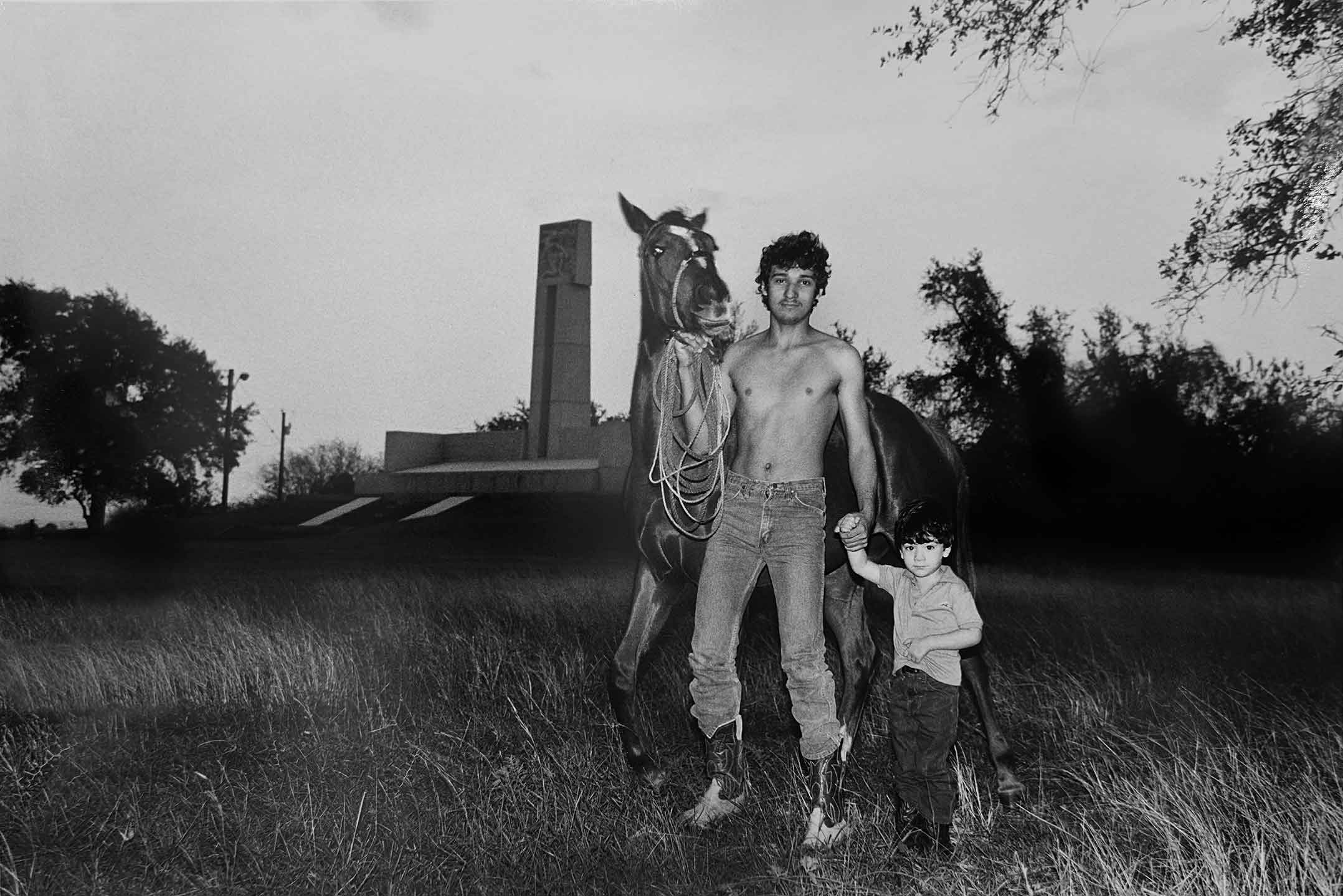
A young man in front of the Goliad Monument holding the reins of a horse in one hand leads a small boy toward the camera.

Paul Hester, ” Fannin’s Men”

Brandon Zech talks with Texas artist Paul Hester about his over 50-year career taking photographs.

There are photographs that I look at and say ‘that just feels right,’ but there are others that bug the hell out of me, and those are the ones that stick with me.

To play the podcast, click on the orange play button below. You can also find Glasstire on Apple Podcasts and on Spotify.

If you enjoy Glasstire and would like to support our work, please consider donating. As a nonprofit, all of the money we receive goes back into our coverage of Texas art. You can make a one-time donation or become a sustaining, monthly donor here.

Related Readings:
Glasstire: Review: Paul Hester’s “Prisoners of Masculinity” at Andrew Durham Gallery, Houston
Glasstire: Business and Pleasure: 50 Years of Photography by Paul Hester
Glasstire: Five-Minute Tours: Paul Hester & Sarah Sudhoff at Andrew Durham Gallery, Houston
Glasstire: “WAR/PHOTOGRAPHY” at the MFAH: All But Death, can be Adjusted…
Glasstire: Talking with Glasstire Contributor Rosa Boshier González
MoMA: The Machine as Seen at the End of the Mechanical Age

Photography Month, 7am

Photography Month, 7am

Photography Month, 7am – Good Day Sacramento


Watch CBS News


Sacramento area museums are proud to participate in the 6th Annual Photography Month Sacramento happening in April 2024. SMUD Museum of Science & Curiosity (MOSAC) is displaying a special “Celebration of Student Photography” in the museum lobby that is presented in partnership with the photography department at the California State University Sacramento.

View CBS News In

Be the first to know

Get browser notifications for breaking news, live events, and exclusive reporting.


Photography trip to Vancouver Camera Swap-Meet and Used Camera Sale

Photography trip to Vancouver Camera Swap-Meet and Used Camera Sale

This past weekend was the “photography” weekend I have been waiting for all year.

April 7 was the spring Vancouver Camera Swap-Meet and Used Camera Sale and my photo pal Jo McAvany and I made the drive the day before to stay two nights at the Inn at Quay in New Westminster. Our reserved, fourth floor room had a great view of the boardwalk with its food, shops, moored tugboats and the wonderfully scenic Fraser River.

I saw other guests arrive and go to their room to relax after their journey, but as tired as I was after that four-hour-plus drive the last thing I wanted to do was lounge in my room.

I was throwing my suitcase on the bed, looking out from the balcony, picking up my camera, letting Jo know we can look for some snacks, then we left the hotel to start pointing my camera at everything.

“The camera makes you forget you’re there. It’s not like you are hiding but you forget, you are just looking so much,” said Annie Leibovitz

There was so much to photograph; pigeons outside a restaurant, seagulls along the pier, two big yellow tugboats, a bright red 32-foot-tall tin soldier, the cable Skytrain Metro railway and the Pattullo bridge going high across the Fraser River, and so much more.

We also browsed the many craft shops, chose an eatery that had takeout, and wandered along the waterfront. I kept making Jo pose beside and on everything, but she is used to me always wanting that. Hmm… who said “Once photography enters your bloodstream, it is like a disease?”

A note here: For my wandering opportunity type of photographs I usually choose aperture priority. I want the aperture to be small enough so I can have lots of depth-of-field and even thought the day was bright I had my camera set at ISO 800. That high ISO means the camera will always be choosing a fast shutter speed that stops subject movement and reduces the chance of camera shake.

I enjoyed that location and absolutely intend to go back there again. This time most of my photos included lots of background and space around my central subject. I think that’s because I wanted to see everything in that new place. Next time I will be able to be more specific with my image’s frame.

Influential American teacher, editor, and photographer Aaron Siskind wrote, “Photography is a way of feeling, of touching, of loving. What you have caught on film (or memory card) is captured forever… It remembers little things, long after you have forgotten everything.”

Stay safe and be creative. These are my thoughts for this week. Contact me at www.enmanscamera.com or emcam@telus.net.

Photographer James Balog on documenting climate change: “Adventure with a purpose”

Photographer James Balog on documenting climate change: “Adventure with a purpose”

Photographer James Balog on documenting climate change: “Adventure with a purpose” – CBS News


Watch CBS News


Photographer James Balog has become one of the foremost chroniclers of human-caused climate change, as his cameras have tracked the dramatic effects – vanishing ice, rising seas, fires, and the toll climate change is taking on all living things. He tells correspondent Ben Tracy that his photos are his testimony, a record of our past and present, and a message for the future.

View CBS News In

Be the first to know

Get browser notifications for breaking news, live events, and exclusive reporting.


Dhritiman Mukherjee on contributing to science through photography

Dhritiman Mukherjee on contributing to science through photography

The second in the monthly series by WWF-India that highlights niche and unconventional green careers through the stories of well-known personalities from the field of environment and conservation.

My journey as a photographer began in 1997 when I purchased my first camera. Initially, I shot anything and everything I could. But it wasn’t until 1999 that I truly delved into wildlife photography, a decision that would shape the rest of my life. In fact, I sold my first photograph, of a swamp deer or barasingha, to WWF-India!

When I came to this field, I knew I would have to do something that set me apart. I chose places that not many photographers used to work in and that allowed me to explore species and ecosystems that have rarely been photographed before. While the success rate was low and it was difficult to get results, being able to contribute to science through photography is what kept me content. In a field like this, we must be patient; the impact is not immediately visible. We’ll see it only years later.

Collaborations

Today, I have successfully explored every corner, habitat, and ecosystem of India and have been to 42 countries! This journey was gradual and involved a lot of collaborations with researchers, scientists, and organisations. It was never just about me and my camera, but about the countless individuals who continue to inspire me. From porters to drivers to field guides, their contributions have been invaluable in shaping my career.

There is no set route or model that one can follow to become a photographer. But if someone asks me, my mantra is simple: step out of your comfort zone.

A challenge has been achieving financial stability. But I refuse to have a Plan B and have fully committed myself to the field of photography for conservation. I lead a minimalist lifestyle, prioritising my passion for photography over material possessions.

In the last 27 years, I have witnessed some of Nature’s most breathtaking moments, from diving in front of an active volcano in the Andamans to trekking in the snow-capped Himalayas. What inspires me the most is the unpredictability of my work. Every day presents a new challenge and new opportunity to capture something extraordinary. Whether photographing lions in Gir or waiting patiently in a hide for the elusive Western tragopan, I never know what to expect. It is this element of surprise that keeps me coming back for more.

Catching the snow leopard in the wild

Catching the snow leopard in the wild
| Photo Credit:
Dhritiman Mukherjee

With every photograph I capture, I try leveraging it as a tool to raise awareness and connect people with nature. Photography for conservation is more than just taking pictures; it’s about telling stories that resonate with people on a deep and emotional level. I know I have achieved this when people come and share their positive stories with me. In 2020, I was in Spiti, a high-altitude region in the Himalayas, when a few porters thanked me for photographing the snow leopard, probably for the first time in the wild. Such photographs led to the area being marked on the world map, ecotourism being established, and earning them their livelihood.

Looking ahead, I’m excited to continue pushing the boundaries of wildlife photography and exploring new ways to engage and inspire audiences globally. Whether it’s capturing rare and endangered species or documenting the effects of climate change on our planet, I’m dedicated to using my camera as a tool for conservation. My advice to aspiring photographers is simple: strive not to be the best but to connect the disconnected and be a contributor to science and society.

I handed my teenaged daughter an iPhone 13 — she came back with some pretty spectacular photos

I handed my teenaged daughter an iPhone 13 — she came back with some pretty spectacular photos

On some level, we know that the best camera phones have placed some incredible picture-taking capabilities into our hands, turning an amateur shutterbug into a digital Ansel Adams. But it’s easy to take for granted just what today’s smartphones can do with imaging until you see it up close.

That’s what happened to me on a recent family vacation when my teenage daughter commandeered an iPhone 13 and started shooting one photo after another of the places we visited. Some of the photos were fine, some less so — but more than a few looked like they had been sized up and captured by a professional photographer. For all her considerable charms and capabilities, my teenager is definitely not that, so I’m going to give a lot of the credit to the iPhone’s photo-processing moxie and the imaging features Apple builds in to its camera app.

By way of background, my daughter is not exactly a novice when it comes to photography. On past family trips, she’s lugged around a throwback Polaroid camera for capturing snapshots, and she’s taken an after-school photography class or two, so she’s not entirely at sea when it comes to framing a shot. But she’s never owned her own phone — iPhone or otherwise — and I’ve never sat down with her to walk her through the different camera settings and controls.

In fact, the only reason she had the iPhone 13 was that I gave her a device from the stockpile of Tom’s Guide-supplied devices I keep around for testing purposes so that she could have a screen to watch stuff on during the 5-hour plane ride. But as we started hiking down the trails of the Hawaiian Tropical Botanical Garden outside of Hilo, I noticed she had brought the iPhone 13 with her. After a silent prayer that this excursion would not end with me explaining to my bosses why the $799 device they left to my care had taken up permanent residence at the bottom of a waterfall, I let my daughter do her thing.

Hand a kid an iPhone and about 128GB of storage to stash all those photos in, and they can produce some pretty eye-catching stuff, as it turns out.

Photos of an orange hibiscus, rose grape, and pink hibiscus shot with an iPhone 13

(Image credit: Future)

My daughter became particularly adept at shooting flowers, as one might expect when you spend a couple hours in a tropical botanical garden. That photo of the orange hibiscus is an early effort of hers, but it really shows how adept the iPhone’s cameras are at recreating surfaces, whether it’s the creases on the hibiscus petal or the patterns of the nearby green leafs.

The other two shots in that collection represent my daughter’s experiments with the iPhone’s portrait mode, which she quickly realized is not just for framing portraits of people. The purple rose grapes really stand out from their blurred background, and while the bokeh effect isn’t perfectly applied — some of the buds toward the rear of the cluster got caught up in the blur — it still turns out to be a striking shot. 

With the pink hibiscus image, my daughter has discovered the lighting effects that accompany the iPhone’s portrait mode, specifically the stage light effect. The filter manages to highlight the flower while blackening out the surrounding jungle. It’s quite an artistic effect which some people might find over the top, but I find the overall look to be pretty pleasing.

photos of Onomea Bay shot by an iPhone 13 and iPhone 12

(Image credit: Future)

The photo of Onomea Bay on the left side was shot by my daughter while the one on the right was captured by me. Mine comes from the iPhone 12’s ultrawide lens, and I’ve cropped it to have the same orientation as the photo taken by my daughter, who insists on shooting everything vertically. The kids these days, I tell you…

Arguments over whether landscape shots should be in… well, landscape orientation aside, I’m really impressed with what my daughter did here with framing. Rather than leave a tree in the middle of her photo like her old man did — an old man who takes photos all the time for this very website, mind you — my daughter found a different perspective that better highlights the bay. She also kept the portrait mode on so that the focus is one the foreground — an interesting approach that I wouldn’t have thought to try. But the nature of digital photography allows you to experiment.

photo of Waialea Beach shot by an iphone 13

(Image credit: Future)

Finally, here’s how my daughter captured Waialea Beach at sunset. It’s not a perfect shot, as shooting directly into the sun has left a bit of a digital artifact in the form of that blue dot in the lower third of the photo. Still, I think Apple’s Smart HDR feature is on display here, as you can still see the colors, highlights and textures even with the shadows resulting from the harsh sunlight. The pattern on the sand and the shape of the waves are still easily visible, even with the sun beating down on the camera lens.

Digital camera outlook

We’re focusing on the iPhone here, as that’s the device we had on hand. But I imagine if I had grabbed a recent Pixel phone or a Galaxy S24, the results would have been the same. These are very well-designed camera phones that take a lot of the guesswork out of digital photography. A more advanced user could probably dig into the settings and fiddle with things to produce a perfect shot, but the devices that Apple, Google, Samsung and others are making are really democratizing photography.

Again, not every photo my daughter took on her trip is a masterpiece. We’re certainly not sharing the one she took of me crossing a bridge that’s framed at an angle like the 1960s Batman TV series and prominently features my rear end. But the beauty of digital photography is that you can retain the gems and discard the photos that didn’t quite work out, and you’ll stillhave ample storage space left.

And keep in mind, these photos were captured with a phone that’s two years old. Camera phones don’t stay in one place, as you can see just be reviewing the iPhone’s recent history. If I had given my daughter an iPhone 15 instead, she’d have a camera powered by a 48MP sensor instead of a 12MP one. And she’d be able to approximate a 2x zoom by cropping in on shots captured by the main camera for a closer look at the subject of her photos.

Then again, imagine explaining to my bosses if an accident befell an iPhone 15. I think on the next trip we’ll stick with the older iPhones for photo purposes.

More from Tom’s Guide

Lessons From a New York Times Photographer

Lessons From a New York Times Photographer

Capturing the essence of a city during a momentous occasion presents a unique challenge for photographers. You need to go beyond the obvious celebratory visuals and find images that tell a deeper story, conveying the emotions and atmosphere of the event. This is especially true when documenting a significant historical milestone, like the 1,000-year anniversary of Hanoi, Vietnam.

Coming to you from Justin Mott, this insightful video takes you behind the scenes of his experience photographing this historic event for The New York Times. Mott, a seasoned professional photographer, shares his approach to capturing the spirit of Hanoi during its millennial celebration. He emphasizes the importance of going beyond the official ceremonies and parades, opting instead to explore the city’s streets and capture candid moments that reveal the true essence of the occasion. His focus on “street photography with a theme” offers a valuable lesson for photographers of all levels, encouraging you to seek out unique perspectives and capture the often-overlooked details that contribute to the larger narrative.

Mott’s commentary on his past work is both honest and insightful. He openly discusses his stylistic choices, including his tendency to tilt the horizon in his images, acknowledging that it might not have been the best approach. This self-awareness and willingness to learn from past experiences is a valuable trait for any photographer. He also emphasizes the importance of preparation and understanding the flow of events, highlighting the benefits of attending rehearsals to gain a better sense of where to position yourself for optimal shots. His dedication to capturing the “moments after” – the often-unseen aftermath of major events – serves as a reminder to look beyond the obvious and seek out the unique perspectives that set your work apart. 

One of the key takeaways from Mott’s video is the importance of creating your own assignments. He encourages you to challenge yourself by setting themes and exploring your surroundings with a specific goal in mind. This practice not only helps you improve your photography skills but also allows you to develop your own unique style and perspective. By actively seeking out opportunities to document the world around you, you can transform everyday experiences into compelling visual stories. Check out the video above for the full rundown from Mott.