Los Angeles Chargers Team Photographer, Mike Nowak, has been with the Bolts since 1998 and has never missed a game, making him a true vet of the game. Tune in to watch as Mike breaks down the top photos from his career with players including Philip Rivers, LaDainian Tomlinson, Antonio Gates, Justin Herbert and more and reflects on what it is about photography that keeps bringing him back for more.
Photography
1984 World Series Street Portraits by Photographer Carlos Diaz on Display at the Detroit Historical Museum
By Admin in Photography
Forty years ago, in the summer of 1984, Detroit was electrified by the Tigers as they went wire-to-wire in first place and won the American League pennant before capturing the World Championship at Tiger Stadium in October.
That same year, photographer Carlos Diaz moved to Hamtramck and began teaching at the College for Creative Studies (CCS) in Detroit where the former chair of the photography department taught for 37 years. He previously taught photography at Bowling Green State University and the University of Michigan School of Art.
His first two Detroit projects were photographing Motor City landscapes and people on the streets to initially connect with his new hometown and its people.
At the three World Series games in Detroit, Diaz used his square medium format Hasselblad camera to create crystal-clear black-and-white portraits of unique individuals he randomly found outside of the ballpark at Michigan and Trumbull.
They included rabid Tiger fans, street people, and enterprising, independent vendors hawking their wares trying to make a few bucks while taking advantage of the World Series wave.
The 22 compelling portraits by Carlos Diaz, in addition to his four landscape photos of Tiger Stadium taken from within the Corktown neighborhood, are now displayed until Nov. 17, 2024, at the World Series Street Portraits 1984 exhibit located on the second floor of the Detroit Historical Museum.
“We always wanted to feature some of Carlos Diaz’s wonderful work in the Detroit Artist’s Showcase and I liked the idea of the 40th Anniversary of the Tigers World Championship being recognized in this way, “says Tracy Irwin, Chief Exhibitions and Enrichment Officer at the Detroit Historical Museum.
“It’s not your typical sports exhibit about a team. Instead, you have a broader context from the artist’s perspective showing people around the stadium and how important that season was for the city. We’re very fortunate that Carlos has donated all of the photos to the museum.”
Some of Diaz’s subjects include an elderly man selling peanuts and caramel corn curbside on Michigan Ave.; a Black man standing along Trumbull Ave. selling Tigers hats, buttons, and bumper stickers with a cigarette dangling from his mouth; two fans with painted Tiger faces holding open Budweiser beer cans; an alluring woman dressed as Uncle Sam supporting both Presidential opponents — Ronald Reagan and Walter Mondale — while selling cigars to support the restoration of the Statue of Liberty and the Ellis Island Foundation; and a forlorn bottle deposit collector and a young Latina leaning against a post observing the happenings outside of the ballpark; among others.
“I really wanted to connect with the city and that was easy to do outside Tiger Stadium during the World Series because it was a very exciting place to be,” Diaz told an audience at the exhibition’s opening preview on March 21 during a discussion moderated by Jeremy Dimick, the Director of Collections and Curatorial at the museum that included 1984 Detroit Free Press Tiger beat writer Bill McGraw.
“As I walked along the streets near Tiger Stadium, if I found someone interesting, out of respect I asked if I could photograph them, and because it allows them to recognize the fact that they are being seen as well” said Diaz in a telephone interview.
“In my mind a photograph is more like a sealed time capsule, and to truly appreciate it, you must work to reveal its contents because there are many layers to an image. I hope when people see the exhibit, they will have pride in the city and what the Tigers achieved that year but also that they will see beautiful, down to earth hard-working people trying to survive and others who were simply enjoying themselves.”
Diaz’s four images of Tiger Stadium, the beloved ballpark abandoned by the team following the 1999 season and demolished in 2009, are somewhat haunting and a reminder of a bygone era.
One such image, entitled Residential Parking Lot and Modern Coliseum, was taken from the alleyway between two dilapidated homes in the Corktown neighborhood advertising parking with the ballpark visible in the distance.
The Carlos Diaz exhibition is open to the public until Nov. 17, 2024, at the Detroit Artists Showcase on the second floor of the Detroit Historical Museum located at 5401 Woodward Ave. across the street from the Detroit Institute of Arts. Hours are Wednesday to Saturday 10 a.m. to 5 p.m. and Sunday, 1 to 5 p.m.
For more information, visit detroithistorical.org.
Gatekeeping in Landscape Photography: Good or Bad?
By Admin in Photography
Whether to share locations in landscape photography is a frequent topic of discussion in landscape photographer communities. People get frustrated when they ask where a photo was taken and the photographer won’t tell them. Are they gatekeeping, or are they trying to protect the natural landscape?
We have all seen it unfold on the internet, whether it be a comment on a social media post, a discussion in a Facebook group, or maybe you are the landscape photographer receiving direct messages asking where a photo was taken.
When these requests for locations occur, they are often prompted by a beautiful image of a lesser-known place the photographer shared. The photographer did not geotag the spot or maybe tagged it with a broad location, like Arizona or West Virginia. And the questions start: Where is this? How do I get there? What is the name of this place? And so on.
In many cases, if the photographer didn’t tag the specific location, the answer will be, “No, I cannot disclose the location of this photograph” or something along those lines. From here, the cries of gatekeeping or trying to keep locations from others arise, and the debate unfolds.

What Is Gatekeeping?
Today, the term gatekeeping usually has a negative connotation. Essentially, it means controlling or limiting access to something. When a person is not told the location of a particular photograph, some people will accuse that photographer of “gatekeeping” the location by not sharing. But are they?
Why Not Share A Location?
Not all locations are created equal. Some have had infrastructure built to help accommodate large numbers of visitors. A park service has built parking lots, trails to sustain foot traffic, toilets, and more. These areas, with their infrastructure, can help minimize the damage people could do while exploring an area.
Many areas have sensitive flora, wildlife, or even dirt when it comes to cryptobiotic soil, which can suffer harm that would take years to recover from. Areas with infrastructure built for visitors help keep people away from those more sensitive areas or at least contain the damage we do simply by visiting locations.
Some of the lesser-known areas a landscape photographer might photograph lack these protections. A high volume of visitors could alter the environment beyond repair—flowers could be trampled, sensitive soil disturbed, or even outright vandalism, with people carving their initials into rocks and trees near the area.
This is one of the primary reasons a landscape photographer might choose not to share locations on their posts or why they might not tell you the exact location of a photo. They aren’t being elitist, they are trying to protect sensitive areas and keep them from being overrun with people when the infrastructure and environment might not support it.
Many practicing landscape photographers have stories to tell about areas damaged by over-visitation. Some have learned the hard way and been the ones that shared a location, or they are at the very least familiar with watching the popularity of a location change the environment around it as word gets out.

Can I Never Share?
People often wonder when to share and when not to share. There isn’t really a set rule, but I highly recommend erring on the side of caution and being deliberate about when you share a location.
One only has to look at my social media feed to see I vary how and when I share a location. If an area has infrastructure built and maintained by a park service, I am more likely to share an exact location.
For example, if I am at one of my favorite local areas to photograph and take a picture of one of the more popular waterfalls, I am much more likely to mention the exact location. The park service has built infrastructure to help minimize the impact of people visiting. There are designated parking lots, marked trails, areas marked as restricted (which are unfortunately ignored all too often), and restrooms for visitors. These are easily found areas, with or without my photograph.
Meanwhile, there are other places in the region that I do not tag because the infrastructure is not there to support a high volume of visitors. In those cases, I might tag the county or the state, but do not provide specifics. Even when people ask me in comments or via direct message, I decline to comment on the specific location.

Are We Limiting Access?
If you look at the definition of gatekeeping, it says controlling or limiting access to something. Are we landscape photographers really limiting access by not sharing a location? No—everyone has access to the same tools and information we used to find lesser-known locations.
Using my local area again as an example, several of the locations I have found were done through studying topographic maps, reading trail reports buried deep on the internet, or possibly seeing another photographer’s photo and sparking my own research on the spot to help find it.
For me, exploring and finding new places is part of the fun, whether I’m following something interesting on a topographic map or spending hours scouring the internet for some old, obscure reference to a spot that might be worth checking out. As with all things landscape photography, learning to enjoy the process pays some of the best rewards in the end.
Take the Opportunity to Educate
If you are a photographer who does not share locations, be prepared for people not being happy when you don’t disclose a location. Many are quick to accuse of gatekeeping because some don’t understand the why behind it.
Instead of being annoyed if someone asks for a location, take a moment to tell the person asking why you are not comfortable sharing. Explain the consequences of publicly sharing certain locations and the detrimental effect on the environment of that location. Explain how not disclosing locations can help protect the beauty we are trying to photograph.
I often find this a good opportunity to mention some of the key Nature First principles or direct a person to the Nature First website so they can learn more about them. It is a very helpful resource, especially for those who might not have grown up with Leave No Trace principles.
How to safely photograph the upcoming ‘Ring of Fire’
By Admin in Photography
DELMARVA– If you’re planning to shoot this weekend’s eclipse with a digital camera, particularly a digital single-lens reflex (DSLR) camera, here are a few pointers to increase your chances of success:
1. Use a proper solar filter: Never look at the sun with your naked eyes, or through a telescope, binocular or camera viewfinder without a safe solar filter. Failure to do so can result in serious eye injury or blindness. Use a No. 14 welder’s glass filter, or purchase special solar filters fit them securely in front of your equipment.
2. Use a telescope or telephoto lens with a focal length of 400 millimeters or more: This helps to get detailed, close-up shots of the eclipse. This will give you a reasonably large image of the sun’s disk in the frame.
3. Use a sturdy tripod or mount: Make sure your tripod and head are strong and stable enough to support your camera gear. Keep your setup as portable, light and easy to assemble as possible in case you need to relocate in a hurry to escape clouds.
4. Set the camera to its highest resolution: To record as much detail and color information as possible, use your camera’s highest-quality (least-compressed) JPEG setting or “lossless” (uncompressed) image formats, such as TIFF or RAW.
5. Use a high ISO setting: Set your camera to ISO 400 (or higher) to keep exposures very short and prevent blurring from vibrations.
6. Switch to manual: Set your camera to “manual” so you’ll be able to control its focus as well as exposure and white-balance settings.
7. Focus carefully: Don’t let poor focus ruin your images. If possible, pre-focus your camera the night before the eclipse using a bright star. Otherwise, focus carefully on the sun’s edge (or on sunspots, if some are visible). Place a piece of adhesive tape on your telephoto’s focus ring (or lock the telescope focuser) to keep it from accidentally being moved during the eclipse. Be sure to recheck your focus as the eclipse progresses and refine it if needed.
8. Minimize vibrations: The mirror slap in DSLRs can cause blurred images. If possible, use the camera’s mirror lock-up feature before each shot to keep vibrations to a minimum. You should also operate the shutter with an electronic cable release to eliminate camera shake. Lastly, choose an observing spot that is shielded from the wind.
9. “Bracket” your exposures: It’s a challenge to determine the correct exposure beforehand, so shoot the eclipse at various shutter speeds.
10. Use a fresh battery: DSLRs can easily drain their batteries, especially if you use the LCD screen continuously. Make sure you have a fully charged battery right before the eclipse begins, and have a spare one handy, just in case.
11. Test your imaging setup: Be sure to try out your actual setup before the eclipse. This will reveal any potential problems with focusing and vibrations, as well as internal reflections or vignetting in the optics. Take some test shots of the sun to give you an idea of what exposure to use with your solar filter.
12. Try to shoot the sun in hydrogen-alpha: Unlike “white light,” the plain, visible light from the sun, H-alpha is the red light given off by hydrogen atoms in the sun’s atmosphere. A portable H-alpha telescope offers a wealth of stunning details of the sun at a wavelength of 656.3 nanometers.
13. Process your images: Since the camera’s output is already in digital format, it’s easy to enhance the images’ brightness, contrast, sharpness and color balance using image-editing software such as Adobe Photoshop. You can also “stitch” the frames together to create a movie.
Shooting the Eclipse with Video
As with digital cameras, you need a proper solar filter over your camcorder when recording the sun.
Today’s camcorders have zoom lenses with up to 40x (or more) optical magnification. To videotape the eclipse, simply mount the camcorder on a tripod and zoom in on the filtered sun to the lens’s highest power. (Hand-holding the camcorder can result in shaky footage.) High-end camcorders have manual controls for adjusting the gain, f-stop and shutter speed so you don’t overexpose the sun’s disk.
Again, it is best to test your setup before the eclipse. On the day of the event, be sure to use a fully charged battery and bring a spare one as backup. Take two- to three-second clips every two to five minutes to produce a time-lapse sequence that compresses the eclipse’s hourlong partial phase into just under a minute.
High-end DSLRs are capable of shooting HD video. (Check your camera manual.) In a pinch, you also can use your cell phone camera to shoot video (or still images) through a filtered telescope. Low-cost webcams can also be useful.
These tips were recommended by Imelda Joson and Edwin Aguirre, veteran eclipse chasers interviewed by NBC.
Exhibition review: Miners’ strike – The power of photography
By Admin in Photography
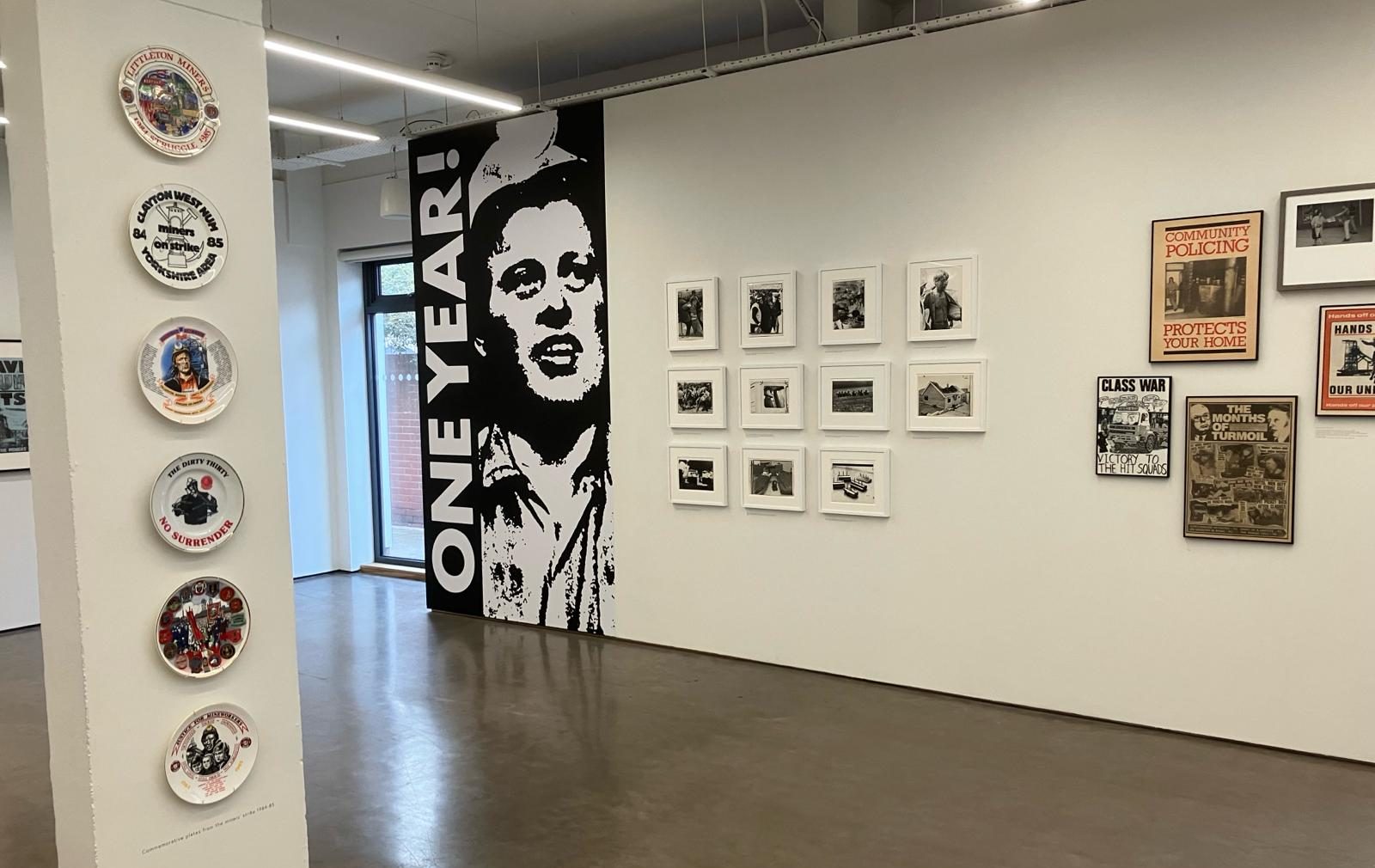
Martin Parr Foundation exhibition: One Year! Photographs from the miners’ strike 1984-85
Featuring works by: John Harris, Chris Killip, Jenny Matthews, Brenda Prince, Neville Payne, Howard Sooley, John Sturrock, Roger Tiley, Philip Winnard and Imogen Young
Reviewed by Roger Thomas

For the 40th anniversary of the miners’ strike, the Martin Parr foundation in Bristol, has hosted an exhibition that looks at the pivotal role photography played in the year-long dispute.
The exhibition looks at the images created and how they were used and disseminated through the visual media of the time. While one side sought to use these images to highlight the chaos on picket lines and to heighten the image of an enemy within, those in support of the strike attempted to undermine this picture, highlighting instead the violence of the state on picket lines, the economic hardship endured, and especially the solidarity and collective strength of a working-class community under siege.
Many of the images show the solidarity between the community and the miners’ union, NUM, spreading out across the country, in the collection of food and funds, and many of the objects – from plates and badges to records – give an indication as to just how disparate the use of different media was for this purpose. As well as posters, postcards and leaflets advertising gigs and comedy nights – using satire, and anti-government language to build solidarity.
One of the images included is of Alan Hardman’s cartoon of the miner and his son. Others feature the multiple representation in different media of John Harris’s iconic image from Orgreave depicting a police officer swinging his truncheon from his horse at Lesley Boulton, of Women Against Pit Closures: an image which clearly expresses the violence of that day inflicted on the miners and their supporters.
The photographs of Brenda Prince focus on depictions of women in the Nottinghamshire coalfield, picketing and fundraising. She highlights the politicising role of the strike, writing in the programme notes: “Women became more confident as a result of strike, which I thought was great. It was good for other women and young girls to see their mums and daughters speaking out at the meetings, doing things they wouldn’t have done before, eg picketing”.
There are several scenes expressing the humanity of the strike which so captured the imaginations of photo-journalists, many of them using their position to champion the miners’ cause. John Harris and John Sturrock focus primarily on the day-to-day activities from picketing, to union meetings and coal riddling. Such events, mundane in themselves, and making up the majority of a day on the picket line, are punctuated by police violence administered without any compunction in mismatched confrontations on picket lines.
John Sturrock covered the strike from day one and the exhibition features compelling images from pits in Cortonwood, to Bilston Glen, and down to Didcot. One compelling image is of the march on the anniversary of the death of miner David Jones, killed whilst picketing at the start of the strike: miners marching in a snowstorm. Another gripping image is John Harris’s picture of a police charge at the Battle of Orgreave which exudes the tension of that grim moment in the strike.
A more intimate view of the strikes comes through the albums of Philip Winnard, himself a striking miner. These pictures have a certain rawness and his photographs of scabs loading coal to break the strike are contemptuous and lay those individuals bare. Similar feelings are evoked by snapshots of police picnicking between breaking the strike. There is a real sense of unreality about these photos.
There is one exhibit which is not of 1984-85, that is the textile created by Jenny Matthews, who during Covid began revisiting her photo archive, using the tactile nature of embroidery to weave a photo-quilt, which evokes the idea of images of the miners’ strike with the traditional union banner.
The exhibition clearly expresses the power of photography to capture the moment and the power and tensions at play. But I think this and similar exhibitions that will undoubtedly take place across the country give us an opportunity to reconnect with what was, and still is, a life-changing event, which still sits deep in the collective consciousness. However, I also think these photographs do much more: they expose the nature of the state and the lengths the ruling class will go to defend itself, while also expressing the solidarity and determination of the working class to struggle.
Two decades later, photographer James Evans revisits his book ‘Big Bend Pictures’
By Admin in Photography
From Marfa Public Radio:
After years of wandering across the region, photographer James Evans published “Big Bend Pictures” in 2003. The large collection of black-and-white prints captured the vastness of Far West Texas and the grit of the people that call it home.
Now, over 20 years later, Evans has released a new edition of the book with some new additions and a new design.
Sitting in his studio, leafing through a copy, it seems like Evans is reuniting with old friends. For instance, one photo of a woman whose knees had to be stitched up after a surgery.
“Shirley had the Burnt Biscuit cafe here. She ran it for years,” he explained. “She had just had her knees replaced. She said I was crazy.”
Pointing to another photo of an older couple dancing, “This is Hallie dancing with her son and this is literally the last time she danced. She was old and went into a nursing home not long after that.”
James Evans sits in his studio in Marathon, Texas.
Mitch Borden / Marfa Public Radio
The faces staring up from the pages of his book are people who’ve shaped the region in one way or another. One portrait that Evans was especially proud of is a photo of Big Bend National Park’s first superintendent Ross Maxwell. He photographed a close-up of Maxwell in a dark room — the glow from a match is the only thing illuminating his face.
“I was so intimidated by him and I’d ask him questions, but he was so reluctant to talk and he lit that pipe and I asked him to draw on it a few times. I shot about four frames,” Evans said.
Before moving to the Big Bend in 1988, Evans had previously worked in Austin as a photographer, but when he visited West Texas he was immediately taken by the desert and the people.
Evans said, “The book is really more about the type of person that lives here, no one was recording that. I had seen pretty picture books, you know heavy-saturated color, for tourists and I didn’t want to do a book like that, that’s not the type of work I wanted to do.”
So, he started documenting locals — shooting on black-and-white film.
Over two decades after his original version of “Big Bend Pictures” was published, Evans says he’s been able to improve his work with the new edition. The images have deeper tones, the crop of the photos are just right, and Evans has added a few new ones.
Evans didn’t consider himself a landscape photographer when he first moved to the Big Bend so he mostly focused on making portraits.
Mitch Borden / Marfa Public Radio
“I was really trying to make honest portraits of people not to make people icons or anything, but just trying to make who I thought that person was and that’s what a portrait photographer does,” he said.
Evans went beyond photographing people to show the character of the region. He captured a lightning strike near a surveillance blimp outside of Marfa, a tarantula crawling across a table cloth, as well as sweeping landscapes.
“What I get out of the image and what other people get out of the image are totally different. I have a really terrible memory for the most part, but with my photographs I can remember. I can remember how I felt and what I was thinking,” he said. “I feel like what I captured is fleeting and is actually gone.”
A lot has changed since Evans first moved to Marathon. Today, a record-number of tourists flock to the area, filling the region’s dusty towns. And even though Evans misses the quieter days of the past, his love for the Big Bend has not faded.
After all, it’s the place he found his calling.
“I was always searching for what would be my life’s work and so I just knew once I was here that this was it,” Evans said.
Welsh astrophotographer Alyn Wallace, 34, dies in Turkey
By Admin in Photography
Taken by storm: Propsect Harbor photographer Dean Kotula documents wrath of winter storms
By Admin in Photography
GOULDSBORO — Dean Kotula’s photojournalism and fine art photography have always been ways for him to connect to the larger world. Starting as a kid, it was his outlet to interact with life around him.
In his upcoming exhibit, “Taken By Storm,” his work will connect to the Maine coast, where he has called home for the last 20 years, through photos that document the impact of climate change following this winter’s series of wind and rainstorms.
This page requires Javascript.
Javascript is required for you to be able to read premium content. Please enable it in your browser settings.
Photographers who joined the Oct. 7 pogrom deserve censure, not awards
By Admin in Photography
Capture the Essence of Ohio’s Hocking Hills in This Photography Contest
By Admin in Photography
Amateur and professional photographers alike are invited to traverse Ohio’s Hocking Hills region — just a two-and-half-hour drive from Cincinnati — and snap its essence in a fun photo contest this May.
The “Picture Hocking Hills” photo contest will be held Friday-Saturday, May 17-18 with an awards ceremony on Sunday, May 19. Any photos being submitted to the contest must be shot between 2 p.m. May 17 and 2 p.m. May 18. The contest will be limited to just 70 photographers, who will need to register at explorehockinghills.com. Registration is $50 and on a first-come-first-serve basis.
Organizers say this is meant to be a fun and lighthearted contest. There will be $100 prizes for the best photo in each category for each division, as well as a grand prize of $500 for the Best in Show overall photo.
Each photographer can submit up to three photos in any category, and a panel of expert judges will select both an amateur and a professional photographer winner in each of the four categories: Landscape, People, Flora and Fauna and Wild Card (a photo that doesn’t fit any of the other three categories). Scoring will be based on how each photo captures the essence of Hocking Hills, as well as its emotional appeal and impact, composition, originality and technical quality. Light editing is allowed.
Photos may be taken in Hocking County, as well as contiguous counties, including Athens, Perry, Vinton and Fairfield. If you’re taking photos of any people, you must also include a signed photo release form for each photo with people who can be easily identified. Photos of people without a signed form will be disqualified.
Organizers also want to remind photographers to stay on all trails, to leave no trace, to not pick or damage wild plants and to respect the space of wild animals.
All contest photos will need to be uploaded as JPEGs. If you need help uploading them, Wi-Fi and staff assistance will be available at the Logan Theater on Saturday, May 18 from 11 a.m. to 3 p.m. The awards ceremony will be Sunday, May 19 at the Logan Theater at 2 p.m. for contestants and one guest each.
For all the official rules or to register, visit explorehockinghills.com.