Photography

Something Good: National Geographic photographer stops by North Florida Wildlife Center

Something Good: National Geographic photographer stops by North Florida Wildlife Center

TALLAHASSEE, Fla. (WCTV) – This one is also something a little wild!

A National Geographic photographer stopped by the North Florida Wildlife Center to photograph rare, endangered and unique species there.

Photographer Joel Sartore is trying to document every species living in zoos, aquariums and wildlife sanctuaries as a way to document the world’s biodiversity. He’s been at it since 2006!

No matter its size, each animal is treated with affection and respect.

He visits the North Florida center once a year to capture everything furry, feathered or flora!

To stay up to date on all the latest news as it develops, follow WCTV on Facebook and X (Twitter).

Have a news tip or see an error that needs correction? Write us here. Please include the article’s headline in your message.

Keep up with all the biggest headlines on the WCTV News app. Click here to download it now.

Wedding Photographer Goes Viral With Images of Bride Almost Passing Out

Wedding Photographer Goes Viral With Images of Bride Almost Passing Out

bride passes out wedding

A wedding photographer has gone viral after posting photos of the moment a bride almost passed out and continued shooting her.

Paola Tassinari, a wedding photographer in Monterrey, Mexico, shared photos on Instagram of a bride looking faint and unwell on the big day.

In the widely-shared images, the bride is seen being nursed and fed sugary food by the groom and other members of the wedding after nearly passing out.

Tassinari, who has been a wedding photographer for 20 years, says that she decided to keep clicking instead of helping the bride.

Firstly, because it was not a dangerous situation, but secondly, because Tassarini knew the photos would convey the unique story of the couple’s wedding day.

‘I Decided I was Going to Take Photos’

According to the photographer, the bride had not eaten much on the day. Tassarini says that the bride started looking pale and unwell after the communion during the wedding ceremony.

Tassarini saw the lightheaded bride whisper something to the groom. And the concerned photographer immediately arranged to give her something sweet to eat so she would not faint.

“One of my assistants had a Coca-Cola which he had bought and I told him to give it to her,” Tassarini tells PetaPixel.

“My videographer had bought a ‘Gansito’ which is a typical Mexican cake and he also gave it to her.

“I decided, for the most part, that I was going to take photos of the whole scene.”

‘You Have to Go Beyond What a Typical Wedding Looks Like’

Tassarini knows some people might question why she continued shooting the bride during this moment, instead of going to her aid.

However, the photographer says that her job is to document the wedding as it is. Tassarini says she knew the couple would look back at these photos and laugh and warmly remember the incident.

“One of the things I learned from my career is that if you go into with a mental space of photographing the scripted timeline that every wedding has, the photos of the wedding can be boring,” Tassarini, who shoots destination weddings as well as in Mexico, says.

“In order to tell a unique story, you have to go beyond what a typical wedding looks like and find its individuality and special details.

“The interesting things usually are the moments that seem to fall out of place, or maybe the chaos around the perfection of the wedding.

“So, I knew that this wasn’t something serious, that she was going to be ok, and that maybe they would laugh back at the photos (which they did).”

In the Instagram caption, Tassinari also noted how the images showed the importance for brides to eat properly on their wedding days which can often be long and emotional events.

“Don’t pass out! Brides: please don’t forget to eat,” the photographer warns.

More of Tassinari’s work can be seen on the photographer’s website and Instagram.


Image credits: All photos by Paola Tassinari Photography.

SANDMARC debuts new dedicated iPhone photography backpack [Exclusive deal]

SANDMARC debuts new dedicated iPhone photography backpack [Exclusive deal]

SANDMARC, a brand that has quickly become a personal favorite and one of the better-selling iPhone accessory makers around here, is introducing its latest piece of kit today known as the Travel Backpack. In a marketplace filled to the brim with carriers geared towards photography, SANDMARC has decided to create a dedicated backpack “for the most popular camera in the world: the iPhone.” While it appears to me to be just as useful as a typical backpack as well, it is specifically geared towards iPhoneographers, filmmakers, and content creators with a special exclusive pre-order price available to 9to5Toys readers starting today (details below). Head below for all of the details. 

New SANDMARC iPhone photography backpack

The new SANDMARC iPhone photography backpack is designed “with the creator in mind.” It is said to feature “innovative compartments for iPhone photography and best-in-class materials for travel at a remarkably lightweight form-factor.”

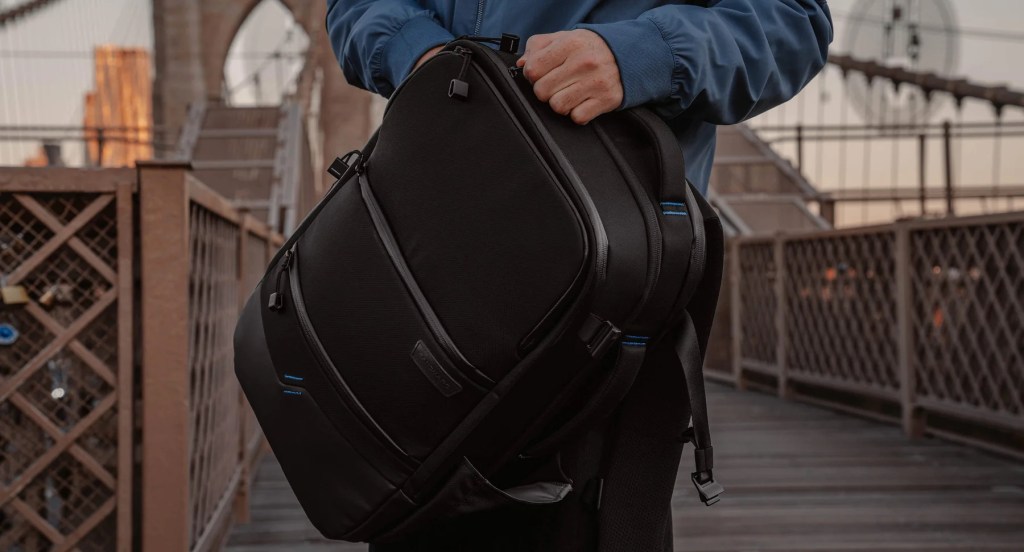
Firstly, let’s talk build. The bag is made of an all-black 840D ballistic nylon with subtle blue stitching accents throughout. The weather sealed YKK zippers are joined by a waterproof material along the bottom of the main compartment alongside aluminum-tipped zippers and hardware. 

It features a 25L capacity that can be expanded to 30.5L and the ability to carry extra items by way of a bottom compartment that features elastic straps to lug extra gear such as a blanket or a jacket. You can even carry it duffle style with extra handles on either side – there are built-in small elastic bands to tuck away loose straps when not in use – with a luggage strap on the back to string it through the telescoping handle on your suitcase. 

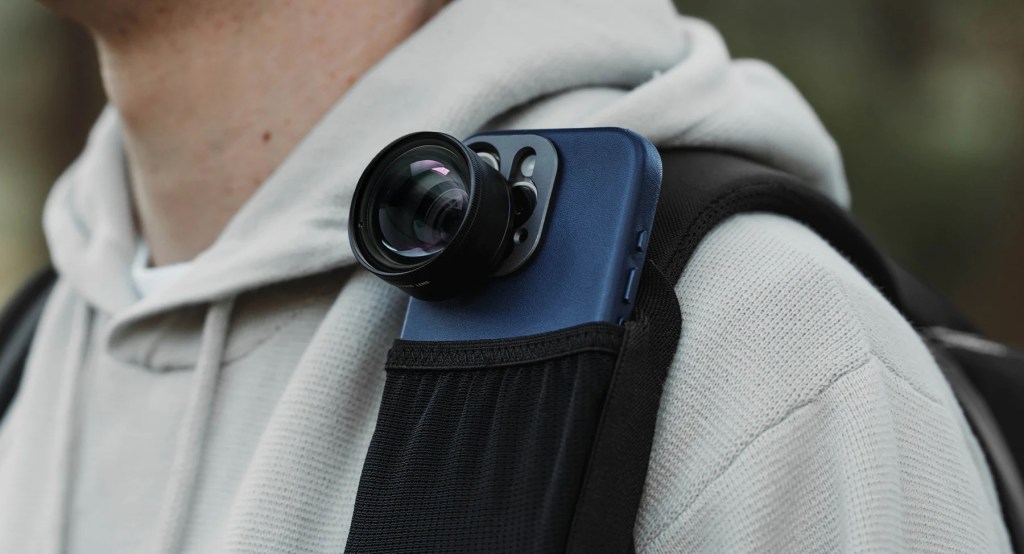
One interesting feature is the POV pocket. SANDMARC is integrated a small elastic-trimmed pocket directly in the traditional backpack shoulder strap. Users can tuck an iPhone in here while shooting for some hands-free fire-person action on-the-go – “Without the iPhone, the strap holder blends in so you barely know it exists.”

Now let’s talk internals. There are dedicated compartments for four iPhone lens attachments alongside partitions for iPhone filters a tripod, and more. SANDMARC says the internal laptop comportment is large to fit a 16-inch MacBook Pro and you can even get a 12.9-inch iPad in there as well. 

Best of all, you score all of this with our exclusive discount. The new SANDMARC iPhone photography Travel Backpack is now available for pre-order with deliver scheduled for April 2, 2024– just in time for spring and summer adventures. Regularly $250, you can score one for $224.99 shipped using our exclusive 9TO5TOYS discount code at checkout. 

SANDMARC iPhone photography backpackSANDMARC iPhone photography backpack

More of the latest from SANDMARC:


Subscribe to the 9to5Toys YouTube Channel for all of the latest videos, reviews, and more!

Recent VideosRecent Videos

How to safely photograph, and experience, April’s solar eclipse

How to safely photograph, and experience, April’s solar eclipse

NEWS RELEASE
BROCK UNIVERSITY
*************************
When the total solar eclipse takes place over North America on April 8, many people will naturally reach for their phones or cameras to capture the moment.
Brock Associate Professor of Visual Arts Amy Friend, an internationally recognized photographer, is offering tips on documenting the rare phenomenon safely while also encouraging the public to consider different ways of experiencing what for many will be a once-in-a-lifetime event. 

The chair of visual arts at Brock first points to taking safety precautions for viewing and documenting the eclipse, which can be found on Brock’s Eclipse on the Escarpment web page. Friend says it’s crucial to have a proper solar filter on any camera, including on a smartphone. 

“Solar filters for traditional cameras and cell phones are available online from several retailers, but consumer research is key to ensuring the purchase of an international standard filter (full-aperture and off-axis) with regulated qualities, making it safe for photographing the eclipse,” she says.

According to the award-winning photographer, practice is also key. Practise beforehand by photographing the everyday sun, without looking directly at it, Friend 
says. Taking photos of the sky on a sunny day will help determine appropriate aperture and shutter speed for such bright light. She also suggests getting comfortable with outdoor night photography.

“During totality, when the sun is fully blocked by the moon, turning the sky dark, the camera will need adjusted shutter speeds and aperture settings to take a successful photo,” Friend says.She recommends experimenting with the high dynamic ange (HDR) setting on cameras, which 
captures high-contrast photos. With this setting, many photos of the eclipse could be put together to create one image.

“The visual effect of this is very interesting as the second-to-second variations in the sun flare created by the eclipse combine creating a beautiful image capturing unique details,” Friend says. 

For those looking to get creative, there are other ways to view the solar eclipse, including pinhole projectors or building boxes that filter the sunlight and create a projection of the sunlight onto a nearby surface.

“Using this approach, the person would be looking at the projection instead of the eclipse itself,” Friend says. “What they would see is a darkening circle in the form of a crescent, which is the moon starting to cover the sun.”

While many people will want to capture a photo of the eclipse themselves, photographers throughout history have cautioned against photographing the celestial phenomenon, as it is difficult for the average person to achieve a great photo. 

“We know what it will look like, and yet we still want to photograph it. But we don’t want to miss an incredible experience in the process,” Friend says.

Through her research into the role of photography as proof of experience, however, Friend says the desire to personally capture the moment is very natural.

“There is also the excitement of going online and sharing your photo — the ‘after’ of the experience — that can be quite engaging and stirs up response and dialogue, simultaneously amplifying the experience and documenting it in popular culture,” she says.

Friend is fascinated by historic images of people experiencing celestial events in group settings as a visual time capsule into the culture and technology of the time. 

“I think there is something quite beautiful about that moment, where we all just stop and view something rare and spectacular in the sky together,” she says. “The sun and moon have paused life for a moment.”

*************************

Photographers, it’s time to enter the Dogwood Festival photo contest

Photographers, it’s time to enter the Dogwood Festival photo contest

ORLEANS – Calling all photographers, it’s time to enter the Dogwood Festival photo contest.

The last day for entries is Friday, April 19th. Photos may be dropped off at the Orleans Public Library and picked up there the following week after the festival.

Starting Tuesday, April 23rd, photos will be on display at the Orleans Public Library during business and student art reception hours.

There are three skill levels for you to choose from for your entries:

Amateur – This is great if you’re just getting started and using your cell phone camera or a simple point-and-shoot camera, doing little to no editing, taking photos for fun, etc.

Intermediate – If you are comfortable with your photography but do not consider yourself a pro, this level is for you – Especially if you have a Facebook page, only occasionally share/sell your images, use intermediate equipment, edit images,

Advanced – This is an excellent level if you have your own photography business that brings you regular income or exposure, have your watermark/website, and consider your photography/equipment and editing skills to be advanced – if any of these things apply, please select this level.

It will be entirely up to you which level you choose to submit your photos to, but please be honest and accurate with your work. They want to welcome all talent levels and see what everyone can do.

Photographers are encouraged to print out a small bio/photo for an “About the Photographer” display that can sit next to their entries, but this is not required.

The subjects of your photos can be of your choice – But please be sure to include at least ONE Orleans-related photo with your entries.

Non-biased out-of-town judges will rate the photos based on several attributes.

There will be a first, second, and third place in each entry-level as well as several honorable mentions as:

  • Favorite Nature Photo
  • Favorite Animal Photo
  • Favorite People Photo
  • Favorite Black and White Photo
  • The People’s Choice award for the Favorite Pride of Orleans Theme Related Photo will be decided by the public placing quarter votes.

This contest is for Orleans and surrounding township residents only. There will be a $1 entry fee for each photo you submit. Entries should be limited to no more than five photographs per person. You may only submit photos to the one level that best suits you and your photos.

Any photo of a person that you, as the photographer, have been permitted by the subject to submit your photo. Please be responsible.

All photos must be no smaller than a 5×7 and must be framed or matted. Entries should include the name and telephone number of the photographer, as well as the level of choice for judging. This can be done with a sticky note on the back of the frame or mat. People should not submit a photo unless they are the photographer.

All questions should be submitted to contest chair Katlin Phillips. She can be contacted at 812-653-8877; (texting is okay), or by e-mail at kcpcreative@hotmail.com.

Scientist Photograph Pink ‘Barbie Pigs’ Among New Species in Pacific Ocean

Scientist Photograph Pink ‘Barbie Pigs’ Among New Species in Pacific Ocean
barbie pig underwater species
The scientists photographed new species unknown to science, such as this sea pig named the “Barbie pig” due to its hot pink colour and tiny “feet”.

Scientists photographed never-before-seen underwater species including pink “Barbie Pigs” during a deep-sea expedition.

An international team of Natural History Museum (NHM) scientists spent the last few weeks exploring the eastern tropical Pacific Ocean as part of the latest SMARTEX expedition to the Clarion-Clipperton Zone (CCZ).

A beautifully delicate glass sponge spends its life filtering out nutrients from the never-ending fall of marine snow.
The scientists photographed this beautifully delicate glass sponge which spends its life filtering out nutrients from the never-ending fall of marine snow.
A brisingid sea star sitting on a sponge stalk to raise its arms into the water to catch falling food.
A see-through sea cucumber nicknamed the “unicumber.”

The team’s mission was to discover the species that were living 13,000 feet (4,000 meters) beneath the surface.

And the scientists discovered several strange and curious species that are “new to science” during the deep sea expedition — including rattail fish, unicumbers, glass sponges, and pink Amperima sea pigs that have now been formally named “Barbie pigs.”

An other-worldly glass sponge growing on the sea floor.
A large, branching bryozoan using one of the polymetallic nodules as a surface on which to grow.
An abyssal sea anemone growing in a manganese-encrusted reef.

The astonishing animals have now been captured on camera for the first time ever in incredible photos.

“We can assume that many of these species will be new to science,” Regan Drennan, a post-doctoral marine biologist at London NHM, tells IFLScience..

“Sometimes they have been seen/observed/known before, but not collected or formally described. For example, the sea pig nicknamed the unicumber had been seen in previous seabed imagery surveys, but not collected or imaged in high definition to the best of our knowledge.”

Sea stars with whip-like limbs
Sea stars with whip-like limbs are picture here.
A worm-like tanaid, which are a group of crustaceans living on the sea floor.
This rattail fish is among the few vertebrates that can survive in these depths despite the extreme pressure.

University of Southampton PhD student Bethany Fleming coined the name “Barbie pig” for the hot pink alien-like species with sausage-like fingers after the team of scientists watched the Barbie movie on the plane together.

“All the specimens that have been collected will be brought back to the museum, where they will be identified and studied by the researchers here,” Eva Stewart, a post-doctoral marine biologist based at the NHM, tells IFLScience.

“Some may be described as new species, and lots of the specimens will be used for research looking at patterns of diversity across the seafloor in this area.”


Image credits: All photos by © SMARTEX Project, NERC.

Valeria Secchi’s classmates

Valeria Secchi’s classmates

Ana Topoleanu is a Romanian-Mexican photographer who blends elements from her origins into captivating visual narratives. Her journey into photography began as a means to express her thoughts and capture the essence of the world around her, a passion ignited after completing her studies at the University of Sociology in Bucharest. Since then, photography has become more than just a craft for Topoleanu: it is her universal language and preferred form of expression. Inspired by the diverse cultures of Romania and Mexico, Topoleanu’s work invites viewers on a journey of discovery, urging them to pause, reflect, and appreciate the beauty that exists in both the ordinary and extraordinary. Her photography delves into themes such as the role of women in society, the complexities of motherhood, and the power of human relationships and memories. Today, we discuss “My Pillow”, a project that reflects on memory; let’s see how.

Ana Topoleanu’s My Pillow

One of her most touching projects, “My Pillow,” is a testament to the emotional depth and complexity of her work. The project began during the last years of her grandmother’s life, who accompanied her during her formative years. Topoleanu fondly remembers her grandmother, affectionately called mamaia, as a source of love, guidance, and inspiration. As her grandmother’s health declined, Topoleanu embarked on a photographic journey to preserve the memories of their time together and honor her legacy.

Topoleanu felt that this approach lacked the depth she wanted to convey. Through continuous refinement and introspection, the project evolved into “My Pillow,” a title deeply rooted in memory, representing a poignant moment before her grandmother’s passing. While working on My Pillow, Topoleanu focused on capturing the ephemeral nature of time and the inevitable passage of generations. Each photograph served as an attempt to freeze moments slipping away, reflecting the gradual fading of precious memories and the profound impact of loss.

For Topoleanu, “My Pillow” is more than just a photographic series: it is a labor of love, a tribute to her grandmother, and a reflection of her personal journey through grief and healing. Through her lens, she invites viewers to explore the universal themes of love, loss, and the enduring power of memory.

Former Corrections Officer Uses Animal Photography to Help Shelters

Former Corrections Officer Uses Animal Photography to Help Shelters

Hannah Lee Bratz, a former corrections officer, has found purpose behind the lens of her camera, finding rescue animals find their home. Transitioning from law enforcement to the compassionate world of animal welfare, Bratz’s journey exemplifies the power of following one’s passions.

After spending two years navigating the complexities of human behavior within the walls of a corrections facility, Bratz felt a stirring desire to channel her energy toward something more altruistic. “I always wanted to make a difference in something,” she shares, reflecting on her aspirations. With an admiration for law enforcement, Bratz initially found herself drawn to a career path that aligned with her desire to serve her community.

However, fate had other plans in store for her. A serendipitous encounter with her future husband, a Marine stationed in Florida, set Bratz on a new course. Following her heart and marrying her now-husband eventually led her to Eastern North Carolina, where her husband’s military orders brought them to Cherry Point. It was here that Bratz’s latent passion for photography found its voice, nurtured by the Support of her spouse.

Encouraged by her husband to explore her artistic talents, Bratz found herself drawn to the Craven-Pamlico Animal Services Center (CPASC). Equipped with her camera, Bratz was on a mission to capture the essence of these animals, each possessing a unique personality yearning to be seen and understood.

Departing from the mundane snapshots reminiscent of mugshots, Bratz’s photography looks into the depths of each animal’s soul. “I wanted to show more of what the animals looked like,” she explains, emphasizing her commitment to portraying their true essence. Through her lens, Bratz offers a glimpse into the untold stories of these animals, illuminating their individuality and charm with every click of the shutter.

What began as pro-bono work for CPASC soon blossomed into a partnership with Operations Manager Alyssa Merget. Today, Bratz can be found at the shelter, volunteering her time and talent, bridging the gap between the animals in need and potential adopters through HLB Photography.

Tiny Rescue Animal Collection

Best Things In Life Are Rescued Tee By Tiny Rescue: Animal Collection

Related Content:

Easy Ways to Help the Planet:

  • Eat Less Meat: Download Food Monster, the largest plant-based Recipe app on the App Store, to help reduce your environmental footprint, save animals and get healthy. You can also buy a hard or soft copy of our favorite vegan cookbooks.
  • Reduce Your Fast Fashion Footprint: Take initiative by standing up against fast fashion Pollution and supporting sustainable and circular brands like Tiny Rescue that raise awareness around important issues through recycled zero-waste clothing designed to be returned and remade over and over again.
  • Support Independent Media: Being publicly funded gives us a greater chance to continue providing you with high-quality content. Please consider supporting us by donating!
  • Sign a Petition: Your voice matters! Help turn petitions into victories by signing the latest list of must-sign petitions to help people, animals, and the planet.
  • Stay Informed: Keep up with the latest news and important stories involving animals, the environment, sustainable living, food, health, and human interest topics by subscribing to our newsletter!
  • Do What You Can: Reduce waste, plant trees, eat local, travel responsibly, reuse stuff, say no to single-use plastics, recycle, vote smart, switch to cold water laundry, divest from fossil fuels, save water, shop wisely, Donate if you can, grow your food, volunteer, conserve energy, compost, and don’t forget about the microplastics and microbeads lurking in common household and personal care products!

I took nearly 400 photos with Pentax’s B&W-only digital camera — and I may never shoot in color again

I took nearly 400 photos with Pentax’s B&W-only digital camera — and I may never shoot in color again

I recently got my hands on the Pentax K-3 Mark III Monochrome, a tough-built DSLR with a 26-megapixel APS-C sensor which, as the name suggests, shoots only in B&W. With a gorgeous Sunday afternoon to try it out on, I strolled toward Seattle’s touristy waterfront eager to flex a little creative muscle. 

Little did I know that my afternoon with the K-3 III Monochrome would help shake me out of a photographic rut and get me stoked to snap frames again. By the end of the day, I took nearly 400 photos with Pentax’s B&W-only digital camera — and I may never shoot in color again. Here’s why. 

Sample photo from the Pentax K-3 III Monochrome. DNG file lightly processed in Adobe Camera Raw/Photoshop. Shot at ISO 200, 1/1250 sec, f/5 with a 43mm lens.  (Image credit: Dan Bracaglia/Future)

Pentax has been making cameras for 100+ years

Pentax is a historic camera brand with roots that stretch back to the early twentieth century and the dawn of the single-lens reflex camera (SLR). These days, Pentax continues to concentrate on SLR cameras — digital ones — at a time when most other manufacturers are prioritizing newer mirrorless camera technology.

However, for folks like me who prefer composing images with an optical viewfinder rather than an electronic one, Pentax is the only brand focusing on new DSLR models. Fortunately, these bodies — including the full-color Pentax K-3 III — are a delight to shoot with and quite capable image quality-wise. 

B&W sensors have advantages over color ones

Sample photo from the Pentax K-3 III Monochrome. DNG file lightly processed in Adobe Camera Raw/Photoshop. Shot at ISO 2000, 1/160 sec, f/1.9 with a 43mm lens. (Image credit: Dan Bracaglia/Future)

But, wait, what’s the point of a camera that only shoots in B&W? After all, converting a color image to monochrome is a painless affair, easily accomplished a zillion different ways. 

The simple answer is that the Pentax K-3 Mark III’s sensor captures images natively in B&W, including Raw DNG files. With digital photography, more data from a sensor is always better. And because the Monochrome’s sensor isn’t wasting time processing color data, the outputted images have a particularly gorgeous tonal quality, richness and level of detail, unmatched by a color conversion. 

There are other advantages to a Monochrome-only sensor, particularly in low light settings. Because there’s no chroma noise to suppress — those ugly speckled multi-colored dots — you can shoot at very high ISOs and still get great-looking images. The grain at high ISOs looks more like “film grain,” aesthetically pleasing at best and acceptable at worst, than gross digital noise.

At lower ISOs, images from this monochrome sensor also look sharper than their color-sensor counterparts due to the lack of a color filter array between the lens and sensor. This is a necessary part of most modern color sensors, but one that has a slightly softening effect on shots.

Who is Pentax’s B&W camera for?

Sample photo from the Pentax K-3 III Monochrome. DNG file lightly processed in Adobe Camera Raw/Photoshop. Shot at ISO 200, 1/1250 sec, f/5 with a 43mm lens. (Image credit: Dan Bracaglia/Future)

The Pentax K-3 Mark III Monochrome is best for photographers who enjoy approaching the craft slowly and methodically. It’s not going to fire off 50 frames a second with real-time subject tracking, like some of the best mirrorless models. The autofocus system is also a tad sluggish by 2024 standards and the camera itself is honker to lug around. 

However, once you wrap your head around using it — there’s pretty much a direct button for any setting you could ever want to adjust  — it quickly becomes a creative extension of your being. 

For example, after just one day with the camera, operating it felt like second nature. Plus, the oh-so-satisfying “Kerchunch” of the shutter and mirror mechanism dancing in harmony made me feel downright nostalgic — sadly, my mirrorless cameras don’t produce nearly as enjoyable mechanical sounds.

Pentax K-3 III Monochrome

Sample photo from the Pentax K-3 III Monochrome. DNG file lightly processed in Adobe Camera Raw/Photoshop. Shot at ISO 200, 1/5000 sec, f/8 with a 43mm lens. (Image credit: Dan Bracaglia/Future)

Pentax engineered the K-3 III so photographers theoretically never need to take their eye away from the larger optical finder: most tasks can be accomplished via the aforementioned direct controls without a trip to the menus — setting changes are reflected via info panels within the viewfinder.

Pentax K-3 III Monochrome

Sample photo from the Pentax K-3 III Monochrome. DNG file lightly processed in Adobe Camera Raw/Photoshop. Shot at ISO 200, 1/1320 sec, f/1.9 with a 43mm lens. (Image credit: Dan Bracaglia/Future)

In particular, the K-3 III Monochrome is a solid choice for lowlight photographers, including music and event shooters, landscape lovers, street photographers and even portrait shooters. I enjoy all of the above, which may explain why I so relished my time with Pentax’s monochrome-only camera. 

I took nearly 400 photos with Pentax’s B&W camera

I’ve wanted to check out the K-3 III Monochrome ever since its launch in April 2023. It’s one of the only truly attainable monochrome-only digital cameras on the market and also one of the only new DSLR cameras to launch in the past few years.

The only other camera manufacturer with monochrome-only models is Leica. And you can bet your monocle they cost a pretty penny: The Leica M Monochrom starts at $9,195 with no lens — that’ll be another $5,000  to $10,000 — and the Leica Q2 Monochrom will set you back a cool $6,345 new but thankfully comes with a lens built in.

The Pentax K-3 III Monochrome, meanwhile, starts at a much more reasonable $2,195 for the body, with plenty of lenses available to the tune of several hundred bucks, rather than several thousand. 

Sample photo from the Pentax K-3 III Monochrome. DNG file lightly processed in Adobe Camera Raw/Photoshop. Shot at ISO 200, 1/200 sec, f/8 with a 43mm lens. (Image credit: Dan Bracaglia/Future)

A lover of affordable glass, I paired the loaner Pentax with a petite, all-metal Pentax 43mm f/1.9 lens, which provides a roughly 65mm equivalent field of view on the K-3 III’s APS-C sensor. At $445, it’s not a bank-breaker, yet it still performs exceptionally well in the sharpness department.

I love shooting with both a 50mm and 85mm lens but wasn’t sure how I’d get on with a focal length that sits smack between the two. However, during my saunter through Seattle’s Pike Place Market, I frankly fell in love with the field of view: It works exceptionally well for candids, street photography and portraits, regardless of the lighting. 

Sample photo from the Pentax K-3 III Monochrome. DNG file lightly processed in Adobe Camera Raw/Photoshop. Shot at ISO 200, 1/400 sec, f/8 with a 43mm lens. (Image credit: Dan Bracaglia/Future)

While I was far from “spraying and praying,” I did manage to fire off exactly 365 frames during my Sunday adventure, including snaps of incoming ships, vacation revelers, suave pups, city scenes and more.

I may never shoot in color again

With so many shots, narrowing down my favorites was no easy assignment. However, you’ll find my top choices scattered throughout, with additional samples below. I chose these images not just because I am fond of the compositions but because the level of detail and tonal quality is superb.

I’m now eager to get back out and shoot more with this black-and-white beast. In fact, I may never shoot in color photography again. Well, not until I have to return the K-3 III Monochrome to Pentax, at which point, I’ll probably dust off my old Nikon FM2 and load it up with some expired Kodak B&W film from the freezer.

More Pentax K-3 Mark III Monochrome sample images

Sample photo from the Pentax K-3 III Monochrome. DNG file lightly processed in Adobe Camera Raw/Photoshop. Shot at ISO 2500, 1/160 sec, f/12.2 with a 43mm lens. (Image credit: Dan Bracaglia/Future)

Sample photo from the Pentax K-3 III Monochrome. DNG file lightly processed in Adobe Camera Raw/Photoshop. Shot at ISO 200, 1/100 sec, f/5.6 with a 43mm lens. (Image credit: Dan Bracaglia/Future)

Sample photo from the Pentax K-3 III Monochrome. DNG file lightly processed in Adobe Camera Raw/Photoshop. Shot at ISO 400, 1/5000 sec, f/8 with a 43mm lens. (Image credit: Dan Bracaglia/Future)

(Image credit: Dan Bracaglia/Future)

Sample photo from the Pentax K-3 III Monochrome. DNG file lightly processed in Adobe Camera Raw/Photoshop. Shot at ISO 400, 1/1600 sec, f/8 with a 43mm lens. (Image credit: Dan Bracaglia/Future)

Sample photo from the Pentax K-3 III Monochrome. DNG file lightly processed in Adobe Camera Raw/Photoshop. Shot at ISO 400, 1/2000 sec, f/2.5 with a 43mm lens. (Image credit: Dan Bracaglia/Future)

Sample photo from the Pentax K-3 III Monochrome. DNG file lightly processed in Adobe Camera Raw/Photoshop. Shot at ISO 400, 1/800 sec, f/8 with a 43mm lens. (Image credit: Dan Bracaglia/Future)

More from Tom’s Guide: