Photography

KELOLAND Chief Photographer featured on CBS Sunday Morning

KELOLAND Chief Photographer featured on CBS Sunday Morning

KELOLAND Chief Photographer featured on CBS Sunday …

38 mins ago


.cls-3{fill:#fff;fill-rule:evenodd}

KELOLAND On The GO 2/18/2024

6 hours ago


.cls-3{fill:#fff;fill-rule:evenodd}

Bouncing back after giving birth

6 hours ago


.cls-3{fill:#fff;fill-rule:evenodd}

Harrisburg High School gathers bedding for children

6 hours ago


.cls-3{fill:#fff;fill-rule:evenodd}

USD takes on Mardi Gras

2 days ago


.cls-3{fill:#fff;fill-rule:evenodd}

On the road to a roundabout in Fort Thompson

2 days ago


.cls-3{fill:#fff;fill-rule:evenodd}

Wakefield to celebrate 50th anniversary Saturday

2 days ago


.cls-3{fill:#fff;fill-rule:evenodd}

O’Gorman players look to Caitlin Clark as inspiration …

2 days ago


.cls-3{fill:#fff;fill-rule:evenodd}

Dry winter may impact South Dakota crops in 2024

2 days ago


.cls-3{fill:#fff;fill-rule:evenodd}

What past Februarys could tell us about the weather …

2 days ago


.cls-3{fill:#fff;fill-rule:evenodd}

Sleep in Heavenly Peace returning to Sioux Falls

2 days ago


.cls-3{fill:#fff;fill-rule:evenodd}

Presidential audio tours headed downtown

2 days ago


.cls-3{fill:#fff;fill-rule:evenodd}

Revolutionizing Cinematic Production: The VoLARe Project and Light…

Revolutionizing Cinematic Production: The VoLARe Project and Light…
image

In the scenic landscapes of Malta, a revolution in cinematic technology unfolds, blending the realms of academic research and practical filmmaking into a groundbreaking venture known as the VoLARe project. Spearheaded by the University of Malta and Stargate Studios Malta, with generous funding from MCST, this initiative seeks to transform the cumbersome process of background removal in post-production with an innovative application of light field photography. Diving into the essence of this technology, the project aims not just to refine but to redefine the efficiency of cinematic production as we know it.

Advertisment

The Genesis of VoLARe: A Technological Symphony

At the heart of the VoLARe project lies a daring ambition: to apply light field photography—a technique traditionally confined to still photography—to the dynamic and demanding world of cinematic video. This involves capturing a scene from a multitude of angles using a strategically arranged array of cameras, thereby creating a comprehensive depth map of the scene. Such a map is pivotal, for it allows for the seamless removal of backgrounds, a task that has historically been a painstaking hurdle in post-production. The collaboration between the academic prowess of the University of Malta and the cinematic expertise of Stargate Studios Malta is not just a partnership but a fusion of theory and practice aiming to leap over the current limitations of filmmaking technology.

Challenges and Breakthroughs

Advertisment

The journey of VoLARe is not without its challenges. The transition from static to motion pictures introduces complexities such as the synchronization of video feeds and the pixel-level calibration of cameras—daunting tasks that demand both innovation and precision. Yet, the project has already marked significant milestones, boasting a functional rig and invaluable experience garnered from actual video shoots. These achievements underscore the project’s commitment to not just conceptualize but actualize a solution that caters to the real-world needs of the film industry. The rig, a testament to four years of relentless research and development, stands as a beacon of progress in the quest to simplify and streamline the post-production process.

The Future of Filmmaking

The implications of the VoLARe project extend far beyond the immediate convenience of easier background removal. By harnessing the power of light field photography for video, the project paves the way for a future where filmmakers can exert unprecedented control over their visual narratives. This technology promises to reduce the physical and financial constraints of set design and location scouting, opening new vistas of creativity and storytelling possibilities. As the project continues to evolve, it is poised to not just enhance but revolutionize the landscape of cinematic production, offering a glimpse into a future where the boundaries of filmmaking are redefined by the limitless potential of technology.

In conclusion, the VoLARe project stands as a vivid illustration of what happens when visionary academic research meets practical cinematic expertise. By tackling the intricate challenges of applying light field photography to video, the initiative is not only simplifying post-production processes but also setting the stage for a new era of filmmaking. As this technology continues to develop, it holds the promise of transforming the cinematic landscape, making the once laborious task of background removal a relic of the past and unlocking new realms of creative freedom for filmmakers around the globe.

Totaled: Presentation offers information about eclipse science, safety and photography

Totaled: Presentation offers information about eclipse science, safety and photography

Rick Galloway of the Indiana Astronomical Society wears his science-enthusiast colors with pride.

Sporting a T-shirt that stated, “Indiana is on the path to be totaled,” Galloway recently led a presentation at the Fort Harrison State Park Inn that focused on the upcoming April 8 total solar eclipse. Central Indiana is directly in the eclipse’s path of totality.

Galloway started with a funny story about his shirt.

“Last October, my wife and I were driving down to Florida for fall break and we stopped at a gas station in Tennessee,” he said. “I went inside to get a cola or something to drink. And the lady behind the counter was ringing it up. She looks at (my shirt) and she looks at me (and said), ‘Is there something bad that’s going to happen in Indiana?’”

Nope — it’s good, and very, very cool. A little after 3 p.m. April 8, people in central Indiana will experience a total eclipse, something that hasn’t happened in this area for more than 800 years.

But what is an eclipse, and how does it occur?

“In its simplest, simplest terms, … what it does is, the moon lines up directly (between) the sun (and Earth) and puts a shadow onto the Earth,” Galloway said. “Simplest thing, but astronomically, it’s a very difficult thing to be able to do.”

That’s because the moon has an elliptical and angled orbit, so the lining-up part doesn’t happen very often, at least not over any specific spot.

“On average, somewhere on Earth about every year and a half, 18 months, we’ll have a total eclipse,” Galloway said. “The problem is, many times they’re out over the ocean — no way to go see it. So, having this thing come through the middle of Indiana is extraordinarily rare. And this is just so cool. This is so amazing.”

The upcoming eclipse also coincides with a predicted uptick in solar activity, Galloway said, which means that when the eclipse reaches totality — a complete covering of the sun by the moon — the corona, or outer atmosphere of the sun, likely will be even more spectacular.

When the eclipse has reached totality — and only at that time — Galloway said it is safe to remove special eclipse-viewing glasses. It’s a brief window of time, though, because as soon as totality starts to wane, the glasses need to go back on. He recommends getting special viewing glasses sooner rather than later.

“Being able to get these things online is getting more and more difficult,” he said, stressing that the eclipse safety glasses must be ISO certified, and there is no substitute. “Sunglasses, no. Welders glasses, no. I had one kid at a high school presentation, he says, ‘Well, what happens if I put on 18 pairs of sunglasses?’ Still no. Certified is the way to go.”

Looking directly at the sun before or after totality can cause severe eye damage.

Galloway said that when using binoculars, telescopes or any kind of camera, an ISO-certified filter lens made from the same material as the glasses must be placed on the front exterior lens, even if you’re wearing safety glasses while looking through it. A filter not only protects the eyes, it protects digital cameras, including phone cameras, from expensive damage.

Photographing a solar eclipse can be challenging. Galloway, who is a photographer, said a digital camera with a zoom lens can work well — just remember to remove the filter once totality is reached and then put it back on when totality starts to wane.

For those with phone cameras, he recommends a filter, of course (you can take apart a spare pair of safety glasses and tape one of the filters over the lens), along with a small tripod to keep the phone steady and an app called Solar Snap. The app manufacturer sells a kit to help with cell-phone eclipse photography, but the app itself is free and provides simple guidance to inexperienced photographers about how best to get a shot of the eclipse.

Galloway said several times that the weather on April 8 will be perfect, with no clouds for miles. But, he admitted, there’s actually only about a 40 percent chance of clear skies that day.

“This is what keeps me up at night,” he said. “This is what wakes me up in the middle of the night and makes me have night sweats.”

Galloway said he has four weather apps on his phone, and he won’t decide until a few days before the eclipse where he’ll go for optimal viewing, based on what those apps predict. If it is overcast that day, he said people in central Indiana will still see something. It won’t be nearly as cool as it could be, though.

“Things will just get darker and darker and darker,” he said. “So, remember, it’s going to be hundreds of miles from the nearest cloud on that day, beautiful, bright, sunny, 62 degrees.”

Fingers crossed.

For more, visit iasindy.org or science.nasa.gov/eclipses/future-eclipses/eclipse-2024.

CIG COM EclipsePrep 022024 2
Rick Galloway of the Indiana Astronomical Society gave a slide-show presentation about the April 8 total eclipse to an eager crowd at the Fort Harrison State Park Inn. The event was hosted by the Fort Harrison State Park/Department of Natural Resources. (Photo by Leila Kheiry)

Total eclipses are going extinct

Nobody on Earth today will be around to witness it, but in about 600 million years, give or take a few years, there will no longer be total solar eclipses.

Rick Galloway of the Indiana Astronomical Society said that’s because the Earth and its moon, which is named Luna, are very, very slowly moving away from each other, which means the shadow the moon casts on the earth during an eclipse will be narrower and won’t completely cover the sun.

“It’s pretty neat that they can measure this thing at 4 centimeters a year,” he said. “They basically put mirrors up on the moon, and they sit here on the Earth, and they shine lasers back and forth, and they can tell with that much accuracy — 4 centimeters a year, 600 million years, it’s going to be so you’ll only have annular eclipses. You won’t have total eclipses anymore. But I don’t think we’ve got too much to worry about.”

During an annular eclipse, the edges of the sun remain visible, creating a bright ring around the moon.

YSRC Men Attack Media Photographer Covering Raptadu Siddham Meeting

YSRC Men Attack Media Photographer Covering Raptadu Siddham Meeting

Anantapur: The photographer of a local newspaper suffered serious injuries after being attacked by YSRC cadres at the Siddham meeting in Raptadu on Sunday.

Krishna, the photographer, suffered several injuries after he tried to rescue another photographer of a local paper from being attacked by a group of YSRC cadres consuming liquor.

This led to Krishna himself getting beaten up. Others shifted him to a nursing home, where he is undergoing treatment. Krishna has lodged a complaint with the police.

Journalist unions have condemned the attack on the photographer and demanded stringent action against the attackers.

The value of high-end headshots: Elevate your personal and professional brand at Scott Peek Photography

The value of high-end headshots: Elevate your personal and professional brand at Scott Peek Photography

Scott Peek Photography has mastered the art of high-end headshots. Clients booking with the business can put their best foot forward through a portfolio of authentic, high-quality portraits.

Owner Scott Peek said anyone looking to elevate their personal and professional brand should see headshots as an opportunity to make an impact.

“Especially now with social media, everybody who has a face, with some presence in the world, and wants to be known for something should have to have a portfolio of headshot portraits,” Peek said.

Peek said high-end headshots go far beyond a stereotypical school picture experience, and his team’s role in delivering a variety of portraits customers love is to provide facial expression coaching. By capturing a variety of subtle differences in facial micro-expressions, professionals can choose slightly different looks to promote different initiatives.

As executives are ready to book a session, Peek encourages a call to have a conversation about the purpose of updating their headshots.

“Headshot opportunities are really about your personal and professional brand,” Peek said. “Executives and professionals should enter this opportunity thinking more broadly about how their portraits would be perceived by others.”

Peek’s goal is to get at the core of an individual and find out about each professionals’ personality and what they want to be known for. By taking the time to understand clients at a deeper level, Peek and his team can better coach them throughout the headshot process.

“Photographers are capturing the essence of somebody’s personality and soul, and most people are initially intimidated to be seen beyond ‘looking professional,’” Peek said. “Everyone is seeking to be seen as authentic, approachable, and confident as a baseline. They want to make sure that they’re represented well, and it’s our job to ensure those unique characteristics are displayed through their headshot portraits.”

Peek said the importance of having a good headshot is simple: people will look at a picture before they read a caption and make an assessment of what they see. Throughout the interactive headshot session, Scott and his team coach each professional a sense of camera presence. This ensures to capture clients’ best moments. Scott said at the end of a session, the best thing clients can say is that they’ve been given specific direction.

“We’ve told them how to pose, and we’ve gotten them comfortable and relaxed,” Peek said. “We capture those moments in-between the forced smiles and sometimes we get them to giggle. In the end, they are amazed at the results commenting, ‘We’ve never had headshots look this good!’”

When booking a high-end headshot session with Scott Peek Photography, clients should bring a couple different outfits. Peek said he and his team can help clients pick out the best outfit and color scheme for their overall look. In addition, having different outfits allows the photographer to capture both formal and casual headshots.

Peek said something beyond a white shirt often looks better, but clients should stick with a simple colored shirt or blouse that doesn’t feature big and bold patterns. He also recommends wearing few accessories and simple jewelry.

After deciding on an outfit, clients will stand in front of the lights and be coached through different poses and expressions. The photographer’s pictures are linked to a computer, so after a few are taken, clients see some of the headshots to have an idea of what they look like.

“Often, we will capture a second or third round of portraits, where each professional starts to become more relaxed,” Peek said. “They’ll know a few cues and clues for things they might improve upon.”

As the session ends, clients will choose the portraits that best represent them… the pictures they absolutely love. Peek said it might be one, three or even 10 headshots that are all slightly different from one another with great lighting, depth and dimension.

“Most professionals are shocked when they love multiple portraits,” Peek said. “…And that’s the point: capture their best moment [and] allow them the opportunity over that next year to use those headshot portraits in a variety of ways to promote themselves to market themselves to make sure their personal and professional brand is enhanced. That’s our job.”

When clients book a high-end headshot session, they’re paying for the photographer’s expertise and ability to coach them into poses that make them look their best. In addition, Peek said each client will be provided licenses to use the portraits to enhance their overall personal brand.

In addition to individual headshots, Scott Peek Photography also offers group headshots, entire team portraits as well as photography for corporate and nonprofit events. Peek said his job is to tell clients’ stories and produce high-quality portraits that make a lasting impression.

To learn more about Scott Peek Photography’s services, visit the website.

The above story was produced by Senior Multi Platform Journalist Summer El-Shahawy with Community Impact’s Storytelling team with information solely provided by the local business as part of its “sponsored content” purchase through our advertising team.

5 iPhone Accessories Every Photographer Should Have

5 iPhone Accessories Every Photographer Should Have

Having a solid base for your iPhone to rest on isn’t strictly necessary for all of the photos you’ll take, but that won’t always be the case. If you’re shooting outside, at a convention, or in any other scenario where you can’t just brace your phone on a steady surface, you may need something extra to help you out.

You won’t need something as advanced (or expensive) as a camera-steadying gimbal or stabilizer if you’re not shooting video, but a good grip can still come in handy. Something like the $109.95 ShiftCam SnapGrip, which AppleInsider notes is quick to set up and use but could’ve implemented the SnapLight and SnapPod accessories more successfully, or the $149.95 ShiftCam ProGrip that Digital Camera World says makes up for its lack of compactness with a secure fit and wireless phone charging. Both models ultimately give you a way to more comfortably hold your iPhone when taking photos along with a wireless shutter option (so you don’t accidentally jostle anything).

Tripods will also be a big help for photos that require a longer exposure, are time-lapse, or otherwise need the camera to not move at all. There are many options available, too, whether you use a portable, pocket-sized stand like the credit card-sized $30 Pocket Tripod that folds around to hold up your phone (though it’s only as tall as whatever you balance it on), MagSafe-supporting adapters like Moment’s $49.99 Tripod Mount that MacRumors recommends as a decent option with a strong magnetic grip, or something more substantial like two-in-one $49.95 Ulanzi RMT-01 that works as a selfie stick or tripod.

National Portrait Gallery presents ‘Star Power: Photographs From Hollywood’s Golden’

National Portrait Gallery presents ‘Star Power: Photographs From Hollywood’s Golden’

The Smithsonian’s National Portrait Gallery will present “Star Power: Photographs from Hollywood’s Golden Age by George Hurrell,” an exhibition exploring timeless images of film royalty from the 1930s and 1940s.

George Hurrell, the acclaimed Hollywood portrait photographer, captures these stars in their most enchanting light. Among those featured are film icons, ranging from Jean Harlow and Bill “Bojangles” Robinson to Greta Garbo and James Wong Howe.


Featured Local Savings


PHOTOGRAPHER NATHANIEL RYAN THOMPSON: Breaking down barriers in the art world

PHOTOGRAPHER NATHANIEL RYAN THOMPSON: Breaking down barriers in the art world

What an absolute pleasure to meet Eduardo Capilla, the generous-hearted, Argentinian visual artist and film maker behind the recently opened installation space, Capilla Studio. The studio first came to my attention  when I attended a beautifully conceptualized and pure show by fibers artist Samantha Mack ( I mentioned my excitement in a 2023 year-end review of the arts scene in Savannah). Mack’s meditative and thoughtful installation, entitled “Things Removed” was the second show Capilla curated in the 31st Street home. He had previously organized a solo show for James Bailey, a self-taught artist working in wood who I reviewed in February of 2022.

Splitting his time between Savannah where son is attending SCAD, and New York where his daughter is attending Parsons, Capillo (b.1960) has enjoyed a storied career both as a contemporary artist/creator and as a promoter of others who deserve the art world’s light to shine upon them. In the past he has helped showcase such important contemporary artists as fellow Argentinians Judi Werthein and Tomas Saraceno, and American portraitist Elizabeth Peyton. Moving here, Capilla felt, “there are so many artists, and so few spaces,” and so he and his son Lucio opened three rooms of his son’s 31st street home to show art (he does not call it a gallery as he takes no commission on sales).

The upcoming show by self-taught photographer Nathaniel Ryan Thompson (b. 1997) is a beautiful example of Capilla’s generous spirit and his genuine excitement to nurture new and interesting work by new and interesting artists.

Thompson was born to missionaries in Thailand, grew up in Georgia,  and currently lives and works in Savannah. He considers himself a multidisciplinary artist who specializes in photography, primarily using vintage and analog devices such as early digital cameras, 1980’s slide projectors, medium formats, 35mm, and instant film. The son and grandson of photographers, the young man says he’s had a camera in his hands for most of life, and says, “I try to shoot all of my printed artwork on film.”

Thompson’s website states that he “finds inspiration through his current geographical location, road trips, and historical reenactments, then channels this inspiration to explore themes such as the mundane, transformation, and the relationship between the past and present.” He likes to document “the subtle changes in Southern Georgia landscapes” with work that straddles “the line between memory and reunion, capturing the feeling of nostalgia when recalling a place of the past and viewing it in the present.”

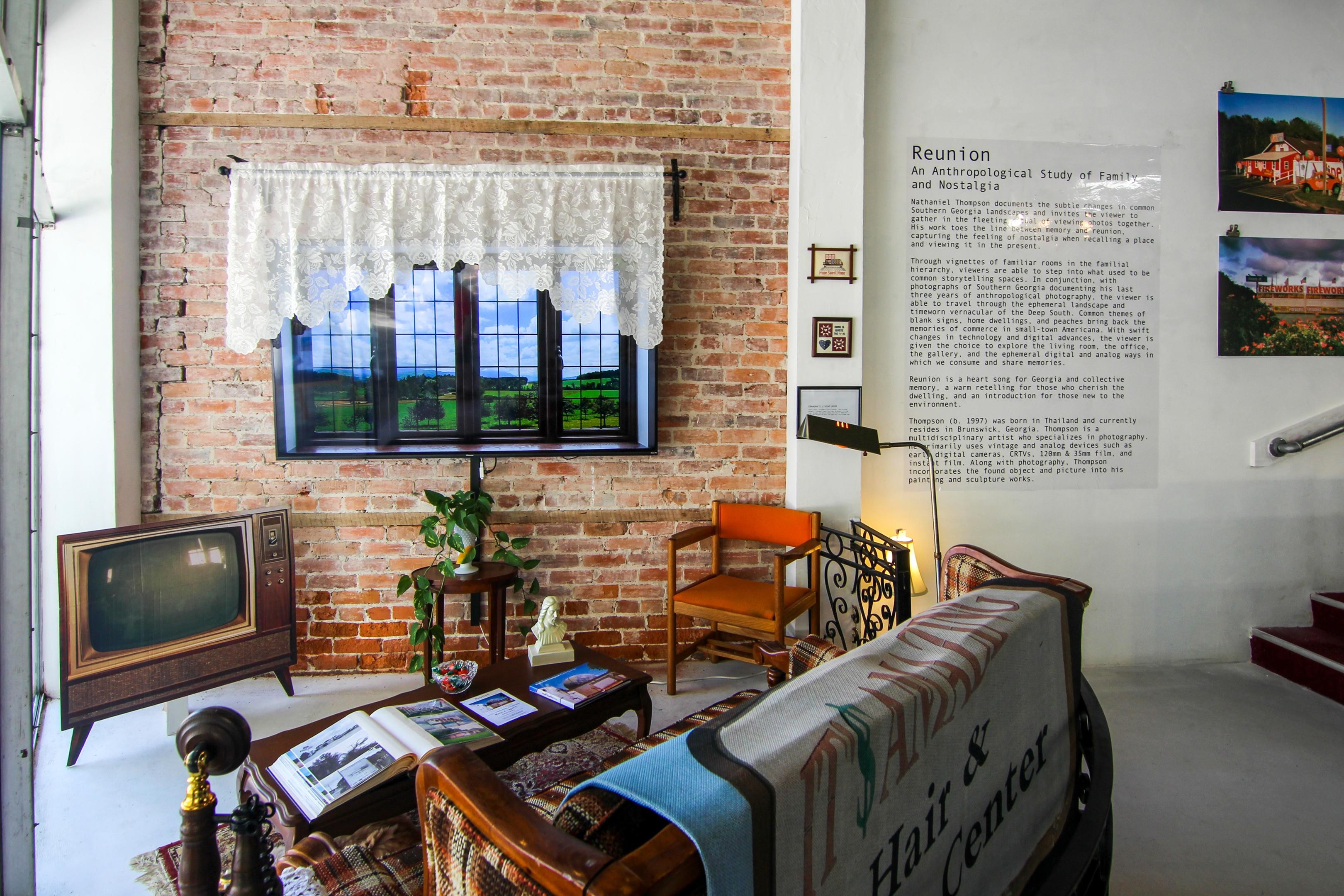
Thompson’s first solo show, entitled Reunion: An Anthropological Study of Family and Nostalgia held in the spring of 2022 at SoGlo Gallery in Brunswick, GA,  epitomized this genre perfectly. He installed an exact replica of an early 20th century office complete with wall art, and recreated a southern grandmother’s living room where one could sit down and flip through pictures in a photo album (remember those?!) Wanting to “document our time and place in history,” the office, living room, and photographic images together made up a road trip through time which perfectly reflected the ephemeral landscape and timeworn vernacular of the deep South.

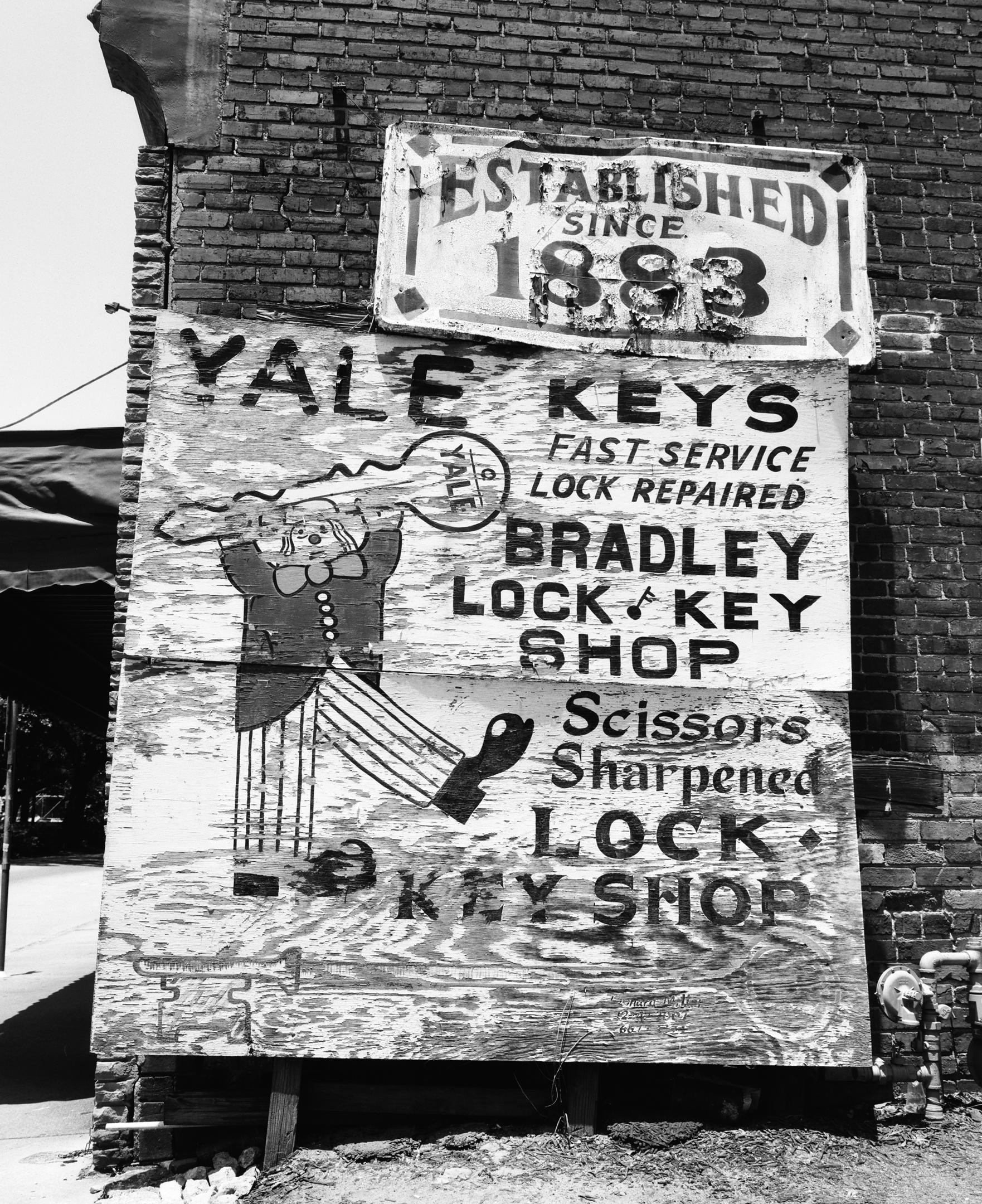
Thompson’s themes of blank signs, homes, kudzu vines and peaches, bring back memories of commerce in small-town Americana. Many are reflected in his self-published book “Planet Georgia,” the cover of which sports an image of Savannah’s iconic globe on DeRenne Avenue. The photographs of roadside shacks, convenience stores, and simple white churches remind me of the work of famed Alabamian multi-media artist William Christenberry (1936-2016)  and of images by former Savannah photographer and gallerist Meryl Truett, who described her 2003 book “Thump Queen & Other Southern Anomalies” as a collection of “eccentric southern images exploring the world of Thump Queens, Velvet Elvises, Soul Palaces, and Bad Antiques” from the “vanishing authentic South.”

Thompson’s new show at Capillo Studio, entitled For Your Convenience, opens on the evening of Sunday, February 25 and features an installation project; Visitors will be attending and experiencing the grand opening of Nat’s Variety Shop. A little tight-lipped about the surprises in store (pun intended), Thompson hints at recreating a convenience store inside the 32nd street home, complete with many of the products and items one would expect for sale…Claxton fruit cakes are mentioned (!) It will be an experiential show “with photos in places you don’t really expect…all the rooms in the house are part of the show, and also the canvas.”

“With this show I’m focusing on spaces of commerce because in the south, especially in the smaller towns, the convenience store is more than just a place to get a soda or a snack. It can be a grocery store, a meeting place, or the center of a town. As we start moving towards  more homogenized  and corporate commerce [think Dollar General and Wal-Mart], we are losing these places, which I think of as very beautiful. I’m creating an archive of spaces that I don’t think are being documented.” Capilla and I discuss how this phenomenon is worldwide; I reminisce about the corner confectionaries/news agencies in my native Ireland, and he reflects on how the almacen (bodega) is disappearing and being replaced by huge supermarkets in his native Argentina.

“My goal with the show is that people should appreciate and experience these spaces now, while we still have them,” Thompson continues. Then he says something important: “Coming from a self-taught background, I can understand how there are barriers with the fine art world. People who haven’t learned about art can feel separation when they see work on a wall, in a frame, behind glass. There are multiple barriers between the viewer and the art world. So, I’m trying to use this show to break down those barriers.”

At this point, Studio Capilla’s producer Victoria Gatlin joins the conversation. A dynamic young woman on a gap year between school in her native Costa Rica and university in Madrid, Gatlin is helping with marketing and social media. She says, “We’re inviting not only those in the fine art world, but people from the community – like the people from Randy’s BBQ [the baby blue cube building on Wheaton Street is the subject of one of Thompson’s photographs]. It’s to make this art form more accessible, to destroy those barriers. Because art is expression, and it’s for everyone.”

Part of the artwork is the advertising that Gatlin and Thompson have developed to show that this is a genuine place – that is really opening. As you go around town, keep your eyes peeled for flyers and coupons for the grand opening of Nat’s Variety Shop.

As Gatlin says, “I think the reason people should see this is to experience the childlike wonder of when you were younger and walked into a convenience store with your parents. I feel so much of this work is to do with the wonder and the love that Nathaniel has for these spaces, for the community, and for people.”

An art happening not to be missed.

Nathaniel Ryan Thompson’s For Your Convenience opens on Sunday, February 25 from 6 to 9pm at Studio Capilla, 806 E. 31st Street. Look for information on events and talks @nr.thompson and @studiocapilla, and visits can be scheduled for other times through [email protected]. The show will be on display through March 25. Find out more about Thompson at nathanielryanthompson.com

Landscape pro photographer Drew Buckley shares the best times of day to shoot landscapes

Landscape pro photographer Drew Buckley shares the best times of day to shoot landscapes

Above: watch our video guide

Photography is all about the light and how you use it. You’ll also need to decide when you shoot too as different scenes will suit a certain type of light at specific times.

Photographing your scene before sunset or after sunrise, with warm side light bathing the scene can create long shadows, while shooting before sunrise and after sunset in the blue hour will give your images a cooler feel as well as subtle, pastel colours. 

The above two choices are the main magical hours for landscape photography, but there’s a third timeframe too: twilight. This is split into three stages that encompass some of the golden and blue hours: civil, nautical, and astronomical twilight, before, it’s finally classified as nighttime. Photographing your scenes in any of these timeframes will result in vastly different looks to your photos, but fundamentally create interesting and compelling images. 

In this project I’ll run through the best times to shoot your scenic shots on any given day and demonstrate how the light can dramatically change in just a few hours.

1. The golden hour

(Image credit: Drew Buckley)

The Golden Hour refers to the hour after sunrise and before sunset. Not necessarily lasting an hour (depending on the location and season). It’s my favourite time for landscapes: the nature of the light at this time of day is simply stunning. 

2. Sunrise and sunset

(Image credit: Drew Buckley)

When the sun is near the horizon, sunlight travels through more of the atmosphere, reducing the light intensity. A softer more diffuse light bathes across undulations casting long shadows, enhancing the landscape and clouds bring on a new life.

3. Just after sunset (or before sunrise)

(Image credit: Drew Buckley)

Immediately after sunset it’s not uncommon for the sky to have a lovely, graduated colour to it, ranging from pastel oranges, purples, and blues. This time of day really can suit all sorts of image ideas and is great if the sky has a few clouds that will take on the colour.

4. The blue ‘magic’ hour

(Image credit: Drew Buckley)

Before the golden hour in the morning or after sunset, the world takes on a much bluer look. Namely known as the ‘blue’ or ‘magic’ hour, this is when the sun is below the horizon and the scene is illuminated by a cool and soft light, with no direct light angle.

5. Catch a moonrise

Landscapes

(Image credit: Drew Buckley)

Another blue hour idea is photographing the rising moon. Usually when a full moon rises, it coincides close to the sun setting. In the first fifteen to thirty minutes when the moon rises, there is still enough ambient light to evenly illuminate the landscape.

6. Nautical twilight

Landscapes

(Image credit: Drew Buckley)

After the enjoyment of the golden and blue hours we head into nautical twilight. As the sky darkens and takes on a deep blue colour I love to shoot man-made lit areas featuring water such as harbours, castles with moats and still lakes at this time. 

7. Total darkness

Landscapes

(Image credit: Drew Buckley)

After civil and nautical twilight we move into astronomical twilight and the night. This is when you can have some fun with star filled night sky images. A camera body with good high ISO low-light performance like my EOS R5 is ideal, though most full-frame bodies will work well. A high ISO will allow you to capture more information in low light situations too. Wide-angles work best, as they let you fit more sky into your shots, and a fast aperture such as f/2.8 will help you suck in lots of light.

A shutter speed of 20-30 secs is ideal, so a sturdy tripod is essential for blur-free shots. Focus on the starts themselves or turn your camera to manual focus and set it at infinity. Incorporating landscape features work well and it may sound obvious but head away from city lights or any light pollution that might affect your images. Keep an eye on the moon phase as well; a full moon will wash out stars, so aim to shoot your night sky images around the time of a new moon for best contrast.

These are the best low light cameras and the best painting with light photography tips. You might also like the best photo editing software and the best photo-editing laptopsx.