Photography

The Photography and Video Show 2024: A Triumphant Return with Cano…

The Photography and Video Show 2024: A Triumphant Return with Cano…
image

The Photography and Video Show 2024, set to dazzle the Birmingham NEC from March 16-19, is poised to make a triumphant return after an 18-month hiatus. With an enticing blend of fresh attractions and an illustrious roster of speakers, this year’s show promises an unparalleled immersion into the world of photography and videography.

Canon Takes Center Stage

Headlining the event is none other than Canon, the largest exhibitor, who will be offering an unprecedented interactive experience. Attendees will have the opportunity to learn innovative techniques, engage in insightful conversations with Canon experts, and get hands-on experience with the latest Canon cameras and lenses. This immersive encounter aims to empower enthusiasts and professionals alike to harness the full potential of Canon’s state-of-the-art technology.

A cornucopia of Masterclasses and Workshops

For the first time, the show will introduce specialist masterclasses, enabling an in-depth exploration of topics ranging from fine-art portraiture to Lightroom Classic updates and newborn photography techniques. Among the distinguished workshops are ‘The Art of Illumination’ by Forough Yavari, an award-winning photographer, and a masterclass by Kelly Brown, an acclaimed newborn photographer.

Julieanne Kost of Adobe will present the latest features in Lightroom Classic, while wildlife photographer Mattias Klum, royal photographer Chris Jackson, and others will grace the speaker lineup. The 2024 event will eliminate the Super Stage to make these esteemed figures more accessible to visitors.

New Stages, Exhibitors, and Discounts

A new stage, ‘Shoot to Inspire,’ will cover various genres, and interactive shoot-sets will allow hands-on practice. Exhibitors such as Panasonic Lumix, Laowa, Sirui, and CaptureOne will showcase their latest offerings. The show will also feature a gallery of AP Awards 2024 winners and images from legendary music photographer Jill Furmanovsky.

To further sweeten the deal, the show offers a 20% discount on standard entry tickets with the code AMPHOTPS24. This is an opportunity not to be missed for those seeking to expand their photographic horizons and engage with the global photography community.

As the countdown to The Photography and Video Show 2024 begins, anticipation builds for an event that promises to captivate, inspire, and educate. With its blend of expert knowledge, hands-on experience, and networking opportunities, the show is set to redefine the boundaries of photographic and videographic artistry.

In the grand tapestry of human expression, The Photography and Video Show 2024 stands as a vibrant thread, weaving together technology, creativity, and the enduring power of the visual narrative. It is more than just an event; it is a testament to the indomitable spirit of artistic exploration and the relentless pursuit of innovation.

Polar Bear Napping on an Iceberg Wins Wildlife People’s Choice Award

Polar Bear Napping on an Iceberg Wins Wildlife People’s Choice Award
Polar bear napping on a small iceberg

“Ice Bed” by Nima Sarikhani, UK. Winner, People’s Choice Award. Location: Off Norway’s Svalbard archipelago, Norway.
“A polar bear carves out a bed from a small iceberg before drifting off to sleep in the far north, off Norway’s Svalbard archipelago. Having spent three days desperately searching for polar bears through thick fog in the far north off Norway’s Svalbard archipelago, the expedition vessel Nima was on decided to change course. It turned and headed to the southeast, where there was still some sea ice. Here, they encountered a younger and an older male and watched the pair over the following eight hours. Just before midnight, the young male clambered onto a small iceberg and, using his strong paws, clawed away at it to carve out a bed for himself before drifting off to sleep.”

A polar bear curled up on an iceberg for a nap has won the Wildlife Photographer of the Year People’s Choice Award. This image, taken by amateur photographer Nima Sarikhani, beat out 24 other images that were in the running. Over 75,000 votes were cast by wildlife photography fans—a record number.

It took three days of searching off Norway’s Svalbard archipelago before Sarikhani happened upon polar bears. After the expedition vessel changed course, he happened upon two polar bears in the water. The male then climbed aboard the sea ice and, using his strong claws, created a bed for the evening.

“I am so honored to have won this year’s People’s Choice award for WPY, the most prestigious wildlife photography competition,” he says. “This photograph has stirred strong emotions in many of those who have seen it. Whilst climate change is the biggest challenge we face, I hope that this photograph also inspires hope; there is still time to fix the mess we have caused.”

Director of the Natural History Museum, Dr. Douglas Gurr, couldn’t agree more. “Nima’s breathtaking and poignant image allows us to see the beauty and fragility of our planet. His thought-provoking image is a stark reminder of the integral bond between an animal and its habitat and serves as a visual representation of the detrimental impacts of climate warming and habitat loss.”

In addition to Sarikhani’s winning image, four other photographs were revealed as top vote-getters with a highly commended status. This includes Tzahi Finkelstein‘s charming photo of a happy turtle balancing a dragonfly on its nose and Daniel Dencescu‘s image of a bird-shaped starling murmuration in Rome.

The five images will be displayed both online and in the accompanying exhibition at the Natural History Museum, London, until June 30, 2024.

See the top vote-getters of the Wildlife Photographer of the Year People’s Choice Award.

Turtle in the water balancing a dragonfly on its noseTurtle in the water balancing a dragonfly on its nose

“The Happy Turtle” by Tzahi Finkelstein, Israel. Highly Commended, People’s Choice Award. Location: Jezreel Valley, Israel
“A Balkan pond turtle shares a moment of peaceful coexistence with a northern banded groundling dragonfly in Israel’s Jezreel Valley.
Tzahi was positioned in his hide in Israel’s Jezreel Valley, photographing shore birds, when he spotted a Balkan pond turtle walking in the shallow water. At first, he wasn’t interested in it and carried on watching the birds. It wasn’t until a northern banded groundling dragonfly flew past his lens in the direction of the turtle that his focus changed. The dragonfly unexpectedly landed on the turtle’s nose, but instead of snapping up the insect, the turtle appeared to be experiencing pleasure from the interaction as they shared a moment of peaceful coexistence in the midst of the swamp’s murky waters.”

Pair of lionesses grooming a cubPair of lionesses grooming a cub

“Shared Parenting” by Mark Boyd, Kenya. Highly Commended, People’s Choice Award. Location: Maasai Mara, Kenya
“A pair of lionesses devotedly groom one of the pride’s five cubs in Kenya’s Maasai Mara. Early in the morning, Mark watched as these lionesses groomed one of their five cubs in their territory in Kenya’s Maasai Mara. The evening before, they’d set off to hunt, leaving the cubs hidden overnight in dense bushes. Returning from their unsuccessful mission, they’d called the cubs out onto the open grassland. Females raise each other’s cubs as their own, sharing parenting duties. Here the youngster was clearly enjoying the moment of affection and attention.”

Moon jellyfish floating in the water under the Northern LightsMoon jellyfish floating in the water under the Northern Lights

“Aurora Jellies” by Audun Rikardsen, Norway. Highly Commended, People’s Choice Award. Location: Tromsø, Northern Norway
“Moon jellyfish swarm in the cool autumnal waters of a fjord outside Tromsø in northern Norway illuminated by the aurora borealis. It’s common for this species to gather in their hundreds under the aurora borealis. Sheltering his equipment in a self-made waterproof housing, Audun used a single exposure as well as his own system for adjusting the focus and aperture during the exposure. This enabled him to capture the reflection of the sky’s colors on the surface of the water and, at the same time, light up the jellyfish with flashes. Moon jellyfish are common in all oceans and are easily recognized by their four rings, which are, in fact their genitals.”

Starling murmuration in the shape of a birdStarling murmuration in the shape of a bird

“Starling Murmuration” by Daniel Dencescu, Germany/Romania. Highly Commended, People’s Choice Award. Location: Rome, Italy
“A mesmerizing mass of starlings swirl into the shape of a giant bird on their way to communal roosts above the city of Rome, Italy. Daniel was mesmerized by the movements of the starlings as they formed colossal organic shapes in the sky. Each day, as they returned from foraging, they would gather in large numbers and perform spellbinding aerial shows, known as murmurations, on their flight home to their communal roosts. In a bid to locate the best roosting sites at which to capture the spectacle, Daniel spent hours following the starlings around the city and suburbs of Rome. Finally, on this cloudless winter’s day, the flock didn’t disappoint, swirling into the shape of a giant bird.”

Wildlife Photographer of the Year: Website | Facebook | Instagram

My Modern Met granted permission to feature photos by the Natural History Museum – Wildlife Photographer of the Year.

Related Articles:

16 Highly Commended Photos From the 2023 Wildlife Photographer of the Year Contest

20 Incredible Winners From the 2023 European Wildlife Photographer of the Year Contest

Snow Leopard Surveying Its Territory Wins Wildlife Photographer of the Year People’s Choice

25 Incredible Photos in the Running for Wildlife Photographer of the Year People’s Choice Award

Visual Alchemy: National Geographic’s ‘Photographer’ Series to Red…

Visual Alchemy: National Geographic’s ‘Photographer’ Series to Red…
image

Visual Alchemy: National Geographic’s ‘Photographer’ Series Set to Redefine Storytelling

National Geographic, a beacon of exploration and discovery, is poised to unveil its latest offering, a six-part documentary series titled “Photographer,” on March 18th in the United States. This riveting journey into the world of visual storytelling is the brainchild of esteemed documentarians E. Chai Vasarhelyi and Jimmy Chin. The series promises an intimate look into the lives and artistic processes of some of the world’s most extraordinary photographers, including Cristina Mittermeier, Paul Nicklen, Dan Winters, Campbell Addy, Krystle Wright, Muhammed Muheisen, and Anand Varma.

Each hour-long episode, a collaboration between these masters of the lens and leading documentary filmmakers, will delve deep into the photographers’ creative journeys. Viewers will gain a unique insight into their artistic processes, their singular ways of perceiving and experiencing the world, and the extraordinary lengths they go to in their quest for visual perfection.

A Symphony of Stills

One of the episodes features Ami Vitale, a renowned National Geographic photographer and documentarian. Vitale’s work is a testament to the power of visual storytelling, exploring themes of wildlife conservation, conflict photography, and ethical issues in photography. In the episode, she discusses the profound impact of social media on photography and the crucial role of storytelling in captivating audiences.

Vitale’s photography is more than just a collection of stunning images; it’s a symphony of stills that narrate compelling stories about our world. Her work is a potent reminder of the responsibility that comes with the power to shape perceptions and influence change.

The Future of Visual Storytelling

As we stand on the precipice of a rapidly evolving digital age, the series promises to explore the future of visual storytelling. With the rise of virtual reality, augmented reality, and artificial intelligence, the boundaries of what is possible are being constantly pushed and redefined.

The ‘Photographer’ series is a timely exploration of this exciting new frontier, showcasing the work of visual storytellers who are harnessing these technologies to create immersive, engaging, and impactful narratives. It is a celebration of the human spirit’s unyielding quest to document, understand, and share our world’s stories.

A Commitment to Groundbreaking Narratives

Tom McDonald, executive vice president of Global Factual and Unscripted Content at National Geographic, has hailed the series as a testament to the network’s commitment to delivering groundbreaking narratives that spark curiosity and have a lasting impact. The series will be available for streaming on Disney+ and Hulu the day after its National Geographic channel premiere.

In a world where the deluge of information can often drown out the quieter, more profound stories, National Geographic’s ‘Photographer’ series stands as a beacon of hope. It is a powerful reminder of the importance of visual storytelling in helping us make sense of our world, and a testament to the enduring power of the human spirit.

As we prepare to embark on this enlightening expedition into the world of visual storytelling, one thing is certain: the ‘Photographer’ series is set to redefine the boundaries of what is possible and showcase the extraordinary lengths that photographers go to in their quest for visual perfection.

Apple’s Foldable iPhone: A New Era of Mobile Photography and Video…

Apple’s Foldable iPhone: A New Era of Mobile Photography and Video…
image

Apple, the tech titan known for its sleek designs and game-changing innovations, is reportedly venturing into uncharted territory with the development of a foldable iPhone. This new device, still in the prototype stage, promises to redefine mobile photography and videography, offering users a more immersive and versatile experience.

The Foldable Revolution

February 8, 2024 – In a world where smartphones have become an extension of our lives, capturing moments and telling stories through photography and videography, Apple is poised to change the narrative once again. According to reliable sources, the tech behemoth is working on a foldable iPhone, a device that could significantly impact how we create and consume visual content.

The foldable iPhone is said to feature a small outer screen that doubles as a viewfinder for the camera, allowing users to take selfies without unfolding the phone or resorting to the less-than-ideal front-facing camera. This innovation alone could revolutionize the way we interact with our devices, making self-portraiture more intuitive and spontaneous.

A Clamshell of Creativity

The foldable iPhone’s clamshell form factor is not just a design choice; it’s a statement. This design provides a more secure grip and portability, enhancing stability during photo and video capture. It’s a nod to the classic flip phones of yore, but with a decidedly modern twist.

Moreover, the flexible OLED display offers a larger canvas for reviewing and editing content, providing a more immersive experience with greater detail. This feature could be a boon for professionals and enthusiasts alike, offering new creative opportunities and redefining the mobile photography and videography landscape.

Overcoming Challenges and Looking Ahead

However, the road to innovation is never without its challenges. Apple’s engineers are reportedly grappling with technical hurdles related to design and components. Despite these obstacles, Apple’s commitment to pushing boundaries suggests that a foldable iPhone could be a future offering, though not necessarily in the immediate product roadmap for 2024 or 2025.

The anticipation surrounding this potential game-changer is palpable. If successful, the foldable iPhone could set a new standard for mobile devices, further solidifying Apple’s position as a leader in technology and design. As we await more developments in this exciting journey, one thing is clear: the foldable revolution is upon us, and Apple is ready to lead the charge.

As we look to the horizon, it’s evident that the foldable iPhone is more than just a device; it’s a testament to human ingenuity and our relentless pursuit of progress. It’s a story of innovation, resilience, and the power of technology to transform our lives. And as always, Apple is at the forefront, shaping the future one fold at a time.

Lara croft costume hi-res stock photography and images – Alamy, costume lara croft

Lara croft costume hi-res stock photography and images – Alamy, costume lara croft

5
(577) ·

€ 25.99 ·

En Stock

Tomb Raider Lara Croft Cosplay Costume With Bag Halloween

Lara Croft 3D Render

54 Jill Croft Stock Photos, High-Res Pictures, and Images – Getty

Lara croft hi-res stock photography and images – Alamy

Old Tomb Raider Polygon-Style Lara Croft costume

Lara croft costume hi-res stock photography and images – Alamy

Lara croft costume hi-res stock photography and images – Alamy

Breasts: the ultimate weapons, Science

Lara Croft Tomb Raider Cosplay Costume Stock Photo 1889409880

Lara croft lookalike hi-res stock photography and images – Alamy

Tomb raider underworld hi-res stock photography and images – Alamy

Lara croft prem hi-res stock photography and images – Alamy

54 Jill Croft Stock Photos, High-Res Pictures, and Images – Getty

Lara Croft Costume Tomb Raider Lara Croft Full Set Cosplay Costume

2,748 Lara Croft Photos & High Res Pictures – Getty Images

Matthew Jordan Smith Gives You 3 Important Photography Tips

Matthew Jordan Smith Gives You 3 Important Photography Tips
Spread the love

There are lots of photographers who aren’t talked about as much as they should be these days despite the incredible work that they’ve done. And one of those is Matthew Jordan Smith. Smith is a photographer who did incredible work before the Instagram and Facebook algorithms started to dominate everything. Many of his images are timeless, which is evident in his work on his website. There’s no emphasis on the clothes or anything like this that makes it seem like the image was shot during the 90s or those trends have come back. Instead, it puts the beauty of who people are front and center. There are other great tips you can learn from him, though.

Lead image by Matthew Jordan Smith and used with permission in our interview with him. Check out his website and follow @matthewjordansmith for more.

Looking vs. Seeing

“I think I’ve always seen images like this in my head. It feels so natural to me. I’m not sure when the idea first hit me to bring the image to life because these images have been in my head for decades. I can tell you this, however. I began working on the first Still…Motion images in 2014. I’ve been going to visit parts of Japan since 2008, and at times I would see images of someone being still in the midst of a sea of movement.”

Matthew Jordan Smith

Matthew shares one big tip with us: the idea of looking vs seeing. When you look at a scene, all you’re doing is documenting it. But you see a creative vision — and then you work to make that manifest in a still image. That’s a quote from an interview we did with him a while back.

He often goes about scouting for the location, looking for the right light, and

Do it In Camera (When You Can)

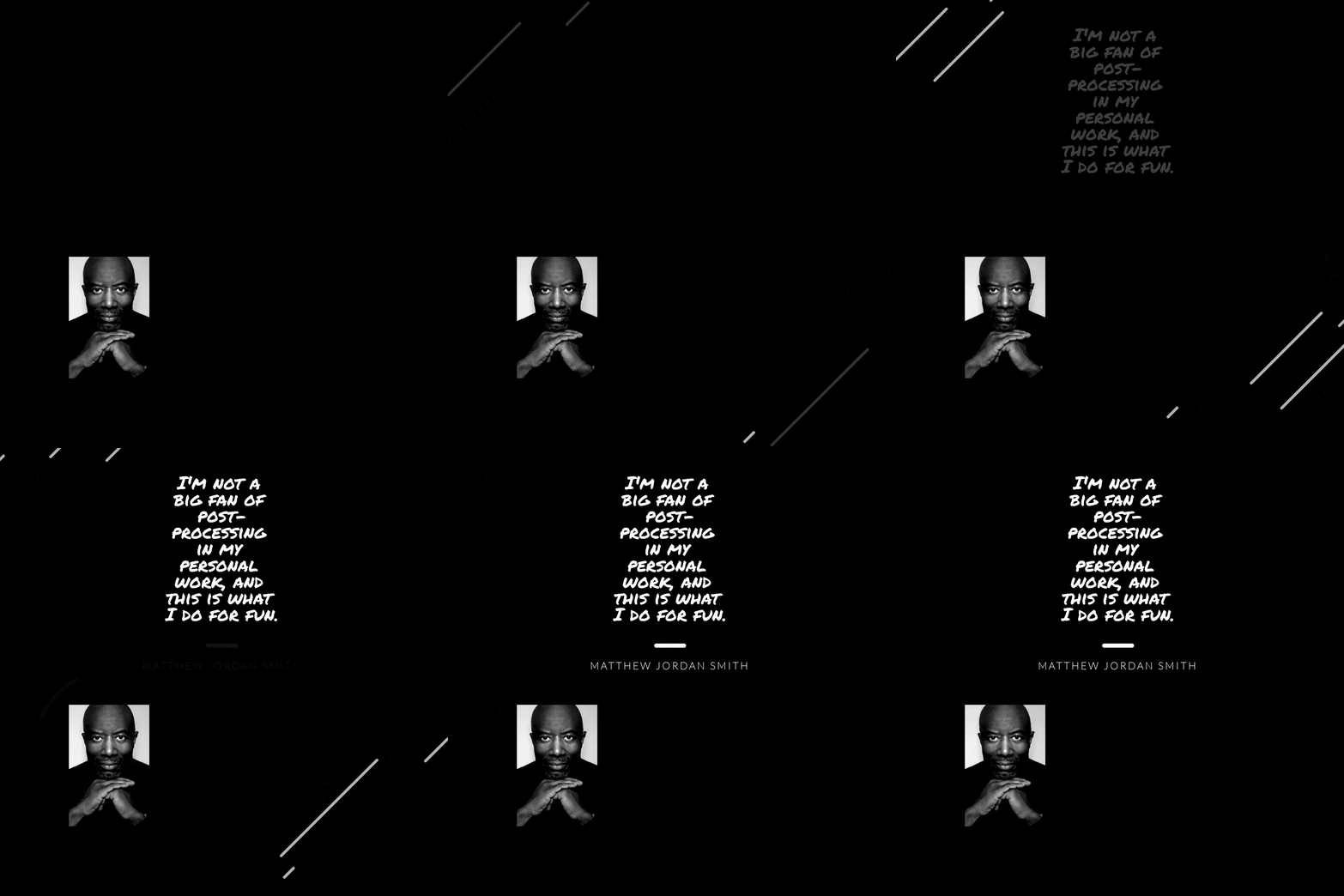
Smith has never been a big fan of fixing a photograph in post-production. Sure, you can do so yourself if you wish. But truly realizing an image and making it stand out from others is much more effective when you do it in-camera. Any algorithm or AI imagery generator can try making the same image you did. However, they can’t quite mimic your creative vision. I’m specifically saying “they” in that sentence because it’s a process between a human and AI making the image. That’s all done via compositing and setting up exact shading, etc. But getting that photo in camera? That requires so much more effort and pre-planning.

For the record, he doesn’t really use post-production for the work that he does for fun. But for his commercial work, it’s a different story.

An organic moment and mood can’t be mimicked in post-production. It’s something that has to happen in front of the camera. You, as a photographer, have to be part of that and not just shoot it at 20 frames a second.

Work for the Shot and Make it Timeless.

One of Matthew Jordan Smith’s most famous images is a photograph he did of Tyra Banks several years ago using Ring Flash. To make the image, he went all out using lighting flags, a ring flash, giving her breaks, etc. Most of the process wasn’t done in post-production — which means that he was far more creative in real life.

  • The distance of light from the subject is a big deal: getting too close to a subject and a ring flash might give you that Terry Richardson-style look.
  • Make a sweet spot: Position your subject in just the right area of the frame to make everything else work for that subject.
  • Specific props: In this case, he only used black backgrounds and side pieces
  • Use flags: Flags helped focus and add direction to the light. It also cuts out any extraneous light. Using light, like a flash, is a process that requires you to see the scene and not just look at it.

He talks about the image being timeless because there are no clothes or hairstyles in the image that take center stage. Instead, it’s just a shot of Tyra lit by a ring flash and blending into the background.

Dick Waterman, Promoter and Photographer of the Blues, Dies at 88

Dick Waterman, Promoter and Photographer of the Blues, Dies at 88
image

A “crackpot eccentric Yankee” from Massachusetts, he revived the careers of long-forgotten Southern artists during the blues boom of the 1960s.

Dick Waterman, a beacon in the world of blues who as a promoter, talent manager and photographer helped revive the careers of a generation of storied purveyors of that bedrock American art form while lyrically documenting their journeys with his camera, died on Jan. 26 in Oxford, Miss. He was 88.

His niece Theodora Saal said the cause was heart failure. A native of Massachusetts, he had lived in Oxford for nearly four decades.

Through his company, Avalon Productions, which was considered the first management and booking agency devoted primarily to Black blues artists, Mr. Waterman provided overdue exposure — and income — to early blues luminaries like Mississippi John Hurt, Son House and Skip James.

He also shepherded the careers of a younger blues cohort, including Buddy Guy and Otis Rush, as well as one young white artist, the singer-songwriter and future Grammy Award winner Bonnie Raitt.

Mr. Waterman in 2003 in Oxford, Miss. A native of Massachusetts, he lived in Oxford for nearly four decades.Bruce Newman

“Dick Waterman just may be the most knowledgeable man on the history of blues,” the music writer Don Wilcock wrote in 2019 on the website American Blues Scene. Mr. Waterman, he added, “sought out the originators of the genre, pulled them out of ‘retirement’ and presented them to a folk audience that to that point considered blues to be a footnote in the American musical history.”

We are having trouble retrieving the article content.

Please enable JavaScript in your browser settings.


Thank you for your patience while we verify access. If you are in Reader mode please exit and log into your Times account, or subscribe for all of The Times.


Thank you for your patience while we verify access.

Already a subscriber? Log in.

Want all of The Times? Subscribe.

Lightweight Photography: Maximizing Mobility Without Sacrificing

Lightweight Photography: Maximizing Mobility Without Sacrificing

The process of streamlining one’s photography equipment for a day out in the field is a crucial consideration for anyone who value mobility and the freedom to capture images without the burden of heavy gear. This approach not only enhances physical comfort during long treks but also allows you to focus more on the creative aspect of capturing stunning images.

Coming to you from Ian Worth, this engaging video showcases his new lightweight photography setup designed for extended outdoor adventures. Worth emphasizes the importance of minimizing gear without compromising on the quality of photographs. By selecting a compact but capable camera system and reducing the number of accessories carried, photographers can enjoy their passion with greater ease and flexibility, particularly on long treks. He introduces viewers to his choice of gear, including a smaller camera body and lens selection, a versatile yet lightweight tripod, and a functional backpack that offers quick access to equipment. This setup is ideal for photographers looking to maintain agility and spontaneity in their work.

Worth’s experience along an unexplored coastal path underlines the practical benefits of a lighter setup. Despite challenging lighting conditions and unexpected compositions, his ability to adapt and continue shooting without the physical strain of heavy equipment underscores the value of his approach. The video is a testament to the idea that successful photography is not just about having the most extensive kit but about knowing how to make the most of a carefully selected array of tools. Check out the video above for the full rundown from Worth.

A pair of ambitious photo shows look at sexuality and race in Boston during the ’70s

A pair of ambitious photo shows look at sexuality and race in Boston during the ’70s

A lot was going on in the ′60s, in a “the whole world is watching” sort of way. That’s conventional wisdom. A lot was also going on in the ′70s — in the culture and society, in photography, in Boston. That’s a less conventional view. In the ′60s lines were being crossed that hadn’t been crossed before. In the ′70s, lines were being blurred that maybe hadn’t even been noticed as lines. That blurring wasn’t necessarily attention getting, but for some people it was life altering.

Some of those people or their work or both can be seen in two shows currently at the School of the Museum of Fine Arts at Tufts. They potently convey the a-lot-going-on aspect of the ′70s and beyond.

Mark Winer, film still from “As the World Burns,” 1973.Courtesy of the artist

“As the World Burns: Queer Photography and Nightlife in Boston” and “Christian Walker: The Profane and the Poignant” run through April 21. Both shows inevitably, also satisfyingly, sprawl. Both nonetheless feel coherent. With “World,” it’s the coherence of a particular time and place and attitude. With Walker, it’s the coherence of a particular sensibility, one notably restless and searching. For a while, he shared that time and place and took that attitude in different, unexpected directions.

Curator Jackson Davidow organized “World,” along with the Tufts University Art Galleries’ Laurel V. McLaughlin. Davidow and Noam Parness curated “Christian Walker,” also with the assistance of McLaughlin. The Walker show originated at New York’s Leslie-Lohman Museum of Art.

“World” takes its title from an 18-minute film made in 1973 by Mark Winer, then a student at Boston University. The film, shown in its entirety, serves as a kind of centerpiece for the show. The title takes off on the daytime soap opera “As the World Turns.” “Burns,” as a verb, isn’t altogether accurate, at least not as seen four decades later: “Smolders” would be more accurate. The transgressiveness on display now seems largely aspirational.

Nick DeWolf, “Young Men Hanging a Poster for Gay Liberation Dance at Charles Street Meeting House,” 1970.Courtesy Nick DeWolf Foundation Photo Archive

What we see are highlights from a day in the life of Bobby Busnach, a self-described “street hustler,” then in his teens. Busnach, who died in 2019, would go on to become a photographer and chronicler of the gay community in Boston and New York. The show includes one of his photos.

Did New York Dolls-era David Johansen have a kid brother? If not, his parents could have adopted Bobby. He has the pouty features and lion’s mane of streaked hair. You almost don’t notice the magenta James Dean T-shirt he’s wearing or white platform heels (almost). David Bowie and early Kool and the Gang (“Jungle Boogie,” not “Celebrate”) are on the soundtrack. Although the drugs of choice are champagne, marijuana, and nicotine (Bobby smokes Salems), the atmosphere feels very Quaaludes. Yup, it’s 1973, all right.

A revealing comparison for Winer’s short is Shirley Clarke’s celebrated 1967 documentary, “Portrait of Jason.” Jason’s also a hustler, but considerably older, far more sophisticated, and Black. Clarke’s film is hard to watch now because of the revulsion her subject inspires in this ostensibly hip filmmaker. What a difference six years can make. Despite how very much of its moment “World” is, thanks to the clothes and music and Super 8 film it’s shot on, it doesn’t feel all that distant in time — precisely because of how matter of factly the film accepts Bobby.

Bobby is louche and out of the ordinary but not so out of the ordinary as to seem exotic or “deviant.” A year later, guys who weren’t all that different from Bobby — in age, in background, even in interests — were throwing rocks at school buses. It was weird around here back then, and Bobby’s weirdness was the least of it. Deviant is as deviant does. Say this for the ′70s: It was the decade that made deviance seem obsolete conceptually.

Allen Frame, “Nan [Goldin] photographing The Other Side, Boston,” 1973.Courtesy Gitterman Gallery © Allen Frame

This shift that was taking place is documented throughout the show. There are copies of such publications as Gay Community News, Boston Gay Review, Fag Rag, Bad Attitudes. There are safe-sex brochures (we’re now in the ′80s). Most of all, there are lots of photographs. They’re as likely to be in color as black-and-white. That, too, was part of the shifting that was going on: color being accepted in serious photography. Acceptance back then didn’t just involve people.

Among the photographers are Allen Frame, Jason Byron Gavann, Shelburne Thurber, Gail Thacker, Nick DeWolf, Angela Russo. Appearing in three of the photographs is Nan Goldin. The show includes a couple of postcards for exhibitions of hers. An SMFA grad, Goldin moved to New York at the end of the decade. Her slide show, “The Ballad of Sexual Dependency” (published as a book in 1986), would become a defining work of the ′80s. All sorts of affinities — formal, thematic, even emotional — present themselves inwhat we’re seeing in “World.” Goldin can be seen, or felt, as the show’s presiding spirit.

Patricia A. Gozemba “Untitled [Fran’s Place],” 1983.Courtesy The History Project, Boston © Patricia A. Gozemba

In some ways, the most affecting photographs in “World” weren’t taken by people who considered themselves photographers. Jim McGrath was a bartender. Pat Gozemba is an academic and activist. McGrath’s snapshots and Polaroids of the clientele at bars where he worked, and Gozemba’s photos of a 1983 reunion at a lesbian bar in Lynn, Fran’s Place, are like pages from a family album. Like such pages, they’re moving and unfussy and familiar in feeling.

Christian Walker (1953-2003) has photographs in “World” as well as his namesake show. Born in Springfield, he came to Boston in the ′70s and graduated from the Museum School in 1984. In a nice touch, his student ID card is on display.

The show includes a lecture Walker gave at the University of Arizona’s Center for Creative Photography in 1991. Photography, by its nature, is unavoidably voiceless. It’s nice to have it here given a literal voice.

V. Elizabeth Turk, “C.W. — Summer 1992.”© V. Elizabeth Turk

The man heard from is both appealing and slightly wary. One of the most striking things about Walker’s work is a sense of apartness. Like voicelessness, that’s another thing innate to photography as a medium: A photographer always remains on the other side of the lens. But Walker’s apartness is more than that. He mentions in the lecture that he was one of three Black students at the school and the only one studying photography. It wasn’t just the lens he was on the other side of.

Walker’s first titled series, “The Theater Project,” consists of 32 photographs taken in 1983 and ′83 at the Pilgrim Theater. The Pilgrim was an old vaudeville house in what had become the Combat Zone, the downtown red-light district. Walker has a set of pictures of the Zone in the retrospective.

Christian Walker, “Untitled (Boston’s Combat Zone),” 1979-83.Collection of David VanHoy © Christian Walker

The Pilgrim screened porn. Even though it wasn’t gay porn, gay men went there for sex. Walker would go there with his camera. What we see in the images (there are 15, split between the two shows) are balconies, stairways, restrooms, patrons. What we feel are longing and rot: the intersection of desire and decrepitude. The darkness feels natural, like a haven, the stray irruptions of light like a violation.

Evocation and emotion matter vastly more than description does, though that has its place, too. There is nothing theatrical here. The graininess of the pictures underscores a combination of furtiveness and evasion (by the patrons, not Walker), concealment and release. The most remarkable thing about these remarkable images is how they are in no way voyeuristic, or they’re voyeuristic only in the way that looking in a mirror can be.

After graduating from the Museum School, Walker moved to Atlanta. He’d started as a painter, and a number of his series involved layering pigments to photographic images. He experimented with scale. Race relations were an abiding concern, as indicated by such series titles as “Miscegenation,” “Evidence of Things Not Seen,” and “Another Country” (a nod to James Baldwin). That last series, from 1990, involved re-photographing and enlarging archival images, some of them famous, like Marion Post Wolcott’s of a segregated movie theater. Obscenity is as obscenity does. The Pilgrim profited from one kind, Wolcott’s from another. At least the Pilgrim let people sit wherever they wanted.

Walker was an outsider, but by no means marginal. He showed at the Whitney. Atlanta’s High Museum of Art acquired his work while he was still living. He and Carrie Mae Weems were among the few contemporary photographers included in Deborah Willis’s acclaimed 1989 exhibition, “Black Photographers Bear Witness: 100 Years of Social Protest.”

At some point in the ′90s, Walker moved to Seattle. He spent a period of time there homeless. It’s believed he died of a drug overdose, though that’s uncertain. Such biographical details are extraneous to his art, except that with the sense of distance in Walker’s work there’s also, however paradoxically, a sense of person: that restless and searching sensibility. Having heard that voice in the lecture, you want to know why it was stilled.


Both of these shows are intrinsically historical. But they’re also intensely immediate and, in a very real sense, as much about now as then. This makes sense, actually. What’s more immediate or less past tense than identity, desire, community, and, yes, acceptance?

AS THE WORLD BURNS: Queer Photography and Nightlife in Boston

CHRISTIAN WALKER: The Profane and the Poignant

At School of the Museum of Fine Arts at Tufts, 230 the Fenway, through April 21. 617-627-3518, artgalleries.tufts.edu/exhibitions


Mark Feeney can be reached at mark.feeney@globe.com.

Photographer Bill Tennessen to give ‘Gallery Talk’ about his ‘Dynamic Range’ photographs on display at Haggerty Art Museum Feb. 21

Photographer Bill Tennessen to give ‘Gallery Talk’ about his ‘Dynamic Range’ photographs on display at Haggerty Art Museum Feb. 21
Image: Bill Tennessen, American, b. 1934, Juneteenth Day Celebration, 1985 (detail), 8 x 10”, Silver nitrate print, Collection of the artist

The Haggerty Art Museum is hosting a gallery talk by Bill Tennessen about his exhibit of photos at the museum titled: ‘Dynamic Range: Photographs by Bill Tennessen,’ at 11 a.m. on Wednesday, February 21, at the art museum. This talk is free and open to the public. The Haggerty is located on the campus of Marquette University. 

Dynamic Range includes 50 photographs by Tennessen that highlight Milwaukee’s Black community from the 1980s to the early 2000s. 

The exhibition was curated by Lynne Shumow (Haggerty Museum Curator for Academic Engagement) in collaboration with Dr. Robert Smith (Marquette University Harry G. John Professor of History and Director of the Center for Urban Research, Teaching and Outreach—CURTO) and Mia Phifer (Education and Research Coordinator at America’s Black Holocaust Museum). 

Additional assistance was provided by Kate Rose, Caroline Bielski, Sebastien Brown, Sophia Furman, Logan Glembin, Niktalia Jules, and Adamali De La Cruz. 

Support for this exhibition is generously provided by the Marquette University Women’s Council Endowment Fund. 

Image at top: Bill Tennessen, American, b. 1934, Jimmy Carter at Milwaukee’s Habitat for Humanity, 1989, 8 x 10 inches, Silver nitrate print, Collection of the artist courtesy of Charlie Tennessen