Photography

Exposed: Local Photographer a Complete Fraud, His ‘Deep’ Instagram

Exposed: Local Photographer a Complete Fraud, His ‘Deep’ Instagram

Houston, Texas: In a dramatic revelation, local photographer Jason Artique’s deep and insightful Instagram captions have been unmasked as nothing but a collection of trending hashtags. This shocking discovery has overturned his reputation as a profound artist and shaken the Instagram community. 

Artique’s portfolio, lauded for its emotional depth, combined everyday scenes with captions like “Amidst chaos, find serenity #DeepThoughts #UrbanJungle,” now revealed as mere echoes of popular social media tags. His followers, who admired his seemingly philosophical insights, are left feeling betrayed and disillusioned.

Take his viral shot of a chipped coffee mug, paired with the caption “Broken, yet holding the elixir of life #CaffeinatedSouls #FragmentedExistence.” Eagle-eyed fans noticed its uncanny similarity to a hashtag-storm under #MotivationMonday. And who can forget the image of a wilted flower with “Beauty in decay, the transient poetry of nature #EphemeralAesthetics #WitherWithWisdom,” a near-verbatim echo of #ThoughtfulThursday’s musings.

Artique’s admirers, who once revered him as a modern-day philosopher, have expressed their discontent and sense of betrayal. “I thought he was channeling the essence of life, but he was just channeling trending topics,” said one former fan, echoing the sentiments of many.

Artique, amidst the controversy, maintains a defiant stance. “Art is about capturing the zeitgeist, and my captions reflect the collective psyche of our time,” he argued, seemingly undisturbed by the accusations of unoriginality.

Art historians and social media experts are now weighing in on the scandal. “This case opens up a broader discussion about originality in the digital age,” commented a noted art critic. “Where do we draw the line between inspiration and outright appropriation in art?”

As the story unfolds, the art community and social media users are left to ponder the fine line between artistic inspiration and intellectual theft. Meanwhile, Artique continues to post, undeterred, with his latest photo of a raindrop on a leaf accompanied by yet another trending caption, igniting further debate over the nature of art and authenticity in the era of social media.

“It wasn’t the disability. It was the ability.” The inspiring story of teen photographer Nash Pils

“It wasn’t the disability. It was the ability.” The inspiring story of teen photographer Nash Pils

Nash Pils is a seventeen-year-old junior at Franklin High School. The small Texas town has a population of 1,614, but he is quickly becoming one of its best-known residents.

You see, as ESPN’s Dave Wilson writes, Nash has become a fixture at sporting events and major moments around the town because he is an extremely gifted photographer for his age, routinely capturing moments in ways that make his mentors in the field marvel.

Nash also has Down syndrome, a disability that has defined much of his world beyond the camera’s lens but which has also given him a unique perspective while behind it.

A “fearless” photographer

Nash has loved cameras since he was a kid and would often take pictures at his older brother’s games.

As his parents recount, early on people would see him with the camera and say, “Oh dear, no, give that camera to your parents, you’re going to break that.”

His parents would simply reply, “No he’s not. That’s his job.”

And it’s one he’s excelled at from an early age. He’s won multiple photography competitions.

  • Pulitzer Prize-winning photographer and family friend Tom Fox said Nash is “fearless” when it comes to taking pictures, adding, “I just love how real and natural his photos are.”
  • Hannah White—another of Nash’s mentors—said “he knows what he wants to capture, and he’s not going to let anyone else dictate it to him. He is able to capture people’s happiness, laughter and just true human emotion.”
  • White added that “through this process of him being able to get out and be involved with the school and with the community, it’s allowed people to see who Nash is. He is so much more than his Down syndrome.”

For his parents, that last part is what they care about most.

Nash’s mom, Honny, said, “For the first time, it wasn’t the disability. It was the ability.”

A close-up on how God sees you

Wilson’s profile is worth reading, but the part that stands out most is the joy his parents take in watching the community see their son through the lens of his gifts rather than his limitations.

And his story is a good reminder that that’s how our heavenly Father sees each of us as well.

Scripture is clear that not only are each of us sinners deserving of damnation, but that God is keenly aware of our status as well (Romans 3:23). However, it speaks with equal clarity to the reality that we are loved and valued in spite of that fact (John 3:16).

In short:

God is not ignorant of our sin, but our sin doesn’t define us either.

If we have accepted the free gift of salvation that Jesus died to give us, then we are first and foremost children restored to a personal and eternal relationship with the Lord.

Yes, we need to be honest about our shortcomings and repent of the sin in our lives, but the guilt that would try to make those failures the foundation of who we are is not from God.

And the same is true for others as well.

So the next time you are tempted to see either yourself or someone else through the lens of sin, take a step back and ask God to help you look through the lens of his love and grace instead.

After all, if that’s how our heavenly Father sees us, then it’s how we should see ourselves as well.

Photographer Captures Earth’s Magnetic Field Being Played Like a Guitar

Photographer Captures Earth’s Magnetic Field Being Played Like a Guitar
Aurora curl
An aurora curl causes by the Earth’s magnetic field rippling. | Jeff Dai

Aurora lights are shapeless illuminations that dance and swirly randomly but one photographer in Iceland recently looked up and saw the northern lights being “curled.”

This ultra-rare phenomenon is still being studied but scientists believe that what Jeff Dai captured over a volcanic crater is Earth’s magnetosphere rippling like a guitar string — illustrated by the aurora borealis.

[embedded content]

Dai says that he witnessed the aurora curls for “several minutes” taking spellbinding video where the green light looks visually similar to a heart monitor in a hospital.

“Imagine that Earth’s magnetic field is like a guitar string,” says Xing-Yu Li of Peking University’s Institute of Space Physics and Applied Technology. “In Jeff Dai’s picture we are seeing vibrations in that string.”

SpaceWeather explains that usually this type of magnetic pulsation can only be seen as a squiggle on a chart recorder. However, Dai captured energized particles from space caught up in the rippling geomagnetic field which caused it to glow with auroral light making it visible as a wave in the night sky.

It is exceptionally rare to see such an occurrence, the magnetic tremors that Dai captured were not picked up by any scientific equipment so there is little else known about the incident.

The magnetic waves are known as ultra-low frequency (ULF) waves and they are most commonly triggered by a gust of radiation from the Sun. These solar winds collide with Earth’s protective shield and can cause the atmosphere to “ring like a bell.”

ULF waves are typically invisible and are only caught by specialized scientific equipment but in rare instances, the solar radiation can penetrate the magnetosphere to create the singular strip of aurora light seen in Dai’s photo.

“It’s still a hot topic for the experts,” Dai writes on his Instagram page. “The specialist told me that the formation of these curl-like structures may be connected with flow shear driven by ultra-low frequency waves.

“These curls are fine structures in the poleward boundary of multiple arcs formed by longitudinal-arranged field-aligned current pairs.”

More of Dai’s work can be found on his Instagram.


Image credits: Photographs by Jeff Dai.

Former US senator Patrick Leahy, with new photo show, has plenty of company as a celebrity camera enthusiast

Former US senator Patrick Leahy, with new photo show, has plenty of company as a celebrity camera enthusiast

Patrick Leahy retired from the US Senate in 2023, having served there for 48 years. Such longevity isn’t the only thing senatorially unusual about Leahy. The Vermont Democrat is a Deadhead. He’s had bit parts in four Batman movies — five, if “Batman v. Superman: Dawn of Justice” counts, but let’s not get carried away.

Leahy, 83, is also a passionate photographer. An exhibition of his work, “The Eye of Senator Patrick Leahy,” runs at the Vermont Supreme Court Gallery Feb. 1-March 29.

Actually, being a passionate photographer isn’t unknown among senators. Barry Goldwater and Howard Baker, both of whom Leahy served with, were devoted amateurs.

Howard Baker photographing Elizabeth Taylor, 1980.Howard H. Baker Jr. Papers, MPA.101. University of Tennessee, Knoxville – Libraries

There are a surprisingly large number of famous people who are also camera enthusiasts. One reason is that their fame can give them access denied most photographers. As the Hall of Fame pitcher Randy Johnson says on his website, rj51photos.com, “Thanks to the people I got to meet during my baseball career, I’ve been fortunate to have unique opportunities in photography.”

Randy Johnson, left, photographs his fellow Baseball Hall of Famer Pedro Martinez at the 2015 induction ceremony. Jim Davis/Globe Staff/file

Another is the opportunity it gives a celebrity to change the fame equation.

In 1955, President Dwight Eisenhower was posing for photographs outside his farm, in Gettysburg, Pa. Picking up an early Polaroid Land Camera, he said, “Now, let me reverse the tables and take your picture.” The resulting image is like looking at a firing squad. One can imagine the satisfaction Ike took in being the one behind a camera instead of at the receiving end.

Paul McCartney, “Self-portrait, London,” 1963.© 1964 Paul McCartney under exclusive license to MPL Archive LLP

A much larger and higher-profile photography exhibition than Leahy’s opens at the Brooklyn Museum in May: “Paul McCartney Photographs 1963–64: Eyes of the Storm.” Other musician photographers include Frank Sinatra, who shot the first Ali-Frazier prizefight for Life magazine; Lenny Kravitz, who’s exhibited his work at Art Basel; former Rolling Stones bassist Bill Wyman; Graham Nash; Patti Smith (“Each photograph is like a diary entry in my life”); and Michael Stipe, who published a book of photographs of a 1995 Patti Smith tour.

Probably the most talented non-photographer photographer is the actor and film director Dennis Hopper. Between 1961 and 1967, Hopper took some 10,000 photographs. The best are collected in his book “Out of the Sixties” (1986). Hopper’s “Double Standard” (1961) may be the best Lee Friedlander picture Friedlander never took. The comparison flatters both men.

Dennis Hopper in 2001, in front of his 1961 photograph “Biker Couple.”COR MULDER/ANP/AFP via Getty Images

Hopper, who died in 2010, is far from the only actor photographer. Both Jessica Lange and Candice Bergen have had exhibitions at the George Eastman Museum, in Rochester, N.Y. Bergen, in a nice bit of typecasting, played the photojournalist Margaret Bourke-White in “Gandhi” (1982).

Ben Kingsley walking beside Candice Bergen in a scene from the film “Gandhi.”Columbia Pictures/Getty Images

Jeff Bridges has published two books of his photographs and devotes a significant chunk of his website, jeffbridges.com, to his photography. Other stars who’ve published books of their photography include Viggo Mortensen, Diane Keaton, and the late Gina Lollobridgida (no fewer than five).

Italian actress Gina Lollobrigida with one of her cameras in her villa on the Appian Way in Rome, Nov. 26, 1972.Massimo Sambucetti/AP/File

Bridges’s camera of choice is a a Widelux F8. Sammy Davis Jr. believed in having more photographic options. At one time he owned a Contax, two Rolleiflexes, a Hasselblad, a pair of Nikons, a Canon, a Leica, a Polaroid, and a Praktica. Davis also believed that a performer has an advantage as a photographer. “I can anticipate the climax of a person’s activities, can shoot at just the right moment to capture the high point.”

There have been famous authors who were photographers: August Strindberg, George Bernard Shaw, Jack London (between 1906 and 1916 he took more than 12,000 photographs), Allen Ginsberg, Orhan Pamuk. Wright Morris owed his fame to his writing, but it’s fair to say he was a better photographer than novelist.

Jack London photographing the skeleton of the Snark, San Francisco Bay, 1906.Collection of the Huntington Library, Art Museum, and Botanical Gardens

Not that writing and photography are unrelated. As with performing, there can be a connection between the two or the provision of a means of emotional entry. Before she became known for her short stories, Eudora Welty worked as a photographer for the Works Progress Administration during the Great Depression. “The camera was a hand-held auxiliary of wanting-to-know,” she writes in her memoir “One Writer’s Beginnings” (1984). “Making pictures of people in all sorts of situations, I learned that every feeling waits upon its gesture; and I had to be prepared to recognize this moment when I saw it. These were things a story writer needed to know.”

Patrick Leahy’s beginnings as a photographer came early: taking pictures with cameras belonging to his mother. “There was such a sense of adventure in putting a camera up to my eye and framing the view around me,” he writes in his 2022 memoir, “The Road Taken.” His parents later bought him a Brownie and then a Hopalong Cassidy box camera. Leahy’s first “professional” camera was a Zeiss Ikon Contaflex B, which he bought the summer before college.

Patrick Leahy: Ronald Reagan, left, being sworn in for a second term as president by Chief Justice Warren Burger, with Nancy Reagan, center.Courtesy Patrick Leahy

A quarter century later, US News and World Report asked Leahy to photograph Ronald Reagan’s inauguration. Two of his pictures led the newsweekly’s coverage. Signing a print of one, Reagan said to him, “What are the odds that my favorite photo was taken by a Democrat?”

Trying to get then-Governor Bill Clinton to make a campaign appearance in Burlington in 1992, Leahy pitched his argument in visual terms. “Come up to Vermont in the afternoon. We’ll get a big crowd on the water, right on Perkins Pier. It’s a beautiful photo.”

In 1999, Leahy’s reputation preceded him as he walked in the funeral procession for Jordan’s King Hussein. Egyptian President Hosni Mubarak called out to Clinton and Gerald Ford, “Bill, Gerry! Pat wants to take your picture!” It was more a case of Mubarak wanting to have his photo taken with the former presidents. Either way, Leahy obliged.

US Attorney General nominee John Ashcroft looks at photographers as US Senator Patrick Leahy takes a picture on Jan. 4, 2001, on Capitol Hill. STEPHEN JAFFE/AFP via Getty Images

THE EYE OF SENATOR PATRICK LEAHY

At Vermont Supreme Court Gallery, 111 State St., Montpelier, Vt., through March 29. 802-828-0749, curator.vermont.gov/vermont-supreme-court-gallery


Mark Feeney can be reached at mark.feeney@globe.com.

Garuda Aerospace Introduces Droni: India’s Smart Personal Drone in Consumer Photography and Cinematography

Garuda Aerospace Introduces Droni: India’s Smart Personal Drone in Consumer Photography and Cinematography

Garuda Droni DroneDrone Tech Startup Expands Portfolio with Mahendra Singh Dhoni-Backed Droni, Offering Impressive Features and Accessibility

Garuda Aerospace, the forefront player in the Agri Drone Segment with a commanding 55% market share, has unveiled Droni, marking its inaugural foray into the consumer photography and cinematography drone sector. The launch represents a notable shift in an industry traditionally dominated by DJI drones. Droni, named after the cricket legend and brand ambassador Mahendra Singh Dhoni, is now globally available for purchase exclusively on Amazon.

Founder and CEO of Garuda Aerospace, Agnishwar Jayaprakash, expressed his excitement about the launch, emphasizing the product’s cutting-edge design and its alignment with convenience and quality. He highlighted the significance of the collaboration with Mahendra Singh Dhoni, stating, “Besides being our first B2C product in the market, it is a product that is cutting-edge, and purposefully designed for convenience and quality. Moreover, it strengthens our partnership with our brand ambassador Mahendra Singh Dhoni and offers consumers an opportunity to own a product that is created in association with him. The product is a game-changing one in the aerial photography and videography market, and we are confident that it will empower users to push creative boundaries.”

Garuda Droni DroneGaruda Droni Drone

Garuda Aerospace has the distinction of being the first company with Dual DGCA certifications for both Manufacturing and Training in both Small and Medium Categories, and has secured a significant position in the drone market. Presently, Garuda Aerospace drones constitute 25% of the total drones in India, with a Garuda drone taking off every 30 seconds across the nation, according to a company press release.

Droni, a foldable, portable, and lightweight quadcopter weighing only 249 grams, offers an impressive 60 minutes of flight time, catering to the increasing demand for user-friendly drones in India and beyond. The drone positions itself as a game-changer in the aerial photography and videography market, boasting features such as 11 intelligent flight modes, a high-quality 48 MP camera with optical flow positioning, and a three-axis mechanical stabilized pan tilt for stable shots.

With an MRP of Rs 1,40,000, Droni is currently available at an introductory price of Rs 85,000, exclusively on Amazon. To support the product launch, Garuda Aerospace has initiated an integrated marketing campaign, including an ad film featuring Mahendra Singh Dhoni.

Garuda Aerospace, established in 2015, has rapidly scaled to become India’s leading drone tech startup. Focused on disrupting the Precision Agri Tech and Industry 4.0 sectors, the company operates with an asset-light, recession-proof, and agnostic approach. With over 400 drones and 500 pilots operating in 84 cities, Garuda Aerospace serves a diverse client base, including notable names like TATA, Godrej, Adani, and global partnerships with Lockheed Martin, Cognizant, and Elbit Systems.

Read more:

Miriam McNabbMiriam McNabb

Miriam McNabb is the Editor-in-Chief of DRONELIFE and CEO of JobForDrones, a professional drone services marketplace, and a fascinated observer of the emerging drone industry and the regulatory environment for drones. Miriam has penned over 3,000 articles focused on the commercial drone space and is an international speaker and recognized figure in the industry.  Miriam has a degree from the University of Chicago and over 20 years of experience in high tech sales and marketing for new technologies.
For drone industry consulting or writing, Email Miriam.

TWITTER:@spaldingbarker

Subscribe to DroneLife here.

Black-British women photographers to know now

Black-British women photographers to know now

Shining Lights: Black Women Photographers in 1980s–90s Britain is the new photo book bringing together the work of trailblazing Black image-makers from the UK

31January 2024

In Britain, the two decades that preceded the millennium were marked by significant social, political and economic shifts. Racked by deindustrialisation, urban uprising and controversial policies, people turned to one another to forge communities and exchange ideas. A prime example of such was the political and artistic mobilisation of Black women’s groups.

Shining Lights: Black Women Photographers in 1980s-90s Britain (co-published by MACK books and Autograph gallery) honours the legacy of the image-makers of the burgeoning Black arts movement; a radical, collective voice and key driving force of the independent creative scene of the 80s and 90s. Joy Gregory, one of the period’s most influential photographic artists, compiles the work of 57 female practitioners alongside historical essays and roundtable conversations that deftly explore the innovative and diverse images that emerged during this time.

The work between the covers of this book was created under the shadow of Thatcher’s Britain which, for many, was brutal and unyielding. “Margaret Thatcher came to power in 1979, denying the existence of class and, in the tradition of her party, casting all immigrants as problematic,” Gregory tells Dazed. “It was a time coloured by profound racism, illustrated by the lack of justice for the New Cross Fire and the murder of Stephen Lawrence as well as uprisings in major cities against ills such as racially motivated police brutality.”

Looking back on her own practice – which primarily focuses on self-identity and beauty culture through auto-portraiture – Gregory explains the pain of remembering the “discouragement, neglect, condescension, and rebuttals” she encountered while trying to pursue a career in her twenties. As the first Black woman to be enrolled on the photography course at the Royal College of Arts, she redressed the blanket erasure of positive images of Black women in the media.

Gregory recalls that the comprehension of ‘Black’ in Britain during this period seemed to be “more of a political identity than a physical one, revolving around the notion of representing oneself as ‘other’”. As such, Shining Lights features work by photographers of varying heritage, whether that be southern Mediterranean, African, Middle Eastern, Latin American, Indian or Eastern European. From Claudine Holmes and Roshini Kempadoo’s shared series of contemplative portraits centring Black subjectivity to Maria Luiza Melo Carvalho’s 1987 exhibition Our Space in Britain, these photographers share in a multi-located vision of Britain.

Born out of grassroots darkroom activism, the work – while at times subtle – is inherently polemical. Gregory’s unparalleled anthology examines a gamut of photographic styles ranging from photojournalism and portraiture to travel photography and photomontage. Illuminated by ephemera and archive material, in its comprehensive and egalitarian composition, the book remains in keeping with the spirit of the time, reflecting the plurality of womanhood expressed by its subjects. “I think one of the very important aspects of this book was that it wasn’t about competition or hierarchies, who was the best or who do you like more? It was about being there and being a support to others,” says Gregory.

The variety of practices also narrates the radical impact of the burgeoning digital age during this period. This is evidenced throughout the book by the analogue practices of Chila Kumari Burman with her photo-etchings, Veena Stephenson’s sculptural installation and AnnetteSylvester’s film-based superimpositions, moving through to the tape-slide productions of Amina Patel and Laxmi Jamdagni or the digital collages of Roshini Kempadoo and Anita Jenni Mckenzie.

Largely overlooked by established institutions, publishers and art dealers, Gregory and the women of Shining Lights embodied a spirit of self-organisation and community, safeguarding creative identities by curating their own exhibitions, events, and publications. “While there were small pockets of support within the Arts Council, the primary bolster, especially in London, came from the Greater London Council,” recalls Gregory. “Its decline during this period marked a significant downturn in opportunities and support for many to sustain their artistic practices. Due to the inhospitality of mainstream institutions, we had to forge our own spaces which is precisely why venues like Autograph, InIva, 198 Gallery, the Black Art Gallery, and Brixton Art Gallery emerged.”

Shining Lights is an impressive paean to those pioneering women who came before and created a myriad of magical images against a backdrop of social and political turbulence. “I’ve always maintained that photography is a much broader subject than people often give it credit. Sometimes it sits on the edge of printmaking, sometimes on the edge of filmmaking but in all cases, it’s about telling stories,” Gregory concludes. “This book is a starting point rather than an end, and I very much hope that someone else takes up the batten.”

Shining Lights: Black Women Photographers in 1980s-90s Britain is co-published by Autograph and MACK and is available to purchase here.

Capturing Culture: Local photographer’s exhibit showcases hip-hop, music celebrities

Capturing Culture: Local photographer’s exhibit showcases hip-hop, music celebrities

Leon Laing

Visitors to Harrisburg’s city hall may see a few famous faces they recognize.

For the next two months, photographs of hip-hop artists and other celebrities by local photographer Leon Laing will be displayed in the MLK City Government Center atrium.

Laing, a Harrisburg resident, has worked since the early 2000s to capture cultural moments, photographing everyone from rappers J. Cole, Drake and Kendrick Lamar to local artists as well. Before he started his blog, Vigoronline.com, no one else locally was providing this type of coverage, he said.

“There was no one covering urban music, Black music, hip hop, R&B. No one was writing about it or taking photos,” he said. “So I said, let me fill this void.”

Laing has photographed local artists at Harrisburg events, festivals and concerts, but also regularly travels to Philadelphia, Washington D.C., New York City and other larger metros to snap pictures of celebs.

His exhibit at city hall showcases a range of photos from his earlier years, using his father’s film camera, to more recent shots. The exhibit is part of the Art Association of Harrisburg’s Community Exhibition Program.

Photo of J. Cole by Leon Laing.

Laing said that he has always been artistic and grew an interest in photography while an art student at HACC. He also took art classes at the Art Association of Harrisburg and eventually zoomed in on celebrity and music culture as his focus. He made connections in the music industry and studied all things music, specifically hip-hop news, and began to find himself behind the camera at concerts and even meeting and interviewing artists backstage.

“I’ve been blessed to do this and to get access to people that other people don’t,” he said.

Laing has also photographed several famous actors and rappers who have connections to Harrisburg, such as the late actor Michael K. Williams.

“I like to show that we are a small city, but we’re hip,” he said. “I’m always trying to bring some of the experience from these larger cities to Harrisburg.”

The photo exhibit will be on display in city hall through March, and Laing hopes that visitors will find joy in spotting a celeb they love and enjoy reflecting on cultural moments spanning decades.

“I like to see the smile on people’s faces,” he said. “I’d like to give Harrisburg residents a sense of pride. We are a small city, but we have some cool things going on.”

If you like what we do, please support our work. Become a Friend of TheBurg!  

Continue Reading

New York City photographer showcases the rare stillness of Times Square in new book

New York City photographer showcases the rare stillness of Times Square in new book

Bob Krasner shooting in Times Square, 2023.

Photo by Daniel Root

A New York City photographer is showcasing the beauty that you find between the flashing lights of Times Square in a new limited edition photography book.

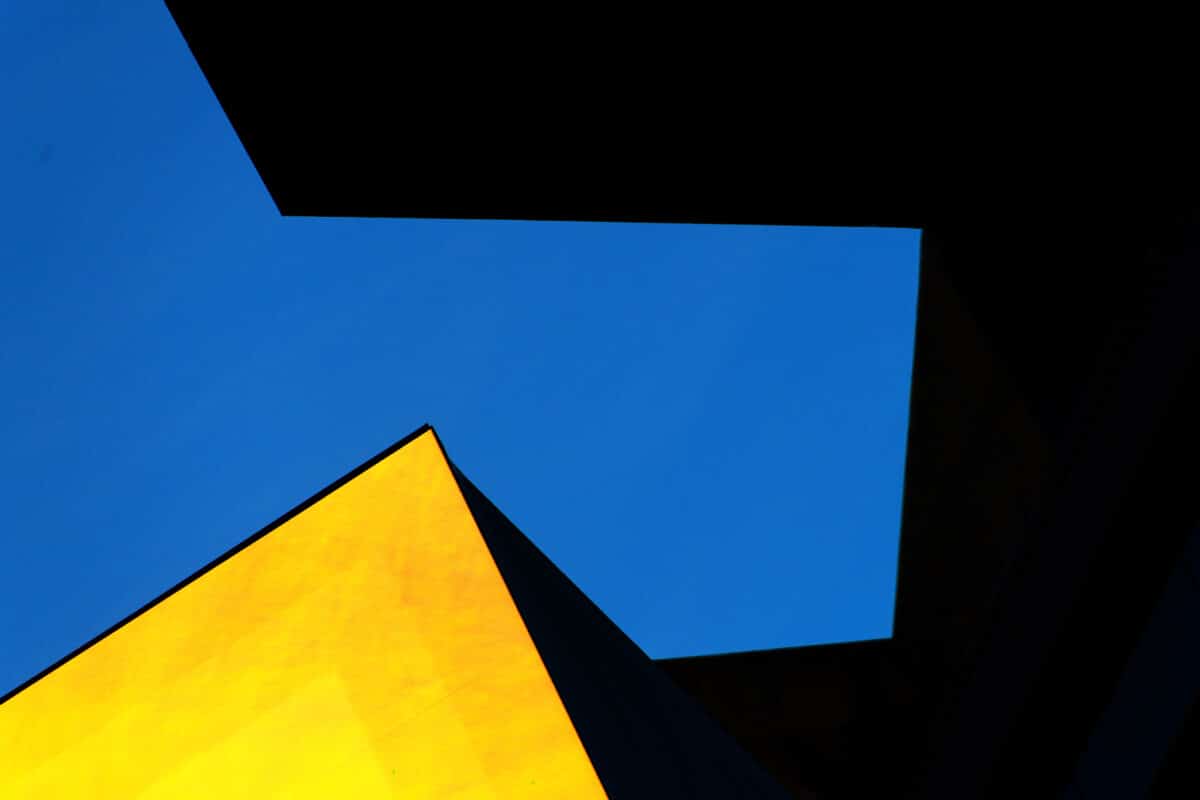
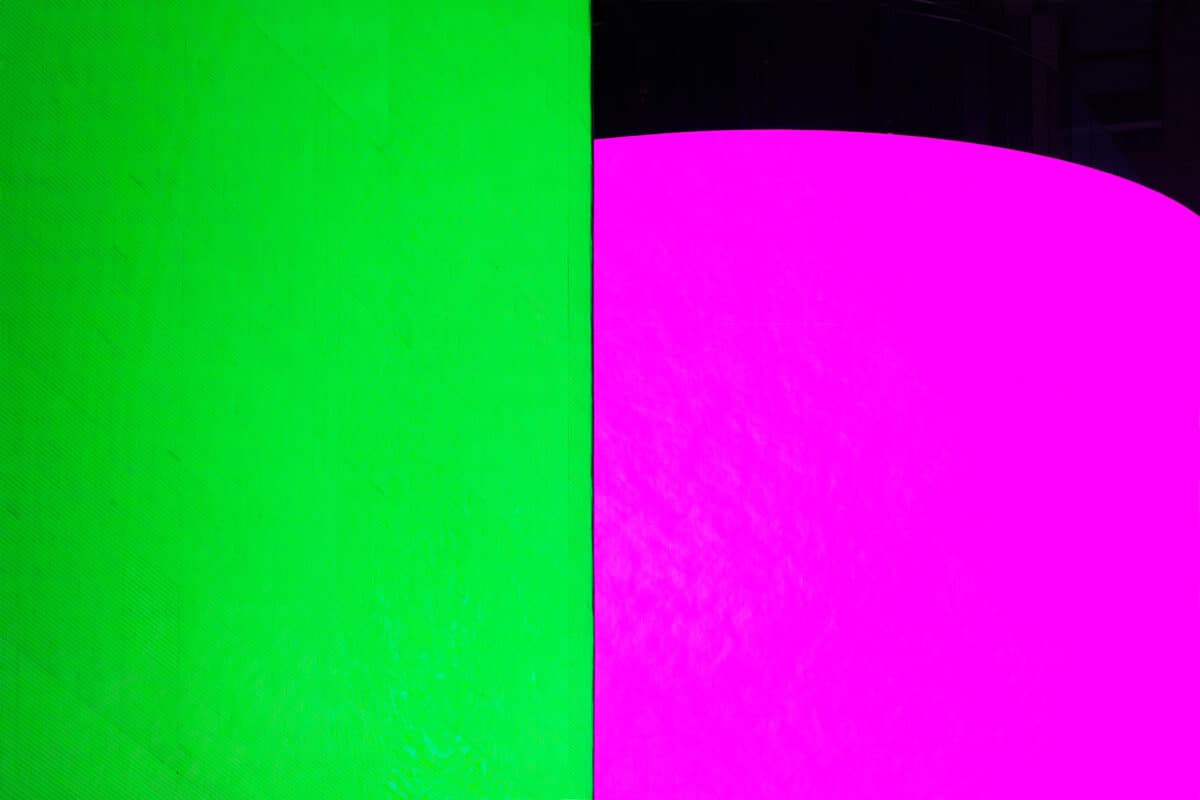
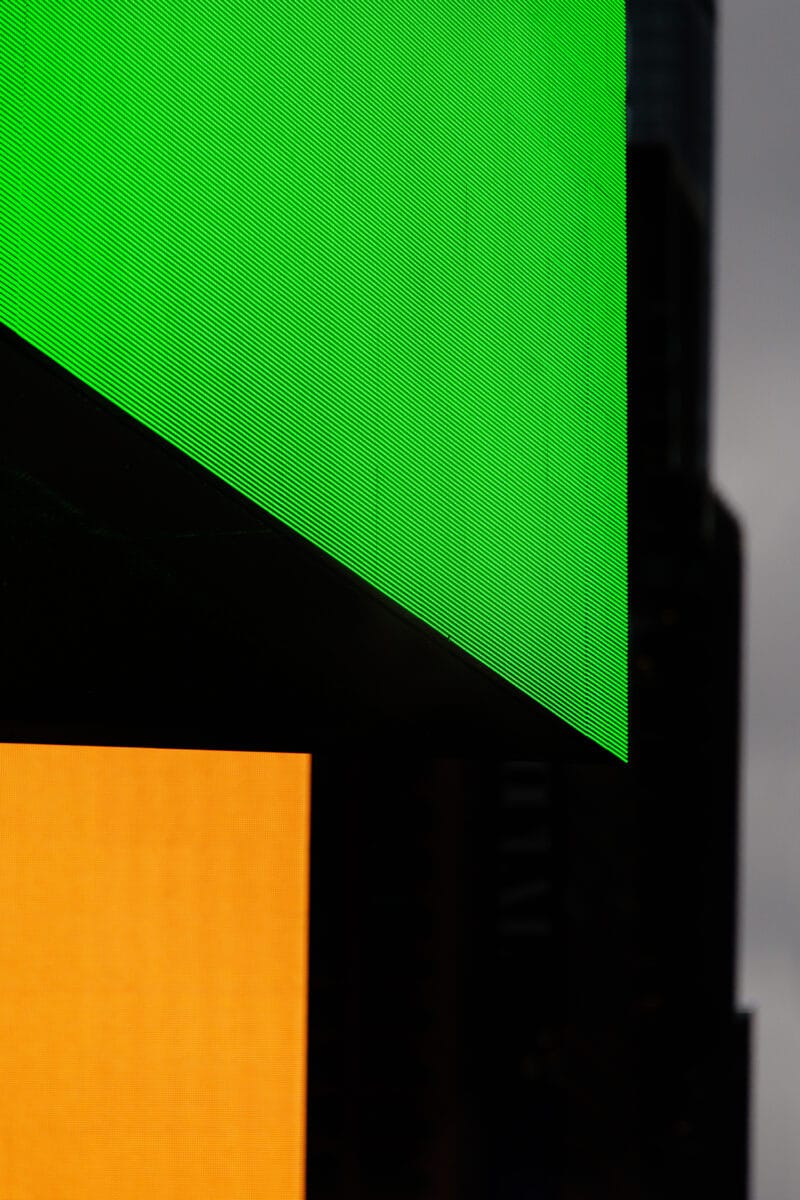
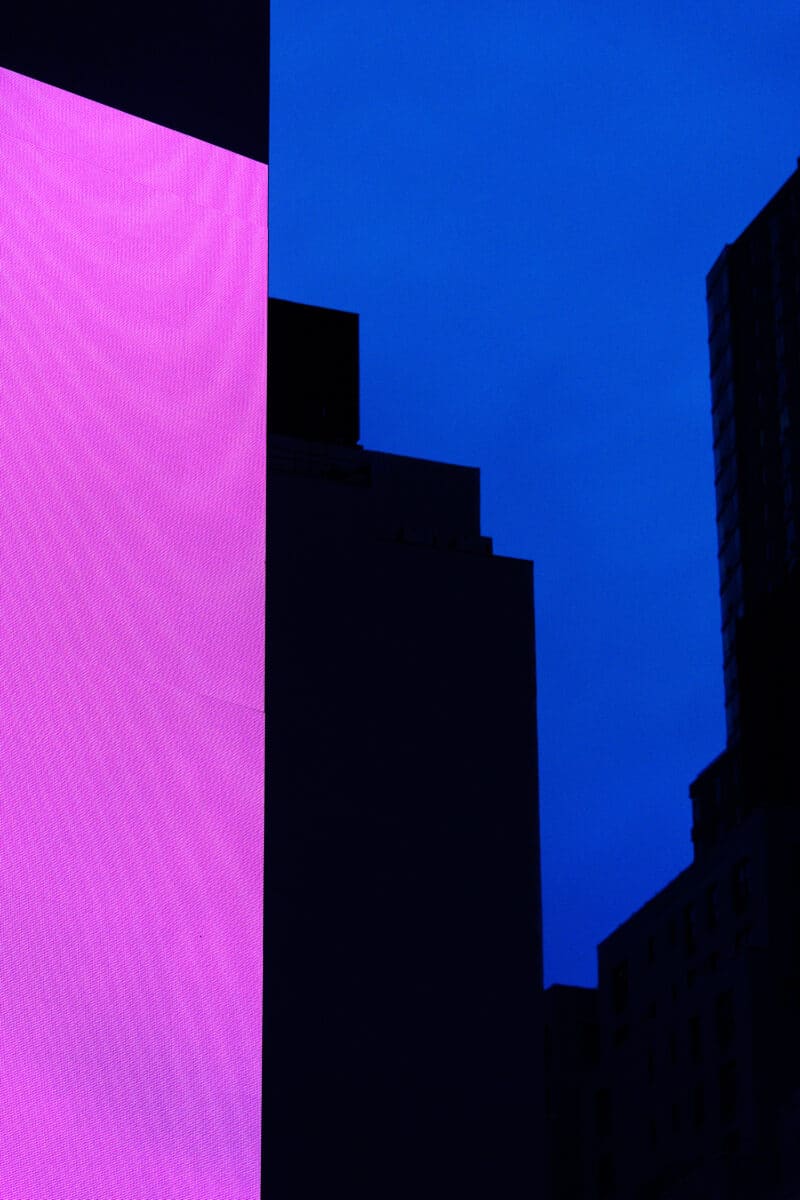
Bob Krasner has been shooting and creating minimalist graphics of the city for the past seven years. In the summer of 2022, he was in Times Square when he noticed that occasionally the major entertainment hub had moments of stillness and quiet.

“Sometimes full billboards, every once in a while, the billboards will just go blank like for a second or two and while they switch to the next ad, they have a blank screen and then all of a sudden it fills in with imagery,” said Krasner. “I started shooting them and I really liked it.  It’s such a different takeaway from Times Square than you’re used to seeing.”

Ever since, Krasner has returned to Times Square to shoot more of these images. Unlike many New Yorkers who may avoid the area because of the crowds and tourists, Krasner dives in head-first, relishing the opportunity to be there.

An example of Bob Krasner’s Times Square photography, as seen in “The Archive № 7”Photo by Bob Krasner

“You’re used to seeing thousands of people and billboards screaming at you from everywhere. People when they shoot Times Square, they tend to shoot the abundance of everything rather than just finding these kind of quiet abstract moments,” said Krasner. “I know most people who live in New York will go out of their way to walk around Times Square. I’ll go out of my way to walk right through it if I’m not taking pictures because the constant faces coming at you and they’re from everywhere, it’s like middle America and Europe — it’s just constant.”

After posting several of his photos of Times Square, Krasner got in touch with Akeem Duncan, who runs Quiet Lunch, a New York City-based publication that highlights and promotes the arts. Quiet Lunch had produced a book for a friend of Krasner’s in the past, and felt like the perfect medium.

The result was “The Archive № 7,” which as the title suggests, is the seventh installment of Quiet Lunch’s “The Archive” series. The book features a curated selection of Krasner’s Times Square photos.

An example of Bob Krasner’s Times Square photography, as seen in “The Archive № 7”Photo by Bob Krasner

The book will have a limited run with only 100 copies being printed (and also signed by Krasner).

“I think it’s a really nice little piece. [Duncan] took one look at the pictures and he was like, yes, absolutely, and he hadn’t even seen the Times Square stuff yet. He looked at my other stuff and I was like, yeah, I’ll do it,” said Krasner. “At that point, I realized that I had a really nice group of Times Square pictures and it would be perfect to do.”

Because the book is a limited run, there will only be a handful of people who are able to get their hands on one. For those who do, Krasner hopes that they are going to be able to take away something from it.

“A lot of times I’ll do pictures and I’ll put something up and somebody will say to me, ‘This really struck me emotionally.’ I think that they find things to relate to on a personal level that I would never have seen,” said Krasner. “I hope people enjoy that and I hope that you can find these moments of of serenity and order, even in a chaotic place like Times Square.”

To preorder “The Archive № 7,” visit quietlunch.com. You can follow Krasner on Instagram @bobkrasner.

An example of Bob Krasner’s Times Square photography, as seen in “The Archive № 7”Photo by Bob Krasner

Eastern Oregon University Colloquium, gallery exhibition to feature Michael Sell’s photography

Eastern Oregon University Colloquium, gallery exhibition to feature Michael Sell’s photography
image

LA GRANDE — Following a year-long sabbatical, Eastern Oregon University professor Michael Sell has returned to campus and will be exhibiting a new exhibit of his photography in February.

Sell will present for the next EOU Colloquium on Feb. 8 from 4-5 p.m. at the Nightingale Gallery at Eastern Oregon University.

This page requires Javascript.

Javascript is required for you to be able to read premium content. Please enable it in your browser settings.

#placement_575865_0_i{
display: block !important;
}
#placement_575865_0_i{width:100%;margin:0 auto;}