Golden state warriors logo hi-res stock photography and images – Alamy


By Bea SwallowBBC News, West of England

 Cíara Hillyer
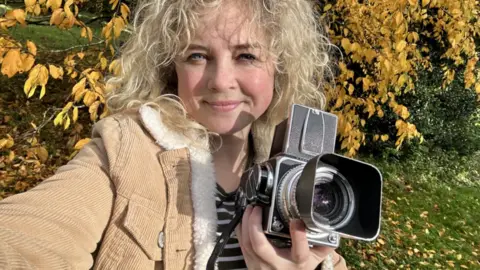
A Portrait of Britain winner has said photography has provided a “holistic outlet” to living with a rare genetic condition.
Cíara Hillyer, 31, from Bristol, was selected as one of 100 winners for the prestigious photography competition.
She was diagnosed with cystic fibrosis at just five days old and finds it “therapeutic” to document her journey.
Ms Hillyer said she felt “honoured” to be recognised alongside other talented photographers in the Vol. 6 photobook.
The Portrait of Britain Awards are an annual celebration of British identity, offering photographers the chance to showcase diversity and representation.
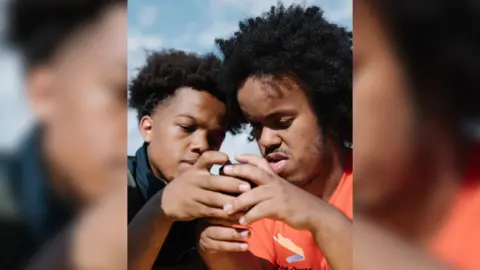
Ms Hillyer’s winning submission showed Wolverhampton boys Isaac and Nima intricately trying to fix a Bluetooth speaker following a football match.
“I had gone to support a friend of mine, who has dwarfism, playing football and he introduced me to his friends,” she said.
“As soon as I took it, I felt a wave of excitement because I knew it was a great image.”
 Cíara Hillyer
Ms Hillyer says the title of her submission, ‘Making it Work’, served as a double meaning to reflect what it is like to live with a genetic condition.
“It just became a bigger representation of their community, of them making it work for themselves day to day,” she said.
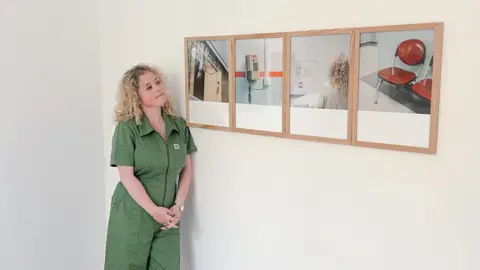
Ms Hillyer discovered her passion for creativity at an early age and said it provided a welcome distraction during her many visits to Bristol Children’s Hospital.
Her final project at university, titled ‘Breathing Space’, provided an insight into life with cystic fibrosis by documenting idle moments during hospital visits as she received treatment for the respiratory condition.
“It also reflects a lot of other people’s stories, people who know what it’s like to split your time between home and the hospital,” she said.
“[Photography] is definitely an outlet, a holistic approach to my health condition and my mindset.”
 Cíara Hillyer
Ms Hillyer said her recent win had provided the “boost” she needed to pursue a professional career in the subject, hoping to provide a platform for more “underrepresented stories”.
“I’ve photographed a lot in terms of disability and ill-health over the years, and I feel like I could tell someone’s story,” she said.
“Photography has done that for me for such a long time and it would be nice to do that for someone else.
“It’s photographing what I know, so it’s quite therapeutic in that sense.”

Follow BBC West on Facebook, X and Instagram. Send your story ideas to: bristol@bbc.co.uk


John Emslie and his wife, Liz, were on a city break to Rotterdam when he took this photo. “We were on the Erasmusbrug, nicknamed the Swan, which links the northern and southern halves of the city,” he says. “The long, white pylon and its distant glow, and the angled cable stays picked out by the projector lights, drew me in; I wanted to capture all of that light, form, scale and perspective. All I had to do was wait for the final element: the passing motorcyclist and his headlight.”
Emslie describes himself as an “enthusiastic amateur” and used his Google Pixel 7 to capture the scene. “I’m not sure my main camera could have produced such quality under such challenging shooting conditions. In low light, getting a manual camera set up is tricky and the moment is often lost by the time I’m ready,” he says. “The smartphone’s ‘brain’, on the other hand, is so fast and clever that shots like this are made possible. I can’t claim any credit other than for keeping my phone steady!”
Modesty aside, Emslie regards this as one of his most special shots, in which “everything fell into place … It seems sprinkled with some kind of magic fairy photo dust.”


An experimental philosopher from the University of Arizona has set up what he’s calling the Millennium Camera: a device designed to take a single image of the Tucson, Arizona landscape over the course of a thousand years.
Creator Jonathon Keats says he wants the Millennium Camera to provoke deeper thought about the past, present, and future of humanity – and what our society might look like by the time we get into the 31st century.
“Most people have a pretty bleak outlook on what lies ahead,” says Keats. “It’s easy to imagine that people in 1,000 years could see a version of Tucson that is far worse than what we see today, but the fact that we can imagine it is not a bad thing.”
“It’s actually a good thing, because if we can imagine that, then we can also imagine what else might happen, and therefore it might motivate us to take action to shape our future.”

The camera comprises a steel pole with a copper cylinder on top. As light enters the cylinder, it goes through a pin-sized hole in a thin sheet of 24-karat gold, then on to a surface treated with an oil paint pigment called rose madder.
Keats could only make an educated guess on the kind of material that would change gradually enough over the course of centuries to leave a recognizable image, but hopes the rose madder pigment’s fading in the repeated cycles of daylight does the trick.
Set near a hiking trail on Tumamoc Hill, overlooking Tucson, the camera is accompanied by a notice that encourages passers by to reflect on what the next millennium might hold.
When the picture is finally revealed, the most static parts of the landscape will look the clearest, while areas that have regularly changed will take on more ghostly forms.
What’s most likely is that the outline of the natural landscape will be strongly imprinted, while the number and design of the buildings in the shot will change over the centuries – though the camera project is neutral in terms of forward planning.
“By no means is the camera making a statement about development – about how we should build the city or not going forward,” says Keats. “It is set there to invite us to ask questions and to enter into conversation and invite the perspective of future generations in the sense that they’re in our minds.”
What life will look like in a thousand years is hard to imagine, though it’s an interesting thought experiment. If you go back a millennium, we were still in the Middle Ages, fighting our battles with swords and axes.
By the time another thousand years have passed, climate change, AI technology, and many other factors will no doubt have changed our world in ways that mean it’s very different from today.
Keats admits that there are “so many reasons” why the Millennium Camera might not work as intended: no one has built a camera like this before, and it could even be removed by future generations. However, the intention is to keep it in operation until 3023.
“If we open in the interim, then it diminishes the imagining that we need to be doing,” says Keats.


Most people rarely have a chance to get close to wildlife. But at the Art Museum of Eastern Idaho’s newest exhibit, attendees can get close enough to see each hair and whisker. The museum is hosting “A Life in the Wild,” a retrospective collection from renowned wildlife photographer Thomas Mangelsen.
This exhibit will be at the art museum, 300 S. Capital Ave. in Idaho Falls, from now through March 30.
Thomas Mangelsen is pictured here with a camera.
A photograph by Thomas Mangelsen of a cougar.


A tumultuous decade in Turkey is captured in a vivid and fast-paced series of photographs, in the highly anticipated first book of Magnum photographer, Emin Ozmen.
Olay, meaning event or incident, is a retrospective of Ozmen’s work to date, recounting the years of his homeland in a ceaseless state of turmoil, hit by dramatic events: a failed coup d’etat, popular uprisings, natural disasters, political purges, economic turbulence and ongoing military operations.
The photographer says: “We are constantly being tossed around between violence and quiet daily life. Turkey gives no respite. Never a week without a drama, never a month without a major event.
Police use water canon to disperse the crowd near Taksim Square in Istanbul. The civil unrest began in May 2013 after the violent eviction of a sit-in at Gezi park protesting an urban development plan
A car seen damaged on the broken highway road during the powerful earthquake on 8 February 2023
“Olay is a documentation of Turkey, on the brink of violence and grace. Here, nothing is simple, everything intertwines and clashes, the beautiful as well as the ugly, sadness as well as joy.”
The book includes an extensive timeline introduced by Piotr Zalewski, Turkey correspondent for The Economist, as well as personal texts written by Ozmen, and is co-edited with Cloe Kerhoas.
A member of the PKK linked Civilian Protection Unit uses a hole in a wall to cross a street controlled by Turkish special military forces in Nusaybin in 2015
Exhausted refugees who failed to cross the sea from the Turkish coast to the Greek island of Kos head back to Bodrum city centre by bus before trying to cross again later in July 2015
Emin Ozmen, born in 1985 in Turkey, is a Magnum photographer based in Istanbul.
He joined the prestigious photography collective in 2017 and became a full member in 2022.
The minaret of a sunken mosque emerges from the reservoir of the Birecik dam in Gaziantep. For several decades now, dozens of villages and towns have disappeared under water as a result of the numerous hydroelectric power plant projects of successive governments under the Southeast Anatolia Project
Syrian children play in Istasyon neighbourhood of Mardin in October 2020. Turkey is home to more than 3.6 million Syrian refugees, who constitute the vast majority of the over 4 million refugees and asylum seekers that make the country the world’s largest host of refugees
For more than fifteen years, he has undertaken a long project of photographic documentation of the social, climatic, and civil troubles around the world, and in his country in particular.
His work has been published by Time magazine, The New York Times, The Washington Post, Der Spiegel, Le Monde magazine M, Paris Match and Newsweek, among others.
People gathered as security forces collect bodies after deadly twin car bombings that killed 53 and injured 146 in Reyhanli, a Turkish town on the Syrian border, on 11 May 2013
Smoke and tear gas fill the sky as Turkish police and protesters clash near Taksim Square in Istanbul on the first day of the Gezi park protests in June 2013
“For me, there is something more important than good or bad photography. It’s about the quality of your character, it’s about your soul.
“I believe photography follows this and is already a reflection of who you are,” Ozmen said.

Ernest Cole’s life was defined by exile. In 1966, the photographer landed in New York from South Africa. He was still fresh-faced at 26, but he wasn’t in America by choice. Earlier that year, the authorities had arrested Cole for documenting Black life under the country’s hellish system of apartheid. By the time he’d landed in the home of the free, he was on his native country’s “banned list.”
In 1967, Cole’s House of Bondage was released, the first and only book of those early South African photographs published during his lifetime. Though it was widely acclaimed, and copies were sent to the chairman of the United Nations Special Committee on Apartheid, Cole refused to consider doing another book, which would have featured his American photographs. He said he still didn’t understand the country well enough.

The works of François Halard, a leading figure in contemporary photography, are now showcased in Hong Kong in the second chapter of Whispers of the Soul, hosted by Villepin gallery and curated by Arthur de Villepin and Oliver Kaeppelin. The exhibition is open to the public from January 19 to February 4.
The exhibition features photographs by Halard, taken in the various studios and homes of renowned artists and architects of the 20th century and presented alongside their works. The spaces featured in Halard’s work include Cy Twombly’s home in Gaeta, Giorgio Morandi’s studio in Bologna, and the Casa Malaparte, a legendary villa in the Mediterranean that is known to be one of the best examples of Italian modern and contemporary architecture. Through Halard’s lens, the spaces inhabited by these great artists are unveiled to the public. Presented together with the works of the artist who live and work in these spaces, his photographs reveal a new perspective to their art and process.
His works bring to question how our lives and narratives become embedded into the spaces we settle in. The inanimate objects we collect reflect our emotions and memories, carrying a soul of their own. The essence of these objects and spaces becomes Halard’s canvas, turning each photograph into its own story. As we take in Halard’s works and the spaces they portray, we can’t help but reflect on how our own lives, habits, and experiences become embodied in our homes.
Watch François Halard talk about what photography means to him and get a sneak peek into what’s in the exhibition.
Whispers of the Soul: François Halard is open to the public at Villepin gallery from January 19 to February 4. Don’t miss out on this unique chance to see the works and the places they were conceived in side-by-side with each other, creating its own unique experience of taking in art.
Location: Villepin, 53-55 Hollywood Road, Central
(Images: François Halard via Villepin)






