This Happened—January 9: Birth Of Photography


For the eighth episode of IN STUDIO, we headed to the Romolo area to meet documentary photographer Glauco Canalis. Impressed by his work and story, we decided to meet him and discover what led him to pursue this type of photographic research. Of Sicilian origin, Glauco Canalis was educated between Milan and England, studying first in Plymouth before moving to London. Here began his career as a photographer, primarily in the music world and occasionally in fashion and advertising. However, his personal projects are something else entirely. His approach is documentary. He’s interested in places and the people who inhabit them, delving deep into the nature of certain traditions, investigating Mediterranean architecture, and social contexts. Often, the places and communities he chooses are “on the margins,” and the resulting stories are raw and painful. «For this reason, as I immerse myself deeply in the projects, sometimes I need to find moments to step back because inevitably they weigh on me as well,» he explains. But let’s start the interview to understand how a nomad like him has finally found his place.

We are located in Romolo, a neighborhood south of Milan. Glauco Canalis’s home-studio is located in a basement with large windows that filter a gentle, diffuse light. The somewhat British underground soul is perceptible even though everything is carefully organized. The space is very large, an open space divided into zones, on one side the living area and on the other the working area. On the latter side we notice the presence of boxes and many binders on the shelves, a large desk with a computer and a small table on which Glauco is reorganizing all his cameras. We are curious about how he lives in this space and how he organizes his work. Let’s start with the questions.

I found my path when I started working as a music photographer. After seven years as a freelancer, I returned to Italy, mainly due to COVID and Brexit, and started working for the Controluce agency, which represents me now. In Italy, for the time being, I work less with music, focusing more on fashion and my personal projects.
There’s a significant overarching theme characterizing my research—the identity of the Mediterranean. Under this large umbrella, there are projects like the one I did in Sicily, which deals with the political landscape. After the American invasion, there was a separatist movement aiming to make Sicily the forty-ninth American State. Being Sicilian myself, I became intrigued and investigated this story, particularly by photographing at the sites of American military bases. In recent years, the themes I’m most engaged with revolve around adolescence. I’m interested in depicting youth situations in suburban neighborhoods, narrating unique stories, such as areas affected by poor governance.

Currently, I’m working on a project exploring the Neapolitan tradition linked to the cult of Saint Anthony the Abbot and the “Cippo.” This project, tentatively titled “The darker the night, the brighter the stars,” essentially documents the Neapolitan tradition of burning Christmas trees found—or rather, stolen—around town. All of this occurs on the day of Saint Anthony the Abbot, which falls on January 17. This tradition turns into a kind of gang warfare. For four years now, I’ve been working on this project, following a group of youths from a neighborhood in Naples. This project has earned me awards and exhibitions in Portugal, Puglia, and next year, I’ll present it in Paris.
Research is often impulsive. I rely a lot on intuition—I find myself in a place and start shooting, then the research begins. Often, it’s the place that finds me and inspires me. From there, I delve into the context and seek answers. As I study, I uncover the place’s history, and almost always, I discover an element that connects to me. There’s always something autobiographical and personal in the things that interest me—I sense them, and I dive right in.

When it comes to my personal projects, it’s actually never been the case. For instance, this project I’m currently working on – “The darker the night, the brighter the stars” – originated from my stay in Naples. It was 2018, and I was working on Liberato’s music video. I noticed children hiding Christmas trees, curious, I asked, and they told me this absurd story. The following year, I spent New Year’s Eve in Naples, and that story came back to me. I began asking more questions and doing research. That’s when I decided to narrate this story. Reading about a place before visiting it happens very rarely; usually, if I do it, it’s because it’s already tied to something I’m working on.
When I lived in London, I had a fairly large room where I used to shoot, but it was never as big as the space I have now. In general, my studio always coincides with my home, mainly because, as a photographer, I don’t need a proper studio like an artist might. Once I have a space for my computer and a backdrop for shooting, I have everything I need. This is my first space this large and solely dedicated to work. I immediately felt at home here.

I feel comfortable in this house. If I had to stay in Milan, I wouldn’t want to be in a different house. I really like the light here; maybe the only thing missing is a garden. I’m the opposite of someone rooted; this is my attempt to have a fixed point because I have a very nomadic approach to life.
I’ve been here for a year, and I’m thrilled to have found this space. I enjoy cooking a lot, so when I’m in the mood, I often have dinners and lunches. With this large table, it’s natural to invite many people. The most alienating aspect of this space is that it’s a basement, so I can’t see what’s happening outside. Also, my modus operandi often involves being at the computer for weeks for post-production or writing, so the possibility of feeling isolated is there. However, fortunately, my work varies enough. I’m either here at the computer or away for weeks. There’s a sort of polarity. But I like knowing I have this place as a base; it makes me feel calm to know I have a place with my things where I’ll return.

This place reflects a lot of who I am. Certainly, its spaciousness gives me room to think. The ability to have a space I can shape keeps my mind active.
It’s sad to say, but it’s the computer. It’s the tool I use the most here in the studio for post-production, research, and communication. One thing I always feel the need to have physically with me are my photography books and negatives. I need to know they’re with me. I get a bit anxious when I don’t have them, and I have a great fear that something might happen to them. My dream is to have a wall for archiving and cataloging everything; otherwise, when I can afford it, I’ll put them in a vault.


Ph Credits Andrés Juan Suarez


Take a glimpse at the winning images chosen from hundreds of entries by professional photographers for the Architecture category at the International Photography Awards (IPA) 2023. The sub-categories include historic architectural marvels as well as modern structures like bridges.

Ruined luxury. I shot this series in Georgia, in the city of Tskhaltubo, where the abandoned sanatoriums of the Stalin era are located. Once luxurious boarding houses look very sad.
When the light passes through the stained glass of the window and shines on the carpet patterns and tiled lilies, It creates such a beautiful charter that we see it together. One winter day, in this commotion of color and light, I invited the sun inside to sit In the corner next to the column with the warmth of its existence And watch Her own masterpiece in between Nasir Al-Molk Mosque is a masterpiece of Iranian architecture
I was fortunate to travel to Egypt 4 times and photograph many historic locations from the ancient times to the medieval era. These are my favorite architecture photos from Egypt capturing its history. The images are the following:Luxor Temple at night, Luxor Temple columns at night, the mortuary temple of Hatshepsut, an aerial shot of the pyramid of Khafre, a section of the court yard of the Citadel of Saladin, and the interior of main cupola of Citadel of Saladin.
The Tsing Ma Bridge, an iconic piece of engineering spanning the channel between two islands of Hong Kong, is shrouded in dense seafog. The bridge’s base is barely visible in the thick haze, but the top section of the bridge rises high above the fog, creating a floating illusion. It serves as a vital link for commuters, a symbol of human ingenuity and progress. This photograph captures an ethereal and serene moment, with the bridge emerging above the fog, a majestic sight that inspires all who see it.
Baimahu Bridge starts from Qihu Village, Chahe, Hongze District in the south and connects Chuzhou in the north, with a total length of 1033 meters, a main bridge length of 246 meters and a total width of 26 meters; The structure of the bridge adopts the spatial special-shaped beam-arch composite system, the main beam is a steel box girder, and the large arch tower is a spatial special-shaped cable structure

Urban environments can be a frenetic mass of contrasts – vibrant or mundane, lively or eerie, beautiful or drab. For a photographer, it’s easy enough to capture how places like this look, but it’s more of a challenge to convey how they feel.
To create a sense of a place without the distractions of detail, we can turn to abstract techniques that emphasize the emotion of the place, and create wall-worthy art that feels more in touch with the work of Impressionist painters than it does with conventional photographic techniques.
Normally camera skills are about eliminating shake, keeping scenes in focus and preventing wonky horizons – but here, we’re throwing all of that out of the window. Instead, we’ll celebrate blur and softness. When you think about it, streets and buildings are rather simple geometric shapes and lines, dotted with people and lights, making them ripe for an abstract treatment. We can reduce the elements down to blurry strokes of color, impressions of people and flowing shapes, while still retaining the spirit of the scene.
You don’t need any special equipment or lenses for this – in fact, even the cheapest lens will produce results just as good as premium optics. What’s more, you can try this in all conditions – sunny, overcast, rainy, even at night.

Intentional camera movement
There’s beauty in every urban area if you look for it. Search out bold colors and the vertical lines of shop windows or lamp posts, then try an up-down camera movement over a 1/15 sec exposure to create streaks of blur. A side-to-side movement, or even a camera swivel, can also lead to some interesting results.

Zoom bursts
A zoom burst is similar to intentional camera movement, but with a twist. Over the course of a long exposure (try 1/10 sec to begin with), use a zoom lens and quickly zoom in or out during the exposure. The edges of the frame will be transformed into streaks of blur.

Camera motion
Intentional camera movement can transform scenes into streaks of blur while still retaining an impression of the place. Move the camera up, down, left, right or swivel it during the exposure. There’s a real skill in doing this – for a smoother motion, it helps to press the camera against your forehead or use a tripod.
Slow shutter speed
We need to slow our shutter speed down so that the camera movements register in the exposure. Try setting your camera to shutter priority at 1/15 sec and ISO 100, then see what kind of blur you get. For a stronger blur effect, either experiment with a longer shutter speed or make quicker camera motions.
Bold colors
One of the main reasons why this scene works for the intentional camera movement technique is because of the colorful rainbow umbrellas hanging over the street and illuminated from behind by sunlight. When blurred by dragging the camera downwards, these offer beautifully bold highlights that filter into the street below.
Focal length
Your choice of lens focal length has an impact on the camera motion. The longer the lens, the more exaggerated the camera motion will be, so with wider lenses, you might need a longer shutter speed or faster camera movement. With a wide angle, the blur is more exaggerated in the center than at the edges.
Try a filter
Depending on the brightness of the scene, you might need to use a filter to reach shutter speeds slow enough to blur the movement of the camera. In bright sunlight, you can usually get as slow as about 1/10 sec with ISO 100, and an f/22 aperture, but if you need to go slower, use an ND filter or polariser.
Compose the shot
Even though we’re intentionally blurring the scene, it helps to choose a street with recognisable shapes and simple geometry, so that the viewer’s eye can still make sense of the abstract shapes. We composed centrally so that the two sides converge in the center and the shoppers recede into the distance.
Read more:

With all the flak Deep Ellum gets about gentrification, violence and the revolving door of new businesses constantly opening and closing, it’s hard to argue that the historic neighborhood doesn’t always provide fertile ground for Dallas art.
For instance, Kettle Art Gallery, known as an epicenter for Deep Ellum creatives, has been successfully trucking along now for almost 20 years, helping just about every artist in the 75226 ZIP Code get their work from the sketchbook into local collectors’ hands. Just down the road, Deep Ellum Art Company, at 3200 Commerce St., also hosts DIY art shows in conjunction with its busy live music schedule.
On Jan. 9, a photography exhibition titled Music in Frames: A Thousand Words of Sound will open at the venue, Curated by photographer and Dallas Famous Podcast host Andrew Sherman, the exhibition presents an ensemble of canonized North Texas music photographers including Mike Brooks, Vera ‘Velma” Hernandez, our own staff writer Carly May Gravley, Madison Raney and Sherman. The show displays more than 40 framed photographs sharing the common theme of live music. Viewers can view and purchase framed pictures of music greats such as Mick Jagger and Lil Wayne, and locals such as The Old 97’s.
The show is the brainchild of Sherman, who had curated another art show for the venue several years ago. This time around, he wanted to focus exclusively on shots created by the live photography community around him. After having his work published online by Rolling Stone and Alternative Press within the past year, subsequently shooting Morgan Wade at Longhorn Ballroom and Jane’s Addiction at American Airlines, Sherman was approached again by Deep Ellum Art Company co-owner Kari La Rue about creating a new photography exhibition.
“This is my second show to curate, but my first-ever concert photography show,” Sherman says. “It was important to me to feature people who have never shown photos in a gallery before because for a lot of concert photographers, it never occurs to them to sell their work like this.”
For Sherman, doing creative work with Deep Ellum Art Company has been a major part of his success in Dallas. He started shooting live bands and showing his work there when the venue opened. It was during a hospital stay for an appendectomy that he sold his first piece at the venue, receiving the good news while laid up in a hospital.
“I feel like Art Co. gave me my first big break and I really cut my teeth there,” Sherman says. “In 2018 I was in the hospital with appendicitis, and I got a call that they had sold a piece of mine. It meant the world to me. I was in the hospital depressed, but I was in a good mood after that.”
Sherman moved to Dallas after spending a significant amount of time in Los Angeles as a professional musician with comedian Andy Dick’s band. As a former guitarist who played Woodstock ’99, Sherman knows both sides of the lens when it comes to concert photography. The musician had always wondered what it would be like to be a concert photographer. He couldn’t be happier about leaving his music in LA and pursing concert photography as an art.
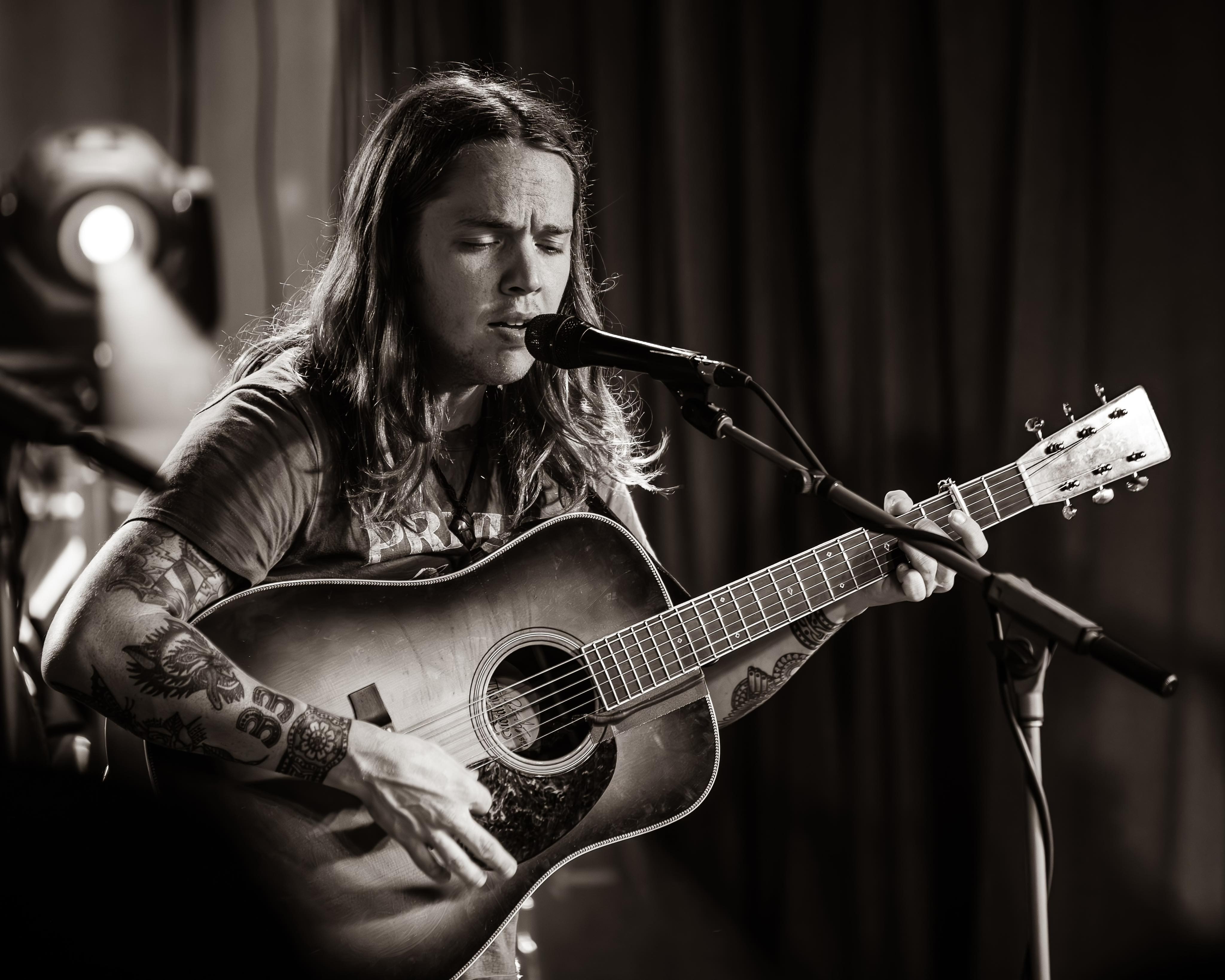
Billy Strings plays Deep Ellum Art Company in 2019.
Andrew Sherman
“I remember I’d go to concerts and see photographers working and just never thought I’d get to do that,” Sherman says. “It’s a challenge to sell anything artistic and especially concert photos. To buy one, you must first love the band and then like the photo, because you’re going to look at it all the time. I do have one of the coolest jobs in the world, though.”
Sherman’s other project, which he started in December 2022, came with the launch, production and publication of Dallas Famous. The podcast presents guests who embody the often cheeky phrase “Dallas famous,” recognizing this as a term of endearment and taking it in stride. Notable guests have included Tim DeLaughter of Tripping Daisy and Polyphonic Spree, Jaret Reddick of Bowling for Soup and actress Tina Parker of Breaking Bad. Last year, Sherman produced more than 30 episodes for the first season. Between snapping artists on stage and interviewing them for his show, Sherman tries to get the full picture of Dallas music. Giving back to this scene is part of his ethos as he credits his fellow photographers and musicians for inspiring him. Sherman is showing 16 photos in the exhibition and is donating some of the proceeds to the local nonprofit Foundation 45.
“I have two sets of Texas bands I’m showing. If they sell, all the proceeds for those sets will go directly to Foundation 45,” Sherman says. “Right now, the quality of photographers shooting live concerts in DFW is unrivaled. This show is a way to showcase in living, breathing print some fantastic art that is happening.”
As Sherman makes his way down to Deep Ellum Art Company on a rainy night in Dallas to put the final touches on hanging and curating the show, he ponders the future of the neighborhood that’s given him so much. For him, the music scene and people who have made Deep Ellum famous over the past 150 years mean something truly special, a rare story of independent art, change and survival.
“As long as there is a scene, there will be concert photography,” Sherman says. “The scene must survive for it to happen, though. I don’t know where we are at now, but the pure artisan vibe may be losing the battle. However, there’s a lot of artists that want to exist in a non-homogenized way and ultimately will survive.”
Music in Frames runs through March 9. Patrons can view and purchase works online through the Deep Ellum Art Company website. After the exhibition closes, Sherman plans to return to concert photography and his podcast while waiting for his next call.
“Where do you go from here? I guess I’m waiting for Rolling Stone to call,” Sherman says with a laugh. “My favorite quote [to say] about my work is, ‘You will always sound great in my photos.’”
Music in Frames: A Thousand Words of Sound will have an opening reception from 7 to 9 p.m. on Tuesday, Jan. 9, at Deep Ellum Art. Company, 3200 Commerce St.

Oppo has just released the first-ever dual periscope cameraphone, setting a new bar in mobile photography.
The latest flagship camera from Oppo, the Oppo Find X7 Ultra, was released in China yesterday (January 8), and it looks set to become one of the best camera phones for photography. The new Android phone has a total of four 50MP rear cameras, each with a different optical zoom, meaning that the quad-cam setup offers a consistent zoom between 14mm and 270mm, ‘without degradation in image quality’.

The Find X7 Ultra incorporates a dual-periscope camera, making it the first smartphone ever to do so. It retains the 65mm 3x perioscope from the Oppo Find X6 Pro providing a bright aperture of f/2.6. The second periscope camera comes in the form of a 135mm 6x telephoto camera, with an in-built OIS and a minimum focusing distance of just 35cm.
The other two cameras consist of one wide camera with a second-generation 1-inch Sony stacked sensor, an aperture of f/1.8 and OIS, and an ultra-wide 14mm f/2 equivalent with an impressive minimum focusing distance of just 4cm!


Another reason to be excited about this camera is that Oppo has continued its partnership with Hasselblad and the portrait sample images provided, may just be the best photographs I have seen taken on a phone. Granted, great lighting conditions, photographer, and subject are a huge part, but how the camera seems to render the depth of field looks more medium format camera-like than a camera phone.
The 65mm and 135mm focal lengths are perfect for portraiture, enabling enhanced subject compression and depth of field fall-off. Portraits are also now said to be easier to capture in low light, with improved ISO, large sensors, and wide apertures.

Smart capture also lets you focus on humans and animals, recognizing both with ease. The cameras render the bokeh and out-of-focus areas naturally, without the odd blur that is often produced in portrait modes on other phones.
In addition to the natural-looking background blur, another reason why I think the sample images sing is the color tones. I have always had an appreciation for Hasselblad’s color science, and it appears to have been replicated in the Oppo cameras. Skin tones appear natural and the depth in color tone is exceptional.

The Oppo Find X7 Ultra enables more refinement in its Master Mode developed by Hasselblad. This is a pro capture mode where you can refine settings, much like on a mirrorless camera, and control RAW shooting with RAW MAX.
The Oppo Find X7 Ultra is out now in China, and unfortunately, there is no news or scheduled release for the US and Europe. Hopefully, this may change moving forward, or perhaps Oppo is working on another camera for these regions that incorporate the same camera tech, as I will be first in line to test it out.
You can find out more about the Oppo Find X7 Ultra on the .
You may also be interested in our guides to the best phone for vlogging and the best stylus phone.


{{format_dollars}}
{{start_price}}
{{format_cents}}
{{promotional_format_dollars}}
{{promotional_price}}
{{promotional_format_cents}}
{{term}}
(renews at {{format_dollars}}{{start_price}}{{format_cents}}/month + tax)

It’s a bit weird, isn’t it? For most people, lockdown was the biggest event in our lives and probably the one that had the most dramatic impact on us. And yet, the number of art and design projects directly discussing this incredible global upheaval has been relatively few.
Perhaps it’s because, once things started returning to normal, most of us just didn’t want to think about lockdown any more. However, time is a great healer, and as the 2020s continue, we can probably expect more reflection on those momentous events and greater confidence in discussing the highs and lows of the period openly and honestly.
And here’s a great example to follow. Rear Windows is a series of illustrated short stories by Cecilie Maurud Barstad, observing life during lockdown.
It’s a fabulous book, and in the foreword, Lene Renneflott explains exactly why: “As a writer, Cecilie captures the urban isolation’s slow passage of time and underlying quarantine stress. Short bursts of text filled with longing, twists, and endless waiting pinpoint each illustration to the coronavirus crisis. The illustrator’s gaze allows us to study her neighbours from afar, while the writer’s pen invites us into their innermost thoughts, dreams or worries – into the recognizable – into the profoundly human.”
We couldn’t agree more and were keen to chat with Cecilie to learn more about the book. But first, in case you didn’t know, who is Cecilie, exactly?
Born in Norway and now living in London, Cecilie is a creative director and illustrator working alongside her partner Gilles at Gilles & Cecilie Studio. They provide unique illustration, animation and murals to clients and creatives worldwide from their headquarters in London. But in 2020, she embarked on something different.


From the balcony of her home, a development of 650 sustainably-designed flats converted from the old Arsenal Stadium, she spent weeks and months observing, studying, and drawing her neighbours.
In her colourful images and pithy narratives, the reader enters her back courtyard in Highbury with all its smells, conversations, noise, silence, morning light, and night-time shadows. The stories are warm, wise and full of lovable characters. We share three short stories from it to give you a flavour.
The first, A New Start (p63), reads: “They were supposed to be getting divorced. They’d discussed and planned it in February. Everything was decided. It was a relief. Overnight, everything was shut down. Even the law firm was closed. Everyone had to stay home. No one could go out. It was the start of something new. Every day, they sat together on the balcony in the fine weather. They drank tea. They read the books that had been on their shelves. They tidied wardrobes and kitchen cupboards. They dusted off the video player to watch old films. They talked together for hours. They did everything they hadn’t done before. They started again.”
Next is Threesome (p66), which says: “Straight away, they moved in with him. None of them wanted to spend lockdown alone. They all agreed on one suitcase each. He only had one bedroom, but they could live with that. The thought of not being together was much worse. They’ve been a trio for almost three months. They make food together, they exercise together, they laugh at the same jokes, they share a bathroom and a bed, they get up at the same time, and rely on each other when they need each other most.”
And finally, Clouds (p68) reads: “It was a windy day. He’d almost succeeded in getting her to lie down on the grass to watch the clouds scudding past. He loved watching clouds. He could make out rabbits, faces, and a horse’s head. She was simply unable to let her mind wander off like that. How could he just lie there and relax? How could he? They had so much to do. They’d never get through everything on their lists. Some lists were written on both sides of the paper. She added to them every day. Some items had been on a list for years. Was it this that kept them together? All the unfinished business on their lists? What would happen when everything was done? She left him lying there. She had to go in and change out of these tight leggings.”
As you can tell from these stories, while the pandemic was a serious, often tragic event, there was also a lot of sunshine amidst the gloom. “The most fun we had was being in the communal private garden with our children,” recalls Cecilie. “We parents would sit at a two-metre distance and get to know each other by shouting, while the toddlers and young kids ran, cycled and scooted around.

Photography by Charlotte Wiig

Photography by Charlotte Wiig

Cecilie Maurud Barstad. Photography by Charlotte Wiig

Photography by Charlotte Wiig
“After a while, we got to know each other better but would still talk at a distance, even with private conversations. It just wasn’t possible to sit in quiet conversation. That, and also talking across balconies, sharing loss and trivialities into the echo of the backyards.”
As with us all, the phrase ‘mixed emotions’ doesn’t really cover it. “When the first lockdown happened, I had a hotpot of feelings that I tried to sort into ingredients,” Cecilie remembers. “Slight panic, sadness and a feeling of not understanding. I work with my partner Gilles in our studio, and we had meetings cancelled, travels and some work put on hold. Suddenly, we were in an unknown void.
“Naturally, I spent much time looking out the window as I often do when looking for answers. I figured that if I drew here a little bit every day, at least I’d be making something that potentially could be a collection in the end.”
As for finding things to draw, that wasn’t a huge problem. “I am inspired by the things closest to us: home, thoughts, emotions, relationships, daydreaming and imagination,” she says. “And the weather was incredibly nice, so suddenly I could see my neighbours on their balconies.”
Cecilie explains that she’s always been interested in relationships, conversations and everyday problems between people, particularly within households. “What do they talk about? What are their secrets? What motivates them? How can they watch TV every day? How can they live like this or that?
“My genuine interest in what is close to us is an endless source of inspiration. Everyday things like routines, perfection of routines or getting rid of bad habits. Each short story in this book has a source in how I felt, what I saw and conversations with friends and family”.


All are beautifully illustrated in Cecilie’s signature style, which she describes as “colourful compositions of architecture, urban nature, patterns, lights and shadows with human relations within. I strive to create a playful perspective; it’s figurative, but I leave out many details to not make it look too worked or perfect. I like to create compositions that have a certain dreamy view. Like frames in an animation, my images are a snapshot of that moment and the next moment, everything is changing.”
Since that fateful Covid outbreak in 2020, everything has changed, not in a good way. At least this hasn’t taken Cecilie too much by surprise. “I had a hunch that it would last long,” she recalls. “I remember Gilles and I discussed it would take years, so we tried to make a plan on how we would survive this for the next three years or more.”
That doesn’t mean, of course, that she welcomes the current global turmoil. “The fact that social, political and economic crisis followed suit after the pandemic has created a sort of hopelessness,” she reflects. “Some say that it’s in a crisis one can create and come up with fantastic new things. Maybe you can get out of smaller and shorter crises, but it is hard to constantly push for innovation, imagination, and creativity when the world is bleak, even for a born pragmatic optimist like myself.”


For Cecilie, these last years have been spent caring for herself and focusing on what’s most important to her. “Like making projects I care about, such as the book. I read, exercise, cook, sleep, spend time with friends and family, draw every day, write new books, and, in essence, pursue meaningful creative projects.
“I needed to create some positive experiences and personal investments to keep my mind on something other than current affairs. As a creative practitioner, I have a responsibility to paint the time we live in. This book of short stories and illustrations is my contribution to 2020, the year everything was suspended.”

Step onto the Golden Gate Bridge on any given day, and you might just become the focus of Jake Ricker’s six-year-long obsession.
“On November 2017, I came out here one day just by myself just photographing and I never really left,” he said.
A street photographer, he’s on the bridge every day, capturing life along this iconic landmark.
“Some days it’s like a really, really sad day and some days it’s a really exciting and positive experience. I think that’s what makes it so amazing,” he said.
In the last four years, he’s missed only 20 days, snapping an estimated 100,000 photos.
“There are days where I’m warm in bed and most people have a day off and I do not want to be here, but I show up because that’s what you have to do to do something that you think is great,” he explained.
He takes photographs up to 10 hours a day. But unlike most people, his eyes are not on the bridge itself but what happens on it.
“You have one second to get it right,” he said. “You can never duplicate that situation again, and when you get something out of that, I think it’s way more magical than anything than could be captured in a studio.”
The bulk of his work is done on film, using a compact Leica camera. Over the years, he’s witnessed everything from car crashes, to protests to weddings, and something else this span has sadly become famous for.
“There’s been days when I literally stopped or played a role in stopping three or four people from jumping in one day,” he said.
After repeated delays, the long-awaited suicide prevention barrier has finally been completed. In the last few years, Ricker estimates he’s helped around 90 people, either talking them off the ledge or keeping them distracted long enough for a patrol officer to arrive.
Financially speaking, however, he’s barely surviving, relying on savings and credit cards to fund his project. But so far, he hasn’t been able to monetize it. In fact, he can’t even afford to develop most of his photographs.
Kipton Cronkite is an LA-based art consultant and curator. We asked him to look at some of Ricker’s photos.
“What he’s been able to do is not only capture the activity that’s on the bridge but what happens in our daily lives, and I think it will touch the emotions of anyone who sees it,” he said.
Ricker has no idea whether his project will ever see the light of day. But he’ll cross that bridge when he comes to it.
“If all my financial problems were solved this is still what I would be doing,” he said. “Once I realized that, I just put everything else to the side and did it all day, every day.”






