Photography

How Colorado Photographer “Ski the Day” Captures the Most Epic Ski Weddings

How Colorado Photographer “Ski the Day” Captures the Most Epic Ski Weddings

If you’re on the slopes with your significant other this season, and you spot someone dressed like a traffic cone, your life might be about to change.

“I basically just hide in plain sight,” Gabrielle Stowe says. “I’m in all orange. And then I’m just taking photos of random people passing by, and they’ll just assume that I’m doing some kind of marketing thing [for the mountain].”

But Stowe doesn’t work for the resorts, and she’s not interested in the snowboarding bros buttering their boards in front of her lens in the hopes of being the next poster child for A-Basin. She’s waiting for her client to drop to one knee.

The 30-year-old Summit County photographer has found her niche in the Colorado powder, where she captures engagements, elopements, and weddings—slopeside. Better known as Ski the Day on Instagram, Stowe’s often hilarious (and always sentimental) shots have earned her an impressive following since she launched her business in 2019. We sat down with the creative to find out how she went from working at an architectural firm to booking ski weddings all over the globe (she accepted a gig in the Italian Dolomites in January).

Editor’s note: The following conversation has been edited for length and clarity.

Ski the Day photographer Gabrielle Stowe. Photo courtesy of Gabrielle Stowe

5280: Tell me about your upbringing. Were skiing and photography always parts of your life?
Gabrielle Stowe: I grew up in the Northeast, and I grew up ski racing. So I raced for about 10 years, and that was my life. I also had always loved photography. I never really saw it as a career, though. I never thought it was practical. So I actually went to school for architecture because I was just obsessed with buildings and I always wanted to design homes. I moved to Colorado about eight years ago to work at an architecture firm and realized it wasn’t really for me and started exploring photography more as a profession.

How did you end up merging skiing and photography?
About five years ago, I went full time with wedding photography [because I fell in love with shooting them], and not too long after that, in 2019, I was asked to shoot a wedding [on the slopes] because somebody was looking for a wedding photographer who knew how to ski. That was in Jackson Hole [Wyoming], and it was the most fun day. It was so cool. And after talking to that couple about their experience with planning their wedding day and how it was difficult to find a photographer, I was inspired because there are so many other people that have to have this same dream. They want to have their day documented, but it’s like finding a needle in a haystack. It’s the most unexpected career that I never thought I would have—but I absolutely love it.

What goes into planning a ski wedding?
Some people have a traditional wedding, and they just do one ski run for photos. Some people have a ceremony off-site, and then they spend an afternoon skiing. I’ve [been hired for] elopements—it’s just the two of them or maybe just a few friends—and they’re on the mountain the whole day.

Ceremonies on the mountain tend to have a small guest list because obviously you can’t roll up with 100 people; that’s not cool. So there’s a quick ceremony on the mountain. Colorado is awesome because you can self-solemnize, so you don’t need an officiant. I mean, sometimes I’m the only witness, and they just marry themselves.

What does it feel like to be a part of such an intimate, unique ceremony?
It feels very special. It feels like such an honor that I get to be there for the start of their marriage. And I have the honor of capturing it—but also being trusted enough to witness that. It’s very special. I take it very seriously.

Are you skiing and shooting at the same time?
Yes, safety is my priority though, so I’m never like on a black diamond actively shooting as I’m skiing down. Typically, I’’ll ski down a little bit, and I’ll have them ski toward me, and we leapfrog. Depending on how fast they are or what run we’re on, I just catch up with them, ski on the side, and shoot them as they’re going down.

What’s your ski set-up?
I don’t ski with poles since I need to easily grab my cameras. As for my skis, I just have an all-mountain ski: Nordica Santa Ana 93. Admittedly, I am not much of a gearhead. The only gear I get really into is camera gear. When I bought these skis, I told the person at the shop what I do, and he showed me them. He also suggested bindings that were easy to get in and out of since I do that more than a regular person skiing.

What kind of camera gear do you carry on the slopes?
I ski with two mirorrless Nikon cameras that are attached to a harness so I don’t have to worry about dropping them. I like prime lenses for this kind of thing because zooming in and out is one less decision I have to make while skiing (and typically I just zoom in by skiing closer).

I carry a 28-liter trail pack, and it varies in weight depending on the location and type of shoot. Typically I carry a CamelBak bladder, snacks, extra batteries, memory cards, and walkie-talkies, which isn’t too heavy. For weddings I carry more, like an “emergency wedding kit,” a flash if we are going inside, and a longer lens depending on the type of ceremony. The biggest reason why I have to ski with a pack is because most times I’m carrying things for the couple in my bag, like their phones, extra layers, touch-up kit, with their helmets clipped to my bag. A few times I’ve worn their backpack over my backpack, which I’ve gotten some weird looks for.

Have you had any shoots go…awry?
Oh, I did have one that was kind of funny. Weddings, they always run late, which is totally fine. But I did have one where we did it in the afternoon, and things ran a little late, and they were closing the backside of the mountain. The couple put their snowboards in the snow to have some framing, and one of the snowboards fell and slid all the way down the mountain. And that side of the mountain had closed, so there was no lift spinning. They couldn’t ski down to get it, so the bride’s daughter had to walk all the way down and bring it back up. It was way deep in the woods and the poor girl was in a dress and she had to dig through the powder to get the board. Finally, when we spotted her coming up the mountain, everyone just started screaming and cheering.

Your action shots are incredible, but you also capture endearing behind-the-scenes photos. Do you plan those out?
Obviously, there’s a planned time of like, OK, we’re getting ready from this time to that time. But I think something that is important to being a wedding photographer in general is just anticipating moments. Yes, you’re going to be putting on the dress, but anticipating like, OK, he’s looking at her, and he said this, and now they’re gonna laugh and have a moment or The flower girl just walked into the room and something cute is going to happen. Just being able to anticipate those moments.

We know it’s probably like picking a favorite child, but do you have a preference for photographing ski proposals or weddings?
Oh, gosh, it’s hard because they’re both so different. Proposals are fun because I feel like a super spy, you know? There’s a secret plan, and I’m hiding in plain sight, and they don’t know who I am. Sometimes there’s a little bit of acting involved. I did one yesterday at Aspen where they were on vacation with his family, and her family secretly flew in two days prior, and she did not know. We made diagrams of where the family should stand, and we walked around the corner and the whole family was there. So proposals are fun because I get to be in spy mode. And then weddings are fun because there is just so much going on, so much excitement, so many fun moments, and so much love and joy. It’s just fun to see that unfold.


Follow Gabrielle Stowe on Instagram at @skitheday. To inquire about her photography services, visit skitheday.com.

Jury Awards Photographer Max Damages in Copyright Suit Against Senior Living Giant

Jury Awards Photographer Max Damages in Copyright Suit Against Senior Living Giant

“Hargis argued that Pacifica’s infringement was willful because it is a ‘sophisticated for-profit business with full knowledge of the strictures of federal copyright law and the basic requirements for licensing copyrighted content for commercial exploitation.’”

A California jury on Monday awarded what is reportedly the “largest maximum statutory damages verdict for photography infringement in U.S. history,” according to a press release issued by the plaintiff’s counsel in the case.

Scott Hargis is an architectural photographer who sued Pacifica Senior Living Management LLC in September 2022 for damages and injunctive relief related to infringement of 43 of Hargis’ photos that Pacifica used to advertise and market its senior living facilities.

The Central District of California, Western Division jury found all 43 photos to be willfully infringed and awarded the maximum damages allowed per infringement ($150,000). The jury found that Hargis failed to show he holds a registered copyright in one of the photos, so damages were awarded on 42 of the photos, for a total of $6.3 million.

Hargis is a well-known architectural photographer and is hired by architectural and design firms to photograph their works. He authored a series of 43 photos depicting the Fresno, Sun City, Encinitas, Chula Vista, Rancho Penasquitos, Burlingame and Sterling locations of the Pacifica facilities and registered them with the U.S. Copyright Office. Hargis’ complaint accused Pacifica of “unauthorized commercial exploitation of the Photos” through the company’s use of the images “to attract website visitors to, among other things, ‘schedule a tour’ of various Pacifica locations and ‘connect with [Pacifica’s] friendly team today,’ thereby making its use thereof unmistakably commercial.”

Hargis argued that Pacifica’s infringement was willful because it is a “sophisticated for-profit business with full knowledge of the strictures of federal copyright law and the basic requirements for licensing copyrighted content for commercial exploitation.”

Furthermore, the photos remained on Pacifica’s websites even after Hargis had notified the company of the infringement and made numerous attempts to settle, said the complaint.

A statement issued by founding partner John Tehranian of the law firm that represented Hargis, One LLP, said the verdict is “not just a victory for Scott Hargis, but also holds broader societal significance for all creatives by affirming the gravity with which the law will treat willful violations of copyrights and by encouraging responsible business practices in the digital age.”

Joe Naylor, Co-Founder and CEO of ImageRights International, Inc., which worked with One LLP on the case, said that “people brazenly use photos without permission, disregarding creators’ rights. When we sought to settle this issue, we were met with dismissiveness and further infringement.”

ImageRights International uses AI to search the web for infringing uses of creators’ images, among other services.

Image Source: Deposit Photos
Author: zimmytws
Image ID: 61513531 

Eileen McDermott image

How to Use a Drone for Photography

How to Use a Drone for Photography

A drone is a remarkable piece of equipment, enabling you to capture film and photographs from perspectives that were once believed impossible. Using a drone for photography differs significantly from filming with a drone. Let’s share some ideas.

When I purchased my first drone, I initially saw it as an extension of my regular photography. However, as time passed, my interest in the drone’s filming capabilities grew. It provided an exceptional bird’s-eye view of landscapes, enhancing my photography trips to France, Iceland, the Faroe Islands, and Norway.

While the drone enabled the capture of excellent footage in diverse locations, filming presented challenges distinct from those of capturing stills. It involved more than simply managing moving and non-moving images; it required a completely different approach to flying with a drone. I found it difficult, if not impossible, to fly a drone and capture both video and photos simultaneously.

Using a drone for photography isn’t vastly different from using any other camera. You must meter the available light and set the exposure accordingly, just as you would with your regular camera. Occasionally, there may be restrictions based on the type of drone you’re using, such as limitations on using high ISO settings without introducing noise.

It’s possible that the aperture is fixed, leaving you with only shutter speed and ISO to achieve the proper exposure. In contrast to capturing video, these restrictions for photography are easily overcome.

Composition with a drone is similar to that of any other camera. You need to find a suitable subject and, perhaps, some supporting elements in the landscape, incorporating lines to connect different elements within the frame. One advantage of using a drone over a regular camera is the unique bird’s-eye view it offers, enabling you to effectively capture the flow of a river or the winding of a road.

Despite the common tendency among drone photographers to fly at great heights, this approach may not always yield the most interesting images. In fact, it can often make capturing compelling shots more challenging. This is somewhat akin to using an extremely wide-angle lens, where there’s a risk of including too much clutter in the frame.

The Difference Between Photography and Filming

It’s tempting to take your drone out for a flight just for the thrill, as I did in the first few weeks after purchasing my first drone. Yet, flying without a purpose proved to be a dull experience. The only thing I accomplished was depleting the battery.

But I learned to operate the drone, of course, which is imperative. If flying is your primary goal, consider using a first person view (FPV) drone, which I consider to be designed for the joy of flying. However, if the goal is photography or filming, flying is only the means to achieve your images.

For video footage, planning is crucial. You need to determine the clips you need and design a flight path that achieves the desired look. It requires a precise control over the drone’s movements while filming. Even a small steering mistake can ruin a shot.

[embedded content]

My video from an Iceland trip. You will notice some steering mistakes in the video, if you watch it carefully. It’s fun to do, but difficult.

Using a drone for photography is completely different. While maintaining control is also essential, it’s much easier to fly for photography compared to filming. Instead of designing a flight path, you can just fly to the desired location, adjust the position and height, and capture the photo. This approach conserves a lot of battery life, extending the drone’s usability throughout the day.

Fly With Purpose

While flying can be enjoyable, it should serve a purpose. Avoid wasting battery on aimless flights. For photography, it’s straightforward: decide where you want the camera to be, fly there, fine-tune the position and height, and capture the image.

If there’s no unexpected second composition, return the drone. Flying in circles with no purpose is less engaging and may just be a nuisance for bystanders.

If filming is your purpose, it’s also necessary to fly specifically for the desired film footage. If you’re not sure what to film, the result can be disappointing or even not useable.

Don’t Go Too High Up in the Sky

Many drone images exhibit a true bird’s-eye perspective. These are captured by flying up to the maximum allowed altitude. However, unless there’s a good reason for that altitude, it often results in dull images without a clear subject.

Use the drone not at a high altitude, but at the right altitude. This way, you are able to maintain a viewer’s connection with the landscape. Sometimes, this results in an altitude of only two meters. In other situations, this can be 10 or even 50 meters.

The same small river, from a great altitude, and from only 3 meters high. It doesn’t have to be obvious when it’s a drone shot. 

Reaching Impossible Vantage Points

A drone’s benefit lies in capturing images from otherwise unreachable vantage points. Elevated by two or three meters, it enables you to capture leading lines more easily. A drone can also be used to avoiding obstructive foregrounds. Fly to the other side of the obstruction to get a clear view.

Drones also enable shooting from inaccessible or hazardous locations, overcoming potential dangers. After all, you don’t want to risk your life for just a photo. However, a drone can offer you a safe way to get the shot.

Use a Drone Wisely

While drones expand a photographer’s toolkit, providing opportunities for otherwise impossible or dangerous shots, they also pose risks. Strict rules govern where and when not to fly. Respecting these rules is essential, as they exist for a reason.

Do you have experience with drone photography? Please share your insights and any additional advice in the comments below. I look forward to your response.

Photos of the Year from Staff photographer Mike Simons

Photos of the Year from Staff photographer Mike Simons
image

Vivienne Swanston, 16, receives the Imposition of Ashes from the Rev. Deborah Underwood during Ashes to Go at Trinity Episcopal Church on Feb. 22, 2023. Swanston is recovering from a brain injury and her mother, Jacque Slick, says that getting ashes in a drive-thru setting makes it considerably easier.

Hood Museum of Art presents exhibition of photographs by Cara Romero

Hood Museum of Art presents exhibition of photographs by Cara Romero

Concord Monitor – Hood Museum of Art presents exhibition of photographs by Cara Romero

Concord Monitor Logo

Hood Museum of Art presents exhibition of photographs by Cara Romero

“Zenith” by Cara Romero

“Zenith” by Cara Romero
Courtesy

Published: 12-19-2023 5:00 PM


The Hood Museum of Art will present the first major solo museum exhibition of photographs by Chemehuevi artist Cara Romero, titled Cara Romero: Panûpünüwügai (Living Light). The exhibition will be on view at the Hood Museum from Jan. 18 through June 21, 2025, and will feature over 50 works, including several never-before-seen photographs, and site-specific installations that will invite the viewer behind the scenes to experience the sets of Romero’s most iconic photographs.

An exhibition catalog co-published by the Hood Museum of Art and Radius Books will be released in June 2025. The exhibition is curated by Jami Powell, Associate Director of Curatorial Affairs and Curator of Indigenous Art at the Hood Museum of Art.

Says Romero, “The Hood Museum of Art under the leadership of curator Jami Powell and director John Stomberg is an excellent example of how an American museum can create meaningful and positive impacts on Native community, representation, and living artists. When offered my first major solo show to commence at the Hood, I cried because I never imagined this was possible for a Native woman photographer in her 40s. I am so honored to collaborate with this institution and the people making it a major force in sidelining preconceived notions about Native American art.”

Adds Powell, “Cara Romero is an immensely generous storyteller, and her images invite people into complex and transformative dialogues about the histories and lives of Indigenous peoples. Romero’s photographs provide opportunities for two audiences to recognize the humanity of Native Americans and Indigenous peoples and ask questions they might otherwise be afraid to ask.” 

Romero, of Inglewood, CA, is an artist known for dramatic fine art photography that examines Indigenous life in contemporary contexts. An enrolled citizen of the Chemehuevi Indian Tribe, Romero was raised between contrasting settings: the rural Chemehuevi reservation in Mojave Desert, California, and the urban sprawl of Houston, Texas. Informed by her identity, Romero’s visceral approach to representing Indigenous and non-Indigenous cultural memory, collective history, and lived experiences results in a blending of fine art and editorial styles. Maintaining a studio in Santa Fe, New Mexico, Romero regularly participates in Native American art fairs and panel discussions and was featured on PBS’s Craft in America in 2019.

Her award-winning work is included in numerous public and private collections, domestically and internationally, including the Metropolitan Museum of Art, Museum of Modern Art, Whitney Museum of American Art, Guggenheim Museum, Amon Carter Museum, Peabody Essex Museum, and Forge Project Collections, among others. Romero travels between Santa Fe and the Chemehuevi Valley Indian Reservation, where she maintains close ties to her tribal community and ancestral homelands.


More Arts-Life for you.


By using this site, you agree with our use of cookies to personalize your experience, measure ads and monitor how our site works to improve it for our users

Professional Photographer Reveals the Best Destination He’s Ever Captured

Professional Photographer Reveals the Best Destination He’s Ever Captured

[embedded content]

Having visited the likes of Patagonia, Svalbard and Greenland, Burnham Arlidge admits that his recent journey to the Falklands, South Georgia and Antarctica was the best photography trip he’s ever been on.

Burnham says: “Working as a photographer, I’ve been lucky enough to visit some of the most incredible locations on Earth. I’ve stalked Polar Bears in the Canadian Arctic, gazed at the northern lights in Greenland, and wondered at hanging glaciers in Patagonia. Few places on the planet, however, have left me with a gallery of photographs quite like this trip. 

“The composition options, the lights, the dramatic landscapes; it’s just unbelievable.”

He took a South Georgia, Antarctica and Falklands Explorer trip provided by Swoop Antarctica. The 21-day adventure takes travellers on a small ship cruise to remote and underexplored areas of Antarctica, South Georgia and The Falkland Islands.

“The size of the vessel frees you to dock up in tight, isolated bays where no one has been in years. You don’t have a set itinerary or know which precise inlet you’ll be heading to. Instead, you sail with the weather and it dictates where you dock.

“Of course, you know the region you are heading to and the number of days you will be staying there but not the exact location you’ll be. As a result, you get up close to undisturbed wildlife and landscapes that you would never otherwise see.”

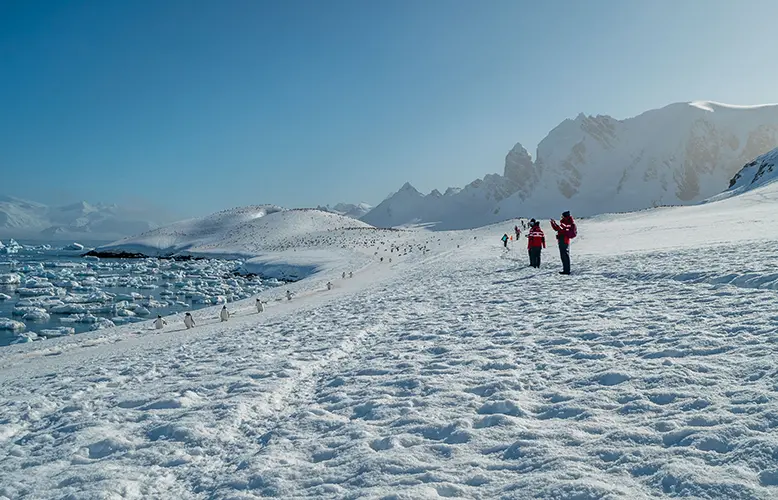
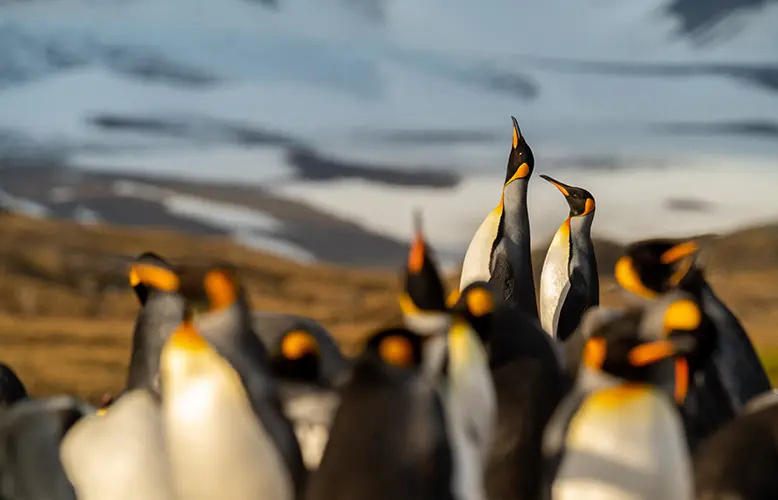
Highlights of the three-week trip include seeing the largest king penguin colonies on the planet, zodiac cruising through crinkling brash ice in Antarctica and visiting the farms in the westernmost settled outposts in the Falklands that have been owned by families for hundreds of years.

Your journey begins with a flight to the world’s southernmost city, Ushuaia. Upon arrival, you’ll be whisked away to a five-star hotel overlooking the Beagle Channel where you can rest and recharge from your travels for the next two nights.

After a leisure day in Ushuaia, during which you can visit Tierra del Fuego National Park, sample the local king crab regional speciality or explore the city and its hiking routes, the real adventure begins as you board the small ship. 

The vessel’s expedition team and officers greet and welcome you onto the 139-passenger ship which features state-of-the-art stabilisers and sleek, spacious suites.

After a fine dining experience, sit down and take snapshots of the glorious mountain scenery as you set sail along the Beagle Channel, passing Magellanic penguins, Rock Cormorants, and sea lion colonies en route to the Falkland Islands.

Drift by icebergs along the Southern Ocean the next day, accompanied by albatrosses, prions, and petrels as they follow the vessel. The expedition team keeps a careful watch on the surroundings, ever ready to highlight whales and dolphins along the way. 

You will also be invited to an informative onboard presentation on the wildlife, history and geology of the Falkland Islands and the Southern Ocean. Additionally, you can actively engage by participating in seabird sighting surveys or contributing to the collection of salinity samples and weather data.

The fifth day is spent exploring the westernmost settled outposts in the Falklands which are home to remote farms that have been owned by families for seven generations. The wild, windswept landscape is devoid of trees and completely silent and undisturbed, bar the lively vibrant local wildlife.

Sheep graze alongside albatrosses and rockhopper, king, and macaroni penguin rookeries, while Caracas fly overhead and upland geese graze by the curling waves of the white sand beaches. 

“It was surreal – it felt like Hawaii but with penguins everywhere. My favourite shot I took here was one of the penguins on the beach. It looked like they were holidaying in the Caribbean.”

While here, you can visit homesteads and gain unique insights into the lives of those living in this remote area over a cup of tea and cakes. 

The next day, you will be taken to Stanley, the capital city of the Falkland Islands. Explore the unique metropolis on foot, popping into shops selling locally-made wool garments, visiting the museum and investigating the lively pub scene. You can also spot sea lions and dolphins in the harbour and bird life by Gypsy Cove.

Over the next two days, you will travel east across the Antarctic Convergence on your way to South Georgia. You’ll be able to spot wildlife from the ship’s deck and listen to fascinating presentations on the region’s history.

Come day nine, you reach South Georgia. Nicknamed the Serengeti of the South, it is famed for its high populations of penguins and seals. Its marine ecosystem is one of the world’s densest examples of biodiversity.

“I’ve been close to wildlife before, particularly in the Galapagos Islands but the backdrop of South Georgia is so dramatic. We’re talking towering ice-peak mountains in close proximity to thousands of penguins. It makes for incredible photo after incredible photo. And the light there is constantly changing. No matter what time of day you go ashore, you’re guaranteed something new.

“The wildlife is magnificent here. Even just on the beaches, you’re getting huge elephant seals, aggressive fur seals, macaroni penguins, albatrosses, petrels, skuas, and gulls everywhere. It’s like walking through a nature documentary. It’s something you really have to see to believe.”

You’ll also come across hundreds of thousands of king penguins of all ages, from fuzzy chicks to mature adults. 

The region’s unique location is to thank for its sensational wildlife scene. It is situated within the Antarctic Convergence but outside the limit of the yearly sea ice. Consequently, the 3,755 square kilometre island is home to tens of millions of breeding penguins, seals and seabirds. 

Spend the next three days snapping sensational shots of the wildlife, towering mountains, immense glaciers, rugged coastline and tabular icebergs. 

You can visit the Grytviken whaling station during your time in South Georgia. It is the first shore-based whaling station for Antarctic whaling. You’ll also be taken to the Norwegian seamen’s church, the active British Antarctic Survey station and the tiny graveyard where the legendary polar explorer, Sir Ernest Shackleton, is buried.

Over the next two days, you gradually navigate through a growing number of icebergs as you journey southward aboard the vessel, heading towards the trip’s final visit destination: The Antarctic Peninsula and the South Shetland Islands. Informative presentations and wildlife watches will keep you entertained along the way. 

As you approach the Antarctic Peninsula, your expedition leader and captain will draw up a three-night itinerary based on the weather and ice conditions. Entering the region from the east, you come across the northern boundary of the Weddell Sea.

The area is thriving with wildlife, as it marks the point where a large cold body of water rotates clockwise driving cold water and ice north towards South Georgia and the South Orkney Islands. The ocean currents derive nutrients from the deep, feeding countless species of marine animals. 

“Antarctica’s landscape is simply alien. Ethereal, beautiful but undeniably strange. It offers such a contrast to The Falklands and South Georgia. 

“My favourite moment in Antarctica was when we were on a zodiac cruise to see wildlife. The light was coming through the clouds giving this blue glow. We were just zodiacing through brash ice as it crinkled and crackled below us.”

Drift by tabular icebergs and groups of whales as seabirds soar across the sky above you. Spend the days visiting the most scenic bays and channels of the Peninsula and visiting penguin rookeries of Adelie, Chinstrap and Gentoo.

You’ll also see crabeater, leopard, Antarctic fur and elephant seal wallows, bird colonies and minke, orca and humpback whale feeding areas. After four days, you will begin your two-night homeward journey along Drake Passage back to Ushuaia.

After disembarking on your final day, you will catch an afternoon flight to Buenos Aires.

Burnham has some advice for other photographers thinking about taking the same trip: 

“These destinations are on a scale almost unmatched anywhere else on Earth. So, take your time – the wildlife is all around you, you don’t need to rush. Also, get low. The animals are low to the ground so you should be too. Get into their world. Lastly, you don’t need to bring long lenses because the wildlife is always right next to you. Bring wide-angle lenses instead to capture the drama. Finally, be as creative as you can and don’t lose your camera in the water!”

An-My Lê, MoMA review — compelling photographs of war, teen life and an America riven by fear

An-My Lê, MoMA review — compelling photographs of war, teen life and an America riven by fear

There’s a stillness at the heart of An-My Lê’s photographs, no matter what turmoil they record. The hubbub of cities, the pantomimed passions of street protests, the frenzy of a neighbourhood soccer game — all freeze theatrically, as in a diorama. Her work, now in a viscerally satisfying exhibition at the Museum of Modern Art in New York, transforms everyday reality into a sequence of set pieces that seem archetypal even when they’re just pictures of people hanging out on a street corner or clouds scudding across the sky. The action orbits around a central hush, as if the world were never too busy to pause its rounds for her camera.

Lê’s first New York survey covers three decades of her peripatetic career. Born in Vietnam in 1960, she fled with her family to California in 1975, after the fall of Saigon. They alighted in Sacramento, and two years later she enrolled at Stanford. While working towards a masters in biology, she took a photography class, a choice that set her down on the rocky road of art.

Her timing was perfect: in 1994, the year after she graduated from Yale’s masters of fine art programme, President Bill Clinton lifted the US trade embargo on Vietnam. Lê travelled to her native country for the first time in 19 years. The show opens with what she calls a “self-portrait” but is actually a Vietnamese girl roughly the same age as the photographer was when she left. We see her in profile, her face unlined but sombre, already marked by sorrow. 

‘Untitled’, Nam Ha (1994) © An-My Lê

This wistful, tender photo stands out in a body of work that generally plays down feeling in favour of fact. It reminds me of Lewis Hine’s angry yet resoundingly humane portraits of child workers, which bared the wrongs inflicted on America’s youngest citizens. Lê does something similar, balancing dignity and compassion.

In another photo of the same girl — not in the exhibition but reproduced in the catalogue — we get a more inclusive view of her life: dirty, ill-fitting clothes, weathered hands, bare feet treading tall, prickly grass. 

Vietnamese sniper lying prone on sand dune near sea shore, pointing rifle towards soldiers about 20 metres away
‘Sniper II’, from ‘Small Wars’ (1999-2002) © An-My Lê

It’s less a study of an individual than a report on existence constricted by poverty and labour, closer to Walker Evans’s sober, forensic portraits of Alabama sharecroppers in their tumbledown homes, pinned in place by circumstances beyond their control. Like Evans, Lê favours a large-format camera with a long exposure, which allows her to pack the view with detail and produce images of static monumentality. 

Her Vietnam homecoming left her disoriented: “I felt I didn’t recognise anything in Vietnam.” She alludes to that feeling obliquely in a street scene taken in Ho Chi Minh City. A knot of men in white shirts, dark pants, and sandals (plus one woman and one child) shield their eyes to gaze up at a solar eclipse. Uncle Ho himself looks benevolently down on his people from a banner at their backs. The past has become two-dimensional, the future is blinding.

A flock of white geese on a grassy bank among trees heading into a river
‘Untitled’, Mekong Delta (1994) © An-My Lê

Rattled by the country’s rapid urban change, she ventured to the Mekong Delta to shoot deep-focus views that have an ageless, idyllic quality. A farming family poses in the middle distance, haloed by a circle of palm trees and a pen full of ducks. Another household, shaded by lush vegetation, dwells by waters so still and glossy they could be a sheet of marble.

When she returned to Vietnam again in 2011, having exchanged black and white for colour, Lê seemed less startled and more analytical. Her Delta series juxtaposes the experiences of teenage girls near the Mekong and the Mississippi. Even though 9,000 miles and vastly different cultures separate the adolescents of Ho Chi Minh City and New Orleans, we watch both groups on parallel tracks, slipping into adult gravity.

Six young Vietnamese women sitting around on floor of office-type room, some with their shoes off, while two more stand behind them by the windows
‘New Orleans, Friends, Heritage and Hope Gala’ (2011) © An-My Lê

War threads its way through her work, but indirectly, in pictures of exercises, games, civil-war statues and fake soldiers. “Small Wars” (1999-2002) features Vietnam war re-enactors in Virginia and North Carolina. Most of the participants had never been in combat but enjoyed the fantasy. In exchange for permission to photograph these events, Lê agreed to play the role of a South Vietnamese Viet Cong fighter. 

The make-believe gives her photos of a downed fighter jet shrouded in mist, or pretend GIs crouching in the foliage, a movie-like look of authenticity. “My pictures stand in complete opposition to combat photography,” she has said. “We are dealing with parallel subjects, but the outcome — the meaning — is completely different.” Her work doesn’t read as anti-war messaging, either, but as a comment on conflict as spectacle.

Battlefield at night scattered with scrubs and bits of equipment, with the sky lit up by flares - the flare trails are showing in the photo
‘Night Operations IV’, from ‘Small Wars’ (2003-04) © An-My Lê

Even the real military concocts fictional battles. She shot the series 29 Palms in 2003-04 at a base in California where Marines trained for the invasions of Iraq and Afghanistan. The desert and the smoke are genuine; the danger isn’t. These photos lack crackle, maybe because Lê positioned herself too far from the action to reproduce much excitement or emotional depth.

Since 2015, disparate projects scattered around the US have cohered into Silent General, a panoramic portrait of a country riven by fear, political chasms and incompatible visions of the future. “I’ve been making this series to relieve anxiety about what’s been going on in the past few years — division, chaos, racial tensions, all stuff I would not have felt so deeply five years ago,” she has said. “What makes America America? The wilderness, the vastness, our sense of history.”

Young people standing holding protest placards in city park square, with tree branches with pink blossom overhanging them in the foreground, along with park benches and a propped-up bicycle
‘High School Students Protesting Gun Violence, Washington Square Park, New York City’ (2018) © An-My Lê

You sense those tremors most powerfully in her pictures of teens, who are never wild or dissipated, just numbly rehearsing for their next chapter. They flop on the ground after a Black Lives Matter protest in Washington, DC, mill around during a gun control rally in New York, enjoy a Fourth of July picnic in New Orleans in ways she can massage into formal compositions.

In the Fourth of July scene, the arrangement of young bodies on the riverbank soon gels into a mash-up of Manet’s “Déjeuner sur l’herbe” and Seurat’s “Île de la Grande Jatte”. The Impressionists, too, chronicled moments of serenity amid shudders of change. Lê has found her great subject in that ongoing subterranean struggle, the tension between the mundane and the seismic that Baudelaire called “the heroism of modern life”.

To March 16, moma.org

Unleash your inner maverick: Breaking the Rule of Odds in photography

Unleash your inner maverick: Breaking the Rule of Odds in photography

In photography, rules are like guideposts that offer us a path to creating visually appealing images.

We’ve all heard of the Rule of Thirds, a fundamental principle that divides our frame into nine equal parts to help us compose our shots with balance and harmony. But what if I told you that another rule can take your photography to a new level? Enter the Rule of Odds!

Why the Rule of Odds?

Picture this: A serene landscape with a lone tree standing tall or a portrait where three people surround the subject. These odd-numbered compositions add a dynamic quality to your photos that can make them truly exceptional.

Here’s why you should embrace the Rule of Odds

1. Dynamic Balance

In photography, the concept of dynamic balance serves as a transformative tool that unfurls the doors to creativity. It captivates the imagination of both photographers and viewers alike. The art of achieving dynamic balance hinges on the deliberate inclusion of odd numbers, such as three or five elements, within the intricate tapestry of your compositions.

This deliberate choice transcends the ordinary. It introduces a captivating interplay of elements that invites viewers to embark on a visual journey of discovery. By embracing odd numbers, you infuse your images with an electrifying energy that kindles an invigorating tension within the frame, instantly seizing your audience’s attention. It draws viewers into the heart of your visual narrative, igniting their curiosity and encouraging them to explore the intricate details within the scene.

Odd numbers, in their inherent unpredictability, become the cornerstone of surprise in your compositions. It adds an element of intrigue that elevates your photography to a higher plane. Picture, for instance, a serene lakeside sunset captured with three gracefully swaying reeds in the foreground. The odd number of reeds creates a dynamic balance and injects a sense of rhythm and harmony into the image. The subtle variation in their height and position beckons viewers to contemplate the beauty of the setting sun, inviting them to engage with the scene on a profound level.

In essence, the Rule of Odds is your artistic passport to a world where visual storytelling is a symphony of dynamic balance, surprise, and captivating tension. It’s an opportunity to unleash your creative spirit and craft photographs that resonate deeply with those who behold them. It becomes a testament to the power of odd numbers in shaping the emotions and experiences of your viewers. This way, your work becomes a timeless and evocative journey into the heart of your photographic vision.

3 trees in field
Picture a serene landscape scene with three tall trees standing side by side. The uneven distribution of these trees creates dynamic balance, making the image visually engaging. Viewers are drawn in by the interplay of the trees, adding a sense of harmony to the natural setting. Image from Adobe Express

2. Storytelling

The inherent allure of odd numbers in photography extends beyond mere compositional aesthetics, as it seamlessly weaves a captivating narrative into each frame. By naturally guiding the viewer’s gaze to the central element, odd numbers assume the role of an unspoken storyteller, directing attention to what matters most within the image.

In this process, they orchestrate a symphony of visual dynamics, harmonizing disparate elements into a coherent and compelling whole. This symphonic quality adds a rich depth and intrigue to your photographs. It effectively transforms them into immersive visual narratives that encourage viewers to delve deeper. As they engage with the carefully constructed storylines, they find themselves drawn into the scenes you’ve meticulously crafted. It can be a trio of musicians in a jazz club. Or, three generations of a family sharing a moment. Maybe even five solitary street performers in a bustling square. Odd numbers act as the conductor, orchestrating a chorus of emotions and interactions that resonate with the audience.

In essence, the Rule of Odds elevates photography beyond the realm of mere visual representation. It becomes a masterful tool for storytellers to captivate the imagination and invite viewers to become active participants in the narrative. Ultimately, it allows photographers to forge a profound and enduring connection between the image and its audience.

farm market with 5 people rule of odds
Consider a bustling farmers’ market scene where five vendors passionately sell various products. Using the Rule of Odds, the central group of vendors becomes the focus. They tell the story of diverse offerings at the market and the interactions between sellers and customers. Image from Adobe Express.

3. Emotional impact

The use of odd numbers in photography is a nuanced art form that possesses a remarkable capacity to stir profound emotions within viewers. It achieves this by masterfully crafting compositions that resonate with harmony and rhythm, profoundly engaging the audience’s visual senses. This engagement, fostered by the asymmetrical yet balanced arrangement of odd-numbered elements, leads to a lasting impact that etches the image into the viewer’s memory.

Moreover, the magic of odd numbers lies in their ability to convey a sense of unadulterated authenticity and emotional resonance. When viewers encounter an image with an odd number of elements, they are drawn to the subtle imperfections and variations within the scene, mirroring the intricate tapestry of human emotions.

In essence, the Rule of Odds in photography transcends mere composition. It conveys complex emotions and makes a lasting impression, forging a profound connection between the photograph and its audience. Through this artful use of odd numbers, photographers have a unique tool to create images that evoke authentic, resonant and enduring emotions.

Example: Imagine a close-up portrait of a musician playing a violin, with three tears rolling down the musician’s cheek. The odd number of tears adds emotional depth, emphasizing the musician’s connection to the music and evoking viewers’ empathy and a deep emotional response.

4. Breaking the mold

Embracing the Rule of Odds becomes a profound declaration of a photographer’s commitment to shaping a unique visual narrative. It stands as an artistic ethos that transcends the ordinary. It challenges the conventional norms that often dictate the composition of images. By intentionally incorporating an odd number of elements into their composition, photographers embark on a transformative journey of creativity and innovation.

This rule is more than just a guideline. It’s also an invitation to go beyond the boundaries of predictability and conformity and to explore the vast, uncharted territories that odd numbers offer. In doing so, photographers redefine the very essence of storytelling through visuals.

When you compose an image that features an unconventional number of elements, you are, in essence, declaring your commitment to the extraordinary. The Rule of Odds thus becomes the catalyst that fuels your innovative spirit, allowing you to craft images that defy expectations, provoke thought, and leave an indelible mark on the world of photography.

cityscape at night rule of odds
While photographing a cityscape at night, you notice a row of five streetlights casting dramatic shadows on the pavement. Focusing on this odd number creates a visually striking composition that demonstrates unconventional angles making your cityscape photo a unique piece of art. Photo by ayumi kubo on Unsplash

Mastering the Rule of Odds

Now that you’re convinced of its potential, here are some tips to help you master the Rule of Odds:

1. Choose your subjects wisely.

Seek out subjects that naturally come in odd numbers, such as trees, rocks, or people. These subjects will make it easier to compose your shot.

2. Experiment with perspective.

Change your perspective and angles to highlight your odd-numbered subjects. Get low, move up high – explore different viewpoints to find the most compelling composition.

3. Use depth of field.

Experiment with depth of field to isolate your main subject. A shallow depth of field can make your subject pop against a blurred background, creating a powerful visual impact.

4. Embrace the “Power of One.”

Refrain from filling your frame with odd elements. Sometimes, a single, striking subject can be more potent than a crowded scene. Embrace the simplicity of one.

5. Practice, practice, practice.

As with any photography technique, practice is key. Grab your camera and head outdoors to experiment with the Rule of Odds. Review and critique your shots to refine your skills.

6. Find inspiration.

Follow photographers who excel at using the Rule of Odds on social media. Their work can provide valuable insights and inspiration for your projects.

To put it in perspective, the Rule of Odds is your secret weapon to unlock a world of captivating, emotionally-charged photos that demand attention. It’s time to break free from the confines of convention and embrace the odd. So, grab your camera, start snapping, and embark on a creative journey that will take your photography to new heights. Let’s turn the photography world upside down together and create a visual revolution!

Killer whale shows off his prey for photographer off B.C. island

Killer whale shows off his prey for photographer off B.C. island

Kali Wexler always brings his camera when he ventures out on the water.

During one evening earlier this year, he captured a rare moment off Hornby Island.

The professional photographer was on his small boat fishing in late August when he was notified about orcas swimming nearby. 

“We were kind of just hanging out, engines off, viewing the pod from pretty far away,” he says.

To his surprise, one of the transient killer whales popped up right beside his boat.

“There was definitely some playful behaviour in the water and then this big, beautiful visual spy-hop with the seal in its mouth,” says Wexler. “It was pretty exciting.”

He explains how the experience felt like a suspended moment in time and how the whale came up really slow. 

“You can actually see in some of the images, its teeth and it’s biting into the seal. So it was holding on quite well,” he says. 

Wexler was able to capture the spy-hop and the whale, named Jack, showing off. 

“I guess he’s a bit notorious for showing off his prey … he likes to play around and he’s a very big male bull orca so he’s amazing to see in person,” says Wexler, who used his 600-millimetre telephoto lens.

“It’s one of those just amazing natural moments and luckily, we got to witness it.” 

He decided to post the photograph to his Instagram and Facebook pages where he shares a lot of his work, and not surprisingly, it took off. Orca Rescue Foundation shared his photograph, which garnered more than 700 comments and 15,000 likes. 

“It was special, and I was holding on to it for a while,” he says. 

Wexler says he shares his photographs with conservation groups that spread awareness about wildlife. 

“Killer whales are always amazing in any capacity,” he says. “You never know what you’re gonna get.”

To view the photographs of Jack or more of Wexler’s work, visit his Instagram or his website