Photography

Photographers Warned They Could Be Sued for Grinch-Themed Shoots

Photographers Warned They Could Be Sued for Grinch-Themed Shoots

photographers warned grinch photoshoots lawsuits copyright infringement trademark dr seuss

Photographers have been warned about doing Grinch-themed photo shoots over the holidays due to “serious trademark infringement issues.”

Alongside traditional Santa photo sessions, Grinch-themed shoots are also popular among photographers during the Christmas period. However, photographers could allegedly risk being sued over this by Dr. Seuss Enterprises.

According to a report by Louisiana radio station 97.3 The Dawg, a social media post which cautioned photographers that using the Grinch theme for a shoot could attract legal action from Dr. Seuss Enterprises went viral among the lens community.

‘Protecting Photographers’

In the Facebook post, which amassed over 25,000 likes and 32,000 shares, Tennessee-based photographer Brittany Kay Photography reminded her followers that she would not be doing the Grinch-themed shoots over the holidays.

“Friendly reminder that doing Grinch photo sessions for a profit is a federal trademark infringement, and Dr. Seuss Int. literally hires out a team this time of year to reverse image search and sue photographers for profit,” Kay writes.

“So unless you got $120,000 for a license, that’s not a lawsuit you will win!

“This isn’t me trying to be a buzzkill. This is me just trying to protect newer photographers that aren’t aware of the situation.”

‘Cease and Desist Letters to Photographers’

As 97.3 The Dawg reports, Brittany Kay Photography provides no specific data on the likelihood of a photographer being sued by Dr. Seuss Enterprises.

However, according to an extensive report from TheLawTog.com which is cited by the radio station, Dr. Seuss Enterprises’ corporate counsel, Nicole Gates, reportedly sent cease and desist notices to infringing photographers who did Grinch-themed shoots.

And in 2019, PetaPixel covered an incident when Dr. Seuss Enterprises purportedly went on the offensive, sending an aggressive cease and desist letter to a photographer after their Grinch-themed holiday photo shoot went viral.

[embedded content]

While TheLawTog.com, a resource dedicated to legal issues in photography, reported that it could not fully verify the legitimacy of these notices from Gates — they do reportedly align with standard legal practices in such cases.

When a photographer uses images from Grinch sessions for advertising purposes, this supposedly not only constitutes copyright infringement of the original photographer’s work but also risks infringing upon the intellectual property rights associated with the Grinch character.

TheLawTog.com describes how copyright protects artistic works, and trademark laws protect brand identities, like logos and names, from being used in a manner that causes consumer confusion. For photographers, using the Grinch character or even the term “The Grinch” in marketing or sales could be seen as a violation of these laws.


Image credits: Header photo licensed via Depositphotos.

Giorgio Armani celebrates the sensual, timeless photography of Aldo Fallai

Giorgio Armani celebrates the sensual, timeless photography of Aldo Fallai

When Giorgio Armani emerged to prominence in 1970s Italy, he proposed a new way of dressing. It was epitomised by his riff on the suit jacket: stripping away its previously rigid structure and synonymy with stuffy formality, his take was defined by a languid elegance, unstructured in design and made to release the body from restriction. Such a philosophy has followed him throughout his career, across both his eponymous label and its various offshoots, including Emporio Armani. ‘It gives presence, stature and dignity,’ he told Wallpaper* of the tailored jacket in a conversation with Paul Smith. ‘And it is one piece: you attain more with less.’

In Florentine photographer Aldo Fallai – who he met when Fallai was still a graphic designer in Milan in the early 1970s – Mr Armani would find a natural ally. In 1977, they worked together for the first time; the resulting collaboration, which would span three decades, saw them refine a vision, particularly of masculinity, which was both widely influential and decidedly Armani. Rigorous in composition, yet imbued with a feeling of sensuality – often the images would celebrate the beauty of the human form – the photographs they produced together continue to define the spirit of the house today. 

Armani Aldo Fallai Exhibition

Armani Jeans S/S 1981 

(Image credit: Photography by Aldo Fallai)

Armani Aldo Fallai Exhibition

Emporio Armani A/W 1994 

(Image credit: Photography by Aldo Fallai)

And now, in Mr Armani’s Milanese hub and exhibition space, Armani/Silos, the designer pays ode to Fallai with a monographic exhibition of the photographer’s work, spanning 1977-2021 (until 11 August 2024). Curated by Mr Armani, his sister Rosanna Armani and Leo Dell’Orco, head of men’s collections, the wide-ranging exhibition celebrates what the designer calls an ‘artistic dialogue’, one largely led by an instinctual connection between the pair. Said to have been inspired by a melange of influences – from Tuscan mannerism and Caravaggio’s chiaroscuro to the pre-Raphaelites – Fallai’s evocative subjects include a man grasping a tiger cub under his arm (photographed in a circus in Palermo), couples in embrace or amid ruffled bedsheets, or model Antonia Dell’Atte playing a career woman on the Milanese street of Via Durini for a campaign in the 1980s.

‘Working with Aldo allowed me from the very beginning to transform the vision I had in my mind into real images: to communicate that my clothes were not just made in a certain way with certain colours and materials, but that they represented a way of life,’ says Mr Armani.

Armani Aldo Fallai Exhibition

Giorgio Armani A/W 1984-85

(Image credit: Photography by Aldo Fallai)

Armani Aldo Fallai Exhibition

Emporio Armani S/S 1993

(Image credit: Photography by Aldo Fallai)

‘Because style, for me, is a total form of expression. Together, with a constant fluid and concrete dialogue, we created scenes of life, evoked atmospheres and sketched portraits full of character. Today, looking back at everything we did, I myself am struck by the power that these shots still emanate, and by Aldo’s great ability to capture the nuances of personality.’

‘My work with Giorgio was the result of a natural, continuous dialogue and great trust on his part,’ adds Fallai. ‘I have vivid memories of our 30-year collaboration. Production was always agile and streamlined: we achieved the results with little means and no special effects. This, I think, appealed to the public.’ 

Aldo Fallai per Giorgio Armani, 1977-2021, open now until 11 August 2024.

Ticket are available here.

Photos: Missoulian photographers’ photos of the week

Photos: Missoulian photographers’ photos of the week
image

From left, artist Lily Luna Bennett, Allez! gallery co-owner Karen Sippy, artist Lily Kip, artist Jules Lucero, Allez! co-owner Brian Sippy and University of Montana art professor Kevin Bell on Thursday night help set up the alleyway gallery’s newest mural project, “New Perspectives: Art at UM,” which will showcase work by current UM art students and recent graduates in the School of Visual and Media Arts. The alleyway mural gallery is part of a new collaboration with the university.

Hélène Amouzou review – spectral self-portraits of a soul in torment

Hélène Amouzou review – spectral self-portraits of a soul in torment

Hélène Amouzou’s story is hard to stomach. She was forced to flee her home country, Togo, in 1992, as years of political turbulence erupted into protests and violence. Her husband’s political affiliations put them in danger – they, like hundreds of thousands of Togolese, ended up in Benin, Toga’s eastern neighbour. From there, the couple and their infant daughter went to Germany to seek asylum, but soon after their arrival, found their name on a deportation list. When Amouzou’s husband went to attend a registration appointment, he never returned. Amouzou and her young daughter went into hiding.

Amouzou eventually returned to Benin to search for her husband, not realising the German government had sent him back to Togo. In the autumn of 1997, she decided to return to Europe, but this time to Brussels. She began again, building a life from scratch, without her husband. But for almost two decades, Amouzou lived without any official status – that hellish loop that forces immigrants to live in intolerable conditions, tormented by bureaucracy. She eventually became a Belgian citizen in 2015.

Amouzou took photographs throughout. In a small but sublime solo show at Autograph in London, aptly titled Voyages, we see her becoming and growing as an artist, going from her first camera, a classic 35mm Canon AE-1, and later a medium format Rolleicord.

Self-portraits that all but obliterate the self … from the series Autoportrait, Molenbeek, 2007-2011.

Voyages is focused around a series of self-portraits taken in the decrepit, abandoned attic of the building Amouzou lived in, in the Molenbeek area of Brussels, from 2007 to 2011. In many, Amouzou is barely there – a ghostly blur, the result of experimenting with long exposures of more than a minute, while she moved around in the frame. These are self-portraits that all but obliterate the self, reducing it to only a thin image on a peeling wall. In this cold and uninviting space, Amouzou drifts in and out of the frame, clothed and nude, always alone, save for a suitcase. Unwittingly, her self-portraits are reminiscent of Francesca Woodman’s, though Amouzou was not aware of Woodman when she started. Yet they share a sensibility: in a world that didn’t see them, both are trying to figure out whether they are really there or not.

The exhibition spans 15 years of Amouzou’s life, but time slips away – lost or stolen? – in the photographs. Amouzou is still in the attic, with the same symbolic suitcase, the bag that is always packed and ready should she need to leave at short notice once again. In a pair of pictures, also blown up to larger-than-life size, the artist sits on top of her suitcase, fixing the camera with a deep stare. In the next picture, the identical scene appears – but Amouzou is gone. It is a devastating image that lets you into her despair. It is like a scream, piercing but silent.

‘Photography has helped me’ … Hélène Amouzou.

“Photography has helped me,” Amouzou says, “and continues to help me – to escape, to think about something other than my everyday life.” In a more recent self-portrait, shot in colour, she appears in the attic again – but this time resplendent in traditional Togolese dress, seated on a coral-hued chaise longue, her whole figure visible and in focus. It is no surprise to learn the photograph was taken after Amouzou gained citizenship. It is a statement about the reclamation of identity, about confidence, but it also shows Amouzou’s ability to shift to formal portraiture. It’s a world away from the earlier photographs.

The self-portraits, all exquisitely handprinted by Amouzou, represent a significant chapter in Amouzou’s life, moving from an atmosphere of stark oppression to jubilant self-exploration. The works perhaps begin and end with her life experiences, but ultimately shirk them off. Instead, they become lyrical expressions of instability, grief, loss and resilience.

8) Hélène Amouzou, from the series Togo, 2011.

There are glimpses, too, of the outside world beyond the privacy and safety of the attic – such as a clutch of photographs taken during a trip to Togo in 2011, when the artist was at last able to return to visit her mother after 20 years. In one image, a hand extends across the frame, towards a beach, where tents are pitched in the background. The ocean curls on the shore. Home is there – but it is still beyond reach, as flimsy as the canvas of these temporary structures, dwarfed by the infinity of the ocean.

Home cannot be grasped or held. Memories with loved ones cannot be remade. Amouzou tries to repair lost time with photography, in a solemn portrait with her mother. This woman, now elderly, is seated as her daughter, now a mother too, stands by her side. It is a formal portrait, not the typical image of the long-awaited reunion. The faces of two women are etched with the exile that has kept them apart. Their gaze is penetrating, hard to shake off, long after I’ve left the gallery.

In an interview with Bindi Vora, the exhibition curator, Amouzou says: “I look at my passport and identification cards and sometimes think, ‘All my life for this.’ I don’t think I could do this again.”

Jury Awards Architecture Photographer $6.3 Million in Copyright Infringement Case

image

Business

Scott Hargis Photo Vs. Pacifica Senior Living has wound its way through California’s Central District court system and the result is a massive victory for photographers everywhere. The damages award is one of the largest ever recorded for a photographic copyright infringement case.

Scott Hargis Photo Vs. Pacifica Senior Living began as a routine infringement case that escalated when the infringing party refused to offer a settlement. The 43 images in question were used by the infringing party without a license agreement, and after surviving multiple lines of argument from the defendants claiming that there was no infringement, a jury found every image in question to be a willful infringement, awarding Hargis the maximum $150,000 per image allowed by law.  

There are three categories of infringement: innocent, non-willful, and willful, and each category can be awarded a different range of statutory damages depending on the degree of severity that a judge or jury perceives. The penalty for a willful infringement of a timely-registered image ranges from $30,000 to $150,000 each. Clearly, the jury intended to send a very clear message with this verdict.

This verdict further solidifies the importance of timely registration of photographs with the United States Copyright Office and the importance of diligently tracking usage and licensing.

This case is a victory for photographers and creatives everywhere, and will go a long way towards making potential infringers reconsider their actions in the future. There likely isn’t a single photographer reading this who has not had their work infringed one way or another (whether or not they know it) – and if it hasn’t happened yet, it absolutely will over the course of a photographer’s career; It’s part and parcel of working in this field. 

During a brief interview, Hargis mentioned that he was ‘thrilled’ with the result and that he ‘hadn’t quite processed it yet’. The toll that a case this size can take on one’s psyche cannot be overstated, and I am sure we will learn more details as more news and interviews are released. 

Remember, if your photographs are registered with the USCO, you have many options in an infringement situation. While this is an issue that photographers face every single day, you have recourse if you take the simple steps of registering your photographs. It is personally something that I do four times a year – once a quarter – to ensure that I am staying current with registrations and that I have a leg to stand on when my work is infringed.

Christmas dinners eaten by homeless people shown in photography series

Christmas dinners eaten by homeless people shown in photography series
image

Kevin, 71

Two chicken wings

They were pre-cooked and cold, “plundered from my mate’s fridge. Still feel guilty about it. I’m an honest person.”

Liv, 54

Milky Way Chocolate Stars and a coffee

From volunteers on Christmas Day during the pandemic. Lived off junk food during this time (what most of the donations were).

Mei, 63

Sliced sausages

This was from the supermarket reduced section. “I can’t cook hot food because of my injury.”

Matt, 54

Mince pie and a Stella

They were brought during the pandemic by a stranger. They drank the beer together.

Paul, 56

Ice cream

“In hospital with a punctured lung, due to street violence. Couldn’t eat anything else.”

Kamga, 42

Ketchup pasta

“Made using long-life food donations. Cooked it in a hostel.”

Abraham, 43

£1.99 McDonalds big mac + chips

Someone gave him a voucher on the back of a bus receipt.

Yusuf, 38

Cold fish and chips

It was raining so hard he couldn’t go anywhere, so he stayed in a tent. When it eased, he went to a nearby restaurant. They gave him a cold fish and chips.

Wassa, 56

Baked beans

He ate them cold with the free supermarket wooden fork.

Ali, 35

Prawn cocktail crisps, digestive biscuits, and a chocolate

These were long-shelf-life donations handed out by volunteers during the pandemic.

Renowned Photographer Marcel Sauer Unveils New Masterpiece “Urban Faces

Renowned Photographer Marcel Sauer Unveils New Masterpiece “Urban Faces
Urban Faces New York City - Cover

Urban Faces New York City – Cover

Urban Faces – New York City offering viewers a glimpse into the vibrant tapestry of life in one of the world’s most iconic cities.

Marcel Sauer is an internationally acclaimed photographer known for his exceptional ability to capture the essence of cities and the individuals who inhabit them.”

— Marcel Sauer

NEW YORK, NEW YORK, UNITED STATES, December 11, 2023 /EINPresswire.com/ — Esteemed photographer Marcel Sauer is proud to announce the release of his latest photobook, “Urban Faces – New York City”. This highly-anticipated collection showcases over 150 pages of captivating street and portrait photography, offering viewers a glimpse into the vibrant tapestry of life in one of the world’s most iconic cities.

Urban Faces – New York City” transports readers through the bustling streets, capturing the essence of the city that never sleeps. With a keen eye for detail, Sauer beautifully captures the diverse individuals who call this metropolis home. Each photograph tells a unique story, showcasing the beauty, complexity, and vitality of New York City.

Featuring stunning black and white imagery that highlights the raw emotions and personality of each subject, Sauer’s work is a testament to his exceptional talent. His ability to capture raw moments in a city constantly in motion is a testament to his skill and dedication to his craft.

Marcel is thrilled to share ‘Urban Faces – New York City’ with the world. This city served as his muse, and he hope that viewers will be transported into the vibrant streets and feel the energy of this amazing city through his photographs.”

“Urban Faces – New York City” is available for purchase both in stores and online. Readers can find the book at select retailers nationwide, as well as on popular online platforms such as Amazon and on Urban Faces website www.urban-faces.com.

For those seeking a unique and captivating visual experience, “Urban Faces – New York City” is a must-have addition for any photography enthusiast’s collection. With its poignant images and masterful storytelling, Sauer’s photobook will undoubtedly leave a lasting impression.

About Marcel Sauer:
Marcel Sauer is an internationally acclaimed photographer known for his exceptional ability to capture the essence of cities and the individuals who inhabit them. With a passion for street and portrait photography, Sauer creates images that bridge the gap between reality and art. His work has been widely exhibited and published in prestigious art galleries and publications worldwide.

For media inquiries or to schedule an interview, please contact:
Marcel Sauer
hello@urban-face.com
www.urban-faces.com
+49 (0) 171 9741410

Marcel Sauer
Urban Face Photography
+49 171 9741410
email us here
Visit us on social media:
Instagram
YouTube

Urban Faces – New York City

[embedded content]

image

Los Angeles Mayor Comes to the Aid of Fallen Photographer

Los Angeles Mayor Comes to the Aid of Fallen Photographer
[embedded content]

The mayor of Los Angeles, Karen Bass, used her background in medicine to help a photographer who collapsed during a press conference.

While speaking alongside the Los Angeles Police Chief Michael Moore on Thursday, a photographer in attendance apparently suffered a medical episode and collapsed.

Bass reacted quickly, immediately stopping the press conference and leaving her station to administer first aid.

Video footage captured the mayor crouched over the stricken photographer helping with his care until paramedics arrived.

Bass graduated from the University of Southern California Keck School of Medicine Physician Assistant Program and in the 1980s worked in an emergency room as a physician’s assistant.

“The very first person to run to his rescue was the mayor,” says KNX News reporter Craig Fiegener, who was standing next to the photographer when he fell.

Feigner adds that the mayor was orchestrating the photographer’s care — despite all of the police officers who were present.

The first thing Bass did was check his breathing and also took his pulse. An ambulance arrived 20 minutes later and took the man to hospital.

The photographer works for KCAL News which provided a positive update about his condition to KTLA.

“Our photographer is home and feeling back to normal. He expects to be back to work next week,” the station said in a statement.

Typically for a politician, not everyone is a fan of Mayor Bass but online commenters put political aspersions aside to applaud her for taking swift, decisive action.

“Good to know the photographer is doing ok, the mayor responded well, and good on her to have those medics qualifications,” writes one person on YouTube.

Bass has just passed one year in office with the Californian city’s homeless crisis topping her priorities. She has spent $76 million on the “Inside Safe” program which aims to permanently house those with no fixed abode.

Gifts for Architectural Photographers – a Few Things to Make Life Easier

Gifts for Architectural Photographers – a Few Things to Make Life Easier

Gear Review

The Christmas holidays are approaching, and with them, the rise of consumerism. Many people are thinking about gifts and creating lists of gift suggestions. Articles on the APA website are typically read by photographers themselves rather than their loved ones. So, I thought I would create a list of things that we can buy for ourselves to make our work easier and more enjoyable. I wish you all to find something better under the Christmas tree this year.

Stone bag

A tripod is truly a crucial piece of equipment for architectural photographers. We use it extensively, and I’ve written about it in previous articles (check out my reviews of a large tripod and a small one, as well as a head). That’s why I’ll start with small accessories related to it. On my Instagram profile, I often share behind-the-scenes content, and I’ve noticed that I receive the most reactions and questions from around the world regarding my stone bag. It’s a really inexpensive, simple, and lightweight item that has been a tremendous help in my work!

As the name suggests, the bag is designed for holding stones. A fellow architecture photographer recently told me that he was capturing a building on the summit of Śnieżka Mountain in winds reaching 150 km/h! He found the stone bag I recommended to be very useful for him as he could weigh down the tripod with rocks he found on the summit. This prevented the wind from tipping over the camera. However, I often use this bag to carry lenses. The version with three compartments works perfectly for me because I frequently use the LAOWA 20 mm f/4 Zero-D Shift, Canon TS-E 50mm f/2.8L, GF 45-100 mm f/4 R LM OIS WR (waiting for the GF30 shift) so there’s still space for a bottle with something to drink. I can always have these lenses at hand, and in most situations, I can move the tripod with them inside the stone bag. This solution works especially well indoors.

I personally use two Leofoto products: the smaller RB-1 with compartments and the larger, more rugged RB-2. The latter is definitely more suitable for larger tripods and challenging mountain conditions, and additionally, it comes with a hook allowing you to hang extra weight. Of course, there are many other similar products from different companies. It’s not a complicated or expensive product, but I really regret that I’ve only started using it recently.

The umbrella holder

Have you ever had to work in rainy weather? While you likely photograph most often in optimal conditions, sometimes you have to work in the rain. I recently photographed a floating sauna. The designer who built it and commissioned the photos chose an autumn date for the session. The leaves on the trees and the overcast sky created a great atmosphere, combined with the warm light emanating from the heated stove. Additionally, there was a light rain. A handy accessory for me in such situations was the umbrella holder attached to the L bracket. It also has great applications for working in harsh sunlight. A lightweight, small umbrella that won’t be a hindrance when carrying or adjusting the camera can shield the screen from light and make it easier to assess the frame.

If you don’t want to buy a special holder, you can make one yourself, for example, by using A Practical Guide to Making an Umbrella Holder prepared by Holly Gordon…

source: https://www.hollygordonphotographer.com/tips/a-practical-guide-to-making-an-umbrella-holder/

Leofoto offers various solutions for holding a rain umbrella. However, I opted for a different option. I recommend a small additional holder that you can attach to an L-bracket or another Arca Swiss standard rail or plate. The TetherArca Cable Clamp is theoretically designed for holding cables but can also be used to attach an umbrella dedicated to studio lamps.

Tether Tools TetherArca Cable Clamp for L-Brackets

You can also screw in a magic arm, which allows you to secure an umbrella or other accessories. Instead of a cable, I simply insert the handle of the umbrella into this holder.

LCC plate 

If you have experience working with medium format digital backs and technical cameras, you’re likely familiar with the invaluable feature of Capture One called LCC, which stands for Lens Cast Calibration. This feature can also be useful when shooting with a DSLR or mirrorless camera. It significantly speeds up and facilitates the removal of vignetting and dust from the sensor. Therefore, it’s worth having the appropriate plate to create a reference file.

LCC Calibration Solution https://www.photo-digitaltransitions.com/product/lcc-plate/

The plate is simply a piece of semi-transparent white plexiglass that you can buy inexpensively, but if you prefer, you can spend a lot of money on a ready-made photographic product.

Multitool

Having a pocket-sized multitool is always a good idea, and there are plenty of interesting models out there. Here are a few of my suggestions:

Have you always wanted to buy a camera from the Swiss company Alpa (I do), but you think they’re too expensive or you’re too poor? You’re right, but maybe you can at least afford their screwdrivers?

Alpa Swiss Tool MK II £75.00 excl. VAT

Do you like jewelry? You can feel like a member of the Inquisition by buying the Sunwayfoto screwdriver. This company also produces a cool, small multitool that you can attach to your keys.

Or maybe you could use a small tripod that hides a screwdriver, or rather a multifunctional screwdriver that can also serve as a tripod extension or a handle when you want to shoot videos with your phone. Check out the LMT-10 produced by Leofoto.

Leofoto LMT-10

Geared panning head

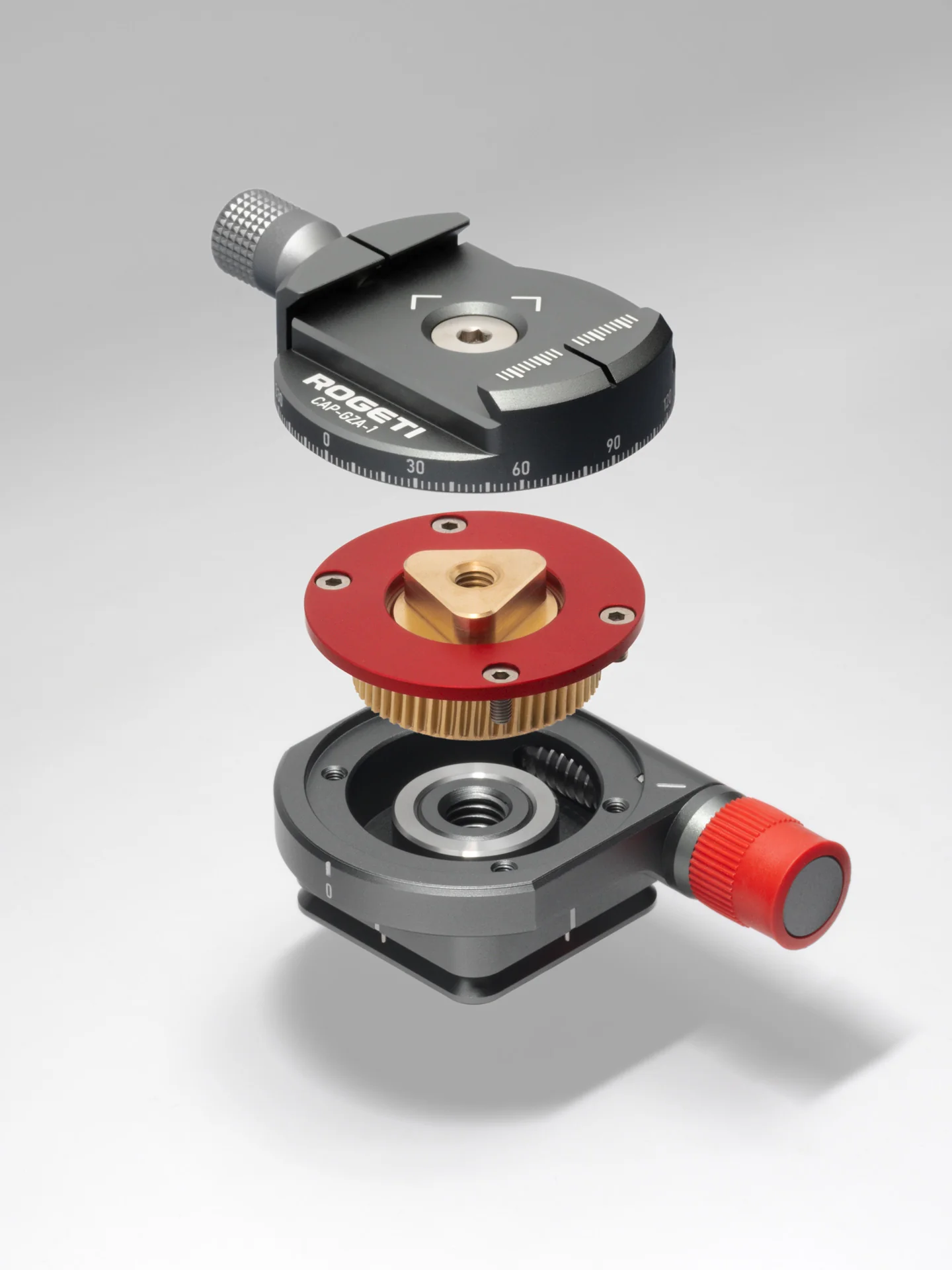
I am a fan of geared heads, and I believe it’s a great solution for architectural photographers. Unfortunately, practically no model is sold with geared pano as a standard feature. All movements are geared, except for panning. I personally use the Rogeti L-bracket and am very satisfied with it. I also had the opportunity to test their geared pano product CAP-GZA, and I liked it a lot. It’s a small, pocket-sized item that is really well-made.Thanks to the Arca Swiss standard connection, we can attach it to virtually any tripod head.