Photography

Carrie Mae Weems Takes Intimate Photographs of A$AP Rocky and His Sons

Carrie Mae Weems Takes Intimate Photographs of A$AP Rocky and His Sons

To announce American rapper A$AP Rocky as Bottega Veneta’s latest brand ambassador, a new photography series by acclaimed photographer Carrie Mae Weems has been released.

“Portraits of Fatherhood”, with A$AP Rocky, commissioned by creative director Matthieu Blazy is a series of six images, released on Father’s Day in the US, that shows A$AP Rocky in a home setting with his two young sons, RZA and Riot Rose.

The tender photographs show the rapper “embodying and embracing fatherhood, parenthood, companionship, and family, while still working on all aspects of my career”, he said.

Weems’ iconic Kitchen Table Series, as well as her first solo exhibition, Family Pictures and Stories (1981-1982), was a rebuke to negative stereotypes and messaging around the African American family. With these photographs of A$AP Rocky, she says she wanted to show an honest representation of the Black family.

An untitled 1990 photo taken by Carrie Mae Weems. Photograph courtesy Suzanne DeChillo/The New York Times.
Carrie Mae Weems in 2021. Photography courtesy Flo Ngala/The New York Times.

Weems answered some extra questions for T Australia about the collaboration:

T Australia: You’re perhaps best known for your Kitchen Table Series which, even though it was fictionalised, is not too dissimilar to these photographs which show great intimacy. How did you approach this work and what did you set out to achieve?

Weems: “We had lovely conversations together that really inspired my entire approach to making the piece. It was absolutely important to have these conversations, guiding the process. There were certain things Rocky wanted to do and see. Part of my responsibility was to listen, to articulate my vision through his, in that collaborative spirit. I think together we really did make something wonderful.

“There are still very few images of Black men with their children, certainly in the commercial and fashion space. I think what Rocky is attempting to do, to use his platform and stage, to use this relationship with Bottega Veneta, is very important. If there is something to be said, he is figuring out dynamic ways to say it and to be a part of that statement. It is quite remarkable and unique.”

T Australia: Art and luxury collaborations are becoming de rigeur – have you worked on commissions for brands before? How did the collaboration with Bottega Veneta come about?

Weems: “I learned that Matthieu [Blazy] had been studying me in school, which was surprising and lovely. We had this wonderful talk about directness, authenticity, and lack of flash, and that for Rocky himself, there was something about the Kitchen Table Series that drew him, and something about his ideas about becoming a father and a husband that mattered. In light of losing my own father, and in light of the importance of what he was trying to do as a person, a father, a parent, I knew I wanted to involve myself.”

One of the photographs from Carrie Mae Weems’s Portraits of Fatherhood series. Photography courtesy of the artist and Bottega Veneta.

More expert Culture & Arts coverage from T Australia:

Photography and Spirituality Intersect in John E. Dowell’s ‘Paths to Freedom’

Photography and Spirituality Intersect in John E. Dowell’s ‘Paths to Freedom’
They Took My Sister ©John E. Dowell

John E. Dowell’s hauntingly beautiful series, Paths to Freedom, originated from a dream featuring his long-departed grandmother and her tales of cotton fields. The dreams were so powerful that it encouraged him to seek out the cotton fields firsthand. In the deep South, in the dead of night, Dowell envisioned the harrowing journey of his enslaved ancestors. Through his photography, he explores their courage, wisdom, and pursuit of freedom amidst the darkness. His images, currently on view at The Charles H. Wright Museum of African American History in Detroit, evoke portals, spirits, signs in nature, and faith.

The concept for your series originated from a dream. Could you share more about this? Did you wake up with a clear vision of what to create, or did it take time to piece it together?
“It took time to piece it together. When I first began having the dreams, I wasn’t quite sure what was being requested. After consulting with my sisters and brother, I assessed that it was about my grandmother’s stories of cotton.”

In your insightful conversation with Brittany Webb, you talk about your connection with your ancestors, specifically your grandmother. How hard was it to trust (and act on) what was being conveyed to you?
“My grandmother was very clear and matter-of-fact. From there it became a matter of how to get to the cotton—contacting farmers, traveling to farms, et cetera.”

The Secret ©John E. Dowell

Can you talk more about the idea of portals in nature offering hope and encouragement to
slaves? Was this something that you read about or something that you came by naturally when out in the fields? And in what forms (light, burrows, etc.) do you feel these portals existed?

“That idea of portals first came from my experiences with religions of African origin—Voodoo, Santeria, and Gullah spiritual traditions. In all of these experiences, the individuals
communicated with their ancestors, gaining informative guidance, strength, and the ability to survive. I almost always had emotional experiences photographing cotton. I experienced
hearing and seeing things that were there only on a metaphysical level. At times when I was out photographing, I could hear singing—and many times while I’m looking at cotton, I know nobody is there but I swear I can see slaves picking cotton. At rare times, I felt like I was really experiencing pain as if I had been beaten.”

Ancestral Dance ©John E. Dowell

For this series, you’ve photographed cotton fields in the dark. What did this process look like? Did you scout the location during the day and then go back at night with specific ideas? Or was it more of an organic process?
“A little of both. I started with an idea based on some exploration during the daytime, and then at dusk, I just followed a feeling. I sort of imagined the path and how a group or an individual would run away. Some of this was based on knowledge of the Underground Railroad and seeing or perceiving escape routes when I was within the cotton fields. When I was there at night, I got a certain feeling—it was an awareness of ancestral presence.”

Untitled ©John E. Dowell

So many of us are living in cities, addicted to screens, and disconnected from nature. I can’t help but think of the concepts of “grounding” or “earthing” when I see your work. Is that something that you think about? What do you think we can learn from nature, and what role does it play in your personal life?
“For me, I have looked for and searched for moments in nature that are very spiritual to me. In my work, I have discovered places and moments that have given that identification. For example, in a banana plantation in Caracas, I photographed an area that felt like I was in the middle of an altar. Not in front of it—I was in it. In South Dakota, I had a similar experience in a corn field where I felt the presence of God. So nature for me becomes a means of discovering my spirituality.

“When I am in nature and have removed all of the distractions of the world, I really feel a presence of God. What’s interesting for me is when I’m in the city, I feel there is a potential awareness of humanity in certain situations, like the park and areas of communication—what I really feel in the city is that disconnecting from screens and enjoying interactions with nature and individuals is possible. So that is to say these connections I experience in the city or outside the city are not formed in spite of a sort of addiction to the screen or an influence by that stuff—I just move through it—it’s not really a part of my life.”

Got It I’m Gone ©John E. Dowell

    Do you think there is a connection between being connected to nature and feeling connected to one’s ancestors?
    “That depends on the experience and background of the individual. I think of experiences I have had in church services, ceremonies within the Gullah culture, Santeria, Voodoo, I could go on and on—all religions of the African diaspora where I’ve felt connected to my ancestors. In a ceremony of this sort there are many individuals who are possessed by spirits of ancestors. For example, in a Voodoo ceremony, one can have experiences with Shango or Ogun, and the same thing in Santeria or Candomblé. In the process of the ceremony, we can see someone who has been taken by the spirit of the particular Orisha or Loa. As I’ve mentioned, I’ve experienced connections to my ancestors in nature, I’ve experienced them alone, and I’ve witnessed others experience it in ceremonial or group environments—so it all depends on the individual.”

    John E. Dowell

      Discover More

      Photographer captures rare white loon in Canada

      Photographer captures rare white loon in Canada

      MINNEAPOLIS — Waterfowl on lakes and rivers are a common sight. But it’s the not-so-common loon that when seen in person is often the apple of a photographer’s eye, especially for Chris Whitty.

      “I’ve been taking pictures of loons and birds on the various lakes for a long time,” he said.

      Capturing wildlife on camera is one of his favorite hobbies, usually involving a trek to a remote lake in British Columbia, Canada. Loons frequent this area, some even nesting, but there’s a “white whale” of sorts always on his mind.

      White loon spotted in Canada

      Chris Whitty


      “If you go out looking for something in my experience, you’re not going to find it. It’s kind of the surprise,” he said. That’s precisely what happened on a spring morning. Whitty did his typical weekend trip to a lake. “I’m like, ‘oh there’s a couple loons’ and then I’m like, ‘oh my god it’s the white one’,” he said.

      Four years after first seeing it, the elusive white and gray feathered loon was back at his favorite photo spot.

      After hastily getting out of his car to the point where he forgot to put it in park, Whitty grabbed his canoe and glided across the water like the great northern diver in his lens.

      “What I like to do is I paddle slowly and quietly and get in the angle for the light and then just stop and then just watch, and they just tolerated me for quite a while,” Whitty said, estimating he took pictures of the white loon among other loons for at least an hour.

      a-cjw-2585.jpg
      White loon glides across the water in Canada

      Chris Whitty


      Dale Gentry, the director of conservation for Audubon Upper Mississippi River, said it’s shocking to see a loon with such a color. “I’ve never seen one in person, and I’ve only seen pictures on the internet,” said Gentry. “Albinism and a leucistic bird, they have some sort of genetic change that influences the genes that code for a pigment in their feathers called melanin.”

      When an animal is albino it cannot produce melanin, which gives an animal its color. Therefore, it’s white. Leucism is when an animal lacks some melanin, making it partially white or gray.

      “It’s much more common for birds to have little patches of white feathers,” said Gentry. “But for the entire bird to be in sort of leucistic plumage is less common.”

      He estimates 1 in 30,000 birds is leucistic. That only adds to the rarity that a loon, known for its strikingly black plumage, would carry the opposite color.

      “A number of questions pop for me about the bird,” Gentry said. He wonders if it has a mate and how it is received by the loon community given its different appearance.

      a-cjw-2642.jpg
      White loon takes flight after being spotted in Canada

      Chris Whitty


      If the white loon does mate, Gentry said the leucistic trait could be passed down. The trait however could be recessive, meaning the chicks would still have their normal dark color.

      Whether it has offspring or not, the chances Minnesotans would learn that in person are slim to none.

      “I think something like 97% of North America’s loons nest in Canada so we’re kind of an outlier (in Minnesota),” Gentry said.

      Whitty said birders have begged him to keep the lake’s location a secret, that way it doesn’t get flooded with photographers. It’s a request he’s happy to oblige, even if the encounter is truly up to nature to decide.

      “It’s funny, you go looking, you won’t find it,” he said.

      Scottish landscape photographers collaborate on new exhibition

      Scottish landscape photographers collaborate on new exhibition

      31 minutes ago

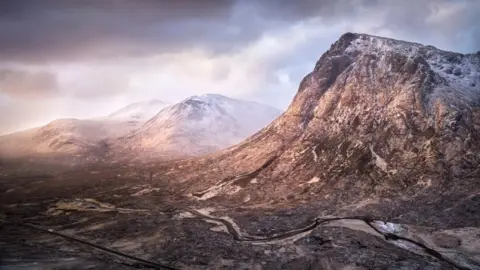
      imageDylan Nardini Mountain landscapeDylan Nardini

      Three Scottish landscape photographers and artists have collaborated for a new exhibition coming to the Highlands.

      Dylan Nardini, David Queenan and Grant Bulloch’s That Other Landscape is to open in Kingussie later this month.

      All three have been recognised in UK awards, and Nardini and Queenan are former Scottish Landscape Photographers of the Year.

      Bulloch is an architect and designer who has travelled extensively throughout Scotland. He often seeks out stormy weather for his images.

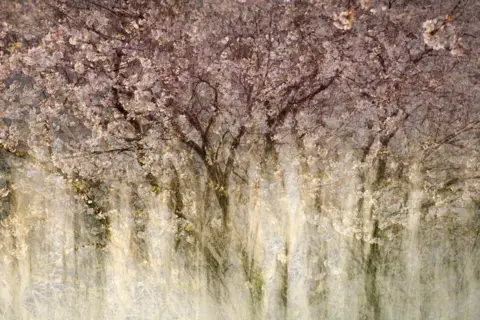
      imageDylan Nardini A photograph by Dylan NardiniDylan Nardini

      Nardini, whose father and sister are artists, uses digital and traditional film photography in his work.

      He also makes images through a technique that involves instant Polaroid pictures and watercolour paper.

      The photographer said using this process meant there was some uncertainty how the finished art might look.

      He said: “Seeing something develop in front of my eyes as it gets put on paper means the process is far more than just capturing an image.”

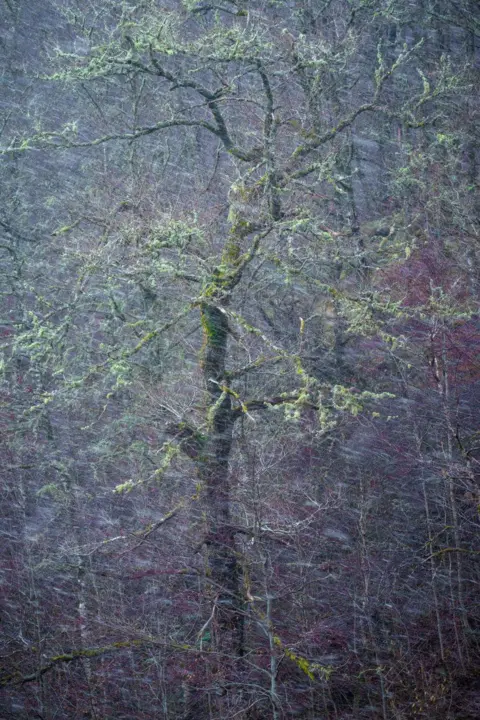
      imageGrant Bulloch Photograph of a tree in snow called Aberfeldy SnowstormGrant Bulloch

      Bulloch’s fondness for bad weather led to an image called Aberfeldy Snowstorm.

      He had to wait for a cold front to hit while in the Birks of Aberfeldy woodland in Perthshire.

      Bulloch said: “We climbed to the top of the glen hoping to be there to meet the forecasted incoming snow, but it was on our way down that the first flurries appeared.

      “I was still able to shoot across the Birks towards the lichen covered trees as they swayed and moved in the snow laden winds.”

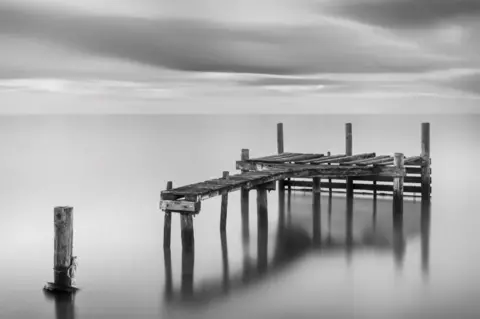
      imageDavid Queenan Photograph of Carriden PierDavid Queenan

      Queenan is based on the south shore of the River Forth.

      He said the nearby Forth Bridge and Queensferry Crossing were among his favourite subjects.

      But Carriden Pier, less than 10 minutes’ walk from his house, has been his most popular subject since lockdown.

      He has been documenting the toil weather has taken on the little wooden structure.

      The free two-week exhibition opens at Eleven41 Gallery on 28 June.

      More on this story

      Birds Star in Spectacular Scenes for This Year’s Audubon Photography Awards


      Nature
      Photography

      #birds
      #contests
      #wildlife

      June 20, 2024

      Jackie Andres

      Two Blackburnian Warblers face each other in profile, their gray and white wings outstretched behind them. Their yellow heads and orange necks stand out against a blurred gray background, and their bills and feet are entangled.

      “Blackburnian Warbler” by Mathew Malwitz, Audubon Photography Awards, 2024 Grand Prize Winner. Promised Land State Park, Pennsylvania, USA

      2024 marks the 15th year of the annual Audubon Photography Awards, which garnered over 2,300 entrants from all 50 states, Washington D.C., and 10 areas in Canada. Highlighting a wide range of skills from youth photographers to professional photojournalists, each image reveals the distinctive beauty of birds. From a Forster Tern spiraling through the air to a Sedge Wren grasping two long stems as if they were stilts, everyday spectacles are masterfully captured in high resolution.

      New this year, the Birds in Landscapes Prize showcases the relationship between avians and their environments. Kevin Lohman’s “California Quail” won this special division, capturing the feathered creature perched atop a small bush in a lush West Coast field.

      Winning photographers will be featured in the Summer 2024 edition of Audubon magazine, and in the meantime, you can find our favorite images below and delve into the full collection on the contest’s website.

      A Black-capped Chickadee clings to a single beige hook-shaped stem filled with seeds. The bird’s black legs appear to be spread at a 90-degree angle to hold the stem. The bird’s black bill is full of seeds.

      “Black-capped Chickadee and Broad-leaf Cattail” by Linda Scher, Audubon Photography Awards, 2024 Plants For Birds Winner. Wood Lake Nature Center, Richfield, Minnesota, USA

      Silhouetted grackles perch on power lines that bisect the image, with their tails nearly all pointing in the same direction. The sky is purple and pink. Through the whole of the photo are blurry figures of grackles flying through the air.

      “Great-tailed Grackle” by Tristan Vratil, Audubon Photography Awards, 2024 Amateur Winner. Corner of Slaughter Lane and Congress Avenue, Austin, Texas, USA

      A Forster’s Tern is in the air, its head turned almost 180 degrees so that its bill is pointing almost straight up, and its tail is twisted. The bird’s outstretched wings give the impression the bird is floating upside down. Water droplets appear in a stream from the bird’s bill and also below it.

      “Forster’s Tern” by Kevin Lohman, Audubon Photography Awards, 2024 Professional Honorable Mention. Shoreline Lake, Mountain View, California, USA

      A California Quail perches on top of a small bush in a field. One row of bushes and trees in the foreground is in focus, along with the quail, while other bushes are out of focus or blurred. The scene is a muted brown and orange, with layers of light and dark.

      “California Quail” by Kevin Lohman, Audubon Photography Awards, 2024 Birds in Landscapes Prize Winner. Santa Cruz, California, USA

      A tiny russet brown Sedge Wren grasps two long, parallel stems as if they were stilts. The bird’s head looks to the left of the frame. Green grasses surround the bird, and yellow flowers are at the bottom of the image.

      “Sedge Wren and Gray-head Coneflower” by Trisha Snider, Audubon Photography Awards, 2024 Plants For Birds Honorable Mention. John E Pearce Provincial Park, Wallacetown, Ontario, Canada

      A female Wild Turkey stands in profile, and her head is held high and wings are fanned out behind her. She stands between railroad tracks littered with leaves that extend into the distance.

      “Wild Turkey” by Travis Potter, Audubon Photography Awards, 2024 Female Bird Prize Winner. Travis Potter/Audubon Photography Awards/2024 Female Bird Prize Winner

      “Red-necked Grebe” by Edwin ​​Liu, Audubon Photography Awards, 2024 Youth Honorable Mention. Colonel Samuel Smith Park, Etobicoke, ON, Canada

      #birds
      #contests
      #wildlife

      Do stories and artists like this matter to you? Become a Colossal Member today and support independent arts publishing for as little as $5 per month. You’ll connect with a community of like-minded readers who are passionate about contemporary art, read articles and newsletters ad-free, sustain our interview series, get discounts and early access to our limited-edition print releases, and much more. Join now!


      Photographer Tyler Mitchell Is Juggling Two Summer Shows on Two Continents

      Photographer Tyler Mitchell Is Juggling Two Summer Shows on Two Continents
      from the magazine
      june 2024 Issue
      A survey of Mitchell’s work on view in Berlin drew over 3,000 people to the opening earlier this month. Now he’s readying a show at the High Museum of Art in his hometown of Atlanta.

      June 20, 2024

      Tyler Mitchell
      Getty Images.

      Tyler Mitchell has been making art at a breakneck pace since 2018, when he photographed Beyoncé for Vogue and became the first Black photographer to lens the cover. He joined the roster of Jack Shainman in 2020 and launched two New York exhibitions across its two Chelsea galleries in 2021. His early shows generated a great amount of excitement about the entire medium of photography, which has in recent years taken a back seat in white cubes and auction houses to painting—especially because Mitchell’s images are brimming with emotion, bursting out of the frames.

      Image may contain Adult Person Baby Clothing Formal Wear Suit Face Head Art Painting Indoors and Interior Design
      Tyler Mitchell.

      And then in late 2022, Mitchell had a show at the Gagosian empire’s outpost on Davies Street in London’s Mayfair, opening in the primo slot during Frieze. The rollicking first-night celebration for his new series of diptychs spilled out into the streets, and guests included artists such as Amy Sherald and Lauren Halsey, then British Vogue editor Edward Enninful, and CNN fixture Christiane Amanpour. By the time guests arrived at the dinner at a posh members club, the works had all sold.

      But even with that brisk ascent, the summer of 2024 is turning out to be a landmark season for the 29-year-old.

      “We’re going to be on two continents in the same month and installing and opening big shows—and let’s hope that we survive to the end,” Mitchell told me during a brief moment of calm before the summer began. “I’m just excited to see the reactions to the work and to see how it might move people. And it feels like an introduction of who I am.”

      Earlier this month a show at the German photography and visual media institution C/O Berlin officially became Mitchell’s first solo outing in the country—over 3,000 people came through the gallery’s home within what was previously the Amerika Haus during the opening on June 1. Mitchell’s “Wish This Was Real” includes work from 2015 to now, but there’s also a section of curated work by Mitchell’s friends and contemporaries, including Rashid Johnson, Garrett Bradley, Grace Wales Bonner, and Loretta Pettway Bennett of the Gee’s Bend Quiltmakers.

      Image may contain Machine Wheel Person Adult Bicycle Transportation Vehicle Clothing Coat Racket Sport and Tennis
      Tyler Mitchell.

      “I wanted to put my work in proximity of other practitioners, for a German audience, to convey the lineage of not only Black image makers and photographers, but Black artists and the multiple modes of expression that are possible around contemporary ideas of Black life,” he said.

      But especially close to Mitchell’s heart is the show “Tyler Mitchell: Idyllic Space,” opening this week at the High Museum of Art in his native Atlanta—a show that will focus on how, even though his studio’s in New York, the ethos of his image making is rooted in the American South.

      “It’s the city I grew up in, the museum that I grew up going to as a kid, so when you have that, it’s a completely different story to tell,” he said. “The High Museum has been a huge, huge, huge goal of mine since I started showing.”

      The show also includes what Mitchell calls a sculptural piece consisting of images all produced as part of a conceptual nod to the kind of studio photography pioneered by the Harlem Renaissance artist James Van Der Zee—one that amounts to a sprawling investigation of a slice of the Black community in Atlanta. Working within the context of traditional studio portraiture, Mitchell photographed 25 families involved in the long-standing local chapter of the Jack and Jill of America, the oldest African American–led nonprofit organization in the country. Jack and Jill is a deeply important developmental force for local Black youth, but Mitchell was fascinated by the fact that it still practices outmoded social functions such as debutante and cotillion balls and encouraged members to approach the portrait sittings “presenting themselves to me as they want.”

      Image may contain Body Part Finger Hand Person Accessories Adult Jewelry and Ring
      Tyler Mitchell.

      “So it becomes this kind of strange love letter to the community I grew up in, but also a sort of critique, a sort of critique of respectability and presentation as it relates to Black Southern life, the sort of gentleness and politeness that lays underneath the way we choose to present ourselves,” he said. “And that is all kind of going on underneath the surface of these portraits of those families.”

      The show is a big deal not just for Mitchell, but for the High Museum itself. The artist has spent the last few years working with senior curator of modern and contemporary art Michael Rooks to do something groundbreaking: He’ll have the first-ever full photography show installed in the museum’s Stent Wing Special Exhibition galleries.

      “Not that anything’s wrong with the photography galleries in the museum, but I often push back against the idea that, as a photographer, we’re sort of relegated to a dark underlit basement,” he said. “Seeing my show in proximity to, let’s just say, a painting show next door, or the European collections next door, could create some interesting conflicts and dialogues.”

      2024 Audubon Photography Awards Celebrates Beauty of Birds

      2024 Audubon Photography Awards Celebrates Beauty of Birds
      ​​Two Blackburnian Warblers face each other in profile, their gray and white wings outstretched behind them.

      Blackburnian Warbler by Mathew Malwitz/Audubon Photography Awards/2024 Grand Prize Winner
      Location: Promised Land State Park, Pennsylvania, USA
      “​​Two Blackburnian Warblers face each other in profile; their gray and white wings outstretched behind them. Their yellow heads and orange necks stand out against a blurred gray background, and their bills and feet are entangled.”

      Now in its 15th year, the Audubon Photography Awards is celebrating the magic of bird photography. Run by the National Audubon Society, the competition is open to professional and amateur photographers of all ages. This year, Mathew Malwitz came away with the top prize for his delightful portrait of two Blackburnian warblers facing each other in a wonderful symmetrical pose.

      Last year’s grand prize winner, Liron Gertsman, was once again celebrated this year. His interesting photo of a flock of willow ptarmigans in flight, with their white feathers melting into the white sky, won the professional category. These winning entries were chosen from more than 2,300 entrants from all 50 U.S. states, nine Canadian provinces, and one territory.

      The photo contest has also expanded its scope, adding the Birds in Landscapes Prize for the first time. Designed to draw attention to how birds connect with their broader surroundings, the inaugural prize was handed out to Kevin Lohman for an atmospheric photo of a California quail perched on a small bush in a field.

      Sadly, birds like the California quail and the Blackburnian warbler are facing increasing obstacles to their survival. The National Audubon Society’s climate science report, Survival by Degrees, states that two-thirds of North American birds are facing extinction due to climate change. A special climate change visualizer even lets you see how the birds in your area will be impacted.

      By taking in these photos and learning more about what the future holds, there’s even more motivation to make the necessary changes on a small and large scale to delay the effects of climate change.

      Here are the winners of the 2024 Audubon Photography Awards, which celebrates exceptional bird photography.

      A Forster’s Tern is in the air, its head turned almost 180 degrees so that its bill is pointing almost straight up, and its tail is twisted.A Forster’s Tern is in the air, its head turned almost 180 degrees so that its bill is pointing almost straight up, and its tail is twisted.

      Forster’s Tern by Kevin Lohman/Audubon Photography Awards/2024 Professional Honorable Mention
      Location: Shoreline Lake, Mountain View, California, USA
      “A Forster’s Tern is in the air, its head turned almost 180 degrees so that its bill is pointing almost straight up, and its tail is twisted. The bird’s outstretched wings give the impression the bird is floating upside down. Water droplets appear in a stream from the bird’s bill and also below it.”

      ​​Seven Willow Ptarmigan are staggered throughout the image in various stages of flight​​Seven Willow Ptarmigan are staggered throughout the image in various stages of flight

      Willow Ptarmigan by Liron Gertsman/Audubon Photography Awards/2024 Professional Winner
      Location: Kluane National Park, Yukon, Canada
      “Seven Willow Ptarmigan are staggered throughout the image. Each is in various stages of flight. Their white bodies blend in with the completely white background; only their black eyes, bills, and tail feathers stand out.”

      A Barred Owl hangs upside down from a thin tree branch, its body horizontal, its face turned and looking at the camera. Above it hangs a squirrel on a branch.A Barred Owl hangs upside down from a thin tree branch, its body horizontal, its face turned and looking at the camera. Above it hangs a squirrel on a branch.

      Barred Owl by Erin Boisvert/Audubon Photography Awards/2024 Amateur Honorable Mention
      Location: Deep Brook Preserve. Newtown, CT, USA
      “A Barred Owl hangs upside down from a thin tree branch, its body horizontal, its face turned and looking at the camera. Above it hangs a squirrel on a branch. Its head is nearly completely severed and is held in the owl’s talons. Its fur is bloodied.”

      Two adult Red-necked Grebes face each other in the water.Two adult Red-necked Grebes face each other in the water.

      Red-necked Grebe by Edwin ​​Liu/Audubon Photography Awards/2024 Youth Honorable Mention
      Location: Colonel Samuel Smith Park, Etobicoke, ON, Canada
      “Two adult Red-necked Grebes face each other in the water. The entire grebe’s body on the right is visible, and two black and white-headed chicks sit on its back. One is leaning to receive a small fish from the bill of the parent.”

      A tiny russet brown Sedge Wren grasps two long, parallel stems as if they were stilts.A tiny russet brown Sedge Wren grasps two long, parallel stems as if they were stilts.

      Sedge Wren and Gray-head Coneflower by Trisha Snider/Audubon Photography Awards/2024 Plants For Birds Honorable Mention
      Location: John E Pearce Provincial Park, Wallacetown, Ontario, Canada
      “A tiny russet brown Sedge Wren grasps two long, parallel stems as if they were stilts. The bird’s head looks to the left of the frame. Green grasses surround the bird, and yellow flowers are at the bottom of the image.”

      n American Kestrel stands on a post in profile, and a male kestrel is on her back with his wings stretched behind himn American Kestrel stands on a post in profile, and a male kestrel is on her back with his wings stretched behind him

      American Kestrel by Parham Pourahmad/Audubon Photography Awards/2024 Youth Winner
      Location: Calero County Park, San Jose, California, USA
      “An American Kestrel stands on a post in profile, and a male kestrel is on her back with his wings stretched behind him. The birds are both in profile facing the left of the frame, the male above appearing to be an extension of the female below.”

      A Black-capped Chickadee clings to a single beige hook-shaped stem filled with seeds.A Black-capped Chickadee clings to a single beige hook-shaped stem filled with seeds.

      Black-capped Chickadee and Broad-leaf Cattail by Linda Scher/Audubon Photography Awards/2024 Plants For Birds Winner
      Location: Wood Lake Nature Center, Richfield, Minnesota, USA
      “A Black-capped Chickadee clings to a single beige hook-shaped stem filled with seeds. The bird’s black legs appear to be spread at a 90-degree angle to hold the stem. The bird’s black bill is full of seeds.”

      A female Wild Turkey stands in profile, and her head is held high and wings are fanned out behind her.A female Wild Turkey stands in profile, and her head is held high and wings are fanned out behind her.

      Wild Turkey by Travis Potter/Audubon Photography Awards/2024 Female Bird Prize Winner
      Location: Roseville, Minnesota, USA
      “A female Wild Turkey stands in profile, and her head is held high and wings are fanned out behind her. She stands between railroad tracks littered with leaves that extend into the distance.”

      Common Gallinule’s green feet stick straight out of the surface of water, while its body is submerged and not visible.Common Gallinule’s green feet stick straight out of the surface of water, while its body is submerged and not visible.

      Common Gallinule by Douglas DeFelice/Audubon Photography Awards/2024 Fisher Prize Winner
      Location: Tarpon Springs, FL
      “A Common Gallinule’s green feet stick straight out of the surface of water, while its body is submerged and not visible. Splashes of water are outlined in gold against a black background and dark surface, making it difficult to distinguish between the feet and water.”

      A California Quail perches on top of a small bush in a field. The scene is a muted brown and orange, with layers of light and dark.A California Quail perches on top of a small bush in a field. The scene is a muted brown and orange, with layers of light and dark.

      California Quail by Kevin Lohman/Audubon Photography Awards/2024 Birds in Landscapes Prize Winner
      Location: Santa Cruz, California, USA
      “A California Quail perches on top of a small bush in a field. One row of bushes and trees in the foreground is in focus, along with the quail, while other bushes are out of focus or blurred. The scene is a muted brown and orange, with layers of light and dark.”

      Silhouetted grackles perch on power lines that bisect the image, with their tails nearly all pointing in the same direction.Silhouetted grackles perch on power lines that bisect the image, with their tails nearly all pointing in the same direction.

      Great-tailed Grackle by Tristan Vratil/Audubon Photography Awards/2024 Amateur Winner
      Location: Corner of Slaughter Lane and Congress Avenue, Austin, Texas, USA
      “Silhouetted grackles perch on power lines that bisect the image, with their tails nearly all pointing in the same direction. The sky is purple and pink. Through the whole of the photo are blurry figures of grackles flying through the air.”

      National Audubon Society: Website | Facebook | Instagram

      My Modern Met granted permission to feature photos by the National Audubon Society.

      Related Articles:

      Stunning Portraits of Rare and Endangered Birds Full of Personality

      Bird Photography Contest Celebrates the Unique Diversity of Australia’s Wildlife

      Peregrine Falcon Fiercely Defending Her Nest Wins Bird Photography Competition

      The 2024 Audubon Photography Awards

      The 2024 Audubon Photography Awards
      image

      The winners of the 15th annual Audubon Photography Awards were just announced. Photographers competed for nine prizes, submitting more than 2,300 entries depicting birdlife from all 50 U.S. states and nine Canadian provinces and territories. The National Audubon Society was once again kind enough to share some of the winning photographs with us.

      To receive an email notification every time new photo stories are published, sign up here.

      12 Beautiful Photos Of Birds, Winners Of Audubon Photography Awards 2024

      12 Beautiful Photos Of Birds, Winners Of Audubon Photography Awards 2024
      image

      The National Audubon Society has announced the winners of its 2024 Photography Awards that, among other amazing images, include photos of birds threatened with extinction.

      Now in its fifteenth year, the contest features stunning work from professionals, amateurs and young people that highlights the beauty of birds and the joy of capturing it through photographs and videos.

      Winning entries and honorable mentions were chosen from more than 2,300 entrants from all 50 states, Washington, D.C., nine Canadian provinces and one territory. For the first time, the competition awarded the Birds in Landscapes Prize, which was introduced to draw attention to how birds connect with their broader surroundings.

      The Grand Prize of $5,000 was awarded to photographer Mathew Malwitz for his shot of a battle between two Blackburnian Warblers, which is one of the endangered species.

      Whether the setting is wild, urban, or suburban, or the relationship is symbiotic or reflects a specific challenge birds face, the prize encourages photographers to take a step back, consider the environment as a whole, then let their photographs tell the story.

      Audubon’s report, Survival by Degrees, reveals that two-thirds of North American birds are threatened with extinction from climate change, including species featured in this year’s Audubon Photography Awards such as the California Quail and Sedge Wren, in addition to the Blackburnian Warbler.

      The next contest begins October 24 and ends February 28, 2025.

      All the winners and honorable mentions can be seen here.

      Taken in Promised Land State Park, Pennsylvania, two Blackburnian Warblers face each other, their gray and white wings outstretched behind them. Their yellow heads and orange necks stand out against a blurred gray background and their bills and feet are entangled.

      Seven Willow Ptarmigan race through the image, each in a different stage of flight. Their white bodies blend in with the completely white background, while only their black eyes, bills and tail feathers stand out.

      A Forster’s Tern is captured in the air, its head turned almost 180 degrees so that its bill is pointing nearly straight up, its tail twisted. The bird’s outstretched wings give the impression the bird is floating upside down. Water droplets appear in a stream from the bird’s bill and also below it.

      Silhouetted grackles perch on power lines that bisect the image, with their tails nearly all pointing in the same direction. The sky is purple and pink. Throughout the photo, blurry grackles fly through the air.

      A Barred Owl hangs upside down from a thin tree branch, its body horizontal, its face turned and looking at the camera. A squirrel hangs on a branch above it — its fur bloody and its head nearly severed and held in the owl’s talons.

      A Black-capped Chickadee clings to a single beige, hook-shaped stem filled with seeds. The bird’s black legs appear to be spread at a 90-degree angle to hold the stem. The bird’s black bill is full of seeds.

      A tiny russet brown Sedge Wren grasps two long, parallel stems as if they were stilts. The bird’s head looks to the left of the frame. Green grasses surround the bird, and yellow flowers line the lower image.

      An American Kestrel stands on a post in profile, and a male kestrel is on her back with his wings stretched behind him. The birds are both in profile facing the left of the frame, the male above appearing to be an extension of the female below.

      A female Wild Turkey stands in profile, her head held high and wings fanned out behind her. She stands between railroad tracks littered with leaves that extend into the distance.

      A California Quail perches on top of a small bush in a field. One row of bushes and trees in the foreground is in focus, along with the quail, while other bushes are out of focus or blurred. The scene is a muted brown and orange, with layers of light and dark.

      A Common Gallinule’s green feet stick straight out of the water while its body is submerged and not visible. Splashes of water are outlined in gold against a black background and dark surface.

      Lake Metroparks’ ‘Photography Contest & Show’ hands out awards

      Lake Metroparks’ ‘Photography Contest & Show’ hands out awards

      Summer is officially here, and the pools are open. What goes well with pool time? If you are an artist, watercolors surely come to mind. If you happen to have a cool, shady spot, paint outdoors. If not, find one. Our parks have stairways and terraced trails leading to the cool creeks and streams.

      Take your camera and sketchbook on a woodland walk. Pick a comfy log or rock, settle in and just be still.

      Listen. Look.

      Life will start to appear around you. Look for details on the logs and rocks. Let your hand choose loose flowing strokes to capture the feel and mood of the environment. Make notes to remind you of the smells and colors and the way they make you feel.

      Your notes will remind you of how you felt you when you were “in the moment.” Being able to put that feeling into your artwork is a priceless gift and needs to be nurtured — a delightful task for a lazy summer day.

      By this time, you should be ready for some air conditioning.

      Calls are out for artists able to bring the viewer into the experience of creating as they look into the artwork. I saw a couple of shows just this week that included several feels-like-you-are-there pieces. Details to follow.

      Penitentiary Glen

      Lake Metroparks’ 37th annual “Amateur Photography Contest & Show” is open for viewing through Aug. 4 at Penitentiary Glen Reservation, 8668 Kirtland-Chardon Road, Kirtland.

      I was a judge, as was Maria Perme, Maria Perme Photography and Roni Leatherman, Roni Leatherman Photography. This year’s show had 129 entries from 56 participants. Only four of them were juniors — 14 or younger. It’s a number we’d all like to see increase.

      The Best of Show winner in the Adult division is Doug Wilson, and the Best of Show winner in the Junior division is Branson Porter.

      The contest also named winners in several categories:

      — in Lake Metroparks: Stewart Unsdorfer, first place; Rob Lewis, second place; Linda Janosko, third place; John Venen, honorable mention; and Sebastian Knez, honorable mention.

      — in Lake Erie: Emily Zerecheck, first place; Nic Cassell-Greene, second place; Earl Linaburg, third place; and Lana Andriyenko, Sarah Komaromy and Jay Joseph, honorable mentions.

      — in Wildlife: Gary Wright. first place; Doug Wilson, second place; Jim Legat, third place; and Dwight Boyer, Alexandria Novak, Jacquelyn Leach, Ty Whiting and Tony Gazso, honorable mentions.

      Photos in the Wildlife category of Lake Metroparks’ 37th annual “Amateur Photography Contest & Show” hang at Penitentiary Glen Reservation in Kirtland. (Courtesy of Lake Metroparks)

      — In Landscape: Grace Eapen, first place; Alexandria Novak, second place; Stewart Unsdorfer, third place; and Heather Barninger, Jacqueline Sprenger and Emily Zerecheck, honorable mentions.

      — In Black & White: Doug Wilson, first place; Gary Wright, second place; Christy Buser, third place; and Linda Kelley, Evan Brzeczkowski and Taylor Stanley, honorable mentions.

      — in Floral: Gary Wright, first place; Raymond Rundelli, second place; Heather Barninger, third place; and Roger Lokar, Evan Brzeczkowski, Sarah Komaromy and Aaron Knight, honorable mentions.

      — in the Junior Division, which included all the above categories: Branson Porter, first place; Emma Gooden, second place; Brooklyn Amato, third place; Brooklyn Amato and James Komaromy, honorable mentions.

      Wildwood Fine Art & Wine Festival

      Enjoy the Wildwood Fine Arts & Wine Festival from noon to 6 p.m. on June 22 on the shady grounds of the Wildwood estate,7645 Little Mountain Road, Mentor. Learn more about the event or become a volunteer by calling 440-974-5735 or emailing wildwood@cityofmentor.com.

      Stella’s Art Gallery

      Stella’s Art Gallery, 38033 Euclid Ave., Willoughby, opened the first of a double show in the main gallery last weekend. This first exhibit, “Size Matters,” began with the artists’ awards reception.

      Congratulations to Rickie Denes, the Best of Show winner.

      The winners in Tiny Bits, no larger than 4 by 6 inches, are Tracy Zakaysek, first place; Nancy Nelson Brotz, second place; and Linda Janosko, third place.

      The winners in Medium Muscle, between 8 by 10 inches and 12 by 16 inches, are Gregory Johnson, first place; Nancy Nelson Brotz, second place; and Wendy Playter, third place.

      The winners in Living Large, for artworks 18 by 24 inches or larger, are Becky Grasser, first place; Heather Hayden, second place; and Anna and Sam Weisend, third place.

      The second show, “Ekphrastic Poetry,” calls for the art of the word. Writers are to select and confirm their choice of artwork from the exhibit before June 27. Only one author per art piece is permitted. Writers will express their feelings or reactions to this specific piece, and it will join its inspiration on the gallery walls.

      All are invited to the open-mic reading in the gallery from 7 to 9 p.m. on June 28. Cleveland Heights Poet Laureate Ray McNiece will jury the writings.

      The July show is “Opposites Attract?” You decide between the two categories, Abstract and Realism, as both will fill the gallery with their opposing points of view.

      Abstract is art that does not represent reality but uses colors, shapes and textures to present an appealing image. Realism features art that depicts everyday life in a naturalistic manner and can reach the point of appearing to be a photographic image.

      All mediums are welcome. Art will be accepted from 11:30 a.m. to 5:30 p.m. on July 2 and 3 and from 11:30 a.m. to 7:30 p.m. on July 6.

      For more information, visit StellasArtGallery.com or call 440-266-9111.

      Ashtabula Arts Center

      Entry is open for the 2024 Paul & Norma Tikkanen Painting Prize. Interest has grown as news spreads of this $40,000 competition. The first-place prize is $12,000 in both abstract and realist painting. There are also two $5,000 second-place prizes and up to four honorable mentions, $1,000 each.

      Paintings must have been completed in the past three years, and the contest is open to artists from Ashtabula, Cuyahoga, Geauga, Lake, Lorain, Mahoning, Medina, Portage, Summit and Trumbull counties. It is also open to artists from Pennsylvania counties Crawford, Erie, Lawrence and Mercer. Maximum size is 4 by 4 feet and 25 pounds.

      The first round of submissions will done digitally and must be received by July 14.

      Entry details and a link to entry are available at ashtabulaartscenter.org. Good luck, everyone!

      Fairmount Center for the Arts

      Fairmount Center for the Arts, 8400 Fairmount Road, Russell Township, is looking for artists to enter the 48th annual “Fairmount Art Exhibit,” set to open Aug. 6.

      Submissions are being accepted online and will be accepted at the center on July 27 and 29. Get details at fairmountcenter.org or 440-338-3171.