Photography

Georg Baselitz’s erotic prints and the world’s best photography portraits – the week in art

Georg Baselitz’s erotic prints and the world’s best photography portraits – the week in art

Exhibition of the week

Georg Baselitz: Belle Haleine
Witty, provocative and accomplished erotica by the great German artist.
Cristea Roberts, London, until 22 December

Also showing

New Blavatnik Art, Film and Photography Galleries
Artistic responses to the horrors of war, as collected and commissioned by this uneasy museum of the modern world.
Imperial War Museum, London, from 10 November

Rebecca Salter and James Gillray
The current president of the Royal Academy of Arts and scabrous satirist Gillray show at the home of one of Britain’s greatest artists.
Gainsborough’s House, Sudbury from 11 November until 10 March

Discover Liotard and the Lavergne Family Breakfast
A close look at key works by the 18th-century Swiss painter Jean-Etienne Liotard.
National Gallery, London, from 16 November until 3 March

Taylor-Wessing Photo Portrait prize
See the winners and also-rans in this roundup of what’s happening in photographic portraiture. What sets these pics apart from your own selfies?
National Portrait Gallery, London, until 25 February

Image of the week

An Edible Family in a Mobile Home by Bobby Baker, recreated for the first time, since the original piece was created in 1976.

From women crying out in labour pain to a family made of meringue (above), the Women in Revolt! show at Tate Britain, London, is full of wit and collective anger. It couldn’t be more timely, says Adrian Searle. Read his full review.

What we learned

A US museum postponed an Islamic art exhibition because of the Israel-Hamas war

Picasso’s paintings can still fetch a pretty penny

Seaweed can be turned into high fashion, art, even shoes

A splash of colour can bring the most abandoned houses back to life

You can travel the world without leaving Wales thanks an art extravaganza

Aged 85, Arvie Smith is ‘flexing his muscles’ and taking on New York

You can learn a lot about famous paintings by looking at their backs and frames

Sir Peter Blake is excited by the ‘magic’ possibilities of AI in art

Masterpiece of the week

The Origin of the Milky Way by Jacopo Tintoretto, c1575

The Origin of the Milky Way, ca. 1575. Artist: Tintoretto, Jacopo (1518-1594)

The Venetian painter Tintoretto was a sceptic about Greek mythology. A deeply religious man, he often suggests these old stories of gods and lovers are a bit silly. In his version of Leda and the Swan, for instance, in which Jupiter takes the form of a swan to have a surreal sexual encounter, he depicts Leda with a collection of other animals waiting in her bedroom. But here he plays it straight, inspired and exhilarated by the myth that the Milky Way, our galaxy, is actually a trail of divine milk spilt by the goddess Juno. This cosmic origin story is played out in a flowing cascade of floating silks and silvery clouds in the deep blue sky where the gods circle one another as majestically as planets.
National Gallery, London

Don’t forget

To follow us on X (Twitter): @GdnArtandDesign.

Sign up to the Art Weekly newsletter

If you don’t already receive our regular roundup of art and design news via email, please sign up here.

Get in Touch

If you have any questions or comments about any of our newsletters please email newsletters@theguardian.com

Ghost In The Machine – A Paranormal Photography Collection

Ghost In The Machine – A Paranormal Photography Collection

Gen X and Boomers might think that this article’s heading is a reference to the smash hit album by the English band, The Police. However, it’s actually the title of a new physical-digital project from Candy Digital and Getty Images, looking at the history and impact of paranormal photography. This is the latest in a series of initiatives from these companies who have partnered on three other successful projects.

What Is Paranormal Photography

A stereoscopic view from the London Stereoscopic Co. Along with Spirit Photography, the late 19th century was a popular time for Stereo views. These photographs were produced by a single camera with two lenses placed roughly the same distance apart as the human eye. The glass plates were printed on heavy card stock with elegant embellishments and branding. The cards were placed in a wooden holder that looked strikingly similar to modern VR goggles. The holder, which had a divider, caused viewers to look at each image on the card separately and simultaneously. The human brain, which naturally combines separate views into a single image, ‘sees’ a 3D image. (Photo by London Stereoscopic Company/Hulton Archive/Getty Images)

The term paranormal is often used to describe occurrences and phenomena that fall outside the realm of what’s considered normal in everyday life. For me, every episode of the TV show The X Files has been the perfect on-screen portrayal of this. This show genuinely piqued the curiosity of millions in the 90s. But an obsession with the paranormal has been something that humans have been practicing, researching, and documenting for centuries now. Delving into the supernatural, paranormal photography (not to be confused with spirit photography) attempts to capture images of unexplainable phenomena. People often practice this to win over skeptics and to provide firm ground for those who challenge conventional scientific understanding. It offers a glimpse into the supernatural, challenging the boundaries of our conventional understanding of the dead.

Such photographs are now considered to be steeped in rich historical and cultural contexts. They often tend to invite debates and discussions over their authenticity, challenging skeptics and offering half-believers of the supernatural a lifeline to clutch onto. And of course, there’s the thrill of capturing something that very few humans (claim to successfully) have done.

What Tools Are Often Used

Image by Flickr user WCGAPS; used under Creative Commons License

Standard camera equipment is often unable to photograph the paranormal. Photographers have often used a diverse array of tools and equipment, each with a specific purpose, to prove the existence of spirits. These range from ultraviolet and infrared photography cameras to even long exposures methods in order to try and capture elusive supernatural beings. And unlike nowadays when many of these tools are easily purchasable, things were a lot tougher at the start. These days, no serious paranormal photographer would head out without an Electro Magnetic Field meter. Thermal imaging cameras and motion sensors are among some of the other tools that aid such photographers. Early spirit photographers would even try stereoscopic techniques to immerse the viewer into their spooky creations.

The Early Years

This scene captured in Paris ca. 1900 shows a table being lifted off the ground by spirits from beyond. The body language here is one of skepticism—a frequent charge leveled against practitioners. Scientists, journalists, and other non-believers were often invited to attend seances, and while many mediums were proven to be frauds, there were a handful that convinced witnesses they were indeed capable of communing with the dead. (Photo by General Photographic Agency/Getty Images)

Throughout history, humans have sought to document and understand the paranormal. A global interest in photography began to rise in the mid-19th century. This was not long after the first documented photograph was taken in France. Incidentally, so did a fascination with spiritualism – a belief that the deceased moved into the afterlife, but still continued, on some level, to maintain contact with the living world.

A chance double-exposure accident in the darkroom led William H. Mumler to invent and become well-known in the field of “spirit photography.” Effectively this was double exposure photography done right for that era. A skill he would later master and milk for his own good, preying on those grieving for their loved ones. Mumler became well known for being able to “capture the spirits” of dead relatives or even strangers in the same frame as living subjects. One of his most famous subjects was Mary Ann Todd Lincoln, the former First Lady of the United States. The gig went on successfully for a couple of years. Until one such subject recognized the “spirit” alongside him in the photograph as being someone who was quite alive.

Capturing The Unseen With Paranormal Photography

That photograph effectively killed Mumler’s career as a spirit photographer. However, countless others since then haven’t given up on the pursuit of trying to photograph what’s commonly invisible to the naked eye. Such paranormal photographers combine scientific and artistic elements to try and capture phenomena that push the boundaries of reality. Skeptics of this genre have often argued that what shows up in these images is unambiguous. Or they blame it on a combination of camera trickery and visual artifacts. That hasn’t stopped more and more people from trying each year to photograph, and now videograph what they believe to be the existence of ghosts and apparitions from other dimensions. Of course, for each such photographer, countless debunkers pop up too

Ghost In The Machine

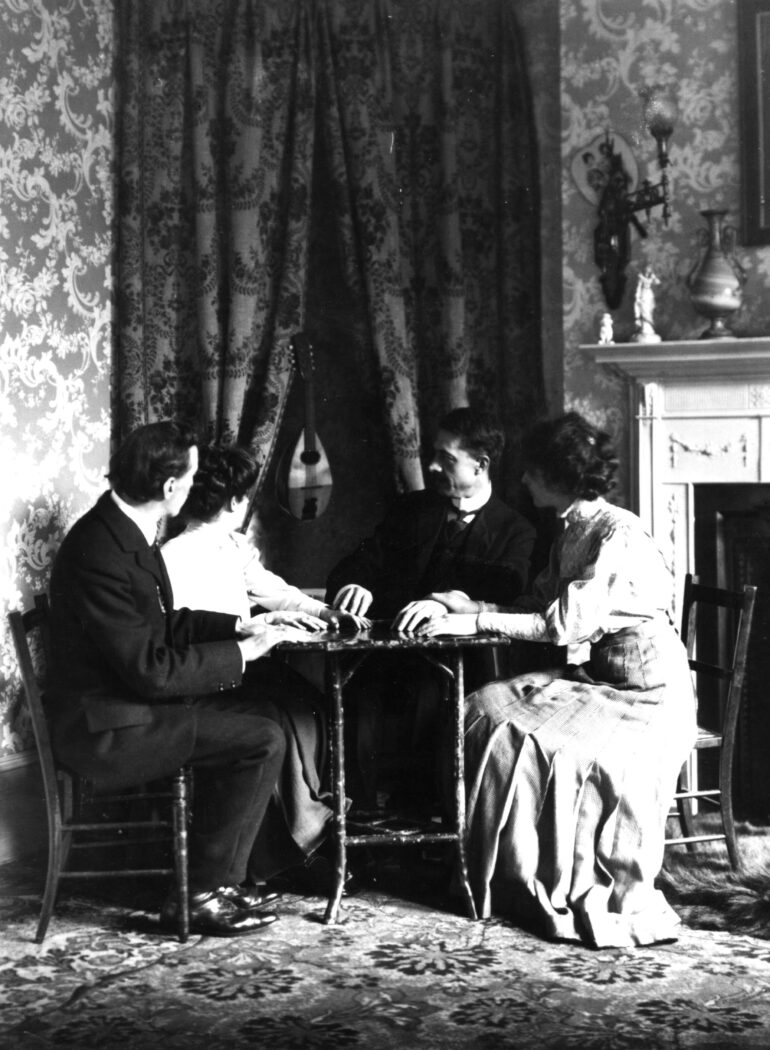
Seances are an integral part of Spiritualism and the main vehicle for communicating with the dead. Throughout the second half of the 19th century, mediums began increasing the visual spectacle to keep their audiences interested. Objects in the room would begin to levitate or musical instruments would begin to play themselves—or as in the case of this image, both at the same time. (Photo by Mills/Hulton Archive/Getty Images)

Candy Digital and Getty Images have teamed up to explore how blockchain technology can be used to safeguard significant art movements. This partnership reflects their dedication to finding creative ways to protect and document these historical and artistic milestones. The fourth collaborative initiative between them, Ghost In The Machine, is an image collection that takes a look at the early years of spirit photography in the 19th century, as well as some 20th-century work.

“You can see the undead among us, if you’re willing to look.”

Ghost In The Machine

Twenty such archival images are made available in this paranormal photography collection. Some from the Hulton Archive have never been released before. This is also the first first physical-digital project between these two organizations. The collection also features a zine titled Nightmare Logic, and a digital exhibition that explores the impact of spirit photography through the work of contemporary artists. Collectors can purchase historic physical-digital artworks until November 27th. The images cost just USD 75 for digital editions and USD 225 for a digital edition with a 9.5” x 14” print (framed with a 15” x 19.5” black frame, and a white top mat.)

What Do You Believe?

The specter of a young woman floats over a sleeping child in this scene from 1860. The image, equal parts haunting and innocent, was produced by the London Stereoscopic Company, the world’s first commercial photo agency. LSC, as it is known, produced photographs across a variety of themes and subjects for the purpose of editorial licensing. The fact that LSC was producing a series on Spiritualism (notice the ’16’ in the lower right corner) proves widespread public interest in the subject. (Photo by London Stereoscopic Company/Hulton Archive/Getty Images)

Technology has advanced greatly since that first spirit photo by Mumler in the 1860s, but the fascination with the paranormal has anything but dwindled. As you peer at a paranormal photograph and pore over it closely to wonder how much of it is real, you can’t help but think about the intriguing and thought-provoking questions that went through the minds of the photographers behind the images in this collection. What could have made them want to start photographing the unseen? What was that one incident that made them want to showcase the worlds that many of us go without seeing? Whether you’re a fervent believer in this or a cynic, the allure of paranormal photography is a testament to our undying curiosity about the mysteries that surround and spook us. After all, for many of us, seeing is the only form of believing.

All images here, unless mentioned otherwise, have been provided to The Phoblographer by Getty Images, for usage within this article.

Small artwork, photography featured on Second Saturday

Small artwork, photography featured on Second Saturday

PORT ANGELES — The Harbor Art Gallery will present a “Small Works Show” while Studio Bob is presenting a photography show this weekend during the Port Angeles Second Saturday Art Walk.

Many members of the artist collective at Harbor Art Gallery, 114 N. Laurel St., who have created delicate, diminutive and affordable works, will be on hand from 4 p.m. to 7 p.m. on Saturday.

Studio Bob at 118½ E. Front St., will host a reception from 5 p.m. to 8 p.m. Saturday with live music featuring Tin Sandwich and Guests, followed by an additional showing from noon to 3 p.m. Sunday featuring ekphrastic poetry beginning at 1 p.m.

Harbor Art

Harbor Art Gallery’s November show of small works is open for viewing from 11 a.m. to 4 p.m. Tuesday through Saturday, in addition to this Saturday’s art walk.

“It’s a great time of year to check out the gallery,” said Terri Enck, a mixed media sculptor and ceramicist.

The gallery has welcomed new artists in recent months, including painter Andrèa Woods and bronze sculptor Katie Graham.

“I like the spontaneity that the Small Works Show encourages in everyone,” said Randy Radock, a printmaker.

Other local artists showcased at Harbor Art Gallery are Bob Stokes, Cindy Elstrom, Carolyn Guske, Robert Amaral, Garret DeLaBarre, Katie Graham, Tammy Hall, Susan Kantowitz, Nancy McFaul, Gail McLain, Roger Mosley, Eric Neurath, Miranda Petruska, Sallie Radock, Jodi Riverstone, Nathan Shields, Lance and Haley Snider, Eileen Webb and Kevin Willson.

For more information, see https://www.facebook.com/harborartgallery.

Studio Bob

Studio Bob’s Second Weekend Art Opening show, “Anything Goes,” features the photography of Olympic Peaks Camera Club with Lewis Bennett, Bruce Fryxell, Ed Hartman, Dana Martell, Sasha Parrott, Daniel Parrott, Phil Tenault, Kevin Talbot and Susan White.

The Olympic Peaks Camera Club (OPCC) was established in Sequim in 1982. OPCC’s mission is to connect, educate and support photographers from beginner to professional across the North Olympic Peninsula, including Sequim, Port Angeles, Port Townsend and surrounding areas.

Tin Sandwich, made up of Marilyn, Marty and Mochi Kaler, is a regular live music guest at the Saturday Second Weekend Art Openings at Studio Bob. It offers covers and originals.

The Ekphrastic Poets are poets within The Olympic Peninsula Authors, who gather regularly at special art openings to recite pieces composed for the occasion.

The onsite Loom Bar will be open with appetizer plates, mocktails, wine, beers and ciders. The Loom has regular hours of 4 p.m. to 8 p.m. every Thursday, Friday and Saturday.

For more information, see https://studiobob.art.

Scottsdale photographer displays passion for cars

Scottsdale photographer displays passion for cars

 Scottsdale photographer Bill Pack has been described as “an artist with the soul of a sculptor and the eye of a designer.”

And people who can get to the Showcases Exhibition at the Indianapolis Motor Speedway Museum this month will see why.

His “Painting With Light” exhibit shows off his stunning photos of 34 cars that won the Indy 500, reflecting his passion for race cars and automotive art and design.

The exhibition mirrors Pack’s book, “Epic Drama,” which depicts 34 Indy 500-winning cars. The exhibit is in its final weeks at the Speedway Museum, which is closing until April 2025 for an extensive renovation.

“The concept of ‘Painting With Light’ is not entirely new and traces its roots back to the earliest days of studio photography,” Pack said. 

“What I’ve done over the years is meticulously refine and adapt this technique to achieve unparalleled mastery over my lighting.”

Pack differentiates his photographic style from “big-box lighting that dominates traditional commercial car photography.”

His goal is to transform the car “from a mere mechanical entity into an artistic masterpiece” by orchestrating light, shadow and texture so that each image “tells a compelling narrative.”

“Lighting is everything and is nothing short of magical,” said Pack. “It invites you to actively discover and see the car from a different point of view. These are the images that will long resonate with viewers long after they are seen.”

Pack’s work has led to collaborations and conversations with luminaries like Roger Penske, Jay Leno, and Mohammed Ben Sulayem, as well as private collectors worldwide. 

It has also been celebrated at prestigious Concours events at Amelia Island and Pebble Beach and taken him to picturesque locations in Paris and the United Kingdom.

“I’m thrilled to share a special project that’s currently underway. My creative collaborator and I have been commissioned to create a bespoke book detailing part of Roger Penske’s exclusive car collection. It’s truly an honor and privilege to work closely with such an eminent figure like Roger on this endeavor,” he said. 

Publicist Holly Morgan said OPack’s work instills interior designers with “a sense of movement, history, and passion.”

“His pieces can act as a focal point in a room and serve as a perfect complement, adding a layer of richness and depth,” Morgan said. “His work encourages designers to think outside the box, pushing the boundaries of traditional art placement and inviting conversation and admiration.”

Pack’s career in automotive photography began with an emphasis on advertising, collaborating with clients such as Apple Computer, Del Monte Foods, Visa, and others. 

Over time, his approach to lighting and design became the foundation of his automotive imagery. In 2015, Pack’s focus shifted exclusively to post-war cars from the 1950s and 1960s, particularly the Italian V12s. 

This inspired the name of his company, V12 Enterprises, reflecting his unique perspective on cars as pieces of art and design. 

Pack’s work has also won several advertising awards at the San Francisco Show, the Communication Arts Magazine award for his current automotive work, a Gold ADDY Award for his Phoenix Art Museum book “Legends of Speed.”

Pack also had the opportunity to showcase his photography during a social media takeover of the Smithsonian Magazine’s Instagram platform for a week. 

Early next year, Pack’s latest artistic work will be featured at the Celebration of Fine Art Scottsdale, offering art enthusiasts a chance to experience his distinctive car photography. 

Open call for photographers and image-based artists – Announcements – e-flux

Open call for photographers and image-based artists – Announcements – e-flux

Open call for photographers & image-based artists to the seventh Jaou Festival, October 10–26, 2024.

Jaou Festival is delighted to launch an open call for photographers and image-based artists working mainly with photography, video, montage-collage, etc. This call is open to creatives based in or from Africa and the broader southwest Asia and North Africa (SWANA) region. The chosen artists will have the opportunity to showcase their work in an open-air exhibition along the iconic Habib Bourguiba Avenue in the heart of Tunis during the upcoming Jaou Festival, to be held October 10 to 26, 2024.

The projects selected for the 2024 Jaou festival will receive support from the festival team and will work with guest curator Taous Dahmani

Applicants should be actively involved in visual and artistic practices.

This call serves two main objectives:
–To promote the work of image-based artists (e.g. photography, video, montage, multimedia practices, etc.).
–To champion artists residing in or from the African continent and/or the SWANA region (from Morocco to Iran).

Applications should include:
–A brief artist biography (or collective description) encompassing background, artistic practice, exhibition history, and publications.
–A portfolio featuring previous work and a link to the artist’s (or collective’s) website and/or social media profiles.
–Contact details, including email address and telephone number for the artist.
–A 400-word description of the proposed project/series along with accompanying visuals.

All elements must be compiled into a single PDF document, named as follows: SURNAME_FIRST NAME_COUNTRY OF ORIGIN. Texts can be either in French or English (as they will be the working languages). Incomplete applications will not be considered. Preference will be given to applications that demonstrate a consistent artistic practice and a certain regularity in the creative process.

Applications should be submitted exclusively to the following email address: =(c=c.charCodeAt(0)+13)?c:c-26);});return false”>opencall [​at​] klf.tn. For further inquiries, please contact: =(c=c.charCodeAt(0)+13)?c:c-26);});return false”>opencall [​at​] klf.tn.

Deadlines
Applications must be submitted before November 30, 2023 (midnight Tunis time). Applications received after this date will not be considered. Selected artists will collaborate with the guest curator and the festival teams (production, communication, logistics) to ensure the delivery of the final project within the specified deadline.

Provisional timetable*
Application deadline: November 30 2023 / Contact with selected candidates and contract conclusion: First week of January 2024 / Public announcement of chosen artists: February 1, 2024 / Exhibition design period: January–March 2024 / Production period (scenography, texts, test prints): April–June 2024 / Production and installation of works: August–September 2024 / Exhibition opening to the public: October 8–10, 2024 (to be confirmed).

*This timetable may be subject to minor changes. Thank you for sharing this call with anyone who may be interested.

Biography of Taous Dahmani
Taous R. Dahmani is a French, British, and Algerian art historian, writer, and curator based in London, specializing in photography. Her projects revolve around the nexus of photography and politics. She teaches at the London College of Communication. Her written work has been featured in books published by Loose Joints and Chose Commune, as well as in magazines such as The British Journal of Photography, FOAM, GQ, and 1000 Words Magazine. She delivers lectures widely, including at prestigious institutions like Tate Modern, the Getty Research Institute, the Barbican, Le Bal, and the MEP. She recently curated the Prix Découverte Louis Roederer at Rencontres d’Arles 2022. Since 2019, Dahmani is the editorial director of the annual thematic and photographic magazine The Eyes.

About Jaou Festival
Jaou Tunis stands as a vital fixture of Tunisia’s contemporary art scene. Established in 2013 by the Kamel Lazaar Foundation, Jaou is dedicated to fostering the local artistic and cultural landscape, strengthening connections between artists and universities specializing in fine arts and architecture across the nation, and cultivating transnational collaborations and solidarity. Functioning as a true nomadic caravan, Jaou assembles diverse and communal experiences encompassing visual arts, dance, music, theater, and dialogues that bridge African nations and the broader global South. During its latest installment, Jaou 2022 animated numerous iconic locations within the capital, including the former Bourse du Travail, Avenue Habib Bourguiba, the Hagsid Abdelliya palace, historic churches, mausoleums, and other forgotten landmarks. It featured contributions from 150 artists, whose creations and performances captivated an audience exceeding 70,000 attendees.

For additional details about the Jaou Festival, please visit the website: www.jaou.tn.

To explore more about the Kamel Lazaar Foundation’s initiatives and projects, you can visit their website at www.kamellazaarfoundation.org and follow them on social media platforms such as Facebook and Instagram.

Brazen crooks caught on camera burglarizing Palmetto Bay camera store

Brazen crooks caught on camera burglarizing Palmetto Bay camera store

PALMETTO BAY, Fla. – Police are investigating after a pair of crooks left quite a mark on a Miami-Dade County photography store.

They struggled to get through the business’ hurricane resistant glass, but they did manage to make a hole large enough to reach in and open the door.

They then got away with over $30,000 dollars’ worth of equipment.

Surveillance cameras captured everything back on Nov. 2 just before 1 a.m.

Pittman Photo store manager Lauren Elsea was frantically calling 911 while watching it go down.

“I see the gentleman breaking into my store, I see them throwing all the cameras and lenses in their bags, I immediately start freaking out,” she said. “They got a lot, they got our entire Sony showcase. It was over $30,000.”

The crooks seemingly tried to limit their damage, searching for how to open the case before ultimately breaking the glass.  They filled up two plastic trash bags with cameras valued at over $2,000 apiece.

“We’re a small business, this is a huge hit,” said Elsea. “We take it very personally.”

It’s the second time bandits have targeted the store in the last five years.

“Not again, not again,” said Elsea. “I was just so upset and so sick to my stomach.”

The store has been owned by the same family since 1928 and they now want to send a message by catching the camera crooks.

“If you find a really good sale on something that’s brand new, it’s probably stolen,” said Elsea. “You have to be looking out for that kind of thing.”

Anyone with information is urged to call Miami-Dade Crime Stoppers at 305-471-TIPS.

Panthers team photographer blazes historic path

Panthers team photographer blazes historic path

CHARLOTTE — Carolina Panthers team photographer Chaenelle Smith-Walker started out as a graphic designer but showed off many talents in her time with the team.

Smith, a former athlete at Elon, has gone through a lot to get to her current role.

“So I’m actually a graphic designer,” Smith said. “A lot of people think I’ve always done for photography. I’m actually a designer originally.”

Smith is the owner of multiple historic firsts. She was first black creative director in the SEC and the first black designer in the college football playoffs.

With the Panthers, she is now trailblazing another historic path.

image

>> In the video at the top of the page, Channel 9′s DaShawn Brown spoke to Smith about her career path.

(WATCH BELOW: Carolina Panthers mull changes to uptown practice site)

image

San Francisco Remembers Visionary Food Photographer Aubrie Pick

San Francisco Remembers Visionary Food Photographer Aubrie Pick

The San Francisco Bay Area mourns the passing of Aubrie Pick, an innovative food and lifestyle photographer. At the age of 42, Pick lost her battle with lymphoma earlier this month, as reported by her family and covered in an SFGATE article. Her significant collaborations with respected figures such as Chrissy Teigen, Tanya Holland, and Kristin Cavallari highlighted her distinct and energetic style across cookbooks, ad campaigns, and editorials.

According to fellow food writer Anna Roth, Pick’s zest for life infused her unique photography style. Deviating from conventional norms, Pick pursued a raw, exciting, and immersive experience to capture the authenticity of people and their culinary creations. Her approach quickly garnered recognition and impacted industry standards.

Pick’s professional achievements were not her only accolades. She exemplified emotional intelligence, fostering strong relationships within her team and beyond, as stated by Adeena Sussman in a touching Instagram post. Pick’s character left a profound effect, affirming her status as a compassionate mentor and friend in addition to being a respected industry leader.

Pick’s remarkable career saw her progress from a student at the San Francisco Art Institute to an influential independent business owner. Her portfolio includes collaborations with industry giants such as Food & Wine and Williams-Sonoma. Marcia Gagliardi, founder of the Tablehopper newsletter, articulates Pick’s ability to seamlessly capture joyful moments.

San Francisco journalist Erin Feher recounts a challenging assignment with Pick for Habitat, a former San Francisco Chronicle interior design magazine. Feher’s fond memory of Pick’s expert abilities allowed the duo in this instance to efficiently handle a demanding project.

Colleagues interviewed by SFGATE acknowledged Pick as more than just a creative collaborator. Painted as a loving mother, a generous spirit, and a deeply empathetic friend, Pick’s influence reached far beyond San Francisco’s close-knit community.

A U.K. Researcher Has Unearthed the Original 19th-Century Photo Featured on an Iconic Led Zeppelin Album Cover

A U.K. Researcher Has Unearthed the Original 19th-Century Photo Featured on an Iconic Led Zeppelin Album Cover

The cover of Led Zeppelin’s celebrated 1971 record depicts an elderly man, his back laden with a bundle of sticks. It is an image that is as evocative as it is enigmatic. Word is that the band’s Robert Plant and Jimmy Page found the photograph in an antique shop in Reading, England. But now, a researcher in Wiltshire has uncovered the original source of the image, in the pages of a late Victorian photograph album. 

Brian Edwards, a visiting fellow at the University of the West of England, was conducting research for the Wiltshire Museum’s 2021 exhibition, “Ways of Seeing Wiltshire,” when he came across an album dated to 1892. Titled Reminiscences of a Visit to Shaftesbury, it contains images of black-and-white photographs of Wiltshire, Dorset, and Somerset, including architectural views, street scenes, and portraits of rural workers. 

Ernest Howard Farmer, Reminiscences of a Visit to Shaftesbury (1892). Photo courtesy of the Wiltshire Museum.

One photograph stood out to Edwards—that of a bearded and bent figure hauling sticks—underneath which is handwritten “A Wiltshire Thatcher”. As a long-time Led Zeppelin fan, Edwards immediately linked the picture to the one on the cover of Led Zeppelin IV. 

“I instantly recognized the man with the sticks. He’s often called the stick man,” Edwards told BBC Wiltshire. “It was quite a revelation.” 

Handwriting research into the album has surfaced the photographer behind the images: Ernest Howard Farmer. He was the first head of the School of Photography at the Polytechnic Regent Street, which now forms part of the University of Westminster. His book of Reminiscences is inscribed, “A present to Auntie from Ernest.” 

The man Farmer photographed has also been identified as Lot Long (1823–93), who was a widower residing in a small cottage in Shaftesbury Road, Mere, when the image was taken. 

The inside pages of Ernest Howard Farmer’s album, including the photograph titled A Wiltshire Thatcher. Photo courtesy of the Wiltshire Museum.

For the sleeve of Led Zeppelin IV, Farmer’s image was hand-colored and framed against a wall of peeling papers. The record, which contains Led Zeppelin’s most beloved hit “Stairway to Heaven”, is one of the group’s many bestselling releases and was immortalized on a Royal Mail postage stamp in 2010. However, the whereabouts of the photograph that Plant and Page based their album cover on remains unknown. 

“Led Zeppelin created the soundtrack that has accompanied me since my teenage years,” said Edwards in a statement, “so I really hope the discovery of this Victorian photograph pleases and entertains [band members] Robert, Jimmy, and John Paul.” 

The cover of Led Zeppelin IV (1971). Photo courtesy of Atlantic Records.

The Wiltshire Museum has acquired Reminiscences and plans to include its images in an upcoming exhibition on Farmer, titled “The Wiltshire Thatcher: A Photographic Journey through Victorian Wessex.” The museum bills Farmer as a photographer who, though little-known today, “was a leading figure in the development of photography as an art form.” 

“We will show how Farmer captured the spirit of people, villages and landscapes of Wiltshire and Dorset that were so much of a contrast to his life in London,” David Dawson, the museum’s director, told BBC Wiltshire. “It is fascinating to see how this theme of rural and urban contrasts was developed by Led Zeppelin and became the focus for this iconic album cover 70 years later.” 

More Trending Stories:  

News Icon Barbara Walters’s $8 Million Estate Hits the Block at Bonhams, With Her ‘Audacious’ Jewelry Taking Center Stage 

There’s Much More to Caravaggio’s ‘The Cardsharps’ Than Vice. Here Are Three Facts That Offer a New Perspective on His Early Masterpiece 

Here’s Your Guide to the Priciest and Most Sought-After Artworks for Sale During New York’s $2 Billion Fall Auction Season 

Revealed: The Major Mystery Consignors of New York’s Multi-Billion-Dollar Fall Auction Season 

A Secret Room in a 16th-Century Italian Chapel, Where Michelangelo Hid—and Drew—for Months, Opens to the Public 

Christie’s Pulled Two Works by a Prominent Middle Eastern Artist From Sale After a Complaint 

A Nautical Chart Sold at Auction for $239,000 Is Revealed as the 4th Oldest of Its Kind and Is Now Tagged at $7.5 Million 

Follow Artnet News on Facebook:
Want to stay ahead of the art world? Subscribe to our newsletter to get the breaking news, eye-opening interviews, and incisive critical takes that drive the conversation forward.

Is Micro Four Thirds Useful for Landscape Photography?

Is Micro Four Thirds Useful for Landscape Photography?

When it comes to landscape photography, there are generally three sensor sizes: APS-C, full frame, and medium format, but even smaller than APS-C is micro four thirds. In a genre that often requires significant physical exertion, such portable cameras can be quite attractive, but can those especially small sensors keep up with the demands of professionals and enthusiasts? This great video takes a look. 

Coming to you from Jason Friend Photography, this interesting video takes a look at using micro four thirds cameras and lenses for landscape photography. Traditionally, photographers opt for as large a sensor as possible given their needs and budget, but the advancements in modern sensor technology have broken this paradigm a bit, allowing creatives to prioritize other things as well, such as portability and features. And those two categories are where micro four thirds often shines, with its very small size allowing photographers to carry a bag of equipment with ease. Furthermore, many micro four thirds cameras have some of the most innovative features on the market, which is part of the reason it maintains such a fiercely loyal fan base. And, of course, there are typically much more affordable. Check out the video above for the full rundown from Friend.