Tennessee Top 25 | Falcons vs. Titans Photography


In “The Art of Smartphone Photography,” Vanelli, Director of Education at Skylum, sits down with Hazel Meredith to talk about creative post-processing using smartphones.
Hazel is an accomplished photographer, educator and speaker. She discusses the artistic side of photography and demonstrates how to create exclusive and personal visuals out of popular locations. This is possible by harnessing the power of smartphone cameras and a range of editing applications. Hazel also offers a visual journey with photos captured through her smartphone, highlighting the device’s convenience and the quality it can achieve.
Hazel also delves into the realm of smartphone apps. These apps include Distressed Effects, Sketch Master, and Grungetastic, to unlock the potential of creative editing. She also extends an invitation to her texture group on Facebook and shares where everyone can see her work.
This episode is an exploration of the artistic possibilities inherent in smartphone photography. It is complete with valuable tools for post-processing creativity.
The Art of Photography Webinar Series is an insightful and educational program brought to you by B&H Photo in collaboration with Skylum, the makers of Luminar Neo, and led by Vanelli, Skylum’s Director of Education.
This series aims to provide guidance and knowledge to photographers, regardless of their experience level. It is presented to enhance photography skills. Across a series of webinars, we will talk about diverse photography genres. These webinars will offer in-depth insights into the tools, techniques, and artistic methods contributing to creating breathtaking images.

Dikye Ariani impressed judges at this year’s CEWE Photo Award with a picture that purportedly shows people playing a card game at a roadside coffee shop in Bogor city, but its authenticity has been disputed by photographers in Indonesia.
A studio owner in Bogor, requesting anonymity over fears of impact on his business, told This Week in Asia that Dikye’s picture was taken during a promotional event he had organised in November last year, to promote a camera launch for Japanese brand Fujifilm.

“The theme of the event was to simulate the appearance of a coffee shop in the old days,” he said, adding that the photo showed ordinary people who lived in his studio’s vicinity.
“There is a sense of joy for me because the photo is being seen by many people,” he added. “But we have to be transparent from the start that the photo entered in the competition is a staged photo. That concerns our ethics as photographers.”
Pictures taken by other photographers and the studio owner at the event have also been shared on social media.
The CEWE Photo Award, organised by German printing company CEWE, describes itself as “the world’s largest photography competition”.
Dikye last month travelled to Hamburg city to receive her award, which included a holiday worth €15,000 (US$15,800), €7,500 worth of photography equipment and €2,500 of CEWE products.

Thomas Mels, a board member of CEWE, said Dikye’s winning photo conveyed “an authentic glimpse into everyday life in Indonesia”.
“She succeeds in capturing the beauty of the moment. Her motif perfectly reflects the motto of the CEWE Photo Award: ‘Our world is beautiful’.”
Questions surrounding the authenticity of the image had emerged among Indonesian photographers online for weeks after the winner was announced in September, according to Yulianus Ladung, a photographer based in Jakarta.
To a trained eye, it was clear that Dikye’s work was not a natural scene at an Indonesian warung kopi, or streetside coffee shop, he said.
Woman caught on camera faking road accident in payout bid
Some users on X, formerly Twitter, also speculated whether the image was generated using artificial intelligence technology. Concerns over the use of AI have made headlines in the country after a video of President Joko Widodo speaking in Chinese went viral on social media last week, with the Ministry of Communication and Information attributing it to “AI-deep fake technology”.
Dikye did not respond to requests for comment.
“We take this matter very seriously and are currently investigating whether there has been a violation of our terms and conditions,” said Robert Kriesten, senior public relations manager at CEWE.
This is not the first time a photo competition has come under scrutiny over the authenticity of its winning entry.
In 2019, the Hamdan International Photography Award hosted in Dubai faced controversy after it emerged that the first-prize winner, Malaysian Edwin Ong, had staged his picture.
The image, which showed a woman in Vietnam carrying two children, won Ong the competition’s US$120,000 grand prize.
While news reports after his win showed behind-the-scenes images of his winning photograph being staged, Ong maintained his photo was genuine, according to Malaysian website The Star.


Julia Smelley started taking photos at 14 years old, and now she is opening her own photography studio at 109 E St. Peter’s Street.
Smelley’s passion lies in wedding photography. To her, the love and energy of this important day sweeps her away.


Karolina Jonderko
Every child in Silesia (Poland) knows it. Who is Bebok? Is it good or bad? Should we be afraid of it? Does it visit you too? Is it one of us? What are you scared of? What is your Bebok?
When I was a child, I was frightened by the monsters hiding under my bed. Later, my mum used to scare me with another one hiding in the darkness of our basement. In my teenage years, I felt I didn’t belong. But the list of my fears was very long. There is always Bebok waiting for us or hiding within us.

Karolina Jonderko

Karolina Jonderko

Karolina Jonderko

Karolina Jonderko

Karolina Jonderko
This project, and now book, tells a contemporary story about a group of friends. The young people from the small town of Września playing themselves in Bebok, therefore some of the photographs are typically documentary, although the audience can only guess which ones. Everything in this world seems fictionalized and real at the same time. Almost all the characters play the role of teenagers spending a carefree holiday together. Except for one. The title role. Bebok. Bebok is made of fear. The fear that is not fabricated, is truly real and can affect all of us.

Karolina Jonderko

Karolina Jonderko

Karolina Jonderko

Karolina Jonderko

Karolina Jonderko
What do we know about Bebok? Not much. It appears as a secretive observer of the pleasant events in the lives of the young people. It stands in the street and looks through the window of a flat where a party is taking place, it peeps at a kissing couple or secretly observes a group of friends spending time together in a summer house. For all intents and purposes, we do not know whether Bebok actually — physically — appears in the situations depicted. Perhaps even these events do not take place at all and only happen in its imagination?

Karolina Jonderko

Karolina Jonderko

Karolina Jonderko

Karolina Jonderko

.
Karolina Jonderko
Karolina Jonderko

Karolina Jonderko

Karolina Jonderko
Bebok could be the story of any of us. The project and the book are about taming anxiety and fear, as well as a lack of belonging and seeking acceptance by the group. It is also about growing up and facing the unknown.
See to what extent Bebok is also your story. Don’t be afraid. You will not be alone.

Karolina Jonderko

Karolina Jonderko

Karolina Jonderko

Karolina Jonderko

Karolina Jonderko

Karolina Jonderko

Karolina Jonderko
Karolina Jonderko is a documentary photographer based in Poland. You can see more of her work on her website, KarolinaJonderko.com, or on Instagram, at @karolinajonderko.
Photos edited by: Virginia Lozano
Text edited by: Zach Thompson

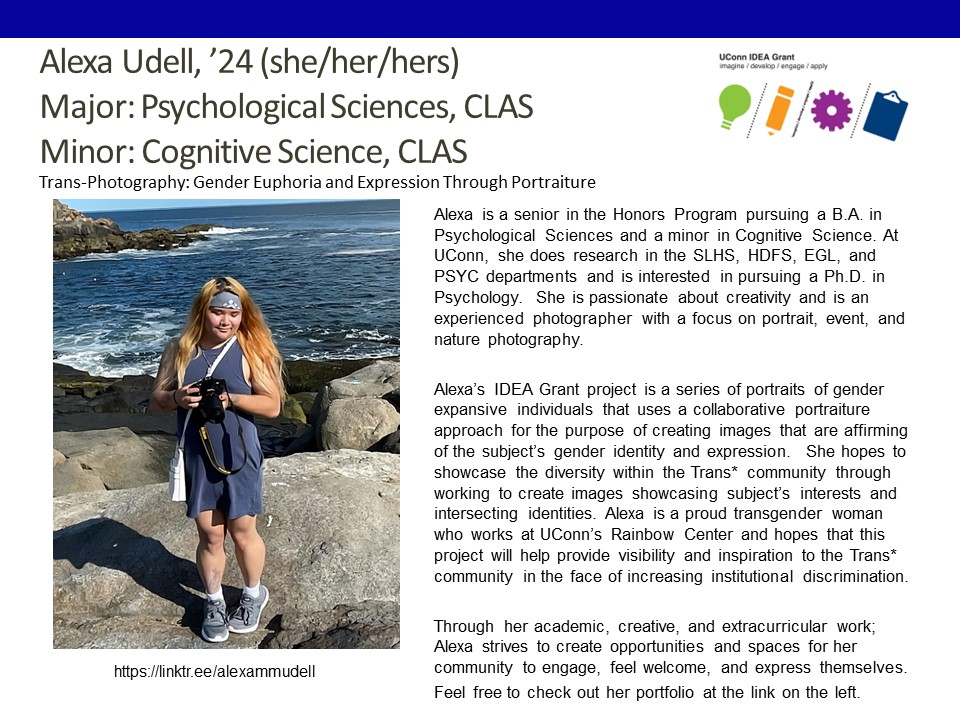
Alexa Udell will almost always suggest the outdoors as a photographic backdrop for a formal portrait and will almost always recommend the winding backroads of northeastern Connecticut.
Whether framed in the colors of autumn or monochromatic in shades of green, the open road is a Goldilocks location, she says, even in winter when black asphalt and white snow contrast to make a human subject pop like red lipstick on a pale face.
Oftentimes, those being photographed take her up on the suggestion, eager for natural light and an escape into the woods. Sometimes, though, they prefer the privacy of the indoors and the comforts of home. Whatever they decide, Udell’s goal is always the same – to photograph her subjects in a way that reflects their natural and true selves.
“It’s a personal mission of mine to make sure that trans people have photos of themselves that make them feel proud and happy,” Udell ’24 (CLAS) says. “Some people aren’t safe to express their gender at home or in public. They can’t be their authentic self, and that’s an unfortunate reality. Because of that, it’s important to capture the image of how they see themselves in their heads, so they can say, ‘This is my identity. This is me, and I’m proud of that.’”

It’s a project Udell – who describes herself as a psychological sciences major with a cognitive science minor and a co-curricular focus in photography – conceived last Valentine’s Day when she dressed in pink, had her makeup done, and did a photoshoot, this time as a subject.
“It was so euphoric and made me feel so feminine in a way that I hadn’t really ever experienced before,” she says. “Having a formal photo shoot made me feel beautiful and more importantly made me feel affirmed. It was then I thought about doing a project that would bring that same feeling to a bunch of different people at once.”
While sharing the same opportunity was her first thought, her next was the realization of how important it is to highlight the individualism of people in the trans community – differences in the way people describe themselves, how they project that image to the world, what pronouns they choose, among so many other things – so those on the outside can see their diversity.
Her project, “Trans-Photography: Gender Euphoria and Expression Through Portraiture,” funded by an IDEA Grant through the Office of Undergraduate Research, puts Udell behind the camera to photograph members of the trans community at UConn and beyond. It will culminate with a gallery show and artist talk in the spring, along with a presentation at the Spring Frontiers in Undergraduate Research Exhibition in April.
‘Self-image is a tricky thing’
Remi Dupuis ’26 (CLAS) says he’s been able to live his authentic self for a while now, but even still there are some family photos he wouldn’t want many people to see.
“When you’re being photographed as yourself in the light that you want to be shown in by a photographer who is trans and who understands that experience and wants to help you in every way, that’s so different. Family photographs can be fine if you feel comfortable in your skin, but that’s not always the case,” Dupuis says. “So, yeah, there are photographs of me and my family that I wouldn’t want shown to the public. Self-image is a tricky thing with all the other factors that go into the trans experience. It’s lovely when you get to sort of control your own image in a way that makes you feel best.”
One recent fall day in the shade garden behind the William Benton Museum of Art, Dupuis and Udell talked about what Dupuis might want for his upcoming photo shoot.
“Something just like this,” he says, gesturing to nature around him and to his outfit picked out in case the meeting resulted in some photos, which it did.
Dupuis says trans people can be represented in the media in any number of ways, affecting other’s judgments and observations. For a project like Udell’s to validate, celebrate, and educate others about the trans community is a significant thing.
“It’s so important for trans bodies to be celebrated and recognized as normal because there’s a lot of misinformation out there,” he says. “It’s just really cool to get the representation from an authentic point of view, to see people enjoying being themselves and not having to worry so much about what other people think. That’s our everyday existence and it’s hard.”

Udell put out a survey early this semester seeking trans people who would like to be part of her project. She hoped for 10, but from that call received 25 responses, with 17 of those moving forward with photo shoots, which are being arranged now.
She says that as she’s contacting people, she’s interviewing them to take note of individualized styles, personal interests, potential locations for the photo shoot, and best time of year, so she can work with them to customize an appointment.
One friend, she explains, celebrated their 21st birthday recently and wanted to document their excitement. With balloons, streamers, and other inexpensive decorations in the background, they did the photo shoot in the friend’s dorm room.
For another friend who wanted photos of their new red snowsuit, out to the snow-dusted backroads of northeastern Connecticut they went early this year.
“I love the way the roads in New England look when they’re all wet,” Udell says. “We just went out to Mansfield Hollow. Around here, there are just so many good settings.”
Shared struggles bring connection
In addition to helping her subjects settle on outfits, locations, and props, Udell says she’s careful to work with the person to find a flattering way to pose – because she knows there are things about a person’s body that might not be the most flattering or might not help project the masculinity or femininity they feel.
She acknowledges she’s better at posing females because over the last few years she’s studied her favorite social media influencers and how they move their hands, flip their hair, tilt their head, or cross their legs. Simply, she’s modeled herself after those who gave her gender envy and mirrored their mannerisms.
“The thing people don’t realize about being trans is that you have to learn how to express yourself and do everything manually,” she explains. “If you were socialized as a different gender than what’s affirming, you have to learn it and figure it out. It’s a lot for someone, never mind when they’re having their picture taken.”
But with that shared struggle, Udell connects with her subjects to carry them through what otherwise could be an unnerving or uncomfortable experience.
Dupuis says he would think twice about doing a formalized photo shoot with someone who isn’t trans. He says he’d have to get to know that person before committing to make sure they’re a good ally for the LGBTQ+ community.
Udell, who in addition to a resume of extracurricular pursuits also is the co-team lead of student programs at the Rainbow Center, fits that bill.
She’s been taking photographs since getting a camera in the summer of 2021 and before that staging shoots on her phone. Over the last two years her skills have improved, and side gigs have filled her calendar as friends have asked for pictures and event organizers have sought to document concerts, symposiums, conferences, and trips.
For the last two years her Nikon D3400 with a 50 mm f/1.8 lens has been her best friend, and this semester she’s enrolled in Basic Studio Photography in which she says she’s trying to learn more about product photography. Next semester, as she wraps up her undergraduate work, she plans to take another photography course.
“Photography is one of the best parts of my life,” Udell says. “My goal is that everyone who wants photos from me comes away with beautiful, professional quality photos of themselves that make them feel how they see themselves. That’s a big thing. I see myself in a certain way, that’s my sense of self in my head. But the way I look when other people take photos of me or when I’m on a store camera aren’t necessarily how I see myself.”
She continues, “One of the things I try to do with my life is merge the work that I do with my social identities and try to be a good ally to other communities. My work is meant to amplify the voices of marginalized groups, even beyond gender and sexual minorities, to make sure everyone’s voice is heard.”

For two decades, indie duo The Kills has been expertly crafting garage rock that’s by turns sultry and swaggering, but always explosive. From “Fried My Little Brains” to “Future Starts Slow,” their tracks are shot through with edgy riffs and the nervy pulse of a drum machine, surfacing a lo-fi yet visceral grittiness. But there’s also always been a noiseless, silent part of the band’s work that plays no less of a vital role in its DNA: photography.
Flipping through the liner notes for The Kills’s new and sixth album, God Games, you’ll encounter pairs of photographs that accompany each set of song lyrics. “Blank,” for one, is coupled with disparate images, one depicting a tangle of utility pole wires, another a clutch of flowers in a hotel room, while the words to lead single “103” run alongside pictures of a grimy fountain floor and a bleak parking lot.
They’re images intended to illustrate each track, shot separately then brought together by members Alison Mosshart and Jamie Hince.
“I thought it would be really interesting, to each submit a photograph for every single song and then put the two photographs together,” Mosshart explained. “It’s like a third side of the story, giving another feeling to the lyrics that are next to it.”

A photograph that accompanies “103” in the artwork for God Games by The Kills. Photo: Jamie Hince.

A photograph that accompanies “103” in the artwork for God Games by The Kills. Photo: Alison Mosshart.
While an ostensibly simple idea, the duo relished the project, enthusing over a Zoom conversation about how it brought out their different perspectives.
“When looking at mine, I’ve got a really specific way of framing that I didn’t even know I was doing—so weird,” Hince said. “Alison’s are like how she writes music—explosions. There’s so much energy in them.”
“I love that this is also representative of how we were in the same places, but had slightly different angles, like visions, of the same experiences,” Mosshart added, referring to a pair of photos that she and Hince had obviously shot in the same spot, on the same Halloween night. “You’re getting a piece of my creative eyes and his creative eyes.”

A photograph that accompanies “Wasterpiece” in the artwork for God Games by The Kills. Photo: Jamie Hince.

A photograph that accompanies “Wasterpiece” in the artwork for God Games by The Kills. Photo: Alison Mosshart.
Mosshart and Hince have been taking photographs for as long as they’ve been a band. Over the years, they have amassed pictures in the thousands—photo booth shots, Polaroids, images shot with analog cameras. Some of them have been exhibited (most recently by Morrison Hotel Gallery in Los Angeles and New York) and others, more prominently, have been included in the band’s album art.
The sleeves of Keep on Your Mean Side (2003), No Wow (2005), and the 2020 compilation Little Bastards were bedecked with the pair’s photo booth pictures, plus their drawings and handmade collages. Meanwhile, the cover of 2008’s Midnight Boom captured the pair sprawled out in a bed blanketed with art and photographs. They’re testaments to the pair’s admitted—and long-running—obsession with the medium.

Polaroids by The Kills on view at “It’s Not Only Rock’n’Roll Baby” at Triennale Bovisa in 2010 in Milan, Italy. Photo: Vittorio Zunino Celotto/Getty Images.
Mosshart recalled being a sixth-grader learning how to develop photos in the school’s darkroom—”my happiest time as a teenager.” It was the beginning of a practice, she said, that allowed a shy kid to “express myself without having to say a word.”
Hince, for his part, picked up photography as a way to immortalize the places and experiences he’s had on tour: “I’ve done a lot of painting, drawing, and cut-up art—all that stuff is really hard to do on the road. But it takes one 25th of a second to take a photograph. It’s really conducive to living on a bus and traveling.”
Mosshart and Hince first bonded by mailing their art to each other when they were living on separate continents; they also shared an appreciation for photographers such as Chris Shaw and Nikolay Bakharev. Decades on, they’ve each developed visual art practices—Hince with his Moriyama-esque body of photography, Mosshart with her abstract figurative paintings—alongside their music careers. Fittingly, they continue to deeply consider how each of their records will look and feel.
“It’s often a lot of trial and error,” said Mosshart of the process. “It’s bringing up images and photos we’ve taken, paintings I’ve painted, or things in our notebooks. We start to look at that material because it’s all happening at the same time as the writing.”

Artwork for God Games by The Kills. Courtesy of Domino Recording Company.
Case in point: the cover of God Games features a recreation of a painting that was left on the mantelpiece when Hince bought his home. The work features a matador squaring up to a bull, his red cape flapping wide behind him—a “common image,” said Mosshart, that her bandmate nonetheless “stared at” for six months while writing the record. For Hince, the artwork, however simple, harbored multiple meanings in line with the album’s title.
“My first reaction wasn’t, ‘Oh my god, it’s a bullfight,’” he said. “On one hand, you can be quite profound and see the image as being a struggle between nature and culture—how man destroys everything, but he has to dress it up in a little embroidered jackets and tight pants. But there’s also the [smaller] struggle of this artist working the shading on the cape. I wanted it to be something that didn’t have one meaning.”
That the painting was recreated by one of Mosshart’s friends—because the band was unable to locate the piece’s original artist to legally clear it for use—only deepened the plot.
“As an artist you want to absorb the times that you’re living in and present them—and this just added another hilarious layer to this. The law was dictating the kind of art we could use as we were trying to get this bad piece of art on our cover,” Hince added.

Artwork for The Kills’ double single “LA Hex / New York” by Alison Mosshart. Courtesy of Domino Recording Company.
Mosshart also created paintings on playing cards for each track on the album, two of which appear on the cover for the double single “New York / LA Hex.” It was a harkening back, she said, to her earlier years when she would create artworks for mixtapes she’d made—a way of “trying to put some visual to it.”
And it’s no different to how the band has approached its own records, every inch of which remains pure canvas.
“I think it has to do with identity,” said Mosshart. “It’s another way to display or explain who you are, where you’re coming from.”
“I remember as a teenager, I did go to the record shop and buy a couple of records every week, sometimes on the strength of the artwork. It’s such an expressive way of showing what you’re getting out. Rarely did you get a record home and it didn’t sound like it looked,” Hince said. “The look of a record is a much clearer mission statement of your band than anything you could write down.”
“I don’t know how that always works, but it seems to, you know?” Mosshart added. “Your eyes see it before your ears hear it.”
Follow Artnet News on Facebook:
Want to stay ahead of the art world? Subscribe to our newsletter to get the breaking news, eye-opening interviews, and incisive critical takes that drive the conversation forward.

Photographer Rhona Bitner visited a seminar class at the School of Art to discuss her work and provide feedback for fine arts students.
2:33 am, Oct 30, 2023
Staff Reporter
Courtesy of Rhona Bitner
Photographs of circus entertainers, worn ballet shoes and spot-lit stages make up the œuvre of Rhona Bitner. On Friday, Oct. 27, students from the School of Art had the chance to speak with Bitner about these works as she visited their class.
Bitner spoke with students enrolled in the Advanced Photography Project Seminar, which is taught by professor Lisa Kereszi ART ’00. The talk was supported by the Poynter Fellowship in Journalism.
“I’ve had a camera in my hands since I was a child,” Bitner wrote to the News. “When I was studying art and exploring various art-making methods and tools, photography felt the most natural to me. It was my language.”
Bitner’s photography is on display at Hamilton College’s Wellin Museum of Art. The exhibition includes seven of Bitner’s photographic series, such as “Circus,” “Stage” and “Pointe.” The exhibition went up on Sept. 9 and it will remain on display until Dec. 9.
The photographic series spans 30 years of Bitner’s work. “Circus” documents a decade of Bitner’s life, during which she followed 46 different circus troupes around Europe.
“I was interested in the parallels between how the circus is structured: The circle as mimicking our planet but also as a sacred space, and the hierarchy of the performers,” Bitner wrote. “The acrobats are angels flying through the air, the clowns represent us; we get knocked down and we have to get back up, we juggle, jump through hoops, hang by a thread, perform balancing acts.”
Bitner said that she has been inspired by other artists including Zoe Leonard for her process and structure, On Kawara for his exploration of time, Claude Monet for his methodical technique and Jason Moran for his “ferocity.”
Place, Bitner said, has inspired her work as well. Growing up in New York gave the photographer broad access to the arts. As a child, she often visited museums, ballets, concerts and the theater.
“[I sat] mostly [in] the last rows of the balcony, which was what our budget allowed,” Bitner said. “Seeing the stage at that angle was in some way defining. That is why my work retains a sense of wonder — someone once described it as the perspective of a child peering through a keyhole.”
Lisa Kereszi, who is also an art critic, welcomed Bitner to Yale last week. Kereszi, like Bitner, is a photographer and shared that the two artists have photographed many of the same subjects.
“Our work intersects around themes of performance and spectacle, and the spaces that house them when they are not full of people,” Kereszi wrote the News. “We somehow had previously passed like ships in the night, circling around some of the same subject matter, such as circuses and venues like CBGB’s [a New York music club].”
Bitner also visited the studios of School of Art students, as well as seniors concentrating in photography to provide them with feedback on their work.
Among the art students who received a studio visit from Bitner was Aliaksandra Tucha ART ’25.
“I’ve had a studio visit with Rhona Bitner. I was moved by how kind, perceptive, and caring she was,” Tucha wrote. “She is a true teacher. She shared how she thickened her own skin, shared about her journey as an artist. I needed it all. In moments of doubt, this is what I hold onto. Rhona is someone who made me feel courageous, which I know I am, but it doesn’t always feel so. I feel stronger now that I know her.”
Her exhibition at the Wellin Museum of Art is the first solo museum survey of Bitner’s photographs. Her work has also been exhibited at museums and institutes including the Whitney Museum of American Art in New York, the Art Institute of Chicago and Fonds national d’Art contemporain in Paris.
Bitner is a 2020 recipient of the Pollock-Krasner Foundation Grant, and she recently published a book of her photographs with Rizzoli titled “Listen: The Stages and Studios That Shaped American Music.”
When asked about whether or not she’s ever experimented with other media, Bitner hinted at future work saying, “I am an active and willing participant, viewer, reader, audience member, but I do not incorporate other media in my work … yet.”
The Poynter Fellowship in Journalism will host The New Yorker’s art critic on Tuesday at 4 p.m. at Pierson College’s Leitner House.

 Bath and North East Somerset Council
At a glance
A photography exhibition has been installed at the Egg Theatre, in Bath, in support of young people who are leaving care
It has been timed to coincide with Care Leavers’ Week
The display will remain up until 3 November, when it will be moved to Keynsham library
Images captured by young people who have experienced being in care are being exhibited.
The photography exhibition is made up of images that are important to them, each with a caption to explain their significance.
The display is being held at the Egg Theatre, in Bath, where the photos will be on show throughout Care Leavers’ Week, with the exhibition ending on 3 November.
Shakira, who left care five years ago, said: “I beat drug addiction, gained my own flat and now have a perfect life with my little girl.”

The exhibition has been organised by Bath and North East Somerset Council, which helps young people who are leaving care, or who have already left care, up to the age of 25.
The council currently supports 110 care leavers who are allocated to a personal advisor and a further 90 people aged between 21 and 25 can ask for support at any time.
Shakira said: “A lot happened while I was in care that I’m not proud of nor want to ever remember, but with the help of my personal advisor, Sarah, in the Care Experienced Team I beat drug addiction, gained my own flat and now have a perfect life with my little girl.
“I couldn’t have done it without their support and will be forever grateful for the respect they gave me even when I didn’t deserve it.”

Cabinet member for Children’s Services, Paul May, said care leavers’ week is an opportunity to learn more about young people’s experiences and how they can best be supported.
“It’s been powerful and extremely moving to hear from Shakira and others about how they have transformed their lives after leaving care,” he said.
“I’m delighted to see the photography exhibition amplifying their voices and marking the start of this special week to celebrate all their achievements.”
The council has recently signed up to the Care Leaver Covenant to become a Care Leaver Friendly Employer and support care leavers throughout their careers.
It said that additional support will be provided to people applying to the council – including a guaranteed interview – and the support will continue upon employment without an age limit.
“Studies have shown that care experienced people are a worrying seven times more likely to die by the age of 25 than their peers and that nearly half of people under 21 who are in the criminal justice system have been in care,” Mr May said.
“That’s why it’s important that local authorities sign up to the Care Leaver Covenant and ensure that care leavers are supported and prevented from discrimination.”
After being displayed at the Egg Theatre, the exhibition will be moved to Keynsham Library from 6 November and Bath Central Library from 4 January.

From Facebook to Instagram and Snapchat, millions of selfies can be found all over social media.
But according to scientists in Germany, they can all be separated into five categories – ‘aesthetics’, ‘imagination’, ‘state’, ‘trait’ and ‘theory of mind’.
If you like posting selfies that look stylish for the sake of it, you are an ‘aesthetics’ selfie taker, but if you tend to post snaps with objects you trigger ‘imagination’.
‘Trait’ means you like to reflect aspects of your personality in your snaps, while ‘state’ selfie-takers tend to post transient snapshots of a time and place.
Lastly, ‘theory of mind’ selfies – named after the cognitive ability to understand others and their behaviour – force viewers to make assumptions about the taker’s motives or identity.

The new study has been led by psychologists at the University of Bamberg’s Graduate School of Affective and Cognitive Sciences, who think there’s a lack of understanding of how people use selfies to communicate.
‘Selfies are taken to communicate about mental conditions, aims, loves, and commitments,’ they say in their paper.
‘Despite the pivotal role of selfies in expressing our own state of mind, we lack a unified nomenclature or established classification system for selfies.
‘We revealed five distinct categories which we call semantic profiles – aesthetics, imagination, trait, state, and theory of mind.’
For the study, 132 participants were asked to give spontaneous descriptions of selfies from various people, including celebrities and the public.
Researchers used an algorithm to select 15 random selfies for each participant to review, out of a total pool of 1,001.
Study authors provided five text boxes per selfie for participants to write down their spontaneous reactions to the snaps.


Researchers processed this data to collapse the respondents’ first impressions into 26 categories, including ‘mood’, ‘pose’, ‘objects’ and ‘alcohol’.
From this, the scientists then analysed how frequently these categories appeared in responses, and if they appeared together, before clustering them into the five different ‘semantic profiles’.
According to the team, the most popular selfie type, ‘aesthetics’, refers to selfies that show off style or ‘aesthetic experience’.
These are snaps that look good for the sake of it – and could be anything from posing with an extraordinary hairstyle, making a duckface or using artistic techniques such as using a mirror to crop picture details.
The next most popular type is ‘imagination’ and refers to selfies that trigger assumptions about where the subject is or what they might be doing.
They often feature buildings or other objects that could imply that the selfie-taker is at a party or on holiday, for example.
The third most popular type, ‘trait’, convey messages about what our personality might be like – such as outgoing, intelligent or happy-go-lucky.
Less popular, but still substantially found all over social media, are ‘state’ selfies, which reflect a temporary mood of the person or atmosphere of the scene.
Lastly, ‘theory of mind’ selfies cause the viewers of the photo to make assumptions about the selfie-taker’s motives or identity.


‘We were quite impressed how often the category “theory of mind” was expressed, because this is a very sophisticated way of communicating inner feelings and thoughts,’ said study author Tobias Schneider at the University of Bamberg.
‘It shows how effective selfies can be in terms of communication.’
The study authors admit these five semantic profiles may not be expressed or understood in the same way worldwide, so more research is needed.
What’s more, their method only used a sample of 1,001 selfies, so the next step will be widening the selfie database to better reflect the millions online.
‘We definitely need larger, more diverse, and cross-cultural samples in the future to understand how different groups and cultures use selfies to express themselves,’ said senior study author Christian Carbon at the University of Bamberg.
The full results have been published in the journal Frontiers in Communication.