Photography

Rancho Bernardo man to exhibit his black and white photography at Art San Diego

Rancho Bernardo man to exhibit his black and white photography at Art San Diego

The route to Benjamin Rinenbach’s career was not direct, even though photography has been a lifelong passion.

“I’ve always been fascinated by photography,” said Rinenbach, 46, an award-winning Rancho Bernardo photographer. “Since I was a kid, before I could read, I was looking at ‘National Geographic’ magazines, fascinated by the pictures.”

Throughout his life, in the military, working in construction and as a firefighter/paramedic, Rinenbach said he always took photos with whatever camera he had, be it a point-and-shoot or smartphone. But it was not until six years ago that on a whim he decided to pursue photography seriously.

“A spinal fusion and a drunken late night camera purchase on eBay changed his path forever,” he wrote on his website, rinenbachphotography.com.

This photo by Benjamin Rinenbach is called “4 minutes at Sunset Cliffs.”

This photo by Benjamin Rinenbach is called “4 minutes at Sunset Cliffs.”

(Benjamin Rinenbach)

That path is taking him to the San Diego Convention Center, where Rinenbach will be among the 95 exhibitors representing hundreds of artists from across the country and around the world displaying their works Nov. 3-5 at the 15th annual Art San Diego.

Rinenbach plans to exhibit around 20 photos, ranging from 12-inch squares to 30-inch by 40-inch.

Last year, he won Art San Diego’s “Best Solo Exhibitor” award during his debut at the event.

“It was a nice shot in the arm, overwhelming,” Rinenbach said about his award. “I am extremely humbled and appreciative of it.”

Art San Diego is organized by the Redwood Art Group, which holds contemporary art and design fairs across the United States. In addition to the exhibits, the event will feature art labs that provide interactive experiences. The fair has also partnered with Monarch School, Humble Design and Arts District Liberty Station. Artwork purchased through this partnership will benefit downtown San Diego’s Monarch School, which educates elementary through high school students who are homeless.

Rinenbach’s self-taught photography is primarily in black and white. His inspirations are photographers Edward Curtis and Ansel Adams, along with film directors John Ford and Sergio Leone.

The Chicago native said during the early parts of his life he lived “a predominately left-brain existence.” This included being a skateboarder, gymnast and “secretly” writing poems while serving as an Army infantryman and working in construction. A back injury six years ago while firefighting in Chicago ended his 12-year career as a firefighter/paramedic.

During his recovery he started pursuing his right-brain creative side.

“I wanted to explore and experiment with the artistic side of myself,” Rinenbach said. “I have fallen in love with it.”

His preference is for black-and-white photography.

“I find color to be distracting,” he said. “I like shadows, shapes, contours and contrasts. I find no benefit of those in color. I love looking at black-and-white. It is emotive and suiting to my eyes. It is interesting to my eyes.”

Benjamin Rinenbach took this photo at Joshua Tree National Park. He calls it “Josh at Dusk.”

Benjamin Rinenbach took this photo at Joshua Tree National Park. He calls it “Josh at Dusk.”

(Benjamin Rinenbach)

Three years ago Rinenbach, his wife Christa, who grew up in Scripps Ranch, and their now 15-year-old son, Ben, and 13-year-old daughter, Cam, moved to Rancho Bernardo. Leaving Chicago, where the couple met, and moving to San Diego to be closer to his wife’s family was something they had wanted to do for a long time, he said.

Since moving here, Rinenbach said he has found lots of creative inspiration. He calls most of his photos “desert and coastal noir,” so he has many options within a short drive. Taking photos of the Pacific Ocean and San Diego’s coastal areas is a given for local photographers, he said, but some of his favorite spots are in San Diego’s desert.

“For me, to have the ability to be in a place where I can look at the horizon in any direction and there is nobody between in that chunk of the world, but yourself, the critters and clouds … there is great peace. It is humbling. There is nothing man-made. It is just mother nature in any direction.”

His favorite lighting is overcast. He said he often does long exposures, letting the lens stay open from two to eight minutes.

“The cloud cover or water collaborates with you … with the clouds you do not have any blown-out highlights from the sun, which is too harsh,” he said. “It is just natural filtered light that provides great photo opportunities.”

Rinenbach said he enjoys the process, which requires him to be patient and slow down. “I can’t wander away, so I am forced to be patient and enjoy the scene before me. It is about more than a cool snapshot, but the process for me.”

Cam sometimes accompanies him on his photography road trips that may have no set destination. He stops when inspiration strikes.

“My daughter is very invested in it, has a decent camera and gear, and explores with me,” he said. “Not long from now she will be a far superior photographer than I am.”

This photo by Benjamin Rinenbach is “4 minutes at Cabrillo.”

This photo by Benjamin Rinenbach is “4 minutes at Cabrillo.”

(Benjamin Rinenbach)

He did not start out doing landscape photography. Initially, he took whatever jobs he could get, which is why he has several photos of ballet dancers on his website. He started working with a ballet company in Chicago, which led to him not only photographing the dancers, but their families who liked his experimental and artistic style.

“I loved it,” Rinenbach said about working with the dancers. “I figured that work was not too far astray, very emotive and high contrast … it was a good fit for my style.”

Even now, when creating some of his visual arts pieces that often incorporate multiple levels of glass with his photography, he will overlay a photo of a dancer with a landscape scene to create a new image.

“It is other worldly,” Rinenbach said of the final image.

Rinenbach said he enjoyed exhibiting his work at last year’s Art San Diego and that it led to several commissions for him. For example, he was hired by San Diego biotech company Illumina to help decorate its building. He contributed work that incorporated acrylic and wood with his photography and was involved in the installation’s coordination so all the artwork complements the building’s design.

Some of his mixed-media is 3D photography sculptures that weigh 50 to 100 pounds due to the multiple layers of glass.

Benjamin Rinenbach took this 4-minute long exposure of the Ocean Beach pier. He calls it “Oceanic Shavasana.”

Benjamin Rinenbach took this 4-minute long exposure of the Ocean Beach pier. He calls it “Oceanic Shavasana.”

(Benjamin Rinenbach)

Art San Diego is open noon to 5 p.m. Friday, Nov. 3; 11 a.m. to 7 p.m. Saturday, Nov. 4 and 11 a.m. to 5 p.m. Sunday, Nov. 5. It is in the San Diego Convention Center, Hall E, 111 W. Harbor Drive. Tickets in advance are $30 for a three-day pass, $20 for general admission and $10 for students, seniors and military. Prices are higher at the door. Buy at redwoodartgroup.com/art-san-diego.

A special offer has been extended to Pomerado News readers, who can access free tickets at bit.ly/ASD23-COLLECTOR-NE.

Tickets — paid or free — do not include parking at the San Diego Convention Center, which is an additional fee.

OUR NEIGHBORS | HR professional finds passion and connection in photography

OUR NEIGHBORS | HR professional finds passion and connection in photography

Local photographer Dwan Miller, 47, found inspiration to do photography from his daughter. Because of her, he said he has found the passion that has filled his free time and helped him connect with his daughter on a deeper level.

“It’s a valuable connection,” Miller said. “I got separated from them at an early age from their mom. Having a connection with her this strong means the world as a father. Every day we talk and every day we are teaching each other more. And it’s more than just photography, it’s about life.”


10252023-mer-new-dwanmiller-2

Dwan Miller stands next to a 1931 Hupmobile Century Six Series S at Midwest Dream Car Collection in Manhattan, while attending the Black Entrepreneurs of the Flint Hills’ Circle of Community Black Business Gala and Awards on Feb. 25. Miller, 47, a North Carolina native, joined the military when he was 20 and served until 2017.


A bullet for the bridegroom: Barry Lewis’s best photograph

A bullet for the bridegroom: Barry Lewis’s best photograph

For my generation, the People’s Socialist Republic of Albania was a place of mystery, both exotic and dangerous. The first time I visited was in 1990. I went with a group of journalists and a couple of archaeologists – we were pretending the visit was an “archaeological tour”. There was no translator and we had maybe four words of Albanian between us. Needless to say, the writer I was with had a pretty hopeless time trying to interview people, but as the only photographer in the group, I had a fantastic trip.

We were there for a few weeks, touring communes and cooperative farms as well a tractor factory where no tractors were being made. We got as far as Shkodër, on the edge of the Accursed mountains, but were only able to make a very limited trip to the north, which was what really intrigued me. Exploring that mountain region only became a possibility 18 months later, following the collapse of the communist regime.

This time I went for the Sunday Times, along with writer Ian Thomson. I’d kept in contact with someone in Tirana who let me know when the snows had melted enough for us to get into the mountains. Having spent some time in Romania shortly after the 1989 revolution, I knew times of change can be a great opportunity to visit places that have been isolated – things are chaotic, but suddenly there’s a chance to really see what’s going on.

Enver Hoxha [the dictator who ruled Albania for more than four decades until 1985] had never really controlled the north of the country and village life had resisted his influence. Up there, people followed the Kanun, a set of codes based on honour and blood, dating from medieval times. The villages often felt almost medieval too, with horses and carts and astonishing outfits. I had shot in black and white during the previous visit and decided to do so again. I’d brought colour film, but black and white gave the images a timeless quality.

We had a great driver, Lida Kita, who also acted as our guard and an empathetic and well respected translator. It was down to her that we got invited to a wedding in the village of Bogë, where this picture was taken. The mountain villages tended to be either Muslim or Catholic – there was no edge between them, but nor was there any intermarrying. This was a Muslim wedding, an arranged marriage, I think, but there was still a lot of drinking. The celebrations went on for a week – we only lasted a day.

The picture is quite painterly – it has a chiaroscuro effect, with the bride lit by a window. On the left, people seem to be whispering to each other, laughing and joking, but she is isolated. This was taking place in the house of her new husband’s family, where she would be living under the rule of her mother-in-law. She looked so unhappy and no one was really talking to her. The groom had just been given a little box containing a “trousseau bullet” by the bride’s father as part of her dowry. The idea is that this can be used in the event of desertion or infidelity. It’s a symbolic and traditional gift, but given how friendly everyone else seemed, this still came as a shock to me.

Meanwhile the groom was partying hard. I have another photograph of the couple arriving, both looking nervous, but though I didn’t see the wife touch a drop, everyone else ended up drinking and dancing. For that day I was essentially the wedding photographer by default, and was expected to drink a toast of raki – colourless homemade moonshine – with every male guest. Eventually I blacked out. I was staying at a nearby hotel and members of the wedding party must have carried me back, because I remember coming to in my tiny room with all my equipment and rolls of film beautifully laid out on the bed opposite. On the contact sheets, you can see that my compositions become increasingly loose, but as soon as I saw this image I thought: “Gosh!”

Gulag: A Journey into the Darkness of Stalin’s Siberian Prison Camps, by Barry Lewis, is published by Fistful of Books. A Kickstarter campaign closes on 4 November

Barry Lewis.

Barry Lewis’s CV

Born: London, 1948
Trained: “Originally a chemist, taught for three years, then RCA for two year MA with Bill Brandt as tutor”
Influences:Bill Brandt, August Sander, Joel Meyerowitz
High point: “Starting the agency Network Photographers in 1981 and winning the 1991 Oscar Barnack (the inventor of the Leica) award for humanitarian photography for work in Romania”
Low point: “The end of Network Photographers in 2005 alongside the growth of the internet”
Top tip: “Keep fit, be bold, ask questions, listen, read, wear good shoes”

Why Feel Is More Important Than Rules in Landscape Photography |

Why Feel Is More Important Than Rules in Landscape Photography |

Between the rule of thirds, camera settings, guidelines on focal length, depth of field calculations, and more, landscape photography can be a rather prescriptive genre. And while it can be good to have rules that increase your chances of coming home with a keeper, they can also be overly restrictive. This great video tutorial features an experienced landscape photographer discussing why feel is more important than following the rules in the genre. 

Coming to you from Alister Benn of Expressive Photography, this fantastic video tutorial discusses the importance of feel over following the rules in landscape photography. For sure, this does not mean there is no value in learning the rules. After all, as Picasso said: “learn the rules like a pro, so you can break them like an artist.” Rather, adhering too strictly to rules can make your work overly formulaic and prevent you from discovering what makes your individual creative voice unique and special. The next time you’re out shooting and catch yourself on autopilot, stop and make each decision intentionally instead. Check out the video above for the full rundown from Benn. 

And if you really want to dive into landscape photography, check out our latest tutorial, “Photographing the World: Japan With Elia Locardi!” 

Icons Only: Steven Klein’s Polaroids Of Madonna, Prince & Naomi Are Going Under The Hammer

Icons Only: Steven Klein’s Polaroids Of Madonna, Prince & Naomi Are Going Under The Hammer
image

Back in 1989, having never photographed a celebrity, Klein set his sights on shooting the icon that was Prince. By then, the photographer had already worked with Liz Tilberis, the editor-in-chief of British Vogue, and she had expressed a vague interest in running an editorial with the Grammy winner – without making any specific promises re its prominence or pagination. Klein, though, decided to take some liberties with the truth for the sake of his art, telling Prince’s team that Tilberis wanted the “Purple Rain” singer “to be the first man on a cover in the history of [the magazine]” and promptly flying to Minnesota’s Paisley Park, sans either editor or clothes. “The first thing I remember seeing in the house is [Prince’s then partner] Kim Basinger… At that time, they were filming Batman, and he was in full gear, transparent purple shirt and pants.” The shoot took place in Prince’s bedroom – complete with a round bed, while the Cocteau Twins played on the stereo in the background. “When he came in, he said to me, ‘Okay, what do you want me to do?’ And I just froze,’” Klein recalls. As did Prince, it seems: “He didn’t really move… He didn’t really talk… It taught me to never expect celebrities to perform in person the way that they do onstage.” Eventually, though, Klein “shot a series of black and white portraits that were really beautiful”, along with some close-ups that did indeed make their way into British Vogue. While the publication ultimately declined to run Prince on the cover proper – the supers had already claimed the first slot of the decade – it did run a full feature inside the magazine.

Photography: Faye Webster at Franklin Music Hall

Photography: Faye Webster at Franklin Music Hall

Posted: 25th October, 2023 by The Editor

Indie singer-singwriter, Faye Webster, has earned their title as an indie icon. The Atlanta, Georgia-based singer has an impressive discography. Their sound has only developed and grown with age as they explore new themes and explore their instrumentals. Promoting their latest album “I know I’m funny haha” in 2021, captivating a more sultry sound and dynamic, the whole band played an incredible set. Jay was at their Philly show at Franklin Music Hall. Check out their incredible pics from the night.


Photos by Jay Leiby

The Alternative is ad-free and 100% supported by our readers. If you’d like to help us produce more content and promote more great new music, please consider donating to our Patreon page, which also allows you to receive sweet perks like free albums and The Alternative merch.

Can Photography Build Peace? The Case From Thailand

Can Photography Build Peace? The Case From Thailand
Yostorn with youth at the training session, photo by Realframe.

Thailand has experienced conflict in its Deep South over recent decades. The Deep South includes the provinces of Yala, Pattani, and Narathiwat, as well as four districts of Songkhla province. Muslims make up 76% of the region, with Buddhists comprising around 23%, and Christians and other religious groups making up smaller percentages of the population. Most Thai Muslims are ethnically Malay. 

Some Muslim separatist groups are active in the region, most notably the Barisan Revolusi Nasional (BRN). Violence related to the separatist conflict and politics caused 3,686 deaths and 10,872 injuries between January 2004 and March 2022. When counting deaths from other crimes and resource conflicts in the region, the numbers stand at 7,344 deaths, and 13,641 injuries.

In August, photographer Yostorn Triyos led a training session for youth in the region to do photography about peace. The training, sponsored by Minority Rights Group International, allowed youth ages 18 to 30 to submit their photography portfolios, before participating in a four-day camp. This is the second year Yostorn has led the camp, where youth are instructed to take photos telling stories about their communities. 

Yostorn said, “There is a theme of peace, but these trainees are new to this. So their interpretation is very wide in scope in terms of what it means for them regarding peace.”

The topics of the the youth’s photography include a range of societal issues and challenges in their communities. Some have taken photos about the heavy presence of military checkpoints in their communities, particularly when compared to other areas. Others have taken photos showing how women play a role in their communities, even though the communities are very male-dominated. Yostorn said that many of the youth also have their own platforms and fan pages, and therefore “can also play a role in social movements.” For example, one youth, Yostorn said, has focused on their work helping disabled people in the region. 

“So they don’t just come and learn skills to take pictures, but also how to make photos look interesting and tell an interesting story,” he said.

While both Muslims and Buddhists attended the camp last year, this year, the 12 youth who participated were all Muslims. However, Yostorn said that in all the projects he has done, there have never been issues between the two groups. He said the two groups live together, and understand each other’s way of life.

From September 19 to October 1, Yostorn had an exhibition displayed at the Bangkok Art and Culture Centre titled “The Deep Places in the Deep South.” The photos in the exhibition captured residents of the Deep South during their day-to-day activities. Yostorn took these photos to challenge stereotypes that many Thais have about the Deep South. People often think of the region as filled with terrorists, thieves, and people causing chaos, he said. He added that the key message of his exhibition was to erase these stereotypes and. and to remind the public that people in the Deep South are fathers, mothers, and teachers. 

“Because the understanding of the people in the society is such that people cannot live together because of their differences, because of different religions. But I want to portray and help people be able to relate to the human side of this.”

The subjects of Yostorn’s photos included a woman named Tua who works for a civil society organization called Duayjai. The organisation provides counseling and peace education to detainees and their families, and also provides support to survivors of torture. Yostorn’s photos of Tua show her smiling while sitting with her family. Yostorn wrote in the photos’ caption that his friendly conversation with them appeared to involve clashes between the different generations.

Realframe’s photos of Tua, photo by Tara Abhasakun.

One subject in the exhibition was a Buddhist peace leader known as ‘Uncle Kook.’ He is respected by both Muslims and Buddhists in his community, and ensures that the two groups live in harmony together. The photos of Uncle Kook show him with his beloved dog, and photos of his family. 

Realframe’s photos of ‘Uncle Kook,’ photo by Tara Abhasakun.

In the exhibition, Yostorn aimed to highlight three special laws in the Deep South, which he believes have caused the conflict to continue for the past 19 years. Yostorn said these laws: the Martial Law, the Internal Security Act, and the Emergency Decree, give authorities the power to violate human rights. 

“People get arrested without bail. As long as the time the court takes to judge whether they’re in the right or wrong, they don’t get bail,” he said. “So some people who are innocent might get locked in jail for a year or 10 months. And at the end of it, the court decides they’re innocent.”

Another subject in the exhibition was a man named Mulid, who was imprisoned for eight months after being labeled as an “insurgent.” The court eventually dropped the charges. Yostorn’s photos show Mulid with his wife and their baby. 

Realframe’s photos of Mulid, photo by Tara Abhasakun.

Yostorn noted that the government has made people “desperate,” since when they try to fight for their rights using the law, they are fighting “an unjust system.” He said that this is why people turn toward groups like the BRN.

When asked if he believed that art could fight stereotypes in a way that political discussions cannot, Yostorn said, “Yes, definitely, otherwise I would not be doing this. I think that if I choose the right topic, then it can reduce stereotypes. And it will speak to people with various opinions.”

Yostorn said that most people who have discussed his exhibition with him say that it allowed them to see the other side of people living in the Deep South. They say they have seen the side of the region different from the violence shown in the news. Yostorn added that his photos, together with the captions, made people understand the reality of the area, and see more of the humanity of the people living in it.


Tara Abhasakun

Tara Abhasakun is a journalist in Bangkok. She has written for several outlets on a range of human rights issues involving youth protests in Thailand, as well as arts and culture.

Photographer William Eggleston’s New Album Bottles His Serene Piano-Playing, With Special Guest Brian Eno on Bells

Photographer William Eggleston’s New Album Bottles His Serene Piano-Playing, With Special Guest Brian Eno on Bells

William Eggleston was playing the piano long before he picked up a camera. Classically trained as a young child, he continues to do so daily when so moved, but for a select audience of close friends. While they’re hanging out, Eggleston might launch into some Bach or perhaps an American standard on his Bösendorfer piano, but he would also meander into impromptu compositions of his own. They’re ephemeral improvisations he’s likened to dreams—”it’s here,” he said in 2017, “and then it’s gone.” 

Well, not entirely. Eggleston’s musical extemporizations have been captured on one album, the idiosyncratic Musik (2017), and more will now follow on his second. Set for release on November 3, his new record, titled 512, is filled with his serene piano-playing across six tracks—four of them standards (such as “Ol’ Man River” and “Over the Rainbow”) and two of them originals, including the aptly titled lead single “Improvisation.” 

The album was produced by Tom Lunt, founder of the The Numero Group record label, who met the photographer through his son Winston. Lunt recorded Eggleston playing his piano in his Memphis, Tennessee, apartment—number 512—over two days in 2018, in a process he characterized as a “field recording.” It captured not just Eggleston’s performance, but the ambient sounds of his apartment with its windows left wide open.  

“He was up for it,” Lunt said over the phone about Eggleston’s participation. “And we pretty much got everything on the second day because he was just flowing on that day.” 

Lunt then invited musicians to add flourishes to these recordings in a sort of remote collaboration, as if “they were spirits of musicians that heard him playing and just wanted to join in.” Among them are Sam Amidon on fiddle and banjo, Leo Abrahams on electric guitar and synthesizer, and ambient legend Brian Eno, who added bells to “Improvisation.” 

The effect is stark, yet moving and occasionally ominous. It’s an atmosphere—or the creation of an atmosphere—that Lunt sees as in sync with Eggleston’s photographic practice. 

“He has the same approach with his music as he does with his photography. That is, ‘I’m doing what I’m doing and that’s it. This note goes here and if it’s wrong note, I’m fine with that,’” Lunt explained. “Everything’s dependent on mood and what he sees in that instance. And that’s very much what he’s like as a photographer.” 

William Eggleston, Greenwood, Mississippi (1973). The Gayle Greenhill Collection. Gift of Robert F. Greenhill © 2020 Eggleston Artistic Trust.

That instinct has indeed powered Eggleston’s career since the mid-1960s when he first embraced color photography, shaking loose the once-staid medium with his expressive, hyperrealistic hues. His photographs defamiliarized the most ordinary of subjects—a child’s tricycle, a ceiling fan, a girl lying on a patch of grass—and were shot with an evident spontaneity that teased the strange out of the banal. “When I discover the picture, it happens very quickly,” he once said. “Suddenly there it is.” 

At no time has Eggleston, now 84, intended to embark on a music career even as that world has come calling for him.”I just don’t happen to be a professional public performer or I would be a concert musician,” he said in 2017. His distinctive piano-playing was first heard on “Nature Boy,” a 1978 cover by Big Star, and his photographs have bedecked the covers of records by Primal Scream, Spoon, and Joanna Newsom, among other musicians.  

In 2017, Lunt put together Musik by combing through Eggleston’s recordings (so old they were stored on floppy disks) of his Bach-inflected experiments on a Korg synthesizer. As with 512, the photographer observed the making and release of his own records with some distance, allowing Lunt to take the lead. “Tom,” Lunt recalled Eggleston telling him, “you can do whatever you want.” 

But Eggleston did offer this very succinct take on 512: “I’ve never heard anything like it. It’s very modern.” 

The cover of William Eggleston’s second album, 512, photographed by Tom Lunt. Photo: Courtesy of Secretly Canadian.

As a visual artist and photographer himself, Lunt deemed it a “real privilege” to know Eggleston and to learn more about visual art while visiting the photographer at his apartment. He recalled Eggleston would occasionally pull out one of his books and pick a picture: “He’ll go, ‘Look at it.’ And I’ll be looking at it and he goes, ‘Nope, you’re not looking at it long enough.’” 

Probably as much of an honor is having his photographs accompany a William Eggleston release. Lunt’s images feature on 512‘s inner sleeve; on its cover is his stark snapshot of Eggleston’s front door, plain but for a curious stamp depicting Rosa Parks. 

“It just lent itself immediately to being the cover of the album because it’s where [the recording] took place. It has his name on it. It just became very simple to do it,” Lunt said of the photograph. “I think I got it a little bit in his style. He’ll forgive me for that.” 

More Trending Stories:  

The World’s Most Popular Painter Sent His Followers After Me Because He Didn’t Like a Review of His Work. Here’s What I Learned 

Archaeologists Excavating the Tomb of Egypt’s First Female Pharaoh Found Hundreds of Jars Still Holding Remnants of Wine 

The Second Paris+ Started With a Bang. Could Art Basel’s New Venture Unseat Its Flagship Fair One Day? 

Is There a UFO in That Renaissance Painting? See 7 Historical Artworks That (Possibly) Depict Close Encounters With the Third Kind 

A Glasgow Museum Reveals a $3.7 Million Rodin Sculpture Has Been Missing From Its Collection for Nearly 75 Years 

What I Buy and Why: Art Entrepreneur Hélène Nguyen-Ban on Her Original ‘Art Crush’ and Owning a Half-Ton Book by Anselm Kiefer 

Christie’s 20th/21st Century Evening Sale Notches Steady Results, a Feat in the Current Tepid Art Market 

Four ‘Excellently Preserved’ Ancient Roman Swords Have Been Found in the Judean Desert 

An Early Edition of an ‘Unhinged’ Christopher Columbus Letter Outlining What He Discovered in America Could Fetch $1.5 Million at Auction 

Follow Artnet News on Facebook:
Want to stay ahead of the art world? Subscribe to our newsletter to get the breaking news, eye-opening interviews, and incisive critical takes that drive the conversation forward.

The Role of Professional Photography in Selling Your Home

The Role of Professional Photography in Selling Your Home

When you’re selling your house, one of the first items on your to-do list is to get photos for your listing. 

If you’re like a lot of buyers, you may consider taking them yourself. After all, your Instagram account is probably full of nice-looking selfies and photos of food — how much harder could it be to take photos of your home? Actually, it’s a lot harder than you think. 

While you can use a discount real estate agent and still get high-quality service, the same doesn’t apply to your listing photos. Generally speaking, professional photos will far surpass even the best amateur photos, not only because the professionals have a better understanding of what the average buyer wants to see, but also because they’re working with superior equipment and a more refined sense of composition. 

Subpar listing photos have a price — literally. Many buyers will cross a home off their list if it has unappealing listing photos, which means less interest for you, which means less competition and a lower sale price.

Let’s talk about what professional listing photos can do for you.

Making a critical first impression

Nearly everyone starts their home search online these days. And when they look at a listing, they’re heading straight to the photos. If they don’t like what they see in those first few moments, the listing goes in the “no” pile. Some buyers won’t even look at a home’s basic information unless the photos jump out at them.

If you heard the term “curb appeal” when you were planning your showings, this is something very similar. Curb appeal is how enticing your home looks as a buyer approaches it from the street. Those first few seconds largely determine how they feel about the property, regardless of how the rest of the tour goes.

We’re talking about visceral, gut-level reactions. First impressions are formed very quickly and are tough to change. While not every buyer who likes your listing photos will put in a bid, no prospective buyer who dislikes your listing photos is going to consider buying. Getting professional listing photos maximizes your home’s appeal, and allows it to appeal to the maximum number of buyers.

Pre-photoshoot staging and art direction

While extensive home staging is often done by specialized professional home-staging services, a professional photographer can contribute some suggestions on how to increase your home’s appeal. Many photographers will even recommend home-staging services they’ve worked with previously, similar to how agents can recommend trusted movers or home inspectors.

An experienced real estate photographer has a well-developed understanding of light and space, and will know exactly how to present your home to its best advantage. They’ll know the most flattering time of day to photograph your home, how to maximize the amount of natural light your home gets, and bring in supplemental lighting if needed. In terms of space, they may rearrange your furniture to showcase the living space. 

If you have a lot of furniture, they may even suggest removing some of it, and putting it into self-storage until the sale is finalized. They’ll know how to make your home feel roomy without making it feel cold. They may also advise you to depersonalize your home by strategically removing sentimental items. If your home needs a little more energy, they can also advise you on how to upgrade your home décor, even on a budget.

If your photographer recommends professional home staging, they may bring in all new furniture and furnishings, down to art on the walls. Your photographer will have seen hundreds of listings, if not more, and will know how to adjust your home’s aesthetic for modern buyers.

High-quality photos

At risk of stating the obvious, a professional photographer’s listing photos are going to be far superior to amateur efforts. Even if you set the home staging and art direction aside, they’re using professional-quality equipment to capture high-quality shots. Their use of light and composition will produce photos that are appealing and evocative, and make a narrative out of your home. 

Many homeowners renovate a house before they put it on the market, but those improvements won’t help the home sell if they’re not framed properly in the listing photos. On the other hand, warm, professional listing photos can often enhance your home’s appeal — and at a much lower price point than pre-sale renovations.

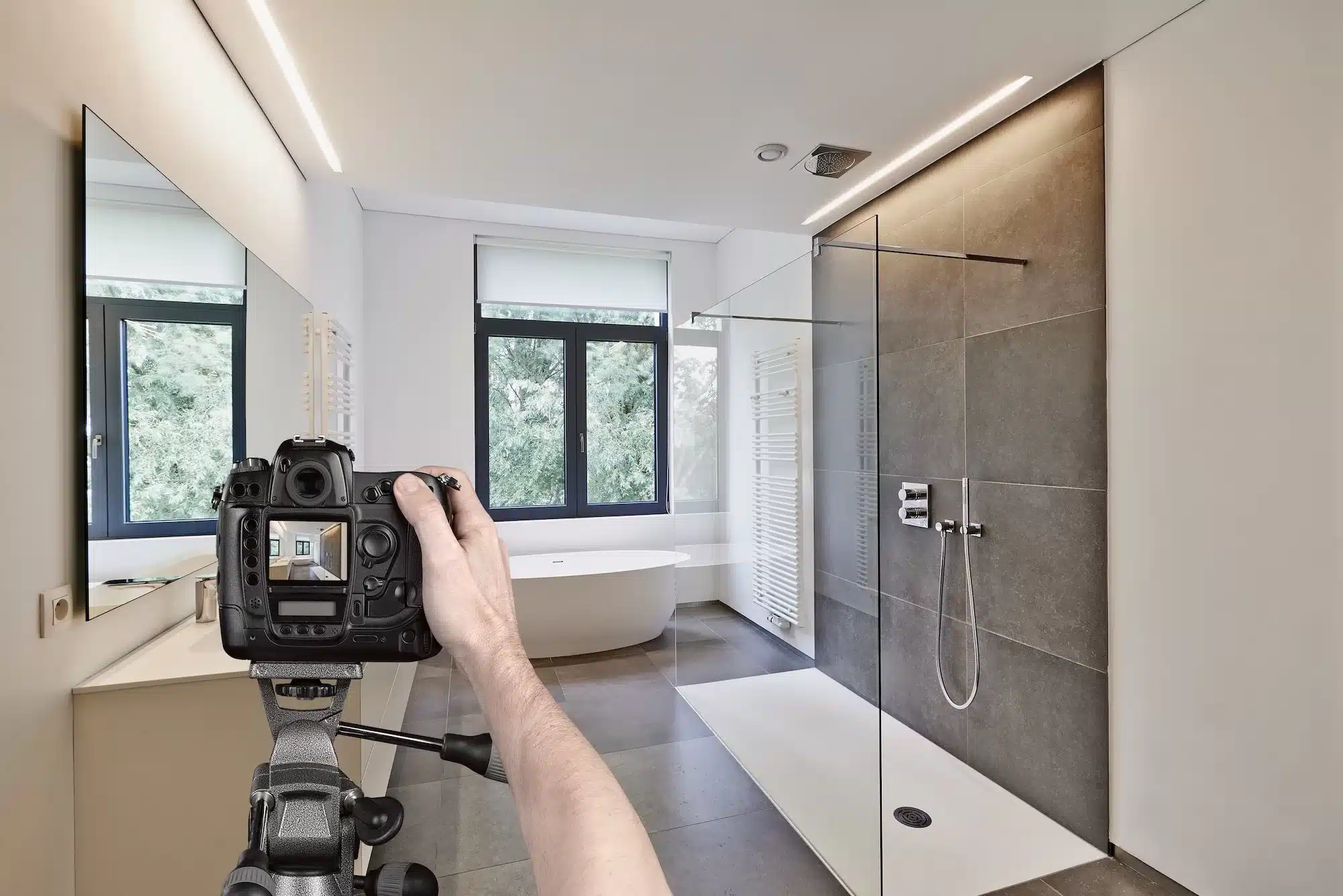
Experienced real estate photographers also know little tricks of the trade that amateurs won’t. For example, using lamps in the room instead of flashes to avoid an overexposed or “washed out” photo, or moving vehicles out of the driveway to avoid visual clutter.

And the photos themselves are just part of what a top-quality real estate photographer can do. Many photographers offer services like drone-guided video tours, virtual 3D tours, digital floor plans, digital staging, and social media videos that are increasingly valuable in today’s hypercompetitive and tech-driven market.

Post-production enhancement

If you post a lot of selfies on Instagram, you probably understand the power of photo editing. After your home’s shoot, your photographer will select the best photos, often with the assistance of an art director, and then edit and optimize them. Photo editors will fix color and contrast, and can even correct small flaws in your home or landscaping’s appearance. Only after they’ve been carefully selected and enhanced will the listing photos be presented to the seller.

The price and time bump

Homes with professional photographs sell 32% faster than homes without professional listing photos. That’s a substantial benefit, since the longer a home is on the market, the lower the chances it’ll sell. If your home sits on the market too long, buyers will assume it has hidden problems and avoid it. In that situation, you’ll have no choice but to take it off the market, or sell it to a company that buys houses for cash at a huge discount.

There’s a significant price benefit, too. Homes with professional listing photos sell for 47% more, per square foot, than homes with amateur photos. That’s a staggering difference, and it means that your professional listing photos will pay for themselves, many times over.

Latest posts by Thomas O’Shaughnessy (see all)

Mangrove photography awards 2023

Mangrove photography awards 2023
image

The Sundarbans is one of the wildest places left on Earth: a biodiversity hotspot and a complex tidal network of waterways and islands. Scientists forecast that the whole coastal belt of Bangladesh around the Sundarbans will be submerged by 2050.Helena Begium, 55, pictured, says: ‘Six months ago, during Cyclone Amphan, I lost my cattle, all domestic animals. Since then, I live in our wrecked house all alone. My children have left for the city to find a job. There is no work … we hardly get to catch fish. I have little left to eat. How am I going to survive with so much struggle, I do not know.’