Louis Vuitton’s New ‘Fashion Eye’ Photography Books Capture Vienna, Hong Kong and Deauville


The city of Eagle Pass is seen in the background as Carolina, a migrant from Venezuela, and her four-year-old daughter Valentina hide in an abandoned house. They are trying to escape from the Mexican authorities, who are stopping migrants from attempting to cross the Rio Grande River into the US
Photograph: Adrees Latif/Reuters

Xiaomi, the renowned Chinese smartphone manufacturer led by Lei Jun, has introduced its latest mid-range/high-end smartphone, the Xiaomi 13T. This device stands out for its commitment to delivering a Leica camera experience to its users, making it a compelling choice in the competitive smartphone market. While photography prowess is a key selling point, the Xiaomi 13T offers more than just exceptional imagery. Let’s delve deeper into its specifications, camera performance, and overall value.

Under the hood, the Xiaomi 13T is powered by MediaTek’s Dimensity 8200 Ultra processor, built on the 4nm process technology. Complementing this chipset, the device packs a generous 8 GB of RAM and offers 256 GB of internal storage. These specifications are certainly noteworthy, especially considering the smartphone landscape in the middle of 2023.
Xiaomi 13T camera specs
DxOMark, the authoritative entity in photographic sensor, lens, camera, and smartphone evaluation, has already reviewed the Xiaomi 13T. The smartphone garnered an overall score of 123, with individual scores of 134 points for photography and 114 points for video. This comprehensive evaluation highlights the Xiaomi 13T’s capability to capture stunning photos and videos, showcasing its prowess in the imaging department.
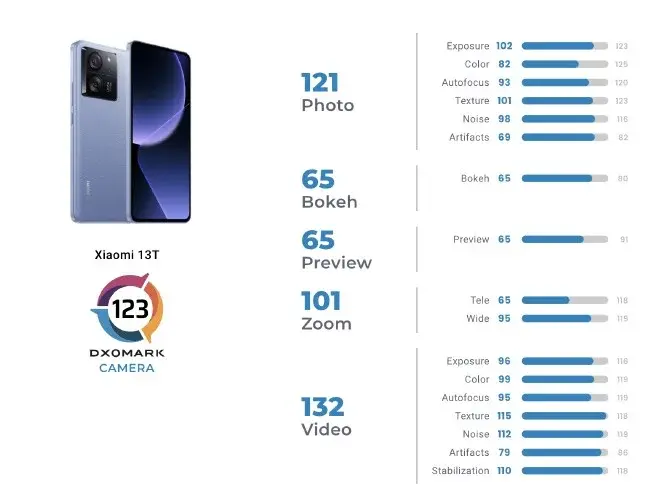
Among DxOMark’s extensive list of smartphones tested for photography and video performance, the Xiaomi 13T secures a respectable 60th place. While it may not occupy the top tier, it’s essential to consider the Xiaomi 13T’s price point in this context.
Comparatively, devices like the Samsung Galaxy S23 Ultra, iPhone 15 Pro Max, and Huawei P60 Pro outperform the Xiaomi 13T in DxOMark’s rankings. However, it’s crucial to note that these competitors often come with significantly higher price tags, making the Xiaomi 13T an attractive option for budget-conscious consumers.
The Xiaomi 13T’s camera performance is impressive, excelling in areas such as exposure, contrast, white balance, and detail preservation. Autofocus, dynamic range, and noise reduction also receive high marks, contributing to the device’s overall photography capabilities.
However, the Xiaomi 13T does have some limitations. It struggles to capture colors faithfully in more complex lighting situations, and there have been reports of a loss of detail in certain scenes, particularly when light is scarce.
The Xiaomi 13T: A Smart Investment
In conclusion, the Xiaomi 13T’s base model proves to be an excellent choice for users who prioritize mobile photography without breaking the bank. Considering its price point, it offers solid performance and impressive camera capabilities. To maximize its value, it’s advisable to aim for a price tag of no more than €600, making it a compelling option for those seeking a well-rounded smartphone experience without the premium price tag. The Xiaomi 13T’s Leica-inspired photography and respectable performance make it a noteworthy addition to the mid-range smartphone landscape in 2023.

In today’s digital age, it’s rare to find someone without a smartphone or camera. From capturing picturesque landscapes to snapping selfies, photography has become an integral part of our daily lives. While photography is often associated with preserving memories and sharing moments, recent research suggests that it can also have a profound impact on mental health.
Photography provides a non-verbal means for individuals to express and communicate their emotions, particularly when they find it difficult to articulate their feelings. This can be especially helpful for people with conditions like depression, anxiety, or trauma.
A 2016 study titled ‘Promoting Positive Affect through Smartphone Photography’ investigated how smartphone photography can be leveraged to help individuals increase their positive affect.

The researchers designed and conducted a 4-week study with 41 participants. Participants were instructed to take one photo every day in one of the following three conditions: a selfie photo with a smiling expression, a photo of something that would make oneself happy and a photo of something that would make another person happy. After 3 weeks, the researchers found that participants’ positive affect in all conditions increased.
According to research by Professor Denise C. Park from the University of Texas, photography is a highly cognitive activity to help keep the brain healthy. In her study, participants who engaged in digital photography were able to enhance and improve their episodic memory and reasoning skills.
Some mental health professionals use photography as a form of narrative therapy. Patients are encouraged to take photos that represent their experiences, which can then be discussed in therapy sessions. This can help people better understand their emotions and experiences.
Powerful ancient herb that can fight cancer
Keeping a photographic journal or documenting personal growth through photos can provide a visual record of progress in therapy or recovery. It can be motivating and reassuring for individuals to see how far they’ve come.
While photography can be a valuable therapeutic tool, it’s essential to acknowledge that it is not a substitute for professional mental health treatment. It can complement traditional therapies and self-help strategies, but individuals with mental health conditions should seek guidance from mental health professionals for a comprehensive treatment plan.

Also, it is important to balance photography with being present in the moment, as excessive photo-taking can have the opposite effect on mental well-being. Use photography as a tool for self-expression, connection, and mindfulness, and enjoy the positive effects it can bring to your life.

The Royal Meteorological Society has announced the winners of this year’s Standard Chartered Weather Photographer of the Year Competition.
For 2023, the coveted Weather Photographer of the Year Title Prize Winner is Francisco Negroni from Chile. The winning shot, A Perfect Cloud, depicts Villarrica (Chile’s most active volcano) illuminating two rings of lenticular cloud with the warm orange light from the lava within. The snow on the volcano-top contrasts the lava’s glow, and the star trail above signifies the passing of time it took to capture – a once-in-a-lifetime shot! The winning image was taken using a Nikon D610.
• The best professional cameras have great weather sealing for outdoor shots
With this photo, Negroni beat the other 24 shortlisted images as well as entries from over 94 countries, winning the top prize of £5,000 (approximately $6,120 / AU$9,585). The winners were chosen by a panel of experts from the fields of meteorology, photography and journalism, including members of the UK’s Met Office and broadcast television station ITV’s weather team.

The main title runner-up was awarded to Tran Tuan, whose photograph shows an aerial drone shot, taken with a DJI Mavic Pro, of a wildfire destroying a forest in Bac Giang province, Vietnam. Titled Forest Fire Boundary, the photograph shows a split landscape; half lush and green, the other half engulfed by smoke and flames. A powerful image that draws attention to the current climate crisis.
The winners of the other three categories are:
Smartphone Weather Photographer of the Year
Lez Irwig, for Braving the Storm captured on a Samsung Galaxy S23. The photo shows a surfer looking out towards a stormy skyline, contemplating surfing among the heavy connecting clouds. Irwig wins the cash prize of £2,500 ($3,060 / AU$4,790). You only have to take a look at our list of the best phone cameras to see the incredible advancement in handsets, and this is a showcase of what is possible.
Young Weather Photographer of the Year
Jamie McBean, for Overhead Mammatus over Beach Huts at Herne Bay. The 17-year-old captured unusual, bulbous, mammatus clouds at sunset, overlooking a set of beach huts in Herne Bay, UK. McBean wins a cash prize of £750 ($920 / AU$1,440), plus a double-page spread in the Week Junior Science+Nature Magazine and a year’s subscription.
Public Vote winner
Fernando Braga, for the photograph Divine Power. Over 9,000 members voted for Braga’s image, which captures forks of lightning framing the world-famous Christ the Redeemer statue in Rio De Janeiro, Brazil. This dramatic image was taken on a Nikon D750 using the AF-S Nikkor 70-300mm f/4.5-5.6G.
The 2023 competition saw an increase in entries, raising more awareness of the impact of climate change on our weather systems. “The judges had tough decisions to make this year, as we had such variety and quality of entries from all over the world,” said Liz Bentley, chief executive of the Royal Meteorological Society.
“We’re delighted with the results, which show the capacity of the world’s weather for beauty and destruction, tranquility and power. The competition serves as a reminder that we must strengthen the global response to the threat of climate change to keep our heating planet from exacerbating extreme weather events.”
Congratulations to all of the winners and runners-up. You can see the full list on the competition website.
If you’re looking to brave the elements, you might be interested in the best waterproof cameras or perhaps the best action cameras.


In 1973, aged 21, Daniel Meadows refitted a 1948 doubledecker as the “Free Photographic Omnibus” and set out on a 14-month journey around England offering portraits, gratis, to all-comers. In the back window of the bus was a Letraset sign to give punters an idea of the project: Meadows was in the business, it proclaimed, of capturing “how things are and how they are changing”. With this in mind, he covered 10,000 miles and made audio recordings along with his pictures, selling the idea to his subjects that their images and thoughts would be preserved for history. That hopeful pitch came true. The archive of Meadows’s journey was bought by the Bodleian Libraries in 2018. A selection of the pictures and fragments of reporting from his journals and recordings are now collected in a new Book of the Road.
This image was taken during a couple of days in the Northumberland town of Haltwhistle that began at the Railway Inn, where Meadows, his diary records, played darts and sank several pints with some friendly ex-miners. Subsequently, he pitched up at the local bingo hall and, in breaks from “eyes down” games, talked to some of the regulars there. One, Moira Little, gave him a potted history of the place, which had been a music hall for the troops stationed nearby before they left for France in 1914, the stage featuring “stars like George Formby, Gracie Fields”. “After that,” Little said, “we had the silent films with a man playing the piano in the corner here” and then there were talkies. The bingo had taken over in the late 60s. “After the bingo was over,” Meadows reports, for posterity, “I went through to the Railway Inn again and did some pictures in the folk club… Retired to bed, pissed, about midnight.”
Book of the Road is published by Bluecoat Press. An exhibition, Free Photographic Omnibus, 50th anniversary, is at the Centre for British Photography, London SW1 until 17 December

Swedish artist Annika Nordenskiöld has won the world’s first artificial intelligence art award at the Ballarat International Foto Biennale with a life-like image of sisters cuddling an octopus, which she created using computer prompts.

Twin Sisters in Love (2023) by Annika Nordenskiöld.Credit: Ballarat International Foto
Biennale
Accepting the $2000 first prize on Sunday from Sweden for the winning image Twin Sisters in Love (2023), Nordenskiöld said: “I understand the fear of AI and find it somewhat healthy. But I see it more like a colleague I am working with.”
“None of these places, people or creatures exist in the physical realm,” said the artist who recently had an exhibition of her work in Stockholm called We don’t exist, and is about to publish her third book using text prompts to create photo-like images.
“Many people say my pictures make them uncomfortable … When I explain that AI creates them as a kind of collage… many laugh, others are distressed and find them disgusting,” she said of the pictures she has created using the AI program Midjourney.
The organisers of the Ballarat festival hope the inaugural AI prize, Prompted Peculiar, a world first for an international photography festival, will open debate about the difference between photography and what they call “promptography.”
The term was coined this year when German photographer and judge at the Ballarat festival Boris Eldagsen turned down first prize in the creative open category of the Sony World Photography Awards because his image “The Electrician” was generated by AI, and in his words, was “not photography”.

Photographer Boris Eldagsen (left) and the image he created using AI, “The Electrician.”Credit: Boris Eldagsen
“At the time, I was considered a fire starter in the photography world in opening up this conversation on ‘promptography’, but now I am seen as the Che Guevara of analogue photographers and how we approach the elephant in the room – AI-generated images,” he said.
“Now the default position for when you look at pictures online will be to assume they are artificially generated – rarely are they fact-checked … which presents a problem for picture editors, photographers, developers, AI experts and social media consumers the world over.”
Eldagsen, who was joined on the judging panel by Una Rey, editor of Artlink magazine and Ballarat International Foto Biennale CEO Vanessa Gerrans, says an international roundtable conversation on photography is needed.
“A photographer goes out into the world and shoots what they see by chance in a certain place, but nowadays, a ‘promptographer’ can stay in a darkened room and create a computer-generated image. Seeing is no longer believing it is real,” he said.
He suggested a code of ethics for photographers with perhaps watermarks to ensure authenticity of photos may be necessary.
With photography co-ops like Magnum, and lawyers the world over seeking to clarify copyright laws of photographed material, his fellow judge, Gerrans said they were concerned about the potential to create disinformation.
“There are clearly unresolved issues around moral rights and consent, these are the conversations we need to start having so we can make sure we’re primed and acting ethically and responsibly,” Gerrans said.
As new technology impacts visual culture, Prompted Peculiar is an invitation to debate where this
new art of “promptography” belongs, she said at the end of a weekend of public forums in Ballarat, which covered these topics.
Lawyer Alana Kushnir, who helped work out the terms and conditions of the competition which attracted entries from all over the world, said it was a courageous move on behalf of a photography festival to engage with AI.
“We don’t have much guidance when it comes to the law in this space. We had to ask ourselves from an art history position, what is the difference between a photo and an image.
“There are parallels to when the camera was first invented – artists felt threatened. It will take time for the terms around IT and AI to align better,” Kushnir said.
Start the day with a summary of the day’s most important and interesting stories, analysis and insights. Sign up for our Morning Edition newsletter.

Esther Umoh, a poet and the Chief Executive Officer of Pendrops Photography, tells BLESSING ENENAITE about her career and other issues
What influenced your decision to become a photographer, and how long have you been practising?
Depression influenced my decision to become a photographer. I am a poet and a creative person. I decided to open a photography studio as a business, and I had someone manage it for me. At a point, the person managing it left and I was confused. It led me to a bad state. However, in August 2022, I underwent training in photography.
What are the challenges you have faced so far in your career?
Photography is quite expensive and not as cheap as people might think it is. The financial aspect, and being able to master the craft itself are the two challenges for me.
What are your notable works so far?
Working with the 2023 presidential candidate of the Labour Party, Peter Obi, is one of my major works so far. Also, taking the picture of the teenage boy on the road who stood in front of Obi’s motorcade when we went for a (presidential) rally in Lagos, is one of my notable pictures so far.
How did you feel after the picture of that teenager went viral?
I initially did not know I took that picture. I was just taking random photos, trying to capture moments, because one does not know which particular picture might be the best. I posted all the pictures. It was after the event that I went on Twitter and I saw that people were talking about it. I was surprised and happy, because after that picture went viral, people recognised the boy. He was helped and taken back to school. That was really fulfilling for me.
Did you get any benefits from that picture?
No, I did not. However, I believe that all rewards come from God.
You were one of Peter Obi’s official photographers during the presidential campaign. How would you describe your experience working with him?
I think anyone that sees Obi will be excited. Imagine having to work with him all through the campaign period almost every day; those were practically the happiest days of my life. When he was the governor of Anambra State, I was in secondary school, so, I did not really know much about him. Fast forward to the presidential elections, I had to read up on him, and I was really impressed, especially with him saying that he had never stolen any government money. I believe him because nobody has come out to refute his claims. To me, that indicated integrity. My father is also someone who does not joke with his integrity. It felt good to see someone else who represented what my dad and my family represents.
After working with Obi, my perception of him has become even more positive. He loves getting things done. Nothing is impossible with him, and inasmuch as it is doable, one cannot tell him that it is not doable. He loves to go for what he wants.
The elections caused a lot of rancour, with many relationships being negatively affected. Did you have a similar experience?
Yes, I did. I had to ‘block’ many people (on social media). I consider anyone who does not want a better Nigeria to be an enemy of the country.
Tell us about your family and educational background?
I am from Akwa Ibom State. I studied Communication Arts at the University of Uyo, Akwa Ibom. My dad worked with the Independent National Electoral Commission for about 35 years. Until his retirement, he was an administrative secretary at INEC. I am the fifth of seven children.
My mum is a businesswoman, but she is currently serving her people as the Vice Chairman of Udunguko Local Government in Akwa Ibom.
You once stated that four of your siblings are lawyers. Why did you decide to toe a different path?
It was a matter of choice. I could have also become a lawyer, but I decided not to toe that line. Also, I used to be really interested in football, but I could not play. So, my dad said I should go into football commentary. That was why I decided to study Communication Arts.
You dress like a tomboy. Have you always been that way?
I don’t really have a reason for the way I dress. I just want to be free (comfortable). One thing one should not do to a creative is to gag them. I don’t like to be gagged. I often get comments about my looks. Whether one looks good or bad, one would surely get comments. However, I have mostly got positive comments. I don’t think anybody can look at me and say I am not pretty, or commend the way I dress.
What plans do you have for your career?
I want to advance it. I want to use my skill to help people, and engage in activities that would make the common person on the street hopeful about their goals.
What are your most memorable moments as a photographer?
My memorable moments are when I am able to visualise a certain picture the way I want it to look like, and I am able to actually bring it to life. Capturing a moment properly and editing it to tell the story one wants to tell is quite memorable for me.
Who are the people you look up to as a photographer?
I respect photographers such as TY Bello and Joshua Okoro. I also admire my friends who are good photographers, such as Jude Monami, who was actually the person who trained me in photography.
What are your other areas of interest?
I am a poet, and event manager.


American photographer Deborah Turbeville’s work has intrigued and captivated audiences for decades. Her brooding, almost surreal fashion photography landed her a job at Harper Bazaar in the 1970s and has since been celebrated for her evocative, dreamlike imagery. Five decades later, and commemorating the tenth anniversary of her death, her latest book Deborah Turbeville: Photocollage shines a spotlight on the area of work that makes her an iconic artistic powerhouse – her photo collages.
Unlike her contemporaries in fashion photography, Turbeville approached her craft with a deliberate sense of playfulness. She used techniques such as xeroxing, cutting, scraping, pinning prints together, and even writing in the margins to create narrative sequences that transcend the confines of single, glossy images. Her work occupies a liminal space between art and commerce, challenging traditional notions of fashion photography.
• Check out the 50 best photographers ever including icons such as Henri Cartier Bresson, Diane Arbus and Helmut Newton.
This collection of 180 images is the result of extensive research from the Deborah Turbeville archive. The carefully curated publication showcases a diverse range of commercial and personal projects, with many previously unpublished images. It features insightful texts contributed by Vince Aletti, Anna Tellgren, and Felix Hoffmann, offering readers a deeper understanding of how Turbeville redefined fashion photography on her own terms. Her work, in contrast to the stereotypes assigned by male photographers, presents a more nuanced and authentic portrayal of femininity rather than the highly sexualized images we are so used to seeing.
Born in Boston, Massachusetts in 1934, Deborah Turbeville sadly passed away in 2013 leaving an indelible mark on the world of fashion photography. Her work graced the pages of renowned publications such as Vogue, Harper’s Bazaar, Nova, and The New York Times.
Nathalie Herschdorfer, Director of Photo Elysee-Museum of Photography in Lausanne, Switzerland, has played a crucial role in the creation of this remarkable book. Known for her books Coming into Fashion, Afterwards: Contemporary Photography Confronting the Past, and Body: The Photography Book, Herschdorfer’s insightful introduction delves into the professional and personal life of Turbeville, highlighting her successes and celebrating her contribution to photography.
Deborah Turbeville: Photocollage is an essential book for any coffee table with modern relevance to those with a passion for fashion photography and the female gaze. It invites readers to explore the artistic innovation and timeless allure of Turbeville’s work, cementing her place as a visionary photographer who transcended boundaries and challenged conventions. As we embrace her legacy, we can appreciate her enduring influence on the art of photography and the ever-evolving landscape of fashion. Copies will be available from published Thames & Hudson from October 12 in the UK, and in November in the US, for £55/$75/AU$110.
Check out the best film cameras – retro classics that have been a mainstay in the analog world





