This week’s Dan’s Papers cover art, provided to us by DTR Modern Galleries, showcases the work of internationally renowned sculptor Jane Manus.
Dan’s Cover Artist Jane Manus Talks Sculpture & DTR Modern


For Todd Slatt, a.k.a the “Aurora Hunter” photographing the northern lights is nothing out of the ordinary, but last Saturday, he witnessed something emerging from the darkness of the night sky that shocked and inspired him.
A spiral of pale blue light began to form in the distance, growing ever larger and coming ever closer to the man holding his camera and his breath.
Eventually, it completely passed over his viewing spot in Delta Junction, Alaska, leaving the expert photographer mystified.
“It was a beautiful piece of art in the sky,” Slatt told Anchorage News Daily. “I would say this was maybe the most bizarre thing I’ve ever seen in my life.”
Residents farther north, who are used to wild weather phenomenon, also saw the spiral and wondered what it was.
MORE WILD WEATHER: Hiker Captures Video of Rare Ice Disk Vortex Spinning in Scottish Winter Weather Phenomenon–WATCH
Like many others that night, Slatt did some research and soon appeared on his Facebook with a stunning image of the spiral and a surprising explanation for its origin.
“After doing some online research, this phenomenon appears to be rocket engine exhaust from a SpaceX Transporter-7 mission that launched on the Falcon 9 about three hours earlier in California,” he wrote.
“Water vapor in the exhaust (or jettisoned fuel causing it to spiral?) from the second stage engine freezes and catches high-altitude sunlight, effectively glowing and creating this spiral-galaxy-looking display of light.”
The beauty of the aurora is augmented no end by the blue spiral atop it, and serves to make the sky look somewhat like a national flag.
SHARE This Inspiring And Beautiful Photography With Your Friends…


Graciela Iturbide: I became Maya’s mentor through a government grant in the 1990s and, not long after, she traveled with me to France and Hungary as an assistant. We have a similar way of thinking, politically and spiritually, and we live in similar worlds, but our temperaments are very different. Maya has often looked for the toughest thing she can find — the femicides in Juárez; her wonderful projects with sex workers — though she has also photographed healers and shamans. I prefer to shoot in calmer situations. When I get surprised by something, that’s when I pull the trigger.
I don’t feel I’m her teacher, although I suppose she learned about photography from our long conversations and from looking at images together, and we have a shared way of working. I go to live with the people I photograph for a month or two [in order to] establish relationships. It makes the work less intrusive. While Maya was working on “Plaza de la Soledad” (2006), her book about prostitutes in Mexico City, she took me to meet those women. She’d developed such close relationships with them, too.


But I don’t know if we have such clear-cut legacies in Mexican photography. When I started out in the 1970s, the great Manuel Álvarez Bravo was the first photographer I knew. As his assistant, I learned how to develop, how to draw out blacks, whites and grays. More than anything, though, in the many years I knew him, he taught me a way of life. He taught me about literature and music and painting, about how to be myself and how to have liberty. My family, who were very conservative, didn’t approve, but now I have nieces who want to be photographers so, in one way or another, I’m passing down the legacy that he left to me, to Maya and others. We all have to go our own way at some point. If we don’t, we never become ourselves.
Maya Goded: For more than 30 years, Graciela and I have had this intense dialogue. I would go over and we would drink a lot of mezcal, look at images, talk about photography, what we were reading, what we were listening to, ideas, politics, the social and cultural life taking place around us. Photography wasn’t just looking at photo books. It was life itself. For a time, Graciela was the only person I always showed my work to, and she’s the only photographer I’ve gone into the field with. She has this powerful but natural way of moving through space, which is something I learned from her: to wait and observe, letting time do its work.
If you’re photographing vulnerable situations, you have to make yourself vulnerable, too. Photography’s a kind of healing, a way to understand your own wounds, which is something Graciela and I have spoken about a lot. Over the years, I’ve seen that she’s always searching. If you have a fixed idea about your work, if you’re not questioning yourself, that means you’re not really living your craft.
Interviews have been edited and condensed.

Dominique Thorne,
Actress

Maya Goded,
Photographer

Sarah Ruhl,
Playwright & Writer

Emel Mathlouthi,
singer-songwriter

atsuko okatsuka,
comedian

raven leilani,
writer

aneeth arora,
textile maker & fashion designer

eleanor shearer,
writer

thuso mbedu,
actress

sophie thatcher,
actress

layli long soldier,
poet & writer

symone harcum,
opera singer

michela marino lerman,

mona awad,
writer

alexia khadime,
actress

klein,
musician & filmmaker

monica lópez santiago,
chef

sondra radvanovsky,
opera singer

multidisciplinary artist

weike wang,
writer

nina raine,
playwright & director

priscilla aleman,
multimedia artist

lynette linton,
playwright & director

lana del rey,
singer-songwriter

teyana taylor,
singer-songwriter & actress

zadie xa,
interdisciplinary artist

aisling franciosi,
actress

melissa cody,
textile artist

elle fanning,
actress

safiya sinclair,
poet & writer

issa rae,
actress, producer and screenwriter

michell zauner, a.k.a. japanese breakfast,


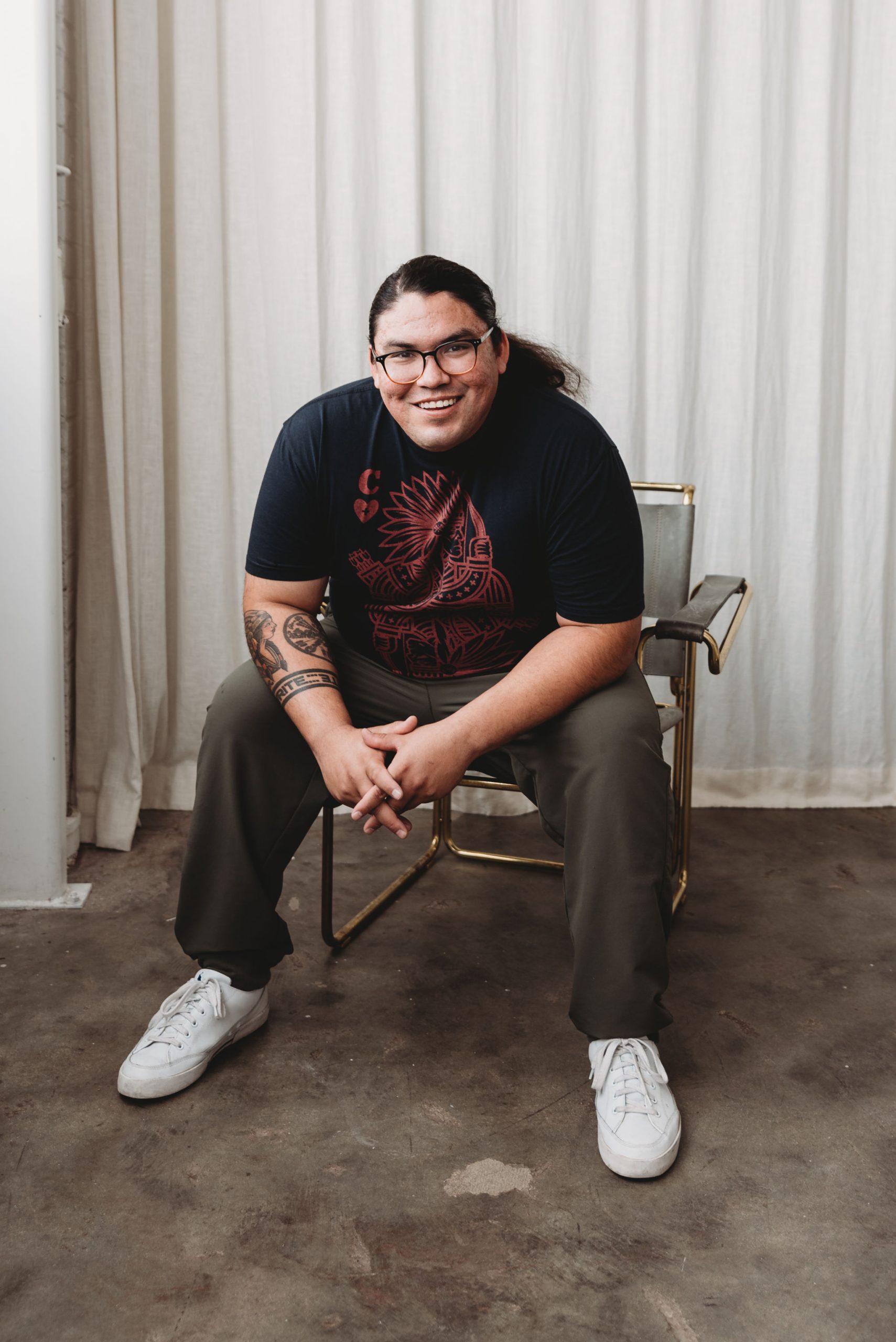
When Joshua Emerson’s mom died in the winter of 2019, he felt like a crucial part of himself had been severed. The Denver-based comedian, writer and actor was raised partly on the Navajo reservation in Arizona, and his mother’s passing sparked a difficult reckoning with his Native heritage.
“There’s a sense that I lost a little of my Indigenousness when she died, because she was the one that was Navajo, and was from the reservation, and she spoke Navajo,” says Emerson, whose dad is white. “I don’t speak Navajo. There’s a sense that I have to learn how to come back to that as an adult … I feel orphaned culturally, and because of that, it’s made me want to do Native projects and be around Native people.”
Now 31, Emerson is co-chair of the Denver American Indian Commission, and puts on one of the only Native comedy showcases in the United States. He also just became managing director of Creative Nations Collective, a permanent onsite gallery for Indigenous artists at the Dairy Arts Center in Boulder.
Emerson stays busy these days, performing comedy and helping various communities blossom — from the Colorado indie-comic circle to the world of local Indigenous artists. He’s also the co-founder of DeadRoom Comedy in Denver, a troupe and production company he started with friends Elliot Weber and Jacob Jonas after graduating from Fort Lewis College in Durango four years ago.
Hosting nearly 200 events since its inception, including the Colorado Native comedy showcase, DeadRoom has become the perfect vehicle to combine Emerson’s industrious ambition with his passion for Indigenous issues. He sees comedy as a vehicle for Native people of various tribal backgrounds to connect and learn from each other.
“Comedy is unique in that it’s able to give voice to minority communities,” he says. “It helps us talk about difficult things and then relieve it through a punchline that just makes everybody laugh and brings [them] into community. When you can talk about difficult things, you’re able to be more honest.”

With that uplift and honesty in mind, Emerson stresses that “Native Americans are not a monolith.” As the only Indigenous member of DeadRoom, which has expanded from its three founding members, he wants folks to know that understanding Native people takes more than catching up on the latest season of Reservation Dogs.
“When you’re talking to a Native you gotta ask, ‘So what tribe or community are you from?’ They [each] have their own history and backstory,” he says. “There’s a big difference between being Ojibwe and being Navajo — being Diné, which is what I am. But it’s cool; we have similar struggles; we see each other. There’s definitely, like, a head nod. There’s a community [that comes] from being Native.”
DeadRoom is now putting on roughly a dozen comedy events a month, according to Emerson, stretching across Colorado and into surrounding states. And as the collective’s footprint grows, Emerson waxes poignantly when asked whether there is any subject that shouldn’t be joked about.
“If you’re going to talk about something that’s going to bring up trauma in people, you gotta have an exit for it,” he explains. “Are you being irresponsible by making jokes that are gonna hurt people? And then there’s this other thing of, you don’t know what’s funny until you try it. So the attempt becomes sacred.”
When it comes to that “sacred” attempt, Emerson says there are few crowds tougher than those found here in Boulder.
“I’d say Boulder is one of the hardest places to talk about race … even [harder than] Colorado Springs or Fort Collins. When you’re talking about race in those communities, their racism is out in the open, and they’re OK laughing about it,” he says. “You come up to Boulder, I think there’s less racism but the racism that is here is very inside — very hidden — and it’s very hard to reach. When you do bring it up it makes people uncomfortable, because they’ve compartmentalized it. It’s hard for them to find the funny in it. I don’t know if it’s that they’re ashamed, or if they’re aware they even have it stored away.”
But as Emerson continues to push audiences into uncomfortable territory while working to ensure “a seat at the table” for Native people through various organizations and events, the self-described comedy “lifer” returns to a simple but profound goal.
“The best you can do is try to make it better, and hope that creates a lineage so that it’s easier for anyone that comes behind you.”
ON STAGE: Underground Comedy Showcase feat. Joshua Emerson and Ben Roy. 7:30 p.m. April 27-29, License No. 1, 2115 13th St., Boulder. Tickets here.


#inform-video-player-1 .inform-embed { margin-top: 10px; margin-bottom: 20px; }
#inform-video-player-2 .inform-embed { margin-top: 10px; margin-bottom: 20px; }
A film event, playwrights festival, concert and a workshop by the Idaho Circus Collective join the traditional artisan booths and food trucks for the 37th annual Art Under the Elms Friday through Sunday at Lewis-Clark State College in Lewiston.
Admission to the event, organized by the LCSC Center for Arts & History, is free. Hours are noon to 7 p.m. Friday, 10 a.m. to 7 p.m. Saturday and 10 a.m. to 4 p.m. Sunday.
#inform-video-player-3 .inform-embed { margin-top: 10px; margin-bottom: 20px; }


Lying in bed the other morning listening to the radio, I experienced a dark epiphany; I’ve never been much fun in the mornings. There had been problems in Jerusalem, and one side in the conflict had provided video footage supporting its claim that it had been wronged. For my whole life up to this point, I would have been minded to take a look at that video. But now I found myself thinking, why bother? How would I know it showed what it said it showed? How would I know it wasn’t a complete fake? Videos and photos used to mean something concrete, but now you can’t be sure.
I haven’t enough confidence in my human intelligence to formulate a firm view on the dangers or otherwise of artificial intelligence. What I do know is that before long, we won’t know anything for sure. As it stands, however good a fake might be, you can still just about tell it’s a fake. But only just. Sooner rather than later, the joins will disappear. We might even have already passed that point without knowing it. If the judges of the Sony world photography awards couldn’t spot the fake, what chance have the rest of us got?
Television drama is ahead of the curve on this. The Capture and The Undeclared War were both great and did the subject justice – both gave off an unsettling sense of the end of days. If the twist in every crime drama is some kind of deep fakery, it’s all going to get terribly boring. So, in the outside world, to paraphrase GK Chesterton, everything will go to pot as we’ll believe in nothing or, indeed, anything. And, back home, there won’t even be a decent box set to watch. What a time to be alive.






