88301 is an ART FULL destination @art88301 #art88301 Carrizozo Music, Inc. hosted the The N’Awlins Gumbo Kings on World…


An entry into the World Photography Organization’s Sony World Photography Awards has brought new attention to the conversation around AI-generated art. After artist Boris Eldagsen entered his AI-generated piece “The Electrician” into the art contest and won, he opted to turn down the prize.
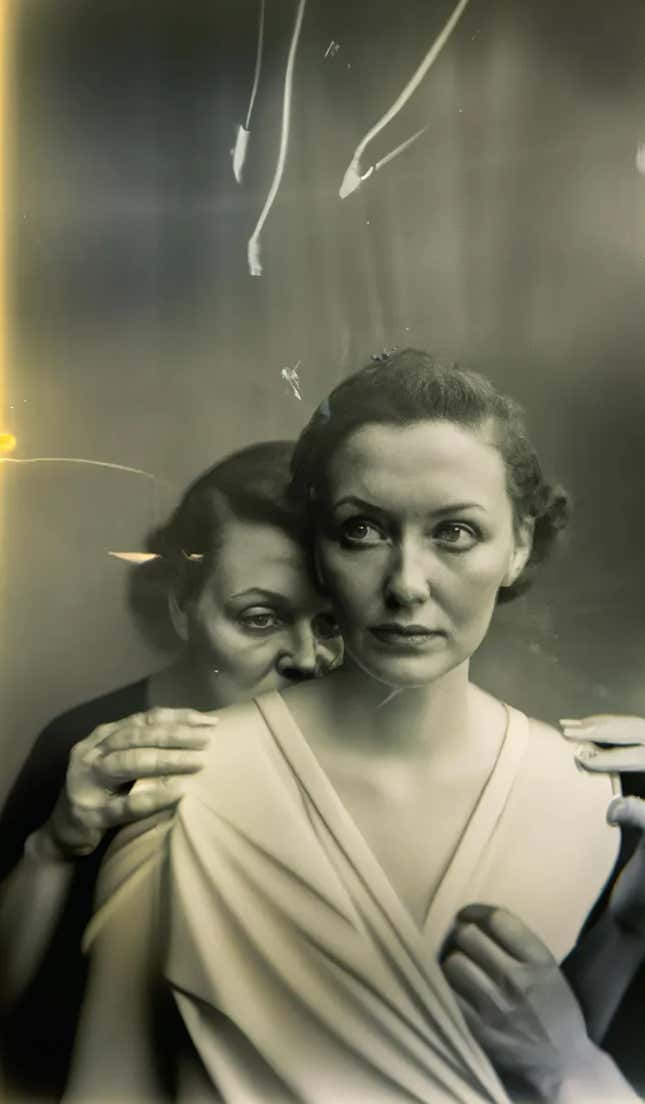
“The Electrician” features two women—one leaning her face on the other’s back—in a grainy sepia tone with streaks of light that recall the “spirit photography” of the early 20th century. It’s a beautiful work of art that showcases clear talent from the artist, except the work was created in collaboration with an AI used by Eldagsen, who refers to himself as a “photomedia artist” on his website. Eldagsen entered the Open Category at the Sony World Photography Awards according to his website and won with “The Electrician.” As a winner, Eldagsen would have received photography equipment from Sony, inclusion in a World Photography Organization’s book and exhibit, as well as plenty of exposure for his career.
“I have been photographing since 1989, been a photomedia artist since 2000. After two decades of photography, my artistic focus has shifted to exploring the creative possibilities of AI generators,” Eldagsen wrote on his website. “The work SWPA has chosen is the result of a complex interplay of prompt engineering, inpainting and outpainting that draws on my wealth of photographic knowledge. For me, working with AI image generators is a co-creation, in which I am the director. It is not about pressing a button—and done it is.”
As Peta Pixel reports, the World Photography Organization announced the awards winners on March 14, with Eldagsen being among the finalists. A month later, on April 13, Eldagsen announced on his website that he would not accept the award. As Eldagsen writes in his announcement, he applied to the contest as a “cheeky monkey” looking to test if “competitions are prepared for AI images. They are not.”
The World Photography Organization decried Eldagsen’s stunt in a statement sent to Gizmodo, saying Eldagsen had claimed “co-creation” of the image in conjunction with an AI prior to winning. “Given [Eldagsen’s] actions and subsequent statement noting his deliberate attempts at misleading us, and therefore invalidating the warranties he provided, we no longer feel we are able to engage in a meaningful and constructive dialogue with him,” the statement reads.
The conversation around the applications of AI has seemingly come to a head in recent months, and Eldagsen was not the first artist to win a competition with AI. In August of last year, Jason Allen submitted his piece, titled Théåtre D’opéra Spatial, to the Colorado State Fair Fine Arts competition, and he won. In that case, the artist was happy to accept the accolades.
As the AI boom continues, there has been a substantial rise in AI-generated art, with Runway’s Gen-2, and the infamous DALL-E 2 from OpenAI demonstrating how easy it can be for a computer to create video and images from text. The issue with most of these generators is their clear tendency to lift pre-existing (often copyrighted) material from other sources, only to Frankenstein it into an original piece of art.
Want to know more about AI, chatbots, and the future of machine learning? Check out our full coverage of artificial intelligence, or browse our guides to The Best Free AI Art Generators, The Best ChatGPT Alternatives, and Everything We Know About OpenAI’s ChatGPT.
Update April 17 11:50 a.m. EST: This article was updated to include a statement from The World Photography Organization.


The Stone Archive installation, created by Mexican lighting brand davidpompa, will explore the volcanic origins of a new light sculpture series – Ambra Toba – at Alcova during Milan Design Week. The collection combines ancient stone with aluminum, but the stone isn’t one you might stumble across on your own. Mexican Toba volcánica stone consists of minerals, glass, and volcanic debris that was created one million years ago during eruptions. Debris, ashes, and dust – Toba volcánica is millions of years speaking to us today through texture.

The combination of stone and aluminum elements originated after researching the bond between handmade shapes and industrial parts. In partnership with the geological department of the National Autonomous University of Mexico (UNAM), an investigation into the origins of Toba volcánica gave further insight as to why it’s widely used in Mexican culture.

The Stone Archive installation took the project further. The space captures and connects science, aesthetics, culture, and materiality, allowing visitors to pause and visualize time in a tangible way. Tall, archival shelves filled with stones, folders, and prototypes allow the Ambra Toba light sculptures to connect with their evolution in the midst of the exhibition space. Visitors are even invited to take a single archive folder with them when they leave.

Alongside the Ambra Toba lighting series, Stone Archive includes a wide range of collaborations sharing the same discourse. Visitors will experience research of the National Autonomous University of Mexico and the work of Dutch microphotographer Wim van Egmond. Mexican chocolate manufacturer Cuna de Piedra will be present at the installation’s “Terroir Milan” event, held April 19th. Design studio SAVVY, filmmaker Wolf Lass, Portuguese fashion brand Naus, food designer Philipp Kolmann, and writer Alexander Slotnick are also part of the installation.


Stone Archive will be part of the itinerant Alcova platform during Milan Design Week, and is located in the former slaughterhouse in the historical quarter of Porta Vittoria Abattoir, at Viale Molise, 62. The installation can be viewed April 17-23, 11am-7pm. To learn more, visit davidpompa.com.


A German artist whose AI-generated image won first prize at one of the world’s top photography competitions has declined the award
Berlin-based “photomedia” artist Boris Eldagsen submitted his image, “The Electrician,” to the Creative category of the 2023 World Photography Organization’s Sony World Photography Awards open competition.
The picture, which appears to be a dated black-and-white portrait of two women, is part of Eldagsen’s “Pseudomnesia: Fake Memories” series(Opens in a new window). Based on the Latin term for fake memory (“such as a spurious recollection of events that never took place, as opposed to a memory that is merely inaccurate,” the project page said), the images were “co-produced” using artificial intelligence generators.
The photo—which, if you look long enough, will reveal itself to be just a little bit wrong—was shortlisted in the Creative category, and eventually selected as the overall winner on March 14.
At the time, Eldagsen, who’s been a photographer since 1989, wrote in a blog post(Opens in a new window) that he was “very happy” to have won, while also acknowledging that the work “is the result of a complex interplay of prompt engineering, inpainting, and outpainting that draws on my wealth of photographic knowledge.
“For me, working with AI image generators is a co-creation, in which I am the director,” he said. “It is not about pressing a button—and done it is. It is about exploring the complexity of this process, starting with refining text prompts, then developing a complex workflow, and mixing various platforms and techniques. The more you create such a workflow and define parameters, the higher your creative part becomes.”
A month later, Eldagsen took to the same blog to announce his refusal of the prize, asking audiences and judges how many “knew or suspected” the image was artificially generated.
“AI images and photography should not compete with each other in an award like this,” he wrote last week. “They are different entities. AI is not photography. Therefore I will not accept the award.” Instead, he suggested the World Photography Organization donate his prize—$5,000, Sony digital imaging equipment, a trip to the award ceremony in London, and more—to Fotofestiwal 2023, an international festival of photography in Poland.
“I applied as a cheeky monkey, to find out if the competitions are prepared for AI images to enter,” Eldagsen continued. “They are not. We, the photo world, need an open discussion. A discussion about what we want to consider photography and what not. Is the umbrella of photography large enough to invite AI images to enter—or would that be a mistake? With my refusal of the award I hope to speed up this debate.”
The WPO was, it turns out, aware of Eldagsen’s AI “co-creation,” a spokesperson told PCMag in an emailed statement, adding that “as per the rules of the competition, the photographers provide the warranties of their entry.
“The Creative category of the Open competition welcomes various experimental approaches to image making from cyanotypes and rayographs to cutting-edge digital practices,” the organization said. “As such, following our correspondence with Boris and the warranties he provided, we felt that his entry fulfilled the criteria for this category, and we were supportive of his participation.”
But “in keeping with his wishes,” the WPO removed Eldagsen from the competition—including replacing the display copy of “The Electrician” at the exhibition in London.
“We recognize the importance of this subject and its impact on image-making today,” the group says. “We look forward to further exploring this topic via our various channels and programmes and welcome the conversation around it. While elements of AI practices are relevant in artistic contexts of image-making, the Awards always have been and will continue to be a platform for championing the excellence and skill of photographers and artists working in the medium.”
 This AI robot was made to be your best friend
Sign up for What’s New Now to get our top stories delivered to your inbox every morning.
This newsletter may contain advertising, deals, or affiliate links. Subscribing to a newsletter indicates your consent to our Terms of Use and Privacy Policy. You may unsubscribe from the newsletters at any time.


“Mue n°5 (Amnios).” All photos by Adrien Millot, © Jeanne Vicerial, courtesy of TEMPLON, Paris, Brussels, and New York, shared with permission
Evocative of medieval suits of armor or monastic traditions, Jeanne Vicerial’s intricate sculptures exude quiet strength in thousands of draping threads. The French artist layers halyards, a type of cord used to hoist sails or flags, to outline the curves of figures wearing elegant cloaks, hoods, and shield-like accessories with unraveled coils at their feet. In her series Armors—a play on the French words amour and armure, meaning “love” and “armor,” respectively—she assembles enigmatic garments that await use, as if crystallized over time.
Vicerial was inspired by the Gorgons of Greek mythology, the most famous of which is Medusa, whose hair roiled with snakes and turned anyone who looked at them into stone. “The idea was to insert myself into that great mythological story but to suspend its time, making it impossible to define the time or place where they were born,” the artist tells Colossal. She leaves the wearers’ identities open to interpretation, allowing the viewer to imagine the possibilities of their histories or purposes.
Drawing on her background in fashion and textiles, Vicerial was originally interested in studying the male figure and clothing. She began to focus on expressions of the female form when she participated in a year-long residency at Villa Medici in Rome and was struck by the way women have been represented throughout art history. “When I looked at the sculptures in the Villa’s park and saw the Venuses with their wet drapery, the representations of women in lascivious postures with draped cloth that always seems to be accidentally slipping off, I decided to focus again on the female body,” she says. Vicerial turns the ancient trope on its head by emphasizing garments as protective coverings that beget a formidable presence, merely hinting at the figure beneath.

“Puppa n°1”
Describing the works as “guardians,” Vicerial provokes subtle associations with medieval European burials of knights and nobles, Japanese samurai armor, or nuns’ habits. She sometimes places varnished flowers like roses into cavities located where a metal chest plate would have protected one’s vital organs in combat. Like portals glimpsing a mysterious interior, they highlight the body’s vulnerability.
Blurring the boundary between fashion and sculpture, the phantom-like works are devoid of facial expressions. Long threads cascade from headdresses, shoulders, and faces illustrating dignity and vulnerability, and the spectral, imposing armors are “protections that express a form of power, but that are in reality extremely fragile because they are made only of threads,” she says, underlining the dubious tension between strength and weakness. “To touch them is in a way to destroy them because they could never be presented in the same way again.”
Armors comprised a recent exhibition with TEMPLON. If you’re in Paris, you can find Vicerial’s work in the group exhibition Des cheveux et des poils at the Musée des Arts Décoratifs through September 17. Follow updates about forthcoming shows and new works on the artist’s Instagram. (via .able)

Detail of “Puppa n°1”

“Encéphale n°1”

“Catula Présence”

Left: Detail of “Présence à l’enfant.” Right: “Présence à l’enfant”

“Gisante de Coeur”

Detail of “Gisante de Coeur”

Left: “Mue n°1.” Right: Detail of “Mue n°1”

“Puppa n°4”

“Mue n°5 (Amnios)”
Do stories and artists like this matter to you? Become a Colossal Member today and support independent arts publishing for as little as $5 per month. The article Jeanne Vicerial’s Enigmatic ‘Armors’ Evoke Timeless Strength in Elegant Sculptures Made of Thread appeared first on Colossal.






