Delhi High Court discusses the importance of novelty and originality in design disputes

Delhi High Court discusses the importance of novelty and originality in design disputes

The judgment dated 03 July 2023 of Delhi High Court, in Jayson Industries Vs Crown Craft India Pvt. Ltd addresses the crucial issue of design novelty and originality. The plaintiff, who holds Design Registrations 326707, 326883, and 326882, accused the defendant of design piracy. Central to the plaintiff’s claim is the novelty and uniqueness of the designs of their bucket, mug, and tub. According to the plaintiff, these products incorporate distinctive shapes, configurations, and surface patterns, setting them apart visually from similar items in the market. The plaintiff argued that the defendant’s products are obvious and fraudulent imitations of their registered designs, constituting piracy. The following comparisons were made:

To support their claims, the plaintiffs presented various views of their registered designs, showcasing different angles and sections of each item. It was emphasized that the designs have been granted novelty based on their unique features, particularly the ribbed nature of the body and the flange-like extensions on the vessels’ rims.

The dispute, initially filed before a District Judge (Commercial Court), was transferred to the High Court due to the defendant’s plea challenging the validity of the suit designs. The district court had previously granted an ex-parte ad interim injunction in favour of the plaintiffs, restraining the defendant from selling, marketing, distributing, or supplying the disputed bucket, mug, and tub. The ex-parte interlocutory injunction remained in force, and the defendant sought relief and vacation of the injunction.

In response to the allegations, the defendant raised questions on the imitative nature of the designs and challenged the validity of the suit designs. The defendant argued that the Designs Act, 2000 lacks a provision similar to the Trade Marks Act, 1999, which statutorily presumes the validity of a registered trademark. Contrarily, the defendant claimed that there is no such presumption of validity for a registered design under the Designs Act. Additionally, the defendant contested the novelty and originality of the suit designs, seeking their cancellation based on grounds such as lack of novelty, originality, and prior publication.

The defendant presented various documents, including brochures and registered designs to demonstrate the lack of novelty and originality in the suit designs. The argument emphasized that even slight differences in the shape of flanges or other minor changes would not save a design from invalidation if it were deceptively similar to the prior art. Furthermore, the defendant contended that trade variants of the existing prior art cannot be considered “original” within the meaning of the Designs Act. These contentions gave rise to a prima facie triable issue challenging the validity of the designs.

The court conducted a thorough examination of the application of the law to the presented facts, particularly focusing on the issue of design novelty. Based on the principles outlined in the Designs Act, the court raised doubts regarding the novelty and originality of the suit designs. It concluded that the suit designs lacked novelty and originality, leading to the rejection of the plaintiff’s request for an interlocutory injunction

The court analysed the suit designs, specifically highlighting the plaintiffs’ claimed novel and original features: the vertical ribs along the length of the designs and the flanges on the rim. However, upon careful examination of the prior art, the court found no convincing evidence that these features were indeed novel and original.

The court held that the vertical ribs along the length of the bucket, tub, and mug, as well as the extended flanges at the rim, were not unique to the plaintiffs’ designs. It cited various prior art references that demonstrated the existence and use of similar features before the plaintiffs’ designs came into play. Following were the prior design documents:

i)  Bathroom tub as uploaded by Sara China Bona Mould:    

ii) Mug as uploaded by Sara China Bona Mould:

iii) Tub No. BN2103169 invoiced by Bona Mould to Crown Craft,

iv) Mug No. BN2103170 invoiced by Bona Mould to Crown Craft

v) Bucket from the catalogue of Migeplastics

vi )Design 784645, registered in favour of David  A. Richardson.

vii )SeMius Durable Practical Solid Geometric Shape Storage Garbage Household Trash Can, available on amazon .in since 14 March 2019:

The court observed that the vertical ribs in the suit designs were identical to those found in the prior art. While there were some minor variations in the shape, number, and extent of protrusion of the flanges, the court considered these changes as trade variants rather than substantial differences. Therefore, the court deemed the defendants’ challenge to the suit designs’ novelty and originality credible, resulting in the rejection of the plaintiff’s request for an interlocutory injunction.

The court’s decision emphasizes the significance of demonstrating novelty and originality in design disputes and underscores the necessity of thorough prior art investigation to support assertions of uniqueness and exclusivity. It also highlights the cruciality of conducting comprehensive prior art searches before making accusations or initiating legal action for design infringement.

Phoenix Art Museum acquires large-scale tipi with funds from Men’s Arts Council

Phoenix Art Museum acquires large-scale tipi with funds from Men’s Arts Council

Phoenix Art Museum announced the acquisition of Cannupa Hanska Luger’s Incendiary (2023), a vibrantly colored, large-scale tipi work from a recent series that explores the adaptability and versatility of the nomadic structure as a metaphor for the resilience of Indigenous peoples in the face of settler- colonial violence. The painted and shaped canvas is a significant addition to the Museum’s contemporary art collection and furthers the Museum’s efforts to collect and display art that reflects a diversity of voices from the Southwest region and Arizona. Incendiary by Luger was acquired by the Museum with funds from the Men’s Arts Council, a Museum support group dedicated to supporting acquisitions, exhibitions, and education and engagement programming. It is on view now in the Katz Wing for Modern Art.


DEEPER DIVE: Ranking Arizona: Top 10 resorts for 2023


“Adding Incendiary by Cannupa Hanska Luger into the collection of Phoenix Art Museum represents a significant step forward in growing contemporary Indigenous perspectives within the PhxArt Collection,” said Jeremy Mikolajczak, the Museum’s Sybil Harrington Director and CEO. “The work is a wonderful example of how Luger uses Indigenous knowledge to challenge histories and stereotypes and, in dialogue with other works, assertively demonstrates a reframing and repositioning of historical narratives of Native peoples. Incendiary joins other paintings and multimedia works in our contemporary art holdings by contemporary Indigenous artists such as Fritz Scholder and Steven Yazzie.”

Cannupa Hanska Luger was born in 1979 on Standing Rock Reservation in North Dakota. Now based in New Mexico, he is an enrolled member of the Three Affiliated Tribes of the Fort Berthold Reservation and is of Mandan, Hidatsa, Arikara, Lakota, and European heritage. By incorporating wide-ranging media, from ceramics, steel, and fiber to video and repurposed materials, Luger creates monumental installations and sculptures, performances, and wall works that attempt to reframe and reclaim 21st-century narratives about Indigenous cultures and identities. His work unites historical references and tradition with contemporary concerns, all to imagine and dream of Indigenous futures.

Luger is a 2022 Guggenheim Fellow and a recipient of a 2021 United States Artists Fellowship Award for Craft. In 2021, he was named a GRIST Fixer, and in 2020, he was named a Creative Capital Fellow and a Smithsonian Artist Research Fellow, among other previous awards and accolades. Luger has exhibited nationally and internationally at institutions such as The Metropolitan Museum of Art, Gardiner Museum, Kunsthal KAdE, ASU Art Museum, Berkeley Art Museum, New Orleans Museum of Art, Mesa Arts Center, and the National Center for Civil and Human Rights. His work is featured in collections of various museums around the world, including the North American Native Museum (Zürich, Switzerland); the Denver Art Museum; the Museum of Contemporary Native Arts (Santa Fe); the Yale University Art Gallery (New Haven); and the Conley Gallery, California State University (Fresno). Luger holds a BFA in studio arts from the Institute of American Indian Arts.

Incendiary (2023) is one of 10 canvases from Luger’s tipi series, a recent investigation of painting. For the Plains people, tipis represent a nomadic lifestyle, defined by patterns of migration that mirror the movements of buffalo herds. The structures were often made from the skins of hunted buffalo, making them part of the land and the humans who constructed them simultaneously. Tipis also adapt to the land on which they exist, similar to how Indigenous peoples have adapted over centuries of struggle and ongoing conflict with colonizers.

As part of his tipi series, Luger transformed the word “tipi” into an acronym—Transportable Intergenerational Protection Infrastructure. The acronym suggests that the structure can cross time and space, even into future realms of existence, thus solidifying its status as a testament to Indigenous resilience and innovation. Incendiary, like other canvases from the body of work, features recognizable graphic forms of stars and oversized cartoon eyes with curled eyelashes, which are drawn from specific historical references. The eyes reference stereotypical cartoon characterizations of Indigenous peoples in early animations, while the overall pop aesthetic refers to historical air force nose art. This type of nose art first appeared on British Royal Air Force Tomahawks during World War II and was later adopted by U.S. forces to adorn US P-40s, or Warhawks. By appropriating this imagery and placing it onto a Native nomadic structure, Luger reflects on the ability of Indigenous peoples, their knowledge, and their technologies to withstand the colonial violence and aggression these designs represent. It is also a reflection on how Native American cultural motifs have been appropriated by Western popular culture for centuries.

I Am A Professional Aerial Photographer And Here Are My Tips On Getting Started (6 Pics)

I Am A Professional Aerial Photographer And Here Are My Tips On Getting Started (6 Pics)

Unique Perspective 

Aerial photography offers a captivating and often unseen view of the world. It allows you to capture landscapes, cityscapes and natural wonders from a bird’s-eye perspective, revealing patterns, symmetry, and beauty that are not easily visible from the ground. This is where you’ll find your ‘voice’ and point of difference. 

As a commercial aerial photographer and videographer based in Byron Bay, Australia, I have always been spoilt for choice and inspiration – my family and I quite literally live in paradise – however, I regularly travel to work in challenging locations, from tight city spaces to hostile Arctic environments. I’m here to tell you, there’s always a way to safely and respectfully show a scene in a new light. Don’t be afraid to try.

The Pursuit of Truth: Will AI Prompt a Return to Film Photography? |

The Pursuit of Truth: Will AI Prompt a Return to Film Photography? |

Are we living in a post-truth era of photography, where the authenticity and reliability of images have become questionable? Given the rise in AI’s association with photography and the ease with which photos can be altered, it might be worth considering a return to the use of traditional film as a means to regain trust and ensure the integrity of photography.

Photography has long been regarded as a medium that documents the world around us, offering a glimpse into the reality of a specific place and time. However, with the advancement of artificial intelligence (AI), concerns surrounding truth and authenticity in photography have become more pronounced. In this article, we explore the current evolving landscape of photography, delving into the impact of AI and its implications for truth, authenticity, and the future of the medium.

The advent of digital photography and image sharing on social media platforms have already significantly reshaped our understanding of authenticity in photography. In an era where filters and editing apps are readily available, the notion of viewing an unaltered image has become increasingly elusive. The pressure to present flawless images is leading to a loss of the perception of reality that photography once celebrated.  From portraits featuring poreless porcelain skin and perfect body ratios, to landscape images stitched together with moody skies and no blemishes on the land to create the perfect shot, we accept that some of what we see should be taken with a pinch of salt. But now that AI has entered the chat, where do we draw the line?

AI has revolutionized the field of photography, offering powerful tools designed for streamlining workflow, removing imperfections, and even creating entirely new visuals. While these advancements have undoubtedly opened up possibilities for photographers and artists, they have also raised significant questions about the authenticity and integrity of the images we see around us every day.

Okay, so my header image for this article is very clearly fake, but what if you opened an article discussing the dangers of fully opening windows in apartments where children live, and this article was accompanied by the image below?  As photographers, we have a trained eye and can scrutinize the image, but I showed this image to my 72-year-old mother, and she gasped, thinking it was real. 

One of the main concerns revolves around the ease with which AI can be used to manipulate and distort reality. Deepfake technology allows for the creation of highly convincing fake images and videos, making it difficult to tell what is real and what is not. This raises ethical questions, particularly in a photojournalistic context, where the truthfulness of visual evidence is of huge importance.

In an era where the authenticity of digital images can be easily compromised, film photography instills trust in the medium itself. Film photography, characterized by the use of light-sensitive film and chemical development processes, holds a closer position to truth and authenticity. Unlike digital photography, where images can be easily manipulated and altered, film captures a moment as it truly exists. As the lines between reality and digital manipulation continue to blur, shooting with film could serve as a reliable back up where negatives are available in the event that the authenticity of images is under scrutiny. 

It’s not all negative. AI can be a useful tool, enabling photographers to automate laborious tasks, leaving more time to focus on creating. However, AI algorithms can alter images in convincing ways, blurring the line between reality and fiction. This poses a threat to the credibility and trustworthiness of photojournalistic work, as viewers may be misled by digitally manipulated images that appear genuine. The authenticity and truthfulness that have long been associated with photojournalism are at risk in an era where AI can easily deceive the audience.

Film negatives serve as physical evidence of the captured moment, providing a connection to the truth which we can hold in our hands and see for ourselves. This transparency and tangibility offers confidence in the authenticity of the photograph, as it is difficult to dispute the reality of an image that exists, as captured, as a physical object. Returning to film photography would represent a commitment to preserving the art and craft of the medium. The process of shooting, developing, and printing film photographs requires a level of skill and craftsmanship that is distinct from the convenience of digital photography or AI algorithms. By embracing film, photographers can reconnect with traditional techniques, allowing their technical expertise to convey their artistic vision. 

It is important to recognize that authenticity in photography is a multifaceted concept. Of course, film can be digitized, and through that process becomes at risk of falling foul to AI in the same way that digital images are. One thing is for sure: AI continues to evolve and is here to stay. It is essential that AI systems are developed within a set of defined ethical standards, which don’t seem to exist in any meaningful way as yet. Perhaps any AI manipulation should be listed within image metadata as standard, which would be a good place to start.

Could a resurgence of film photography serve as an antidote to the concerns surrounding AI-driven image manipulation? To counteract concerns and re-establish photography as a medium of truth, it is worth exploring the unique qualities of film that foster authenticity and argue for its resurgence as a means of capturing genuine moments in an increasingly AI-driven world.  This post-truth problem challenges our ability to assess reality, and this leads to questions about the authenticity of photography. As we navigate this complex landscape, have we gone so far that “the truth” is now just a concept?

I have ended this article with the original apartment image, which I shot in early 2020 while leading a photography walkabout in Glasgow. Noticing a herd of photographers in the street, a decorator leaned out of a window and asked for a picture. After reading this article, can you trust this information or the content of the image?

Smartphone Photography Shootout: Samsung And Apple Head-To-Head

Smartphone Photography Shootout: Samsung And Apple Head-To-Head

Through the pandemic, I became passionate about photography. Although I’ve technically been doing “professional” product photography for articles featured on-line and in print for a couple of decades, it was only in the last few years that I stepped up my game. As much as I love my pro camera gear though, it’s not something you can carry around perpetually. As the old saying goes, “the best camera is the one that’s with you”, and like most of you, my smartphone camera is the one that’s almost always within reach. So, when presented with the opportunity to test a couple of the top smartphones for photography, I jumped at the chance.

The smartphones I’m referencing are the Samsung Galaxy S23 Ultra and the Apple iPhone 14 Pro Max. Both of these devices might be the current flagships for their respective manufacturers, but they couldn’t be any more different in terms of their rear “world facing” camera configurations (both cameras feature 12MP selfie cameras). The iPhone 14 Pro Max features a 48MP main camera, with a 24mm 7-element lens (ƒ/1.78 aperture), with sensor-shift optical image stabilization. That main camera is flanked by a 12MP Ultra Wide shooter, with a 13mm 6-element lens (ƒ/2.2 aperture) and a 120° field of view, and a 12MP Telephoto shooter, with a 77mm 6-element lens (ƒ/2.8 aperture), with 3x optical zoom (digital zoom up to 15x) and optical image stabilization.

The Samsung Galaxy S23 Ultra features a bleeding-edge 200MP main camera with a 24mm lens (ƒ/1.7 aperture) and optical image stabilization. Adjacent to the main camera, there’s also a 10 MP “periscope telephoto” shooter (ƒ/4.9 aperture), with OIS and 10x optical zoom, a 10 MP telephoto camera with a 70mm lens (ƒ/2.4 aperture), OIS and 3x optical zoom, and a 12 MP ultra-wide camera, with a 13mm lens (ƒ/2.2 aperture), 120˚ field of view, and Dual Pixel PDAF. The ultra-wide shooters on both the Galaxy S23 Ultra and iPhone 14 Pro Max also do double-duty as Macro shooters.

Those main camera specifications need some additional clarification, however. While many of today’s high-end smartphones boast ultra-high megapixel ratings, they also do something called “pixel-binning”. Pixel binning uses multiple pixels on the sensor to gather data that’s grouped, or “binned”, together to effectively act a single pixel of a certain color. For example, the iPhone’s 48MP main camera actually outputs 12MP images by default, because it is using quad-pixel binning. Users must shoot in RAW, which requires additional processing, to capture a 48MP image. The Galaxy S23 Ultra does the same thing; 200MP image captures are possible, but typical captures are 48MP. Pixel binning is one way to counter-balance the more limited light-gathering capabilities of the small pixels on densely-packed smartphone camera sensors. It results in more accurate color captures and less noise, but creates images that are only 25% of the maximum resolution of the sensor, when using quad-binning at least.

High-End Smartphone Camera Systems Require Massive Processing Power

Smartphones designed with high-quality photography in mind usually use complex image processing techniques, high-quality optics, and a multitude of computational photography technologies to capture and intelligently process as much image data as possible. As such, today’s smartphones require powerful image processors to not only produce high-quality images, but offer a good user experience.

The iPhone 14 Pro Max is powered by Apple’s own A16 Bionic chipset, which features a 16-Core Neural Engine capable of 17 TOPS and an advanced Image Signal Processor (ISP). The Samsung Galaxy S23 Ultra is powered by the flagship Snapdragon 8 Gen 2 Mobile Platform that features Qualcomm Technologies, Inc.’s first ever Cognitive ISP.

Sensor sizes and megapixel counts may be key differentiators that play a significant role in a smartphone camera system’s quality, but they are less relevant than most people think. Smartphones simply do not have the physical space to accommodate large camera sensors and a sensor’s pixel density can only be so high before image quality is negatively impacted, particularly in challenging lighting conditions. Although there are other things to consider, in general, smaller pixels on a camera sensor gather less light than larger pixels (all other things being equal), which can degrade image quality in sub-optimal lighting. Because of this, a smartphone image processing capabilities are immensely important.

There’s isn’t much data available on Apple’s proprietary ISP. The company consistently enhances the capability of its “Axx” mobile processors with each generation, but specifics are scarce. Qualcomm has also enhanced its Snapdragon platforms over the years with leading image processing and computational photography features. Although Qualcomm’s partners, like Samsung, don’t typically enable every possible photography or videography-related feature available in the latest Snapdragon mobile platforms, those that place a strong emphasis on photography often produce devices capable of capturing excellent photos and videos. In fact, according to DxOMark, many of the best smartphone cameras are powered by Snapdragon.

The Spectra Image Signal Processor featured in the Snapdragon 8 Gen 2 has triple Cognitive ISPs, capable of processing 3.2 gigapixels per second. The trio of Cognitive ISPs gives devices like the Galaxy S23 Ultra the ability to leverage up to three independent cameras simultaneously and enables features like triple simultaneous image capture, seamless zooming between cameras, multi-capture HDR composites, and up to 200 Megapixel photo capture, among other things. The first of its kind Cognitive ISP in the Snapdragon 8 Gen 2, in conjunction with the chip’s Hexagon™ AI engine, also enables something called real-time “Semantic Segmentation”, which is enabled on the Galaxy S23’s selfie camera.

Semantic Segmentation leverages a neural network that was trained to identify many different objects, like people, faces, skies, grass, etc., and each of those objects can be segmented, and custom processing applied to them to enhance a captured image or video. If you’re familiar with image processing applications, you can think of the segments as layers, and each layer can be edited independently to produce a desired effect – bluer skies, smoother skin, greener grass – you get the idea. And since the segments can be altered independently, each segment can be properly exposed, saturated, or sharpened, without diminishing the quality of the other segments. As software support for Semantic Segmentation matures, it has the potential to be a real game changer.

Both the iPhone 14 Pro Max and the Galaxy S23 Ultra use an array of computational photography techniques to produce images. Common computational photography features, like Night Mode, Portrait Mode, and HDR are available on both platforms. The Galaxy S23 Ultra also offers a feature called AI Zoom. AI Zoom is an experiential feature that gives users the ability to seamlessly zoom from the widest angle all the way to 100x zoom, spanning three different cameras, by simply pinching and zooming or using an on-screen slider. There’s no need to manually switch between the ultra-wide, standard, or telephoto camera, or to figure out which one is best to compose a particular shot.

The Mobile Photography Experience

Although I’m focusing on photography here, I should also note that both the iPhone 14 Pro Max and the Galaxy S23 Ultra are high-performance devices, which offer quality user experiences in general. Both of the phones are fast, and have myriad of photo and video-related features. Specifically as it related to photos and videos, autofocus is quick and accurate on both devices, they capture realistic tones and textures, and noise performance is also very good. For general photography, I think anyone coming from a previous-gen device is likely to be quite pleased. But there are some major advantages to the Qualcomm-powered Samsung Galaxy S23 Ultra worth pointing out.

The Galaxy S23 Ultra’s camera application features a number of customizations required to give users access to some of the device’s special photo features, like Hyperlapse, Single Take, and Expert Raw, to name but a few. Users of any skill level, however, should be able to navigate its menu system and manipulate camera settings or quickly switch between modes. Although there are many options available to tune image quality to a user’s liking, auto-mode takes phenomenal shots. The Galaxy S23 Ultra is capable of capturing excellent detail; perhaps one small criticism is that it can sometimes oversaturate images and perform a bit too much sharpening.

Without the right processing, handling wide dynamic range lighting situations can be challenging for the relatively small sensors in a smartphone, but even with strong backlighting with the sun shining brightly, the both the iPhone 14 Pro Max’s and Galaxy S23 Ultra’s cameras performed well. Colors and tones of the scene are well balanced, with crisp detail, when normally some objects would be silhouetted on lesser cameras that can’t handle this kind of lighting. That said, the Galaxy S23 Ultra better handled the exposure and was able to retain more blue in the sky.

The higher resolution 200MP sensor in the Galaxy S23 Ultra also captures more detail. When scaled and posted to social media, with minimal editing, the differences may be very difficult to suss out. But the massive resolution offered by the Galaxy S23 Ultra gives users much more flexibility to crop without sacrificing as much detail in the final image. These zoomed crops of the images captured on both phones shows just how much additional resolution is available on the Samsung device.

A 200MP capture on the Galaxy S23 Ultra is 16320×12240 pixels. A 48MP capture on the iPhone 14 Pro Max is 8064×6048 pixels. You could crop 50% from each dimension on the Galaxy S23 Ultra and still have a similar number of pixels to work with versus the full resolution on the iPhone.

Both phones handled Portrait mode well, though they offer different fields of view in this mode. The simulated blurred background bokeh is smooth, on both with surprisingly realistic looking transitions from in-focus to out-of-focus areas. Portrait Mode can often introduce unwanted artifacts in the fine details around a subject’s edges, but both phones do a pretty good job here. The Galaxy S23 Ultra does a slightly better job though, with smoother transition, and more detail in the subject.

The Galaxy S23 Ultra also stands out with close-up Macro photography. Even when its ultra-wide camera is nearly touching the subject, it is able to focus properly and capture fine detail.

The iPhone 14 Pro Max does a great job too if you don’t pixel peep, but zooming in shows more fine detail in the Samsung capture – you can actually make out individual bits of pollen, whereas on the iPhone the processing makes the internal part of the flower look like it has a rough, bumpy texture.

In terms of video recording, both devices are relatively full featured, but the edge yet again goes to the Galaxy S23 Ultra. The iPhone 14 Pro Max tops out of 4K60 recording, while the Galaxy 23 Ultra can do 8K30 recording. Slow motion, normal, and time lapse recording are available on both devices as well. In practice I found the video quality on both devices to be quite good, though the Galaxy 23 Ultra seemed to handle sub-optimal, low-light conditions somewhat better.

Top camera performance continues to be paramount for flagship smartphone buyers, but whether evaluating specification or real-world results, it’s clear Qualcomm-powered Android devices like the Samsung Galaxy S23 Ultra are a step ahead of the competition. Independent bodies like DxOMark show most of the top smartphone cameras are backed by Qualcomm processors.

thMTHRshp art gallery prepares for takeoff

thMTHRshp art gallery prepares for takeoff

Courtesy Liz Jordan

Liz Jordan thought conventional art world practices could use some updates — changes that would make being an artist a little less impossible for mothers and other people with day jobs. Because a starving artist isn’t very admirable when there are multiple mouths to feed.

So the East Dallas mom started up a company, a fine-arts gallery called thMTHRshp, which aims to change the culture by upgrading the commission structure to favor the artist and offer extra support to historically marginalized artists.

thMTHRshp’s founding artists are women and mothers, LGBTQIA+ people, artists of color, disabled artists and those with professions outside the art world. They will soon launch an online gallery, and will have their first in-person show in November at Ephemeral Space, which is owned by Jason Cohen, who also owns Curiosities.

“We combine our love of art with social justice and community outreach initiatives to create positive change in our communities,” Jordan says by email. “Our dual career artists are stay-at-home moms and other professionals who thrive with the flexibility of a gallery and the community of a collective.”

She says the gallery’s commission agreements, in which artists receive a minimum 70% of the sale of their work, up to 85%, will make a big difference for thMTHRshp artists. Galleries typically take 50% on two-dimensional works such as paintings and photographs, according to art marketing blog reddot.

“That’s a game changer, and I am so excited to offer that opportunity to artists in our community and across the U.S.,” Jordan says. “I am happy to be a part of the movement representing marginalized artists AND supporting financial success for artists.”

The gallery offers workshops open to the public and led by the artists — think yoga, abstract painting, photography, mixed-media pet portraits, creative learning for preschool and elementary students, floral design, mindful and creative learning for preschool and elementary kids, art and hang for LGBTQIA+teens. Workshops accommodate new parents, people with disabilities and others interested in learning and healing through art. They want to create positive change that ripples through East Dallas and beyond, the founding artists note.

“Community engagement and outreach are essential to our mission,” Jordan says. Everyone involved in thMTHRshp believes the whole neighborhood benefits from multicultural and multidisciplinary experiences, she adds.  Texas Women’s University.

thMTHRshp won the 2022 Texas Women’s University StartHER grant, which gives 25 current or aspiring women business owners $5,000 to undertake new and innovative projects. As the gallery page notes, it’s “a place where artists can be artists, no side hustle required.”

U.S. Soccer Announces New Multi-Year Joint Photography Partnership With Getty Images And International Sports Images | U.S. Soccer Official Website

U.S. Soccer Announces New Multi-Year Joint Photography Partnership With Getty Images And International Sports Images | U.S. Soccer Official Website

CHICAGO (July 11, 2023) – U.S. Soccer today announced a new multi-year joint partnership with Getty Images (NYSE: GETY), a preeminent global visual content creator and marketplace, and International Sports Images (ISI), U.S. Soccer’s long-time photo partner, that will provide U.S. Soccer with expanded best-in-class service and photography excellence in coverage.

“We’re excited to add Getty Images to our existing partnership with ISI and have two of the world’s industry leaders in sports and soccer photography for our digital media needs,” said U.S. Soccer Vice President of Marketing Kay Bradley. “This relationship will further evolve our coverage, content creation and storytelling while providing us with the additional service and global reach of Getty Images’ platforms.”

Under the agreement, Getty Images and ISI will work closely with U.S. Soccer to cover a range of matches, programming and events, including the U.S. Women’s and Men’s National Teams, Youth National Teams and Extended National Teams, all to be distributed exclusively through gettyimages.com. 

“Sport imagery lies at the very foundation of Getty Images. For over 25 years, we pride ourselves in being a partner to all stakeholders in the sports industry and work hard to deliver outstanding service in the creation and distribution of world‑class sports content,” said Getty Images Global Head of Content Ken Mainardis. “With an elite roster of specialist and award‑winning sport photographers, Getty Images is thrilled to continue its history of highlighting the iconic moments and achievements of U.S. Soccer athletes to the widest possible audience via our unparalleled distribution platform, especially in the lead up to the Women’s World Cup.”

“Our relationship with U.S. Soccer has spanned over 30 years, capturing the most relevant and recognizable moments in American soccer history,” said John Todd, President and CEO of International Sports Images, Inc. “We look forward to continuing our exemplary photography services, in partnership with Getty Images, to promote and highlight the U.S. Soccer Federation, its sponsors, athletes and fans.”

The extended joint partnership will provide U.S. Soccer with the global scale, technology, innovation, and quality of service for which Getty Images and ISI are renown across the industry, while providing U.S. Soccer with ownership of its own photography copyright.

For over 25 years, Getty Images has partnered with many of the most significant sports leagues and governing bodies in the world. Today, Getty Images is the official photographer or photographic partner to over 120 of the world’s leading sport governing bodies, leagues, and clubs, including FIFA, the International Olympic Committee, NBA, Major League Baseball, National Hockey League, UEFA, FA, UFC, NASCAR, Manchester United and FC Bayern Munich, covering over 50,000 sports events a year.

Since 1992, ISI has been at the forefront of soccer in the United States, serving as team photographer and image manager for the U.S. Soccer Federation and providing comprehensive and in-depth coverage of national team matches, teams, players, and events. ISI’s passion for covering the sport is unparalleled. Its archive holds over half a million soccer images and chronicles the growth of soccer in the United States during the modern era, starting with the 1994 World Cup, the very first MLS game in San Jose, the WUSA, the WPS, and the NWSL. ISI provides the highest quality imagery and service to its clients and partners.

Moving forward, all U.S. Soccer images will be accessible through Getty Images’ platform, eventually including the Federation’s historical catalog. U.S. Soccer will continue to work with ISI on sourcing its photographers as well as leverage Getty Images’ award-winning sports photographers from around the globe.

Maine native violinist featured in second concert of season for Sebago-Long Lake Music Festival

Maine native violinist featured in second concert of season for Sebago-Long Lake Music Festival

Sebago-Long Lake Music Festival’s second concert of the 2023 season features Maine native violinist Jennifer Elowitch. Submitted photo

Violinist Jennifer Elowitch returns for the second season in a row to the Sebago-Long Lake Music Festival. Elowitch will perform with six other artists from across the United States, but she is the only one of them “born and brought up” in Maine. Most well known in the chamber music tradition is her founding and directing the Portland (Maine) Chamber Music Festival. Today she remains its Music Director Emerita.

The Program on Tuesday, July 18 features:

HAYDN: Divertissement in G Major for Flute, Violin and Cello, Hob. IV:7
KODÁLY: Duo for Violin and Cello, Op. 7
DVOŘÁK: Piano Quintet in A Major, Op. 81

The Haydn piece is one of six produced in 1784 when London was “awash in amateur flutists” seeking new pieces to play. And after years of producing works exclusively for the Hungarian House of Esterhazys’ “music-mad court,” Haydn was finally allowed to profit from his work. Prior to that, the Esterhazys owned everything he wrote.

Bela Bartok praised Kodaly as the “perfect embodiment of the Hungarian spirit.” As his compatriot, fellow ethno-musicologists and close friend, he was able to capture the authentic folk music of the Hungarian peasantry and make the folk heritage the basis of a genuine Hungarian musical style.

Dvorak did the same with his Slavonic musical heritage within the classical traditions of Beethoven, Schubert and especially Brahms. For years the composer wrote many of his famous compositions at his family’s peaceful retreat in a small village near Prague.

“We want to remind audiences, that those under 21 years of age are admitted to our concerts free of charge,” said Treasurer Lee Bearse of the SLLMF Board of Trustees. “As a former music teacher at Lake Region High School, I’ve long been an advocate for keeping music accessible to young people. So, I encourage folks to bring their children and grandchildren, even young neighbors. We are always so pleased to see youngsters in the audience.”

Sebago-Long Lake Music Festival performs Tuesdays at 7:30 pm at Deertrees Theatre in Harrison for the next four weeks: July 18 to Aug. 8. For more information about the festival, each concert, artists and to order tickets, go to sebagomusicfestival.org/concert-tickets-2023. Tickets can also be purchased the evening of the concert at the box office.


Use the form below to reset your password. When you’ve submitted your account email, we will send an email with a reset code.

filed under:

Today’s Photo from Ted Grussing Photography: The Little Ones

Today’s Photo from Ted Grussing Photography: The Little Ones

… in a sense, today was terrific because I got so much done … I was working with beautiful photographs and that is a pleasure, but the day was spent going through folders deleting photographs and that is not so much fun … more like unpleasant work! This is the second time through these folders, the first time is after the shoot and typically 85% end up in the bit bucket and on the second time about 65% of the remaining ones are being deleted and for the most part they are good enough to be published, but there are those that are a little better and that is the hard choice … they still only have about two or three seconds to talk to me and make the case that they should stay before I delete and move on to the next one. Over 150 GB gone today!

More of the same tomorrow, but a break to have lunch with longtime friends … and to finish up a superb 35 to 40 carat gem silica (gem quality of chrysacolla), it is an oval approximately 30mm x 18mm x 8mm and an incredible translucent robin egg blue color … that will bring a smile to my face any day of the week … I’ll send a photo of it out tomorrow evening. For a special friend 🙂

The photo above is a rock wren coming in for a landing on a tree branch poking up out of the water down at lake Pleasant … the water level is down about six feet from a few weeks ago as the stored water is released for agricultural purposes (80+%) and over the next eight weeks it will go down another 25 feet or so … a totally new lake again and trees and islands will once again appear … and I will find the ones almost at the surface with my hull as I get used to the changes again.

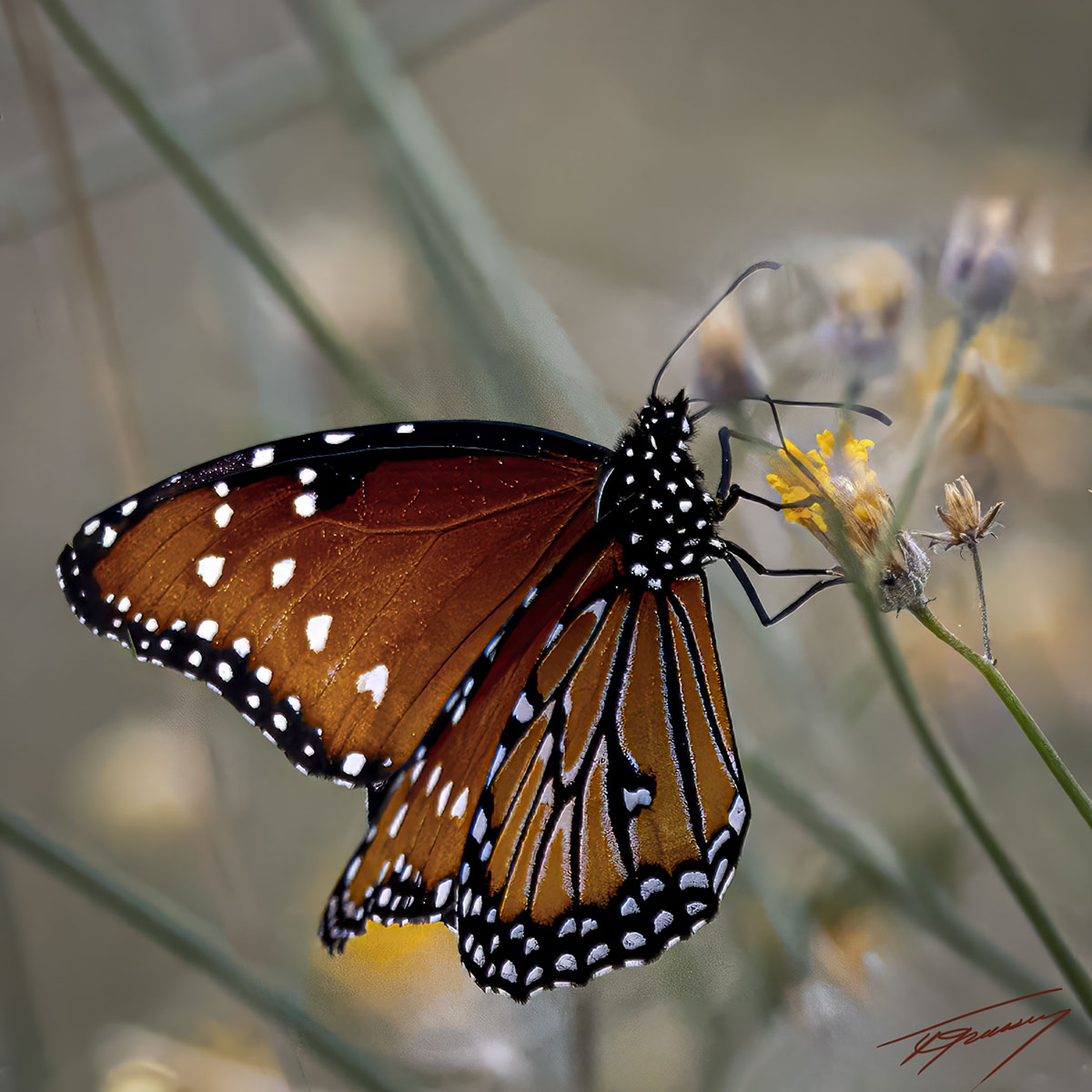
Below is a butter fly coming in for a landing and a snack … they play a very important roll in life as well as being beautiful. Not sure what it is, but I took this shot down at the lake also. Kinda looks like a monarch, but not certain … a lot of life is like that … uncertain, that is, all we have is now and no promise for more … is there a better reason to smile and treat others well? With only this moment, we make choices that will shape us over time if we are so lucky as to have it.

Have an absolutely beautiful day, keep breathing and smiling … we are alive!

Cheers,

Ted

A bird flies through the sky, and I fly with it. I am in
each pearl of moisture sparkling in the sun. I lie lazy
on the clouds. And I acknowledge my kinship with
each winged thing.

I see all as one, and nothing repels me, as this new
day climbs noiselessly out of the valley of night.

Peace lies over the world and over the world of my soul.

excerpt from On A May Morning by Max Ehrmann

###

photo_tedgrussingThe easiest way to reach Mr. Grussing is by email: ted@tedgrussing.com

In addition to sales of photographs already taken Ted does special shoots for patrons on request and also does air-to-air photography for those who want photographs of their airplanes in flight. All special photographic sessions are billed on an hourly basis.

Ted also does one-on-one workshops for those interested in learning the techniques he uses.  By special arrangement Ted will do one-on-one aerial photography workshops which will include actual photo sessions in the air.

More about Ted Grussing


Healing Paws

Healing Paws

This is an advertisement