Recognising what’s special about museums: marking 10 years of the Art Fund Museum of the Year prize

Recognising what’s special about museums: marking 10 years of the Art Fund Museum of the Year prize

This is the tenth year of the Art Fund’s Museum of the Year – but prizes for UK museums have a much longer history. An annual award has been taking place for 50 years, since a small charity called National Heritage (not to be confused with the many groups that have similar names) started a prize, which awarded the winner £2,000 and a Henry Moore-designed statuette.

By the turn of the millennium, it was felt that something more substantial was required. National Heritage joined with Art Fund, the Museums Association and the Campaign for Museums; several smaller museum prizes were merged into one and the Calouste Gulbenkian Foundation provided a £100,000 top prize, one of the most generous arts awards in the world. As David Barrie, the then director of Art Fund, told the Guardian in 2007: “It’s important… that the prize is a fairly decent sum of money, which can help to do something great, not just a bauble to sit on the mantelpiece.”

The award went through several further iterations before it was relaunched as Art Fund Museum of the Year in 2013, but its substantial first prize has remained. Indeed, this year it has been bumped up to £120,000 to mark 120 years of Art Fund’s support for museums. The remaining four shortlisted finalists will get £15,000 each.

The money makes a huge difference. Hadrian Garrard, newly appointed
director of the first winner, William Morris Gallery in north-east London, says: “Winning the award in 2013, just after [the museum] had undergone a major redevelopment, brought recognition for the many people that work here – our volunteers, supporters and local communities – at a crucial time for us. It allowed us to invest into initiatives that have helped to secure the gallery’s long-term future. In the last ten years, we have built on this success and expanded our audiences locally, nationally and globally.”

The exposure is also vital, says Art Fund’s director, Jenny Waldman, boosted by the fund’s marketing muscle and its 135,000 members. Recent research conducted by the charity has found that two-thirds of the museums shortlisted in the last 10 years saw higher visitor numbers, which is crucial as the UK’s museums struggle to recover from the impact of the pandemic. For example, the 2019 winner St Fagans National Museum of History in Cardiff reported a 65 per cent increase in visitors, while The Hepworth Wakefield (2017 winner) saw 22 per cent more. The CCA Derry~Londonderry (shortlisted 2021) is now being namechecked in guided tours of the city, when before it had been ignored.

“That’s a tribute to them for using the opportunity of being shortlisted to sing about themselves locally, regionally and nationally,” says Waldman, “It’s a way for people to discover museums that they didn’t even know about in the heart of their communities.”

Bigger visitor numbers also help museums when they’re advocating for funding, whether that’s from central government, the Arts Council, local councils or universities, says Waldman. Garrard agrees, saying that William Morris Gallery winning the award helped to secure “ongoing commitment” from Waltham Forest, the London borough which owns and operates the museum.

Of course, different museums have different needs. As every year, the shortlisted museums in 2023 cover the length and breadth of the UK and vary greatly in size and scope. How do you go about comparing apples (the Natural History Museum, the most-visited museum in the UK last year) with oranges (the tiny Scapa Flow Museum on remote Orkney)?

“It’s, remarkably, not a problem,” says Waldman. “You’re looking for the same kind of creativity, invention, ideas, passion, energy, commitment, and the embracing of community, supporters and artists… You get that whether it’s large- or small- or medium-scale, whether it’s an art museum, a history museum or an arts centre. You can just recognise what is special about museums wherever they are and whatever scale.”

The winner of Art Fund Museum of the Year 2023 will be announced on 12 July in a ceremony at the British Museum

Diego Bendezu captures brotherhood and resilience among Venezuelan migrants

Diego Bendezu captures brotherhood and resilience among Venezuelan migrants

If you were to visit a hand car wash service, you’d likely see bodies working together in a seamless chain; spray, soap, rinse, wipe, repeat, as soap suds hit the ground. Although it’s a familiar sight for many of us, the New York-based Peruvian photographer Diego Bendezu believes that not enough of us know or understand the journey of some of its workers.

As such, his latest body of work Dear Prima is inspired by the “resilience and work ethic of young Venezuelan migrants in San Martin de Porres [a northern district in the country’s capital Lima]”, Diego says, as he seeks to showcase their determination, courage and brotherhood. “I want to give them a voice, challenge stereotypes and foster empathy”. And so, what initially started as small conversations with the men on trips to the car wash with his father, has blossomed into a vast and emotionally revealing project for the photographer and those captured by his lens.

The quality and depth of Dear Lima isn’t merely up to Diego’s talent and skill. It’s also in the way he can describe the very specific details he learned about the men while photographing them. “I learned that one of the men’s mothers only earns the minimum wage back in Venezuela and another couldn’t afford to go back,” he tells us. In a trio of photos of one of the men, Diego captures his lived experience through his tattoos, his cap placed on a bollard and his hands at work holding a blue hose. The blue of his cap and the blue of the hose almost have a synergy, highlighting the car wash as their portal to a new life. “They are the heroes of their own story. All of them are the first to leave their home country and are here to provide a better life for their families back home”.

Brothels, bartenders and film stars: Eve Arnold’s women

Brothels, bartenders and film stars: Eve Arnold’s women
image

In 1950, having spent several years working at a Kodak processing factory in New Jersey, Arnold developed an interest in photography. Encouraged by her nanny, she signed up to a six-week photography course in Manhattan led by Harper’s Bazaar’s influential art director, Alexey Brodovitch

Mission Impossible star Simon Pegg praises photographer’s film shots

Mission Impossible star Simon Pegg praises photographer’s film shots
Rebecca Ferguson and Simon PeggStepping Through Film/Paramount

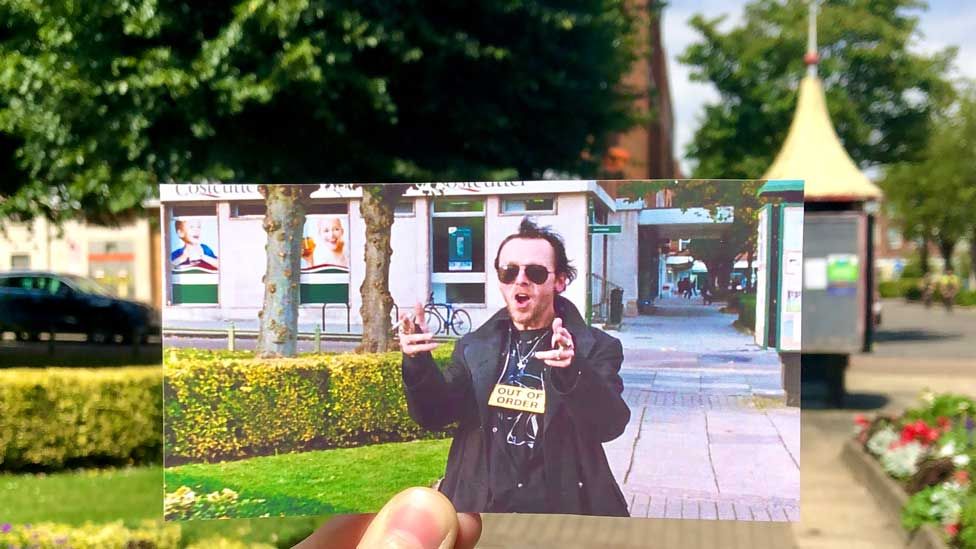
A photographer who lines up scenes from movies with the locations where they were shot has been congratulated by one of his subjects.

Thomas Duke, 24, showed his images from three of Simon Pegg’s films to the actor at an event for the latest Mission: Impossible film.

A surprised Pegg said he had “seen all my stuff” and “it was great what I did”, the photographer said.

Mr Duke said that as a fan, it was now “great to be recognised” for his work.

Simon Pegg in Shaun of the Dead

Thomas Duke/Stepping Through Film

“It was very surreal,” he added. “I’ve done his movies for years.

“It made me feel that it’s not just a digital space, people do actually see my work.

“It’s still amazing to me that I’m here after admiring these actors my whole life.”

Thomas Duke

Thomas Duke/Stepping Through Film

Mr Duke, from Newport, near Saffron Walden, Essex, started photographing scenes from movies or TV series in the locations where they were shot while he was a film student.

He put his examples of the technique, known as rephotography, on social media under his Stepping Through Film banner and soon gained a following.

Now working on it full-time, he also attends media events for his social media channels.

Simon Pegg in The World's End

Thomas Duke/Stepping Through Film

Invited by Paramount to speak to Simon Pegg and Rebecca Ferguson about Mission: Impossible – Dead Reckoning, he took along the images he had created of what are known as The Cornetto Trilogy.

It refers to three films written by Pegg and director Edgar Wright and starring Pegg and Nick Frost – Shaun of the Dead (2004), Hot Fuzz (2007), and The World’s End (2013) – where the photographer had visited north London, Wells in Somerset and Welwyn Garden City in Hertfordshire to do his shots.

The films do not share a storyline but each feature a scene in which a character buys an ice cream.

Nick Frost and Simon Pegg in Hot Fuzz

Thomas Duke/Stepping Through Film

“I’ve always loved his [Pegg’s] work and the trilogy is ingrained in British culture so it’s fun to celebrate a trilogy so many people have seen,” Mr Duke said.

“Plus they were all filmed in the UK so it was easy to visit for me.”

Rebecca Ferguson and Simon Pegg

Thomas Duke/Stepping Through Film

Mr Duke said he took along prints as a “talking point” and as soon as the actor saw them he said “what?! I know you!”.

“It was the most nerve-wracking interview of the day because I love them both as actors but they were friendly and chilled so it was also the easiest.

“After admiring the work of both Simon and Rebecca from afar, it was lovely to get their approval in person and enjoy a shared passion for cinema.

“This would have all felt impossible to me 10 years ago, but now I look back and realise that anything is possible. Never give up!

“I started as a fan but it’s great to now be recognised and involved in a professional capacity.”

Thomas Duke with Simon Pegg in 2014

Thomas Duke

presentational grey line

Follow East of England news on Facebook, Instagram and Twitter. Got a story? Email eastofenglandnews@bbc.co.uk or WhatsApp us on 0800 169 1830

Related Internet Links

The BBC is not responsible for the content of external sites.

Art Exhibits

Art Exhibits

#inform-video-player-1 .inform-embed { margin-top: 10px; margin-bottom: 20px; }

#inform-video-player-2 .inform-embed { margin-top: 10px; margin-bottom: 20px; }

“Contrast & Contours” — July 15 to 28, Just Lookin’ Gallery, 40 Summit Ave., Hagerstown. Known for his masterful pencil work, Michale Gibson’s drawings reflect on universal humanity. Hampton Olfus’ adroitness with ink takes us on a journey, both inward and outward. Gibson is visiting from Canada and D.C. native Olfus resides in southern Maryland. Meet both artists July 15 and July 16 from 1 to 7 p.m. There will be an artist talk at 3 p.m. both days. 301-714-2278 or justlookin.com.

“Over 70 Show” — July 15 through Aug. 27, Delaplaine Arts Center, 40 S. Carroll St., Frederick. Works in a variety of media. A signature of the Delaplaine’s Creative Aging Month, this annual exhibition celebrates local artists over age 70 and showcases a wide range of styles, techniques, and interests. Gallery hours are 9 a.m. to 5 p.m. daily. 301-698-0656 or delaplaine.org.

#inform-video-player-3 .inform-embed { margin-top: 10px; margin-bottom: 20px; }

Ladies Day Golf

Ladies Day Golf
image

Seven ladies met on July 5 to participate in Ladies Day golf. They divided up into two teams and played an “Odd Scramble.” All the holes were played, but only the scores from the odd holes counted.

Both teams finished with scores of 20, so the team with the fewest putts was determined to be the winner. With only 6 putts, the team of Leslie Talbot, Jeri Crawford, and Ruth Nelson took first place. Polly Dahlke, Cindy Raymond, Erika Thompson, and Julie Jones came in second with 7 putts.

Eve Arnold’s forgotten photographs of the 1950s Harlem fashion scene

Eve Arnold’s forgotten photographs of the 1950s Harlem fashion scene

“As a photographer, one has to accept the fact that one does invade other people’s privacy,” Eve Arnold commented in a BBC documentary in the 1980s.

She was expressing misgivings about her professional relationship with Marilyn Monroe, and her intimate portraits of the actress that would establish Arnold as one of the 20th century’s leading photojournalists. But Arnold, who died in 2012, could equally have been talking about another, little-known project: her year-long study of backstage scenes at community fashion shows in Harlem, shot in black and white at the start of her career in the early 1950s. A selection of those images are on show in West Sussex as part of “To Know About Women: The Photography of Eve Arnold”, a retrospective that opened this month at Newlands House Gallery in Petworth.

“This was a time when the mainstream fashion industry was entirely white, and black women were not considered to be clients,” says Maya Binkin, the gallery’s artistic director, who curated the exhibition. “The models Arnold photographed made the clothes themselves and put on shows in hired venues for paying black audiences. It was a whole developed, professional scene. And Arnold was everywhere: present, but invisible.”

The Harlem series was Arnold’s first assignment. What she produced was a nuanced study of style, elegance and self-reliance, captured just before the US civil rights movement.

The photographs of models, often mid-change, and the crews of agents, dressers, make-up artists and security guards that surrounded them, exude energy and action. In the early 1950s, Arnold’s reportage approach to fashion photography (Binkin describes it as “slow journalism”) was unusual, an antecedent to ubiquitous shots of 1990s supermodels backstage. But it was nothing like the contemporaneous static, posed editorial images of white models shot in studios by Arnold’s 1950s contemporaries, such as Nina Leen or Richard Avedon.

Two young black models check their make-up backstage
Two young black models check their make-up backstage, 1950 © Eve Arnold Estate

At times, Arnold’s Harlem photographs feel intimate to the point of unsettling — that invasion of privacy she acknowledged.

Arnold’s star is Charlotte Stribling, a young model known as “Fabulous” and recognisable by her hair, dyed a silken blonde and coiled in plaits around her ears. In one shot, Stribling bends to step out of her underwear with her back to the camera. It is a moment of inhibition and hurried action — the model is changing costumes — but there is little vulnerability in her nakedness. She could be mooning at us, not least because she and her dresser are laughing.

Arnold would later note that Stribling changed her walk when she first met her, the moment when the novice photographer realised her camera was always intrusive

In another shot, a luminous Stribling waits backstage for her cue at the same fashion show, held in the Abyssinian Baptist church on West 138th Street in 1950. Arnold catches Stribling as she emerges from the shadows wearing a lavish evening gown, her hair framing her expectant face like a nimbus, while a security guard hovers behind her.

Binkin says Arnold achieved the effect without artificial lighting. “It would be a case of going back to the dark room and praying that something was going to come out,” she says. “But she turns the dark church to her advantage.”

Model Charlotte Stribling aka ‘Fabulous’ waits backstage for the entrance cue to model clothes designed and made in the Harlem community. 1950
Stribling waits backstage at a Harlem fashion show in 1950 © Eve Arnold Estate

Arnold was born in Philadelphia in 1912 into a poor, working-class Jewish family. She shot the Harlem series as a student on a short course at the New School for Social Research in New York, led by Alexey Brodovitch, the legendary art director of Harper’s Bazaar (Brodovitch had also taught Avedon and Irving Penn).

She was in her late 30s when she joined Brodovitch’s course, at a moment when her marriage was failing and she had left her job working in a film processing factory in search of intellectual stimulation.

Brodovitch assigned her the subject of “fashion”. She had heard about the 300 shows that took place every year in Harlem, and contacted the modelling agencies who organised them to ask if she could document them. Perhaps her maturity worked in her favour, allowing her Harlem subjects to relax in her presence — Arnold was 20 years older than many of the models.

Like Arnold, we become present but invisible in their world. The photographer was a reticent figure, at 4’10” an unobtrusive presence more interested in her subjects than commanding attention herself, says Binkin.

Arnold sent her Harlem images to US fashion magazines in the hope of publication, but none — including Harper’s Bazaar — would publish them, a refusal that Binkin attributes to racism. Arnold did find a UK taker, Picture Post, which ran the series over an eight-page spread, though Arnold was unhappy with the accompanying text, which she felt misrepresented the shows.

Two young black models backstage before a show at the Abyssinian Church in Harlem, 1950
Two young black models backstage before a show at the Abyssinian Church in Harlem, 1950 © Eve Arnold Estate

Regardless, the Harlem series caused a sensation with readers and eventually led to an invitation for Arnold to join Magnum Photos, the prestigious photographer’s agency — with Inge Morath one of its first two female members. The membership would lead to a 60-year international career, including as a Sunday Times photographer from the early 1960s to the 1980s.

Arnold’s Harlem shots are discomfiting in many ways. Some show models applying skin-bleaching creams and straightening their hair, common practice at the time, but in contrast to another sequence of Arnold portraits — “Black is Beautiful” — also on show at Newlands, shot nearly 20 years later in 1968.

Here are two subjects belonging to a new generation of black women formed in the civil rights era, who promoted pride in black features: Arlene Hawkins, model and owner of Arlene Hawkins Cosmetics, a beauty brand for black skin and hair, and Cicely Tyson, an actress whose face appeared on the cover of Miles Davis’s 1967 album Sorcerer and later became his wife. Tyson and Hawkins are presented with natural hair.

The Harlem fashion shows have continued in various forms since Arnold shot them. By the 1970s, the scene had produced The Harlem Institute of Fashion and the Black Fashion Museum, although both organisations closed in the early 2000s. More recently, Harlem’s Fashion Row agency, which represents black designers and brands, opened New York Fashion Week in September 2022. 

Marilyn Monroe resting between takes during a photographic studio session in Hollywood
Marilyn Monroe photographed by Eve Arnold in Hollywood, 1960 © Eve Arnold Estate

Binkin and Nicola Jones, director of Newlands, made efforts to track down the people involved in the early 1950s shows shot by Arnold, including Stribling and the other models, without success. “They would be in their 90s now,” says Jones. Hawkins, too, they were unable to trace; Tyson died in 2021. “Someone told me Fabulous’s agent became good friends with Eve, stayed in touch and came to her funeral,” says Binkin, although she discovered he has since died.

Their main sources for the story have been Arnold’s own documents, including her memoirs, and the recollections of her son, Frank.

Over the course of her career, Arnold would alternate between shooting portraits of famous people, most famously Monroe, and the photojournalism that echoed that first assignment. She returned to record black American society again and again, often when few mainstream magazines were interested.

In the early 1960s, she went on to document for 18 months the Nation of Islam movement of black supremacy, championed by Malcolm X, for a series eventually published in Esquire. Later assignments for the Sunday Times included recording people — often women — at work in China, Afghanistan, Russia and South Africa.

The Harlem series recorded a significant moment in African-American fashion that would likely have been undocumented without her.

“Maybe her reportage style of fashion photography would have happened anyway, it was the obvious next step,” says Binkin. “But she did it first. Her camera turned ordinary people into something special.”

‘To Know About Women: The Photography of Eve Arnold’ is at Newlands House Gallery until January 7 2024

Find out about our latest stories first — follow @financialtimesfashion on Instagram

Krasl Art Fair on the Bluff wraps up 61st year

Krasl Art Fair on the Bluff wraps up 61st year

ST. JOSEPH, Mich. (WNDU)The 61st annual Krasl Art Fair on the Bluff wrapped up another big year.

Throughout the weekend, thousands of artists and art enthusiasts were in St. Joseph for the event. The fair featured nearly half a mile of art, with over 170 artists from 24 states.

Officials with the Krasl Art Center say the $5 admission fee goes to support year-round access to the arts in southwest Michigan.

“We see around 20,000 people who come here, they are excited to buy,” said Matthew Bizoe, marketing manager for the Krasl Art Center. “The other reason artists love coming here is this amount of support that we get through our volunteer team. It takes about 300 people to come here and take care of all the different elements, and that’s just in the weekend alone. We also start planning this event really in August every year.”

The fair also has quite the significant local business impact. A study conducted by Krasl Art Center revealed that the two-day event brought in an estimated $1.2 million in 2021 to the local economy.

The 2021 Krasl Art Fair was also ranked No. 24 on the Sunshine Artist Magazine’s best art and crafts festivals in the country.