“It’s us, it’s who we are…” Terri O’Connor on her role and the importance of Native American artwork and culture

“It’s us, it’s who we are…” Terri O’Connor on her role and the importance of Native American artwork and culture

Wisconsin is no stranger to the presence of deep, yet often under-discussed Native American history that ties in so closely with the state. While much of the visual representation of Native history is most immediately seen in the geography of Wisconsin, many artists are pushing for more visibility and vocality around Native history and culture through their own creations. 

Terri O’Connor is one such local artist. While Terri now lives in Poynette, Wisconsin, she has been around the Madison area since her early 20s. O’Connor’s passion for art started long before she found her way to Madison as art was second nature at home.    

“I started my art way back when I was young,” O’Connor told Madison365. “I just always dabbled in the art scene a bit, slowly working with the tribe on quite a few little projects that they had. My dad was an artist, so he had paintings that he had done in the house like some horses, I remember. I also had my mom’s brother who was an artist, so he did a lot of beautiful artwork, too, as a painter, as well. I saw that and was always interested in art.”

O’Connor grew up surrounded not just by art, but by Native American art and culture specifically that fueled a passion for learning more. Being raised on the Stockbridge-Munsee Band of Mohicans Reservation, O’Connor was exposed to culture and connections within the tribe that eventually led to working in smaller ways to provide artistic needs for her community. 

“Going to the Pow-Wows in the summertime was a huge influence on me,” said O’Connor. “I just loved the character. I’m a people person when I draw. I love looking at faces and I was intrigued with the history. I like old photos, so working at the museum, I got to see some of the history. It just really influenced me on the culture. The tradition of Native Americans’ respect for their elders, and the Pow-Wows as gatherings and always giving thanks. It’s basically a gathering to get together to see family and see people that you haven’t seen in a while.”

Connecting with people gave O’Connor the opportunity needed to practice her art in ways that may not be immediately thought of such as designing badges for the tribal Natural Resources Department, and logo design for businesses out of the tribe, such as Tribal Sun Soap. However, the most inspiring things for O’Connor’s artwork may just be the joining together of people in ways that uplift and support the community. 

“I did a piece honoring women called ‘The Gatherer,’ O’Connor said. “A lot of the women in our culture were gatherers of not only the food, but they were a great support for the community. I like to do a lot of my art in honor of men, women, and children, because it’s all part of us. We’re all part of that community. We all make a difference in all the things that we do and contribute to help each other. I think that’s true in all cultures.”
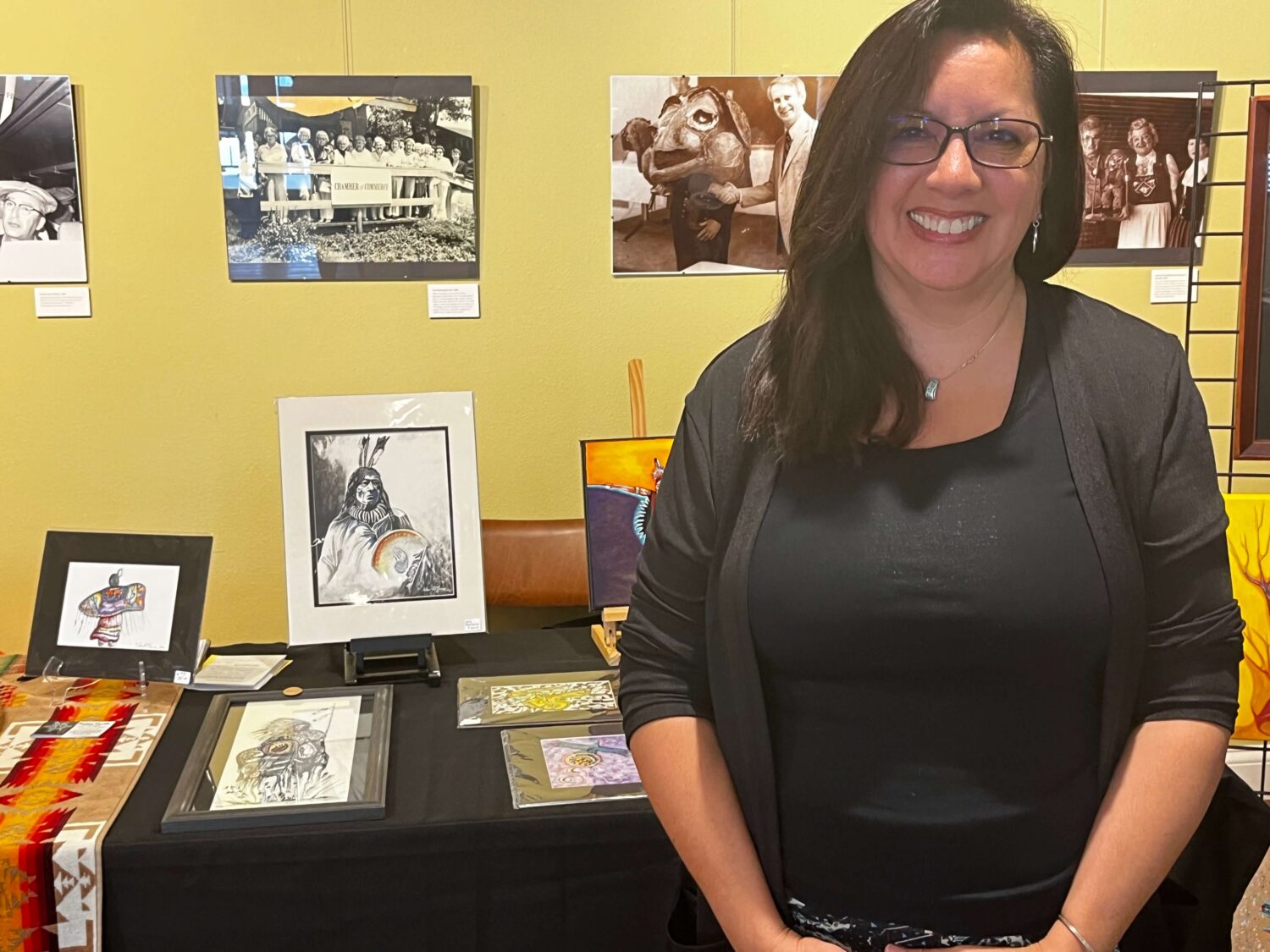
Terri O’Connor at the Native Art Marketplace in Mt. Horeb.
(Photo by Robert Chappell.)

One of the communities O’Connor has found herself in is with other local Native American artists who frequently do shows around the area such as the Native Art Marketplace that took place early last month in Mt. Horeb. It is in spaces such as these that she says people may be surprised to find art and culture in a variety of ways including storytelling and carvings as well.   

“There’s such a diversity with some of the artwork in Native culture,” expressed O’Connor. “You’ve got basketmakers and the beadwork that is amazing. There’s so many influential pieces of artwork that maybe a lot of people don’t even realize are out there.”

As time moves forward, many Native cultural traditions and ways of understanding are lost both to the cycle of life, but also to silence. As artists and community members such as O’Connor push to make their history, culture, and passion visible, it takes the community to respond and invest their interest and support in remembering the deep and beautiful Native history that is crucial to maintain for future generations. 

“We want to show people our culture and our passion for it while always having appreciation for everything that’s around us. We are a part of this earth, and there’s so many beautiful things of this earth for us to express and show in our art,” O’Connor said, praising the perseverance and continued collective effort of local artists, especially Native artists. 

“They’re multitalented and they need to be seen and heard because it’s part of our lives. It’s us, it’s who we are, and it’s great that it’s being recognized that we are artists. We are actual artists working out there, and doing it because we love it.”

Lover to lover: photographers’ most intimate images

Lover to lover: photographers’ most intimate images
image

Schorr collaborated with Angel Zinovieff, who writes: ‘When I look at you with the camera in your hand looking at me, there is a difference between that and what I see when the camera is not present. It is different because the camera is a third presence, a witness.’ In Angel Z, the two artists work together to explore the traditions of the muse along with intimacy, visibility and performance’

Photography Contest open to public

Photography Contest open to public

Mahr Park Arboretum in Madisonville is calling photographers of all levels to come try their hand in the first annual photography contest.

This is the first year for the contest, according to Lead Volunteer at Mahr Park Arboretum, Chip Tate, although they have held photography hikes in year’s past.

12,795 possessions! Meet the woman who photographed every single thing she owns

12,795 possessions! Meet the woman who photographed every single thing she owns

‘If I had known how much work was involved, perhaps I never would have started.” Belgian photographer Barbara Iweins is thinking about the decision she made six years ago to photograph every object she owned. The project took four years and 12,795 photos later, her task was complete. Now her work is on show at the Cortona on the Move photography festival in Tuscany.

The decision came after a divorce and having to move house for the 11th time. “I was exhausted to have all these objects to pack once again. I really wanted to see what it was like – a houseful of objects. I decided to photograph room by room and drawer by drawer. I was putting Post-its on the drawers because I was scared of photographing the same thing again.”

Objects from Iweins’ bathroom.

The result is an extraordinary inventory of the commonplace, the personal, the irreplaceable and the intimate. No object was too mundane for inclusion – safety pins, clingfilm, screws, hooks, toilet rolls, hangers, keys, socks, pants and plates all made the cut.

Goldorak

The brand names are similarly quotidian – Vanish, Pledge, Cif, Bic, Sudocrem, Dove, Playmobil and Lego. Among so much domestic flotsam are precious items with personal significance, such as a Goldorak toy she was obsessed with as a child, and objects usually kept out of sight in her bedside table – lubricant, condoms and antidepressants.

The cumulative effect of viewing Iweins’ anodyne product shots can be overwhelming, and suggestive of an unchecked consumerism. She concedes that she and her three children are “extremely messy”, and that she has been a collector with an interest in vintage clothing in particular, but she describes her buying habits as otherwise normal. She is probably not the only parent of three children who aspires to a more minimalist lifestyle.

Besides her desire to get a measure of just how much stuff she possessed, Iweins was pursuing an interest in consumption and instant gratification. She saw her project as a counter to social media users “posting pictures of their ideal life – what they’re buying, what they’re eating”.

“I wanted to play with it and I thought: ‘I’m not going to show this ideal recto of an ideal life, I’m going to show the verso, the holes in underwear and stuff like that.’”

Barbara Iweins: objects from kitchen

Her commitment to the fullest disclosure introduced difficulties. She had to resist the urge to discard, unphotographed, a vibrator. And it was only with reluctance that she included what she feels is her most unlovable object: “a mould of my teeth. I don’t especially like my teeth, it’s extremely personal, and it’s a horrible mould. But I had to be honest.”

Clothes, too, presented problems, especially those she had bought and then forgotten. “We are hiding stuff that we are buying,” she laments. “Everything is in closets – that’s the thing.” Perhaps transparent wardrobes might be a solution. “I was rediscovering skirts and thinking: ‘I haven’t worn this – it’s really quite nice. Now I’m going to use it and use it.’”

Barbara Iweins with some of her object images.

As her photographic evidence accumulated, Iweins organised and classified her pictures, including by colour, material and frequency of use. She can field her own array of idiosyncratic – and not always impressive – statistics: 21% of bathroom objects are metallic, 43% are plastic; 1% of her clothes are purple, a colour she hates.

“I noted that 37% of our Playmobil figures are bald. I never used or moved 56% of the objects. I think I’m the only person who knows – well it’s not very important – that the dominant colour in my house is blue.”

Iweins’ treasured objects

Most significantly, she says, she came to realise that “only 1% of these objects are important: 99% I could get rid of. Most of the objects I really care for are the things I cannot replace.” Perhaps unsurprisingly, once finished, Iweins was able to throw away full bin bags. Similarly, her shopping habits cooled. “The thing that changed most are the clothes. I think recently is the first time I’ve bought clothes in four years.”

Her most treasured belonging is a dahlia, at once delicate and invulnerable, preserved in a jar of formalin. She had seen it in a shop in Amsterdam and her cousin later bought it for her. She is drawn to its permanence. “I’ve had a divorce and I’ve lost a boyfriend to cancer. These objects – the 1% that are important to me and my children – I know they are going to be there. I realised – it’s pathetic, I know – that you can rely on things.”

Accumulating objects, she says, “was my therapy. There’s so much chaos in the world, and in my head, that the inertia of things – they are my reference. I know what I am saying is sad, but it’s true.”

Dahlia preserved in formalin

As an unanticipated benefit of her work, now published as a book called Katalog, Iweins is enjoying a new security. “It structured my thoughts, organising all the chaos. Before, I was scared that something terrible would happen in my life. Now that there is the book, everything can catch fire and at least I will have this reminder that it existed, that it was there. This project was a consolation in a way.”

At the beginning of the process, she says, “I thought it was about overconsumption. And actually, I realised it was more a project about myself.”

Kenneth “C.J.” Bazemore:  Giving back with photography

Kenneth “C.J.” Bazemore:  Giving back with photography

East Harlem-native Kenneth “C.J.” Bazemore has been visually capturing Harlem and hip-hophistory for several decades. He has been instrumental in photographing the local New York hip-hop music scene, and documenting the genre more broadly. 

“I always wanted to be a photographer,” he said. “God put the camera in my hand to get off the streets. Photography saved my life.” 

He bought his first camera, a Canon 81, out of a local pawn shop during the early 1990s, and hasn’t stopped since. He developed his craft as a means to avoid the many pitfalls which surrounded him, and just started taking photos of his neighbors in Wagner Houses and charging $2 per flick.“Not for the money, just to develop the pictures,” he explained. He became well known locally and soon was asked to cover events like weddings, and Sweet 16s. His photographer friend, T.C., from nearby Lincoln Houses started bringing him to the Apollo Theater to take pictures of celebrities.  Bernard worked at the Apollo and gave us access,”Bazemore added. And when Spike Lee was filming  “Malcolm X”  Third Ave. in the early 1990s, Bazemore started to capture some of the actors, and develop his craft.Soon thereafter, he began heading to various video shoots with his camera to flex his lens, and make contacts.  A video shoot for a song off Jay Z’s debut album, Reasonable Doubt, and Big Pun’s funeral were memorable moments for him.“I’d go and take pictures of the bodyguards with the celebrities and tell them it’s for their portfolios,” Bazemore explains.“Then I’d give them the pictures and they would grant me access to events.”Several of his photos from Puns funeral were prominently featured in The Source Magazine the following issue, opening many doors for him.  Bazemore’s photos have also been featured in F.E.D.S. Magazine, Felon Magazine, and High Times, and the and Amsterdam News.   Bazemore recalled bumping into the iconic lens man, Gordon Parks, early in his career and asking him for some advice.“He said, ‘Just shoot what you love,’”Bazemore began.“At first I didn’t get it, but as time went on I understood what he meant.”His finger got trigger happy and he began shooting many prominent artists of that era onward.  “Name them and I got them:Jay Z,Busta Rhymes,Black Rob,Kanye,Grandmaster Caz,DJ Hollywood,Crash Crew,Rakim, Cam’ron, Ma$e  Dip Set, Puffy,Biggie,Red Alert. I got them all!”Bazemore also mentioned recently doing a shoot with Grandmaster Melle Mel, the importance of inspiring younger generations, and never forgetting where you came from.“It’s not even work.  It’s an opportunity to have fun,”Bazemore said  “The camera took me to places I never thought I’d be. Hip-hop should be documented cuz it changed a lot of people’s lives.We were able to tell our story and it’s important to document it.  I give back with photography.”

Exploring Curtis Joe Walker’s Photo Bang Bang photography studio

Exploring Curtis Joe Walker’s Photo Bang Bang photography studio
image

When you develop a mental picture of a modern photographer’s studio, the first thing that comes to mind is likely a cyclorama—the large, concave and usually white-painted wall that makes the subject look like they’re floating in a blank void. If that’s what you want, then sure, Photo Bang Bang studio, owned and operated by inventive portrait photographer Curtis Joe Walker, can set you up with one. But in order to access it, you’ll need to walk through a Victorian era-inspired parlor, a dungeon, a boiler room that can double as a mad scientist’s lab and a steampunk-like clock tower, all stacked with nearly every prop imaginable. The studio’s website describes it, altogether fittingly, as a “photographic theme park.”

“Some stuff in here I’ve had for 30 years or more,” Walker says, gesturing around the space at various items—furnishings he inherited from his grandmother, a recently acquired phone booth, a medical chair dating back to 1906 and, oh yeah, a spinning torture wheel. “It’s one of our signature products. Everybody wants to ride on this thing.”

Photo Bang Bang is regularly rented for commercial shoots, music videos and—perhaps unsurprisingly for a place with a dungeon—by the adult film industry, whose business Walker values highly. (“They usually give me whole-day rentals. Music videos are just two to three hours.”) But it’s also open to hobbyists, who show up in numbers for Photo Jam, a five-hour, $25 event that takes place on the fourth Saturday of every month. “They don’t have to have a specific reason to come to the studio; they can just come hang out, and that’s been pretty fun,” he says. “People sometimes come up with pretty cool stuff [using the sets]. It’s a good time for me to work with people I wouldn’t work with otherwise.” 

1.

Every inch of Photo Bang Bang is maximized for use. When Walker took over this New Orleans Square space, he plotted it meticulously using an iPhone app. Take a step back from this clock tower set, and you’re standing in the dungeon. When a set isn’t being used, Walker stacks it with props, and entire walls can be moved to further transform spaces. “It’s like stagecraft. … Photography is 90% moving furniture,” Walker says. By the way: The spiral stairs to the right don’t lead anywhere. They just add to the vibe.

2.

Walker builds some of his props, but acquires most of the others from private sales. This taxidermy bobcat belonged to a man who lost interest in it after “his dog chewed the ear off,” Walker says. “The guy was so disgusted by it. It sat in his garage for a time.”

3.

These 1980s-era television and camcorders represent Walker’s love of old tech. He speaks affectionately and knowledgeably about old cameras, classic video game systems and vintage cars.

4.

These are some of Walker’s cameras, minus the mirrorless Nikon that’s his workhorse. The Lomography Instant Wide on the bottom is a favorite; he takes it to the Telluride Film Festival to shoot celebrities. “It gives me carte blanche, because it looks old, and anybody who is into cameras feels like they should know what it is,” adding that director Werner Herzog loves the camera:.“I harass him every single year. He knows me as a Polaroid guy; it’s like he’d be sad if I wasn’t there. [The Lomo Wide] is a good conversation piece.”

Click HERE to subscribe for free to the Weekly Fix, the digital edition of Las Vegas Weekly! Stay up to date with the latest on Las Vegas concerts, shows, restaurants, bars and more, sent directly to your inbox!

With NewCrits, These 16 Artists Are Revolutionizing Art School

With NewCrits, These 16 Artists Are Revolutionizing Art School

This spring, Baltimore-born, New York-based artist and writer Ajay Kurian founded NewCrits. The experimental educational platform, which has since brought on a cadre of forward-facing art makers as mentors, was born in part of Kurian’s experience as a student of Columbia University’s Fine Arts BFA program, and later as a professor at Columbia and Yale. “Great things happened in those schools: amazing crits, resources, studios, studio visits, and a whole network of people. There’s no denying that,” says the artist.

But Kurian and his peers were disillusioned by other aspects of these programs—the reliance on low-wage adjunct labor, the narrow and sometimes outdated criteria that drive admissions processes, and, of course, the ever-ballooning price tag. These barriers to entry are often justified by the allure of access that a name-brand degree can offer, prying open some of the art world’s heavily gatekept doors. “That bothered me,” he says. “There are certain visions of what a hardcore art education is that I think are just ridiculous, gendered, [and] exclusionary.”

When the pandemic hindered the traditional model of in-person studio visits, most programs went virtual. “The first couple of weeks were pretty heavy,” Kurian recalls. “The Zoom studio visits weren’t standard crits, they were more therapeutic and intense.” As a new normal set in, Kurian and his academic peers quickly realized that the format was here to stay. “It dawned on me that virtual visits would become a way for institutions to exploit faculty even further. But I started thinking, Maybe there’s something here.”

This epiphany gave rise to NewCrits’s foundational premise—a holistic studio visit that takes those pandemic learnings to heart. “To me, the studio visit is the primary building block of an aesthetic education. A great studio visit is when someone is listening so intently to what you’re doing and how you’re making that they intuit the internal rules you’re creating for yourself,” says Kurian. “It’s lovely to have someone listen to you, and almost show you yourself.”

This approach differs from that found in most traditional art school contexts by emphasizing each individual’s internal logic, rather than their ability to apply an external theoretical framework to their process. “There’s an Old World view among arts educators—‘we break you down to build you up.’ There’s the intent to see if you’ll break so that they can make you stronger. Do you really understand what you’re saying? Have you done your research? Can we find a crack? We diverge really strongly there. We’re not trying to show you what good art is, or what bad art is.” 

How does the NewCrits model change the barrier to entry for artists seeking rigorous feedback and institutional training? According to Kurian, “There is no barrier.” Beyond a per-session fee that aims to rectify the chronic under-compensation of arts educators in traditional programs (something that the founding cohort is working to eradicate through fundraising and endowments), NewCrits takes artists as they are, allowing them to tailor their virtual visits to their needs by administering a self-diagnostic quiz that encourages them to interrogate their own expectations of the process.

Kurian paraphrases a few of the quiz’s questions: “The commercial aspect of the art world is a necessary part of creation—yes or no? Is a studio visit exactly what you’re looking for right now? Are you ready to hear that your intentions may not match your output? Some people aren’t,” he says. “And that’s okay.”

Ultimately, while NewCrits represents a departure from many of the norms of traditional arts institutions, it shares the same foundational ethos. “I think there are more people interested in the arts than ever. We just want to find another way for people to participate in creative dialogue or creative mentorship without the economic risk.”

The platform, which launched this spring, is the brainchild of Kurian and his fellow artists Farah Al Qasimi, Kamrooz Aram, Uri Aran, David Brooks, Antoine Catala, Sara Greenberger Rafferty, EJ Hill, Jacob Kassay, Devin Kenny, Pooneh Maghazehe, Erin Jane Nelson, Puppies Puppies (Jade Guanaro Kuriki-Olivo), Curtis Talwst Santiago, Andrew Sendor, and Fin Simonetti. Together, they represent a range of disciplines, philosophies, and relationships to institutional spaces, offering prospective artist-students—regardless of career stage—an array of perspectives from which to seek creative feedback and advice on navigating the opacities of the art market. Below, a selection of these educator-practitioners reflect on their own relationships to artmaking and education.

puppies-puppies-newcrits
Image courtesy of Puppies Puppies.

Puppies Puppies (Jade Guanaro Kuriki-Olivo)

CULTURED: Where did you get your art education? 

Puppies Puppies: Art has existed long before an education system was built around its name. I say “its name” because art is so vague as a word and experience. Art can be so many things, limitless possibilities. My point is that art education in an institutional sense should not be used as a means of understanding what an artist is expressing or putting out into the world. It should not be used as a way to gauge the value of the work or the intellectual abilities of the artist. The brand names of institutions should not signal that an artist is someone to look into or not. If art could be a spiritual object or depiction for many people around the world since ancient times, then it can exist—and be worthy of thought, discourse, preservation, care, and an understanding of its value—beyond the artist’s place of education.

Education is so vast—it has always extended beyond institutions. I hope one day that knowledge and wisdom pertaining to artistic expression can exist outside of the bounds of classism, racism, transphobia, and more. Stories passed down from elders to young spirits, education built up from the ashes to accommodate marginalized folx, and not just a select few who receive scholarships and grants. All of this is sometimes needed to create art, and should be easily accessible to the people.

CULTURED: What does art school train you to do? What should it train you to do?

Puppies Puppies: I keep attending vigils and having flashbacks to my BIPOC trans sisters— especially my Black trans sisters—who were either murdered, injured, or “unalived.” My community and my own transitional journey have made me realize that art manifests in many forms. I spent a year working at a nonprofit supporting trans nonbinary folx. I was taking a break from art, but I also realized that this was an extension of art for me. I’m interested in directing art funds and resources to sisters and siblings in my community whose art is overlooked due to the never-ending obstacles and locked gates listed above. I look through art history and I don’t see many of us. I want to change this. 

ej-hill-artist-newcrits

EJ Hill

CULTURED: What is a moment that taught you more than any traditional fine arts schooling ever could?

EJ Hill: Those who can, do. Those who can’t also do, above all odds, and oftentimes with far more grace and vigor, while holding a high regard for the supplemental alternatives that might, once and for all, amputate the atrophied.

ajay-kurian-newcrits-artist
Image courtesy of Ajay Kurian.

Ajay Kurian

CULTURED: Where did you get your art education? 

Ajay Kurian: I got my Bachelors from Columbia. I don’t have a graduate degree.

CULTURED: What is a moment that taught you more than any traditional fine arts schooling ever could?

Kurian: I’m not sure, really. Education has always felt very fluid to me, where the resonances of those around you are constantly playing a role in your edification. I like to think more in terms of conditions. What are the conditions for receiving an education and when are those most open? School is sometimes that place, but oftentimes it isn’t. I think the moments that I might point to are the moments that I felt most open to education, and those were usually when someone showed me that they were invested, that they cared about me and my overall wellbeing first, and not simply the things I’m supposed to know.  

CULTURED: What does art school train you to do? What should it train you to do?

Kurian: The thing I like about art school in theory is that it was a place where education felt so much stranger and harder to box in. What unfortunately happens in many situations is that art school becomes a place where people are taught how to think combatively rather than collaboratively. You are meant to sharpen your intellectual knives and use them against others, whereas a real education is providing someone with models to understand that knowledge never comes from a place of scarcity. Everyone can know what you know and it doesn’t diminish you.

What we do with knowledge and how it shapes our participation in this life is what makes the knowledge useful and singular. I understand that there is a commercial world to contend with and that power imbalances can make people feel used and abused, but when I think of the training an arts education ought to provide, it’s one where we understand the best conditions of our flourishing. Within that, you can then hone your particular interests freely and expansively. The rigor you apply should be to the conditions of your own making—art education is meant to aid you in this journey.

erin-jane-nelson-newcrits
Portrait of Erin Jane Nelson by Curtis Wallen. Image courtesy of Nelson.

Erin Jane Nelson

CULTURED: Where did you get your arts education? 

Erin Jane Nelson: I studied at Cooper Union, which I wouldn’t have even known about if it weren’t for a very supportive art teacher at my public high school in suburban Atlanta. While I was at Cooper, I worked a lot of part-time jobs and internships in the art world. After I graduated, I did a summer fellowship at [the] Ox-Bow School of Art in Michigan, which was also very formative. 

CULTURED: What is a moment that taught you more than any traditional fine arts schooling ever could?

Nelson: In 2015, I applied to, and got rejected from, just about every major MFA program in the U.S. Everyone told me to try again and keep applying, but the whole experience felt like an expensive waste of time, personally. Something really clicked for me about the need to create my own context and community instead of trying to find it in these more traditional institutions. So, I moved back to my hometown, Atlanta, and started a project space with my partner Jason Benson called Species. I learned so much about how to be an artist from helping and watching other artists put together a body of work, and the sense of community we built with the artists we exhibited has continued to nourish me. 

CULTURED: What does art school train you to do? What should it train you to do?

Nelson: At its very best, art school trains you how to work with new materials and how to think and talk about your work. I didn’t really know anything about the contemporary art world when I came to New York from the South as an 18-year-old. The New York, eurocentric version of contemporary art history that I was taught was helpful, but it also became something to agitate against once I got out of school. 

Unfortunately, I think there are a lot of people who get into tremendous debt going to art school who do not leave with a practical understanding of all the ways to work in and around the art world—as a curator or gallerist or archivist or writer, et cetera. The only possibility that’s ever discussed is being an artist within the gallery and museum system, and even that is limited to a very narrow idea of how an artist can be, what they can make, where they can live, and how old they can be. I think art school should empower people to make a life as an artist, which feels meaningful and sincere, which should be different for everyone. 

pooneh-maghazeke-artist
Image courtesy of Pooneh Maghazehe.

Pooneh Maghazehe

CULTURED: Where did you get your arts education? 

Pooneh Maghazehe: My arts education comes from growing up in Levittown, Pennsylvania. I got my advanced degree, an MFA in Visual Art, at Columbia University in 2011. 

CULTURED: What is a moment that taught you more than any traditional fine arts schooling ever could?

Maghazehe: I studied a division of Kung Fu called Seven Star Praying Mantis and competed for a little over five years. That chapter in my life involved real lessons in physical and mental stamina—and most importantly, learning to respect time. Finding a limit, and experiencing the moment of failure, are skills that are built into how I make things now, and are skills that I acquired during those years training in Chinese boxing.  

CULTURED: What does art school train you to do? What should it train you to do?

Maghazehe: Art school trains you to doubt, which is hugely irritating and can take a long time to unlearn. But I also have a related thought about art school that I want to ride out. Art school is somewhat akin to a fancy rehab. Everyone arrives with some knowledge about what has “worked” for them, and some idea about “betterment.” Some come prepared to get to dismantle those old tricks, and others leave rehab just the same, and—for good or bad—maybe a little more stubborn. Some leave with the impression that the whole thing is a scam.

A great deal of money is spent getting to the bottom of a person’s perspective, or what they are “working on” through a series of studio visits, which sometimes teeters on what therapy rehab looks like. Maybe this hinges on what you might hope to get from art school: to contend with the questions that you are too scared to ask yourself.





