The nearly one-ton sculpture was taken off view in May for some much-needed repairs.
After Restoration, NYC’s Astor Place Cube Spins Again


MIAMI — Miami’s Historic and Environmental Preservation Board has unanimously approved the preliminary designation of a portion of a 2,500-year-old ancestral site belonging to the Native Tequesta people that was found during the construction of a luxury hotel in Brickell. The decision gives a section of the site temporary protection from further demolition and any ground-disturbing digging by the real estate development firm Related Group for at least 6 months while the city preservation office prepares a detailed study concerning its status as a legally protected archaeological zone.
If the site is designated as a historical landmark in the future, Related, the company founded by Pérez Art Museum namesake Jorge Pérez, would have to undergo a process of approval from the board for any building project, including how to handle the public display and interpretation of the findings. The board could also impose requirements for preserving portions of the site, anticipating further clashes or even a lawsuit with one of South Florida’s biggest developers, which can also appeal any board decisions.
The approximately 100 archaeologists who have been excavating the area for the past two years continue to unearth tools and ornaments made from animal bones and shells, cultural objects, and artifacts pointing to a thriving trade network. They also found fragments of human remains under the ground, which were reburied elsewhere in consultation with Seminole tribal leaders. Bob Carr, the county’s archaeologist, shared new findings such as “shell eyelids,” discs of shells representing eye pupils.
“This seems to be a type of Tequesta ornament which has never fully been documented before,” Carr said during a recent City Hall meeting. “Eyes are very important in Tequesta and Native American cosmology.” With a 6-0 vote, all board members agreed the site merits designation.
Currently, the thousands of excavated prehistoric tools, artifacts, and ornaments are “stored on-site” inside boxes in a temperature-controlled environment housed inside the same building at Brickell 444, according to city archaeologist Adrian Espinosa-Valdor’s report. Where they will be housed in the future has not been decided.

Although the decision is a step forward toward preserving Miami’s history, neighbors don’t want to be left in the dark regarding any future decision-making by Related.
“There should be more participatory workshopping with facilitators and all the stakeholders involved, instead of just a board meeting once every few months,” Nina Jean-Louis, a structural engineer and heritage advocate based in Miami, told Hyperallergic.
“What story does this site tell?” she continued. “I think there is the story the developer sees, that this is standing in the way of their profit and construction, and the story the community sees: that this is a part of our heritage.”
When it comes to protecting Indigenous sites considered sacred to some Native American people, advocates say better preservation policies are needed. Robert Rosa, chairman of the American Indian Movement in Florida, asked the city to leave any other Indigenous objects in the ground untouched and not to disturb them with further digging. “I commend the city on this step for preservation, but we need to take this further,” he said. Anthropologist Traci Arden also requested that the city include Native artists in any future displays or interpretations of the findings.
Historic preservation boards and committees in the United States can be traced back to the 19th century, when they were established to protect the homes of America’s “founding fathers,” such as George Washington and John Hancock, from being torn down. Policies later incorporated cemeteries, farms, infrastructure, and European-style buildings, mostly belonging to White owners, reflecting who gets to decide what gets preserved and what doesn’t.
But much of Miami’s Indigenous history and many of its archaeological sites are under the ground, unseen. Preservationists continue to advocate for the Tequesta site in the hopes of holding developers accountable. In an interview with Hyperallergic, Florida Atlantic University Professor and Florida Public Archaeology Network Southeast/Southwest Regional Director Sara Ayers-Rigsby laid out some of the most challenging quandaries facing the Brickell project in the coming months.
“What does what we do with this site say about our values? Is it adequate to document everything and then build a high rise over it?” she questioned. “Are we being respectful of the past? And how does this interact with Miami’s current development policy?”


A Six-Month Exhibition Exploring the Relationship between Indigenous Art and American Art History, Opening October 20, 2023
Kay WalkingStick to be Honored at New-York Historical’s 2023 History Makers Gala
NEW YORK, NY (July 18, 2023)—This fall, the New-York Historical Society presents Kay WalkingStick / Hudson River School, an exhibition that places landscape paintings by the renowned, contemporary Cherokee artist Kay WalkingStick in conversation with highlights from New-York Historical’s collection of 19th-century Hudson River School paintings. On view October 20, 2023 – April 14, 2024, this artistic dialogue showcases the ways in which WalkingStick’s work both connects to and diverges from the Hudson River School tradition and explores the agency of art in shaping humankind’s relationship to the land. The exhibition celebrates a shared reverence for nature while engaging crucial questions about land dispossession and its reclamation by Indigenous peoples and nations and exploring the relationship between Indigenous art and American art history. The exhibition is the result of a close collaboration between the artist and Wendy Nālani E. Ikemoto (Native Hawaiian), senior curator of American art at New-York Historical.
In conjunction with the exhibition, WalkingStick will be honored at New-York Historical’s annual History Makers Gala on October 19, and will receive the History Makers Award, acknowledging her six-decade career.
“This exhibition is a meditation on the theme of humanity’s relationship to nature, as observed by Kay WalkingStick and the artists of the Hudson River School,” said Dr. Louise Mirrer, president and CEO of New-York Historical. “It has been an incredibly rewarding experience to collaborate with the artist on this exhibition and showcase her work, while also examining our historic collections from a new perspective. We look forward to celebrating Kay WalkingStick’s illustrious career at our gala this fall.”
“I hope viewers will leave the Museum with a renewed sense of how beautiful and precious our planet is,” said Kay WalkingStick. “Also, that they leave with the realization that those of us living in the western hemisphere are all living on Indian Territory. These are certainly straightforward, even obvious, thoughts, but I believe they are concepts easily forgotten. It’s easiest to simply get on with our lives. We are all responsible for the health of our planet. We are all responsible to see that our legislators honor the many treaties made with the American Indians throughout our history and that Native rights are honored. Painting is a visual language. This is what my paintings are saying to you.”
Highlights of the exhibition’s more than 40 works include two of WalkingStick’s paintings that are directly inspired by Hudson River School artists; the artist’s sole landscape referencing the Trail of Tears (a journey her Cherokee ancestors were forced to take); examples of her early painted sculptural abstractions inspired by nature; and several of her most recent paintings—like Niagara and Aquidneck After the Storm—which overlay geographically specific abstract Indigenous patterns onto representational landscapes in order to re-assert an Indigenous presence long erased in European settlers’ depictions of North America as a pristine and unpopulated wilderness. Native American objects on loan from the artist and other museum collections, including woven baskets and ceramic jars, offer insight into WalkingStick’s source patterns and artistic process.
Showcasing WalkingStick’s work alongside both Euro-American and Indigenous traditions of art, the exhibition demonstrates the complex ways the artist contends with and interweaves these artistic lineages. Niagara, which was recently purchased by New-York Historical, is grouped with two paintings of the iconic waterfalls by Louisa Davis Minot (1787-1858), which are among the few known works by her hand and rare examples of early 19th-century landscape paintings by a Euro-American woman. These works position WalkingStick within a lineage of women landscape painters in the Hudson River region while also considering the critical differences between the two artists’ work: Minot’s work includes generic Indigenous figures to distinguish the site as North American, while WalkingStick uses a culturally specific Haudenosaunee pattern to mark the land as Indigenous.
Other works from New-York Historical’s collection demonstrate the Hudson River School artists’ attempts to forge landscape into an expression of national and cultural identity. These include Asher B. Durand’s Catskill Study, NY, ca. 1870, which invites direct communion with nature; Albert Bierstadt’s 1860 painting Indian Encampment, Shoshone Village, which promoted US expansion westward; and John Frederick Kensett’s Pulpit Rock, Nahant, from 1859, depicting the touristic allure of coastal nature.
Kay WalkingStick (b. 1935, Syracuse, NY) is a citizen of the Cherokee Nation of Oklahoma with Cherokee/Anglo heritage. Her six-decade career is both a visual record of her life experience and her attempt to present Native American history as a crucial part of America’s history. She draws on formal modernist painterly traditions as well as the Native American experience to create works that connect the immediacy of the physical world with the spiritual. Attempting to connect the present with the past, her complex works hold tensions between representational and abstract imagery. Her paintings represent a knowledge of the earth and its sacred quality. WalkingStick’s work is in many museum collections, including Denver Art Museum; Detroit Institute of Arts; Metropolitan Museum of Art; Minneapolis Institute of Art; Museum of Contemporary Art, San Diego; Museum of Modern Art (MoMA); Smithsonian’s National Gallery of Art; National Gallery of Canada, Ottawa, Canada; Smithsonian’s National Museum of the American Indian; Philadelphia Museum of Art; Portland Art Museum; and Whitney Museum of American Art. She received a BFA from Beaver College (now Arcadia University), Glenside, PA in 1959 and an MFA from the Pratt Institute, Brooklyn, NY in 1975. She lives and works in Pennsylvania.
Publication
Accompanying the exhibition is a full-color, 56-page catalogue. It includes images of all the works on view and a conversation between Kay WalkingStick and Wendy Nālani E. Ikemoto. It will be available for sale at the NYHistory Store.
Programming
Private group tours can be arranged throughout the exhibition. Family programs will also take place. Learn more at the family calendar. Additional programs will be announced.
Support
Major support for Kay WalkingStick / Hudson River School is provided by the Lily Auchincloss Foundation.
Exhibitions at New-York Historical are made possible by Dr. Agnes Hsu-Tang and Oscar Tang, the Saunders Trust for American History, the Evelyn & Seymour Neuman Fund, the New York City Department of Cultural Affairs in partnership with the City Council, and the New York State Council on the Arts with the support of the Office of the Governor and the New York State Legislature. WNET is the media sponsor.
About the New-York Historical Society
Experience 400 years of history through groundbreaking exhibitions, immersive films, and thought-provoking conversations among renowned historians and public figures at the New-York Historical Society, New York’s first museum. A great destination for history since 1804, the Museum and the Patricia D. Klingenstein Library convey the stories of the city and nation’s diverse populations, expanding our understanding of who we are as Americans and how we came to be. Ever-rising to the challenge of bringing little or unknown histories to light, New-York Historical will soon inaugurate a new wing housing its Academy for American Democracy as well as the American LGBTQ+ Museum. These latest efforts to help forge the future by documenting the past join New-York Historical’s DiMenna Children’s History Museum and Center for Women’s History. Digital exhibitions, apps, and our For the Ages podcast make it possible for visitors everywhere to dive more deeply into history. Connect with us at nyhistory.org or at @nyhistory on Facebook, Twitter, Instagram, TikTok, YouTube, and Tumblr.
Image credits from left: Kay WalkingStick (Cherokee, b.1935), Niagara, 2022. Oil on panel in two parts. New-York Historical Society, Purchased through the generosity of Agnes Hsu-Tang and Oscar Tang; Nancy Newcomb; Anonymous; Barry Barnett; Helen Appel; Belinda and Charles Bralver; Dorothy Tapper Goldman; Margi and Andrew Hofer; Louise Mirrer; Jennifer and John Monsky; Suzanne Peck and Brian Friedman; Pam and Scott Schafler; Barbara and Elliott Wagner; and Linda Ferber, 2023.2ab. © Kay WalkingStick. Louisa Davis Minot (1788–1858), Niagara Falls, 1818. Oil on canvas. New-York Historical Society, Gift of Mrs. Waldron Phoenix Belknap Sr. to the Waldron Phoenix Belknap Jr. Collection, 1956.4

… there is a universal manner to settle disputes which crosses the lines of all species and that is combat … food gathering is also a necessity common to all species.
In the photo above we have a coopers hawk that has found captured, de-feathered and is consuming its dinner … quail … we like them too! coopers hawks primarily dine on other birds.
In the photo below we have a coopers hawk in combat with a pair of crows that delight in terrorizing other creatures in the neighborhood. The coopers hawks are favorite targets, but usually the coopers hawk comes out on top in these disputes. I have a photo of the same birds in the same tree on another day in which I got a sequence where a crow was coming in for an attack on the perched coopers hawk and the hawk reared back and body slammed the crow as he came buy, sending him tumbling through the air towards the ground.
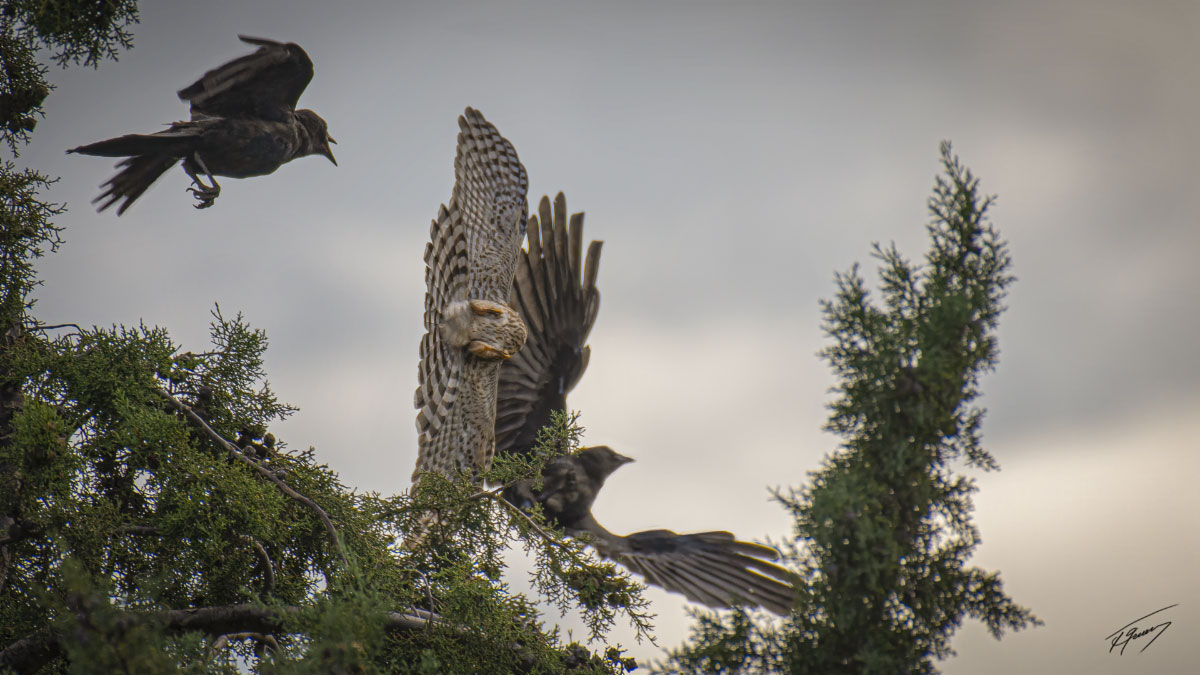

We used to have ravens in the neighborhood, but quite a few years ago a large group (murder) of crows moved in and chased out the competition … crows are incredibly intelligent and pursue other birds in groups such as below one on one is not smart!
Both of these shots were taken in my yard … the back deck is a very good place to be, with camera and mug of coffee … take the time to learn more about your neighbors too, not just the human ones … many life lessons can be observed and learned.
Have a beautiful day … stay cool, keep breathing and smile.
Cheers,
Ted

Forbid that I should judge others
lest I condemn myself.
Let me not follow the clamor of
the world, but walk calmly
in my path. Give me a few friends
who will love me for what
I am, and keep ever burning
before my vagrant steps
the kindly light of hope.
excerpt from A Prayer by Max Ehrmann
###
 The easiest way to reach Mr. Grussing is by email: ted@tedgrussing.com
In addition to sales of photographs already taken Ted does special shoots for patrons on request and also does air-to-air photography for those who want photographs of their airplanes in flight. All special photographic sessions are billed on an hourly basis.
Ted also does one-on-one workshops for those interested in learning the techniques he uses. By special arrangement Ted will do one-on-one aerial photography workshops which will include actual photo sessions in the air.
More about Ted Grussing …

This is an advertisement


The first live music event in Española hosted by Taos-based Awakening Productions took place at the Plaza on July 14.
Presented by Native Winds Radio, the event featured local musicians Bobby Madrid, Kenny Madina, Lluvia Negra and Northern Revolution. Local car clubs also exhibited vintage Chervolettes, Fords and other classic cars, and attendants voted on their favorite.
Native Winds Radio approached the city with the idea earlier this year. Similar events have taken place in Taos, Los Alamos and Santa Fe.
Turnout was low, in part from the heat wave that rolled through the valley last weekend. But coordinators of the event are optimistic about the future.
“It’s ok for our first time I think,” said Glenda Martinez from Native Winds Radio, of Española, in an interview with the Rio Grande Sun. “Española doesn’t have anything like this. Next year, hopefully we can have bigger and better things.”
At sunset, the talleys were in for the crowd favorite car in the competition. The winner, a vintage baby blue Chevy convertible from Viejitos Car Club in Chimayó.
“Just to have the cars and the people passing and looking at them, it’s something you don’t see often,” said Viejitos Car Club Chimayo President Eppie Martinez. “We’re not about the shows. We’re all about community.”
The plaza will host two more Friday night music events this summer on July 28 and August 11, both of which will showcase a wider selection of vintage cars, vendors and caterers.
“It’s something that the valley needs,” Martinez said. “It brings communities together in one place to enjoy some local northern New Mexico music. It gives a little taste of the culture of the valley.”


There are so many talented photographers, and sometimes they pop up in unexpected ways. When scouring a Nikon Z8 Facebook group while writing the story about the Nikon Z8 strap lug issue, an incredible image of a Great Gray Owl carrying its prey through the air popped up.
The photo, captured by Washington-based photographer Betsy Carmona, spurred a conversation with Carmona, where PetaPixel learned more about her photography and how her new Nikon Z8 helped her make the stunning wildlife image.
It is always exciting when the work of a photography enthusiast, someone who is genuinely passionate about capturing images, catches a PetaPixel writer’s eye. For example, while wildlife photographer Ateeb Hussain has a fairly large Instagram following, his incredible shot, “A Mother’s Desperation,” caught PetaPixel’s attention on Reddit.
Not to take anything away from the incredible work of established professionals with huge online presences, but there is something special about seeing a breathtaking shot in places other than Instagram or a pro’s website.

Carmona’s Facebook feed features multiple excellent photos of Great Gray Owls. Carmona tells PetaPixel that she made a few trips to photograph this family during a recent trip to eastern British Columbia. She made three visits to the area during a four-day trip. “We spent about one to one and a half hours per visit. We went at times when we knew they would be active and kept our visits short and spread out.”

The image at the top shows the owl family patriarch bringing a meal to his children, which Carmona says he was doing nearly nonstop all day as the owlets cannot yet fend for themselves.
“Dad does most of the wing work getting meals to mom and the kids until they fledge, but he’ll keep feeding them until they can hunt on their own. Mom tends to be the lookout and protector and keeps her ears open for predators. They have remarkable hearing. She’ll get out and feed them when they are more capable,” Carmona writes.

Carmona’s favorite subject is wildlife, although she describes herself as a “generalist” who “likes to shoot everything.” Aiming to accurately reflect nature as her camera sees it, Carmona explains that she tries to “get the best capture in camera” and perform only “light editing.” She tries to “present nature as I saw it,” Carmona tells PetaPixel.

The Nikon Z8 is Carmona’s first mirrorless camera, and she says that it is her fastest transition ever to a new camera. “It’s a new and super-improved D850,” Carmona says to PetaPixel — her most recent camera was the Nikon D850.

Despite a few hiccups here and there, the camera has proven extremely popular with many photographers. It is one of the best cameras for wildlife photography.
“I’m a hand holder and was shooting with a D850, with a grip, and it weighed between seven and eight pounds. Since switching over to the Z8, I have dropped around two pounds. The compact form of the camera and its lighter weight makes it easier to maneuver the camera in hand,” Carmona explains.
She had previously used the D850 with the optional battery grip. “One of the reasons I had a grip on the D850 was to get those two extra frames, but now it’s a non-issue, and I have solved the battery issue by attaching a power bank to it, which I keep in a shoulder bag.”

“I have seen the light,” Carmona tells PetaPixel of the move to mirrorless. She says she had been a longtime holdout as she was worried that Nikon’s mirrorless cameras could not quite match the image quality of her Nikon D850, which Carmona describes as “a good soldier.”


“The Z8 is outstanding for wildlife, a big improvement over the D850 on keeper rate. Coming from a D850, the autofocus on the Z8 is outstanding,” Carmona says. “But the camera is not a mind reader, and you have to choose the right autofocus for the conditions and be flexible to make changes on the fly.”

Carmona captures wildlife photos with the popular Nikon 500mm f/5.6E PF ED AF-S Nikkor VR lens, a very compact and incredible super-telephoto prime lens for Nikon F mount. Nikon’s FTZ adapter lets photographers use F-mount lenses on Nikon’s mirrorless Z cameras. Given that she moved from a D850, Carmona’s suite of lenses for that DSLR will work perfectly well on her new Z8.


The Nikon Z8 and 500mm f/5.6 PF lens make for a very powerful, lightweight combination. Being able to easily handhold the kit allows Carmona to accurately follow owls in flight. While a photographer’s talent and perseverance are always vital to making great photos, Carmona’s new Z8 mirrorless camera has helped her find additional success.
For now, the best place to see Betsy Carmona’s photography is on her Facebook page. She is currently working on relaunching her photography website.
Image credits: All images © Betsy Carmona






