“Believe in yourself, believe it is possible,” says Bolt at sculpture unveiling in Miramar
By Admin in Photography
Just for a moment, the James Webb Space Telescope and its dazzling images can take a seat, because it’s the Earth-based photographers’ time to shine.
In the annual Astronomy Photographer of the Year contest, skywatchers from across the world vie for the coveted title and the £10,000 ($13,000) grand prize. This year, images of gigantic solar flares, colorful glowing gas and dust and transient comets above Earth’s breathtaking terrain have impressed the judges so far.
The contest, run by the Royal Observatory Greenwich, is currently in its 15th year. Amateur and professional photographers from 64 countries submitted some 4,000 images, which entered the running for nine category prizes, two special prizes and one overall prize. Winners will be announced on September 14.
Until then, the judges have narrowed the entry pool to a shortlist of images that capture the beauty of the cosmos, as seen from our home planet. Here is a selection of ten of these stunning submissions.
The Milky Way and Venus appear above White Desert National Park in Egypt © Burak Esenbey/https://tf-cmsv2-smithsonianmag-media.s3.amazonaws.com/filer_public/c7/6f/c76f76f1-243b-45de-b1ce-5e5d0acd79d4/skyscapes_dune.jpg)
“Dunes are the reason I love to shoot in the desert,” photographer Burak Esenbey tells Royal Museums Greenwich (RMG). Here, in Egypt’s White Desert National Park, the lines of the dunes draw the eye toward the arc of the Milky Way.
Esenbey constructed this image from a vertical panorama and used a sky tracking technique that allowed for a long exposure of the night sky that is more detailed and colorful.
The bright light at the center, just above the horizon, is Earth’s so-called sister planet, Venus.
A long solar flare is visible on the left side of the sun, appearing to pass over its surface like a snake. © Mehmet Ergün/https://tf-cmsv2-smithsonianmag-media.s3.amazonaws.com/filer_public/30/9d/309d1372-d551-4e3a-851f-727b2395f987/our_sun_the_great_solar_flare.jpg)
Solar activity fluctuates on an 11-year cycle, and right now, the sun is nearing its peak. This could lead to more solar flares over the next couple of years—and in turn, we could experience more geomagnetic storms on Earth, which occur when the sun’s bursts of radiation interact with our planet’s atmosphere. These often lead to fantastic auroras.
In this image taken with an H-alpha telescope, used to view the sun in high resolution, the solar flare is “very large,” says photographer Mehmet Ergün to RMG. “According to our calculation, this solar flare is about 700,000 kilometers long.” To put that in perspective, Earth’s diameter is about 12,700 kilometers—so this flare is roughly 55 times the length of our world.
C/2021 A1 (Comet Leonard) passes above Israel’s Negev Desert. © Alex Savenok/https://tf-cmsv2-smithsonianmag-media.s3.amazonaws.com/filer_public/82/fb/82fb4c1a-4fde-425d-948c-0a5ca95dd408/planets_comets_asteroids_c2021_a1_leonard_in_sky_of_israel.jpg)
Comet Leonard dazzled viewers in December 2021, when it came within 21 million miles of our planet. The ball of ice, rock and dust’s rare journey took it toward Earth from the outer zone of our solar system. It disappeared from sight in January 2022, and that was the last time humans could catch a glimpse of it—the comet’s orbit brought it to destruction when it neared the sun and disintegrated that same year.
Here, photographer Alex Savenok captured the comet above Israel’s Negev desert. “Against the backdrop of the vibrant sunset, the comet appears as a bright and ethereal presence, its long tail stretching outwards like a cosmic beacon,” Savenok says to RMG.
Jupiter and two of its moons, Europa and Io © Damian Peach/https://tf-cmsv2-smithsonianmag-media.s3.amazonaws.com/filer_public/36/58/36582f33-32df-4829-8ce1-5c7ceb70da07/planets_comets_asteroids_dance_of_the_moons.jpg)
In this spectacular view of Jupiter, two of its moons stand out against the backdrop of the gas giant. At the lower left is Io, a lava-covered moon that claims the distinction of the most volcanically active body in the solar system.
And casting a shadow atop Jupiter’s stormy Great Red Spot is the icy moon Europa, one of the most promising candidates for hosting life. The moon almost certainly hides a vast liquid ocean beneath its icy crust, and scientists are planning to explore it with upcoming and current missions, including the European Space Agency’s Juice mission and NASA’s Europa Clipper.
Photographer Damian Peach created this image from several frames taken through a 14-inch telescope in Marley Vale, Barbados.
RCW58, a Wolf-Rayet bubble nebula, is made of ejected material from the star WR 40, which shines at the center of the image. © Mark Hanson, Mike Selby/https://tf-cmsv2-smithsonianmag-media.s3.amazonaws.com/filer_public/7c/67/7c67e125-31bb-45b3-9c82-f2c9021fecc8/stars_and_nebulae_rcw_58-wolf_rayet_bubble.jpg)
This bubble-like nebula has formed from the material ejected by WR 40, the star seen at the center of the glowing red ring. The star is called a Wolf-Rayet because of the life stage it’s in—a short-lived, rarely seen phase of stellar death. Ultra-hot Wolf-Rayet stars shed their outer layers, which then encircle them in a colorful halo.
“This just looks like you can hear it sizzling,” Mark Hanson and Mike Selby, the photographers, say in a statement to RMG.
The Milky Way stretches across the sky above the Greek island of Naxos, with art depicting Pandora, who in Greek mythology opened a box to release evil into the world. © Derek Horlock/https://tf-cmsv2-smithsonianmag-media.s3.amazonaws.com/filer_public/65/74/65745da9-9db2-4e76-a9dd-d77412c3da4c/people_and_space_pandoras_box.jpg)
On Alyko Beach in Naxos, Greece, photographer Derek Horlock walked amid the ruins of a hotel complex at night to capture this image. The terrain “is hazardous,” Horlock says to RMG. “There are deep holes in the collapsed concrete floors to avoid.”
This likeness of Pandora, from Greek mythology, was made by a Balinese artist who goes by the name “Wild Drawing.” Placing the woman in the foreground of the Milky Way is a choice by the photographer to contrast two ideas about the world and exploration.
“The moral of Pandora’s box suggests that curiosity could be dangerous, and some things are best left alone,” Horlock says to RMG. But on the other hand, astronomers and NASA “are not going to be dissuaded by the myth.” As soon as 2025, a satellite called Pandora will launch to look at stars and their exoplanets, searching for signs of habitable worlds with Earth-like atmospheres.
Our moon © Rich Addis/https://tf-cmsv2-smithsonianmag-media.s3.amazonaws.com/filer_public/d6/45/d6451ddf-11f1-4831-b23d-9c47a6eb626c/our_moon_ball_of_rock.jpeg)
To create such a high-definition view of the moon, photographer Rich Addis took several close-up shots of various parts of the satellite, then stitched them together like a mosaic to craft the full, zoomed-out picture. Getting all of these images to align is not easy, as our perspective of the moon shifts as it orbits.
In this final composite, Addis combined shots of a 78 percent illuminated waxing gibbous moon with other shots of a full moon to give “the effect of a 3D sphere,” the photographer tells RMG.
Comet C/2022 E3 (ZTF) appears above Mount Etna © Dario Giannobile/https://tf-cmsv2-smithsonianmag-media.s3.amazonaws.com/filer_public/6c/48/6c48e45c-db1a-420b-9737-239839cb9888/skyscapes_comet_2022_e3_above_snowy_mount_etna.jpg)
Above the snowy landscape of Sicily’s Mount Etna, one of the world’s most active volcanoes, the famed comet C/2022 E3 (ZTF) appears as a turquoise blur in the night sky.
The rare, green comet made its closest approach to Earth on February 2, 2023, passing within 26 million miles of our world on a 50,000-year orbit around the sun. However, astronomers say the comet’s recent voyage could have altered its trajectory, raising the possibility that the icy ball may have left us behind for good.
Photographer Dario Giannobile captured the moment with a Canon EOS 6D camera, putting together 27 45-second exposures of the sky and two 180-second exposures of the land.
The Jellyfish Nebula, a supernova remnant © Peter Larkin/https://tf-cmsv2-smithsonianmag-media.s3.amazonaws.com/filer_public/d3/30/d330f072-fa8d-42f8-8c8a-cb422719a2fc/stars_and_nebulae_jellyfish_nebula.jpeg)
Located in the constellation Gemini, the Jellyfish Nebula is a supernova remnant some 5,000 light-years from Earth. The cloud of glowing gas represents the remains of a massive star, and when that star exploded, it might have created a pulsar at the nebula’s edge.
To capture this otherworldly sight, photographer Peter Larkin stacked several images taken with different filters, revealing details that can’t be seen with the human eye. “The image needed very little processing to bring out the contrast and details,” Larkin tells RMG. However, the stars have been removed from the shot to better highlight the nebula’s colors.
The Milky Way without light pollution © Kush Chandaria/https://tf-cmsv2-smithsonianmag-media.s3.amazonaws.com/filer_public/8a/ea/8aea6258-2521-44c3-88f8-09239030b4e6/young_the_milky_way.jpg)
From the Okavango Delta in Botswana, where no light pollution obscures the sky on moonless nights, the Milky Way appears bright, even without a telescope. But this view of our galaxy in all its glory is also a solemn reminder about the damage of brightening the night sky. With the artificial glow of floodlights, street lamps and illuminated signs blotting out the stars, “it’s easy to forget about what is above our heads every night,” photographer Kush Chandaria says to RMG.
“The night I took this image was the first time I had seen the Milky Way so clearly with the naked eye,” Chandaria adds. “I can only hope that in capturing this image I can share the same feeling of amazement that I felt when I looked up at the sky that night.”
Get the latest stories in your inbox every weekday.
Recommended Videos
By Admin in Art World News

Tuesday, July 18, 2023
Media Contact:
Casey Ihde | OSU Museum of Art Marketing and Communications | 405-744-2783 | casey.pankey@okstate.edu
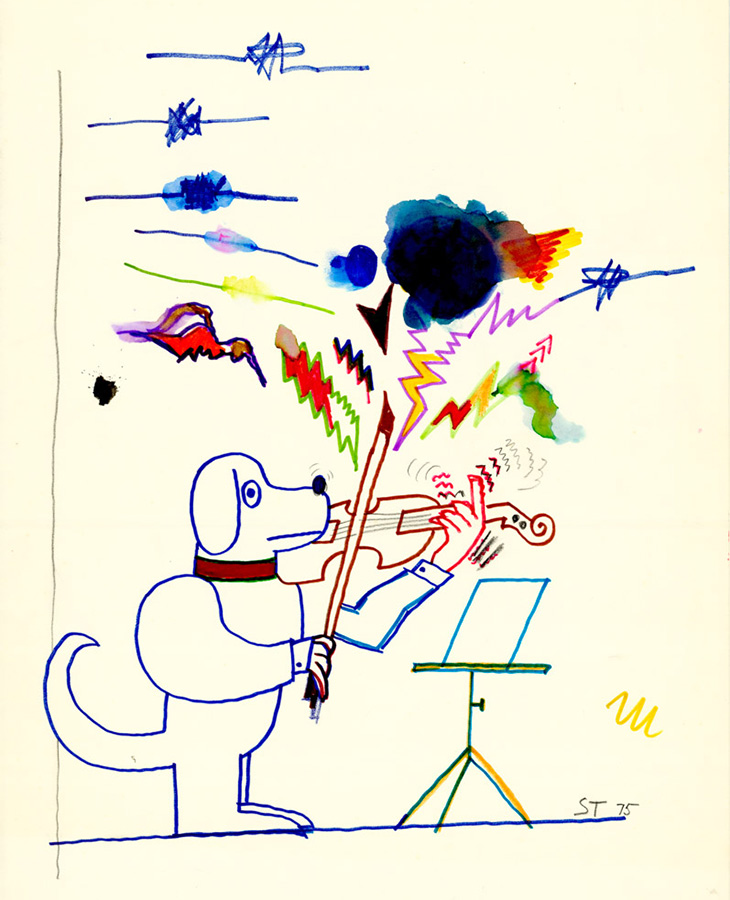
Explore the career of Romanian American artist Saul Steinberg at the Oklahoma State
University Museum of Art’s exhibition “Line of Thought: The Work of Saul Steinberg.”
On view from July 25 to Sept. 30, this exhibition showcases a selection of Steinberg’s
witty drawings and paintings.
Saul Steinberg, best known for his iconic illustrations in The New Yorker, left an indelible mark on the art world with his humorous and insightful depictions
of modern life.
“His drawings combine humor, satire and social commentary, resulting in designs which
are both aesthetically pleasing and intellectually engaging,” curator Christina Elliott
said.
However, Steinberg’s artistic journey was not without its challenges.
Born into a Russian Jewish family in Romania, Steinberg experienced the weight of
antisemitism during the 1920s. Seeking refuge from the growing hostility, he moved
to Milan in 1933. There he pursued architecture studies and worked as an illustrator
for a local Italian newspaper. His time at the newspaper ended quickly due to the
rise of antisemitic ideologies under Benito Mussolini’s regime.
Determined, Steinberg sent his illustrations to periodicals in the United States while
awaiting his visa approval. By the time he arrived in New York City in 1942, his drawings
were already a regular feature in The New Yorker. In 1943, Steinberg joined the U.S. Naval Reserve and became a U.S. citizen.
Throughout his career, Steinberg continued his collaboration with The New Yorker. He exhibited his works in over 80 solo shows in galleries and museums across the
United States, Europe and South America.
“Steinberg’s lines depict forms that look effortless but show clever deliberation,”
Elliott said. “He’s playful but tactical, which allows him to explore serious themes
with humor and visual intrigue.”
Selections for this exhibition were pulled from a generous gift of Steinberg’s artwork
given by the Saul Steinberg Foundation to the museum in 2021. The donation comprises
drawings, textiles, wallpaper samples, paintings and prints.
The exhibition invites viewers to delve into Steinberg’s imaginative world where lines
transform into narratives. “Line of Thought: The Work of Saul Steinberg” offers visitors
an in-depth exploration of Steinberg’s career, artistic talents and sense of humor.
Learn more at http://museum.okstate.edu/art/line-of-thought.html.
By Admin in Photography
A Michigan-based gallerist has pled guilty to defrauding more than 10 collectors out of an estimated $1.5 million, the U.S. Attorney’s Office in the Eastern District of Michigan has announced.
The dealer, Wendy Halstead Beard, was charged with one count of wire fraud related to a multi-year scheme in which she concocted elaborate lies to con clients out of money and photographic prints. She now faces up to 20 years in federal prison. Her sentencing is set for December of this year.
Beard “swindled numerous families out of valuable artwork and lied to them repeatedly in order to keep her fraud scheme afloat,” U.S. Attorney Dawn Ison said in a statement. “She did this for no reason other than to line her own pockets at the expense of her victims.”
“There is no place for this kind of criminal deceit in our community, and today’s conviction holds this defendant accountable for her conduct,” Ison added.
Beard, 58, was arrested last October. Charges filed at the time alleged that the dealer, who ran the Wendy Halsted Gallery in the Detroit suburb of Birmingham, bilked collectors by accepting payment for artworks that she never delivered and taking in artworks on consignment and then selling them without notifying their owners.
The gallerist also went to great lengths to avoid the clients she defrauded, such as by inventing fake employees and exaggerating her own health conditions, according to the U.S. Attorney’s Office.
In 2018, for instance, an 82-year-old art collector consigned Ansel Adams’s The Tetons and the Snake River, Grand Teton National Park (1942) with Beard, who estimated the piece to be worth $625,000. She later told the owner that she couldn’t sell the print, then consigned it herself through a Wyoming-based gallery, where it sold for $440,000.
When the collector asked for the print back, Beard claimed that she was suffering from pulmonary issues. An invented gallery employee named “Julie” later wrote that Beard had undergone lung transplant surgery.
That same year, the dealer sold a separate Adams print to a friend for $73,000. But after the piece went undelivered, and the buyer asked about it, Beard said she had been in a months-long coma.
In an email to Artnet News, Beard’s lawyer, Steve Fishman, said that his client “acknowledged her wrongdoing by entering a guilty plea without requiring the government to obtain an indictment. She accepted responsibility for her conduct which is the first step toward rehabilitation.”
As part of a plea deal, Beard acknowledged that she defrauded 10 clients and agreed to forfeit any property obtained through the scheme. Fishman noted that, while the U.S. Attorney’s Office estimated that her crimes added up to $1.5 million, he contends that the amount was closer to $500,000. He said the actual amount will likely be decided upon sentencing in December.
More Trending Stories:
Influencers Are Realizing That A.I. Might Not Be a Magic Money-Making Machine For Artists After All
Follow Artnet News on Facebook:
Want to stay ahead of the art world? Subscribe to our newsletter to get the breaking news, eye-opening interviews, and incisive critical takes that drive the conversation forward.
By Admin in Art World News
(Nebraska City) — Some Nebraska City residents hope to spur economic development through the arts.
During Monday night’s Nebraska City City Council meeting, supporters announced the formation of a Creative Arts District. Nebraska City Mayor Bryan Bequette tells KMA News local residents worked with state officials on a 10-year plan identifying specific strategies using the arts to increase tourism and business activity in the community.
“We had a group of citizens who came forward and said, ‘Nebraska City fits this perfectly,'” said Bequette. “So, they went through a lot of paperwork, working with the Nebraska Arts Council. First you apply, then they ask you to approve your application, then develop a strategic plan. You have to put together your city partners, and your city supporters, and put out as to how you’re going to use any funding that you might get from the state in order to move forward on economic development, focusing on your arts.”
Bequette says several Nebraska City facilities lend themselves to arts activities.
“Of course, we have the Kimmel Harding Arts Studio here in Nebraska City, where they bring in resident artists to focus on their skills for a couple weeks–two or three weeks at a time,” he said. “We have a lot of history. We have art galleries, and things like that. But, we’re also bringing in other different things in arts. We’re focusing on the (Veterans) Memorial Building with culinary arts. We’re building a commercial kitchen where people can rent out a space, or we could have people come in and do culinary instruction.”
Among other things, communities with creative arts districts are eligible for state funding.
“Typically, when a city first gets approved, there’s $10,000 they can use for planning,” said Bequette. “Then, that’s followed by a little over $2,000 that you can use for marketing. There’s also the Arena Fund–a slang term for it–for communities who put aside a certain amount of their tax proceeds for rural communities. Next fiscal year for the state, only communities with a creative district apply for those funds.”
Arts district supports meet Wednesday at 5 p.m. at the Veterans Memorial Building to establish an executive board, and discuss a strategic plan, among other agenda items.
Thank you for reading kmaland.comAt KMA, we attempt to be accurate in our reporting. If you see a typo or mistake in a story, please contact us by emailing kmaradio@kmaland.com. |
Native art exhibit opens at History Museum
The Washington State History Museum’s highly anticipated 18th annual IN THE SPIRIT Contemporary Native Arts exhibition is returning July 22 through Sept. 24. This juried exhibition features 36 original works by 26 Native American artists from across the United States.
The curated exhibition features a diverse array of mediums including beadwork, painting, carving, glass, basketry, textiles, mixed media, and digital works. From traditional craftsmanship to innovative contemporary styles, the artworks showcase a broad spectrum of Native art today.
Each piece on display will be accompanied by an artist’s statement, offering guests valuable insight into cultural context and influences. One particularly striking painting, “Raven Dancer” by Shana Yellow Calf (Enrolled Northern Arapaho), beautifully captures her blend of Native artistic styles and modern inspirations.
“The merging of the mask of Raven with ballet stems from my granddaughters who both dance traditional Native style and also ballet,” she said. “It’s a combination of two worlds and the gracefulness of not just dance but the stories of Raven.”
Shana Yellow Calf has been producing art in various mediums since the 1990s. Her contemporary art reflects her plains heritage, her mother’s Chippewa/Metis ancestry, along with a Pacific Northwest Coastal influence from the Puget Sound area of Washington where she grew up. Shana is registered with the Department of the Interior Source Directory for Native American Artists. She appeared in “Indianz” magazine in November 2020 as one of their featured artists. The Soil Gallery in Seattle exhibited Shana’s art and carvings in November 2019. She is also a member of the Two Waters Art Alliance in Gig Harbor.
The highlight of opening night on Saturday, July 22 at 5:30 p.m. will be the presentation of the 2023 IN THE SPIRIT Artist Awards. Guests will enjoy first access to the exhibition, light refreshments, and an awards ceremony with contributing artists. The awards categories include Best in Show, Spirit of the Northwest, Honoring Innovation, Honoring the Ancestors, and the Purchase Prize. Throughout the run of the exhibition, guests will have the opportunity to cast a vote for the People’s Choice Award. This event is free with registration.
IN THE SPIRIT awards are carefully selected through a blind-jury process, adhering to pre-determined criteria. The jury panel consists of a rotating selection of Native artists and subject experts. The 2023 jurors include José E. Montaño (Aymara-Quechua), Paige Pettibon (Confederated Salish and Kootenai), and Tisa Matheson (Nimiipuu).
Montaño is a genuinely inspired designer, having designed many award-winning stylistically innovative projects including fine art exhibitions, television commercials, music videos, and live events. He has been nominated for two MTV Awards for best art direction and won for his design for R.E.M.’s “Losing My Religion.” Pettibon is an artist based in Tacoma. Her work is in fine visual arts working with multiple mediums such as acrylics, oils, watercolor, fiber art, jewelry, digital design, and other media. Matheson currently resides in Spokane and is a passionate multimedia artist focusing on Columbia River Plateau cultures.
Each year, the Washington State History Museum works closely with a Native Advisory Committee to shape the exhibition and the accompanying IN THE SPIRIT Arts Market & Northwest Native Festival. The highly anticipated free indoor/outdoor community festival, held on Aug. 12 from 10 a.m. to 5 p.m., serves as a celebration of Native culture. The festival features an artist vendor market, cultural music and dance performances, art-making opportunities, and free access to the Washington State History Museum, Tacoma Art Museum, and Museum of Glass for the day.
In appreciation to our active-duty military families, the Blue Star Museums program, and the Washington State History Museum offers complimentary admission for up to five family members with valid ID from May 29 through Sept. 4.
The IN THE SPIRIT Contemporary Native Arts exhibition has been made possible, in part, through the generous support of Tacoma Venues & Events.
Get all the details for “IN THE SPIRIT Contemporary Native Arts” exhibition and more at washingtonhistory.org.
Exhibitions and Events Dates and Links
IN THE SPIRIT Contemporary Native Arts Exhibition
July 22 through Sept. 24
At the Washington State History Museum, 1911 Pacific Ave., Tacoma, WA 98405 https://www.washingtonhistory.
org/exhibit/in-the-spirit–
2023/
IN THE SPIRIT Artist Awards and Opening Night
FREE with registration
July 22, 5:30-7 p.m.
At the Washington State History Museum, 1911 Pacific Ave., Tacoma, WA 98405 https://www.washingtonhistory.
org/event/in-the-spirit–
artist-awards-2023/
IN THE SPIRIT Arts Market & Northwest Native Festival
FREE
Saturday, Aug. 12, 10 a.m. to 5 p.m.
At the Washington State History Museum, 1911 Pacific Ave., Tacoma, WA 98405
https://www.washingtonhistory.
org/event/in-the-spirit–
festival-2023/
With respect and deep appreciation, a retrospective of artist Gail Tremblay is taking place in the Welcome Cultural Arts Center Longhouse on The Evergreen State College campus on Saturday, July 29. She was an artist, writer, teacher and poet. Tremblay’s decades of contributions to the world and specifically with Evergreen are being formally honored. The public is invited to attend.

“Gail helped shape our connections with a wide array of native artists,” says Laura VerMeulen, director of the House of Welcome Cultural Arts Center. Because she was a nationally well-known writer and artist, Tremblay’s network of relationships was extremely helpful to attract people from afar to Olympia. Guests came to talk and lead workshops and symposia. “It’s all about relationships,” notes Laura, who is grateful for all of it. “We were really new and not like anything in the nation.” The evolution of the House of Welcome Cultural Arts Center is not just as a building, but as a public service center.
Tremblay was integral to the process of establishing a presence of Native culture at The Evergreen State College. Her influence on students of all diversities spans more than a generation. Native arts and studies at the college grew and expanded as time passed.

“Gail had a philosophy of encouraging a lot of students to think more broadly about artwork and writing,” recalls Laura. She was a treasure on campus for anyone who had interest. “She inspired people to do their best.”
Tremblay was a long-standing member of the center’s advisory board. She especially enjoyed selecting tribal grant recipients.
In 2001, she was honored with the Washington State Governor’s Arts and Heritage Award.
Tremblay’s advocacy for diversity and gender equality in the world of academia and arts is a lasting tribute to her life. Her art is on display at Smithsonian Nation Museum of the American Indian in Washington, D.C. and the Portland Art Museum in Oregon.
Tremblay passed away in May 2023.

At the event on July 29, several people will speak reflect on Tremblay’s life well lived, including:
• Former Evergreen provost Barbara Smith will speak about Tremblay’s scholarship.
• Cathy Denning, contemporary art historian and writer, will talk about Tremblay’s artwork.
• Rebeccah Chamberlain will be reading one of Tremblay’s poems that is on display at Paradise at Mount Rainier and talking about her writing.
• Hisami Yoshida, former student, will share about Tremblay’s impact as a teacher.
The artistry of Tremblay’s baskets is notable. “I enjoy keeping traditional basket patterns and use them with new materials,” Trembly explained in a video. A basket maker since childhood, Tremblay started weaving baskets of out scraps from 16mm film from outdated educational films and old movie trailers. One art piece is named “It was never about playing cowboys and Indians.” She used film scraps from a movie that looked at the play of Indian children. “I enjoy the form and playing with forms. That’s how I came to make film baskets,” she said on camera. Color, design and attention to detail are integrated into her pieces.

Her books of poetry blend traditional and modern styles:
“Farther From and Too Close to Home”
“Indian Singing in 20th Century America”
“Close to Home”
“Night Gives Women the Word”
The House of Welcome Cultural Arts Center hosts cultural events that support Indigenous artists locally, regionally, nationally and internationally. There are performances, lectures, films, cultural art workshops and cultural presentations. Annual events take place including a Holidays Native Arts Fair in December, a tribal youth art-making event and a Fall Community Dinner. A summer art camp for Tribally-enrolled youth happens in August.

The Evergreen State College’s Native programs began in 1972, with faculty member Mary Ellen Hillarie of the Lummi tribe. Her articulation and vision of the need for a culturally appropriate facility, as in a longhouse, resulted in its construction. The 10,000-square-foot longhouse was completed in 1995, with a celebration that included many tribal dignitaries. It has classroom and event spaces and a community kitchen. Since then, additional square footage has been added including a carving studio and a fiber studio that has a master weaver.
The public is invited to the retrospective of Gail Tremblay’s visual and literary art works at the House of Welcome Longhouse located at The Evergreen State College on July 29 from 1 p.m. to 4 p.m. There is no cost for the event, but there is a charge for parking on campus. For those who may miss the event, the Longhouse is open for tours during the week where visitors can see artwork on permanent display.
The Evergreen State College
2700 Evergreen Parkway NW, Olympia
Sponsored
Milwaukee Art Museum announces new Herzfeld Center for Photography show
Wondering what’s the importance of PDF editing software for photographers? Hop inside this guide to find out!
The loon traveled from Los Angeles to its permanent home in the Twin Cities.
A new beetle species has been named to honor a fellow Husker, bridging the worlds of academia and wildlife conservation.
Silversea, a premier brand in experiential luxury and expedition travel, recently concluded the inaugural season of its first Nova-class ship, Silver Nova,
The Desert Foothills Land Trust (DFLT) is proud to announce a special presentation event featuring acclaimed botanical photographer Jimmy Fike on Saturday, Oct. 12 at 6:30 p.m. at the Sanderson