What to See at Upstate Art Weekend 2023?

What to See at Upstate Art Weekend 2023?

The summer showcase has grown to 130 participants as artists and art professionals opt out of nearby New York City.

What to See at Upstate Art Weekend 2023?

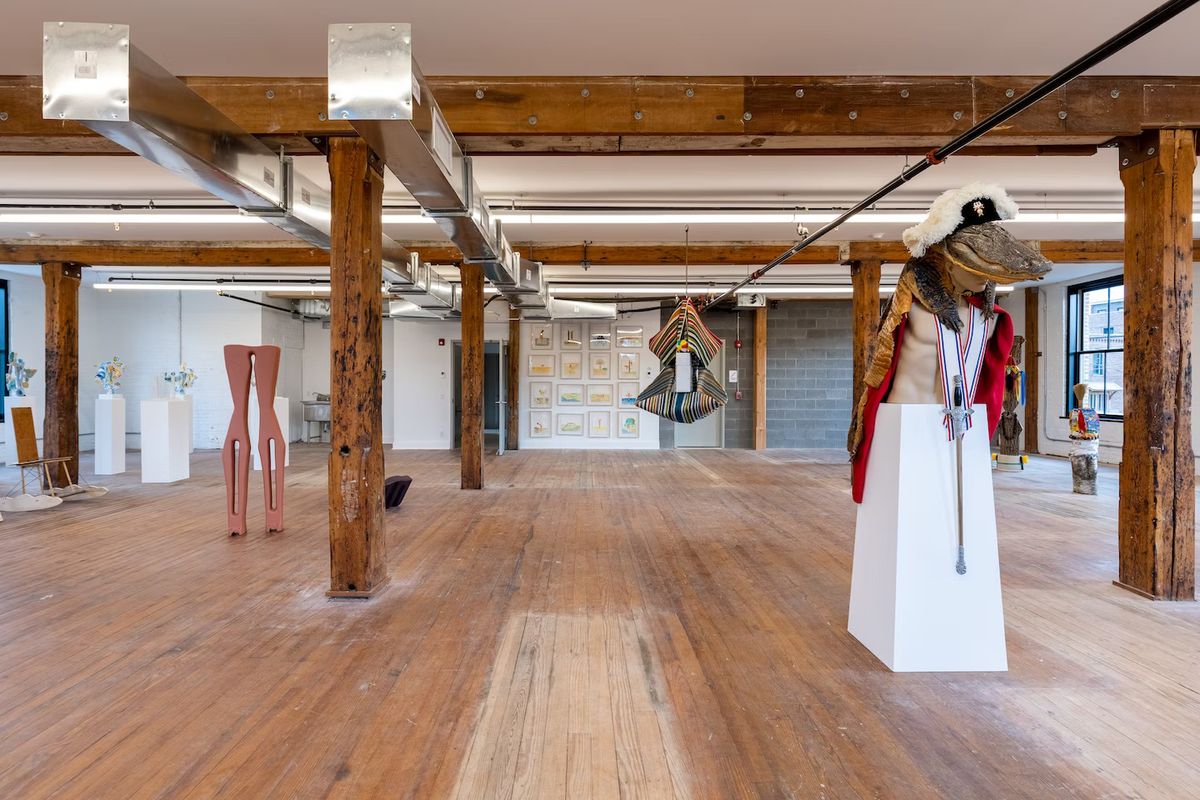
Michela Martello, The Heavenly Princesses and the Bam Ripple (2022). Exhibition view: The Divine, The Passion, and The Magic, Visitor Center. Courtesy Upstate Art Weekend.

Upstate Art Weekend is back for its fourth edition from 21–24 July in the Hudson Valley and Catskills, a short distance from New York City.

Since its inception in 2020 with a modest 30 participants, the annual event has grown exponentially, showcasing over 130 art galleries, museums, residencies, and creative projects this year.

The area’s art scene gained prominence in the 20th century as artists escaped the pressures of city life to live more intentionally, embracing counter cultural modes of living and creating.

The appeal of the Hudson Valley as a haven for artistic expression has only risen since the COVID-19 pandemic, which saw the influx of nearly a dozen Manhattan galleries, alongside many artists who sought refuge from the soaring studio costs in the city.

Exhibition view: Forland, NADA (2021).

Exhibition view: Forland, NADA (2021). Courtesy Upstate Art Weekend.

Founder Helen Toomer—who is also the director of PHOTOFAIRS New York and the Stoneleaf Retreat residency programme—said Upstate New York was complementary to the Big Apple.

‘They have their own personalities, strengths, and incredible resources. There is no city versus country from my perspective,’ she said. ‘They benefit from being in such close proximity—one feeds the other.’

The Hudson Valley first established its art credentials through the Hudson River School, 19th century landscape painters since criticised for their erasure of Indigenous cultures.

Participants in Upstate Art Weekend are making an effort to redress that erasure.

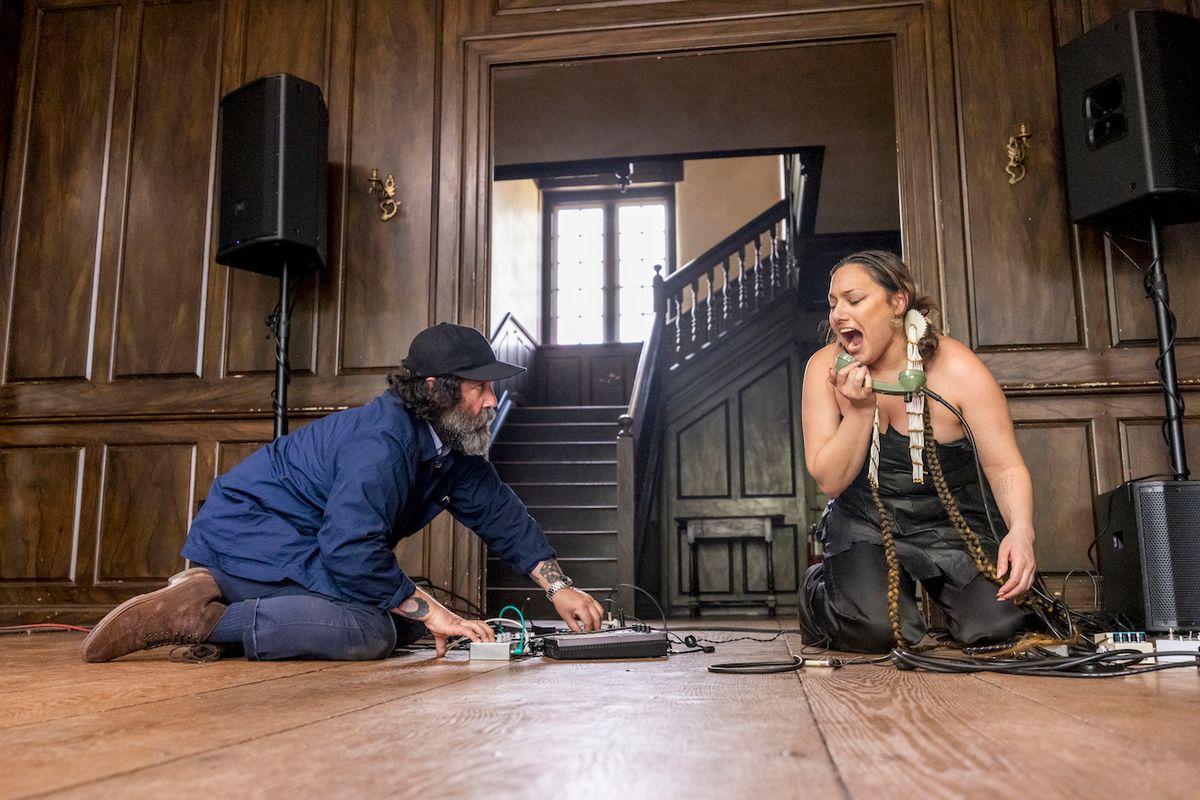
River Valley Arts Collective, for instance, will be showing Oglála Lakȟóta artist Kite, who bridges knowledge from nonhuman realms into human creation, alongside site-responsive works by Anina Major and Sagarika Sundaram that explore the concept of home.

Art Omi Kite and Nathan Young for Hudson Intertribal Noise Symposium.

Art Omi Kite and Nathan Young for Hudson Intertribal Noise Symposium. Courtesy Upstate Art Weekend.

Other not-to-miss exhibitions include two presentations at the Hessel Museum of Art: Indian Theatre, which centres performance as an origin point for the development of contemporary art by Native American, First Nations, Inuit, and Alaska Native artists, with special performances from Emily Johnson and Jeffrey Gibson on 21 and 22 July, and Erika Verzutti‘s New Moons, a solo exhibition spotlighting the Brazilian artist through a survey of her work from the past 15 years.

NADA will also return this year, taking place in Foreland’s historic industrial building in the centre of Catskill, featuring over 40 galleries in a collaborative exhibition. Highlights include Daniel Giordano showing with Turley Gallery and Mirza Hamid with The New Gallery.

An unmissable event is Pippa Garner’s eclectic and uproarious presentation at Art Omi.

‘It’s impossible to do everything during Upstate Art Weekend,’ concedes Toomer.

‘The event was created to shine a light on the incredible organisations in the region and to solidify lasting connections with those visiting to come back again and again and again.’ —[O]

How brands hope to tempt you with videos on labels

How brands hope to tempt you with videos on labels
A person playing Pokémon Go in Instanbul in 2016Getty Images

The Pokémon Go craze of 2016 saw kids around the world use mobile phones to find cartoon characters in their real world neighbourhoods.

It was one of the first widespread uses of augmented reality (AR). If a child successfully found a Pokémon then a computerised animation of the creature would appear on their handset’s screen, superimposed on top of the actual view through the phone’s camera.

It proved irresistible to millions and millions of young users. But are adults equally impressed by the use of AR?

Since Pokémon Go’s success, a growing number of consumer brands are continuing to embrace AR, such as Coca-Cola and US whiskey Jack Daniels. You use your phone camera to scan a QR code on the can or bottle label, and an animation or video pops up on your screen.

Does this use of AR remain a novelty, a gimmick that most people ignore, or does it actually increase consumer engagement and sales?

In 2021, US soft drink firm Jones Soda introduced its first AR campaign, which it called Reel Labels. If you scan an image on the bottle labels then it transforms into a short video.

Jones Soda bottles

Jones Soda

To create the videos the firm partnered with an initial 15 so-called influencers, including a skateboarder, a breakdancer, and a BMX bike rider. Since then the firm’s customers have been able to send in their own videos to be featured.

And last year Jones Soda worked with music labels Sub Pop and Hardly Art to promote videos from more than a dozen new bands.

“A brand’s packaging is so much more than a container for a product,” says Bohb Blair, Jones Soda’s chief marketing officer. “It’s now an opportunity to make a consumer’s moment with your product special.

“Content is a great way to do that, and AR is a fun and convenient distribution vehicle.”

Another drinks business that has used AR to connect with the music industry is Estonian milk brand Tere Piim. In 2019 it joined with the Eurovision Song Contest to enable customers to see mini digital animations of that year’s entrants perform on their kitchen counters and tables. All they had to do was scan a label on the milk cartons.

Tere Piim's Eurovision AR

Overly

The AR technology was provided by Latvian software firm Overly. “Although you may doubt the compatibility at first glance, milk and a song contest make a good cross-marketing duo,” says Overly’s chief executive Ainars Klavins.

“In this instance, a traditional milk carton became a new medium for broadcasting Eurovision songs. It inspired consumers who may not be existing viewers to explore the contestant line-up and choose their favourites.”

Presentational grey line

New Tech Economy

New Tech Economy is a series exploring how technological innovation is set to shape the new emerging economic landscape.

Presentational grey line

He adds that consumers, especially younger ones, are ready to engage with brands “in the augmented reality realm”.

While you’d expect those involved in helping firms create AR to sing its praises, what do independent experts think?

Stuart Duff is a leading business psychologist, who studies how firms can best connect with consumers. He says that AR can help products seem more “interesting, engaging and memorable”.

“Research has highlighted that using AR not only captures our attention more quickly but also increases the likelihood of committing information to memory. So while AR may seem like a gimmick, it offers a genuine alternative approach to lodging brands in our psyche.”

Ainars Klavins

Overly

Jenny Stanley is managing director of Appetite Creative, a Madrid-based tech and marketing firm that helps consumer businesses create AR labels.

She says that a product’s label is already an example of “extremely targeted marketing”, whose effectiveness only increases further when AR content is added.

“It’s not only impactful, but also cost effective. The average cost per digital advertising click is £1.50, whereas a click or scan on packaging is technically free, giving brands a compelling reason to use connected packaging.”

Yet, as Mr Klavins of Overly cautions, content is key. And by that he means that what the AR offers has to be interesting and engaging.

“The key point here is that quality content for augmented reality is vital. I always say that AR content should either inspire, educate or entertain. It has to do at least one of those things to transform from a novelty tech into a strategic tool that drives business value.”

Related Topics

Jane Birkin: An Adventurous Artist Made in England, Forged in France

Jane Birkin: An Adventurous Artist Made in England, Forged in France
image

Birkin had a thriving career as a singer and an actress, in both communicating a seemingly nonchalant demeanor that camouflaged a melancholy core.

For most of her life, Jane Birkin, who died Sunday at 76, acted as a bridge — an elegant one, with an affectless grace that never betrayed the strains of load bearing. She connected her native Britain and her adopted France, two countries physically close but often at odds. She never lost her English accent when she spoke, somehow joining the two languages into her own Birkin-ese, “the improbable French that added to her charm,” as Le Monde put it. She floated among song, cinema and theater, and she could reach large, varied audiences while also connecting with France’s auteur culture.

Her career did not go in a straight line. She made the most of her unassuming, breathy voice in her recordings, and while her unconventional glamour stood out onscreen, she was never afraid to veer off in unexpected directions when choosing roles. She let herself be guided by adventurousness.

After a small role in Michelangelo Antonioni’s ode to Swinging London, “Blow-Up,” Birkin left England in 1968 to make a French movie, Pierre Grimblat’s “Slogan.” On the set, she met Serge Gainsbourg, the brilliant, tortured musician, who was in the cast and wrote the film’s score.

They fell in love and soon became an It couple, impossibly stylish and cool. Crucially, she also became one of the leading interpreters of his songs, starting with their erotically charged duet “Je t’aime … moi non plus,” and continuing through six solo Birkin albums, released from 1973 to 1990. The poppiest and catchiest is “Ex fan des sixties” (1978); the poignant “Baby Alone in Babylone” (1983) largely deals with the couple’s separation.

Birkin left Gainsbourg in 1980, fed up with his drinking and temper, but their personal and professional partnership outlasted the breakup. And despite a reductive media habit of describing Birkin merely as Gainsbourg’s muse, it enriched both of them.

Birkin remained loyal to the Gainsbourg songbook throughout her life. Five years after his death, she released an album of Gainsbourg covers, “Versions Jane” (1996); followed by “Arabesque” (2002), an album of Gainsbourg songs arranged by the Algerian violinist Djamel Benyelles; and “Birkin/Gainsbourg: Le Symphonique” (2017), backed by a symphony orchestra.

But she also escaped Gainsbourg’s shadow, working with younger musicians and producers, and eventually writing or co-writing the lyrics on her albums “Enfants d’hiver” (2008) and “Oh! Pardon tu dormais …” (2020), both largely drawing from her life.

That last record is a good illustration of the way Birkin hopscotched among artistic fields, one feeding into another: “Oh! Pardon tu dormais …” has the same title as, and was inspired by, a made-for-TV movie Birkin directed in 1992 and a 1999 play she wrote and appeared in.

Birkin performing in 2001. As a singer, she made the most of her unassuming, breathy voice.Jean-Loup Gautreau/Agence France-Presse — Getty Images

Beyond her success as a singer — not blockbuster by any means, but attracting a loyal fan base around the world — Birkin had a thriving career as an actress, communicating a similar vibe onscreen as she did in music: a natural, unadorned beauty; a seemingly nonchalant demeanor, camouflaging a melancholy core.

In 1969, the year that “Slogan” came out, Birkin had a supporting role in Jacques Deray’s scorching, now cult thriller “La Piscine” alongside Alain Delon and Romy Schneider. With “La Piscine,” and popular comedies like “La Moutarde Me Monte au Nez!” (1974) and “La Course à l’Échalote” (1975), she could have continued to mine her gamine charm and cute accent for a comfortable if predictable acting career. But in typical Birkin fashion, she made an abrupt stylistic U-turn by starring in Gainsbourg’s provocative debut feature “Je T’Aime Moi Non Plus” (1976), in which she portrayed an androgynous waitress who has a rather complicated relationship with a gay man played by Joe Dallesandro, the Andy Warhol and Paul Morrissey regular.

For much of the 1970s and early ’80s, Birkin alternated between making Gainsbourg records and appearing in mainstream movies, including “Death on the Nile” (1978), which featured the kind of international star buffet that blockbuster movies of the time ate up: Her co-stars included Peter Ustinov, Bette Davis, David Niven, Mia Farrow and Angela Lansbury.

Throwing yet another twist into her career is that after Gainsbourg, Birkin was in a relationship with the uncompromising filmmaker Jacques Doillon. In 1984, she starred in his brutally intense, fever-pitch movie “La Pirate” as Alma, who is torn between her husband (played by Birkin’s own brother, Andrew) and a woman (Maruschka Detmers). It felt like a new Jane Birkin, inhabiting her physicality in a way that was almost dangerously unrestrained — and it earned her the first of three César Award nominations.

The next year, she appeared in a Marivaux play directed by the influential Patrice Chéreau at his Nanterre theater. Despite her trepidation, her performance was a success, and Birkin continued to appear onstage, alternating, as was her wont, between boulevard fare and Euripides.

Another consequential encounter in the 1980s was with the director Agnès Varda, who made the gloriously unconventional film “Jane B. par Agnès V.” (1988), in which, as Glenn Kenny noted in The New York Times, Birkin “retains a slightly breathy girlishness that complements her largely cheery, open personality and her intrepid intelligence” — words that neatly capture Birkin’s enduring appeal. Varda encouraged Birkin to write, and the two collaborated on the script of Varda’s “Kung-Fu Master!” (1988). Birkin went on to direct an autobiographical film, “Boxes” (2007).

For Birkin boundaries were porous: between public and private, high and low, art and life. In his tribute to her, President Emmanuel Macron called Birkin “a French icon.” Of that there is no doubt.

Lawrence community members gather to celebrate Indigenous artists’ works on bus shelters

Lawrence community members gather to celebrate Indigenous artists’ works on bus shelters
Share this post or save for later

Community members gathered at Haskell LIGHT student center and campus ministry Sunday to celebrate six local Indigenous artists and their works decorating 10 Lawrence bus stop shelters.

This project was begun in collaboration with the Indigenous Community Center (ICC) and Lawrence Transit in late 2021, after receiving funding from the Douglas County Community Foundation. 

Advertisement

For the artists, the illustrations are more than visual; they are spiritually connected, too. 

Full-time artist Mona Cliff, Gros Ventre tribe of Montana, illustrated the “Dear Deer” and “Baker Wetlands” pieces at Haskell Indian Nations University and 23rd Street and Haskell Avenue, respectively. These illustrations were personal to Cliff because of her spiritual connection with deer.

“‘Deer’ was one of my names given to me at 12 years old and so I have a special connection to them,” Cliff said. “Because we used them so much to survive a long time ago, they sacrifice their lives for people so that we can feed ourselves.”

August Rudisell/Lawrence Times Mona Cliff speaks to community members at the ribbon cutting on Sunday, July 16, 2023 at Haskell LIGHT.

Cliff expressed the importance behind community representation through public art. 

“After doing public art and seeing the importance and how it brings the community together, it’s really become important to be able to represent the Native community so they can see themselves in our city,” Cliff said. “It’s become an important part of my artist practice.”

Included in the community she hopes to represent is her 13-year-old daughter, Maecyka Beason, an Indigenous artist herself. 

“I feel really proud of her for doing all of this,” Maecyka said. “I think it’s really cool that a Native woman is doing art [displayed] around town, because we aren’t really represented and she represents a lot of Native people in our culture.”

August Rudisell/Lawrence Times Artists Mona Cliff (left), Odessa Star Comes Out and Tokeya Waci U (Comes Dancing First) Richardson

Another artist, Odessa Star Comes Out, Oglala Lakota tribe of South Dakota, illustrated “Sunkawakan (Horses),” at 33rd and Iowa streets, and “Wogligleya (Design)” at Sixth Street and Monterey Way.

Apart from inclusivity and representation of Indigenous culture, she hopes for this experience to encourage younger Indigenous artists to “never give up, just keep doing your art no matter what.”

Advertisement

The ICC and Lawrence Transit both hope to increase representation of Indigenous art and history throughout Lawrence.

Felice Lavergne, city transit planner II, said after an initial experiment with bus stop art, Lawrence Transit wanted to facilitate the display of Indigenous art throughout the community. 

August Rudisell/Lawrence Times Felice Lavergne, transit planner II, speaks during the celebration.

“We really want them to see themselves reflected,” Lavergne said. “The [Indigenous community] are an integral part of Lawrence and we want everyone to see themselves here.”

Adam Weigel, parking and transit manager, also explained the role of the department as facilitators in this project. 

August Rudisell/Lawrence Times Mayor Lisa Larsen (left) speaks with Adam Weigel, parking and transit manager.

“We’re just fortunate to have something of a platform for expression. With the buses, bus stops, we are fortunate to have a lot of infrastructure that can be unique or modified,” Weigel said. “Our role was making the invitation: asking if people want to be included and then seeing what comes from it … We’re here to try to facilitate people showing what they want to see.”

Rep. Christina Haswood, Diné, was also in attendance at the ceremony. Haswood emphasized the value of displaying Indigenous art not only throughout Lawrence, but through the state of Kansas. 

“Seeing the artwork at these bus stops can really add that value and comfort to a city and embrace the Indigenous identity. [It’s] telling that story and that history without having to sit down and give an hourlong presentation,” Haswood said. “You can just look out your window at a red light and you’ll see that Indigenous art.”

August Rudisell/Lawrence Times Rep. Christina Haswood

Haswood hopes for these projects to help increase representation of Indigenous culture outside of the Haskell area. 

“There’s always this feeling that the Native American community is only in this area of town,” Haswood said. “We want to expand that and invite the public and invite the Indigenous community to break down those barriers.”

If community coverage like this matters to you, please support The Lawrence Times.
Click here to subscribe.

According to Weigel and Lavergne, Lawrence Transit is open to more collaborations in the future. 

“I think we’re really open to the ideas that come from this and get brought to us,” Lavergne said. “We want it to be what the community wants and that’s pretty exciting.”

Weigel echoed that message and added that a new addition to Lawrence Transit could open more doors.

“With the new Central Station opening, that’s a space that can fit a lot of physical art events, ways for people to make connections with each other,” Weigel said. “It makes me excited about the future. There’s a lot of things we could do.”

Advertisement
August Rudisell/Lawrence Times Artist Tokeya Waci U (Comes Dancing First) Richardson speaks to the crowd.
August Rudisell/Lawrence Times Robert Hicks, a leader of Lawrence’s Indigenous Community Center, speaks to the crowd at the celebration.
If our local journalism matters to you, please help us keep doing this work.
Don’t miss a beat … Click here to sign up for our email newsletters

Natasha Torkzaban (she/her), a contributor to The Lawrence Times, is a current senior at Lawrence High School. She was an editor-in-chief of The Free Press at Free State High School before becoming an editor-in-chief for The Budget at Lawrence High School for 2023-24. Read her work for the Times here.

Latest Lawrence news:


Molly Adams/Lawrence Times

Share this post or save for later

More than 24 hours after storms wrecked numerous trees and power lines in Lawrence, some folks were still without electricity. Severe weather is possible again on Sunday.


Tom Harper/Contributed photo

Share this post or save for later

Someone is stripping the Wishing Bench of its wishes, and the people responsible for the bench are mystified.
It’s ”like someone stealing flowers off of graves,” one community member says.


Share this post or save for later

A man was charged Friday afternoon in Douglas County District Court with second-degree murder in connection with the death of David Sullivan, 62, of Lawrence.

MORE …

#support::before { content: “Support The Lawrence Times”;
font-family: Helvetica, sans-serif;
text-transform: uppercase;
font-size: 9pt; }

How Much Risk Are You Willing to Take for Your Photography? |

How Much Risk Are You Willing to Take for Your Photography? |

Cover photo : ©Abandonednordic

It’s a subject not often addressed but significant in the process of creating images. There are domains where risks have to be assessed, evaluated, and prevented. Taking risks is sometimes necessary, although that encompasses many different aspects, and the stakes are also diverse. It mostly depends on your photo field and where you are on your photography journey.

Be Prepared

Low on the scale is the simple risk of failing. It may happen when you’re not able to complete an assignment, when your photos of an event are disappointing or they’re technically or aesthetically of poor quality.

There are multiple reasons: you forgot something crucial, you had technical issues, there was a misunderstanding, or the client is simply not happy with the result. Not all photographers include a satisfaction clause in their contracts. It can even be more insidious: the client may be satisfied with the result, but not you.

It happened that I accepted a job, wondering if I would be able to manage. Initially hired for a standard series of corporate portraits, there were also group shots (4-5 people). No big deal. It’s just a question of organization and preparation. But things became more complicated when, from the group shots, I was supposed to make a montage of all of them in panoramic size. Theoretically, it was possible.

It needed some planning, marks on the floor, consistent lighting, and the use of a 50mm lens that shows the least amount of distortion. The shots were spread over two days in an office. If the shooting itself went well, there was no guarantee that the panoramic group image would turn out satisfactory.

It was stressful, as I kept doubting my retouching skills. It needed more work and time than planned. Even the background needed to be retouched. Although gray, it had some tint variations that needed to be leveled, which meant making precise selections around the people.

Finally, even with a 50mm, some deformations were visible. The distance made it impossible to use a longer lens. I guess that an 80mm would have been a better choice. The final result, although shameful to me, pleased the client, which was the most important. But I felt it was a failure nonetheless.

The risk here is not overcoming this fear and losing some self-confidence. Knowing our own boundaries allows us to grow inside them before we push them.

So you have to be prepared. In all meanings. Mentally and technically.

Don’t rely on luck alone. Ewan Lebourdais, a prominent navy photographer who obtained the official title of Peintre de la Marine in the French Navy, remembers that he wasn’t entirely familiar with the use of his newly acquired 600mm f/4 when he accidentally encountered a returning nuclear submarine off the shores of Ouessant Island. Even if it allowed him to win the Nikon Photo of the Month, he humbly confesses that it was only “beginners’ luck,” mostly because it was difficult for him to reproduce it afterwards, only thanks to hard and long work, in order to progress by improving the techniques.

To this end, it’s crucial to keep improvisation at its lowest level. Try to get the most information you can find about what you intend to photograph. If it’s a wedding, check the venue a few days ahead. Try to figure out if you need a flash, a tele lens, a wide angle, if you’re authorized to bring a tripod, etc.

If you plan a landscape trip or an urban tour, use applications such as Sun Position Sunrise & Sunset, SunCalc, or SunOnTrack to determine the sun’s orientation at the time of the shooting, as well as weather forecast applications or websites as exhaustive as Windyty.

And, as the gear doesn’t (yet) magically perform, you might need some training prior to a shooting. That’s the moment when a comparison between photography and sport or music becomes relevant.

When Your Gear Is at Risk

Now, there are domains where your equipment might be at risk. And I’m not talking about getting some drops of champagne during a wedding party.

Natural elements are, by far, the biggest issue. In nautical photography, for example, the salty water shows no mercy, even to the sturdiest gear.

Ewan Lebourdais remembers very well when, on board a light inflatable boat, along with a group of Navy commandos (the equivalent of a Seal Team), he documented an assault against a bigger ship. While the soldiers were climbing to its deck, their boat was swept by huge waves that submerged them regularly. The Nikon D5 didn’t die on the spot, but corrosion finally killed it three weeks later. Fun fact: the operations happened during a night so dark that Ewan had to shoot at ISO 100,000.

So, in such circumstances, it’s safer to use extra protection, such as an underwater housing or case, even if you don’t plan to dive. Motorsport photographers know this very well and don’t hesitate to spend a few coins on an investment that can save the day.

It’s also a good idea to insure your gear. It won’t replace the shots you may lose on the memory card, but at least you’ll get back on your feet faster.

Apart from the material risks, a more significant issue might be your own safety and health.

When It Gets Serious

Some fields are inherently hazardous for the photographer.

Wildlife photography sounds exciting and is within reach of any patient photographer. But it’s not totally free of danger. Andreas Schmid, an underwater and wildlife photographer, advises beginners to “work your way from simple, basic subjects towards more demanding and dynamic animals,” especially as “anytime you face a big animal, there is a certain risk involved that something unexpected might happen.” Still, he is quite clear: it is necessary to take the risk of exposing yourself to a potentially dangerous situation. “Not in a mindless way, though. (…) The key is to know how generally a subject will behave.” It is necessary to stay calm, show respect to animals, get to know them, and know when not to cross the line. “Perfect your craft before trying to capture the most challenging situations and animals”.

In another popular field, such as urbex, this notion of danger is also very present.

Steve, also known as K9urbex, is quite clear about it: “Urbex is risky at 90%.” It’s confirmed by Tanja and Timmo from AbandonedNordic.com: “There are no safety rules for abandoned buildings.”

The question is: is it worth it?

For Andrea Schmid, when underwater, “getting great results requires getting close,” a stance not so far from the famous Robert Capa’s line: “If your photos are not good, it’s because you were not close enough”.

For K9urbex, “each photographer should ponder what he or she is ready to sacrifice for a photo (2 months in hospital for 300 likes?)/” Abandonednordic also insists on weighing the possible risks against the rewards.

In urbex, the list of potential dangers is impressive.

The most obvious would come from the building itself. Floors can collapse, and ceilings can fall down. “Falling is a constant threat,, says AbandonedNordic, especially when floors are strewn with “shattered glass, nails, and all sorts of debris.” So, get your vaccines up to date.

Other hazards are less often reckoned with, but those urbex photographers warn about them: mold is usually encountered in ancient houses, mines, or underground facilities. Asbestos and germs or bacteria from animal droppings are other reasons why the air might be unhealthy or unbreathable. Even radiation might be a concern in some areas.

Not to forget animals, which are also a possible threat. Snakes, dogs, or even owls are known to attack their victims on the face. Insects may not agree with your presence either. Check for ticks when you get back home. Lyme disease is far from pleasant.

Those are the reasons why they don’t recommend this hobby to anyone.

Another matter is the legal part. Neighbors usually have a negative opinion about urbex photographers, who are sometimes suspected of being thieves or drug users. Exercising common sense should be enough to keep you from photographing military installations, even abandoned ones, or anything close to a government facility.

Think of the Lana Sator case, for example.

K9urbex recalls that “nothing justifies your presence.” So, he strongly advises being discreet and respectful, a golden rule in urbex. Tanja and Kimmo confirm this: “Never break or take anything, but photos.”

Ewan Lebourdais admits that “when you shoot in three dimensions, there is always some risk” and “going to the sea is always inherently uncertain.” And there is no need to face a tropical storm or climb Everest to find yourself in a perilous situation. He underlines that “a good sailor is the one who knows when to renounce and turn back. (…) The objective is to never put yourself at risk.”

His advice is that “the more you anticipate and prepare, the better it is.” In the case of a shooting involving several people, the briefing is a very important step. It avoids misunderstandings, sets boundaries, and prevents vagaries.

Ewan concedes not being willing to take uncalculated risks. “I think that it always ends badly, and the photos might not even be good!”

K9urbex keeps in mind a scale, graduated from 1 to 10, and tries to stay at 6 or 7. He always sees urban exploration as “a pleasure, an adventure, a way to surpass oneself,” but he never pushes for a “competition for the shot that has never been done before because of its danger.”

Conclusion

Regardless of any shooting circumstances, anticipation and preparation are crucial. A good understanding of your skills and gear and an in-depth knowledge of your subject and the environment are essential. It will never eliminate all the risks, but it will keep them at the lowest level possible.

“The limit is what allows us to avoid the risk”, concludes Ewan Lebourdais. “Being a hothead never lasts long”.

All images used with permission.

New collectors drive Indian art market surge, says Christie’s

New collectors drive Indian art market surge, says Christie’s

Although Christie’s discontinued its India auctions business a few years ago, the British art auction house remains positive about collector interest from the Indian subcontinent. Having sold artworks worth 400 crore in these previous auctions, Christie’s believes that India will continue to be a significant market for the auction house in the years to come.

Sonal Singh, managing director of Christie’s Indian department, emphasized its focus on modernist and contemporary art, which has played a prominent role in its Indian sales. In a global auction in March, a remarkable 60% of the bidding activity came from India.

“The market has changed a huge amount. It is a really good time to sell since the market is strong. There is a huge appetite for material that has not been seen before, and people are selling them. When there is high-quality material, people will step out to buy, in spite of what the economic situation may be,” Singh said. The auction house saw record sales of $8.4 billion in the year following the pandemic.

Christie’s acquires artworks from both India and outside, including private collections. This approach provides opportunities to find previously undiscovered artworks by esteemed artists such as V.S. Gaitonde, M.F. Husain, and H.S. Raza.

The auction house expects to see more contemporary art in Indian auctions and believes that overlooked artists will gain greater recognition. Additionally, it expects categories such as 18th or 19th-century paintings and miniature art to find their place in the market.

Singh has a positive outlook for the Indian market and highlighted the upcoming launch of two new art fairs and the emergence of private museums, such as the Kiran Nadar Museum of Art, within the next five years.

“We are trying to do more in India now and want to do an exhibition of some kind. I am very optimistic about the market. It has a huge potential for growth. The economics are clear to indicate that people are getting wealthier, and there is more to spend on art and luxury collectables, and we want to be a part of that. In five years, spending may even double. Numbers have changed drastically since the pandemic in the last three years, so I really don’t see why this trend would not continue,” she said.

Interestingly, Christie’s has observed a shift in collecting habits, with individuals expanding their interests to include other art forms such as maps and luxury products like handbags, watches, wine, and old master paintings. While historically focused on Indian art, Christie’s has seen these alternative categories contribute to 20% of its business from Indian buyers. Notably, the older cities in India have produced many art collectors.

The global market for luxury collectables has been growing, with demand for jewellery, handbags, and watches driven by cities outside the major metros. “Watches and some types of bags have become multi-million-dollar objects. That is why Rolex, Patek Philippe, and Hermes bags do so well at auctions because you cannot go into the store and buy them,” she said.

During the pandemic, Christie’s witnessed an influx of new online art buyers who engaged seriously in collecting. This opened doors to new art forms like NFTs (non-fungible tokens), and although the initial surge in interest has tapered, interest in online art remains strong.

The art market has also seen increased engagement from younger buyers, with millennials accounting for 31% of all buyers this year. About 38% of all new buyers were millennials or even younger, reflecting a growing interest in art among the younger generation.

“There is so much interest in art in cities other than Delhi and Mumbai and the other metros. About 10 years ago, we started auctions in India. We also saw a lot of interest from collectors in tier-two cities such as Ahmedabad, Pune, and Nagpur. We are now seeing some collectors from Bengaluru and Hyderabad too, which are newer markets for us,” she added.

Collectors in these emerging markets are also seeking guidance from advisers to navigate international art purchases, which they subsequently acquire domestically.

The robust activity in the Indian art market reflects growing enthusiasm for art and luxury collectables. As collectors diversify their interests and younger buyers participate in the market, the future looks promising for both established and emerging artists, as well as auction houses like Christie’s. Christie’s competes with Sotheby’s and SaffronArt in India.

Related Premium Stories

Catch all the Business News, Market News, Breaking News Events and Latest News Updates on Live Mint.
Download The Mint News App to get Daily Market Updates.

More
Less

Updated: 17 Jul 2023, 12:40 AM IST

Avoid These 5 Photography Mistakes With One Acronym

Avoid These 5 Photography Mistakes With One Acronym

When I’m teaching photography, I always suggest to my students that they make checklists of to remember things when they shoot. I’m also a fan of handy acronyms to remember them.

Coming at you from Canadian nature, wildlife, and astrophotographer Simon d’Entremont is a video that combines both to help you remember to avoid basic compositional mistakes that plague so many a seasoned and beginner photographer.

d’Entremont introduces the concept of HASTE. Ironically, despite the word itself implying speed, that’s not the case.

The “H” stands for highlights, as in, don’t blow them. It’s impossible to recover detail from an overexposed portion of a photo, and d’Entremont offers a variety of ways to avoid that issue that can keep photographers from messing up that portion of a photo on the scene.

“A” is for and? What does that mean? Instead of just your subject dominating the frame and only your subject, what’s the additional component? What’s the “and”? Something to think about as you frame your composition. d’Entremont offers a variety of his own photos that showcase the concept of shooting with a little something extra in the frame.

The “S” stands for subject, something I often realized my photos in graduate school were lacking when my professor would comment: “Nice photo, but it’s waiting for a subject.” It’s one thing to have a strong scene, but that scene needs a subject to anchor it. d’Entremont offers a few tips to help add visual interest in your photos in this way.

Many photography instructors have a variation of d’Entremont’s “T” or Tree in the head. I myself call it polehead, and it’s exactly what it sounds like, where pole-like elements protrude from a subject’s head because of careless composition. Easy to make this mistake, but also easy to fix with just a little movement.

And finally, the “E” stands for enough ISO. When I started out, cameras got pretty dicey at ISOs above even a relatively modest 400 or 800. Nowadays, those ISOs are as good as ISO 100 and cameras can push 3200-6400 with decent quality. It’s important to get a fast enough shutter speed to freeze the action and get photos that aren’t blurry, so don’t be bashful about using a higher ISO to get there. Your camera can handle it.

d’Entremont breaks down the concept of HASTE and offers many more examples and tips to help avoid these mistakes. Check those out in the video above, and share your own in the comments below.